Mrs SUBITHA BABU
Assistant professor OBG SPECIALITY
HOLY CROSS COLLEGE OF NURSING ADOOR
INTRODUCTION
Education aims at the behavior modification of learners. Behavior
modification is achieved through a series of activities. curriculum is
concerned with guiding the teachers and students in the educative
process. Therefore curriculum for the preparation of a teacher, nurse
and student who can carry out these professional functions humanely
and competently must be developed.
MEANING AND DEFINITION OF
CURRICULUM
• The term curriculum is derived from the Latin word “currere”
which means, “run”. Thus, curriculum is a runway of attaining the
goal of education. Curriculum may be considered as a blueprint of
an educational program.
• According to Cunningham, “curriculum” is the tool in the hands of
an artist to mould his material, according to his ideals in his
studio”. In this definition, artist is the teacher, material is the
student ideals are objectives and studio is the educational institute.
• According to Florence nightingale-”curriculum is systematic
arrangement of the sum total of selected experiences planned by a
school for a defined group of students to attain the aims of a
particular educational program.
• Nursing curriculum is the learning opportunities (subject matter)
and the learning activities (clinical experiences and practices)
that the faculty plans and implement in various settings for a
particular group of students, for a specified period of time in
order to attain the objectives
PURPOSES OF CURRICULUM
•To equip the learners through bringing the desirable
changes in them
•To cope with and handle life situations realistically,
rationally without sacrifying the humane principles.
•To establish values through intimate acquaintance with the
humanities, arts, natural sciences, social sciences and
religion
•To develop the character of students, i.e. integrity, honesty,
judgement, cooperation's, friendliness and goodwill.
•To meet the needs of students with a wide range of ability,
FUNCTIONS OF CURICULUM
PRIMARY FUNCTIONS:
To relate the various learning experiences which together
comprise the curriculum so as to produce the maximum
cumulative effect in attaining the objectives of the school.
SECONDARY FUNCTIONS:
– The effect it has on its student motivation.
– Learning experiences should be organized so as to maximize the
total effect of the various learning experiences by Student’s
personality development Within the subject matter
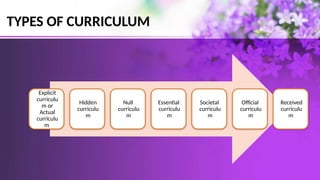
TYPES OF CURRICULUM
Explicit
curriculu
m or
Actual
curriculu
m
Hidden
curriculu
m
Null
curriculu
m
Essential
curriculu
m
Societal
curriculu
m
Official
curriculu
m
Received
curriculu
m
Explicit curriculum or actual curriculum
• Curriculum in use
• Followed at institutional level or school level and also called as
institutional curriculum
• Formal curriculum that explains explicit steps and procedures to
achieve the aims of educational programme
• Divided in to
– educational activities conducted through online methods
– educational activities conducted through traditional method
Hidden curriculum
• Refers to unintended outcomes occur while implementing
explicit curriculum
• Kind of learning students derive from teachers attitudes and
school environment
– E.g. unconsciously developing interest in maths subject
because of influence of the teachers
• Conveys both positive and negative messages to the learners
depending on the teachers attitudes and influence of school
environment
Null curriculum
• Also called as absent curriculum is created when certain aspect of
explicit curriculum Is excluded either intentionally or
unintentionally from the explicit curriculum. Eg teaching about war
not about peace
• A teacher should implement null curriculum carefully.
Essential curriculum
• Is the curriculum implemented for conducting the educational programme when it is impossible to
continue with the already written or explicit curriculum due to foreseen reasons e.g online classes
during covid pandemic situation
• Salient features of essential curriculum are
– New strategies are formulated to achieve the educational aims
– Essential content of curriculum is retained . “must to be taught” topics are given preferences than
“likely to be taught “ topics
– Implemented only for a single academic year
– Highly disruptive in nature
– Depends up on technology and information
– Equal importance to web-based resources
– Highly flexible.
Societal Curriculum
According to Cortes, "societal curriculum is the massive, ongoing
informal curriculum family, peer groups, neighborhoods,
organizations, mass media and other socializing fo that "educate"
children".
This type of curriculum can now be expanded to include the power
effects of social media like YouTube, Facebook, etc., and how it
actively helps in creating perspectives.
Official Curriculum
• The official curriculum or the formal curriculum is the curriculum
prepared and recommended by apex bodies like universities, state
education boards, and regulatory bodies like INC for conducting
educational programs in a region, state or country.
• The main aim of preparing an official curriculum is to bring out
uniformity and standardization in conducting an educational program.
For example, all nursing colleges need to follow curriculum
recommended by INC while conducting nursing programs.
• Educational institutions develop explicit or written curriculum from the
official curriculum prepared by apex bodies
Received Curriculum
• Is also knowns as "actual curriculum” or the "learned curriculum"
is the real or actual experience of students what they actually
learn and is the most important of all curriculum.
• Knowledge, skills, attitude and values the learners attain can be
included and evaluated in the received curriculum.
• There is a gap between the official or planned curriculum and the
received curriculum. The teacher needs to put more effort to
reduce this gap.
OLIVIA BEVIS RECOMMENDS 4 TYPES OF NURSING
CURRICULUM
Legitimate curriculum
Illegitimate curriculum
Hidden curriculum
Null curriculum
TYPES OF CURRICULUM
Subject oriented curriculum
Competency based curriculum
Experience based curriculum
Core curriculum
COMPONENTS OF NURSING CURRICULUM
Curriculum invariably contains
• The statement of philosophy of the educational program
• The statement of the objectives of educational program
• Total duration of educational programme
• Learning experiences
• Instructional methods- Detailed course plan for each course.
• Program of evaluation such as type of examinations, various
grades according to results, percentage meant for internal
assessment in university examinations etc.
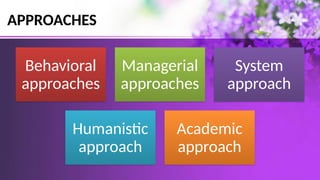
APPROACHES
Behavioral
approaches
Managerial
approaches
System
approach
Humanistic
approach
Academic
approach
Behavioural approach:
It is based on the Behavioural Principle, goals and objectives are
specified, content and activities are also arranged with learning
objectives. Learning outcomes are evaluated in terms of the goals
and objectives set at the beginning. Its main aim is to achieve
efficiency. Change in behaviour indicates the measure of
accomplishment.
Managerial approach
is based on the following principles:
– 1. General Leader: He/ She sets the policies and priorities, establishes the direction of
change and innovation, and plans and organizes curriculum and instruction.
– 2. Curriculum Leader: He/ She looks at the curriculum changes and innovations as they
administer the resources and restructure the school infrastructure.
Role of curriculum leader:
• To help in the development of the School's educational goals.
• To plan a curriculum with students, parents, teachers, and other stakeholders.
• To design programs of study by grade level.
• To help in the evaluation and selection of textbooks.
• To assist teachers in the implementation of the curriculum
• To develop standards for curriculum and instructional evaluation
System approach:
The whole system is approached by system theory. The whole approach
represents the line. staff relationship of personnel and represents the way, how
the decisions are made. It gives equal importance to all levels:
• 1. Administration
• 2. Counselling
• 3. Curriculum
• 4. Instruction
• 5. Evaluation.
A curriculum plan using this approach stresses the use of organizational
diagrams, flow charts, and committee structures including subjects, courses,
unit plans, and lesson plans
Humanistic approach:
It is rooted in progressive philosophy and follows child-centered movements. It
considers the formal or planned curriculum and the informal or hidden curriculum. It
also considers the whole child and believes that in the curriculum the total development
of the individual is the prime consideration. Grounded in utilizing instructional strategies
such as cooperative learning, independent learning, small-group learning, and social
activities instead of competitive, teacher-dominated, large-group learning Schools that
adopt this approach emphasize active student participation in the context of learning
Academic approach:
The Academic approach founded on the theories of
John Dewey, Henry Morrison, and Boyd Bode. This
approach to curriculum is based on centering
curriculum that is non-traditional, such as historical
knowledge, philosophical, social, and political. Schools
adopting this approach are able to develop a student's
sense of self beyond subject matter and pedagogy.
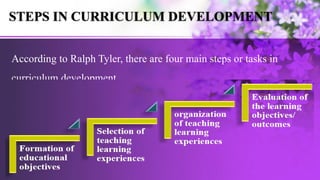
According to Ralph Tyler, there are four main steps or tasks in
curriculum development
STEPS IN CURRICULUM DEVELOPMENT
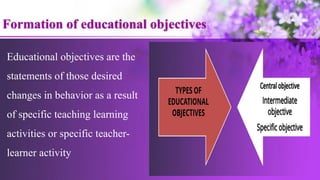
Educational objectives are the
statements of those desired
changes in behavior as a result
of specific teaching learning
activities or specific teacher-
learner activity
Formation of educational objectives
Selection of learning experience
is defined as deliberately planned experiences in selected
situations where students actively participate, interact and
which result in desirable changes in the behavior of the
students
 Learning experiences should allow the student to learn by doing
 Learning experience should create motivation and interest among students.
 Learning experiences should be challenging for the students
 Learning experiences Should satisfy the needs of the time
 Learning experiences Should bring out multiple outcomes in students
 Learning experiences Should help students acquire needed knowledge,
skills and attitude
 Learning experiences Should help hunt or gather information
 Learning experiences Should be helpful to the students in attaining
educational objectives
CHARACTERISTICS OF LEARNING EXPERIENCE
Organisation of teaching learning experience
After the learning experiences have been selected the next step is sequencing
or placement of experience. The placement should be in such a way that it
proceeds from simple to plex concrete to abstract and from normal to
experiences that are to be organized as follows:
• Theoretical experiences
• Supervised and guided experiences in the hospital and community
practical's
• Teaching learning methods
Learning experiences need to be integrated so that students see interrelation
in various subjects that lead to life long learning or holistic learning
Evaluation of learning objectives/outcomes
The final step in the planning process is to conclude, how well
the planning has been done. Evaluation of the curriculum
process must include the following:
– Purposes of the test
– Timing of the various tests
– Duration of tests
– Frequency of tests
– Criteria for pass and fail and grading of students
FACILITATORS OF CURRICULUM PLANNING
Learning experiences must be systematically organized so that learners can
achieve society’s goals. Hence educational experiences must be carefully
planned. Curriculum planning coordinates the goals with the activities
chosen to achieve them. Systematic implementation of curriculum plans
still eludes educational institutions.
1. It should be based on the concept of good life, the characteristics of
contemporary and future society, and the basic needs of human beings.
2. The essential elements of teaching and learning should be well
coordinated so that teaching effectiveness and quality of learning are not
jeopardized.
FACILITATORS OF CURRICULUM PLANNING
3. Curriculum plans should be responsive to the current needs of
society and individuals.
4. Curriculum plans should focus on a broad range of needs of learners
and society.
5. The community at large has the right to identify the goals for its
children. Hence educators inform citizens about foundational areas so
that goal decisions are based upon sound knowled and understanding
of the objectives.
FACILITATORS OF CURRICULUM PLANNING
6. The statements of educational goals should be written with clarity
so that they may prove useful in guiding the process of curriculum
planning
7. The right and responsibility to identify programmes for learners'
rests with educators because of their professional expertise.
8. The curriculum should provide an integrated set of activities rather
than provide a het of unrelated educational experiences. It should
articulate the school programmes and learners across grades and
levels.
BARRIERS OF CURRICULUM DEVELOPMENT
1. The Absence of a curriculum framework: curriculum design is
complicated. Most teachers believe that they can write curriculum,
because they write lesson plans, design formative assessments, and
have spent their entire career planning curriculum and instruction.
But the framework is the strong base.
2. Change: Change occurs in every facet of life. However, change can
greatly impact curriculum design. Standards have become a focus
across the nation. When policymakers change standards, curriculum
designers must align the curriculum with new standards and this
often requires starting over.
BARRIERS OF CURRICULUM DEVELOPMENT
3. Focus on the product: When educators participate in curriculum development
they often focus on completing the curriculum map. Curriculum design should be
viewed as a process, rather than a product. Continuous improvement should be
valued more than finishing a curriculum document. While the product should be
aligned to the standards, teacher-friendly, and focused on the district's priorities, the
product should not de-emphasize the process.
4. Hidden curriculum :The hidden curriculum' is the unintended curriculum. "It
defines what students learn from the physical environment, the policies, and the
procedures of the school". Most of the teachers and administrators don't recognize
the hidden curriculum, because it is 'the way we do business There are messages in
every institution that interfere with the written curriculum. The ability of parents to
voice their concerns and recommendations is part of the hidden curriculum.
FORMULATION
OF
EDUCATIONAL
OBJECTIVES
Educational objectives are the statements of those desired
changes in behavior as a result of specific teaching-learning
activities or specific teacher-learner activity
DEFINITION
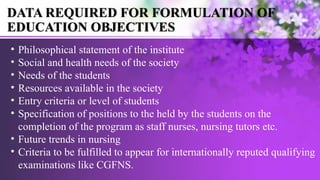
• Philosophical statement of the institute
• Social and health needs of the society
• Needs of the students
• Resources available in the society
• Entry criteria or level of students
• Specification of positions to the held by the students on the
completion of the program as staff nurses, nursing tutors etc.
• Future trends in nursing
• Criteria to be fulfilled to appear for internationally reputed qualifying
examinations like CGFNS.
DATA REQUIRED FOR FORMULATION OF
EDUCATION OBJECTIVES
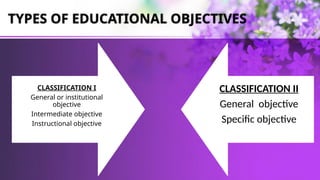
TYPES OF EDUCATIONAL OBJECTIVES
CLASSIFICATION I
General or institutional
objective
Intermediate objective
Instructional objective
CLASSIFICATION II
General objective
Specific objective
CLASSIFICATION I
A. Institutional Objectives: When the objectives describe the broad
over all aspects of an organization or Institution or school, they are
called institutional objectives. E.g.: Providing curative care to the
individual in sickness.
Characteristics of institutional objectives:
– 1. Well constructed Institutional objectives are the foundation of a
relevant program. Eg "At the end of her school of Nursing
Baccalaureate program the graduate should be able to provide
effective Nursing care to people of all ages at all levels of wellness
in a variety of settings.
Characteristics of institutional objectives:
2.apply the Nursing process in the delivery of health care to individual and
group
3.Demonstrate an effective use of self in her interactions with others
4 Collaborate with individuals and groups in reaching realistic health goals
5. Initiate change to improve the quality of professional nursing practice and
the delivery of health care
6 Seek opportunities for continual growth as a person, a citizen and a
professional
7. Practice nursing within a framework which is congruent with her own
philosophy nursing
B. Intermediate objectives:
• These are developed from the Institutional objectives. They
broader than the specific objectives. For instance, they are
prepared at the level of department in an Institution. Eg: Objectives
of the Department of Epidemiology and preventive medicine
At the end of university studies the student should be able to
Plan and undertake, in operation with other members of the
health team, epidemiological studier of an analytic or
descriptive nature.
C. Instructional objectives:
• They are specific, precise and narrow, at the level of a short
learning period. They are also called as specific objectives.
Eg: By the end of the Lecture on Carbohydrates, students
will be able to list the different types of carbohydrates.
CLASSIFICATION II
General objectives:
• General objectives in education refer to broad goals or outcomes that
educators hope to achieve for their students.
• These objectives often relate to a student's overall development and
progress, such as acquiring knowledge, skills, attitudes, values, and
behaviors that will help them succeed in their personal and professional
lives.
• Examples of general objectives in education include improving literacy and
numeracy skills, promoting critical thinking and problem-solving abilities,
fostering creativity and innovation, enhancing social and emotional
intelligence, and preparing students for lifelong learning
B. Specific objectives:
Specific objectives in education, on the other hand, are more precise and measurable
than general objectives. They often relate to specific subject areas, topics, or learning
outcomes For instance, a specific objective in a math class might be for students to
learn how to solve equations with variables on both sides, while a specific objective
in a literature close might be for students to analyze the theme of a novel. Specific
objectives help educates to focus their teaching and assessment strategies, as well as
monitor student progress and adjust their instruction as needed..
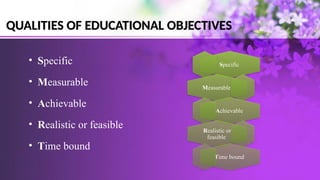
• Specific
• Measurable
• Achievable
• Realistic or feasible
• Time bound
QUALITIES OF EDUCATIONAL OBJECTIVES
Specific
Measurable
Achievable
Realistic or
feasible
Time bound
• Bloom and his associates developed a system of classification of
objectives called the taxonomy of educational objectives.
• The taxonomy of behavioral objectives is developed in the field of
education to look at the intellectual, psychological as well as
motor skills of the learner.
THE TAXONOMY OF BEHAVIORAL OBJECTIVES
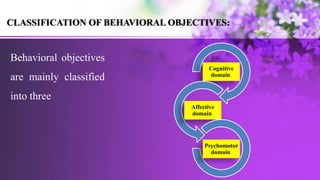
Behavioral objectives
are mainly classified
into three
CLASSIFICATION OF BEHAVIORAL OBJECTIVES:
Cognitive
domain
Affective
domain
Psychomotor
domain
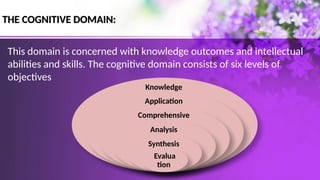
THE COGNITIVE DOMAIN:
This domain is concerned with knowledge outcomes and intellectual
abilities and skills. The cognitive domain consists of six levels of
objectives
Knowledge
Application
Comprehensive
Analysis
Synthesis
Evalua
tion
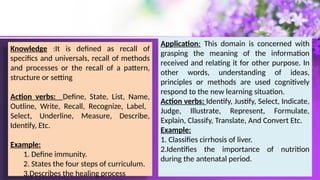
Knowledge :It is defined as recall of
specifics and universals, recall of methods
and processes or the recall of a pattern,
structure or setting
Action verbs: Define, State, List, Name,
Outline, Write, Recall, Recognize, Label,
Select, Underline, Measure, Describe,
Identify, Etc.
Example:
1. Define immunity.
2. States the four steps of curriculum.
3.Describes the healing process
Application: This domain is concerned with
grasping the meaning of the information
received and relating it for other purpose. In
other words, understanding of ideas,
principles or methods are used cognitively
respond to the new learning situation.
Action verbs: Identify, Justify, Select, Indicate,
Judge, Illustrate, Represent, Formulate,
Explain, Classify, Translate, And Convert Etc.
Example:
1. Classifies cirrhosis of liver.
2.Identifies the importance of nutrition
during the antenatal period.
Comprehensive: It is concerned with the
ability to use the learned material
(knowledge of ideas, theories, principle,
abstract etc) in a new situation or concrete
situation.
Action verbs: Apply, Demonstrate,
Develop, Employ, Relate, Convert, Change,
Calculate, Solve. Etc.
Example:
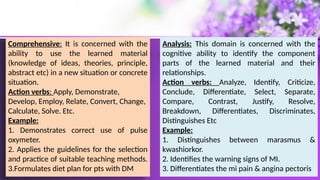
1. Demonstrates correct use of pulse
oxymeter.
2. Applies the guidelines for the selection
and practice of suitable teaching methods.
3.Formulates diet plan for pts with DM
Analysis: This domain is concerned with the
cognitive ability to identify the component
parts of the learned material and their
relationships.
Action verbs: Analyze, Identify, Criticize,
Conclude, Differentiate, Select, Separate,
Compare, Contrast, Justify, Resolve,
Breakdown, Differentiates, Discriminates,
Distinguishes Etc
Example:
1. Distinguishes between marasmus &
kwashiorkor.
2. Identifies the warning signs of MI.
3. Differentiates the mi pain & angina pectoris
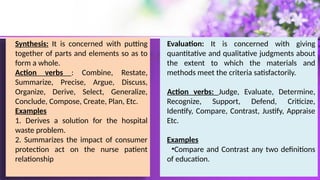
Synthesis: It is concerned with putting
together of parts and elements so as to
form a whole.
Action verbs : Combine, Restate,
Summarize, Precise, Argue, Discuss,
Organize, Derive, Select, Generalize,
Conclude, Compose, Create, Plan, Etc.
Examples
1. Derives a solution for the hospital
waste problem.
2. Summarizes the impact of consumer
protection act on the nurse patient
relationship
Evaluation: It is concerned with giving
quantitative and qualitative judgments about
the extent to which the materials and
methods meet the criteria satisfactorily.
Action verbs: Judge, Evaluate, Determine,
Recognize, Support, Defend, Criticize,
Identify, Compare, Contrast, Justify, Appraise
Etc.
Examples
•Compare and Contrast any two definitions
of education.
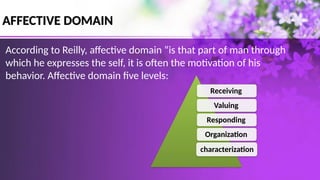
AFFECTIVE DOMAIN
Receiving
Valuing
Responding
Organization
characterization
According to Reilly, affective domain “is that part of man through
which he expresses the self, it is often the motivation of his
behavior. Affective domain five levels:
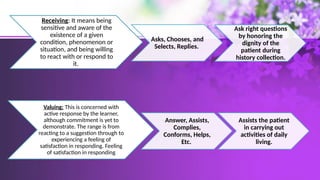
Receiving: It means being
sensitive and aware of the
existence of a given
condition, phenomenon or
situation, and being willing
to react with or respond to
it.
Asks, Chooses, and
Selects, Replies.
Ask right questions
by honoring the
dignity of the
patient during
history collection.
Valuing: This is concerned with
active response by the learner,
although commitment is yet to
demonstrate. The range is from
reacting to a suggestion through to
experiencing a feeling of
satisfaction in responding. Feeling
of satisfaction in responding
Answer, Assists,
Complies,
Conforms, Helps,
Etc.
Assists the patient
in carrying out
activities of daily
living.
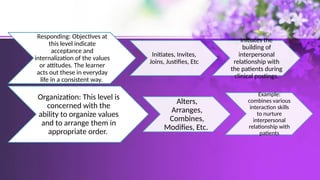
Responding: Objectives at
this level indicate
acceptance and
internalization of the values
or attitudes. The learner
acts out these in everyday
life in a consistent way.
Initiates, Invites,
Joins, Justifies, Etc
Initiates the
building of
interpersonal
relationship with
the patients during
clinical postings.
Organization: This level is
concerned with the
ability to organize values
and to arrange them in
appropriate order.
Alters,
Arranges,
Combines,
Modifies, Etc.
Example:
combines various
interaction skills
to nurture
interpersonal
relationship with
patients
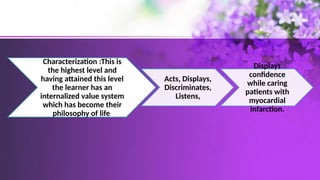
Characterization :This is
the highest level and
having attained this level
the learner has an
internalized value system
which has become their
philosophy of life
Acts, Displays,
Discriminates,
Listens,
Displays
confidence
while caring
patients with
myocardial
infarction.
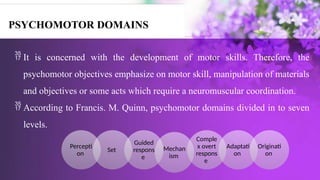
PSYCHOMOTOR DOMAINS
Percepti
on
Set
Guided
respons
e
Mechan
ism
Comple
x overt
respons
e
Adaptati
on
Originati
on
 It is concerned with the development of motor skills. Therefore, the
psychomotor objectives emphasize on motor skill, manipulation of materials
and objectives or some acts which require a neuromuscular coordination.
 According to Francis. M. Quinn, psychomotor domains divided in to seven
levels.
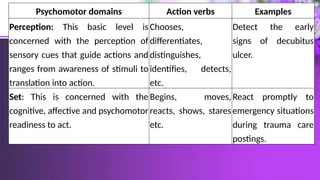
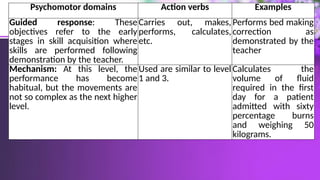
Psychomotor domains Action verbs Examples
Perception: This basic level is
concerned with the perception of
sensory cues that guide actions and
ranges from awareness of stimuli to
translation into action.
Chooses,
differentiates,
distinguishes,
identifies, detects,
etc.
Detect the early
signs of decubitus
ulcer.
Set: This is concerned with the
cognitive, affective and psychomotor
readiness to act.
Begins, moves,
reacts, shows, stares
etc.
React promptly to
emergency situations
during trauma care
postings.
Psychomotor domains Action verbs Examples
Guided response: These
objectives refer to the early
stages in skill acquisition where
skills are performed following
demonstration by the teacher.
Carries out, makes,
performs, calculates,
etc.
Performs bed making
correction as
demonstrated by the
teacher
Mechanism: At this level, the
performance has become
habitual, but the movements are
not so complex as the next higher
level.
Used are similar to level
1 and 3.
Calculates the
volume of fluid
required in the first
day for a patient
admitted with sixty
percentage burns
and weighing 50
kilograms.
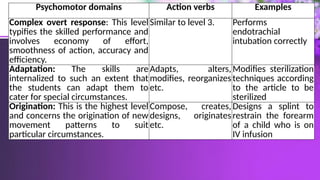
Psychomotor domains Action verbs Examples
Complex overt response: This level
typifies the skilled performance and
involves economy of effort,
smoothness of action, accuracy and
efficiency.
Similar to level 3. Performs
endotrachial
intubation correctly
Adaptation: The skills are
internalized to such an extent that
the students can adapt them to
cater for special circumstances.
Adapts, alters,
modifies, reorganizes
etc.
Modifies sterilization
techniques according
to the article to be
sterilized
Origination: This is the highest level
and concerns the origination of new
movement patterns to suit
particular circumstances.
Compose, creates,
designs, originates
etc.
Designs a splint to
restrain the forearm
of a child who is on
IV infusion
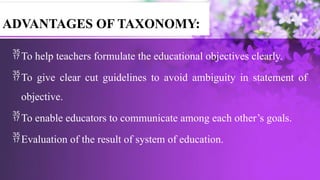
To help teachers formulate the educational objectives clearly.
To give clear cut guidelines to avoid ambiguity in statement of
objective.
To enable educators to communicate among each other’s goals.
Evaluation of the result of system of education.
ADVANTAGES OF TAXONOMY:
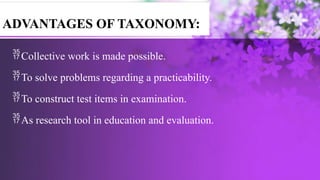
Collective work is made possible.
To solve problems regarding a practicability.
To construct test items in examination.
As research tool in education and evaluation.
ADVANTAGES OF TAXONOMY:
REFERNCES
Lakshmi Prasanna. Educational technology /Nursing
education. frontline publication. 2024.Pg no.69-81
 Sankaranarayanan B. teachers manual of effective
teaching in the digital age . worthreads
Publications;2023 Pg no: 313-380

curriculumandeducationalobjectives-240616105409-b12ba2ea.pptx

  • 1.
    Mrs SUBITHA BABU Assistantprofessor OBG SPECIALITY HOLY CROSS COLLEGE OF NURSING ADOOR
  • 2.
    INTRODUCTION Education aims atthe behavior modification of learners. Behavior modification is achieved through a series of activities. curriculum is concerned with guiding the teachers and students in the educative process. Therefore curriculum for the preparation of a teacher, nurse and student who can carry out these professional functions humanely and competently must be developed.
  • 3.
    MEANING AND DEFINITIONOF CURRICULUM • The term curriculum is derived from the Latin word “currere” which means, “run”. Thus, curriculum is a runway of attaining the goal of education. Curriculum may be considered as a blueprint of an educational program. • According to Cunningham, “curriculum” is the tool in the hands of an artist to mould his material, according to his ideals in his studio”. In this definition, artist is the teacher, material is the student ideals are objectives and studio is the educational institute.
  • 4.
    • According toFlorence nightingale-”curriculum is systematic arrangement of the sum total of selected experiences planned by a school for a defined group of students to attain the aims of a particular educational program. • Nursing curriculum is the learning opportunities (subject matter) and the learning activities (clinical experiences and practices) that the faculty plans and implement in various settings for a particular group of students, for a specified period of time in order to attain the objectives
  • 5.
    PURPOSES OF CURRICULUM •Toequip the learners through bringing the desirable changes in them •To cope with and handle life situations realistically, rationally without sacrifying the humane principles. •To establish values through intimate acquaintance with the humanities, arts, natural sciences, social sciences and religion •To develop the character of students, i.e. integrity, honesty, judgement, cooperation's, friendliness and goodwill. •To meet the needs of students with a wide range of ability,
  • 6.
    FUNCTIONS OF CURICULUM PRIMARYFUNCTIONS: To relate the various learning experiences which together comprise the curriculum so as to produce the maximum cumulative effect in attaining the objectives of the school. SECONDARY FUNCTIONS: – The effect it has on its student motivation. – Learning experiences should be organized so as to maximize the total effect of the various learning experiences by Student’s personality development Within the subject matter
  • 7.
    TYPES OF CURRICULUM Explicit curriculu mor Actual curriculu m Hidden curriculu m Null curriculu m Essential curriculu m Societal curriculu m Official curriculu m Received curriculu m
  • 8.
    Explicit curriculum oractual curriculum • Curriculum in use • Followed at institutional level or school level and also called as institutional curriculum • Formal curriculum that explains explicit steps and procedures to achieve the aims of educational programme • Divided in to – educational activities conducted through online methods – educational activities conducted through traditional method
  • 9.
    Hidden curriculum • Refersto unintended outcomes occur while implementing explicit curriculum • Kind of learning students derive from teachers attitudes and school environment – E.g. unconsciously developing interest in maths subject because of influence of the teachers • Conveys both positive and negative messages to the learners depending on the teachers attitudes and influence of school environment
  • 10.
    Null curriculum • Alsocalled as absent curriculum is created when certain aspect of explicit curriculum Is excluded either intentionally or unintentionally from the explicit curriculum. Eg teaching about war not about peace • A teacher should implement null curriculum carefully.
  • 11.
    Essential curriculum • Isthe curriculum implemented for conducting the educational programme when it is impossible to continue with the already written or explicit curriculum due to foreseen reasons e.g online classes during covid pandemic situation • Salient features of essential curriculum are – New strategies are formulated to achieve the educational aims – Essential content of curriculum is retained . “must to be taught” topics are given preferences than “likely to be taught “ topics – Implemented only for a single academic year – Highly disruptive in nature – Depends up on technology and information – Equal importance to web-based resources – Highly flexible.
  • 12.
    Societal Curriculum According toCortes, "societal curriculum is the massive, ongoing informal curriculum family, peer groups, neighborhoods, organizations, mass media and other socializing fo that "educate" children". This type of curriculum can now be expanded to include the power effects of social media like YouTube, Facebook, etc., and how it actively helps in creating perspectives.
  • 13.
    Official Curriculum • Theofficial curriculum or the formal curriculum is the curriculum prepared and recommended by apex bodies like universities, state education boards, and regulatory bodies like INC for conducting educational programs in a region, state or country. • The main aim of preparing an official curriculum is to bring out uniformity and standardization in conducting an educational program. For example, all nursing colleges need to follow curriculum recommended by INC while conducting nursing programs. • Educational institutions develop explicit or written curriculum from the official curriculum prepared by apex bodies
  • 14.
    Received Curriculum • Isalso knowns as "actual curriculum” or the "learned curriculum" is the real or actual experience of students what they actually learn and is the most important of all curriculum. • Knowledge, skills, attitude and values the learners attain can be included and evaluated in the received curriculum. • There is a gap between the official or planned curriculum and the received curriculum. The teacher needs to put more effort to reduce this gap.
  • 15.
    OLIVIA BEVIS RECOMMENDS4 TYPES OF NURSING CURRICULUM Legitimate curriculum Illegitimate curriculum Hidden curriculum Null curriculum
  • 16.
    TYPES OF CURRICULUM Subjectoriented curriculum Competency based curriculum Experience based curriculum Core curriculum
  • 17.
    COMPONENTS OF NURSINGCURRICULUM Curriculum invariably contains • The statement of philosophy of the educational program • The statement of the objectives of educational program • Total duration of educational programme • Learning experiences • Instructional methods- Detailed course plan for each course. • Program of evaluation such as type of examinations, various grades according to results, percentage meant for internal assessment in university examinations etc.
  • 18.
  • 19.
    Behavioural approach: It isbased on the Behavioural Principle, goals and objectives are specified, content and activities are also arranged with learning objectives. Learning outcomes are evaluated in terms of the goals and objectives set at the beginning. Its main aim is to achieve efficiency. Change in behaviour indicates the measure of accomplishment.
  • 20.
    Managerial approach is basedon the following principles: – 1. General Leader: He/ She sets the policies and priorities, establishes the direction of change and innovation, and plans and organizes curriculum and instruction. – 2. Curriculum Leader: He/ She looks at the curriculum changes and innovations as they administer the resources and restructure the school infrastructure. Role of curriculum leader: • To help in the development of the School's educational goals. • To plan a curriculum with students, parents, teachers, and other stakeholders. • To design programs of study by grade level. • To help in the evaluation and selection of textbooks. • To assist teachers in the implementation of the curriculum • To develop standards for curriculum and instructional evaluation
  • 21.
    System approach: The wholesystem is approached by system theory. The whole approach represents the line. staff relationship of personnel and represents the way, how the decisions are made. It gives equal importance to all levels: • 1. Administration • 2. Counselling • 3. Curriculum • 4. Instruction • 5. Evaluation. A curriculum plan using this approach stresses the use of organizational diagrams, flow charts, and committee structures including subjects, courses, unit plans, and lesson plans
  • 22.
    Humanistic approach: It isrooted in progressive philosophy and follows child-centered movements. It considers the formal or planned curriculum and the informal or hidden curriculum. It also considers the whole child and believes that in the curriculum the total development of the individual is the prime consideration. Grounded in utilizing instructional strategies such as cooperative learning, independent learning, small-group learning, and social activities instead of competitive, teacher-dominated, large-group learning Schools that adopt this approach emphasize active student participation in the context of learning
  • 23.
    Academic approach: The Academicapproach founded on the theories of John Dewey, Henry Morrison, and Boyd Bode. This approach to curriculum is based on centering curriculum that is non-traditional, such as historical knowledge, philosophical, social, and political. Schools adopting this approach are able to develop a student's sense of self beyond subject matter and pedagogy.
  • 25.
    According to RalphTyler, there are four main steps or tasks in curriculum development STEPS IN CURRICULUM DEVELOPMENT
  • 26.
    Educational objectives arethe statements of those desired changes in behavior as a result of specific teaching learning activities or specific teacher- learner activity Formation of educational objectives
  • 27.
    Selection of learningexperience is defined as deliberately planned experiences in selected situations where students actively participate, interact and which result in desirable changes in the behavior of the students
  • 28.
     Learning experiencesshould allow the student to learn by doing  Learning experience should create motivation and interest among students.  Learning experiences should be challenging for the students  Learning experiences Should satisfy the needs of the time  Learning experiences Should bring out multiple outcomes in students  Learning experiences Should help students acquire needed knowledge, skills and attitude  Learning experiences Should help hunt or gather information  Learning experiences Should be helpful to the students in attaining educational objectives CHARACTERISTICS OF LEARNING EXPERIENCE
  • 29.
    Organisation of teachinglearning experience After the learning experiences have been selected the next step is sequencing or placement of experience. The placement should be in such a way that it proceeds from simple to plex concrete to abstract and from normal to experiences that are to be organized as follows: • Theoretical experiences • Supervised and guided experiences in the hospital and community practical's • Teaching learning methods Learning experiences need to be integrated so that students see interrelation in various subjects that lead to life long learning or holistic learning
  • 30.
    Evaluation of learningobjectives/outcomes The final step in the planning process is to conclude, how well the planning has been done. Evaluation of the curriculum process must include the following: – Purposes of the test – Timing of the various tests – Duration of tests – Frequency of tests – Criteria for pass and fail and grading of students
  • 31.
    FACILITATORS OF CURRICULUMPLANNING Learning experiences must be systematically organized so that learners can achieve society’s goals. Hence educational experiences must be carefully planned. Curriculum planning coordinates the goals with the activities chosen to achieve them. Systematic implementation of curriculum plans still eludes educational institutions. 1. It should be based on the concept of good life, the characteristics of contemporary and future society, and the basic needs of human beings. 2. The essential elements of teaching and learning should be well coordinated so that teaching effectiveness and quality of learning are not jeopardized.
  • 32.
    FACILITATORS OF CURRICULUMPLANNING 3. Curriculum plans should be responsive to the current needs of society and individuals. 4. Curriculum plans should focus on a broad range of needs of learners and society. 5. The community at large has the right to identify the goals for its children. Hence educators inform citizens about foundational areas so that goal decisions are based upon sound knowled and understanding of the objectives.
  • 33.
    FACILITATORS OF CURRICULUMPLANNING 6. The statements of educational goals should be written with clarity so that they may prove useful in guiding the process of curriculum planning 7. The right and responsibility to identify programmes for learners' rests with educators because of their professional expertise. 8. The curriculum should provide an integrated set of activities rather than provide a het of unrelated educational experiences. It should articulate the school programmes and learners across grades and levels.
  • 34.
    BARRIERS OF CURRICULUMDEVELOPMENT 1. The Absence of a curriculum framework: curriculum design is complicated. Most teachers believe that they can write curriculum, because they write lesson plans, design formative assessments, and have spent their entire career planning curriculum and instruction. But the framework is the strong base. 2. Change: Change occurs in every facet of life. However, change can greatly impact curriculum design. Standards have become a focus across the nation. When policymakers change standards, curriculum designers must align the curriculum with new standards and this often requires starting over.
  • 35.
    BARRIERS OF CURRICULUMDEVELOPMENT 3. Focus on the product: When educators participate in curriculum development they often focus on completing the curriculum map. Curriculum design should be viewed as a process, rather than a product. Continuous improvement should be valued more than finishing a curriculum document. While the product should be aligned to the standards, teacher-friendly, and focused on the district's priorities, the product should not de-emphasize the process. 4. Hidden curriculum :The hidden curriculum' is the unintended curriculum. "It defines what students learn from the physical environment, the policies, and the procedures of the school". Most of the teachers and administrators don't recognize the hidden curriculum, because it is 'the way we do business There are messages in every institution that interfere with the written curriculum. The ability of parents to voice their concerns and recommendations is part of the hidden curriculum.
  • 36.
  • 37.
    Educational objectives arethe statements of those desired changes in behavior as a result of specific teaching-learning activities or specific teacher-learner activity DEFINITION
  • 38.
    • Philosophical statementof the institute • Social and health needs of the society • Needs of the students • Resources available in the society • Entry criteria or level of students • Specification of positions to the held by the students on the completion of the program as staff nurses, nursing tutors etc. • Future trends in nursing • Criteria to be fulfilled to appear for internationally reputed qualifying examinations like CGFNS. DATA REQUIRED FOR FORMULATION OF EDUCATION OBJECTIVES
  • 39.
    TYPES OF EDUCATIONALOBJECTIVES CLASSIFICATION I General or institutional objective Intermediate objective Instructional objective CLASSIFICATION II General objective Specific objective
  • 40.
    CLASSIFICATION I A. InstitutionalObjectives: When the objectives describe the broad over all aspects of an organization or Institution or school, they are called institutional objectives. E.g.: Providing curative care to the individual in sickness. Characteristics of institutional objectives: – 1. Well constructed Institutional objectives are the foundation of a relevant program. Eg "At the end of her school of Nursing Baccalaureate program the graduate should be able to provide effective Nursing care to people of all ages at all levels of wellness in a variety of settings.
  • 41.
    Characteristics of institutionalobjectives: 2.apply the Nursing process in the delivery of health care to individual and group 3.Demonstrate an effective use of self in her interactions with others 4 Collaborate with individuals and groups in reaching realistic health goals 5. Initiate change to improve the quality of professional nursing practice and the delivery of health care 6 Seek opportunities for continual growth as a person, a citizen and a professional 7. Practice nursing within a framework which is congruent with her own philosophy nursing
  • 42.
    B. Intermediate objectives: •These are developed from the Institutional objectives. They broader than the specific objectives. For instance, they are prepared at the level of department in an Institution. Eg: Objectives of the Department of Epidemiology and preventive medicine At the end of university studies the student should be able to Plan and undertake, in operation with other members of the health team, epidemiological studier of an analytic or descriptive nature.
  • 43.
    C. Instructional objectives: •They are specific, precise and narrow, at the level of a short learning period. They are also called as specific objectives. Eg: By the end of the Lecture on Carbohydrates, students will be able to list the different types of carbohydrates.
  • 44.
    CLASSIFICATION II General objectives: •General objectives in education refer to broad goals or outcomes that educators hope to achieve for their students. • These objectives often relate to a student's overall development and progress, such as acquiring knowledge, skills, attitudes, values, and behaviors that will help them succeed in their personal and professional lives. • Examples of general objectives in education include improving literacy and numeracy skills, promoting critical thinking and problem-solving abilities, fostering creativity and innovation, enhancing social and emotional intelligence, and preparing students for lifelong learning
  • 45.
    B. Specific objectives: Specificobjectives in education, on the other hand, are more precise and measurable than general objectives. They often relate to specific subject areas, topics, or learning outcomes For instance, a specific objective in a math class might be for students to learn how to solve equations with variables on both sides, while a specific objective in a literature close might be for students to analyze the theme of a novel. Specific objectives help educates to focus their teaching and assessment strategies, as well as monitor student progress and adjust their instruction as needed..
  • 46.
    • Specific • Measurable •Achievable • Realistic or feasible • Time bound QUALITIES OF EDUCATIONAL OBJECTIVES Specific Measurable Achievable Realistic or feasible Time bound
  • 47.
    • Bloom andhis associates developed a system of classification of objectives called the taxonomy of educational objectives. • The taxonomy of behavioral objectives is developed in the field of education to look at the intellectual, psychological as well as motor skills of the learner. THE TAXONOMY OF BEHAVIORAL OBJECTIVES
  • 48.
    Behavioral objectives are mainlyclassified into three CLASSIFICATION OF BEHAVIORAL OBJECTIVES: Cognitive domain Affective domain Psychomotor domain
  • 49.
    THE COGNITIVE DOMAIN: Thisdomain is concerned with knowledge outcomes and intellectual abilities and skills. The cognitive domain consists of six levels of objectives Knowledge Application Comprehensive Analysis Synthesis Evalua tion
  • 50.
    Knowledge :It isdefined as recall of specifics and universals, recall of methods and processes or the recall of a pattern, structure or setting Action verbs: Define, State, List, Name, Outline, Write, Recall, Recognize, Label, Select, Underline, Measure, Describe, Identify, Etc. Example: 1. Define immunity. 2. States the four steps of curriculum. 3.Describes the healing process Application: This domain is concerned with grasping the meaning of the information received and relating it for other purpose. In other words, understanding of ideas, principles or methods are used cognitively respond to the new learning situation. Action verbs: Identify, Justify, Select, Indicate, Judge, Illustrate, Represent, Formulate, Explain, Classify, Translate, And Convert Etc. Example: 1. Classifies cirrhosis of liver. 2.Identifies the importance of nutrition during the antenatal period.
  • 51.
    Comprehensive: It isconcerned with the ability to use the learned material (knowledge of ideas, theories, principle, abstract etc) in a new situation or concrete situation. Action verbs: Apply, Demonstrate, Develop, Employ, Relate, Convert, Change, Calculate, Solve. Etc. Example: 1. Demonstrates correct use of pulse oxymeter. 2. Applies the guidelines for the selection and practice of suitable teaching methods. 3.Formulates diet plan for pts with DM Analysis: This domain is concerned with the cognitive ability to identify the component parts of the learned material and their relationships. Action verbs: Analyze, Identify, Criticize, Conclude, Differentiate, Select, Separate, Compare, Contrast, Justify, Resolve, Breakdown, Differentiates, Discriminates, Distinguishes Etc Example: 1. Distinguishes between marasmus & kwashiorkor. 2. Identifies the warning signs of MI. 3. Differentiates the mi pain & angina pectoris
  • 52.
    Synthesis: It isconcerned with putting together of parts and elements so as to form a whole. Action verbs : Combine, Restate, Summarize, Precise, Argue, Discuss, Organize, Derive, Select, Generalize, Conclude, Compose, Create, Plan, Etc. Examples 1. Derives a solution for the hospital waste problem. 2. Summarizes the impact of consumer protection act on the nurse patient relationship Evaluation: It is concerned with giving quantitative and qualitative judgments about the extent to which the materials and methods meet the criteria satisfactorily. Action verbs: Judge, Evaluate, Determine, Recognize, Support, Defend, Criticize, Identify, Compare, Contrast, Justify, Appraise Etc. Examples •Compare and Contrast any two definitions of education.
  • 53.
    AFFECTIVE DOMAIN Receiving Valuing Responding Organization characterization According toReilly, affective domain “is that part of man through which he expresses the self, it is often the motivation of his behavior. Affective domain five levels:
  • 54.
    Receiving: It meansbeing sensitive and aware of the existence of a given condition, phenomenon or situation, and being willing to react with or respond to it. Asks, Chooses, and Selects, Replies. Ask right questions by honoring the dignity of the patient during history collection. Valuing: This is concerned with active response by the learner, although commitment is yet to demonstrate. The range is from reacting to a suggestion through to experiencing a feeling of satisfaction in responding. Feeling of satisfaction in responding Answer, Assists, Complies, Conforms, Helps, Etc. Assists the patient in carrying out activities of daily living.
  • 55.
    Responding: Objectives at thislevel indicate acceptance and internalization of the values or attitudes. The learner acts out these in everyday life in a consistent way. Initiates, Invites, Joins, Justifies, Etc Initiates the building of interpersonal relationship with the patients during clinical postings. Organization: This level is concerned with the ability to organize values and to arrange them in appropriate order. Alters, Arranges, Combines, Modifies, Etc. Example: combines various interaction skills to nurture interpersonal relationship with patients
  • 56.
    Characterization :This is thehighest level and having attained this level the learner has an internalized value system which has become their philosophy of life Acts, Displays, Discriminates, Listens, Displays confidence while caring patients with myocardial infarction.
  • 57.
    PSYCHOMOTOR DOMAINS Percepti on Set Guided respons e Mechan ism Comple x overt respons e Adaptati on Originati on It is concerned with the development of motor skills. Therefore, the psychomotor objectives emphasize on motor skill, manipulation of materials and objectives or some acts which require a neuromuscular coordination.  According to Francis. M. Quinn, psychomotor domains divided in to seven levels.
  • 58.
    Psychomotor domains Actionverbs Examples Perception: This basic level is concerned with the perception of sensory cues that guide actions and ranges from awareness of stimuli to translation into action. Chooses, differentiates, distinguishes, identifies, detects, etc. Detect the early signs of decubitus ulcer. Set: This is concerned with the cognitive, affective and psychomotor readiness to act. Begins, moves, reacts, shows, stares etc. React promptly to emergency situations during trauma care postings.
  • 59.
    Psychomotor domains Actionverbs Examples Guided response: These objectives refer to the early stages in skill acquisition where skills are performed following demonstration by the teacher. Carries out, makes, performs, calculates, etc. Performs bed making correction as demonstrated by the teacher Mechanism: At this level, the performance has become habitual, but the movements are not so complex as the next higher level. Used are similar to level 1 and 3. Calculates the volume of fluid required in the first day for a patient admitted with sixty percentage burns and weighing 50 kilograms.
  • 60.
    Psychomotor domains Actionverbs Examples Complex overt response: This level typifies the skilled performance and involves economy of effort, smoothness of action, accuracy and efficiency. Similar to level 3. Performs endotrachial intubation correctly Adaptation: The skills are internalized to such an extent that the students can adapt them to cater for special circumstances. Adapts, alters, modifies, reorganizes etc. Modifies sterilization techniques according to the article to be sterilized Origination: This is the highest level and concerns the origination of new movement patterns to suit particular circumstances. Compose, creates, designs, originates etc. Designs a splint to restrain the forearm of a child who is on IV infusion
  • 61.
    To help teachersformulate the educational objectives clearly. To give clear cut guidelines to avoid ambiguity in statement of objective. To enable educators to communicate among each other’s goals. Evaluation of the result of system of education. ADVANTAGES OF TAXONOMY:
  • 62.
    Collective work ismade possible. To solve problems regarding a practicability. To construct test items in examination. As research tool in education and evaluation. ADVANTAGES OF TAXONOMY:
  • 63.
    REFERNCES Lakshmi Prasanna. Educationaltechnology /Nursing education. frontline publication. 2024.Pg no.69-81  Sankaranarayanan B. teachers manual of effective teaching in the digital age . worthreads Publications;2023 Pg no: 313-380