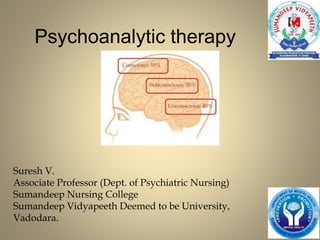
Psychoanalytic therapy
Suresh V.
Associate Professor (Dept. of Psychiatric Nursing)
Sumandeep Nursing College
Sumandeep Vidyapeeth Deemed to be University,
Vadodara.
Introduction
• Psychotherapy is a verbal
communication as the means of
treatment.
• Aimed at relieving patient’s
symptom and helping to modify his
behavior.
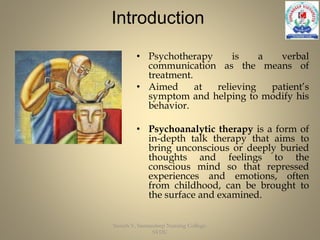
• Psychoanalytic therapy is a form of
in-depth talk therapy that aims to
bring unconscious or deeply buried
thoughts and feelings to the
conscious mind so that repressed
experiences and emotions, often
from childhood, can be brought to
the surface and examined.
Suresh V, Sumandeep Nursing College,
SVDU
Psychoanalytic therapy
• The most important Indication
for psychoanalytical therapy is
the presence of long standing
mental conflicts, which may be
unconscious but produce
symptoms.
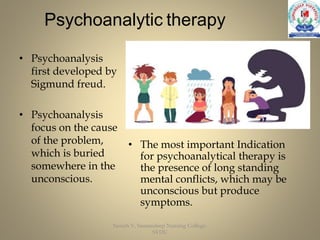
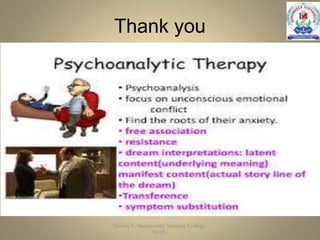
• Psychoanalysis
first developed by
Sigmund freud.
• Psychoanalysis
focus on the cause
of the problem,
which is buried
somewhere in the
unconscious.
Suresh V, Sumandeep Nursing College,
SVDU
• Therapist tries to take the patient into the
past in an effort to determine where the
problem began.
• The aim of the therapy is to bring all
repressed material to conscious awareness
so that patient can work towards healthy
resolution of his problem.
Suresh V, Sumandeep Nursing College,
SVDU
Therapy Process
Typically psychoanalyst to be positioned at the
head of the patient and slightly behind, so that
patient cannot see the therapist.
This decreases any kind of nonverbal
communication between two people.
Patient typically on couch, relaxed and ready to
focus on the therapist instruction which
facilitate the free association.Suresh V, Sumandeep Nursing College,
SVDU
• The patient is an active participant, freely
revealing all thoughts exactly as they
occur and describing all dreams.
• Therapist is a shadow person, he reveals
nothing personal, nor give any directions
to the patient.
Suresh V, Sumandeep Nursing College,
SVDU
Techniques used in Psychoanalysis
• Free association
• Dream analysis
• Hypnosis
• Catharsis
• Abreaction
Suresh V, Sumandeep Nursing College,
SVDU
Free association
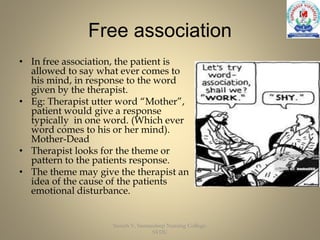
• In free association, the patient is
allowed to say what ever comes to
his mind, in response to the word
given by the therapist.
• Eg: Therapist utter word “Mother”,
patient would give a response
typically in one word. (Which ever
word comes to his or her mind).
Mother-Dead
• Therapist looks for the theme or
pattern to the patients response.
• The theme may give the therapist an
idea of the cause of the patients
emotional disturbance.
Suresh V, Sumandeep Nursing College,
SVDU
Dream Analysis
Dream analysis is the process of assigning
meaning to dreams.
• Freud believed that behaviour is
rooted in the unconscious and the
dreams are a manifestation of the
troubles people repress.
• The better way to get idea of the
problem is to monitor and
interpret dreams.
• Analysis of the patients dreams
helps to gain additional insight
into the problem.
Suresh V, Sumandeep Nursing College,
SVDU
Suresh V, Sumandeep Nursing College,
SVDU
Hypnosis
• Hypnosis is an artificial induced state in which the person is relaxed
and usually suggestible.
• The relaxation is guided by the therapist.
• Hypnosis can be induced in many ways such as by using a fixed
point for attention, rhythmic monotonous instruction.
• In hyponotherapy relaxation is guided by the therapist who has
been trained in techniques of trance formation.
• Hypnosis is a means for entering an altered state of consciousness
and in this state using visualization and suggestion to bring about
desired changes in behaviour and thinking.
Suresh V, Sumandeep Nursing College,
SVDU
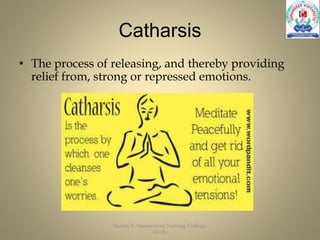
Catharsis
• The process of releasing, and thereby providing
relief from, strong or repressed emotions.
Suresh V, Sumandeep Nursing College,
SVDU
Abreaction Therapy
• Abreaction is a process by which repressed
material, particularly a painful experience or
conflict is brought back to consciousness.
(Can be brought about by strong
encouragement to relieve the stressful event).
Suresh V, Sumandeep Nursing College,
SVDU
Thank you
Suresh V, Sumandeep Nursing College,
SVDU

Psychoanalytical therapy

  • 1.
    Psychoanalytic therapy Suresh V. AssociateProfessor (Dept. of Psychiatric Nursing) Sumandeep Nursing College Sumandeep Vidyapeeth Deemed to be University, Vadodara.
  • 2.
    Introduction • Psychotherapy isa verbal communication as the means of treatment. • Aimed at relieving patient’s symptom and helping to modify his behavior. • Psychoanalytic therapy is a form of in-depth talk therapy that aims to bring unconscious or deeply buried thoughts and feelings to the conscious mind so that repressed experiences and emotions, often from childhood, can be brought to the surface and examined. Suresh V, Sumandeep Nursing College, SVDU
  • 3.
    Psychoanalytic therapy • Themost important Indication for psychoanalytical therapy is the presence of long standing mental conflicts, which may be unconscious but produce symptoms. • Psychoanalysis first developed by Sigmund freud. • Psychoanalysis focus on the cause of the problem, which is buried somewhere in the unconscious. Suresh V, Sumandeep Nursing College, SVDU
  • 4.
    • Therapist triesto take the patient into the past in an effort to determine where the problem began. • The aim of the therapy is to bring all repressed material to conscious awareness so that patient can work towards healthy resolution of his problem. Suresh V, Sumandeep Nursing College, SVDU
  • 5.
    Therapy Process Typically psychoanalystto be positioned at the head of the patient and slightly behind, so that patient cannot see the therapist. This decreases any kind of nonverbal communication between two people. Patient typically on couch, relaxed and ready to focus on the therapist instruction which facilitate the free association.Suresh V, Sumandeep Nursing College, SVDU
  • 6.
    • The patientis an active participant, freely revealing all thoughts exactly as they occur and describing all dreams. • Therapist is a shadow person, he reveals nothing personal, nor give any directions to the patient. Suresh V, Sumandeep Nursing College, SVDU
  • 7.
    Techniques used inPsychoanalysis • Free association • Dream analysis • Hypnosis • Catharsis • Abreaction Suresh V, Sumandeep Nursing College, SVDU
  • 8.
    Free association • Infree association, the patient is allowed to say what ever comes to his mind, in response to the word given by the therapist. • Eg: Therapist utter word “Mother”, patient would give a response typically in one word. (Which ever word comes to his or her mind). Mother-Dead • Therapist looks for the theme or pattern to the patients response. • The theme may give the therapist an idea of the cause of the patients emotional disturbance. Suresh V, Sumandeep Nursing College, SVDU
  • 9.
    Dream Analysis Dream analysisis the process of assigning meaning to dreams. • Freud believed that behaviour is rooted in the unconscious and the dreams are a manifestation of the troubles people repress. • The better way to get idea of the problem is to monitor and interpret dreams. • Analysis of the patients dreams helps to gain additional insight into the problem. Suresh V, Sumandeep Nursing College, SVDU
  • 10.
    Suresh V, SumandeepNursing College, SVDU
  • 11.
    Hypnosis • Hypnosis isan artificial induced state in which the person is relaxed and usually suggestible. • The relaxation is guided by the therapist. • Hypnosis can be induced in many ways such as by using a fixed point for attention, rhythmic monotonous instruction. • In hyponotherapy relaxation is guided by the therapist who has been trained in techniques of trance formation. • Hypnosis is a means for entering an altered state of consciousness and in this state using visualization and suggestion to bring about desired changes in behaviour and thinking. Suresh V, Sumandeep Nursing College, SVDU
  • 12.
    Catharsis • The processof releasing, and thereby providing relief from, strong or repressed emotions. Suresh V, Sumandeep Nursing College, SVDU
  • 13.
    Abreaction Therapy • Abreactionis a process by which repressed material, particularly a painful experience or conflict is brought back to consciousness. (Can be brought about by strong encouragement to relieve the stressful event). Suresh V, Sumandeep Nursing College, SVDU
  • 14.
    Thank you Suresh V,Sumandeep Nursing College, SVDU