PRACTICAL
Name- Saloni Singhal
M.Sc. (Statistics) II-Sem.
Roll No: 2046398
Course- MATH-409 L
Numerical Analysis Lab
Submitted To: Dr. S.C. Pandey
OBJECTIVE
1. Create an M-file to implement
Euler’s method for solving ordinary
differential equations
2. Plot the exact and numerical solution.
Theory
if we make h small enough, we may only need a few terms of the
Taylor-series expansion for good accuracy. The Euler method
follows this idea to the extreme for first-order differential
equations - it uses only the first two terms of the Taylor series.
Suppose that we have chosen h small enough so that we may
truncate the series after the first derivative term.
where last term is the usual error term for the truncated Taylor
series. Adopting a subscript notation for the successive y-values
and representing the error by the order relation, we may write the
algorithm for Euler’s method in the form
This error is just the local error i.e. error in a single step. Over
many steps, the global error becomes of O (h)
Geometric Interpretation
By constructing the
ordinates at x0 and x0+ ℎ . . ,
if we draw the tangent to the
solution
curve at (x0 ,y0) then height
of the ordinate at x1, to the
point of intersection A (say)
of this
tangent and ordinate at x1
gives the value of y at x1 by
Euler method.
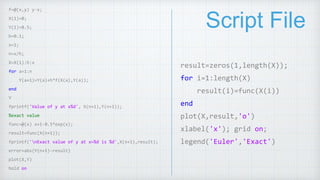
Script File
f=@(x,y) y-x;
X(1)=0;
Y(1)=0.5;
h=0.1;
x=1;
n=x/h;
X=X(1):h:x
for a=1:n
Y(a+1)=Y(a)+h*f(X(a),Y(a));
end
Y
fprintf('Value of y at x%d', X(n+1),Y(n+1));
%exact value
func=@(x) x+1-0.5*exp(x);
result=func(X(n+1));
fprintf('nExact value of y at x=%d is %d',X(n+1),result);
error=abs(Y(n+1)-result)
plot(X,Y)
hold on
result=zeros(1,length(X));
for i=1:length(X)
result(i)=func(X(i))
end
plot(X,result,'o')
xlabel('x'); grid on;
legend('Euler','Exact')
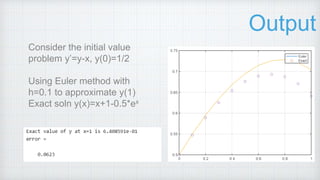
Output
Consider the initial value
problem y’=y-x, y(0)=1/2
Using Euler method with
h=0.1 to approximate y(1)
Exact soln y(x)=x+1-0.5*ex
Conclusion
At h=0.05
Decreasing the step size
improves the accuracy of
Euler's method as evident from
the error and plot
Caveats
• The trouble with the most simple Euler method is it’s
lack of accuracy, requiring an extremely small step size.
• To overcome this problem, Euler modified his method by
considering one more term of the Taylor series and
expressing the second derivative yn’’ by the forward-
difference approximation.

Euler Method

  • 1.
    PRACTICAL Name- Saloni Singhal M.Sc.(Statistics) II-Sem. Roll No: 2046398 Course- MATH-409 L Numerical Analysis Lab Submitted To: Dr. S.C. Pandey
  • 2.
    OBJECTIVE 1. Create anM-file to implement Euler’s method for solving ordinary differential equations 2. Plot the exact and numerical solution.
  • 3.
    Theory if we makeh small enough, we may only need a few terms of the Taylor-series expansion for good accuracy. The Euler method follows this idea to the extreme for first-order differential equations - it uses only the first two terms of the Taylor series. Suppose that we have chosen h small enough so that we may truncate the series after the first derivative term. where last term is the usual error term for the truncated Taylor series. Adopting a subscript notation for the successive y-values and representing the error by the order relation, we may write the algorithm for Euler’s method in the form This error is just the local error i.e. error in a single step. Over many steps, the global error becomes of O (h)
  • 4.
    Geometric Interpretation By constructingthe ordinates at x0 and x0+ ℎ . . , if we draw the tangent to the solution curve at (x0 ,y0) then height of the ordinate at x1, to the point of intersection A (say) of this tangent and ordinate at x1 gives the value of y at x1 by Euler method.
  • 5.
    Script File f=@(x,y) y-x; X(1)=0; Y(1)=0.5; h=0.1; x=1; n=x/h; X=X(1):h:x fora=1:n Y(a+1)=Y(a)+h*f(X(a),Y(a)); end Y fprintf('Value of y at x%d', X(n+1),Y(n+1)); %exact value func=@(x) x+1-0.5*exp(x); result=func(X(n+1)); fprintf('nExact value of y at x=%d is %d',X(n+1),result); error=abs(Y(n+1)-result) plot(X,Y) hold on result=zeros(1,length(X)); for i=1:length(X) result(i)=func(X(i)) end plot(X,result,'o') xlabel('x'); grid on; legend('Euler','Exact')
  • 6.
    Output Consider the initialvalue problem y’=y-x, y(0)=1/2 Using Euler method with h=0.1 to approximate y(1) Exact soln y(x)=x+1-0.5*ex
  • 7.
    Conclusion At h=0.05 Decreasing thestep size improves the accuracy of Euler's method as evident from the error and plot
  • 8.
    Caveats • The troublewith the most simple Euler method is it’s lack of accuracy, requiring an extremely small step size. • To overcome this problem, Euler modified his method by considering one more term of the Taylor series and expressing the second derivative yn’’ by the forward- difference approximation.