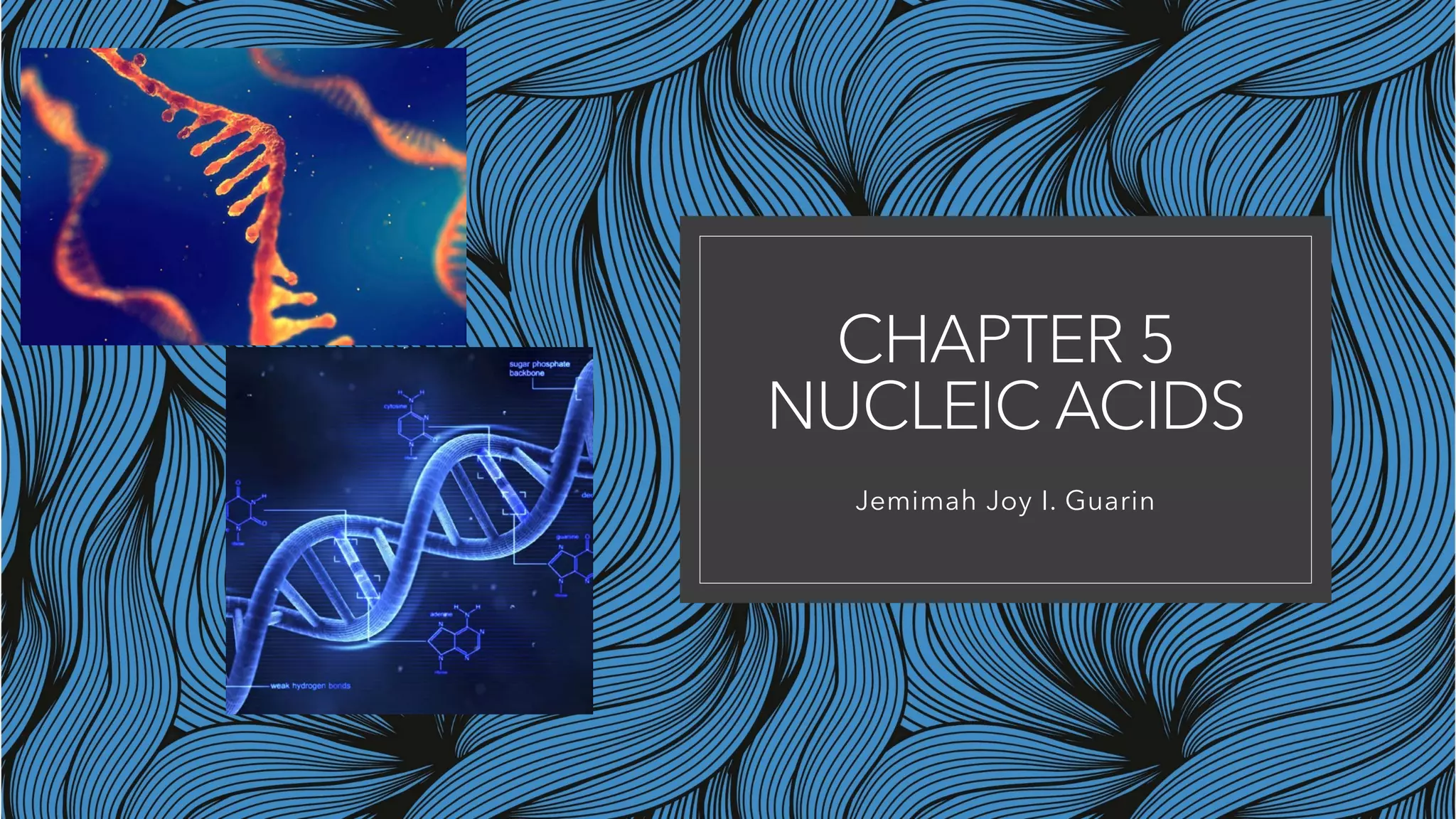
CHAPTER 5
NUCLEIC ACIDS
Jemimah Joy I. Guarin
Nucleic Acids
◦ Discovered by Swiss physiologist Friedrich Miescher in 1869 while studying white blood cells.
◦ Is an unbranched polymer containing a monomer unit called nucleotides.
◦ Nucleotide- a three subunit molecule in which a pentose sugar is bonded to both a phosphate group and a
nitrogen-containing heterocyclic base.
Two types of nucleic acids:
Deoxyribonucleic acid (DNA)
Ribonucleic acid (RNA)
Nucleotide
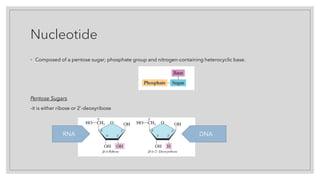
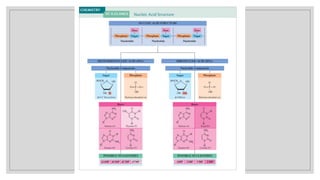
◦ Composed of a pentose sugar; phosphate group and nitrogen-containing heterocyclic base.
Pentose Sugars
-it is either ribose or 2’-deoxyribose
RNA DNA
Nitrogen-Containing Heterocyclic Bases
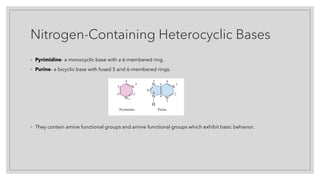
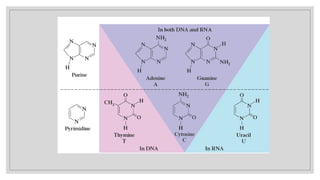
◦ Pyrimidine- a monocyclic base with a 6-membered ring.
◦ Purine- a bicyclic base with fused 5 and 6-membered rings.
◦ They contain amine functional groups and amine functional groups which exhibit basic behavior.
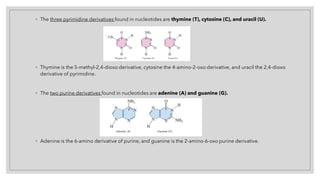
◦ The three pyrimidine derivatives found in nucleotides are thymine (T), cytosine (C), and uracil (U).
◦ Thymine is the 5-methyl-2,4-dioxo derivative, cytosine the 4-amino-2-oxo derivative, and uracil the 2,4-dioxo
derivative of pyrimidine.
◦ The two purine derivatives found in nucleotides are adenine (A) and guanine (G).
◦ Adenine is the 6-amino derivative of purine, and guanine is the 2-amino-6-oxo purine derivative.
Phosphate
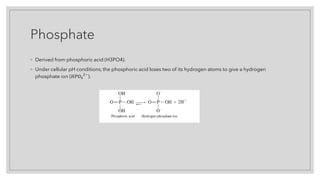
◦ Derived from phosphoric acid (H3PO4).
◦ Under cellular pH conditions, the phosphoric acid loses two of its hydrogen atoms to give a hydrogen
phosphate ion (𝐻𝐻𝐻𝐻𝑂𝑂4
2−
).
Nucleotide Formation
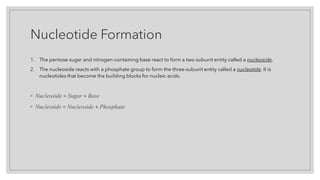
1. The pentose sugar and nitrogen-containing base react to form a two-subunit entity called a nucleoside.
2. The nucleoside reacts with a phosphate group to form the three-subunit entity called a nucleotide. It is
nucleotides that become the building blocks for nucleic acids.
◦ Nucleoside = Sugar + Base
◦ Nucleotide = Nucleoside + Phosphate
Nucleoside Formation
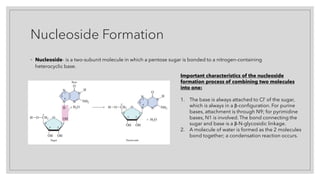
◦ Nucleoside- is a two-subunit molecule in which a pentose sugar is bonded to a nitrogen-containing
heterocyclic base.
Important characteristics of the nucleoside
formation process of combining two molecules
into one:
1. The base is always attached to Cl’ of the sugar,
which is always in a β-configuration. For purine
bases, attachment is through N9; for pyrimidine
bases, N1 is involved. The bond connecting the
sugar and base is a β-N-glycosidic linkage.
2. A molecule of water is formed as the 2 molecules
bond together; a condensation reaction occurs.
Nucleotide Formation
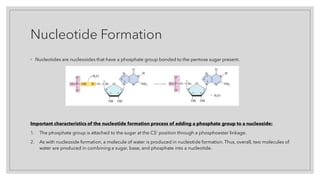
◦ Nucleotides are nucleosides that have a phosphate group bonded to the pentose sugar present.
Important characteristics of the nucleotide formation process of adding a phosphate group to a nucleoside:
1. The phosphate group is attached to the sugar at the C5’ position through a phosphoester linkage.
2. As with nucleoside formation, a molecule of water is produced in nucleotide formation. Thus, overall, two molecules of
water are produced in combining a sugar, base, and phosphate into a nucleotide.
Primary Nucleic Acid Structure
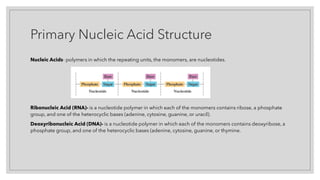
Nucleic Acids- polymers in which the repeating units, the monomers, are nucleotides.
Ribonucleic Acid (RNA)- is a nucleotide polymer in which each of the monomers contains ribose, a phosphate
group, and one of the heterocyclic bases (adenine, cytosine, guanine, or uracil).
Deoxyribonucleic Acid (DNA)- is a nucleotide polymer in which each of the monomers contains deoxyribose, a
phosphate group, and one of the heterocyclic bases (adenine, cytosine, guanine, or thymine.
Primary Nucleic Acid Structure
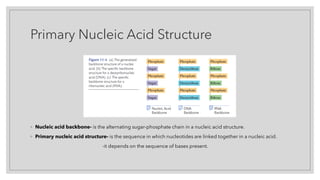
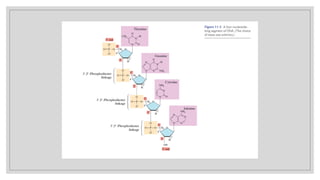
◦ Nucleic acid backbone- is the alternating sugar-phosphate chain in a nucleic acid structure.
◦ Primary nucleic acid structure- is the sequence in which nucleotides are linked together in a nucleic acid.
-it depends on the sequence of bases present.
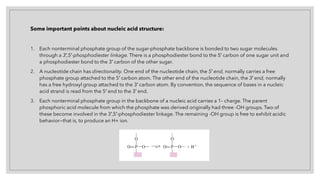
Some important points about nucleic acid structure:
1. Each nonterminal phosphate group of the sugar-phosphate backbone is bonded to two sugar molecules
through a 3′,5′-phosphodiester linkage. There is a phosphodiester bond to the 5′ carbon of one sugar unit and
a phosphodiester bond to the 3′ carbon of the other sugar.
2. A nucleotide chain has directionality. One end of the nucleotide chain, the 5′ end, normally carries a free
phosphate group attached to the 5′ carbon atom. The other end of the nucleotide chain, the 3′ end, normally
has a free hydroxyl group attached to the 3′ carbon atom. By convention, the sequence of bases in a nucleic
acid strand is read from the 5′ end to the 3′ end.
3. Each nonterminal phosphate group in the backbone of a nucleic acid carries a 1– charge. The parent
phosphoric acid molecule from which the phosphate was derived originally had three -OH groups. Two of
these become involved in the 3′,5′-phosphodiester linkage. The remaining -OH group is free to exhibit acidic
behavior—that is, to produce an H+ ion.
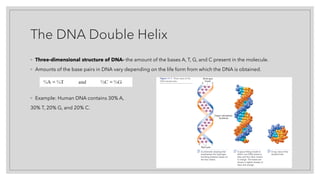
The DNA Double Helix
◦ Three-dimensional structure of DNA- the amount of the bases A, T, G, and C present in the molecule.
◦ Amounts of the base pairs in DNA vary depending on the life form from which the DNA is obtained.
◦ Example: Human DNA contains 30% A,
30% T, 20% G, and 20% C.
Base Pairing
◦ Physical restriction: 1 small base (pyrimidine) and 1 large base (purine).
◦ A is for T and G is for C.
These two combinations are the only two that normally occur in DNA.
They are complementary bases.
Complementary bases- are pairs of bases in a nucleic acid structure that hydrogen-bond to each other.
◦ The two strands of DNA in a double helix are not identical--- they are complementary.
Complementary DNA strands- are strands of DNA in a double helix with base pairing such that each base is
located opposite its complementary base.
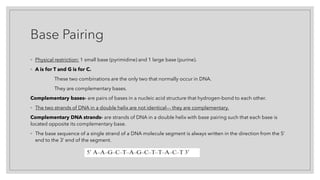
◦ The base sequence of a single strand of a DNA molecule segment is always written in the direction from the 5’
end to the 3’ end of the segment.
Base Pairing
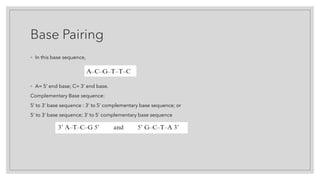
◦ In this base sequence,
◦ A= 5’ end base; C= 3’ end base.
Complementary Base sequence:
5’ to 3’ base sequence : 3’ to 5’ complementary base sequence; or
5’ to 3’ base sequence; 3’ to 5’ complementary base sequence
Hydrogen Bonding Interactions
◦ It is an important factor in stabilizing the DNA double–helix structure.
◦ Hydrogen bonds are relatively weak forces.
Base-stacking interactions contribute to DNA double-helix stabilization.
Base-Stacking Interactions
◦ Stacking interactions involving a given base and the parallel bases directly above and below.
◦ It also contributes to the stabilization of the DNA double helix.
◦ Purine and pyrimidine bases are hydrophobic in nature, so their stacking interactions are those associated with
hydrophobic molecules mainly London forces.
Replication of DNA Molecules
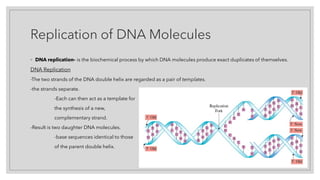
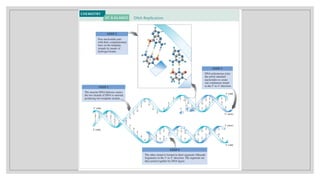
◦ DNA replication- is the biochemical process by which DNA molecules produce exact duplicates of themselves.
DNA Replication
-The two strands of the DNA double helix are regarded as a pair of templates.
-the strands separate.
-Each can then act as a template for
the synthesis of a new,
complementary strand.
-Result is two daughter DNA molecules.
-base sequences identical to those
of the parent double helix.
Replication of DNA Molecules
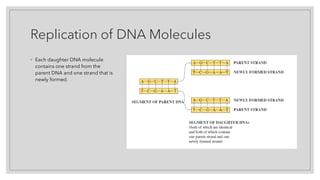
◦ Each daughter DNA molecule
contains one strand from the
parent DNA and one strand that is
newly formed.
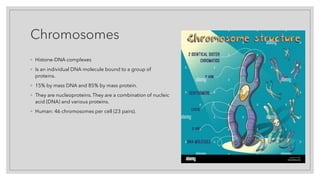
Chromosomes
◦ Histone-DNA complexes
◦ Is an individual DNA molecule bound to a group of
proteins.
◦ 15% by mass DNA and 85% by mass protein.
◦ They are nucleoproteins. They are a combination of nucleic
acid (DNA) and various proteins.
◦ Human: 46 chromosomes per cell (23 pairs).
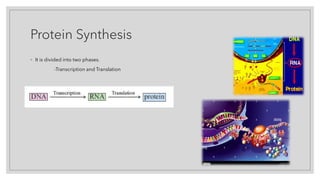
Protein Synthesis
◦ It is divided into two phases.
-Transcription and Translation
Ribonucleic Acids
Four major differences between RNA and DNA:
1. The sugar unit in the backbone of RNA is ribose; it is deoxyribose in DNA.
2. The base thymine found in DNA is replaced by uracil in RNA (Uracil: Adenine).
3. RNA is a single-stranded molecule; DNA is double-stranded (double helix). Thus RNA, unlike DNA, does not
contain equal amounts of specific bases.
4. RNA molecules are much smaller than DNA molecules, ranging from 75 nucleotides to a few thousand
nucleotides.
Types of RNA Molecules
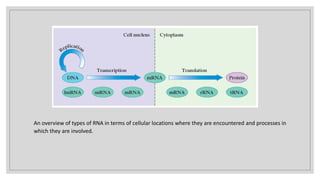
◦ Heterogeneous nuclear RNA (hnRNA)- is RNA formed directly by DNA transcription.
-Post-transcription processing converts the heterogeneous nuclear RNA to messenger RNA.
◦ Messenger RNA (mRNA)- is RNA that carries instructions for protein synthesis (genetic information) to the sites for
protein synthesis.
-its molecular mass varies with the length of the protein whose synthesis it will direct.
◦ Small nuclear RNA (snRNA)- is RNA that facilitates the conversion of heterogeneous nuclear RNA to messenger RNA.
-it contains from 100 to 200 nucleotides.
◦ Ribosomal RNA (rRNA)- is RNA that combines with specific proteins to form ribosomes, the physical sites for protein
synthesis.
-The rRNA present in ribosomes has no informational function.
◦ Transfer RNA (tRNA)- is RNA that delivers amino acids to the sites for protein synthesis.
-the smallest of the RNAs, possessing only 75-90 nucleotide units.
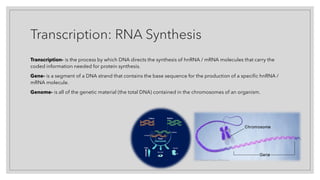
An overview of types of RNA in terms of cellular locations where they are encountered and processes in
which they are involved.
Transcription: RNA Synthesis
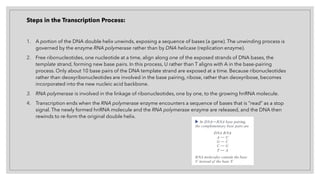
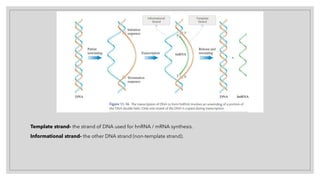
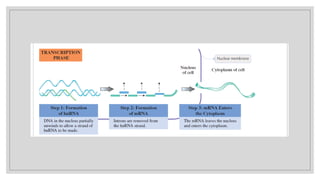
Transcription- is the process by which DNA directs the synthesis of hnRNA / mRNA molecules that carry the
coded information needed for protein synthesis.
Gene- is a segment of a DNA strand that contains the base sequence for the production of a specific hnRNA /
mRNA molecule.
Genome- is all of the genetic material (the total DNA) contained in the chromosomes of an organism.
Steps in the Transcription Process:
1. A portion of the DNA double helix unwinds, exposing a sequence of bases (a gene). The unwinding process is
governed by the enzyme RNA polymerase rather than by DNA helicase (replication enzyme).
2. Free ribonucleotides, one nucleotide at a time, align along one of the exposed strands of DNA bases, the
template strand, forming new base pairs. In this process, U rather than T aligns with A in the base-pairing
process. Only about 10 base pairs of the DNA template strand are exposed at a time. Because ribonucleotides
rather than deoxyribonucleotides are involved in the base pairing, ribose, rather than deoxyribose, becomes
incorporated into the new nucleic acid backbone.
3. RNA polymerase is involved in the linkage of ribonucleotides, one by one, to the growing hnRNA molecule.
4. Transcription ends when the RNA polymerase enzyme encounters a sequence of bases that is “read” as a stop
signal. The newly formed hnRNA molecule and the RNA polymerase enzyme are released, and the DNA then
rewinds to re-form the original double helix.
Template strand- the strand of DNA used for hnRNA / mRNA synthesis.
Informational strand- the other DNA strand (non-template strand).
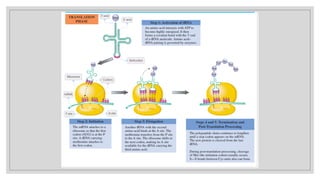
Translation: Protein Synthesis
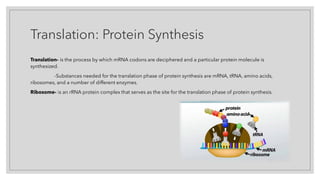
Translation- is the process by which mRNA codons are deciphered and a particular protein molecule is
synthesized.
-Substances needed for the translation phase of protein synthesis are mRNA, tRNA, amino acids,
ribosomes, and a number of different enzymes.
Ribosome- is an rRNA protein complex that serves as the site for the translation phase of protein synthesis.
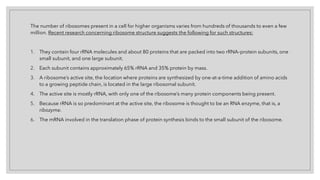
The number of ribosomes present in a cell for higher organisms varies from hundreds of thousands to even a few
million. Recent research concerning ribosome structure suggests the following for such structures:
1. They contain four rRNA molecules and about 80 proteins that are packed into two rRNA–protein subunits, one
small subunit, and one large subunit.
2. Each subunit contains approximately 65% rRNA and 35% protein by mass.
3. A ribosome’s active site, the location where proteins are synthesized by one-at-a-time addition of amino acids
to a growing peptide chain, is located in the large ribosomal subunit.
4. The active site is mostly rRNA, with only one of the ribosome’s many protein components being present.
5. Because rRNA is so predominant at the active site, the ribosome is thought to be an RNA enzyme, that is, a
ribozyme.
6. The mRNA involved in the translation phase of protein synthesis binds to the small subunit of the ribosome.
Mutations
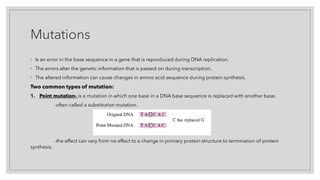
◦ Is an error in the base sequence in a gene that is reproduced during DNA replication.
◦ The errors alter the genetic information that is passed on during transcription.
◦ The altered information can cause changes in amino acid sequence during protein synthesis.
Two common types of mutation:
1. Point mutation- is a mutation in which one base in a DNA base sequence is replaced with another base.
-often called a substitution mutation.
-the effect can vary from no effect to a change in primary protein structure to termination of protein
synthesis.
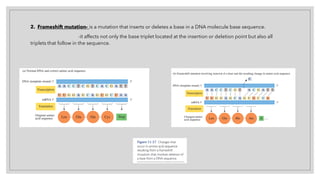
2. Frameshift mutation- is a mutation that inserts or deletes a base in a DNA molecule base sequence.
-it affects not only the base triplet located at the insertion or deletion point but also all
triplets that follow in the sequence.
Mutagen
-is a substance or agent that causes a change in the structure of a gene.
Radiation- UV light, X-rays, radioactivity, cosmic rays.
Example:
Ultraviolet light from the sun is the radiation that causes sunburn and can induce changes in the DNA of skin cells.
Sustained exposure to ultraviolet light can lead to skin cancer problems.
Chemical- Nitrous acid (HNO2)
Example:
HNO2 can convert cytosine to uracil.
Repair enzymes- it recognize and repair altered bases.
Nucleic Acids and Viruses
Virus- is a small particle that contains DNA or RNA (but not both)
surrounded by a coat of protein and that cannot reproduce without the aid
of a host cell.
-To reproduce, viruses must invade the cells of another organism
and cause these host cells to carry out the reproduction of the virus.
-the only function is to reproduce.
-do not generate energy.
Retrovirus- RNA-containing virus. (e.g HIV, AIDS)
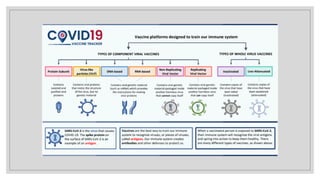
Vaccine- is a preparation containing an inactive or weakened form of a
virus or bacterium.
Chapter 5- Nucleic Acids (ppt).pdf

Chapter 5- Nucleic Acids (ppt).pdf

  • 1.
  • 2.
    Nucleic Acids ◦ Discoveredby Swiss physiologist Friedrich Miescher in 1869 while studying white blood cells. ◦ Is an unbranched polymer containing a monomer unit called nucleotides. ◦ Nucleotide- a three subunit molecule in which a pentose sugar is bonded to both a phosphate group and a nitrogen-containing heterocyclic base. Two types of nucleic acids: Deoxyribonucleic acid (DNA) Ribonucleic acid (RNA)
  • 3.
    Nucleotide ◦ Composed ofa pentose sugar; phosphate group and nitrogen-containing heterocyclic base. Pentose Sugars -it is either ribose or 2’-deoxyribose RNA DNA
  • 4.
    Nitrogen-Containing Heterocyclic Bases ◦Pyrimidine- a monocyclic base with a 6-membered ring. ◦ Purine- a bicyclic base with fused 5 and 6-membered rings. ◦ They contain amine functional groups and amine functional groups which exhibit basic behavior.
  • 5.
    ◦ The threepyrimidine derivatives found in nucleotides are thymine (T), cytosine (C), and uracil (U). ◦ Thymine is the 5-methyl-2,4-dioxo derivative, cytosine the 4-amino-2-oxo derivative, and uracil the 2,4-dioxo derivative of pyrimidine. ◦ The two purine derivatives found in nucleotides are adenine (A) and guanine (G). ◦ Adenine is the 6-amino derivative of purine, and guanine is the 2-amino-6-oxo purine derivative.
  • 7.
    Phosphate ◦ Derived fromphosphoric acid (H3PO4). ◦ Under cellular pH conditions, the phosphoric acid loses two of its hydrogen atoms to give a hydrogen phosphate ion (𝐻𝐻𝐻𝐻𝑂𝑂4 2− ).
  • 8.
    Nucleotide Formation 1. Thepentose sugar and nitrogen-containing base react to form a two-subunit entity called a nucleoside. 2. The nucleoside reacts with a phosphate group to form the three-subunit entity called a nucleotide. It is nucleotides that become the building blocks for nucleic acids. ◦ Nucleoside = Sugar + Base ◦ Nucleotide = Nucleoside + Phosphate
  • 9.
    Nucleoside Formation ◦ Nucleoside-is a two-subunit molecule in which a pentose sugar is bonded to a nitrogen-containing heterocyclic base. Important characteristics of the nucleoside formation process of combining two molecules into one: 1. The base is always attached to Cl’ of the sugar, which is always in a β-configuration. For purine bases, attachment is through N9; for pyrimidine bases, N1 is involved. The bond connecting the sugar and base is a β-N-glycosidic linkage. 2. A molecule of water is formed as the 2 molecules bond together; a condensation reaction occurs.
  • 10.
    Nucleotide Formation ◦ Nucleotidesare nucleosides that have a phosphate group bonded to the pentose sugar present. Important characteristics of the nucleotide formation process of adding a phosphate group to a nucleoside: 1. The phosphate group is attached to the sugar at the C5’ position through a phosphoester linkage. 2. As with nucleoside formation, a molecule of water is produced in nucleotide formation. Thus, overall, two molecules of water are produced in combining a sugar, base, and phosphate into a nucleotide.
  • 11.
    Primary Nucleic AcidStructure Nucleic Acids- polymers in which the repeating units, the monomers, are nucleotides. Ribonucleic Acid (RNA)- is a nucleotide polymer in which each of the monomers contains ribose, a phosphate group, and one of the heterocyclic bases (adenine, cytosine, guanine, or uracil). Deoxyribonucleic Acid (DNA)- is a nucleotide polymer in which each of the monomers contains deoxyribose, a phosphate group, and one of the heterocyclic bases (adenine, cytosine, guanine, or thymine.
  • 12.
    Primary Nucleic AcidStructure ◦ Nucleic acid backbone- is the alternating sugar-phosphate chain in a nucleic acid structure. ◦ Primary nucleic acid structure- is the sequence in which nucleotides are linked together in a nucleic acid. -it depends on the sequence of bases present.
  • 13.
    Some important pointsabout nucleic acid structure: 1. Each nonterminal phosphate group of the sugar-phosphate backbone is bonded to two sugar molecules through a 3′,5′-phosphodiester linkage. There is a phosphodiester bond to the 5′ carbon of one sugar unit and a phosphodiester bond to the 3′ carbon of the other sugar. 2. A nucleotide chain has directionality. One end of the nucleotide chain, the 5′ end, normally carries a free phosphate group attached to the 5′ carbon atom. The other end of the nucleotide chain, the 3′ end, normally has a free hydroxyl group attached to the 3′ carbon atom. By convention, the sequence of bases in a nucleic acid strand is read from the 5′ end to the 3′ end. 3. Each nonterminal phosphate group in the backbone of a nucleic acid carries a 1– charge. The parent phosphoric acid molecule from which the phosphate was derived originally had three -OH groups. Two of these become involved in the 3′,5′-phosphodiester linkage. The remaining -OH group is free to exhibit acidic behavior—that is, to produce an H+ ion.
  • 16.
    The DNA DoubleHelix ◦ Three-dimensional structure of DNA- the amount of the bases A, T, G, and C present in the molecule. ◦ Amounts of the base pairs in DNA vary depending on the life form from which the DNA is obtained. ◦ Example: Human DNA contains 30% A, 30% T, 20% G, and 20% C.
  • 17.
    Base Pairing ◦ Physicalrestriction: 1 small base (pyrimidine) and 1 large base (purine). ◦ A is for T and G is for C. These two combinations are the only two that normally occur in DNA. They are complementary bases. Complementary bases- are pairs of bases in a nucleic acid structure that hydrogen-bond to each other. ◦ The two strands of DNA in a double helix are not identical--- they are complementary. Complementary DNA strands- are strands of DNA in a double helix with base pairing such that each base is located opposite its complementary base. ◦ The base sequence of a single strand of a DNA molecule segment is always written in the direction from the 5’ end to the 3’ end of the segment.
  • 18.
    Base Pairing ◦ Inthis base sequence, ◦ A= 5’ end base; C= 3’ end base. Complementary Base sequence: 5’ to 3’ base sequence : 3’ to 5’ complementary base sequence; or 5’ to 3’ base sequence; 3’ to 5’ complementary base sequence
  • 19.
    Hydrogen Bonding Interactions ◦It is an important factor in stabilizing the DNA double–helix structure. ◦ Hydrogen bonds are relatively weak forces. Base-stacking interactions contribute to DNA double-helix stabilization. Base-Stacking Interactions ◦ Stacking interactions involving a given base and the parallel bases directly above and below. ◦ It also contributes to the stabilization of the DNA double helix. ◦ Purine and pyrimidine bases are hydrophobic in nature, so their stacking interactions are those associated with hydrophobic molecules mainly London forces.
  • 20.
    Replication of DNAMolecules ◦ DNA replication- is the biochemical process by which DNA molecules produce exact duplicates of themselves. DNA Replication -The two strands of the DNA double helix are regarded as a pair of templates. -the strands separate. -Each can then act as a template for the synthesis of a new, complementary strand. -Result is two daughter DNA molecules. -base sequences identical to those of the parent double helix.
  • 21.
    Replication of DNAMolecules ◦ Each daughter DNA molecule contains one strand from the parent DNA and one strand that is newly formed.
  • 22.
    Chromosomes ◦ Histone-DNA complexes ◦Is an individual DNA molecule bound to a group of proteins. ◦ 15% by mass DNA and 85% by mass protein. ◦ They are nucleoproteins. They are a combination of nucleic acid (DNA) and various proteins. ◦ Human: 46 chromosomes per cell (23 pairs).
  • 24.
    Protein Synthesis ◦ Itis divided into two phases. -Transcription and Translation
  • 25.
    Ribonucleic Acids Four majordifferences between RNA and DNA: 1. The sugar unit in the backbone of RNA is ribose; it is deoxyribose in DNA. 2. The base thymine found in DNA is replaced by uracil in RNA (Uracil: Adenine). 3. RNA is a single-stranded molecule; DNA is double-stranded (double helix). Thus RNA, unlike DNA, does not contain equal amounts of specific bases. 4. RNA molecules are much smaller than DNA molecules, ranging from 75 nucleotides to a few thousand nucleotides.
  • 26.
    Types of RNAMolecules ◦ Heterogeneous nuclear RNA (hnRNA)- is RNA formed directly by DNA transcription. -Post-transcription processing converts the heterogeneous nuclear RNA to messenger RNA. ◦ Messenger RNA (mRNA)- is RNA that carries instructions for protein synthesis (genetic information) to the sites for protein synthesis. -its molecular mass varies with the length of the protein whose synthesis it will direct. ◦ Small nuclear RNA (snRNA)- is RNA that facilitates the conversion of heterogeneous nuclear RNA to messenger RNA. -it contains from 100 to 200 nucleotides. ◦ Ribosomal RNA (rRNA)- is RNA that combines with specific proteins to form ribosomes, the physical sites for protein synthesis. -The rRNA present in ribosomes has no informational function. ◦ Transfer RNA (tRNA)- is RNA that delivers amino acids to the sites for protein synthesis. -the smallest of the RNAs, possessing only 75-90 nucleotide units.
  • 27.
    An overview oftypes of RNA in terms of cellular locations where they are encountered and processes in which they are involved.
  • 28.
    Transcription: RNA Synthesis Transcription-is the process by which DNA directs the synthesis of hnRNA / mRNA molecules that carry the coded information needed for protein synthesis. Gene- is a segment of a DNA strand that contains the base sequence for the production of a specific hnRNA / mRNA molecule. Genome- is all of the genetic material (the total DNA) contained in the chromosomes of an organism.
  • 29.
    Steps in theTranscription Process: 1. A portion of the DNA double helix unwinds, exposing a sequence of bases (a gene). The unwinding process is governed by the enzyme RNA polymerase rather than by DNA helicase (replication enzyme). 2. Free ribonucleotides, one nucleotide at a time, align along one of the exposed strands of DNA bases, the template strand, forming new base pairs. In this process, U rather than T aligns with A in the base-pairing process. Only about 10 base pairs of the DNA template strand are exposed at a time. Because ribonucleotides rather than deoxyribonucleotides are involved in the base pairing, ribose, rather than deoxyribose, becomes incorporated into the new nucleic acid backbone. 3. RNA polymerase is involved in the linkage of ribonucleotides, one by one, to the growing hnRNA molecule. 4. Transcription ends when the RNA polymerase enzyme encounters a sequence of bases that is “read” as a stop signal. The newly formed hnRNA molecule and the RNA polymerase enzyme are released, and the DNA then rewinds to re-form the original double helix.
  • 30.
    Template strand- thestrand of DNA used for hnRNA / mRNA synthesis. Informational strand- the other DNA strand (non-template strand).
  • 32.
    Translation: Protein Synthesis Translation-is the process by which mRNA codons are deciphered and a particular protein molecule is synthesized. -Substances needed for the translation phase of protein synthesis are mRNA, tRNA, amino acids, ribosomes, and a number of different enzymes. Ribosome- is an rRNA protein complex that serves as the site for the translation phase of protein synthesis.
  • 33.
    The number ofribosomes present in a cell for higher organisms varies from hundreds of thousands to even a few million. Recent research concerning ribosome structure suggests the following for such structures: 1. They contain four rRNA molecules and about 80 proteins that are packed into two rRNA–protein subunits, one small subunit, and one large subunit. 2. Each subunit contains approximately 65% rRNA and 35% protein by mass. 3. A ribosome’s active site, the location where proteins are synthesized by one-at-a-time addition of amino acids to a growing peptide chain, is located in the large ribosomal subunit. 4. The active site is mostly rRNA, with only one of the ribosome’s many protein components being present. 5. Because rRNA is so predominant at the active site, the ribosome is thought to be an RNA enzyme, that is, a ribozyme. 6. The mRNA involved in the translation phase of protein synthesis binds to the small subunit of the ribosome.
  • 35.
    Mutations ◦ Is anerror in the base sequence in a gene that is reproduced during DNA replication. ◦ The errors alter the genetic information that is passed on during transcription. ◦ The altered information can cause changes in amino acid sequence during protein synthesis. Two common types of mutation: 1. Point mutation- is a mutation in which one base in a DNA base sequence is replaced with another base. -often called a substitution mutation. -the effect can vary from no effect to a change in primary protein structure to termination of protein synthesis.
  • 36.
    2. Frameshift mutation-is a mutation that inserts or deletes a base in a DNA molecule base sequence. -it affects not only the base triplet located at the insertion or deletion point but also all triplets that follow in the sequence.
  • 37.
    Mutagen -is a substanceor agent that causes a change in the structure of a gene. Radiation- UV light, X-rays, radioactivity, cosmic rays. Example: Ultraviolet light from the sun is the radiation that causes sunburn and can induce changes in the DNA of skin cells. Sustained exposure to ultraviolet light can lead to skin cancer problems. Chemical- Nitrous acid (HNO2) Example: HNO2 can convert cytosine to uracil. Repair enzymes- it recognize and repair altered bases.
  • 38.
    Nucleic Acids andViruses Virus- is a small particle that contains DNA or RNA (but not both) surrounded by a coat of protein and that cannot reproduce without the aid of a host cell. -To reproduce, viruses must invade the cells of another organism and cause these host cells to carry out the reproduction of the virus. -the only function is to reproduce. -do not generate energy. Retrovirus- RNA-containing virus. (e.g HIV, AIDS) Vaccine- is a preparation containing an inactive or weakened form of a virus or bacterium.