NUCLEIC ACID
STRUCTURE AND DNA
GROUP 9
INTRODUCTION TO NUCLEIC ACID
 Nucleic acids are biopolymers, or
large biomolecules(any molecule that is present in
living organisms which is made up of carbon and
hydrogen, including large macromolecules such
as proteins, polysaccharides, lipids) essential for all
known forms of life.
 Nucleic acids, which include DNA (deoxyribonucleic acid)
and RNA (ribonucleic acid), are made from monomers known
as nucleotides (The basic component of biological nucleic acids).
UNITS OF NUCLEIC ACID
 Two kinds of nucleic acids are found in cells:
 DNA (present in chromosomes of the nuclei of eukaryotic cells)
 RNA (not found in the chromosomes, but located elsewhere in the
nucleus and even outside the nucleus, in the cytoplasm). Each has its
role in the transmission of hereditary information.
 Both DNA and RNA are polymers. Just as proteins consist of chains of
amino acid, the building blocks (monomers) of nucleic acid chains are
nucleotides.
BASE
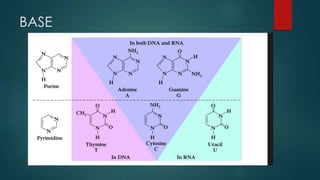
 The bases found in DNA and RNA are basic because they are
heterocyclic aromatic amines
 Two these bases-adenine (A) and guanine (G)-are purines; the
other three- cytosine (C), thymine (T), and uracil (U) are pyrimidines
(C) are found a in both DNA and RNA.
 Uracil (U) is found only in RNA, and thymine (T) is found only in DNA.
Thymine differs from uracil only in the methyl group in the 5 position.
 Both DNA and RNA contain four bases: two pyrimidines and two
purines.
 For DNA, the bases are A, G, C, and T; for RNA, the base are A, G, C,
U
SUGARS
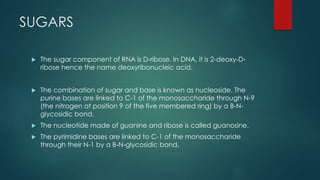
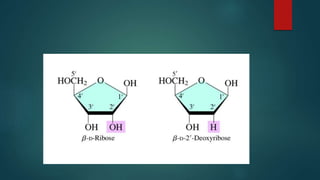
 The sugar component of RNA is D-ribose. In DNA, it is 2-deoxy-D-
ribose hence the name deoxyribonucleic acid.
 The combination of sugar and base is known as nucleoside. The
purine bases are linked to C-1 of the monosaccharide through N-9
(the nitrogen at position 9 of the five membered ring) by a B-N-
glycosidic bond.
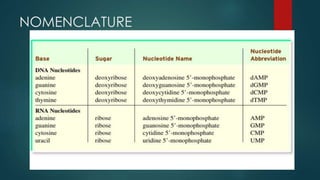
 The nucleotide made of guanine and ribose is called guanosine.
 The pyrimidine bases are linked to C-1 of the monosaccharide
through their N-1 by a B-N-glycosidic bond.
PHOSPHATE
 The third component of nucleic acids is phosphoric acid. When this
group forms a phosphate ester bond with a nucleotide, this result is
acid compound known as a nucleotide. For example, adenosine
combines with phosphate to form the nucleotide 5'-mono
phosphate (AMP)
 Some of these nucleotides play important roles in metabolism. They
are part of the structure of key coenzymes, cofactors, and
activators. ATP serves as a common currency into which energy
gained from food is converted and stored. In ATP, two more
phosphate groups are joined to AMP in phosphate anhydrides
bonds. In ADP, only one phosphate group is bonded to the AMP. All
other nucleotides have important multiphosphorylated forms. For
example, guanosine exits as GMP, GDP, and GTP.
NOMENCLATURE
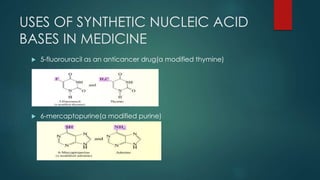
USES OF SYNTHETIC NUCLEIC ACID
BASES IN MEDICINE
 5-fluorouracil as an anticancer drug(a modified thymine)
 6-mercaptopurine(a modified purine)
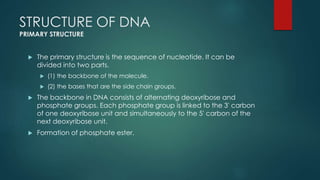
STRUCTURE OF DNA
PRIMARY STRUCTURE
 The primary structure is the sequence of nucleotide. It can be
divided into two parts.
 (1) the backbone of the molecule.
 (2) the bases that are the side chain groups.
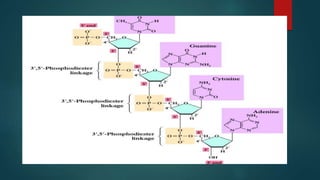
 The backbone in DNA consists of alternating deoxyribose and
phosphate groups. Each phosphate group is linked to the 3' carbon
of one deoxyribose unit and simultaneously to the 5' carbon of the
next deoxyribose unit.
 Formation of phosphate ester.
SECONDARY STRUCTURE
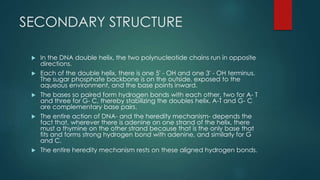
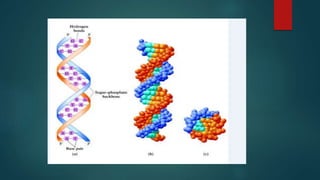
 In the DNA double helix, the two polynucleotide chains run in opposite
directions.
 Each of the double helix, there is one 5' - OH and one 3' - OH terminus.
The sugar phosphate backbone is on the outside, exposed to the
aqueous environment, and the base points inward.
 The bases so paired form hydrogen bonds with each other, two for A- T
and three for G- C, thereby stabilizing the doubles helix. A-T and G- C
are complementary base pairs.
 The entire action of DNA- and the heredity mechanism- depends the
fact that, wherever there is adenine on one strand of the helix, there
must a thymine on the other strand because that is the only base that
fits and forms strong hydrogen bond with adenine, and similarly for G
and C.
 The entire heredity mechanism rests on these aligned hydrogen bonds.
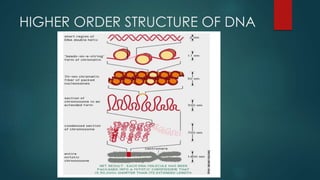
HIGHER ORDER STRUCTURE OF DNA
SUMMARY
 1. DNA has four bases: A, G, C and T. RNA has three of these bases-
A, G and C- but its fourth base is U, not T.
 2. In DNA, the sugar is 2- deoxy- D- ribose. In RNA, it is D-ribose.
 3. DNA is almost always double- stranded, with the helical
structure.
REFERENCE
 Frederick A. Bettelheim et al (2007) General, Organic, and
Biochemistry. Eighth Edition. Thomson Brooks/ Cole Ltd, Page 633-
642.
 H. Stephen Stocker(2010). General, Organic, Biological Chemistry.
Fifth Edition. Thomson Brooks/ Cole Ltd. Pages 734-741.

nucleic acid stucture and Dna

  • 1.
  • 2.
    INTRODUCTION TO NUCLEICACID  Nucleic acids are biopolymers, or large biomolecules(any molecule that is present in living organisms which is made up of carbon and hydrogen, including large macromolecules such as proteins, polysaccharides, lipids) essential for all known forms of life.  Nucleic acids, which include DNA (deoxyribonucleic acid) and RNA (ribonucleic acid), are made from monomers known as nucleotides (The basic component of biological nucleic acids).
  • 3.
    UNITS OF NUCLEICACID  Two kinds of nucleic acids are found in cells:  DNA (present in chromosomes of the nuclei of eukaryotic cells)  RNA (not found in the chromosomes, but located elsewhere in the nucleus and even outside the nucleus, in the cytoplasm). Each has its role in the transmission of hereditary information.  Both DNA and RNA are polymers. Just as proteins consist of chains of amino acid, the building blocks (monomers) of nucleic acid chains are nucleotides.
  • 4.
  • 5.
     The basesfound in DNA and RNA are basic because they are heterocyclic aromatic amines  Two these bases-adenine (A) and guanine (G)-are purines; the other three- cytosine (C), thymine (T), and uracil (U) are pyrimidines (C) are found a in both DNA and RNA.  Uracil (U) is found only in RNA, and thymine (T) is found only in DNA. Thymine differs from uracil only in the methyl group in the 5 position.  Both DNA and RNA contain four bases: two pyrimidines and two purines.  For DNA, the bases are A, G, C, and T; for RNA, the base are A, G, C, U
  • 6.
    SUGARS  The sugarcomponent of RNA is D-ribose. In DNA, it is 2-deoxy-D- ribose hence the name deoxyribonucleic acid.  The combination of sugar and base is known as nucleoside. The purine bases are linked to C-1 of the monosaccharide through N-9 (the nitrogen at position 9 of the five membered ring) by a B-N- glycosidic bond.  The nucleotide made of guanine and ribose is called guanosine.  The pyrimidine bases are linked to C-1 of the monosaccharide through their N-1 by a B-N-glycosidic bond.
  • 8.
    PHOSPHATE  The thirdcomponent of nucleic acids is phosphoric acid. When this group forms a phosphate ester bond with a nucleotide, this result is acid compound known as a nucleotide. For example, adenosine combines with phosphate to form the nucleotide 5'-mono phosphate (AMP)  Some of these nucleotides play important roles in metabolism. They are part of the structure of key coenzymes, cofactors, and activators. ATP serves as a common currency into which energy gained from food is converted and stored. In ATP, two more phosphate groups are joined to AMP in phosphate anhydrides bonds. In ADP, only one phosphate group is bonded to the AMP. All other nucleotides have important multiphosphorylated forms. For example, guanosine exits as GMP, GDP, and GTP.
  • 9.
  • 10.
    USES OF SYNTHETICNUCLEIC ACID BASES IN MEDICINE  5-fluorouracil as an anticancer drug(a modified thymine)  6-mercaptopurine(a modified purine)
  • 11.
    STRUCTURE OF DNA PRIMARYSTRUCTURE  The primary structure is the sequence of nucleotide. It can be divided into two parts.  (1) the backbone of the molecule.  (2) the bases that are the side chain groups.  The backbone in DNA consists of alternating deoxyribose and phosphate groups. Each phosphate group is linked to the 3' carbon of one deoxyribose unit and simultaneously to the 5' carbon of the next deoxyribose unit.  Formation of phosphate ester.
  • 13.
    SECONDARY STRUCTURE  Inthe DNA double helix, the two polynucleotide chains run in opposite directions.  Each of the double helix, there is one 5' - OH and one 3' - OH terminus. The sugar phosphate backbone is on the outside, exposed to the aqueous environment, and the base points inward.  The bases so paired form hydrogen bonds with each other, two for A- T and three for G- C, thereby stabilizing the doubles helix. A-T and G- C are complementary base pairs.  The entire action of DNA- and the heredity mechanism- depends the fact that, wherever there is adenine on one strand of the helix, there must a thymine on the other strand because that is the only base that fits and forms strong hydrogen bond with adenine, and similarly for G and C.  The entire heredity mechanism rests on these aligned hydrogen bonds.
  • 15.
  • 16.
    SUMMARY  1. DNAhas four bases: A, G, C and T. RNA has three of these bases- A, G and C- but its fourth base is U, not T.  2. In DNA, the sugar is 2- deoxy- D- ribose. In RNA, it is D-ribose.  3. DNA is almost always double- stranded, with the helical structure.
  • 17.
    REFERENCE  Frederick A.Bettelheim et al (2007) General, Organic, and Biochemistry. Eighth Edition. Thomson Brooks/ Cole Ltd, Page 633- 642.  H. Stephen Stocker(2010). General, Organic, Biological Chemistry. Fifth Edition. Thomson Brooks/ Cole Ltd. Pages 734-741.