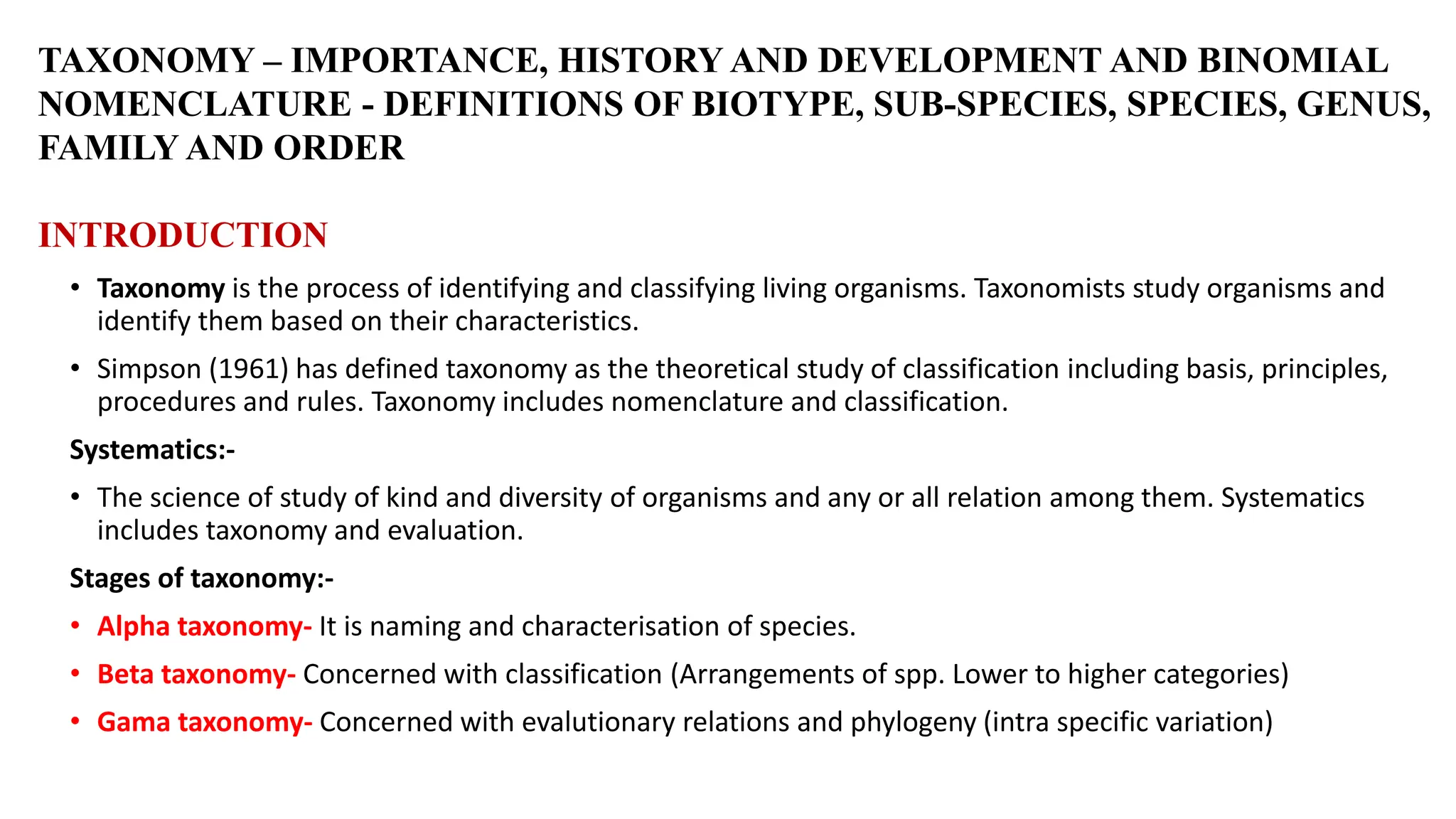
• Taxonomy is the process of identifying and classifying living organisms. Taxonomists study organisms and
identify them based on their characteristics.
• Simpson (1961) has defined taxonomy as the theoretical study of classification including basis, principles,
procedures and rules. Taxonomy includes nomenclature and classification.
Systematics:-
• The science of study of kind and diversity of organisms and any or all relation among them. Systematics
includes taxonomy and evaluation.
Stages of taxonomy:-
• Alpha taxonomy- It is naming and characterisation of species.
• Beta taxonomy- Concerned with classification (Arrangements of spp. Lower to higher categories)
• Gama taxonomy- Concerned with evalutionary relations and phylogeny (intra specific variation)
TAXONOMY – IMPORTANCE, HISTORY AND DEVELOPMENT AND BINOMIAL
NOMENCLATURE - DEFINITIONS OF BIOTYPE, SUB-SPECIES, SPECIES, GENUS,
FAMILY AND ORDER
INTRODUCTION
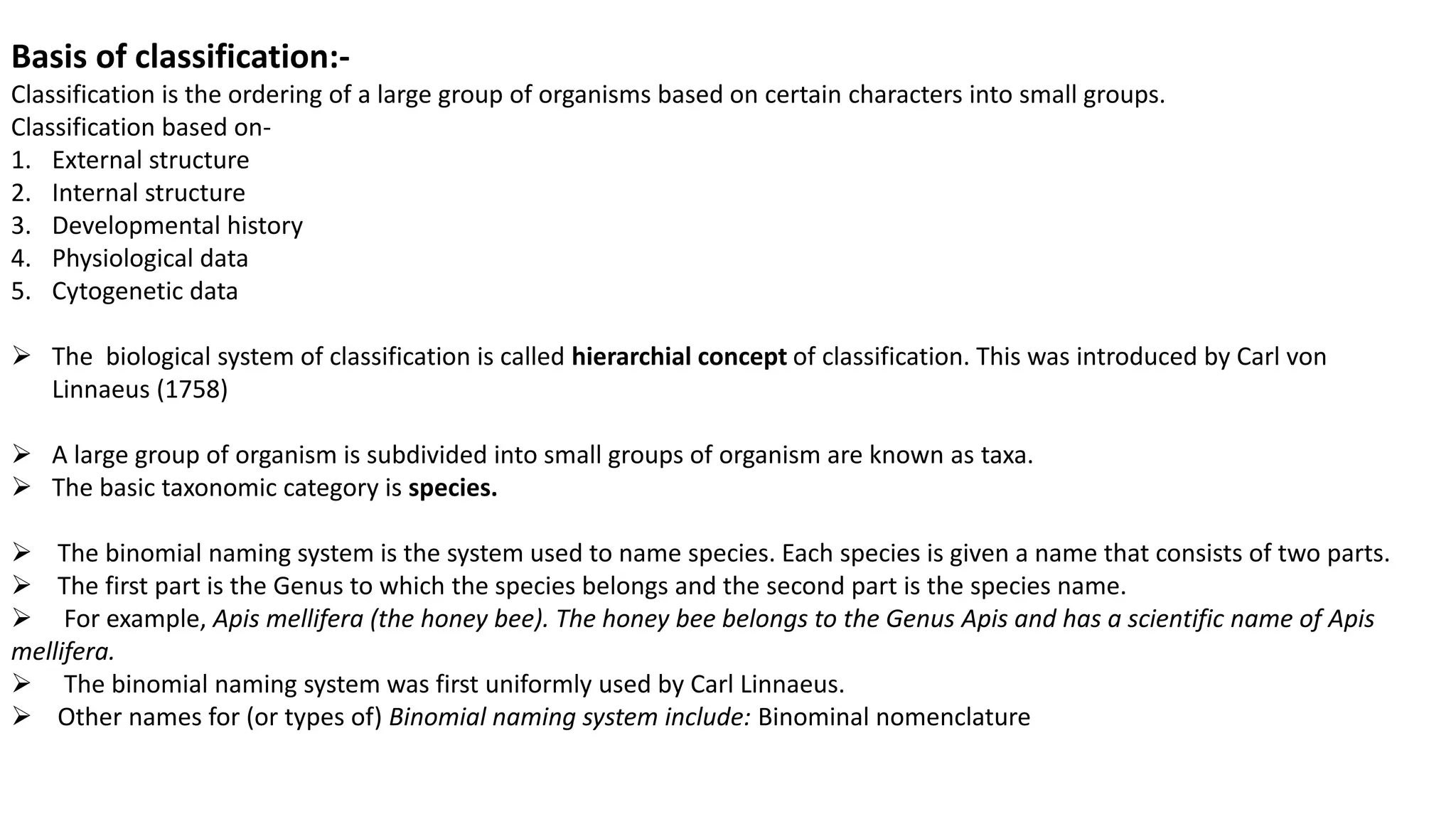
Basis of classification:-
Classification is the ordering of a large group of organisms based on certain characters into small groups.
Classification based on-
1. External structure
2. Internal structure
3. Developmental history
4. Physiological data
5. Cytogenetic data
 The biological system of classification is called hierarchial concept of classification. This was introduced by Carl von
Linnaeus (1758)
 A large group of organism is subdivided into small groups of organism are known as taxa.
 The basic taxonomic category is species.
 The binomial naming system is the system used to name species. Each species is given a name that consists of two parts.
 The first part is the Genus to which the species belongs and the second part is the species name.
 For example, Apis mellifera (the honey bee). The honey bee belongs to the Genus Apis and has a scientific name of Apis
mellifera.
 The binomial naming system was first uniformly used by Carl Linnaeus.
 Other names for (or types of) Binomial naming system include: Binominal nomenclature
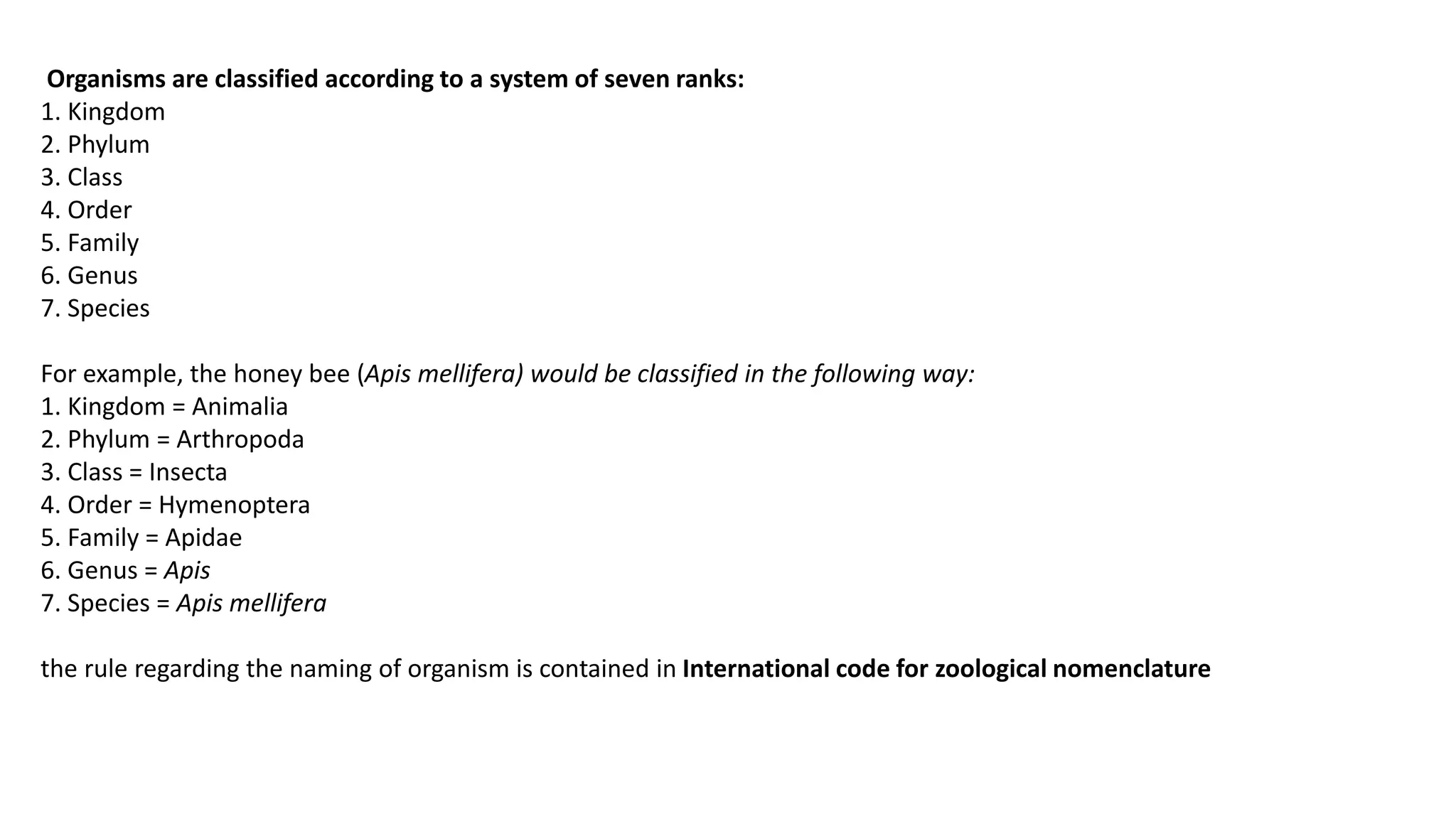
Organisms are classified according to a system of seven ranks:
1. Kingdom
2. Phylum
3. Class
4. Order
5. Family
6. Genus
7. Species
For example, the honey bee (Apis mellifera) would be classified in the following way:
1. Kingdom = Animalia
2. Phylum = Arthropoda
3. Class = Insecta
4. Order = Hymenoptera
5. Family = Apidae
6. Genus = Apis
7. Species = Apis mellifera
the rule regarding the naming of organism is contained in International code for zoological nomenclature
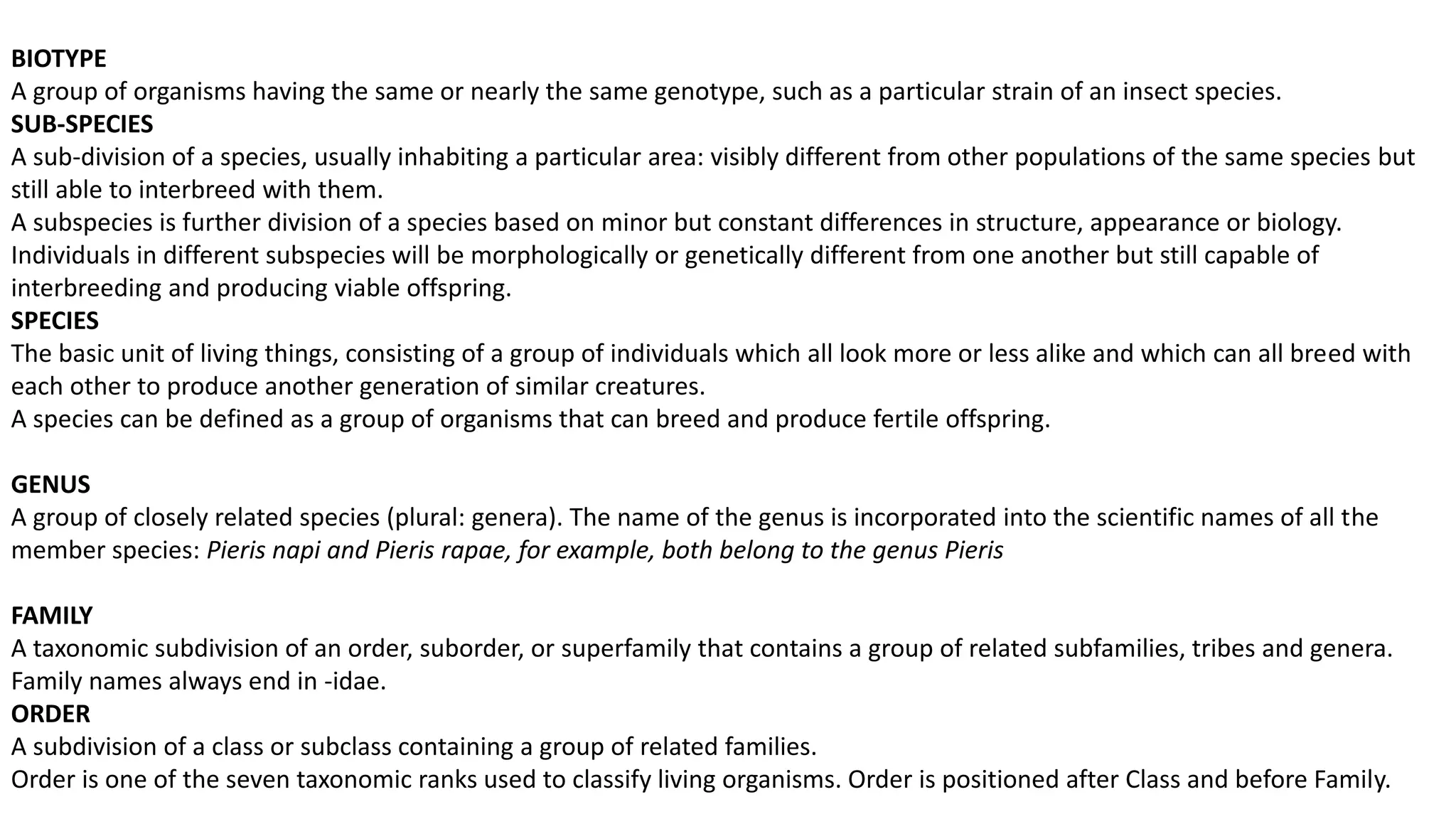
BIOTYPE
A group of organisms having the same or nearly the same genotype, such as a particular strain of an insect species.
SUB-SPECIES
A sub-division of a species, usually inhabiting a particular area: visibly different from other populations of the same species but
still able to interbreed with them.
A subspecies is further division of a species based on minor but constant differences in structure, appearance or biology.
Individuals in different subspecies will be morphologically or genetically different from one another but still capable of
interbreeding and producing viable offspring.
SPECIES
The basic unit of living things, consisting of a group of individuals which all look more or less alike and which can all breed with
each other to produce another generation of similar creatures.
A species can be defined as a group of organisms that can breed and produce fertile offspring.
GENUS
A group of closely related species (plural: genera). The name of the genus is incorporated into the scientific names of all the
member species: Pieris napi and Pieris rapae, for example, both belong to the genus Pieris
FAMILY
A taxonomic subdivision of an order, suborder, or superfamily that contains a group of related subfamilies, tribes and genera.
Family names always end in -idae.
ORDER
A subdivision of a class or subclass containing a group of related families.
Order is one of the seven taxonomic ranks used to classify living organisms. Order is positioned after Class and before Family.
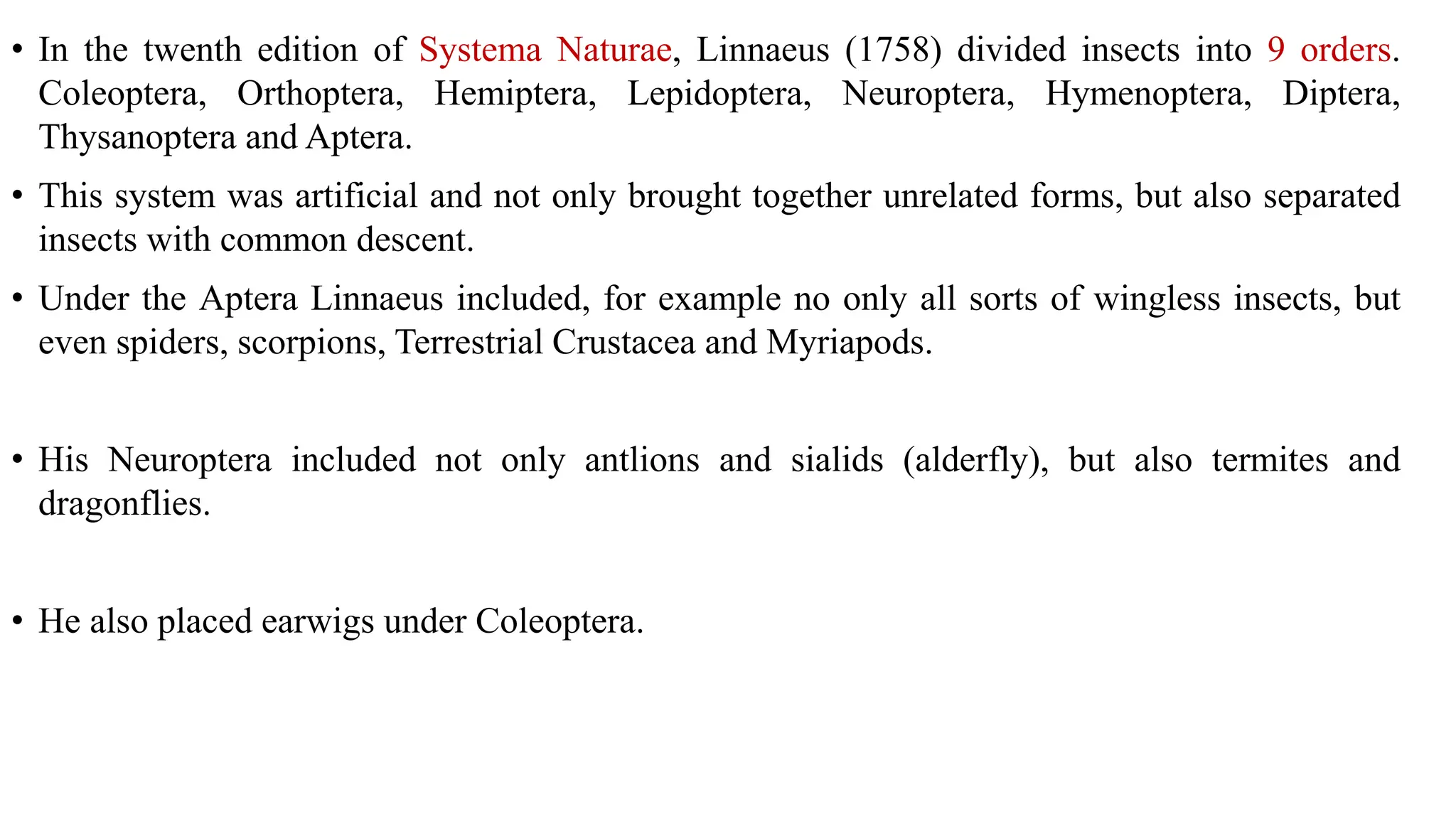
• In the twenth edition of Systema Naturae, Linnaeus (1758) divided insects into 9 orders.
Coleoptera, Orthoptera, Hemiptera, Lepidoptera, Neuroptera, Hymenoptera, Diptera,
Thysanoptera and Aptera.
• This system was artificial and not only brought together unrelated forms, but also separated
insects with common descent.
• Under the Aptera Linnaeus included, for example no only all sorts of wingless insects, but
even spiders, scorpions, Terrestrial Crustacea and Myriapods.
• His Neuroptera included not only antlions and sialids (alderfly), but also termites and
dragonflies.
• He also placed earwigs under Coleoptera.
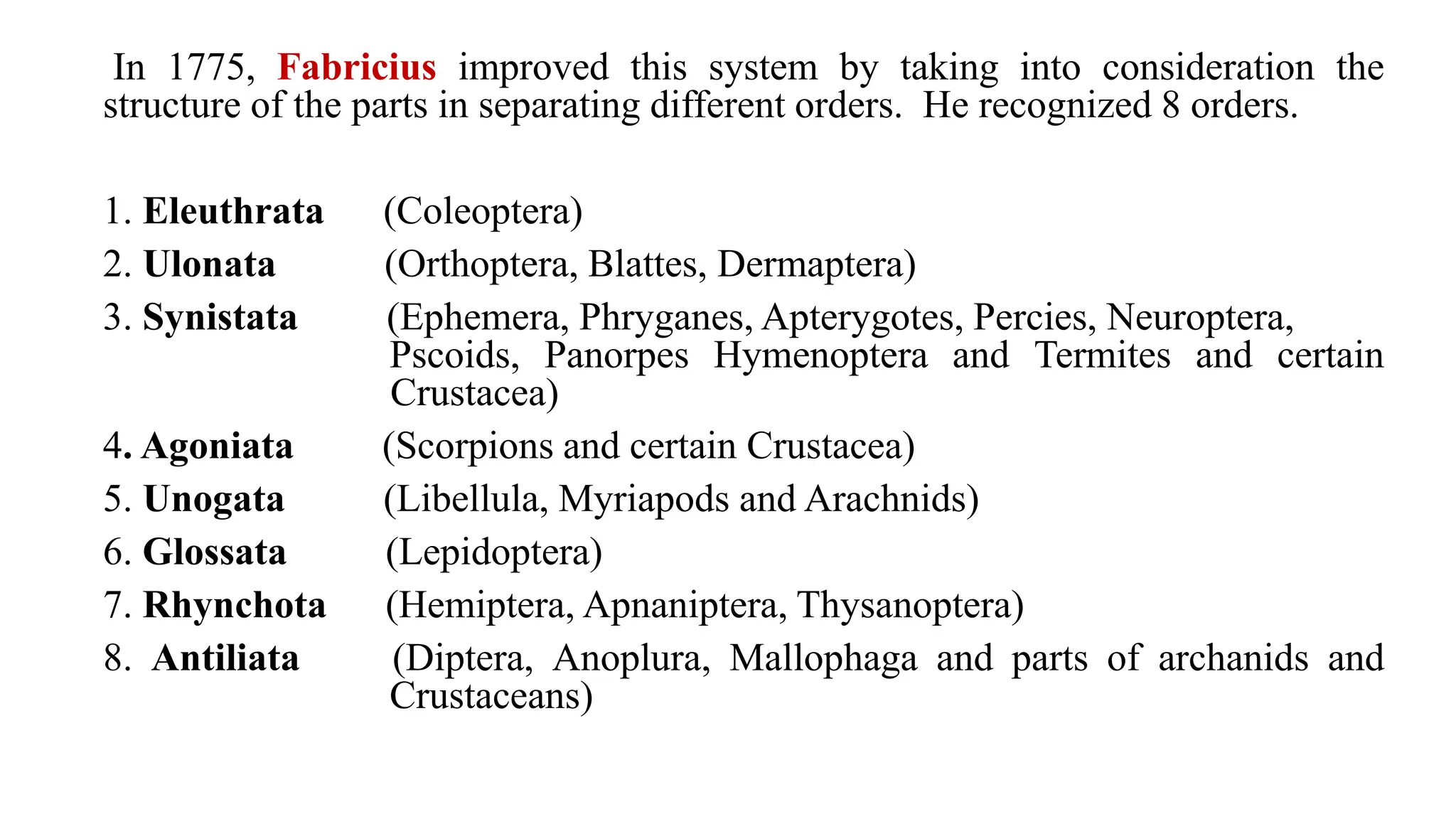
In 1775, Fabricius improved this system by taking into consideration the
structure of the parts in separating different orders. He recognized 8 orders.
1. Eleuthrata (Coleoptera)
2. Ulonata (Orthoptera, Blattes, Dermaptera)
3. Synistata (Ephemera, Phryganes, Apterygotes, Percies, Neuroptera,
Pscoids, Panorpes Hymenoptera and Termites and certain
Crustacea)
4. Agoniata (Scorpions and certain Crustacea)
5. Unogata (Libellula, Myriapods and Arachnids)
6. Glossata (Lepidoptera)
7. Rhynchota (Hemiptera, Apnaniptera, Thysanoptera)
8. Antiliata (Diptera, Anoplura, Mallophaga and parts of archanids and
Crustaceans)
• Later Latereille, Clairville and Lamark followed primarily Linnaean
system of classification.
• Lamark was the first to definitely separate the insects from Crustacea,
Myriapods and Archanids.
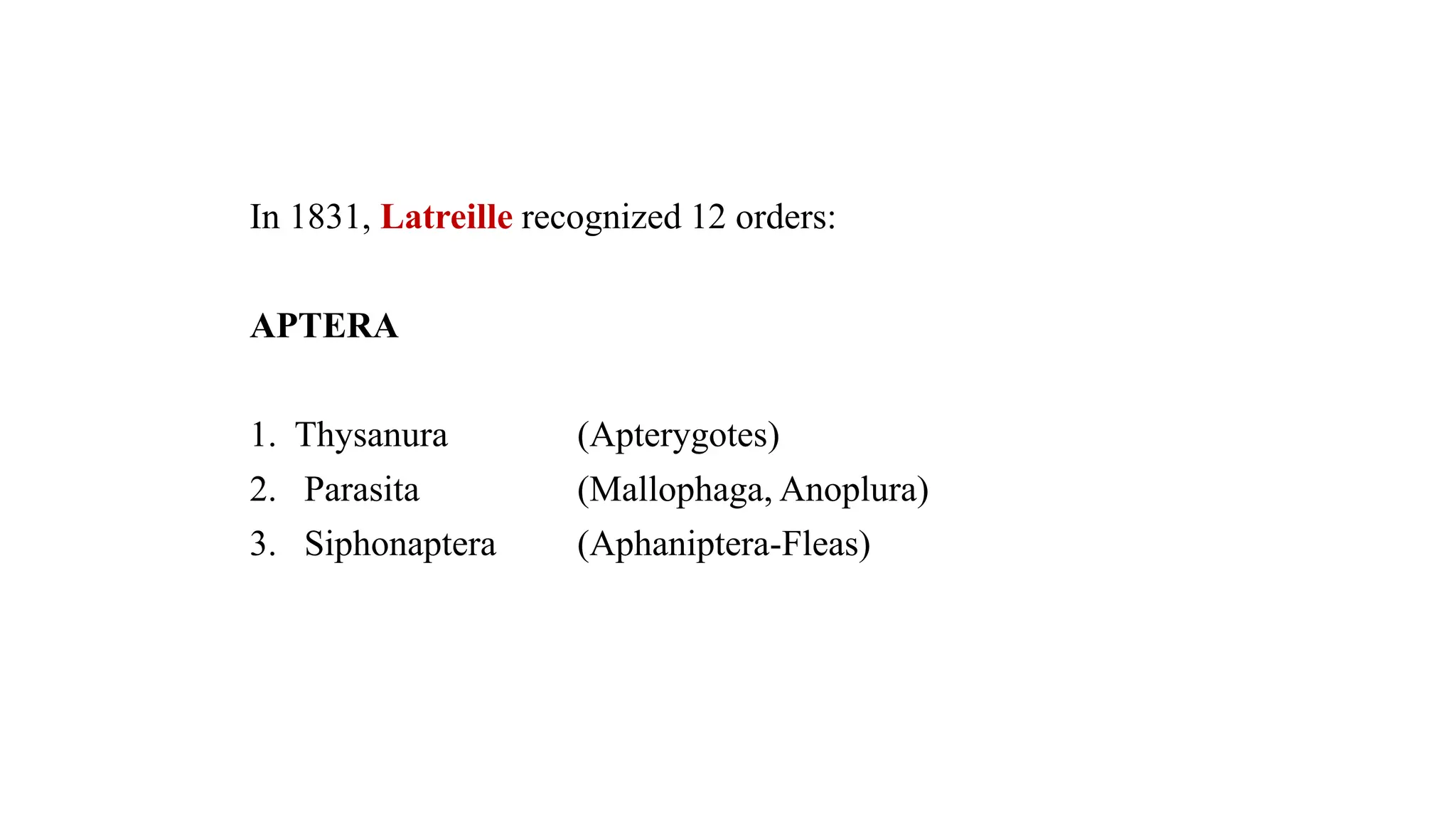
In 1831, Latreille recognized 12 orders:
APTERA
1. Thysanura (Apterygotes)
2. Parasita (Mallophaga, Anoplura)
3. Siphonaptera (Aphaniptera-Fleas)
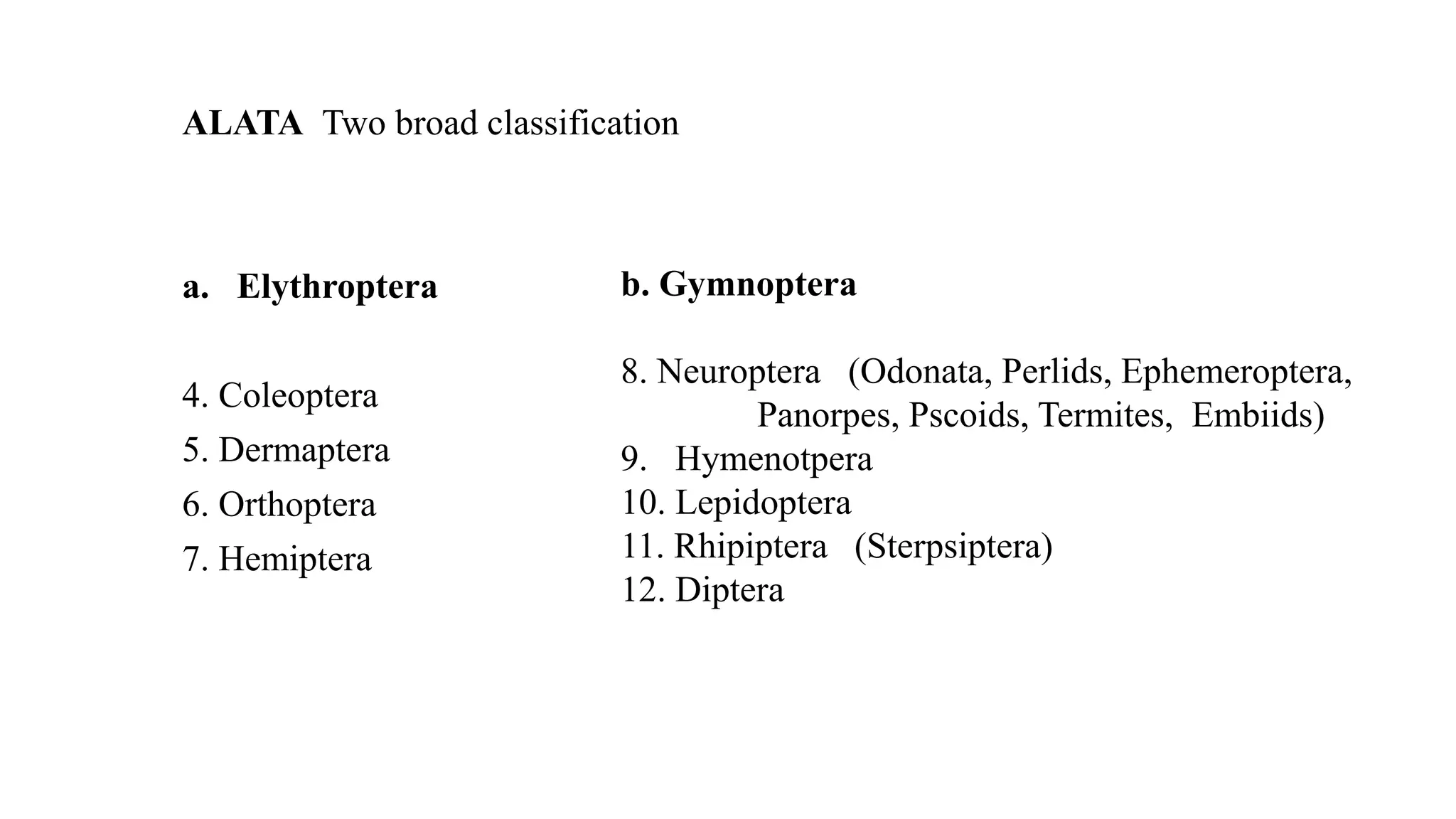
ALATA Two broad classification
a. Elythroptera
4. Coleoptera
5. Dermaptera
6. Orthoptera
7. Hemiptera
b. Gymnoptera
8. Neuroptera (Odonata, Perlids, Ephemeroptera,
Panorpes, Pscoids, Termites, Embiids)
9. Hymenotpera
10. Lepidoptera
11. Rhipiptera (Sterpsiptera)
12. Diptera
• Burmeister was the first person who proposed the subdivision Ametabola
and Metabola on the basis of the type of metamorphosis.
• In 1885, Brauer divided insects into 16 orders.
I class: Apterygogenea 1. Thysanura
2.Collembola
II class: Pterygogenea
Phylum 1: Orthoptera
1. Dermaptera
2. Ephemerida
3. Odonata
4. Plecoptera
5. Orthoptera
6. Corrodentia (Psocids)
Phylum 2: Thysanoptera
7. Thysanoptera
Phylum 3: Menorrhyncha
8. Rhynchota
Phylum 4: Petanoptera
9. Neuroptera
10. Panorpate (Mecoptera)
11. Trichoptera
12. Lepidoptera
13. Diptera
14. Siponaptera
Phylum 5: Coleoptera
15. Coleoptera
Phylum 6: Hymenooptera
16. Hymenoptera
• This classification of Brauer was later slightly modified by Borner.
• Handlirsch, in 1908 slightly modified based on fossil forms.
Later in 1932, Brues and Melander recognizes 34 orders
CLASS: Insecta Legion A and B
Legion A: (Apterygota)
Subclass- I. Thysanura : Thysanura, aptera.
II. Collembola : collembolan
III. Proyrua : Protura
Legion B: ( Pterygota)
Subclass-IV (Exo) Super orders I-IX ( orders 5 to 23)
Ephemerida, Plecoptera, odonata, Embioptera, Grylloblattodea,
othoptera, Phasmida, Dermaptera, Diploglossata, Blatteria, Mantodea,
Isopetera, Zoroptera, Corodentia, Mallophaga, Anoplura, Thysanoptera,
Homoptera and Heteroptera.
Subclass-V (Endo) Super orders X-XIII (orders 24 to 34)
Coleoptera, Strepsiptera, Hymenoptera, Megaloptera, neuroptera,
Raphidoidea, Mecoptera, Trichoptera, Lepidoptera, Deptera, siphonaptera (11)
• In 1938, Martynov recognised 40 orders of living and fossil insects.
• He subdivided the Pterygota into Paleoptera and Neoptera.
• Palaeoptera – included insects with primitive wings Ephemeroptera,
Zygoptera etc.,
• Neoptera – Section-Polyneoptera
Section- Oligneoptera
Section- Paraneoptera
Later in 1953, Hening, Bey-Biyenko in 1962 suggested numerous suggestions.
Taxonomist A.D. Imms proposed a classification of insect.
Phylum : Arthropoda (with several classes)
Class : Insecta (Hexapoda)
The subclass Apterygota has 4 orders namely
1. Thysanura - Silverfish (Thysan-fringed, Ura-tail)
2. Collembola - Springtail or snowflea (coll-glue; embol-peg)
3. Protura - Proturans or Telsontail (Pro-first, Ura-tail)
4. Diplura - Diplurans or Japygids (Di-two; Ura-tail)
The sub-class Pterygota has two division, namely Exopterygota and
Endopterygota based on the wing development.
The class Insecta has 29 orders (4 in Apterygota and 25 in Pterygota)
EXOPTERYGOTA GROUPS
01. Ephemeroptera - Mayflies Group I. Paleopteran orders (1,2)
02. Odonata -Dragonfly, Damselfly
03. Plecoptera - Stonefly Group II. Orthopteroid orders(3-11)
04. Grlloblatodia - Rock crawlers
05. Orthoptera -Grasshopper, locust, cricket, mole cricket
06. Phasmida -stick insect, leaf insect
07. Dermaptera -Earwigs
08. Embioptera -Webspinners/Embids
09. Dictyoptera -cockroach, preying mantis
10. Isoptera - Termites
11. Zoraptera - Zorapterans
12. Psocoptera - Book lice Group III. Hemipteroid orders(12-16)
13. Mallophaga - Bird lice
14. Siphonculata - Head and body louse
15. Hemiptera - Bugs
16. Thysanoptera – Thrips
ENDOPTERYGOTA
1. Neuroptera -Antilions, aphidlion, owl flies,
mantispid flies.
02. Mecoptera - Scorpionflies. Group IV. Panorpoid complex (1-6)
03. Lepidoptera - Butterflies and moths.
04. Trichoptera - Caddisfly.
05. Diptera - True fly.
06. Siphonaptera - Fleas.
07. Hymenoptera - Bees, wasps, ants.
08. Coleoptera - Beetles and weevils.
09. Strepsiptera - Stylopids.
P.J. Gullan and P.S. Cranston, Systematics: Phylogeny and Classification
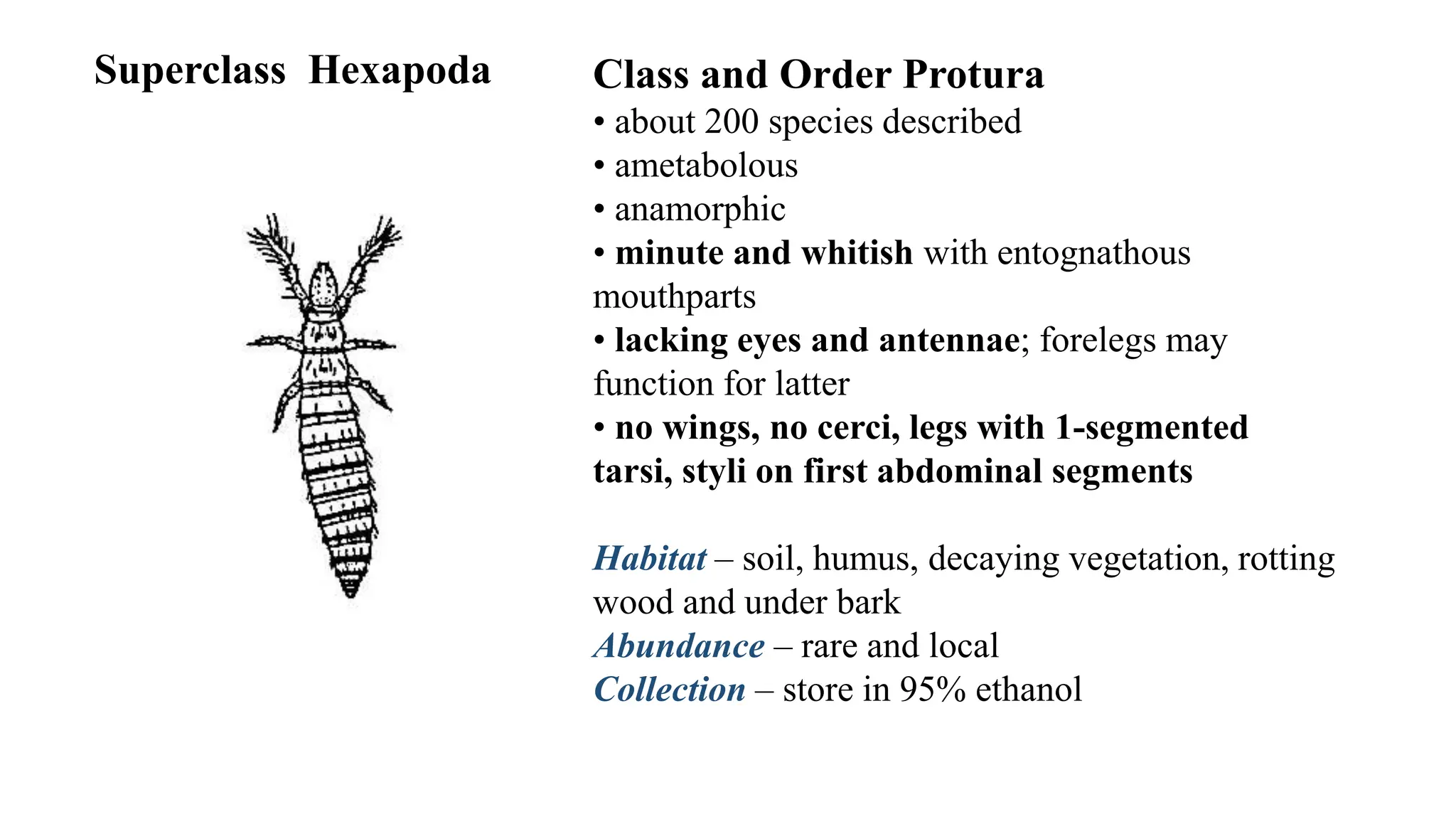
Class and Order Protura
• about 200 species described
• ametabolous
• anamorphic
• minute and whitish with entognathous
mouthparts
• lacking eyes and antennae; forelegs may
function for latter
• no wings, no cerci, legs with 1-segmented
tarsi, styli on first abdominal segments
Habitat – soil, humus, decaying vegetation, rotting
wood and under bark
Abundance – rare and local
Collection – store in 95% ethanol
Superclass Hexapoda
Class and Order Collembola
• about 6000 species described
• ametabolous
• epimorphic3
• minute to small in size; body tubular to
globose.
• patches of 1 to many lateral eyes, 4-
segmented antennae.
• 6-segmented abdomen with tenaculum on
third and furcula on fourth segment
Habitat – most species in soil and leaf litter
Abundance – ubiquitous, abundant
Collection – store in 95?% ethanol with 1%
glycerin
Class and Order Diplura
• about 800 species described
• ametabolous.
• minute, slender, and whitish
• compound eyes absent, long thread-like
antenna.
• 1-segmented tarsi
Habitat – damp soil, under bark, under stones or
logs, in rotting wood, in caves
Abundance – local and scarce
Collection – store in 70-80% ethanol
Subclass Apterygota
Order Archeognatha
• about 350 species described
• wings absent
• abdomen with rudimentary legs (styli)
• compound eyes large
• cerci shorter than terminal filament
Habitat – leaf litter, under bark, among rocks,
cliffs
Abundance – local
Collection – store in 70-80% ethanol
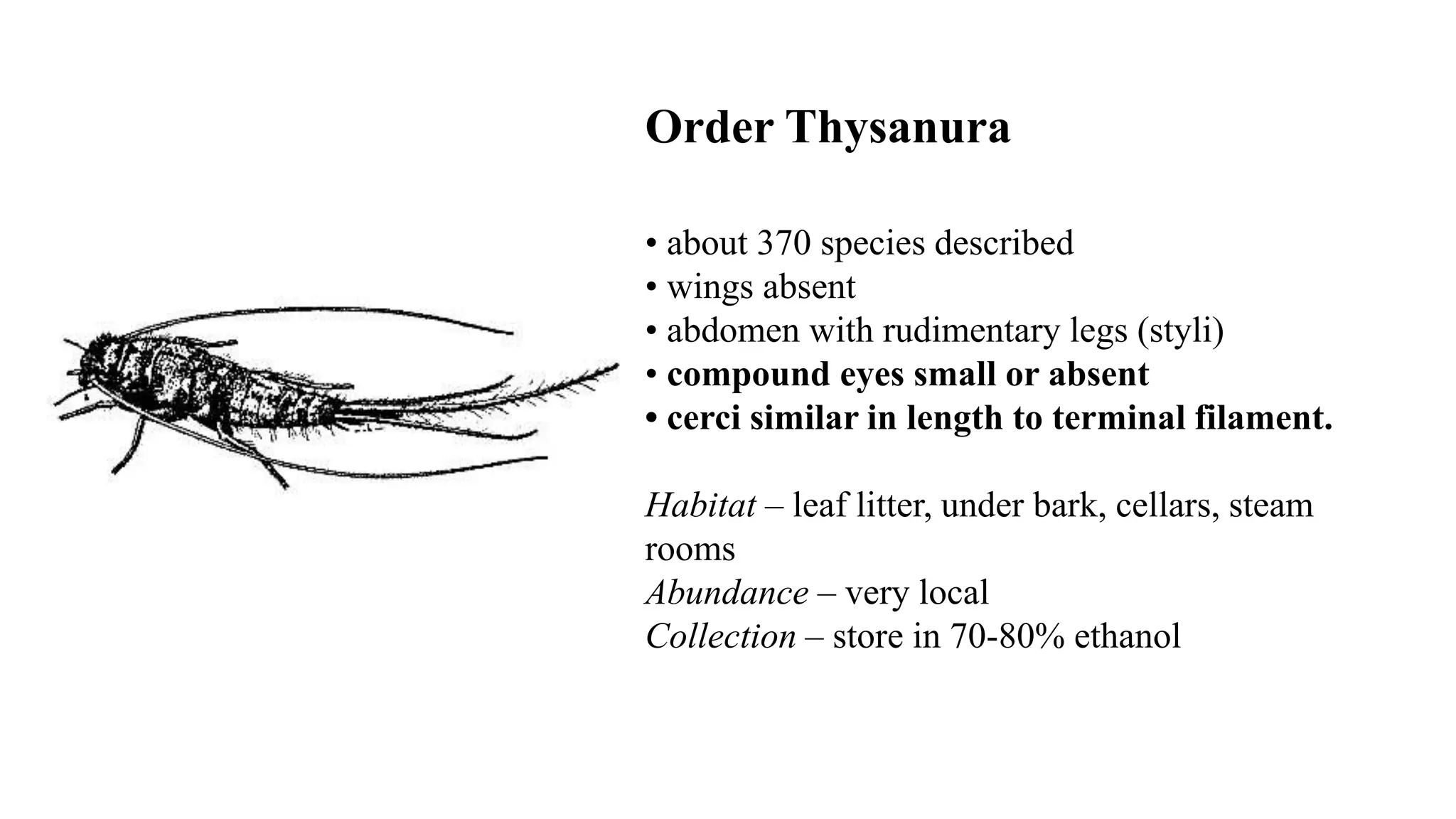
Class: Insecta
Order Thysanura
• about 370 species described
• wings absent
• abdomen with rudimentary legs (styli)
• compound eyes small or absent
• cerci similar in length to terminal filament.
Habitat – leaf litter, under bark, cellars, steam
rooms
Abundance – very local
Collection – store in 70-80% ethanol
• about 5,500 species described
• front and hindwings similar
• antennae short, bristlelike
• mouthparts chewing
• male with secondary copulatory organ on
venter of second abdominal segment
• larva aquatic with prehensile labium
Habitat – generally associated with water; larvae
are aquatic
Abundance – common to abundant around water
Collection – stored in envelopes; larvae stored in
70-80% ethanol
Subclass :Pterygota
Infraclass:Paleoptera
Order :Odonata
Order Ephemeroptera
• about 2,500 species described
• forewings larger than hindwings (sometimes
hindwings absent)
• antennae short, bristlelike
• soft-bodied
• mouthparts nonfunctional
• very long, tread-like cerci
• larval stages aquatic, esp. well oxygenated,
running waters.
Habitat – generally associated with water (esp. well
oxygenated); larvae are aquatic
Abundance – very common to abundant
Collection – adults and larvae should be stored in
70-80% ethanol
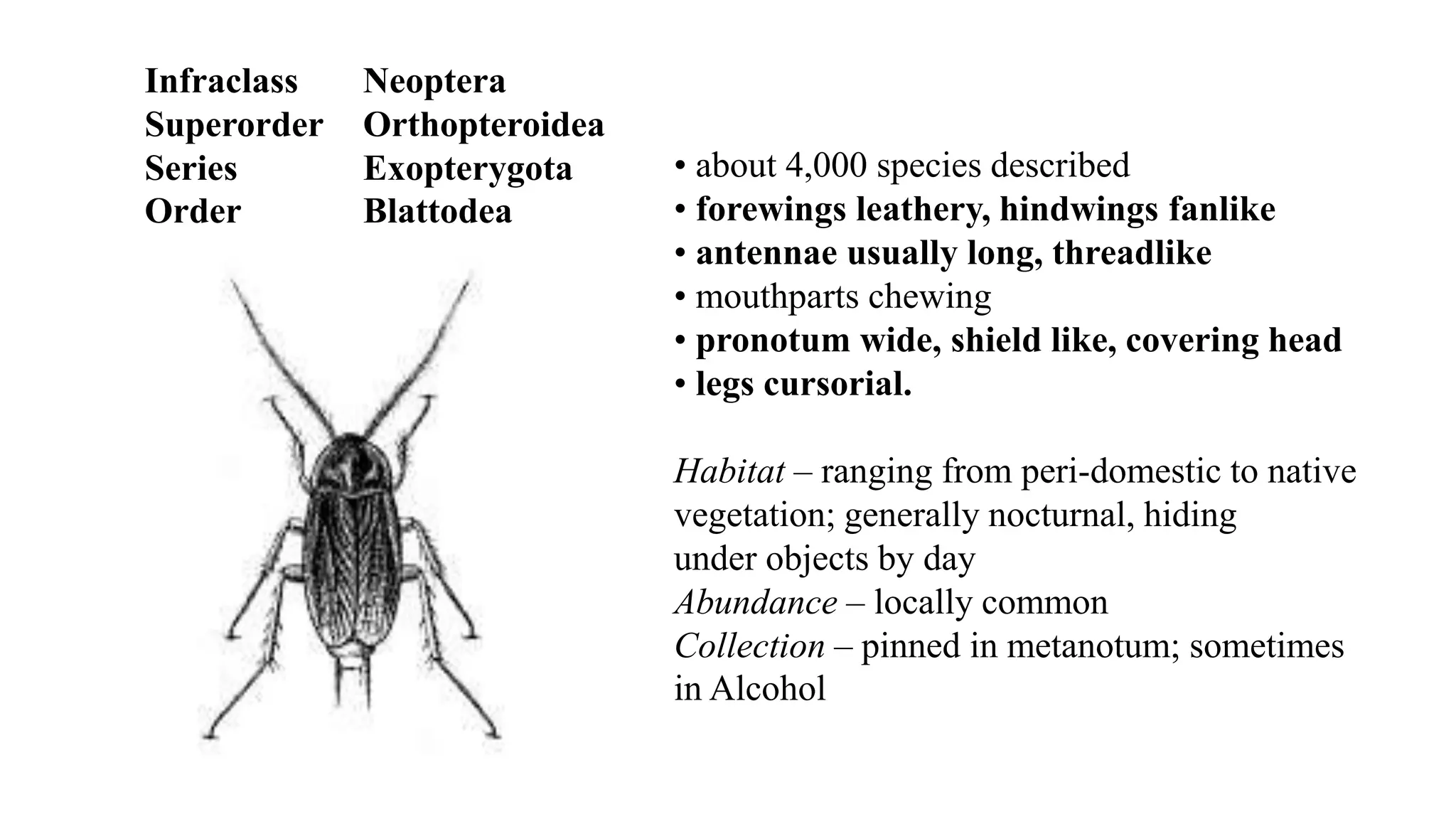
• about 4,000 species described
• forewings leathery, hindwings fanlike
• antennae usually long, threadlike
• mouthparts chewing
• pronotum wide, shield like, covering head
• legs cursorial.
Habitat – ranging from peri-domestic to native
vegetation; generally nocturnal, hiding
under objects by day
Abundance – locally common
Collection – pinned in metanotum; sometimes
in Alcohol
Infraclass Neoptera
Superorder Orthopteroidea
Series Exopterygota
Order Blattodea
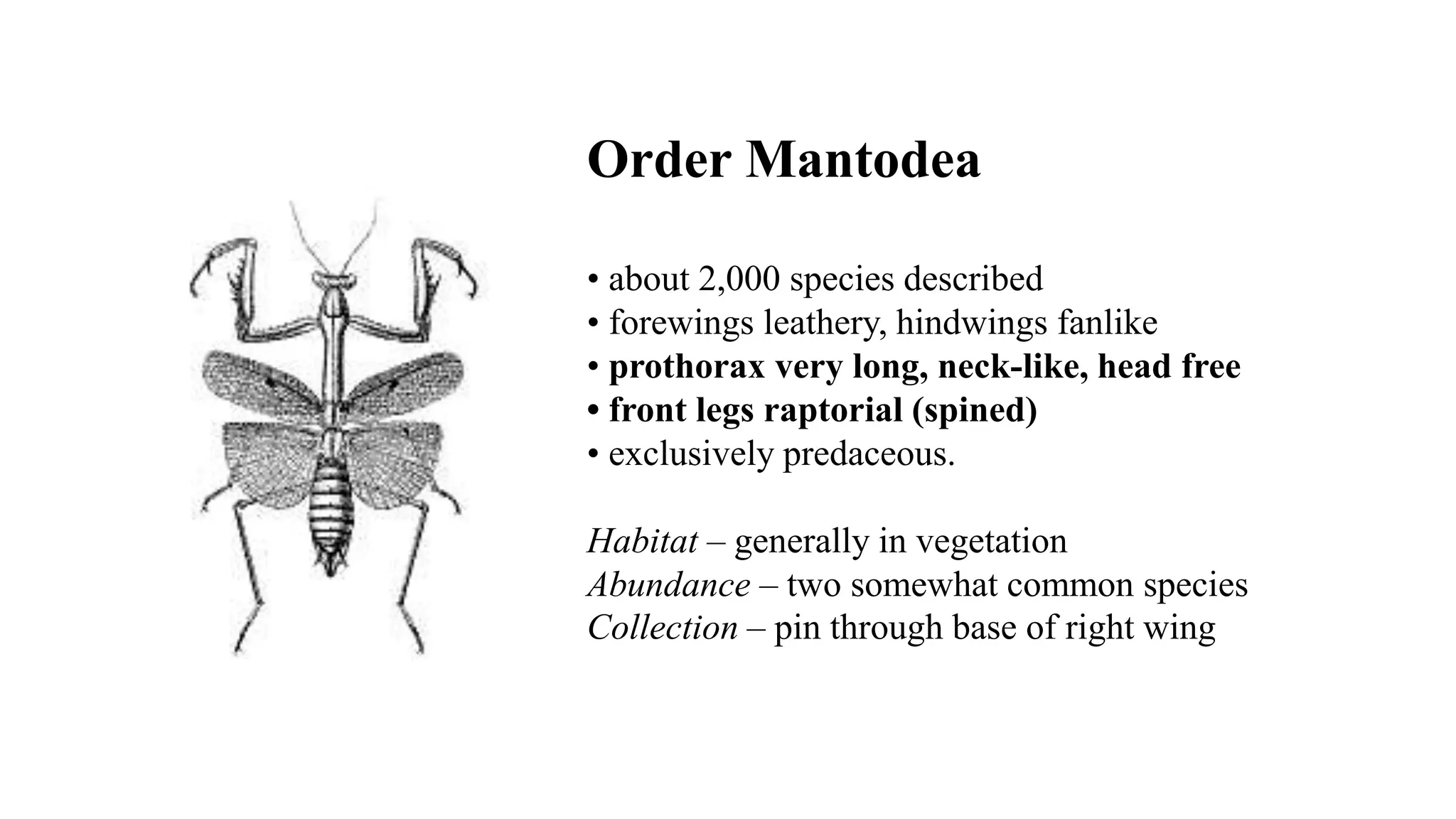
Order Mantodea
• about 2,000 species described
• forewings leathery, hindwings fanlike
• prothorax very long, neck-like, head free
• front legs raptorial (spined)
• exclusively predaceous.
Habitat – generally in vegetation
Abundance – two somewhat common species
Collection – pin through base of right wing
Order Isoptera
• about 2,300 species described
• social insects with different castes (sterile
workers and soldiers, reproductive males and queen)
• white, soft-bodied
• antennae short, threadlike
• non-reproductive castes wingless.
Habitat – wood, especially in dry sandy areas
Abundance – locally common
Collection – store in ethanol (75%)
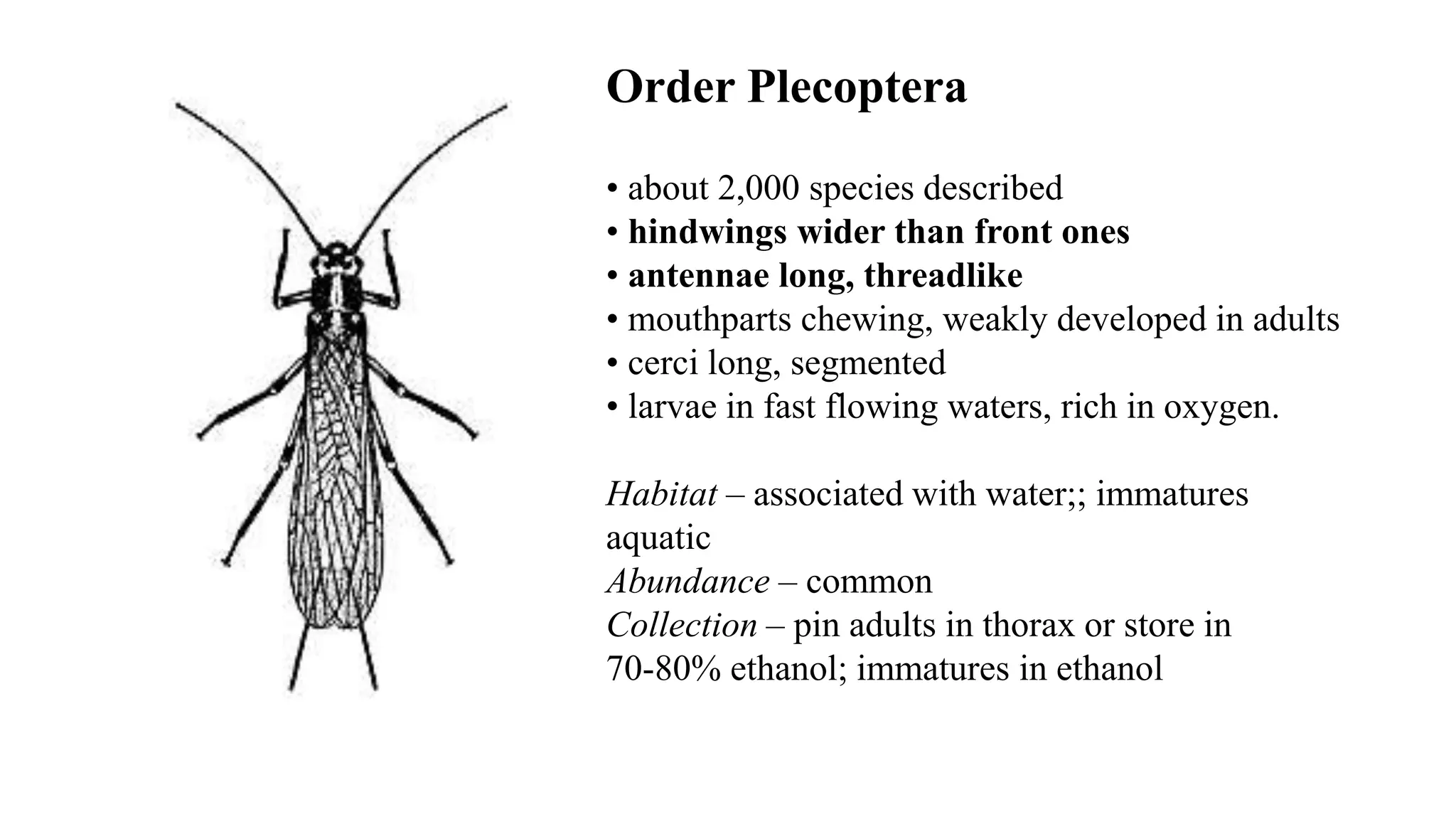
Order Plecoptera
• about 2,000 species described
• hindwings wider than front ones
• antennae long, threadlike
• mouthparts chewing, weakly developed in adults
• cerci long, segmented
• larvae in fast flowing waters, rich in oxygen.
Habitat – associated with water;; immatures
aquatic
Abundance – common
Collection – pin adults in thorax or store in
70-80% ethanol; immatures in ethanol
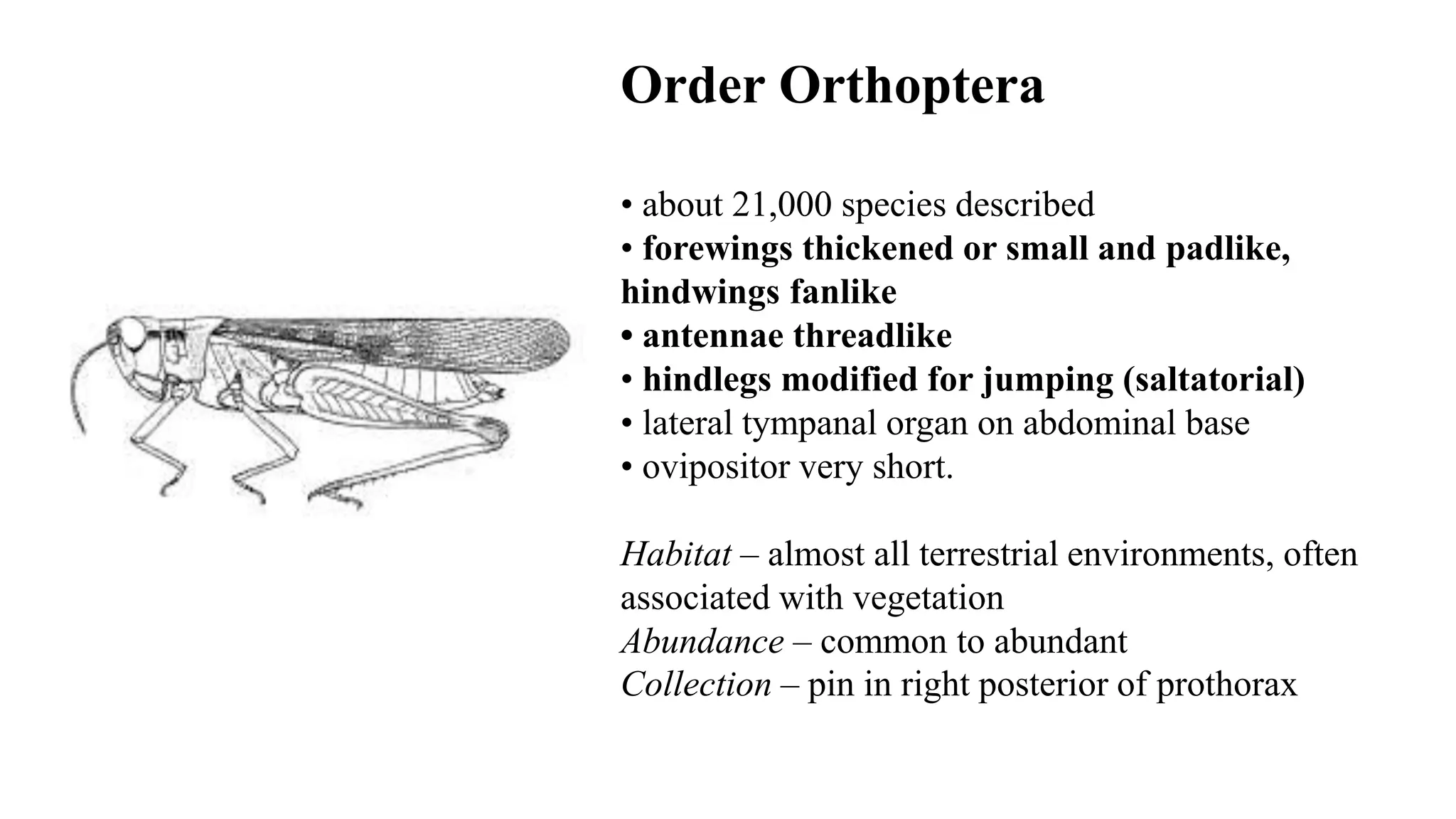
Order Orthoptera
• about 21,000 species described
• forewings thickened or small and padlike,
hindwings fanlike
• antennae threadlike
• hindlegs modified for jumping (saltatorial)
• lateral tympanal organ on abdominal base
• ovipositor very short.
Habitat – almost all terrestrial environments, often
associated with vegetation
Abundance – common to abundant
Collection – pin in right posterior of prothorax
Order Dermaptera
• about 1,800 species described
• forewings leathery, padlike; hindwings
fanlike, with complicated folding system
• antennae short or long, threadlike
• cerci enlarged, forcepslike
• pronotum square
Habitat – under litter, bark, some under rocks
and
wrack on shoreline, gardens, agricultural
fields
Abundance – common
Collection – pin in right elytron
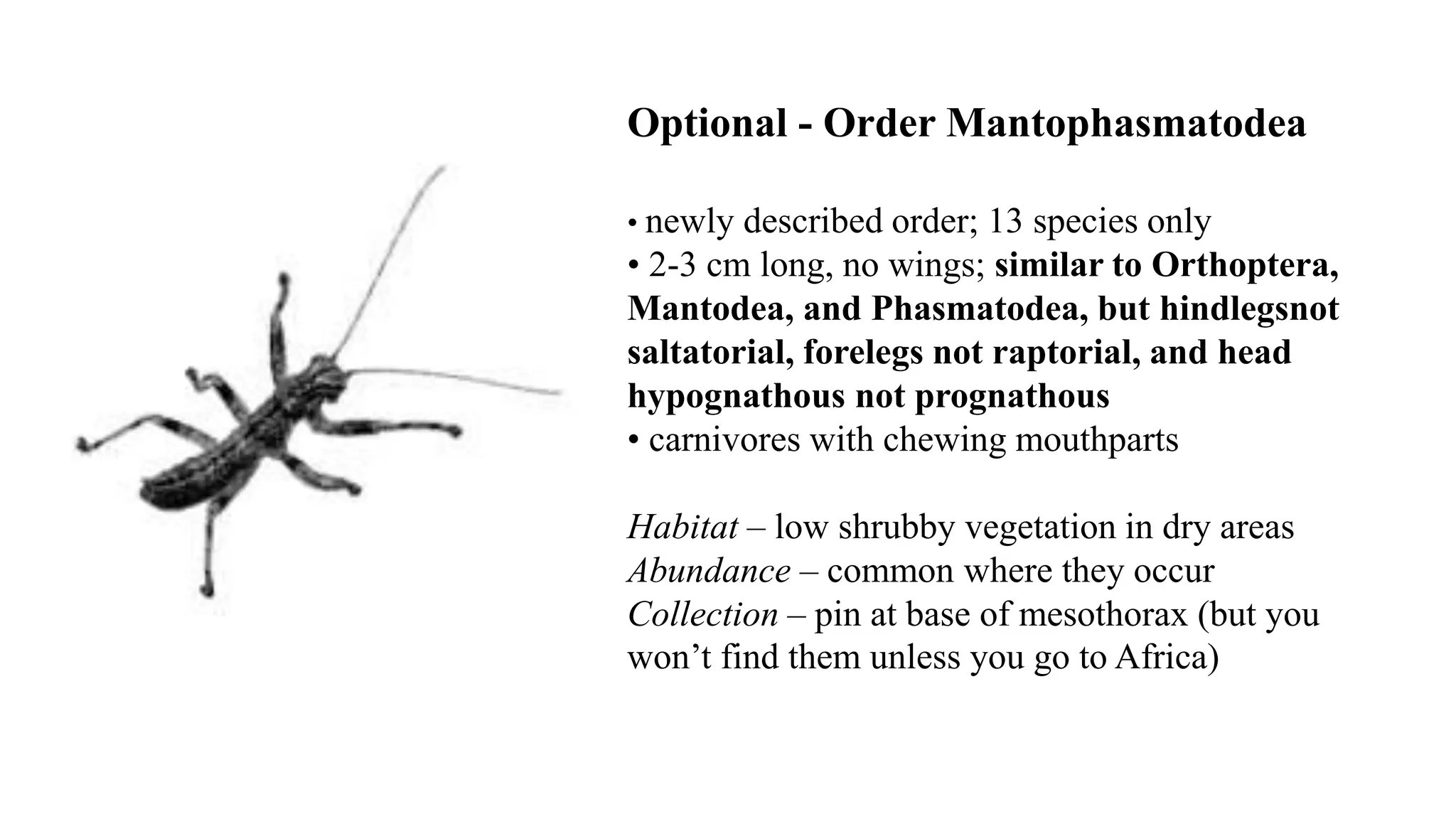
Optional - Order Mantophasmatodea
• newly described order; 13 species only
• 2-3 cm long, no wings; similar to Orthoptera,
Mantodea, and Phasmatodea, but hindlegsnot
saltatorial, forelegs not raptorial, and head
hypognathous not prognathous
• carnivores with chewing mouthparts
Habitat – low shrubby vegetation in dry areas
Abundance – common where they occur
Collection – pin at base of mesothorax (but you
won’t find them unless you go to Africa)
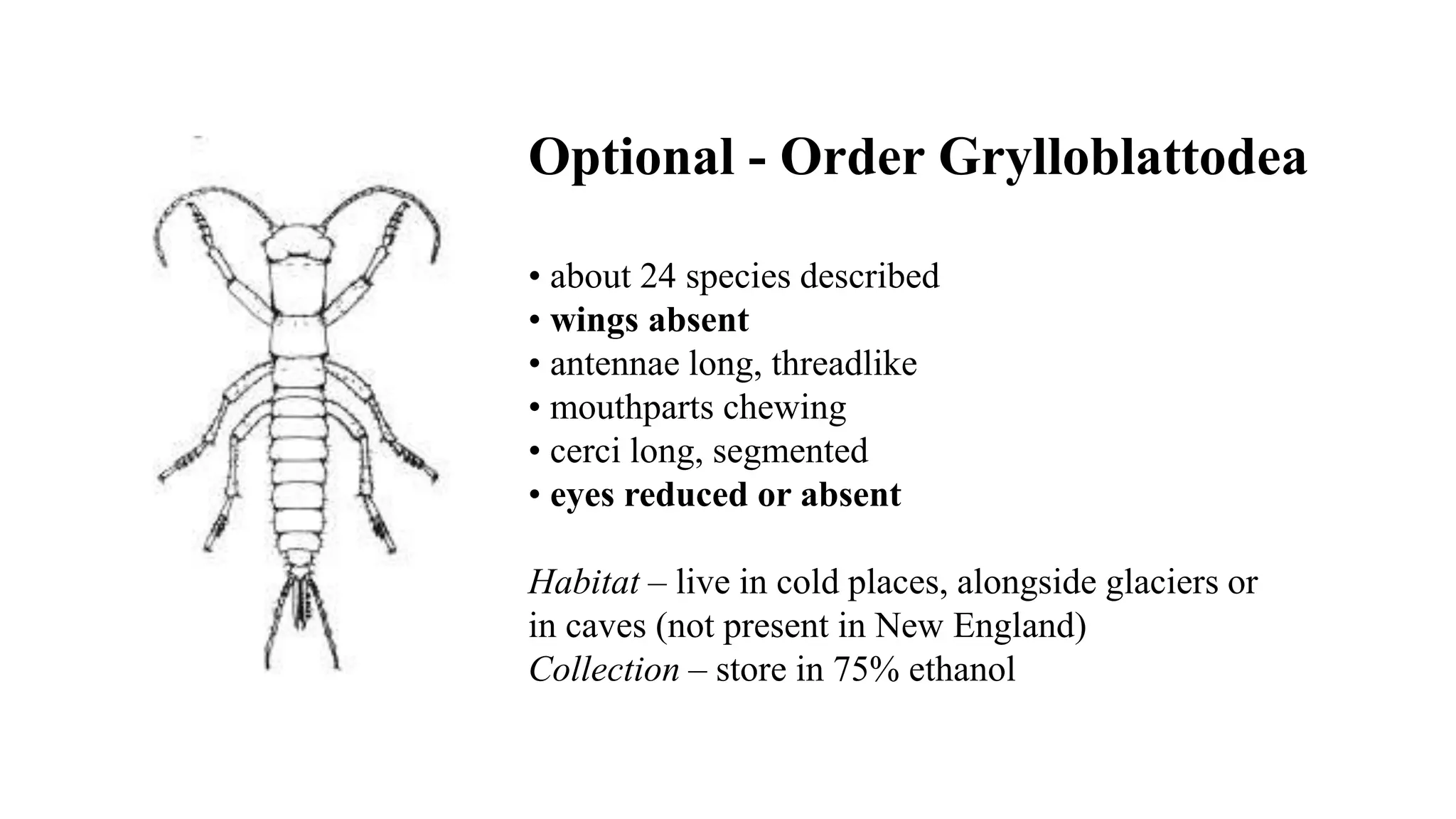
Optional - Order Grylloblattodea
• about 24 species described
• wings absent
• antennae long, threadlike
• mouthparts chewing
• cerci long, segmented
• eyes reduced or absent
Habitat – live in cold places, alongside glaciers or
in caves (not present in New England)
Collection – store in 75% ethanol
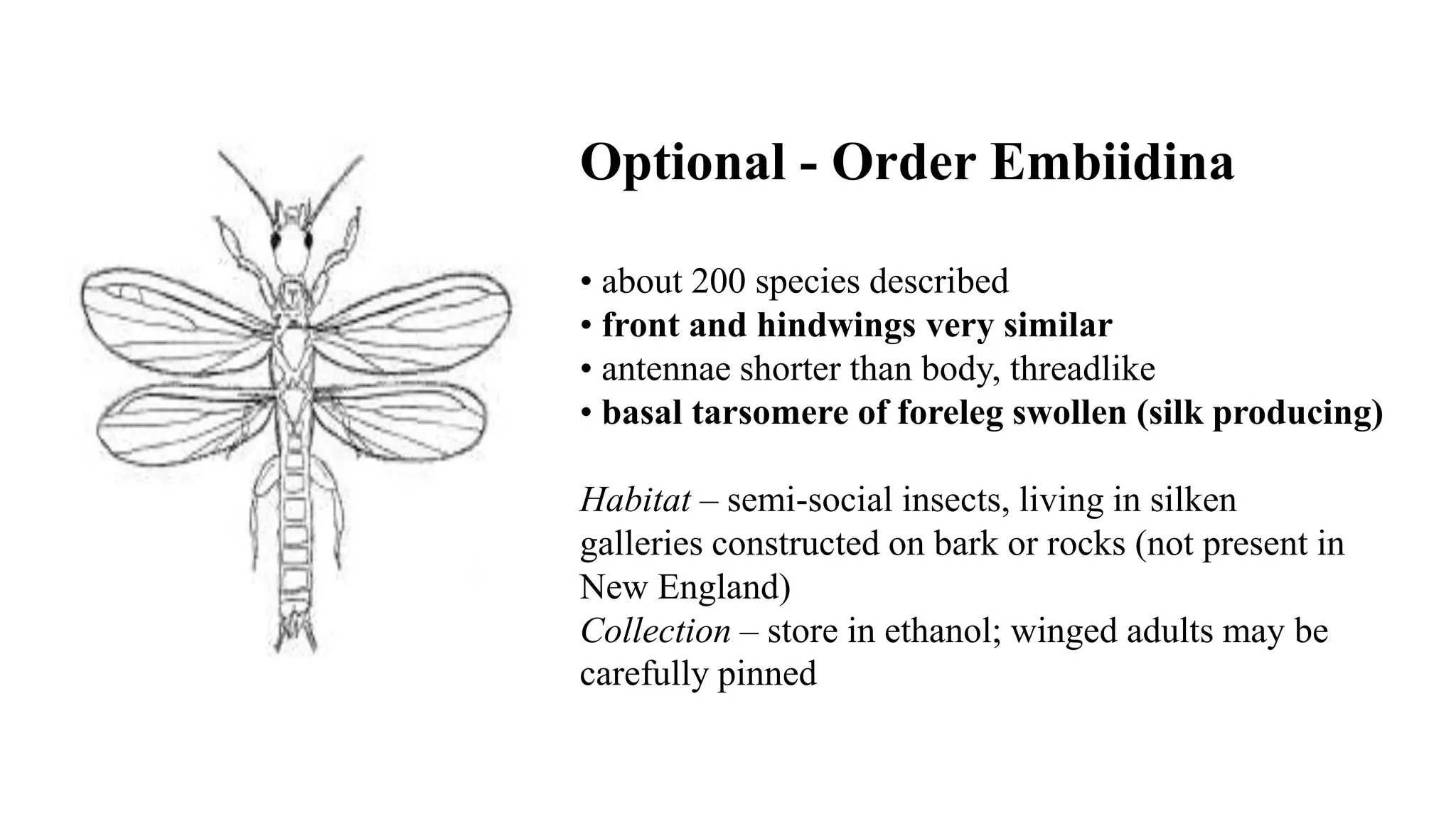
Optional - Order Embiidina
• about 200 species described
• front and hindwings very similar
• antennae shorter than body, threadlike
• basal tarsomere of foreleg swollen (silk producing)
Habitat – semi-social insects, living in silken
galleries constructed on bark or rocks (not present in
New England)
Collection – store in ethanol; winged adults may be
carefully pinned
Order Phasmatodea
• about 2,500 species described
• wings usually absent; if present then hindwings
much bigger than forewings, fan-like
• body strongly elongated (sticklike) or flattened
(leaflike)
• herbivorous
Habitat – on vegetation or buildings; sometimes
near lights
Abundance – locally common in our area
Collection – pin at base of mesothorax
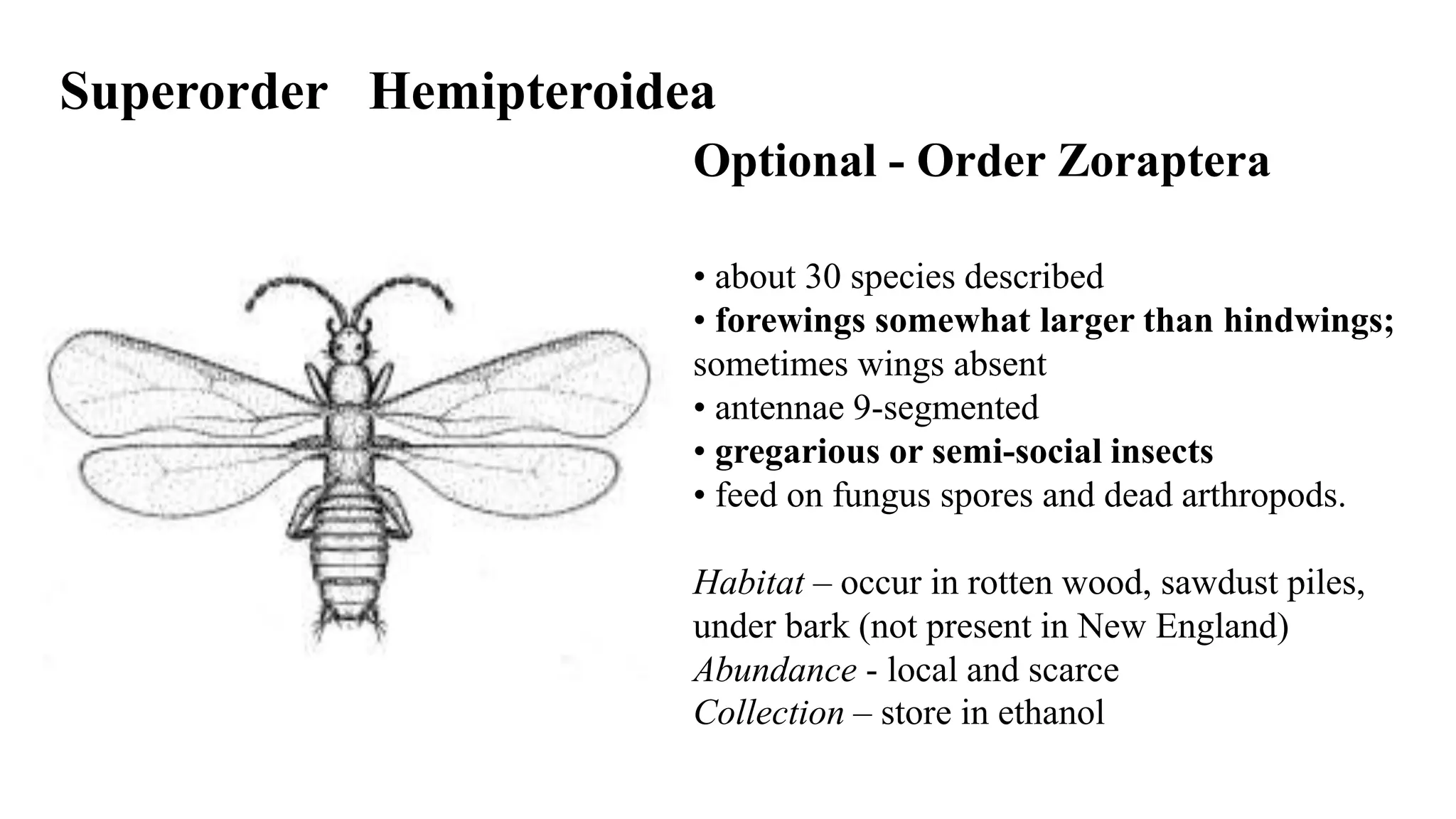
Optional - Order Zoraptera
• about 30 species described
• forewings somewhat larger than hindwings;
sometimes wings absent
• antennae 9-segmented
• gregarious or semi-social insects
• feed on fungus spores and dead arthropods.
Habitat – occur in rotten wood, sawdust piles,
under bark (not present in New England)
Abundance - local and scarce
Collection – store in ethanol
Superorder Hemipteroidea
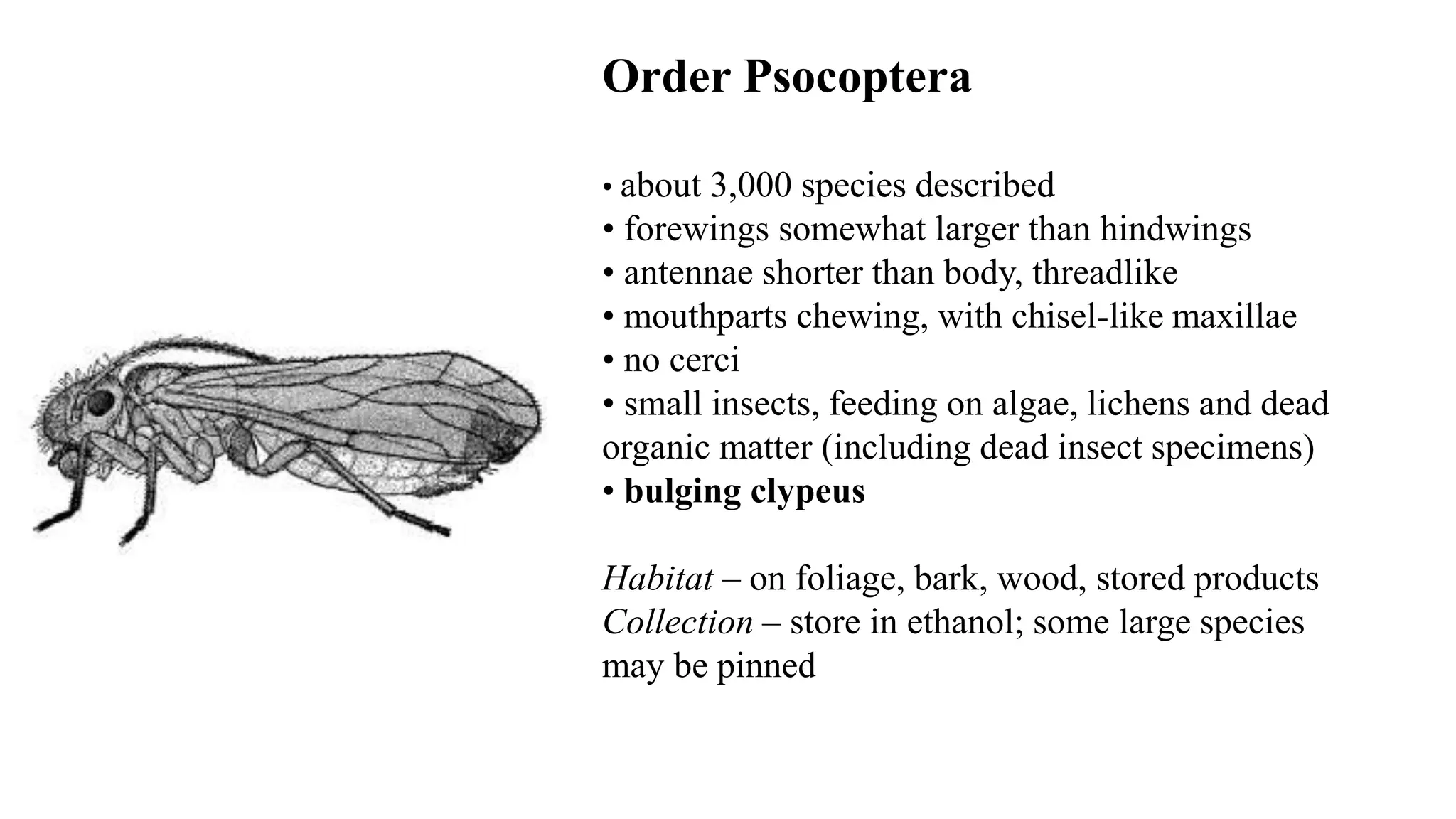
Order Psocoptera
• about 3,000 species described
• forewings somewhat larger than hindwings
• antennae shorter than body, threadlike
• mouthparts chewing, with chisel-like maxillae
• no cerci
• small insects, feeding on algae, lichens and dead
organic matter (including dead insect specimens)
• bulging clypeus
Habitat – on foliage, bark, wood, stored products
Collection – store in ethanol; some large species
may be pinned
Order Phthiraptera
• about 5,500 species described
• wingless, strongly flattened dorsoventrally
• external parasites of birds and mammals
• mouthparts piercing, sucking, and modified
chewing
• tarsi 1-2 segmented, with 1 or 2 terminal claws
• entire life cycle on the host
Habitat – ectoparasites of vertebrates
Abundance – common
Collection – store in ethanol
• about 80,000 species described
• distal portion of forewing is membranous, resting roof-
like on abdomen; hindwings membranous
• herbivorous or predaceous
• mouthparts sucking
• sometimes front legs raptorial, sometimes hind legs
saltatorial
• many species gregarious
Habitat – typically associated with vegetation,
some found on ground with fallen seeds,
some predaceous, several aquatic families
Abundance – common to abundant
Collection – pin in upper right of scutellum
Order Hemiptera
Order Thysanoptera
• about 4,500 species described
• both pairs of wings very slender with wide
fringe of hairs; venation strongly reduced
• mouthparts sucking, asymmetrical
• minute insects
Habitat – small insects feeding on plant juices
or
predaceous; found in flowers, leaf litter,
galls, and fungi
Abundance – very common
Collection – store in ethanol
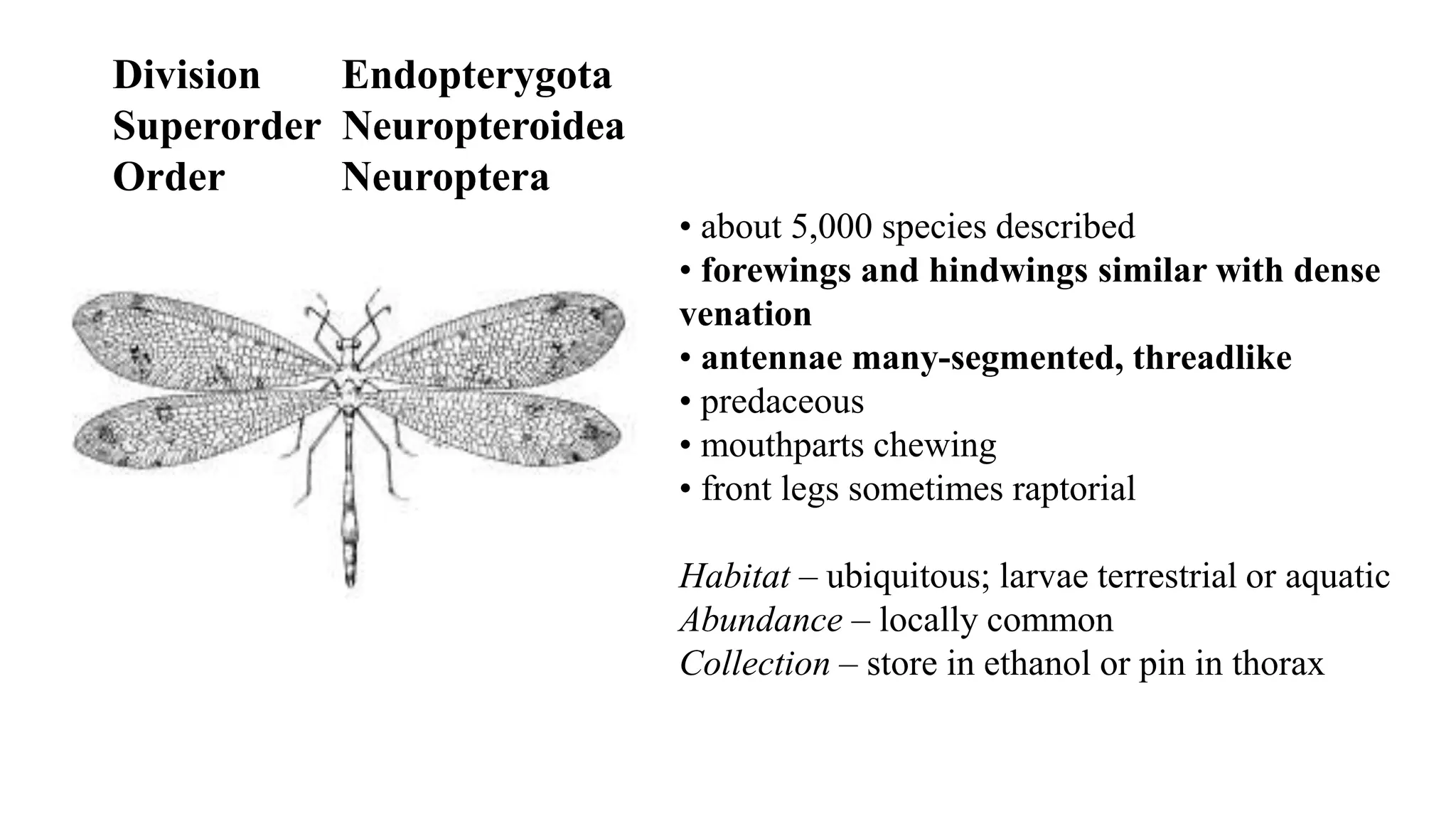
• about 5,000 species described
• forewings and hindwings similar with dense
venation
• antennae many-segmented, threadlike
• predaceous
• mouthparts chewing
• front legs sometimes raptorial
Habitat – ubiquitous; larvae terrestrial or aquatic
Abundance – locally common
Collection – store in ethanol or pin in thorax
Division Endopterygota
Superorder Neuropteroidea
Order Neuroptera
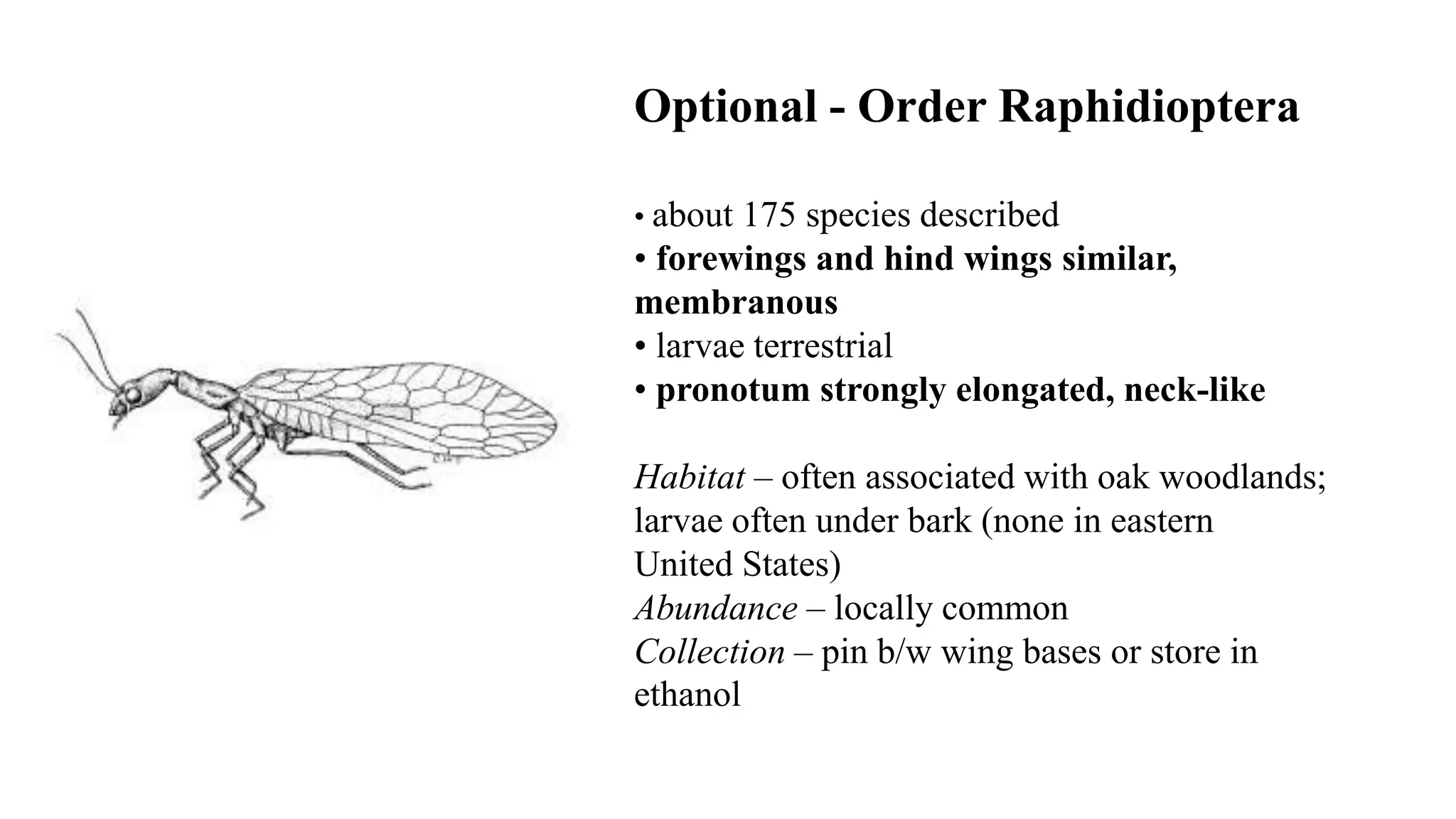
Optional - Order Raphidioptera
• about 175 species described
• forewings and hind wings similar,
membranous
• larvae terrestrial
• pronotum strongly elongated, neck-like
Habitat – often associated with oak woodlands;
larvae often under bark (none in eastern
United States)
Abundance – locally common
Collection – pin b/w wing bases or store in
ethanol
Order Megaloptera
• about 300 species described
• forewings and hindwings similar with dense
venation
• sometimes mandibles strongly enlarged
Habitat – near steams or lakes, sometimes at lights;
larvae aquatic
Abundance – locally common
Collection – pin through thorax or store in ethanol
Order Coleoptera
• more than 300,000 species described
• forewings hardened, forming protective
elytra; hindwings membranous, usually hidden
under elytra
Habitat – everywhere (perhaps 1 out of 5
macroscopic species on Earth)
Abundance – abundant
Collection – pin in upper portion of right elytron.
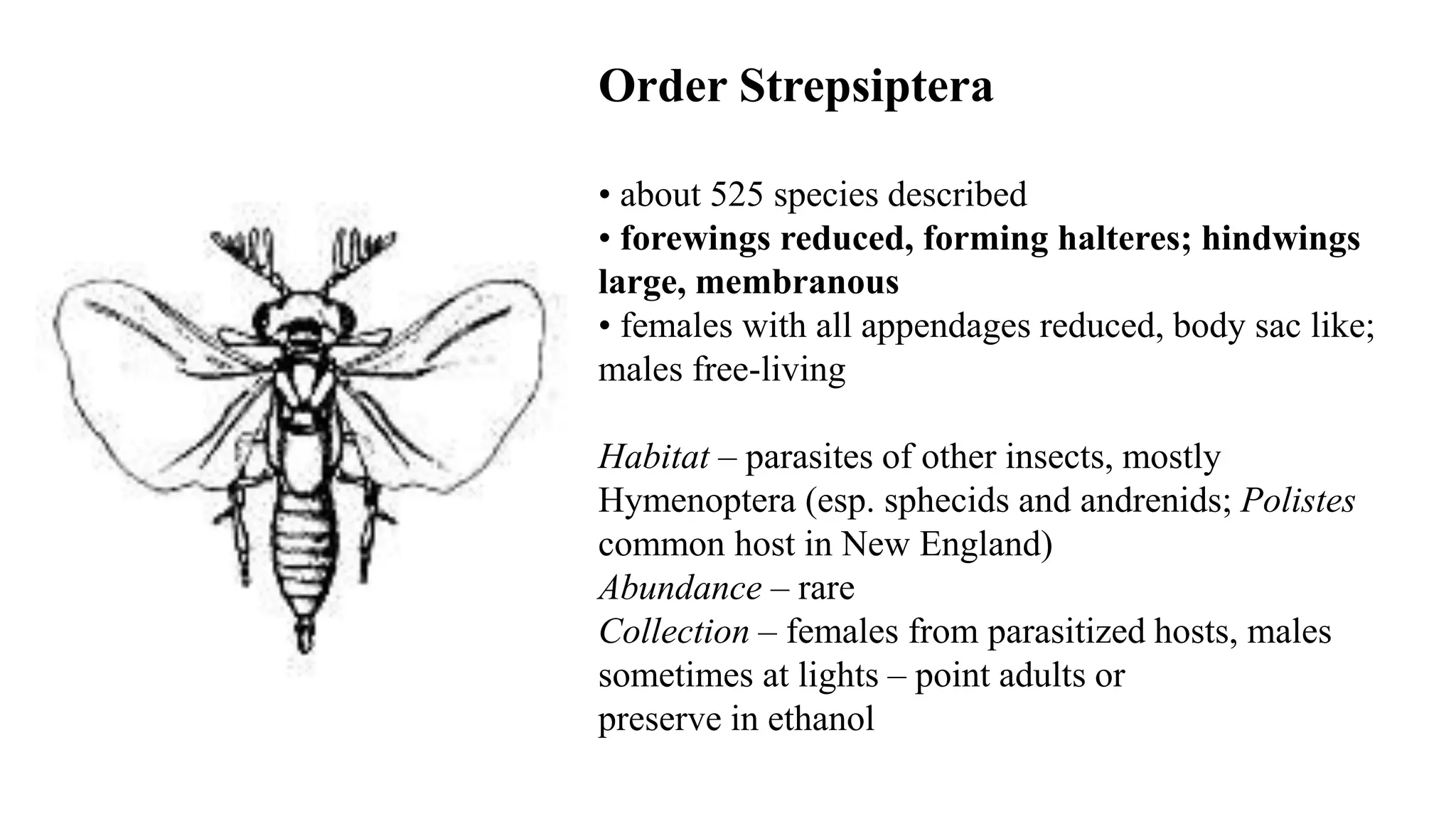
Order Strepsiptera
• about 525 species described
• forewings reduced, forming halteres; hindwings
large, membranous
• females with all appendages reduced, body sac like;
males free-living
Habitat – parasites of other insects, mostly
Hymenoptera (esp. sphecids and andrenids; Polistes
common host in New England)
Abundance – rare
Collection – females from parasitized hosts, males
sometimes at lights – point adults or
preserve in ethanol
Order Mecoptera
• about 500 species described
• forewings and hindwings similar, sometimes absent.
• face elongated
• predaceous or omnivorous
• males with bulbous genital capsule at end of
abdomen
Habitat – damp, often shady areas, mesic
woodlands
Abundance – locally common
Collection – pin in thorax or store in ethanol
Order Siphonaptera
• about 2,400 species described
• wings absent
• mouthparts piercing-sucking; palpi present
• legs saltatorial
• body strongly flattened laterally
• larval development in nest of host (not on host
body)
Habitat – external parasites of vertebrates
Abundance – locally common
Collection – preserve in ethanol
Order Diptera
• about 150,000 species described
• hindwings reduced, forming halteres; forewings
large, membranous
• mouthparts sucking or piercing, of very variable
structure
Habitat – In almost any habitat
Abundance – ubiquitous, abundant
Collection – pin in thorax
Order Lepidoptera
• about 150,000 species described
• forewings and hindwings covered with scales
• mouthparts of adults sucking, tube-like, formed from
maxillae; mandibles reduced or absent
Habitat – ubiquitous, often at flowers, common at
lights; larvae (caterpillars) primarily terrestrial
Abundance – ubiquitous, abundant
Collection – pin in thorax and spread wings
Order Trichoptera
• about 7,000 species described
• forewings and hindwings similar, densely
covered with hairs
• antennae long, often held forward
Habitat – adults usually near water or at lights;
immatures aquatic, most build cases
Abundance – abundant near water
Collection – pin in mesonotum or store in ethanol;
immatures should be stored in ethanol
• about 180,000 species described
• hindwings smaller, attaching to forewings by series of
hooklets; wings often absent; abdomen sometimes with
constriction (petiole)
• many social with reproductive and non reproductive
castes
• mouthparts chewing but maxillae and labium often
modified for sucking
• ovipositor often modified into stinger.
Habitat – ubiquitous; many parasitic; often at
flowers
Abundnace – ubiquitous, abundant
Collection – pin in thorax
Superorder Hymenopteroidea
Order Hymenoptera
REFERENCE
Wheeler, W. C., M. Whiting, Q. D. Wheeler, and J. M. Carpenter. 2001.
The phylogeny of the extant hexapod orders. Cladistics 17:113-169.
P.J. Gullan and P.S. Cranston, 2014. The Insect An Outline of Entomology(5th
Edition), 7. Insect Systematics: Phylogeny and Classification, Publishers: Wiley
Blackwell
A.D. IMMS, 1925. A General Textbook of Entomology, III. The orders of
insects: The classification of insects, Publishers: Methuen & co. Ltd.
Thank you

insect taxonomy importance systematics and classification

  • 1.
    • Taxonomy isthe process of identifying and classifying living organisms. Taxonomists study organisms and identify them based on their characteristics. • Simpson (1961) has defined taxonomy as the theoretical study of classification including basis, principles, procedures and rules. Taxonomy includes nomenclature and classification. Systematics:- • The science of study of kind and diversity of organisms and any or all relation among them. Systematics includes taxonomy and evaluation. Stages of taxonomy:- • Alpha taxonomy- It is naming and characterisation of species. • Beta taxonomy- Concerned with classification (Arrangements of spp. Lower to higher categories) • Gama taxonomy- Concerned with evalutionary relations and phylogeny (intra specific variation) TAXONOMY – IMPORTANCE, HISTORY AND DEVELOPMENT AND BINOMIAL NOMENCLATURE - DEFINITIONS OF BIOTYPE, SUB-SPECIES, SPECIES, GENUS, FAMILY AND ORDER INTRODUCTION
  • 2.
    Basis of classification:- Classificationis the ordering of a large group of organisms based on certain characters into small groups. Classification based on- 1. External structure 2. Internal structure 3. Developmental history 4. Physiological data 5. Cytogenetic data  The biological system of classification is called hierarchial concept of classification. This was introduced by Carl von Linnaeus (1758)  A large group of organism is subdivided into small groups of organism are known as taxa.  The basic taxonomic category is species.  The binomial naming system is the system used to name species. Each species is given a name that consists of two parts.  The first part is the Genus to which the species belongs and the second part is the species name.  For example, Apis mellifera (the honey bee). The honey bee belongs to the Genus Apis and has a scientific name of Apis mellifera.  The binomial naming system was first uniformly used by Carl Linnaeus.  Other names for (or types of) Binomial naming system include: Binominal nomenclature
  • 3.
    Organisms are classifiedaccording to a system of seven ranks: 1. Kingdom 2. Phylum 3. Class 4. Order 5. Family 6. Genus 7. Species For example, the honey bee (Apis mellifera) would be classified in the following way: 1. Kingdom = Animalia 2. Phylum = Arthropoda 3. Class = Insecta 4. Order = Hymenoptera 5. Family = Apidae 6. Genus = Apis 7. Species = Apis mellifera the rule regarding the naming of organism is contained in International code for zoological nomenclature
  • 4.
    BIOTYPE A group oforganisms having the same or nearly the same genotype, such as a particular strain of an insect species. SUB-SPECIES A sub-division of a species, usually inhabiting a particular area: visibly different from other populations of the same species but still able to interbreed with them. A subspecies is further division of a species based on minor but constant differences in structure, appearance or biology. Individuals in different subspecies will be morphologically or genetically different from one another but still capable of interbreeding and producing viable offspring. SPECIES The basic unit of living things, consisting of a group of individuals which all look more or less alike and which can all breed with each other to produce another generation of similar creatures. A species can be defined as a group of organisms that can breed and produce fertile offspring. GENUS A group of closely related species (plural: genera). The name of the genus is incorporated into the scientific names of all the member species: Pieris napi and Pieris rapae, for example, both belong to the genus Pieris FAMILY A taxonomic subdivision of an order, suborder, or superfamily that contains a group of related subfamilies, tribes and genera. Family names always end in -idae. ORDER A subdivision of a class or subclass containing a group of related families. Order is one of the seven taxonomic ranks used to classify living organisms. Order is positioned after Class and before Family.
  • 5.
    • In thetwenth edition of Systema Naturae, Linnaeus (1758) divided insects into 9 orders. Coleoptera, Orthoptera, Hemiptera, Lepidoptera, Neuroptera, Hymenoptera, Diptera, Thysanoptera and Aptera. • This system was artificial and not only brought together unrelated forms, but also separated insects with common descent. • Under the Aptera Linnaeus included, for example no only all sorts of wingless insects, but even spiders, scorpions, Terrestrial Crustacea and Myriapods. • His Neuroptera included not only antlions and sialids (alderfly), but also termites and dragonflies. • He also placed earwigs under Coleoptera.
  • 6.
    In 1775, Fabriciusimproved this system by taking into consideration the structure of the parts in separating different orders. He recognized 8 orders. 1. Eleuthrata (Coleoptera) 2. Ulonata (Orthoptera, Blattes, Dermaptera) 3. Synistata (Ephemera, Phryganes, Apterygotes, Percies, Neuroptera, Pscoids, Panorpes Hymenoptera and Termites and certain Crustacea) 4. Agoniata (Scorpions and certain Crustacea) 5. Unogata (Libellula, Myriapods and Arachnids) 6. Glossata (Lepidoptera) 7. Rhynchota (Hemiptera, Apnaniptera, Thysanoptera) 8. Antiliata (Diptera, Anoplura, Mallophaga and parts of archanids and Crustaceans)
  • 7.
    • Later Latereille,Clairville and Lamark followed primarily Linnaean system of classification. • Lamark was the first to definitely separate the insects from Crustacea, Myriapods and Archanids.
  • 8.
    In 1831, Latreillerecognized 12 orders: APTERA 1. Thysanura (Apterygotes) 2. Parasita (Mallophaga, Anoplura) 3. Siphonaptera (Aphaniptera-Fleas)
  • 9.
    ALATA Two broadclassification a. Elythroptera 4. Coleoptera 5. Dermaptera 6. Orthoptera 7. Hemiptera b. Gymnoptera 8. Neuroptera (Odonata, Perlids, Ephemeroptera, Panorpes, Pscoids, Termites, Embiids) 9. Hymenotpera 10. Lepidoptera 11. Rhipiptera (Sterpsiptera) 12. Diptera
  • 10.
    • Burmeister wasthe first person who proposed the subdivision Ametabola and Metabola on the basis of the type of metamorphosis. • In 1885, Brauer divided insects into 16 orders. I class: Apterygogenea 1. Thysanura 2.Collembola
  • 11.
    II class: Pterygogenea Phylum1: Orthoptera 1. Dermaptera 2. Ephemerida 3. Odonata 4. Plecoptera 5. Orthoptera 6. Corrodentia (Psocids)
  • 12.
    Phylum 2: Thysanoptera 7.Thysanoptera Phylum 3: Menorrhyncha 8. Rhynchota Phylum 4: Petanoptera 9. Neuroptera 10. Panorpate (Mecoptera) 11. Trichoptera 12. Lepidoptera 13. Diptera 14. Siponaptera
  • 13.
    Phylum 5: Coleoptera 15.Coleoptera Phylum 6: Hymenooptera 16. Hymenoptera • This classification of Brauer was later slightly modified by Borner. • Handlirsch, in 1908 slightly modified based on fossil forms.
  • 14.
    Later in 1932,Brues and Melander recognizes 34 orders CLASS: Insecta Legion A and B Legion A: (Apterygota) Subclass- I. Thysanura : Thysanura, aptera. II. Collembola : collembolan III. Proyrua : Protura
  • 15.
    Legion B: (Pterygota) Subclass-IV (Exo) Super orders I-IX ( orders 5 to 23) Ephemerida, Plecoptera, odonata, Embioptera, Grylloblattodea, othoptera, Phasmida, Dermaptera, Diploglossata, Blatteria, Mantodea, Isopetera, Zoroptera, Corodentia, Mallophaga, Anoplura, Thysanoptera, Homoptera and Heteroptera.
  • 16.
    Subclass-V (Endo) Superorders X-XIII (orders 24 to 34) Coleoptera, Strepsiptera, Hymenoptera, Megaloptera, neuroptera, Raphidoidea, Mecoptera, Trichoptera, Lepidoptera, Deptera, siphonaptera (11)
  • 17.
    • In 1938,Martynov recognised 40 orders of living and fossil insects. • He subdivided the Pterygota into Paleoptera and Neoptera. • Palaeoptera – included insects with primitive wings Ephemeroptera, Zygoptera etc., • Neoptera – Section-Polyneoptera Section- Oligneoptera Section- Paraneoptera Later in 1953, Hening, Bey-Biyenko in 1962 suggested numerous suggestions.
  • 18.
    Taxonomist A.D. Immsproposed a classification of insect. Phylum : Arthropoda (with several classes) Class : Insecta (Hexapoda) The subclass Apterygota has 4 orders namely 1. Thysanura - Silverfish (Thysan-fringed, Ura-tail) 2. Collembola - Springtail or snowflea (coll-glue; embol-peg) 3. Protura - Proturans or Telsontail (Pro-first, Ura-tail) 4. Diplura - Diplurans or Japygids (Di-two; Ura-tail) The sub-class Pterygota has two division, namely Exopterygota and Endopterygota based on the wing development.
  • 19.
    The class Insectahas 29 orders (4 in Apterygota and 25 in Pterygota) EXOPTERYGOTA GROUPS 01. Ephemeroptera - Mayflies Group I. Paleopteran orders (1,2) 02. Odonata -Dragonfly, Damselfly 03. Plecoptera - Stonefly Group II. Orthopteroid orders(3-11) 04. Grlloblatodia - Rock crawlers 05. Orthoptera -Grasshopper, locust, cricket, mole cricket 06. Phasmida -stick insect, leaf insect 07. Dermaptera -Earwigs 08. Embioptera -Webspinners/Embids 09. Dictyoptera -cockroach, preying mantis 10. Isoptera - Termites 11. Zoraptera - Zorapterans
  • 20.
    12. Psocoptera -Book lice Group III. Hemipteroid orders(12-16) 13. Mallophaga - Bird lice 14. Siphonculata - Head and body louse 15. Hemiptera - Bugs 16. Thysanoptera – Thrips
  • 21.
    ENDOPTERYGOTA 1. Neuroptera -Antilions,aphidlion, owl flies, mantispid flies. 02. Mecoptera - Scorpionflies. Group IV. Panorpoid complex (1-6) 03. Lepidoptera - Butterflies and moths. 04. Trichoptera - Caddisfly. 05. Diptera - True fly. 06. Siphonaptera - Fleas. 07. Hymenoptera - Bees, wasps, ants. 08. Coleoptera - Beetles and weevils. 09. Strepsiptera - Stylopids.
  • 22.
    P.J. Gullan andP.S. Cranston, Systematics: Phylogeny and Classification
  • 25.
    Class and OrderProtura • about 200 species described • ametabolous • anamorphic • minute and whitish with entognathous mouthparts • lacking eyes and antennae; forelegs may function for latter • no wings, no cerci, legs with 1-segmented tarsi, styli on first abdominal segments Habitat – soil, humus, decaying vegetation, rotting wood and under bark Abundance – rare and local Collection – store in 95% ethanol Superclass Hexapoda
  • 26.
    Class and OrderCollembola • about 6000 species described • ametabolous • epimorphic3 • minute to small in size; body tubular to globose. • patches of 1 to many lateral eyes, 4- segmented antennae. • 6-segmented abdomen with tenaculum on third and furcula on fourth segment Habitat – most species in soil and leaf litter Abundance – ubiquitous, abundant Collection – store in 95?% ethanol with 1% glycerin
  • 27.
    Class and OrderDiplura • about 800 species described • ametabolous. • minute, slender, and whitish • compound eyes absent, long thread-like antenna. • 1-segmented tarsi Habitat – damp soil, under bark, under stones or logs, in rotting wood, in caves Abundance – local and scarce Collection – store in 70-80% ethanol
  • 28.
    Subclass Apterygota Order Archeognatha •about 350 species described • wings absent • abdomen with rudimentary legs (styli) • compound eyes large • cerci shorter than terminal filament Habitat – leaf litter, under bark, among rocks, cliffs Abundance – local Collection – store in 70-80% ethanol Class: Insecta
  • 29.
    Order Thysanura • about370 species described • wings absent • abdomen with rudimentary legs (styli) • compound eyes small or absent • cerci similar in length to terminal filament. Habitat – leaf litter, under bark, cellars, steam rooms Abundance – very local Collection – store in 70-80% ethanol
  • 30.
    • about 5,500species described • front and hindwings similar • antennae short, bristlelike • mouthparts chewing • male with secondary copulatory organ on venter of second abdominal segment • larva aquatic with prehensile labium Habitat – generally associated with water; larvae are aquatic Abundance – common to abundant around water Collection – stored in envelopes; larvae stored in 70-80% ethanol Subclass :Pterygota Infraclass:Paleoptera Order :Odonata
  • 31.
    Order Ephemeroptera • about2,500 species described • forewings larger than hindwings (sometimes hindwings absent) • antennae short, bristlelike • soft-bodied • mouthparts nonfunctional • very long, tread-like cerci • larval stages aquatic, esp. well oxygenated, running waters. Habitat – generally associated with water (esp. well oxygenated); larvae are aquatic Abundance – very common to abundant Collection – adults and larvae should be stored in 70-80% ethanol
  • 32.
    • about 4,000species described • forewings leathery, hindwings fanlike • antennae usually long, threadlike • mouthparts chewing • pronotum wide, shield like, covering head • legs cursorial. Habitat – ranging from peri-domestic to native vegetation; generally nocturnal, hiding under objects by day Abundance – locally common Collection – pinned in metanotum; sometimes in Alcohol Infraclass Neoptera Superorder Orthopteroidea Series Exopterygota Order Blattodea
  • 33.
    Order Mantodea • about2,000 species described • forewings leathery, hindwings fanlike • prothorax very long, neck-like, head free • front legs raptorial (spined) • exclusively predaceous. Habitat – generally in vegetation Abundance – two somewhat common species Collection – pin through base of right wing
  • 34.
    Order Isoptera • about2,300 species described • social insects with different castes (sterile workers and soldiers, reproductive males and queen) • white, soft-bodied • antennae short, threadlike • non-reproductive castes wingless. Habitat – wood, especially in dry sandy areas Abundance – locally common Collection – store in ethanol (75%)
  • 35.
    Order Plecoptera • about2,000 species described • hindwings wider than front ones • antennae long, threadlike • mouthparts chewing, weakly developed in adults • cerci long, segmented • larvae in fast flowing waters, rich in oxygen. Habitat – associated with water;; immatures aquatic Abundance – common Collection – pin adults in thorax or store in 70-80% ethanol; immatures in ethanol
  • 36.
    Order Orthoptera • about21,000 species described • forewings thickened or small and padlike, hindwings fanlike • antennae threadlike • hindlegs modified for jumping (saltatorial) • lateral tympanal organ on abdominal base • ovipositor very short. Habitat – almost all terrestrial environments, often associated with vegetation Abundance – common to abundant Collection – pin in right posterior of prothorax
  • 37.
    Order Dermaptera • about1,800 species described • forewings leathery, padlike; hindwings fanlike, with complicated folding system • antennae short or long, threadlike • cerci enlarged, forcepslike • pronotum square Habitat – under litter, bark, some under rocks and wrack on shoreline, gardens, agricultural fields Abundance – common Collection – pin in right elytron
  • 38.
    Optional - OrderMantophasmatodea • newly described order; 13 species only • 2-3 cm long, no wings; similar to Orthoptera, Mantodea, and Phasmatodea, but hindlegsnot saltatorial, forelegs not raptorial, and head hypognathous not prognathous • carnivores with chewing mouthparts Habitat – low shrubby vegetation in dry areas Abundance – common where they occur Collection – pin at base of mesothorax (but you won’t find them unless you go to Africa)
  • 39.
    Optional - OrderGrylloblattodea • about 24 species described • wings absent • antennae long, threadlike • mouthparts chewing • cerci long, segmented • eyes reduced or absent Habitat – live in cold places, alongside glaciers or in caves (not present in New England) Collection – store in 75% ethanol
  • 40.
    Optional - OrderEmbiidina • about 200 species described • front and hindwings very similar • antennae shorter than body, threadlike • basal tarsomere of foreleg swollen (silk producing) Habitat – semi-social insects, living in silken galleries constructed on bark or rocks (not present in New England) Collection – store in ethanol; winged adults may be carefully pinned
  • 41.
    Order Phasmatodea • about2,500 species described • wings usually absent; if present then hindwings much bigger than forewings, fan-like • body strongly elongated (sticklike) or flattened (leaflike) • herbivorous Habitat – on vegetation or buildings; sometimes near lights Abundance – locally common in our area Collection – pin at base of mesothorax
  • 42.
    Optional - OrderZoraptera • about 30 species described • forewings somewhat larger than hindwings; sometimes wings absent • antennae 9-segmented • gregarious or semi-social insects • feed on fungus spores and dead arthropods. Habitat – occur in rotten wood, sawdust piles, under bark (not present in New England) Abundance - local and scarce Collection – store in ethanol Superorder Hemipteroidea
  • 43.
    Order Psocoptera • about3,000 species described • forewings somewhat larger than hindwings • antennae shorter than body, threadlike • mouthparts chewing, with chisel-like maxillae • no cerci • small insects, feeding on algae, lichens and dead organic matter (including dead insect specimens) • bulging clypeus Habitat – on foliage, bark, wood, stored products Collection – store in ethanol; some large species may be pinned
  • 44.
    Order Phthiraptera • about5,500 species described • wingless, strongly flattened dorsoventrally • external parasites of birds and mammals • mouthparts piercing, sucking, and modified chewing • tarsi 1-2 segmented, with 1 or 2 terminal claws • entire life cycle on the host Habitat – ectoparasites of vertebrates Abundance – common Collection – store in ethanol
  • 45.
    • about 80,000species described • distal portion of forewing is membranous, resting roof- like on abdomen; hindwings membranous • herbivorous or predaceous • mouthparts sucking • sometimes front legs raptorial, sometimes hind legs saltatorial • many species gregarious Habitat – typically associated with vegetation, some found on ground with fallen seeds, some predaceous, several aquatic families Abundance – common to abundant Collection – pin in upper right of scutellum Order Hemiptera
  • 46.
    Order Thysanoptera • about4,500 species described • both pairs of wings very slender with wide fringe of hairs; venation strongly reduced • mouthparts sucking, asymmetrical • minute insects Habitat – small insects feeding on plant juices or predaceous; found in flowers, leaf litter, galls, and fungi Abundance – very common Collection – store in ethanol
  • 47.
    • about 5,000species described • forewings and hindwings similar with dense venation • antennae many-segmented, threadlike • predaceous • mouthparts chewing • front legs sometimes raptorial Habitat – ubiquitous; larvae terrestrial or aquatic Abundance – locally common Collection – store in ethanol or pin in thorax Division Endopterygota Superorder Neuropteroidea Order Neuroptera
  • 48.
    Optional - OrderRaphidioptera • about 175 species described • forewings and hind wings similar, membranous • larvae terrestrial • pronotum strongly elongated, neck-like Habitat – often associated with oak woodlands; larvae often under bark (none in eastern United States) Abundance – locally common Collection – pin b/w wing bases or store in ethanol
  • 49.
    Order Megaloptera • about300 species described • forewings and hindwings similar with dense venation • sometimes mandibles strongly enlarged Habitat – near steams or lakes, sometimes at lights; larvae aquatic Abundance – locally common Collection – pin through thorax or store in ethanol
  • 50.
    Order Coleoptera • morethan 300,000 species described • forewings hardened, forming protective elytra; hindwings membranous, usually hidden under elytra Habitat – everywhere (perhaps 1 out of 5 macroscopic species on Earth) Abundance – abundant Collection – pin in upper portion of right elytron.
  • 51.
    Order Strepsiptera • about525 species described • forewings reduced, forming halteres; hindwings large, membranous • females with all appendages reduced, body sac like; males free-living Habitat – parasites of other insects, mostly Hymenoptera (esp. sphecids and andrenids; Polistes common host in New England) Abundance – rare Collection – females from parasitized hosts, males sometimes at lights – point adults or preserve in ethanol
  • 52.
    Order Mecoptera • about500 species described • forewings and hindwings similar, sometimes absent. • face elongated • predaceous or omnivorous • males with bulbous genital capsule at end of abdomen Habitat – damp, often shady areas, mesic woodlands Abundance – locally common Collection – pin in thorax or store in ethanol
  • 53.
    Order Siphonaptera • about2,400 species described • wings absent • mouthparts piercing-sucking; palpi present • legs saltatorial • body strongly flattened laterally • larval development in nest of host (not on host body) Habitat – external parasites of vertebrates Abundance – locally common Collection – preserve in ethanol
  • 54.
    Order Diptera • about150,000 species described • hindwings reduced, forming halteres; forewings large, membranous • mouthparts sucking or piercing, of very variable structure Habitat – In almost any habitat Abundance – ubiquitous, abundant Collection – pin in thorax
  • 55.
    Order Lepidoptera • about150,000 species described • forewings and hindwings covered with scales • mouthparts of adults sucking, tube-like, formed from maxillae; mandibles reduced or absent Habitat – ubiquitous, often at flowers, common at lights; larvae (caterpillars) primarily terrestrial Abundance – ubiquitous, abundant Collection – pin in thorax and spread wings
  • 56.
    Order Trichoptera • about7,000 species described • forewings and hindwings similar, densely covered with hairs • antennae long, often held forward Habitat – adults usually near water or at lights; immatures aquatic, most build cases Abundance – abundant near water Collection – pin in mesonotum or store in ethanol; immatures should be stored in ethanol
  • 57.
    • about 180,000species described • hindwings smaller, attaching to forewings by series of hooklets; wings often absent; abdomen sometimes with constriction (petiole) • many social with reproductive and non reproductive castes • mouthparts chewing but maxillae and labium often modified for sucking • ovipositor often modified into stinger. Habitat – ubiquitous; many parasitic; often at flowers Abundnace – ubiquitous, abundant Collection – pin in thorax Superorder Hymenopteroidea Order Hymenoptera
  • 58.
    REFERENCE Wheeler, W. C.,M. Whiting, Q. D. Wheeler, and J. M. Carpenter. 2001. The phylogeny of the extant hexapod orders. Cladistics 17:113-169. P.J. Gullan and P.S. Cranston, 2014. The Insect An Outline of Entomology(5th Edition), 7. Insect Systematics: Phylogeny and Classification, Publishers: Wiley Blackwell A.D. IMMS, 1925. A General Textbook of Entomology, III. The orders of insects: The classification of insects, Publishers: Methuen & co. Ltd.
  • 59.

Editor's Notes

  • #45 • Amblycera • Ischnocera • Anoplura
  • #46 • Heteroptera - bugs • Auchenorrhyncha - cicadas, leafhoppers • Sternorrhyncha - aphids, scales