A TECHNICAL ANALYSIS
NUCLEAR WASTE
BY:
Arpit Modh (16BCH035)
B.Tech Chemical
Nirma University,
Ahmedabad.
Environment Studies
Nuclear Waste…WHY?
• Recently nuclear power has entered many
discussions as world energy needs rise and oil
reserves diminish.
• Most opponents of nuclear power point to two main
arguments: meltdowns and nuclear waste.
• Nuclear waste is any form of byproduct or end
product that releases radioactivity.
• How to safely dispose of nuclear waste is pivotal for
the continued operation of nuclear power plants,
safety of people living around dump sites, and
prevention of proliferation of nuclear materials to non-
nuclear states.
Nuclear Fuel Cycle..!
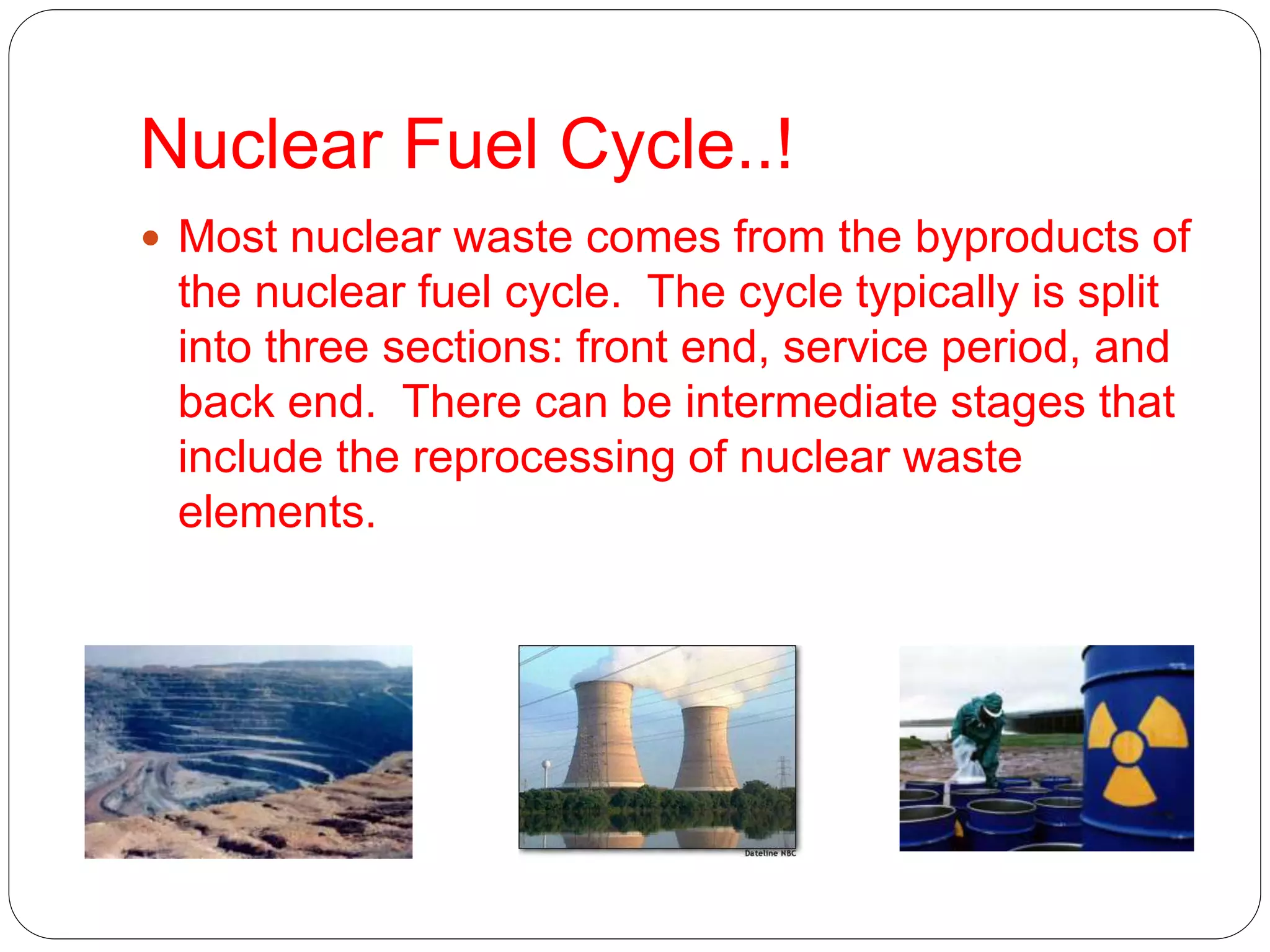
 Most nuclear waste comes from the byproducts of
the nuclear fuel cycle. The cycle typically is split
into three sections: front end, service period, and
back end. There can be intermediate stages that
include the reprocessing of nuclear waste
elements.
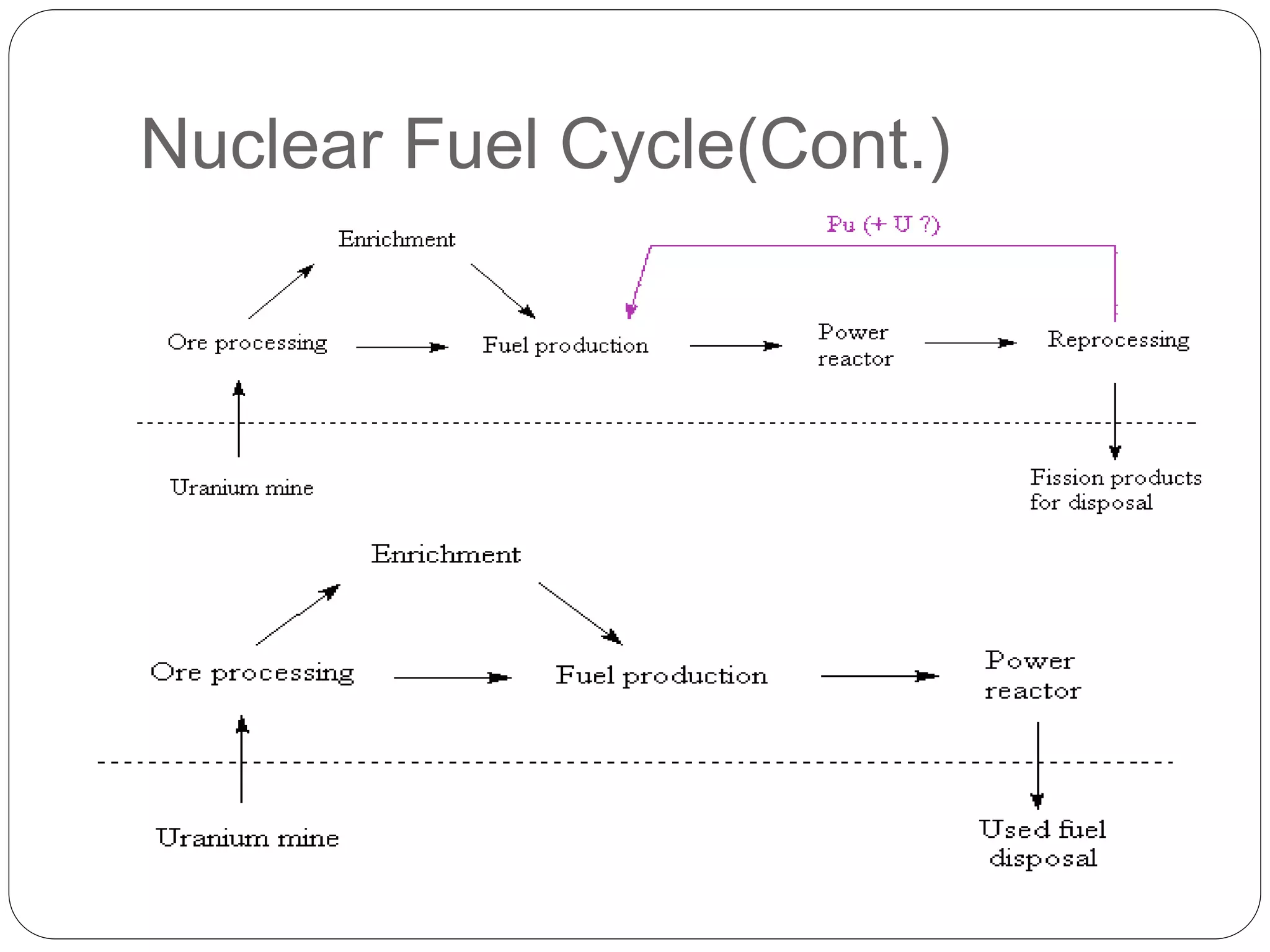
Nuclear Fuel Cycle(Cont.)
Classifications
 Nuclear waste is segregated into several
classifications.
 Low level waste is not dangerous but sometimes
requires shielding during handling.
 Intermediate level waste typically is chemical sludge
and other products from reactors.
 High level waste consists of fissionable elements from
reactor cores and transuranic wastes.
 Transuranic waste is any waste with transuranic alpha
emitting radionuclides that have half-lives longer than
20 years.
Intermediate Level Waste
ILW
 Intermediate level waste requires shielding when
being handled.
 7% volume of waste
 Dependent on the amount of activity it can be
buried in shallow repositories.
 Not recognized in the United States.
High Level Waste
HLW
 High level waste has a large amount of
radioactive activity and is thermally hot.
 3% volume of waste
 95% of radioactivity
 Current levels of HLW are increasing about
12,000 metric tons per year.
 Most HLW consists of Pu-238, 239, 240, 241,
242, Np-237, U-236
 High level waste has a large amount of
radioactive activity and is thermally hot.
 3% volume of waste
 95% of radioactivity
 Current levels of HLW are increasing about
12,000 metric tons per year.
 Most HLW consists of Pu-238, 239, 240, 241,
242, Np-237, U-236
High Level Waste
HLW
Transuranic Waste
TRUW
 Transuranic waste consists of all waste that has
radionuclides above uranium.
 TRUWs typically have longer half-lives than other
forms of waste.
 Typically a byproduct of weapons manufacturing.
 Only recognized in the United States.
Creation of Nuclear Waste
• Nuclear waste is generated at all points of the
fuel cycle.
• Front end waste consists primarily of low level
alpha emission waste.
• Service period waste typically includes LLW
and ILW such as contaminated reactor
housings and waste from daily operation.
• Back end waste normally is the most
radioactive and includes spent fuel rods and
reactor cores.
Service Period Waste
 Consists of mostly ILW.
 Mostly waste produced at the plant during normal
operation.
 Spent fuel rods are the most dangerous waste
produced during the service period.
Back End Waste
 Nuclear waste developed during the back end
of the fuel cycle is the most dangerous and
includes most of the HLW produced.
 Most back end waste emits both gamma and
beta particles.
 Also uranium-234, neptunium-237, plutonium-
238 and americium-241are found in back end
waste.
Waste Management (LLW)
 There are several options available for the disposal of
LLW due to its lack of radioactivity.
 Waste Isolation Pilot Plant
 On-site disposal
Treatment (LLW)
 Filtration
 Ion Exchange
 Evaporation
 Incineration
 Compaction
 Solidification
Waste Management (HLW)
 Most common utilized option are reactor pools
and dry cask storage.
 Other Options for waste management include:
 Deep Geologoical Storage
 Transmutation
 Reuse
 Launching it into space
Treatment
 Most common initial treatment of waste is
vitrification.
 Waste is first mixed with sugar and then passed
through a heated tube to de-nitrite the material.
 This material is then fed into a furnace and mixed
with glass.
 The molten glass mixture is poured into steel
cylinders and welded shut.
Deep Geological Repository
 Most common method for handling nuclear waste.
 Typically kept separate from actual plants and buried
far below ground.
 First used in 1999 in the US.
 Current research is focusing on Yucca Mountain.
Transmutation of Nuclear Waste
 Reduces transuranic waste.
 Integral Fast Reactor
 Banned 1977-1981 (U.S.)
 MOX Fuel
 Behaves as low-enriched uranium
 Research now in subcritical reactors.
 Fusion also being researched.
Reuse of Nuclear Waste
 Research is being performed to find uses for
nuclear waste.
 Caesium-137 and strontium-90 already used in
industrial applications.
 Some waste can be used for radioisotope
thermoelectric generators (RTGs).
 Overall can reduce total HLW but not eliminate it.
Launch it into Space
 Near infinite storage space
 Completely removes waste from biosphere
 Technical risks and problems
 Political entanglements
Conclusions
 HLW is most dangerous
byproduct of nuclear
power.
 Borosilicate glass most
common storage.
 Several venues being
researched for the safe
disposal of HLW.
Nuclear waste

Nuclear waste

  • 1.
    A TECHNICAL ANALYSIS NUCLEARWASTE BY: Arpit Modh (16BCH035) B.Tech Chemical Nirma University, Ahmedabad. Environment Studies
  • 2.
    Nuclear Waste…WHY? • Recentlynuclear power has entered many discussions as world energy needs rise and oil reserves diminish. • Most opponents of nuclear power point to two main arguments: meltdowns and nuclear waste. • Nuclear waste is any form of byproduct or end product that releases radioactivity. • How to safely dispose of nuclear waste is pivotal for the continued operation of nuclear power plants, safety of people living around dump sites, and prevention of proliferation of nuclear materials to non- nuclear states.
  • 3.
    Nuclear Fuel Cycle..! Most nuclear waste comes from the byproducts of the nuclear fuel cycle. The cycle typically is split into three sections: front end, service period, and back end. There can be intermediate stages that include the reprocessing of nuclear waste elements.
  • 4.
  • 5.
    Classifications  Nuclear wasteis segregated into several classifications.  Low level waste is not dangerous but sometimes requires shielding during handling.  Intermediate level waste typically is chemical sludge and other products from reactors.  High level waste consists of fissionable elements from reactor cores and transuranic wastes.  Transuranic waste is any waste with transuranic alpha emitting radionuclides that have half-lives longer than 20 years.
  • 6.
    Intermediate Level Waste ILW Intermediate level waste requires shielding when being handled.  7% volume of waste  Dependent on the amount of activity it can be buried in shallow repositories.  Not recognized in the United States.
  • 7.
    High Level Waste HLW High level waste has a large amount of radioactive activity and is thermally hot.  3% volume of waste  95% of radioactivity  Current levels of HLW are increasing about 12,000 metric tons per year.  Most HLW consists of Pu-238, 239, 240, 241, 242, Np-237, U-236
  • 8.
     High levelwaste has a large amount of radioactive activity and is thermally hot.  3% volume of waste  95% of radioactivity  Current levels of HLW are increasing about 12,000 metric tons per year.  Most HLW consists of Pu-238, 239, 240, 241, 242, Np-237, U-236 High Level Waste HLW
  • 9.
    Transuranic Waste TRUW  Transuranicwaste consists of all waste that has radionuclides above uranium.  TRUWs typically have longer half-lives than other forms of waste.  Typically a byproduct of weapons manufacturing.  Only recognized in the United States.
  • 10.
    Creation of NuclearWaste • Nuclear waste is generated at all points of the fuel cycle. • Front end waste consists primarily of low level alpha emission waste. • Service period waste typically includes LLW and ILW such as contaminated reactor housings and waste from daily operation. • Back end waste normally is the most radioactive and includes spent fuel rods and reactor cores.
  • 11.
    Service Period Waste Consists of mostly ILW.  Mostly waste produced at the plant during normal operation.  Spent fuel rods are the most dangerous waste produced during the service period.
  • 12.
    Back End Waste Nuclear waste developed during the back end of the fuel cycle is the most dangerous and includes most of the HLW produced.  Most back end waste emits both gamma and beta particles.  Also uranium-234, neptunium-237, plutonium- 238 and americium-241are found in back end waste.
  • 13.
    Waste Management (LLW) There are several options available for the disposal of LLW due to its lack of radioactivity.  Waste Isolation Pilot Plant  On-site disposal
  • 14.
    Treatment (LLW)  Filtration Ion Exchange  Evaporation  Incineration  Compaction  Solidification
  • 15.
    Waste Management (HLW) Most common utilized option are reactor pools and dry cask storage.  Other Options for waste management include:  Deep Geologoical Storage  Transmutation  Reuse  Launching it into space
  • 16.
    Treatment  Most commoninitial treatment of waste is vitrification.  Waste is first mixed with sugar and then passed through a heated tube to de-nitrite the material.  This material is then fed into a furnace and mixed with glass.  The molten glass mixture is poured into steel cylinders and welded shut.
  • 17.
    Deep Geological Repository Most common method for handling nuclear waste.  Typically kept separate from actual plants and buried far below ground.  First used in 1999 in the US.  Current research is focusing on Yucca Mountain.
  • 18.
    Transmutation of NuclearWaste  Reduces transuranic waste.  Integral Fast Reactor  Banned 1977-1981 (U.S.)  MOX Fuel  Behaves as low-enriched uranium  Research now in subcritical reactors.  Fusion also being researched.
  • 19.
    Reuse of NuclearWaste  Research is being performed to find uses for nuclear waste.  Caesium-137 and strontium-90 already used in industrial applications.  Some waste can be used for radioisotope thermoelectric generators (RTGs).  Overall can reduce total HLW but not eliminate it.
  • 20.
    Launch it intoSpace  Near infinite storage space  Completely removes waste from biosphere  Technical risks and problems  Political entanglements
  • 21.
    Conclusions  HLW ismost dangerous byproduct of nuclear power.  Borosilicate glass most common storage.  Several venues being researched for the safe disposal of HLW.