Radioactive Waste Classification, Treatment,
Storage & Disposal
Dr. M. Moinul Islam
Chief Scientific Officer and Head
Health Physics & Radioactive Waste Management Unit
Atomic Energy Research Establishment
Bangladesh Atomic Energy Commission
Training Course on Radiation Protection for Radiation
Workers and RCOs’ of BAEC Medical Facilities and
Industries
24-28 October 2021
Radioactive Waste
 Radioactive material not intended for further utilisation
 Spent Fuel: Nuclear fuel, used in the nuclear reactor,
which due to its potential reuse cannot be deemed as
waste
Generation
Pre-disposal management
Disposal
Generic roadmap / Basic steps
Generic roadmap
Radioactive Waste
Management
Pre disposal Disposal
Spent nuclear fuel
 Large inventory, large
number of radionuclides
Nuclear fuel cycle - Power generation
Operational waste
Ion exchange resins, evaporation and
filtering residues
 Metal scrap, thermal insulation
material, protective clothing
 Very low to medium level concentrations
of RN
Waste Arisings (cont)
 Large amounts
Very low to high concentrations - mainly activation products
Decommissioning Waste
Worker protective clothing
– Disposable (shoe covers, gloves, paper, tape)
– Re-useable (boots, respirators, coveralls)
Nuclear fuel cycle - Power generation
Secondary Waste Streams
Nature of Radioactive Waste Generation in
Bangladesh
 Industry, Research, Nuclear Medicine & Education
 Research Reactor
 Gamma Irradiator
 Teletherapy
 RI Production Facility
Nature of Radioactive Waste Generation in
Bangladesh
 Cs-137 Brachetherapy
Spent Sealed Radioactive Source
 Cs-137 Teletherapy unit
From Hospitals, clinics, Industry etc.
 industrial radiography
 Soil moisture and density & other industrial gauges, smoke detectors,
calibration sources
NORM Residue
RR
Research
RIPD
Medical
Industry
Others
Orphan
1993 - 2019
Waste arising from different stakeholders
in the country
The Waste Classification Scheme
 Exempt waste (EW)
 Very low level waste (VLLW)
 Very short lived waste (VSLW)
 Low level waste (LLW)
 Intermediate level waste (ILW)
 High level waste (HLW)
Very Low Level Waste (VLLW)
• Waste containing material that can be slightly above
the exempt region
• Waste does not need a high level of containment and
isolation
• Near surface landfill type facilities is generally suitable
for disposal
• Typical waste would include soil and rubble with
activity low enough not to require shielding
• Concentrations of long lived radionuclides are generally
very limited
Waste that meets the criteria for
clearance, exemption or exclusion
from regulation control for radiation
purposes as described in Safety
Guide RS-G-1.7 “Application of the
Concepts of Exclusion, Exemption
and Clearance” (2004)
Exempt Waste (EW)
• Waste that can be stored for decay over a limited period
of up to a few years and subsequently cleared from
regulatory control for uncontrolled disposal, use or
discharge.
• This class includes waste containing primarily
radionuclides with very short half-lives often used for
research and medical purposes.
Very Short Lived Waste (VSLW)
Low Level Waste (LLW)
• Waste that contains material with radionuclide content
above clearance levels, but with limited amounts of long
lived radionuclides
• Requires robust isolation and containing for periods of up
to a few hundred years
• Suitable for disposal in near surface trenches or engineered
near surface facilities
• This class covers a very broad band of waste, and may
includes:
– short lived radionuclides at higher levels of activity
concentrations
– some long lived radionuclides only at relatively low
levels of activity concentrations
Intermediate level waste (ILW)
• Waste with higher content of long lived radionuclides
• Requires a higher level of containment and isolation than
is provided by near surface disposal
• Needs little or no provision for heat dissipation during its
handling, transportation and disposal.
• May contain long lived radionuclides (in particular Alpha-
emitters) that will not decay to an acceptable activity level
during the time which institutional controls can be relied
upon
• Waste in this class requires disposal at greater depth than
near surface disposal, of the order of tens of meters to a
few hundred meters
• Levels of activity concentrations high enough to generate
significant quantities of heat by the radioactive decay
process
• Large amounts of long lived radionuclides that need to be
considered in the design of a disposal facility for such waste
• Disposal in deep, stable geological formations, usually
several hundreds m or more is the generally recognized
option for disposal
High Level Waste (HLW)
Half-life
Activity
content
VSLW
very short lived
waste
(decay storage)
HLW
high level waste
(deep geologic disposal)
ILW
intermediate level waste
(intermediate depth disposal)
LLW
low level waste
(near surface disposal)
VLLW
very low level waste
(landfill disposal)
EW
exempt waste
(exemption / clearance)
Classification Scheme
The Categorization and its use
Category Examples of practices Activity Ratio
A/D
1 RTG’s; Irradiators;
teletherapy; gamma knife
A/D≥1000
2 Gamma radiography
brachytherapy (HDR/MDR)
1000>A/D≥10
3 Fixed industrial gauges
(e.g.: level, dredger, conveyor gauges)
Well logging
10> A/D ≥1
4 Brachytherapy (LDR): portable gauges;
static eliminators; bone densitometers
1> A/D≥ 0.01
5 smoke detectors, calibration sources, XRF;
ECD,
0.01>A/D>Exe
mpt/D
A = source activity; D = radionuclide-specific ”dangerous” activity
Pre-disposal includes all steps carried out prior to disposal,
such as
-pre-treatment,
-treatment,
-conditioning,
-immobilisation,
-storage and
-transport activities
 Decommissioning is a part of pre-disposal management
Pre-disposal
Pre-treatment of radioactive waste is the initial step in
waste management that occurs after waste generation.
Pre-treatment consists of:
- Collection
- Segregation
- Chemical adjustment
- Decontamination
Pre-treatment may include a period of interim storage.
Pre-treatment
Segregation & Interim Storage of NORM Residue
Waste characterization involves a collection of data that
pertains to specific waste properties as well as processing
parameters and quality assurance. Key elements include
the following:
Radioactivity properties
Chemical properties
 Physical properties
Mechanical properties
Thermal properties
Waste Characterisation
Solid Radioactive Waste Characterisation
Treatment of radioactive waste includes those
operations intended to improve safety or economy
by changing the characteristics of the radioactive
waste.
The basic treatment objectives are:
- Volume reduction
- Radionuclide removal
- Change of physical / Chemical composition
Treatment
Conditioning:those operations that transform radioactive
waste into a form suitable for handling, transportation,
storage and disposal
May include immobilisation, placing the waste into
containers and providing additional packaging
Immobilisation can be performed by cement, bitumen or
glass matrices.
Conditioning
Waste Immobilisation
Converts raw waste, usually containing mobile
contaminants, into a solid and stable form termed a waste
form by solidification
Immobilisation reduces the potential for migration or
dispersion of radionuclides During handling,
transportation, storage and disposal
Main immobilisation technologies:
Cementation
Bituminisation
Vitrification
Waste Immobilisation
Cementation
Physically surround
waste component with set
cement
Waste Treatment
Bituminisation
Bituminisation: The process of incorporating waste into a
bitumen matrix as a means of Immobilisation.
Bitumen: The term bitumen refers a wide range of
hydrocarbons with high molecular weight, Commercially
available as a residue of petroleum or coal tar refining.
Bitumen is used as a matrix for the immobilisation of low and
intermediate level waste.
Waste Vitrification
Nuclear Waste Vitrification
The process of incorporating materials into glass or glass-like
form. Vitrificationis commonly applied to the solidification of
liquid high level waste from the reprocessing of spent fuel
Vitrification is a mature technology and has been used for
high level nuclear waste (HLW) immobilisation for more than
40 years in France, Germany and Belgium, Russia, UK, Japan
and the USA
In most countries HLW has been incorporated into alkali
borosilicate or phosphate vitreous waste forms for many years
and vitrification is an established technology
Packing is preparation of radioactive waste for safe
handling, transportation, storage and disposal by
means of enclosing it in a suitable container.
In many instances, treatment and conditioning take
place in close conjunction with one another.
Conditioning - packing
Storage of radioactive waste involves maintaining the
radioactive waste such that:
isolation, environmental protection and monitoring are provided
Storage may be practiced for:
decay, -thermal considerations prior to geological disposal.
In other cases, storage may be practiced for reasons of
economics or policy.
Storage
Transportation may be necessary between the radioactive
waste management steps.
Transportation
Disposal comprises mainly
emplacement of waste in a
repository.
Disposal may also comprise
the discharge of effluents
into the environment within
authorized limits, with
subsequent dispersion.
(Suitable only for limited amounts of
specific radioactive waste.)
Disposal
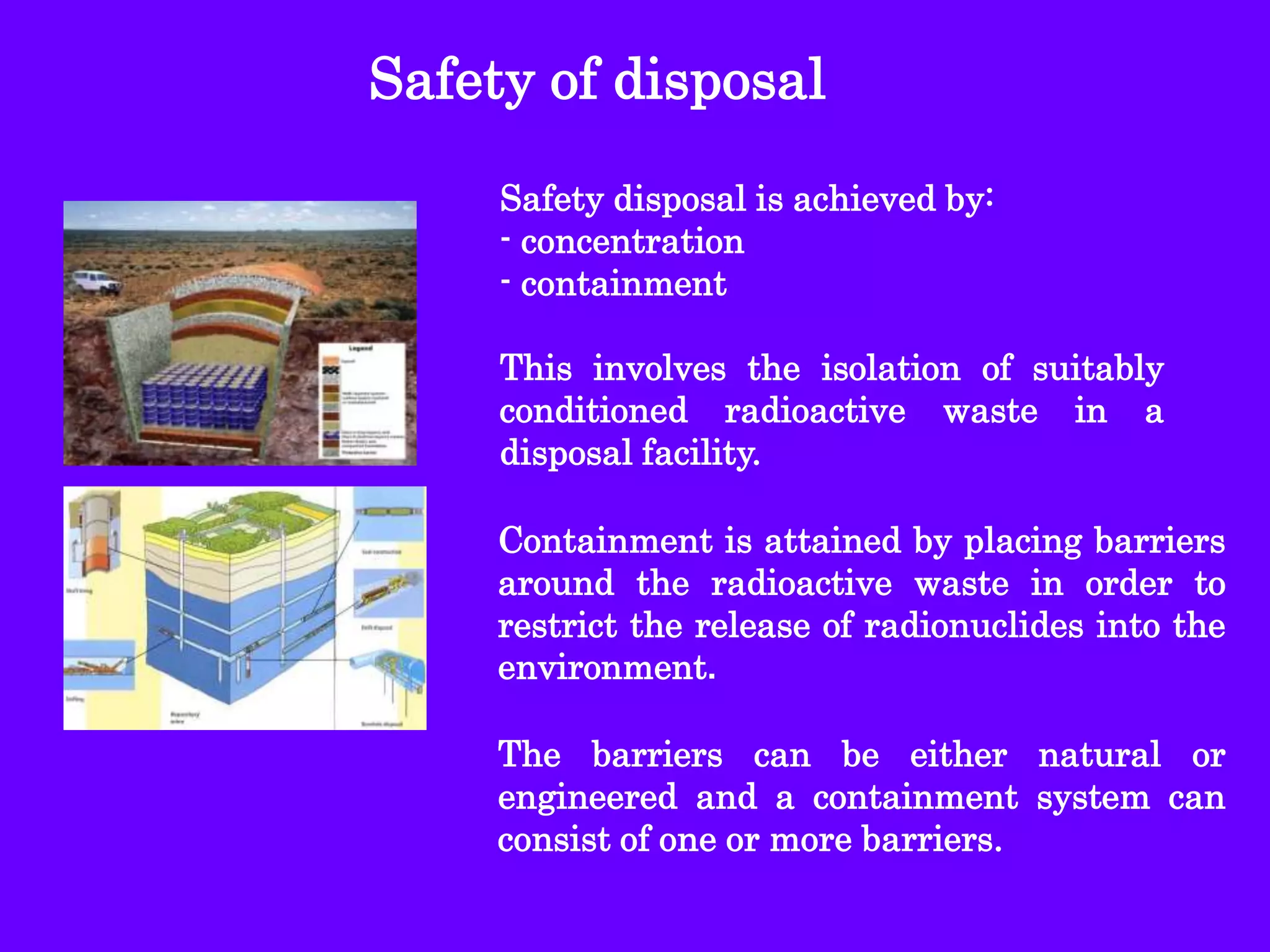
Safety disposal is achieved by:
- concentration
- containment
This involves the isolation of suitably
conditioned radioactive waste in a
disposal facility.
Containment is attained by placing barriers
around the radioactive waste in order to
restrict the release of radionuclides into the
environment.
The barriers can be either natural or
engineered and a containment system can
consist of one or more barriers.
Safety of disposal
Barriers can either provide:
-absolute containment for a
period of time or
-may retard the release of
radioactive materials to the
environment.
During the period when the
radioactive waste is
contained by the system of
barriers, the radionuclides in
the waste will also decay.
Multiple barrier system
Stages of the siting process
 conceptual and planning stage
 area survey stage
 site characterization stage
 site confirmation stage
 To identify desirable site features which can be used as a
basis for the area survey stage
 The human and financial resources
 Types of wastes to be disposed of
 Projected waste volumes and radionuclide contents
On the basis of this information, generic facility design
concepts should be developed
Conceptual and planning stage
The purpose of the area survey stage is to identify one or more
potential sites
 Systematic screening of a region of interest,
Constraints: engineering, operational, socioeconomic &
environmental constraints (it is necessary to take into
account)
The area survey stage generally involves two phases:
 regional mapping to identify areas with potentially suitable
sites
 screening to select potential sites for further evaluation
Area Survey Stage
Site Characterization Stage
 Requires site specific information to establish the
characteristics and the ranges of parameters of a site with
respect to the location of the intended disposal facility.
 Require on-site investigation and laboratory studies to
obtain data on geological, geochemical & hydrogeological
conditions
At the conclusion of the site characterisation stage, a
preferred site or sites should be identified, taking into
account the relevant economic, environmental, social and
political considerations.
 A report on the entire process should be prepared, with
complete documentation of all data and analytical work.
Site Characterisation Stage
To conduct detailed site investigations at the preferred site(s)
to:
 support or confirm the selection;
provide additional site specific information required for
detailed design, safety and environmental impact assessment
and licensing.
Consists of detailed laboratory studies and field
investigation of the preferred site(s) and its (their)
surroundings prior to the start of construction.
Site Confirmation Stage
 Detailed specifications of the site(s) should be established to
allow final detailed design
 Radiological, radionuclide transport and ecological
evaluations should be carried out in detail.
Site Confirmation Stage
 Safety analysis data and models should be updated for the
specific site(s)
 Detailed safety and environmental impact analysis should
be performed using all the detailed information available
 Extensive laboratory studies and in situ testing should
be conducted.
 In situ tests, together with results of laboratory studies,
should provide site specific data for radionuclide transport
modelling
Site Confirmation Stage

Radioactive Waste Classification, Treatment, Storage & Disposal

  • 1.
    Radioactive Waste Classification,Treatment, Storage & Disposal Dr. M. Moinul Islam Chief Scientific Officer and Head Health Physics & Radioactive Waste Management Unit Atomic Energy Research Establishment Bangladesh Atomic Energy Commission Training Course on Radiation Protection for Radiation Workers and RCOs’ of BAEC Medical Facilities and Industries 24-28 October 2021
  • 2.
    Radioactive Waste  Radioactivematerial not intended for further utilisation  Spent Fuel: Nuclear fuel, used in the nuclear reactor, which due to its potential reuse cannot be deemed as waste
  • 3.
  • 4.
  • 5.
    Spent nuclear fuel Large inventory, large number of radionuclides Nuclear fuel cycle - Power generation Operational waste Ion exchange resins, evaporation and filtering residues  Metal scrap, thermal insulation material, protective clothing  Very low to medium level concentrations of RN Waste Arisings (cont)
  • 6.
     Large amounts Verylow to high concentrations - mainly activation products Decommissioning Waste
  • 7.
    Worker protective clothing –Disposable (shoe covers, gloves, paper, tape) – Re-useable (boots, respirators, coveralls) Nuclear fuel cycle - Power generation Secondary Waste Streams
  • 8.
    Nature of RadioactiveWaste Generation in Bangladesh  Industry, Research, Nuclear Medicine & Education
  • 9.
     Research Reactor Gamma Irradiator  Teletherapy  RI Production Facility Nature of Radioactive Waste Generation in Bangladesh
  • 10.
     Cs-137 Brachetherapy SpentSealed Radioactive Source  Cs-137 Teletherapy unit From Hospitals, clinics, Industry etc.  industrial radiography  Soil moisture and density & other industrial gauges, smoke detectors, calibration sources
  • 11.
  • 12.
    RR Research RIPD Medical Industry Others Orphan 1993 - 2019 Wastearising from different stakeholders in the country
  • 13.
    The Waste ClassificationScheme  Exempt waste (EW)  Very low level waste (VLLW)  Very short lived waste (VSLW)  Low level waste (LLW)  Intermediate level waste (ILW)  High level waste (HLW)
  • 14.
    Very Low LevelWaste (VLLW) • Waste containing material that can be slightly above the exempt region • Waste does not need a high level of containment and isolation • Near surface landfill type facilities is generally suitable for disposal • Typical waste would include soil and rubble with activity low enough not to require shielding • Concentrations of long lived radionuclides are generally very limited
  • 15.
    Waste that meetsthe criteria for clearance, exemption or exclusion from regulation control for radiation purposes as described in Safety Guide RS-G-1.7 “Application of the Concepts of Exclusion, Exemption and Clearance” (2004) Exempt Waste (EW)
  • 16.
    • Waste thatcan be stored for decay over a limited period of up to a few years and subsequently cleared from regulatory control for uncontrolled disposal, use or discharge. • This class includes waste containing primarily radionuclides with very short half-lives often used for research and medical purposes. Very Short Lived Waste (VSLW)
  • 17.
    Low Level Waste(LLW) • Waste that contains material with radionuclide content above clearance levels, but with limited amounts of long lived radionuclides • Requires robust isolation and containing for periods of up to a few hundred years • Suitable for disposal in near surface trenches or engineered near surface facilities • This class covers a very broad band of waste, and may includes: – short lived radionuclides at higher levels of activity concentrations – some long lived radionuclides only at relatively low levels of activity concentrations
  • 18.
    Intermediate level waste(ILW) • Waste with higher content of long lived radionuclides • Requires a higher level of containment and isolation than is provided by near surface disposal • Needs little or no provision for heat dissipation during its handling, transportation and disposal. • May contain long lived radionuclides (in particular Alpha- emitters) that will not decay to an acceptable activity level during the time which institutional controls can be relied upon • Waste in this class requires disposal at greater depth than near surface disposal, of the order of tens of meters to a few hundred meters
  • 19.
    • Levels ofactivity concentrations high enough to generate significant quantities of heat by the radioactive decay process • Large amounts of long lived radionuclides that need to be considered in the design of a disposal facility for such waste • Disposal in deep, stable geological formations, usually several hundreds m or more is the generally recognized option for disposal High Level Waste (HLW)
  • 20.
    Half-life Activity content VSLW very short lived waste (decaystorage) HLW high level waste (deep geologic disposal) ILW intermediate level waste (intermediate depth disposal) LLW low level waste (near surface disposal) VLLW very low level waste (landfill disposal) EW exempt waste (exemption / clearance) Classification Scheme
  • 21.
    The Categorization andits use Category Examples of practices Activity Ratio A/D 1 RTG’s; Irradiators; teletherapy; gamma knife A/D≥1000 2 Gamma radiography brachytherapy (HDR/MDR) 1000>A/D≥10 3 Fixed industrial gauges (e.g.: level, dredger, conveyor gauges) Well logging 10> A/D ≥1 4 Brachytherapy (LDR): portable gauges; static eliminators; bone densitometers 1> A/D≥ 0.01 5 smoke detectors, calibration sources, XRF; ECD, 0.01>A/D>Exe mpt/D A = source activity; D = radionuclide-specific ”dangerous” activity
  • 22.
    Pre-disposal includes allsteps carried out prior to disposal, such as -pre-treatment, -treatment, -conditioning, -immobilisation, -storage and -transport activities  Decommissioning is a part of pre-disposal management Pre-disposal
  • 23.
    Pre-treatment of radioactivewaste is the initial step in waste management that occurs after waste generation. Pre-treatment consists of: - Collection - Segregation - Chemical adjustment - Decontamination Pre-treatment may include a period of interim storage. Pre-treatment
  • 24.
    Segregation & InterimStorage of NORM Residue
  • 25.
    Waste characterization involvesa collection of data that pertains to specific waste properties as well as processing parameters and quality assurance. Key elements include the following: Radioactivity properties Chemical properties  Physical properties Mechanical properties Thermal properties Waste Characterisation
  • 26.
    Solid Radioactive WasteCharacterisation
  • 27.
    Treatment of radioactivewaste includes those operations intended to improve safety or economy by changing the characteristics of the radioactive waste. The basic treatment objectives are: - Volume reduction - Radionuclide removal - Change of physical / Chemical composition Treatment
  • 28.
    Conditioning:those operations thattransform radioactive waste into a form suitable for handling, transportation, storage and disposal May include immobilisation, placing the waste into containers and providing additional packaging Immobilisation can be performed by cement, bitumen or glass matrices. Conditioning
  • 29.
    Waste Immobilisation Waste Immobilisation Convertsraw waste, usually containing mobile contaminants, into a solid and stable form termed a waste form by solidification Immobilisation reduces the potential for migration or dispersion of radionuclides During handling, transportation, storage and disposal Main immobilisation technologies: Cementation Bituminisation Vitrification
  • 30.
  • 31.
    Waste Treatment Bituminisation Bituminisation: Theprocess of incorporating waste into a bitumen matrix as a means of Immobilisation. Bitumen: The term bitumen refers a wide range of hydrocarbons with high molecular weight, Commercially available as a residue of petroleum or coal tar refining. Bitumen is used as a matrix for the immobilisation of low and intermediate level waste.
  • 32.
    Waste Vitrification Nuclear WasteVitrification The process of incorporating materials into glass or glass-like form. Vitrificationis commonly applied to the solidification of liquid high level waste from the reprocessing of spent fuel Vitrification is a mature technology and has been used for high level nuclear waste (HLW) immobilisation for more than 40 years in France, Germany and Belgium, Russia, UK, Japan and the USA In most countries HLW has been incorporated into alkali borosilicate or phosphate vitreous waste forms for many years and vitrification is an established technology
  • 33.
    Packing is preparationof radioactive waste for safe handling, transportation, storage and disposal by means of enclosing it in a suitable container. In many instances, treatment and conditioning take place in close conjunction with one another. Conditioning - packing
  • 34.
    Storage of radioactivewaste involves maintaining the radioactive waste such that: isolation, environmental protection and monitoring are provided Storage may be practiced for: decay, -thermal considerations prior to geological disposal. In other cases, storage may be practiced for reasons of economics or policy. Storage
  • 35.
    Transportation may benecessary between the radioactive waste management steps. Transportation
  • 36.
    Disposal comprises mainly emplacementof waste in a repository. Disposal may also comprise the discharge of effluents into the environment within authorized limits, with subsequent dispersion. (Suitable only for limited amounts of specific radioactive waste.) Disposal
  • 37.
    Safety disposal isachieved by: - concentration - containment This involves the isolation of suitably conditioned radioactive waste in a disposal facility. Containment is attained by placing barriers around the radioactive waste in order to restrict the release of radionuclides into the environment. The barriers can be either natural or engineered and a containment system can consist of one or more barriers. Safety of disposal
  • 38.
    Barriers can eitherprovide: -absolute containment for a period of time or -may retard the release of radioactive materials to the environment. During the period when the radioactive waste is contained by the system of barriers, the radionuclides in the waste will also decay. Multiple barrier system
  • 39.
    Stages of thesiting process  conceptual and planning stage  area survey stage  site characterization stage  site confirmation stage
  • 40.
     To identifydesirable site features which can be used as a basis for the area survey stage  The human and financial resources  Types of wastes to be disposed of  Projected waste volumes and radionuclide contents On the basis of this information, generic facility design concepts should be developed Conceptual and planning stage
  • 41.
    The purpose ofthe area survey stage is to identify one or more potential sites  Systematic screening of a region of interest, Constraints: engineering, operational, socioeconomic & environmental constraints (it is necessary to take into account) The area survey stage generally involves two phases:  regional mapping to identify areas with potentially suitable sites  screening to select potential sites for further evaluation Area Survey Stage
  • 42.
    Site Characterization Stage Requires site specific information to establish the characteristics and the ranges of parameters of a site with respect to the location of the intended disposal facility.  Require on-site investigation and laboratory studies to obtain data on geological, geochemical & hydrogeological conditions
  • 43.
    At the conclusionof the site characterisation stage, a preferred site or sites should be identified, taking into account the relevant economic, environmental, social and political considerations.  A report on the entire process should be prepared, with complete documentation of all data and analytical work. Site Characterisation Stage
  • 44.
    To conduct detailedsite investigations at the preferred site(s) to:  support or confirm the selection; provide additional site specific information required for detailed design, safety and environmental impact assessment and licensing. Consists of detailed laboratory studies and field investigation of the preferred site(s) and its (their) surroundings prior to the start of construction. Site Confirmation Stage
  • 45.
     Detailed specificationsof the site(s) should be established to allow final detailed design  Radiological, radionuclide transport and ecological evaluations should be carried out in detail. Site Confirmation Stage  Safety analysis data and models should be updated for the specific site(s)  Detailed safety and environmental impact analysis should be performed using all the detailed information available
  • 46.
     Extensive laboratorystudies and in situ testing should be conducted.  In situ tests, together with results of laboratory studies, should provide site specific data for radionuclide transport modelling Site Confirmation Stage