NUCLEAR WASTE DESPOSAL-
GEOLOGICAL IMPORTANCE
PREPARED BY:
SURANI HARDIK 120070106036
SUB TEACHER:
PROF. D.S. MODI
PREVIEW
Nuclear Waste
How It Works
Types and Categories of Nuclear Waste
Potentials to Harm the Environment
Procedures to Remove the Wastes
Effectiveness of the Procedures
Nuclear waste disposal
NUCLEAR WASTE
• Nuclear waste is the radioactive waste produced by nuclear reactors, or
left over from research projects, medical uses, and the manufacture of
nuclear weapons It categorized as;
High-level Waste (HLW),
Intermediate Waste (ILW)
Low-level Waste (LLW)
• The nuclear wastes are composed of a combination of uranium,
plutonium, and other radioactive elements such as neptunium, americium,
curium, etc.
How Nuclear fuel is used
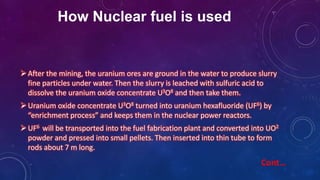
After the mining, the uranium ores are ground in the water to produce slurry
fine particles under water. Then the slurry is leached with sulfuric acid to
dissolve the uranium oxide concentrate U3O8 and then take them.
Uranium oxide concentrate U3O8 turned into uranium hexafluoride (UF6) by
“enrichment process” and keeps them in the nuclear power reactors.
UF6 will be transported into the fuel fabrication plant and converted into UO2
powder and pressed into small pellets. Then inserted into thin tube to form
rods about 7 m long.
Cont…
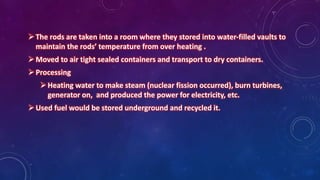
The rods are taken into a room where they stored into water-filled vaults to
maintain the rods’ temperature from over heating .
Moved to air tight sealed containers and transport to dry containers.
Processing
Heating water to make steam (nuclear fission occurred), burn turbines,
generator on, and produced the power for electricity, etc.
Used fuel would be stored underground and recycled it.
Categories of Nuclear waste
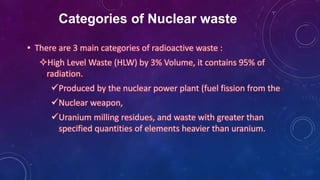
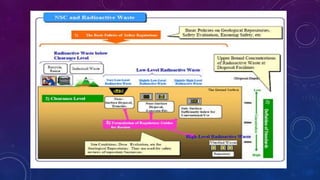
• There are 3 main categories of radioactive waste :
High Level Waste (HLW) by 3% Volume, it contains 95% of
radiation.
Produced by the nuclear power plant (fuel fission from the
Nuclear weapon,
Uranium milling residues, and waste with greater than
specified quantities of elements heavier than uranium.
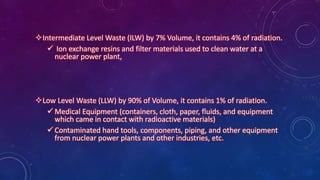
Intermediate Level Waste (ILW) by 7% Volume, it contains 4% of radiation.
 Ion exchange resins and filter materials used to clean water at a
nuclear power plant,
Low Level Waste (LLW) by 90% of Volume, it contains 1% of radiation.
 Medical Equipment (containers, cloth, paper, fluids, and equipment
which came in contact with radioactive materials)
 Contaminated hand tools, components, piping, and other equipment
from nuclear power plants and other industries, etc.
Potential to harm the environment
• It radioactive waste is potentially dangerous because they emit ionizing
radiation, which can damage to human health such as; produce mutations
and birth defects, and cause cancer. The degree of risk depends upon the
level, and type, of radioactivity, with some materials being very hazardous in
raw form, and others posing little threat in most circumstances.
Procedures to remove Radioactive wastes
High Level Waste (HWL)
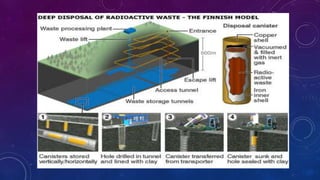
• Deep Geological Disposal
The principle of geological disposal is to isolate the waste deep inside a
suitable host formation, e.g. granite, salt or clay. The waste is placed in
an underground facility or disposal facility, designed to ensure that a
system of natural and multiple artificial barriers work together to
prevent radioactivity from escaping. Placed in dry barrels with air
conditioner or in the barrel put water. It because water used to cool
down the fuel and it works to protect workers from the radiations. It
will lost its radiation in about 10 years by 90 %. It also can be recycled.
• Notre Dame Thorium Borate-1 (NTDB-1)
 It is a new invention of 2012 by Notre Dame University. It is a
crystalline compound that can be tailored to safely absorb radioactive
ions from nuclear waste streams. It traps both Tc-99 (technetium, half-
life 220,000 years) and I-129 (Iodine-129) and half-life 15.7 million
years, Their unique electronic properties lead to applications in a wide
variety of areas ranging from magnetism to catalysis. By testing this
substance into Tc-99, it removes 70%-90% of the radiation.
Intermediate Level Waste (ILW) and Low Level Waste (LLW)
• Disposal
The disposal between intermediate and low level waste are pretty
similar. Only the Intermediate level disposal is going to be close to
the surface, about 18 m down placed in a concrete and sealed it in
steel drums. The low level disposal could be just open on the
surface. Also for the low disposal could be a normal waste after 15
years.
• Sulfide sponge:
• Strontium-90 is a particularly harmful component of nuclear waste with a
half-life of about 30 years. But finding Sr2+ ions is like searching for a
needle in a haystack: non-radioactive ions of sodium (Na+) and calcium
(Ca2+) are a million times more numerous, positively charged and around
the same size. Sulfide sponge used a layered metal sulfide called KMS-1
containing potassium, manganese and tin. This material is a simple ion-
exchanger, capable of swapping potassium ions for heavier ones - and
then holding onto them.
• They tested KMS-1, which looks like a brown powder, by packing it into
porous bags similar to tea bags. When they dipped the bag into a
sodium-rich solution of strontium - resembling the conditions in
nuclear waste - it removed 99.8 per cent of the strontium.
Effectiveness of the procedures
• Generally, disposal is the regular procedure that is used by the
nuclear powered countries these days. However, by finding new
fastest and effective ways to remove the radiations like the sulfide
sponge or Notre Dame Thorium Borate-1 would also helping the
radioactive waste removal.
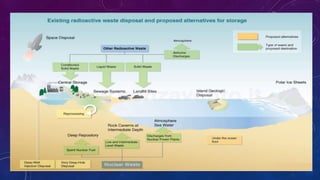
• Approches to Radioactive waste disposal
Geological disposal
Ocean dumping
Transmutati method
Subductive method
Other ways
• Geological dumping means disposal of nuclear waste under continental
crust.
• It provides natural isolation system that is stable over thousands of years to
contain long lived radioactive waste
• Low level radioactive waste(In near surface facilities)
• High level radioactive waste(In host rocks that are crystalline)
• Ocean dumping(Good alternative and least expensive method)
• In this method nuclear waste is dumped into the ocean.
• For many years countries like U.S.A.,U.K. has adopted this system.
• Banned by most of the countries due to scientific proof and bad effects on
the ocean life.
• But still now Russia is using this method because they don’t have any other
option available right now.
• It is one of the signal viable disposal method which ensures non return of
the regulated material to biosphere.
• Subduction is the process where tectonic plate slides beneath another and
is eventually reabsorbed into mantle.
• It forms high level radioactive waste in subductive plates where it will be
dispersed through mantle.
• Transmutating devices consisting of nuclear reactor and an
accelerator of charged particles are used to destroy radioactivity
by neutrons.
• The fission fragments can be transmuted by neutron capture
beta decay to produce stable nuclides.
Review
• Nuclear Waste is a really dangerous waste because it contains high radiation
that can damage human health. It is categorized as high, intermediate, and
lo level of waste.
• High level waste produced by the nuclear weapon, and the nuclear power
plant. Intermediate level wastes produced by water filter that is used to
keep the rods cold.
• The procedures such as deep disposal for high, and regular disposal for low
and intermediate. New procedures such as Sulfide sponge and NDTB-1 and
Bacteria Geobacter sulfurreducens.
• http://news.discovery.com/tech/biotechnology/how-bacteria-clean-up-nuclear-waste-
110909.htm
• http://library.thinkquest.org/3471/nuclear_waste.html#
• http://www.rsc.org/chemistryworld/news/2008/march/03030802.asp
• http://www.pollutionissues.com/Pl-Re/Radioactive-Waste.html#b
• http://www.iaea.org/OurWork/ST/NE/NEFW/_nefw-documents/RadioactiveWaste.pdf
• http://news.nd.edu/news/29727-new-paper-by-notre-dame-researchers-describes-method-
for-cleaning-up-nuclear-waste/
Bibliography
Nuclear waste disposal-geological importance

Nuclear waste disposal-geological importance

  • 1.
    NUCLEAR WASTE DESPOSAL- GEOLOGICALIMPORTANCE PREPARED BY: SURANI HARDIK 120070106036 SUB TEACHER: PROF. D.S. MODI
  • 2.
    PREVIEW Nuclear Waste How ItWorks Types and Categories of Nuclear Waste Potentials to Harm the Environment Procedures to Remove the Wastes Effectiveness of the Procedures Nuclear waste disposal
  • 3.
    NUCLEAR WASTE • Nuclearwaste is the radioactive waste produced by nuclear reactors, or left over from research projects, medical uses, and the manufacture of nuclear weapons It categorized as; High-level Waste (HLW), Intermediate Waste (ILW) Low-level Waste (LLW) • The nuclear wastes are composed of a combination of uranium, plutonium, and other radioactive elements such as neptunium, americium, curium, etc.
  • 5.
    How Nuclear fuelis used After the mining, the uranium ores are ground in the water to produce slurry fine particles under water. Then the slurry is leached with sulfuric acid to dissolve the uranium oxide concentrate U3O8 and then take them. Uranium oxide concentrate U3O8 turned into uranium hexafluoride (UF6) by “enrichment process” and keeps them in the nuclear power reactors. UF6 will be transported into the fuel fabrication plant and converted into UO2 powder and pressed into small pellets. Then inserted into thin tube to form rods about 7 m long. Cont…
  • 6.
    The rods aretaken into a room where they stored into water-filled vaults to maintain the rods’ temperature from over heating . Moved to air tight sealed containers and transport to dry containers. Processing Heating water to make steam (nuclear fission occurred), burn turbines, generator on, and produced the power for electricity, etc. Used fuel would be stored underground and recycled it.
  • 7.
    Categories of Nuclearwaste • There are 3 main categories of radioactive waste : High Level Waste (HLW) by 3% Volume, it contains 95% of radiation. Produced by the nuclear power plant (fuel fission from the Nuclear weapon, Uranium milling residues, and waste with greater than specified quantities of elements heavier than uranium.
  • 8.
    Intermediate Level Waste(ILW) by 7% Volume, it contains 4% of radiation.  Ion exchange resins and filter materials used to clean water at a nuclear power plant, Low Level Waste (LLW) by 90% of Volume, it contains 1% of radiation.  Medical Equipment (containers, cloth, paper, fluids, and equipment which came in contact with radioactive materials)  Contaminated hand tools, components, piping, and other equipment from nuclear power plants and other industries, etc.
  • 9.
    Potential to harmthe environment • It radioactive waste is potentially dangerous because they emit ionizing radiation, which can damage to human health such as; produce mutations and birth defects, and cause cancer. The degree of risk depends upon the level, and type, of radioactivity, with some materials being very hazardous in raw form, and others posing little threat in most circumstances.
  • 10.
    Procedures to removeRadioactive wastes High Level Waste (HWL) • Deep Geological Disposal The principle of geological disposal is to isolate the waste deep inside a suitable host formation, e.g. granite, salt or clay. The waste is placed in an underground facility or disposal facility, designed to ensure that a system of natural and multiple artificial barriers work together to prevent radioactivity from escaping. Placed in dry barrels with air conditioner or in the barrel put water. It because water used to cool down the fuel and it works to protect workers from the radiations. It will lost its radiation in about 10 years by 90 %. It also can be recycled.
  • 11.
    • Notre DameThorium Borate-1 (NTDB-1)  It is a new invention of 2012 by Notre Dame University. It is a crystalline compound that can be tailored to safely absorb radioactive ions from nuclear waste streams. It traps both Tc-99 (technetium, half- life 220,000 years) and I-129 (Iodine-129) and half-life 15.7 million years, Their unique electronic properties lead to applications in a wide variety of areas ranging from magnetism to catalysis. By testing this substance into Tc-99, it removes 70%-90% of the radiation.
  • 12.
    Intermediate Level Waste(ILW) and Low Level Waste (LLW) • Disposal The disposal between intermediate and low level waste are pretty similar. Only the Intermediate level disposal is going to be close to the surface, about 18 m down placed in a concrete and sealed it in steel drums. The low level disposal could be just open on the surface. Also for the low disposal could be a normal waste after 15 years.
  • 13.
    • Sulfide sponge: •Strontium-90 is a particularly harmful component of nuclear waste with a half-life of about 30 years. But finding Sr2+ ions is like searching for a needle in a haystack: non-radioactive ions of sodium (Na+) and calcium (Ca2+) are a million times more numerous, positively charged and around the same size. Sulfide sponge used a layered metal sulfide called KMS-1 containing potassium, manganese and tin. This material is a simple ion- exchanger, capable of swapping potassium ions for heavier ones - and then holding onto them. • They tested KMS-1, which looks like a brown powder, by packing it into porous bags similar to tea bags. When they dipped the bag into a sodium-rich solution of strontium - resembling the conditions in nuclear waste - it removed 99.8 per cent of the strontium.
  • 14.
    Effectiveness of theprocedures • Generally, disposal is the regular procedure that is used by the nuclear powered countries these days. However, by finding new fastest and effective ways to remove the radiations like the sulfide sponge or Notre Dame Thorium Borate-1 would also helping the radioactive waste removal. • Approches to Radioactive waste disposal
  • 15.
    Geological disposal Ocean dumping Transmutatimethod Subductive method Other ways
  • 16.
    • Geological dumpingmeans disposal of nuclear waste under continental crust. • It provides natural isolation system that is stable over thousands of years to contain long lived radioactive waste • Low level radioactive waste(In near surface facilities) • High level radioactive waste(In host rocks that are crystalline)
  • 18.
    • Ocean dumping(Goodalternative and least expensive method) • In this method nuclear waste is dumped into the ocean. • For many years countries like U.S.A.,U.K. has adopted this system. • Banned by most of the countries due to scientific proof and bad effects on the ocean life. • But still now Russia is using this method because they don’t have any other option available right now.
  • 19.
    • It isone of the signal viable disposal method which ensures non return of the regulated material to biosphere. • Subduction is the process where tectonic plate slides beneath another and is eventually reabsorbed into mantle. • It forms high level radioactive waste in subductive plates where it will be dispersed through mantle.
  • 20.
    • Transmutating devicesconsisting of nuclear reactor and an accelerator of charged particles are used to destroy radioactivity by neutrons. • The fission fragments can be transmuted by neutron capture beta decay to produce stable nuclides.
  • 23.
    Review • Nuclear Wasteis a really dangerous waste because it contains high radiation that can damage human health. It is categorized as high, intermediate, and lo level of waste. • High level waste produced by the nuclear weapon, and the nuclear power plant. Intermediate level wastes produced by water filter that is used to keep the rods cold. • The procedures such as deep disposal for high, and regular disposal for low and intermediate. New procedures such as Sulfide sponge and NDTB-1 and Bacteria Geobacter sulfurreducens.
  • 24.
    • http://news.discovery.com/tech/biotechnology/how-bacteria-clean-up-nuclear-waste- 110909.htm • http://library.thinkquest.org/3471/nuclear_waste.html# •http://www.rsc.org/chemistryworld/news/2008/march/03030802.asp • http://www.pollutionissues.com/Pl-Re/Radioactive-Waste.html#b • http://www.iaea.org/OurWork/ST/NE/NEFW/_nefw-documents/RadioactiveWaste.pdf • http://news.nd.edu/news/29727-new-paper-by-notre-dame-researchers-describes-method- for-cleaning-up-nuclear-waste/ Bibliography