Henoch-Schonlein Purpura Jeremy Gitomer MD Division of Pediatric Nephrology
Introduction Heberden in 1801 described a 5 yo with edema, abdominal pain, bloody stools, hematuria and “bloody points” all over his body. Schonlein in 1837 named the association of joint pain and purpura as “purpura rheumatica” Henoch in 1874 described patients with purpura, severe abdominal colic, melena and large joint arthritis
Introduction HSP is the most common vasculitic disease of childhood HSP is considered to be a form of IgA Nephropathy with extrarenal manifestations.
Epidemiology Incidence is 13.5-18/100000 Male to female 1.5:1 Can occur from 6 months- adulthood 50% of cases are under 5 years of age Wide geographical distribution More common in winter and spring Genetics play a small role
IgA Immune System The most abundant immunoglobulin in the body IgA is compartmentalized Secretory Circulating
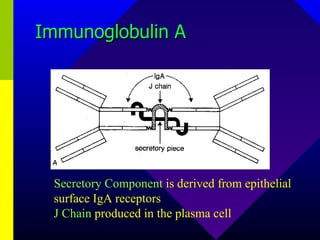
Immunoglobulin A Secretory Component  is derived from epithelial surface IgA receptors  J Chain  produced in the plasma cell
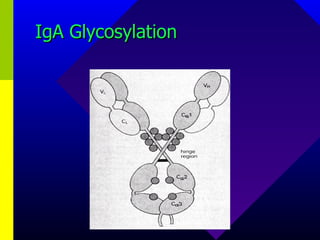
Pathogenesis Abnormalities in IgA : Production Clearance Glycosylation
IgA Glycosylation
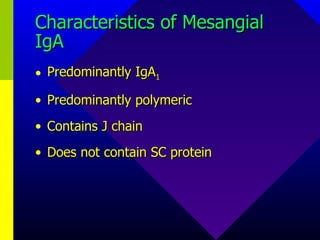
Characteristics of Mesangial IgA Predominantly IgA 1 Predominantly polymeric Contains J chain Does not contain SC protein
Origin of Deposited IgA Enhanced tonsillar production of pIgA 1  has been reported Assessment for pIgA 1  production by  in situ  hybridization for J chain mRNA in IgA plasma cells shows downregulation in the mucosa and upregulation in the bone marrow If the marrow is the source of pIgA 1  then the link between mucosal infection and hematuria remains unexplained
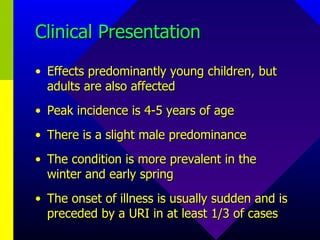
Clinical Presentation Effects predominantly young children, but adults are also affected Peak incidence is 4-5 years of age There is a slight male predominance The condition is more prevalent in the winter and early spring The onset of illness is usually sudden and is preceded by a URI in at least 1/3 of cases
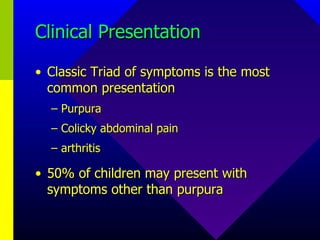
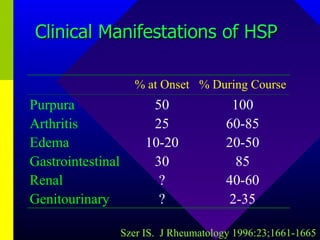
Clinical Presentation Classic Triad of symptoms is the most common presentation Purpura Colicky abdominal pain arthritis 50% of children may present with symptoms other than purpura
Clinical Manifestations of HSP Szer IS.  J Rheumatology 1996:23;1661-1665
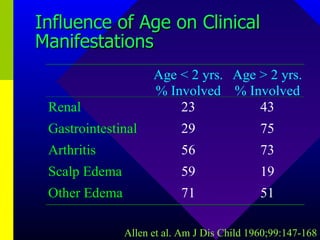
Influence of Age on Clinical Manifestations Allen et al. Am J Dis Child 1960;99:147-168
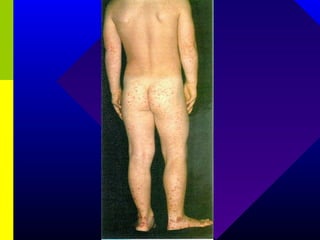
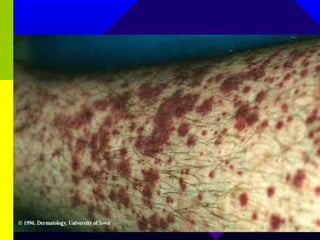
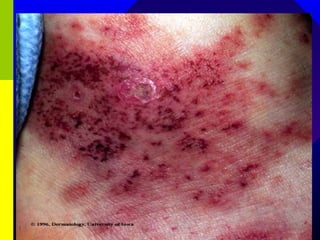
Dermatologic Begins as erythematous macules Some of which develop raised urticarial papules which soon become purpuric or petechial The eruption is symmetric effecting the extensor surfaces of the lower legs, forearms, buttocks and sparing the trunk. Purpura occasionally affect earlobes, nose and external genitalia.
Dermatologic Younger children may only have urticaria Also younger children may present with edema of the feet, dorsum of the hands, face and scalp. As primary lesions fade new crops can present for up to three months from the onset of the disease (and sometimes much longer) Erythema nodosum can occur Blistering lesions can occur


Arthralgia 60-84% of children exhibit transient arthralgia and periarticular edema. The knees, ankles, elbows and wrists are most commonly affected Erythema, tenderness or joint effusions may or may not be present in painful joints Arthritis precedes the onset of skin findings in 25% of cases
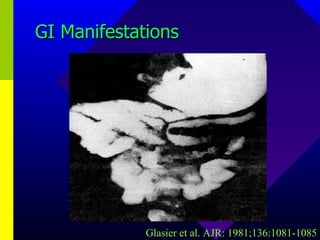
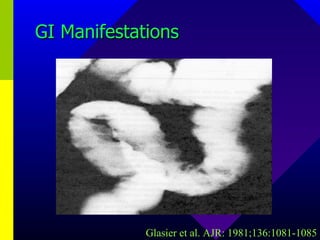
Gastrointestinal Manifestations Gastrointestinal manifestations occur in 50-70% of patients The incidence is 90% in those patients with renal involvement The most common symptom is abdominal colic Abdominal pain precedes rash in 14% of cases
GI Manifestations Melena occurs in 50% of patients Hematemesis occurs in up to 30% of patients Massive GI bleeding occurs in 2%-10% of patients
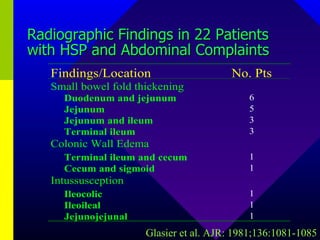
Radiographic Findings in 22 Patients with HSP and Abdominal Complaints Glasier et al. AJR: 1981;136:1081-1085
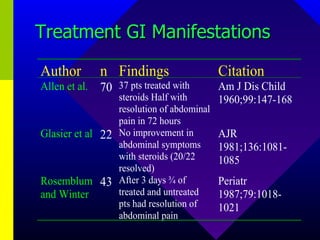
GI Manifestations Glasier et al. AJR: 1981;136:1081-1085
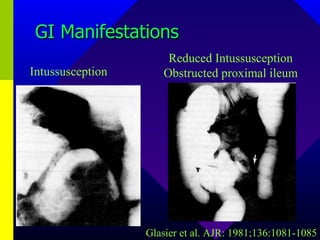
Intussusception and HSP The incidence of intussusception in HSP is between 1-2% of all patients with HSP and  abdominal pain. 50% of intussusceptions in HSP are ileoilial In contrast, in children without HSP, ileocolic intussusceptions are found in 90-95% of cases High resolution ultrasound is the diagnostic study of choice (ileoilial intussusception may not be detected by barium enema)
GI Manifestations Intussusception Reduced Intussusception Obstructed proximal ileum Glasier et al. AJR: 1981;136:1081-1085
Other GI Manifestations Pancreatitis Biliary necrosis Biliary hydrops Hemorrhagic ascites Bowel necrosis Duodenitis Hemorrhagic duodenitis
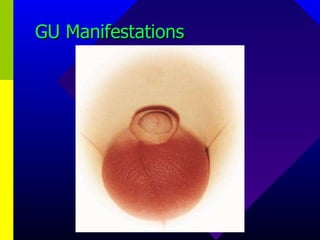
GU Manifestations Acute scrotal swelling secondary to inflammation and hemorrhage of the scrotal vessels occurs in 10-30% of males with HSP Scrotal edema is common Purpuric lesions on the scrotum are common
GU Manifestations
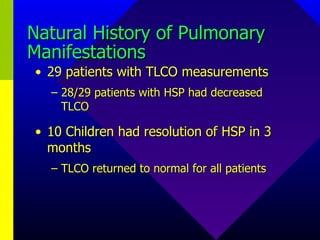
Pulmonary Manifestations Pulmonary hemorrhage is a rare but often fatal complication of HSP Acute interstitial lung disease, as demonstrated by a decrease in TLCO (56% of predicted), was noted in 28/29 patients with HSP without pulmonary symptoms. Chaussain et al. J Ped 1992;121:12-16.
CNS Manifestations Cerebritis Coma Paresis Subacute encephalopathy Subdural hematoma Cortical hemorrhage Cerebral infarction Peripheral neuropathy
Renal Manifestations The incidence has been reported to be between 20-100%.  Two large studies in which routine urine analysis was performed upon admission demonstrated an incidence of 41 and 61% Patients with abdominal involvement are more likely to have renal involvement Relative Risk is 7.5
Renal Manifestations Microscopic hematuria and minimal proteinuria Hematuria and heavy proteinuria Nephrotic syndrome Nephritic syndrome Nephrotic-Nephritic syndrome
Criteria for Diagnosis of HSP ACR established criteria in 1990 Children must have palpable purpura without thrombocytopenia Adults must have 2 of the following: Age <20 years at onset Palpable purpura Bowel angina Biopsy evidence of granulocytes in the walls of arterioles or venules
Differential Diagnosis Systemic lupus erythematosus Polyarteritis nodosa Wegener’s granulomatosis Testicular torsion Acute surgical abdomen Hypersensitivity vasculitis Sepsis with purpura
Laboratory Investigation Urine analysis Urine for protein and creatinine Occult blood should be checked in the stool Serum total protein and albumin Serum creatinine ANCA in patients with appropriate histories IgA levels are useless
Laboratory Investigations Testicular ultrasound when associated with testicular pain Abdominal series and abdominal ultrasound when severe abdominal cramping present CXR Pulmonary function tests if the patients have symptoms ACA IgA isotype
Kidney Biopsy Generally not performed for routine cases Indications are: Severe nephritic syndrome Persistent heavy proteinuria Atypical presentations
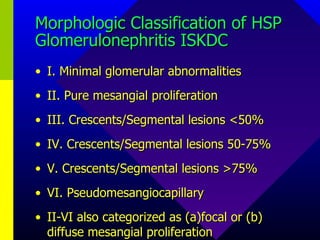
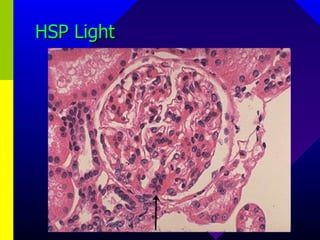
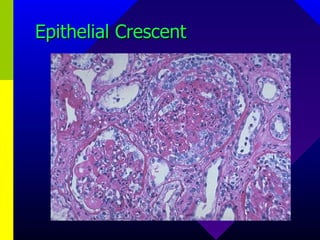
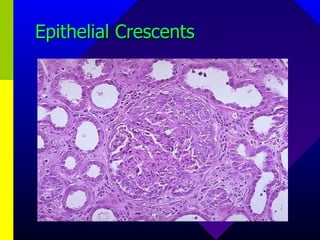
Morphologic Classification of HSP Glomerulonephritis ISKDC I. Minimal glomerular abnormalities II. Pure mesangial proliferation III. Crescents/Segmental lesions <50% IV. Crescents/Segmental lesions 50-75% V. Crescents/Segmental lesions >75% VI. Pseudomesangiocapillary II-VI also categorized as (a)focal or (b) diffuse mesangial proliferation
HSP Light
Epithelial Crescent
Epithelial Crescents
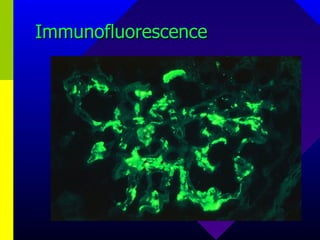
Immunofluorescence
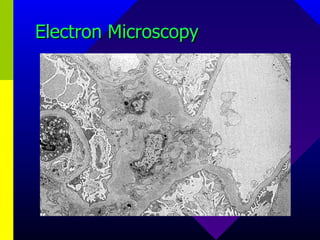
Electron Microscopy
Extrarenal Pathology Skin biopsies of affected areas demonstrate a leukocytoclastic vasculitis with perivascular infiltration of polymorphs and mononuclear cells. Necrosis of small blood vessels may also be seen Immunostaining reveals IgA in most purpuric skin lesions and also in unaffected areas. Similar findings are present in the gut and lungs of affected individuals
Natural History for HSP without Nephritis Generally HSP is a self limited illness. No treatment is required for the purpura NSAIDs are used to treat arthralgias Steroids are not beneficial
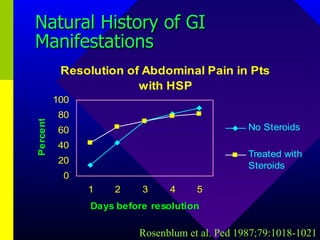
Natural History of GI Manifestations Rosenblum et al. Ped 1987;79:1018-1021
Treatment GI Manifestations
Natural History of Pulmonary Manifestations 29 patients with TLCO measurements 28/29 patients with HSP had decreased TLCO 10 Children had resolution of HSP in 3 months TLCO returned to normal for all patients
Natural History of Pulmonary Manifestations 3 children had recurrent skin lesions and urinary abnormalities the first 3 months but had clinically recovered by 6 months TLCO was 45.7% initially, 58% at three months and 97.5% of predicted at 6 months 5 patients never clinically resolved during the study period 3 of the 5 significant TLCO decreases from predicted at the time of study closure
Treatment of Pulmonary Manifestations No studies have been performed to see if steroids or other treatments for HSP improve Aggressive immunomodulating therapy should be used in patients with severe pulmonary hemorrhage since it is often life threatening
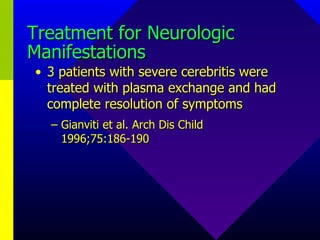
Treatment for Neurologic Manifestations 3 patients with severe cerebritis were treated with plasma exchange and had complete resolution of symptoms Gianviti et al. Arch Dis Child 1996;75:186-190
Long Term Renal Outcome of HSN HSP is the diagnosis for 5-15% of patients diagnosed end stage renal disease Stewart followed 270 patients with HSP for 13 years 1% renal morbidity <1% mortality Eur J Pediatr 1988;147:113-115
Clinicopathologic Correlation
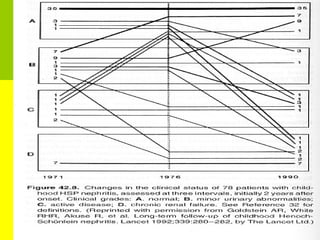
Long Term Renal Outcome for HSNephritis
Long Term Renal Outcome of HSNephritis  Actual Number of patients (Percent of total)
Long Term Renal Outcome of HSNephritis
 
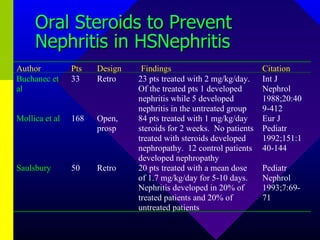
Oral Steroids to Prevent Nephritis in HSNephritis
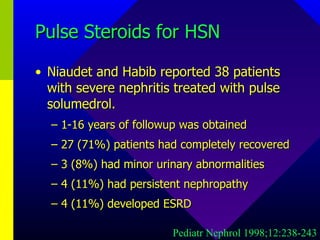
Pulse Steroids for HSN Niaudet and Habib reported 38 patients with severe nephritis treated with pulse solumedrol. 1-16 years of followup was obtained 27 (71%) patients had completely recovered 3 (8%) had minor urinary abnormalities 4 (11%) had persistent nephropathy 4 (11%) developed ESRD Pediatr Nephrol 1998;12:238-243
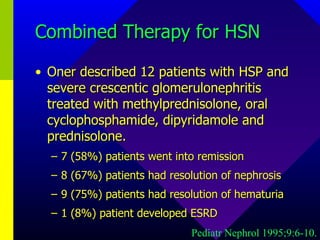
Combined Therapy for HSN Oner described 12 patients with HSP and severe crescentic glomerulonephritis treated with methylprednisolone, oral cyclophosphamide, dipyridamole and prednisolone.  7 (58%) patients went into remission 8 (67%) patients had resolution of nephrosis 9 (75%) patients had resolution of hematuria 1 (8%) patient developed ESRD Pediatr Nephrol 1995;9:6-10.
Plasma Exchange for HSN Khono treated 9 patients with nephrotic syndrome and decreased GFR solely with plasmapheresis.  AJKD 1999 Mar;33(3):427-33 Jardim treated 14 patients with severe renal disease with plasma exchange, dipyrimadole, steroids and imuran. 9 patients responded to therapy with improvement in renal function Pediatr Nephrol 1992;6:231-235
Intravenous Gamma Globulin for HSN Rostoker et al treated 14 patients diagnosed with IgAN or HSP nephritis.  All patients had normal GFR All patients had proteinuria The average proteinuria decreased from 766 mg/day to 171 mg/day  during the 6 months of the study. All but 1 patient responded to the IMIG Nephron 1995;69:327-334
Treatment for Chronic HSN Steroids Fish oil Vitamin E Gluten free diet Tonsillectomy IV/IM IG Combination therapy
Recurrence in Transplant Meulders and coworkers reported the course of renal transplantation in 78 patients with ESRD secondary to HSP in 1994 Histologic recurrence occurred in 50% of patients Clinical recurrence occurred in 20% of patients Graft failure (12%) and graft loss (9%) were common Waiting for 6 months prior to transplant had no effect on recurrence Transplantation 1994;58:1179-1186
Conclusions HSP has a variable presentation Most patients will have complete recovery and their long term prognosis is good Patients with severe crescentic GN or cerebritis should receive aggressive immunomodulating therapy Patients need long term follow-up because of the low, but significant, incidence of late renal complications.

Henoch Schonlein Purpura (2)

  • 1.
    Henoch-Schonlein Purpura JeremyGitomer MD Division of Pediatric Nephrology
  • 2.
    Introduction Heberden in1801 described a 5 yo with edema, abdominal pain, bloody stools, hematuria and “bloody points” all over his body. Schonlein in 1837 named the association of joint pain and purpura as “purpura rheumatica” Henoch in 1874 described patients with purpura, severe abdominal colic, melena and large joint arthritis
  • 3.
    Introduction HSP isthe most common vasculitic disease of childhood HSP is considered to be a form of IgA Nephropathy with extrarenal manifestations.
  • 4.
    Epidemiology Incidence is13.5-18/100000 Male to female 1.5:1 Can occur from 6 months- adulthood 50% of cases are under 5 years of age Wide geographical distribution More common in winter and spring Genetics play a small role
  • 5.
    IgA Immune SystemThe most abundant immunoglobulin in the body IgA is compartmentalized Secretory Circulating
  • 6.
    Immunoglobulin A SecretoryComponent is derived from epithelial surface IgA receptors J Chain produced in the plasma cell
  • 7.
    Pathogenesis Abnormalities inIgA : Production Clearance Glycosylation
  • 8.
  • 9.
    Characteristics of MesangialIgA Predominantly IgA 1 Predominantly polymeric Contains J chain Does not contain SC protein
  • 10.
    Origin of DepositedIgA Enhanced tonsillar production of pIgA 1 has been reported Assessment for pIgA 1 production by in situ hybridization for J chain mRNA in IgA plasma cells shows downregulation in the mucosa and upregulation in the bone marrow If the marrow is the source of pIgA 1 then the link between mucosal infection and hematuria remains unexplained
  • 11.
    Clinical Presentation Effectspredominantly young children, but adults are also affected Peak incidence is 4-5 years of age There is a slight male predominance The condition is more prevalent in the winter and early spring The onset of illness is usually sudden and is preceded by a URI in at least 1/3 of cases
  • 12.
    Clinical Presentation ClassicTriad of symptoms is the most common presentation Purpura Colicky abdominal pain arthritis 50% of children may present with symptoms other than purpura
  • 13.
    Clinical Manifestations ofHSP Szer IS. J Rheumatology 1996:23;1661-1665
  • 14.
    Influence of Ageon Clinical Manifestations Allen et al. Am J Dis Child 1960;99:147-168
  • 15.
    Dermatologic Begins aserythematous macules Some of which develop raised urticarial papules which soon become purpuric or petechial The eruption is symmetric effecting the extensor surfaces of the lower legs, forearms, buttocks and sparing the trunk. Purpura occasionally affect earlobes, nose and external genitalia.
  • 16.
    Dermatologic Younger childrenmay only have urticaria Also younger children may present with edema of the feet, dorsum of the hands, face and scalp. As primary lesions fade new crops can present for up to three months from the onset of the disease (and sometimes much longer) Erythema nodosum can occur Blistering lesions can occur
  • 17.
  • 18.
  • 19.
  • 20.
    Arthralgia 60-84% ofchildren exhibit transient arthralgia and periarticular edema. The knees, ankles, elbows and wrists are most commonly affected Erythema, tenderness or joint effusions may or may not be present in painful joints Arthritis precedes the onset of skin findings in 25% of cases
  • 21.
    Gastrointestinal Manifestations Gastrointestinalmanifestations occur in 50-70% of patients The incidence is 90% in those patients with renal involvement The most common symptom is abdominal colic Abdominal pain precedes rash in 14% of cases
  • 22.
    GI Manifestations Melenaoccurs in 50% of patients Hematemesis occurs in up to 30% of patients Massive GI bleeding occurs in 2%-10% of patients
  • 23.
    Radiographic Findings in22 Patients with HSP and Abdominal Complaints Glasier et al. AJR: 1981;136:1081-1085
  • 24.
    GI Manifestations Glasieret al. AJR: 1981;136:1081-1085
  • 25.
    GI Manifestations Glasieret al. AJR: 1981;136:1081-1085
  • 26.
    GI Manifestations Glasieret al. AJR: 1981;136:1081-1085
  • 27.
    Intussusception and HSPThe incidence of intussusception in HSP is between 1-2% of all patients with HSP and abdominal pain. 50% of intussusceptions in HSP are ileoilial In contrast, in children without HSP, ileocolic intussusceptions are found in 90-95% of cases High resolution ultrasound is the diagnostic study of choice (ileoilial intussusception may not be detected by barium enema)
  • 28.
    GI Manifestations IntussusceptionReduced Intussusception Obstructed proximal ileum Glasier et al. AJR: 1981;136:1081-1085
  • 29.
    Other GI ManifestationsPancreatitis Biliary necrosis Biliary hydrops Hemorrhagic ascites Bowel necrosis Duodenitis Hemorrhagic duodenitis
  • 30.
    GU Manifestations Acutescrotal swelling secondary to inflammation and hemorrhage of the scrotal vessels occurs in 10-30% of males with HSP Scrotal edema is common Purpuric lesions on the scrotum are common
  • 31.
  • 32.
    Pulmonary Manifestations Pulmonaryhemorrhage is a rare but often fatal complication of HSP Acute interstitial lung disease, as demonstrated by a decrease in TLCO (56% of predicted), was noted in 28/29 patients with HSP without pulmonary symptoms. Chaussain et al. J Ped 1992;121:12-16.
  • 33.
    CNS Manifestations CerebritisComa Paresis Subacute encephalopathy Subdural hematoma Cortical hemorrhage Cerebral infarction Peripheral neuropathy
  • 34.
    Renal Manifestations Theincidence has been reported to be between 20-100%. Two large studies in which routine urine analysis was performed upon admission demonstrated an incidence of 41 and 61% Patients with abdominal involvement are more likely to have renal involvement Relative Risk is 7.5
  • 35.
    Renal Manifestations Microscopichematuria and minimal proteinuria Hematuria and heavy proteinuria Nephrotic syndrome Nephritic syndrome Nephrotic-Nephritic syndrome
  • 36.
    Criteria for Diagnosisof HSP ACR established criteria in 1990 Children must have palpable purpura without thrombocytopenia Adults must have 2 of the following: Age <20 years at onset Palpable purpura Bowel angina Biopsy evidence of granulocytes in the walls of arterioles or venules
  • 37.
    Differential Diagnosis Systemiclupus erythematosus Polyarteritis nodosa Wegener’s granulomatosis Testicular torsion Acute surgical abdomen Hypersensitivity vasculitis Sepsis with purpura
  • 38.
    Laboratory Investigation Urineanalysis Urine for protein and creatinine Occult blood should be checked in the stool Serum total protein and albumin Serum creatinine ANCA in patients with appropriate histories IgA levels are useless
  • 39.
    Laboratory Investigations Testicularultrasound when associated with testicular pain Abdominal series and abdominal ultrasound when severe abdominal cramping present CXR Pulmonary function tests if the patients have symptoms ACA IgA isotype
  • 40.
    Kidney Biopsy Generallynot performed for routine cases Indications are: Severe nephritic syndrome Persistent heavy proteinuria Atypical presentations
  • 41.
    Morphologic Classification ofHSP Glomerulonephritis ISKDC I. Minimal glomerular abnormalities II. Pure mesangial proliferation III. Crescents/Segmental lesions <50% IV. Crescents/Segmental lesions 50-75% V. Crescents/Segmental lesions >75% VI. Pseudomesangiocapillary II-VI also categorized as (a)focal or (b) diffuse mesangial proliferation
  • 42.
  • 43.
  • 44.
  • 45.
  • 46.
  • 47.
    Extrarenal Pathology Skinbiopsies of affected areas demonstrate a leukocytoclastic vasculitis with perivascular infiltration of polymorphs and mononuclear cells. Necrosis of small blood vessels may also be seen Immunostaining reveals IgA in most purpuric skin lesions and also in unaffected areas. Similar findings are present in the gut and lungs of affected individuals
  • 48.
    Natural History forHSP without Nephritis Generally HSP is a self limited illness. No treatment is required for the purpura NSAIDs are used to treat arthralgias Steroids are not beneficial
  • 49.
    Natural History ofGI Manifestations Rosenblum et al. Ped 1987;79:1018-1021
  • 50.
  • 51.
    Natural History ofPulmonary Manifestations 29 patients with TLCO measurements 28/29 patients with HSP had decreased TLCO 10 Children had resolution of HSP in 3 months TLCO returned to normal for all patients
  • 52.
    Natural History ofPulmonary Manifestations 3 children had recurrent skin lesions and urinary abnormalities the first 3 months but had clinically recovered by 6 months TLCO was 45.7% initially, 58% at three months and 97.5% of predicted at 6 months 5 patients never clinically resolved during the study period 3 of the 5 significant TLCO decreases from predicted at the time of study closure
  • 53.
    Treatment of PulmonaryManifestations No studies have been performed to see if steroids or other treatments for HSP improve Aggressive immunomodulating therapy should be used in patients with severe pulmonary hemorrhage since it is often life threatening
  • 54.
    Treatment for NeurologicManifestations 3 patients with severe cerebritis were treated with plasma exchange and had complete resolution of symptoms Gianviti et al. Arch Dis Child 1996;75:186-190
  • 55.
    Long Term RenalOutcome of HSN HSP is the diagnosis for 5-15% of patients diagnosed end stage renal disease Stewart followed 270 patients with HSP for 13 years 1% renal morbidity <1% mortality Eur J Pediatr 1988;147:113-115
  • 56.
  • 57.
    Long Term RenalOutcome for HSNephritis
  • 58.
    Long Term RenalOutcome of HSNephritis Actual Number of patients (Percent of total)
  • 59.
    Long Term RenalOutcome of HSNephritis
  • 60.
  • 61.
    Oral Steroids toPrevent Nephritis in HSNephritis
  • 62.
    Pulse Steroids forHSN Niaudet and Habib reported 38 patients with severe nephritis treated with pulse solumedrol. 1-16 years of followup was obtained 27 (71%) patients had completely recovered 3 (8%) had minor urinary abnormalities 4 (11%) had persistent nephropathy 4 (11%) developed ESRD Pediatr Nephrol 1998;12:238-243
  • 63.
    Combined Therapy forHSN Oner described 12 patients with HSP and severe crescentic glomerulonephritis treated with methylprednisolone, oral cyclophosphamide, dipyridamole and prednisolone. 7 (58%) patients went into remission 8 (67%) patients had resolution of nephrosis 9 (75%) patients had resolution of hematuria 1 (8%) patient developed ESRD Pediatr Nephrol 1995;9:6-10.
  • 64.
    Plasma Exchange forHSN Khono treated 9 patients with nephrotic syndrome and decreased GFR solely with plasmapheresis. AJKD 1999 Mar;33(3):427-33 Jardim treated 14 patients with severe renal disease with plasma exchange, dipyrimadole, steroids and imuran. 9 patients responded to therapy with improvement in renal function Pediatr Nephrol 1992;6:231-235
  • 65.
    Intravenous Gamma Globulinfor HSN Rostoker et al treated 14 patients diagnosed with IgAN or HSP nephritis. All patients had normal GFR All patients had proteinuria The average proteinuria decreased from 766 mg/day to 171 mg/day during the 6 months of the study. All but 1 patient responded to the IMIG Nephron 1995;69:327-334
  • 66.
    Treatment for ChronicHSN Steroids Fish oil Vitamin E Gluten free diet Tonsillectomy IV/IM IG Combination therapy
  • 67.
    Recurrence in TransplantMeulders and coworkers reported the course of renal transplantation in 78 patients with ESRD secondary to HSP in 1994 Histologic recurrence occurred in 50% of patients Clinical recurrence occurred in 20% of patients Graft failure (12%) and graft loss (9%) were common Waiting for 6 months prior to transplant had no effect on recurrence Transplantation 1994;58:1179-1186
  • 68.
    Conclusions HSP hasa variable presentation Most patients will have complete recovery and their long term prognosis is good Patients with severe crescentic GN or cerebritis should receive aggressive immunomodulating therapy Patients need long term follow-up because of the low, but significant, incidence of late renal complications.