Network Security
CS-7 (CH13-14)
By: Prof. Ganesh Ingle
Session 2 objective
CS-6 Revision Previous Session revision
CS -7 Model of Asymmetric Key Cryptography
CS – 7 Factorization and other methods for Public Key
Cryptography
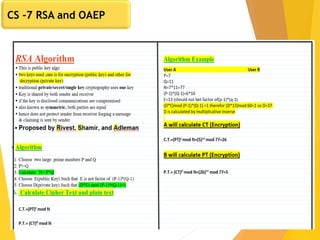
CS -7 RSA and OAEP
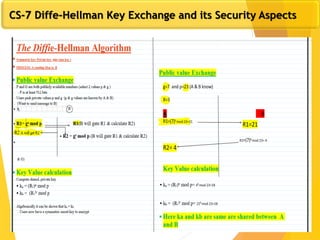
CS-7 Diffe-Hellman Key Exchange and its Security Aspects
SUMMARY
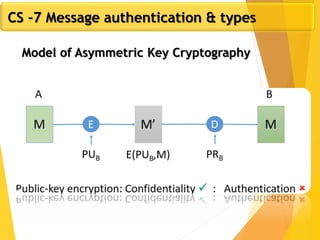
CS -7 Message authentication & types
Model of Asymmetric Key Cryptography
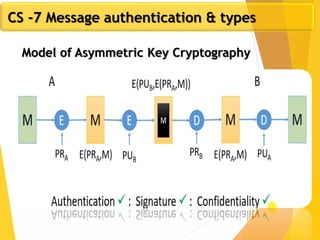
CS -7 Message authentication & types
Model of Asymmetric Key Cryptography
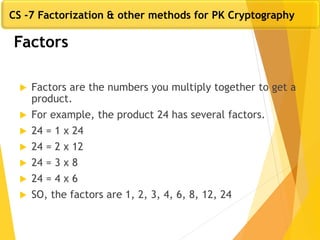
Factors
 Factors are the numbers you multiply together to get a
product.
 For example, the product 24 has several factors.
 24 = 1 x 24
 24 = 2 x 12
 24 = 3 x 8
 24 = 4 x 6
 SO, the factors are 1, 2, 3, 4, 6, 8, 12, 24
CS -7 Factorization & other methods for PK Cryptography
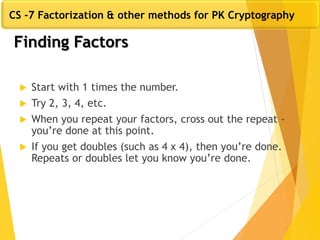
Finding Factors
 Start with 1 times the number.
 Try 2, 3, 4, etc.
 When you repeat your factors, cross out the repeat -
you’re done at this point.
 If you get doubles (such as 4 x 4), then you’re done.
Repeats or doubles let you know you’re done.
CS -7 Factorization & other methods for PK Cryptography
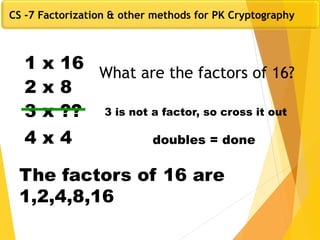
What are the factors of 16?
1 x 16
2 x 8
3 x ?? 3 is not a factor, so cross it out
4 x 4 doubles = done
The factors of 16 are
1,2,4,8,16
CS -7 Factorization & other methods for PK Cryptography
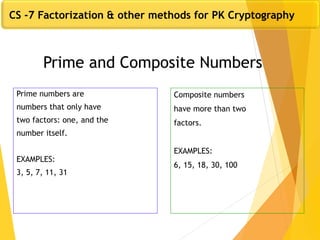
Prime and Composite Numbers
Prime numbers are
numbers that only have
two factors: one, and the
number itself.
EXAMPLES:
3, 5, 7, 11, 31
Composite numbers
have more than two
factors.
EXAMPLES:
6, 15, 18, 30, 100
CS -7 Factorization & other methods for PK Cryptography
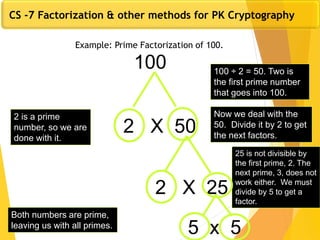
Example: Prime Factorization of 100.
100
2 X 50
100 ÷ 2 = 50. Two is
the first prime number
that goes into 100.
2 is a prime
number, so we are
done with it.
Now we deal with the
50. Divide it by 2 to get
the next factors.
2 X 25
25 is not divisible by
the first prime, 2. The
next prime, 3, does not
work either. We must
divide by 5 to get a
factor.
5 x 5
Both numbers are prime,
leaving us with all primes.
CS -7 Factorization & other methods for PK Cryptography
CS -7 RSA and OAEP
CS-7 Diffe-Hellman Key Exchange and its Security Aspects
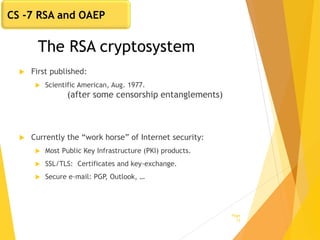
The RSA cryptosystem
 First published:
 Scientific American, Aug. 1977.
(after some censorship entanglements)
 Currently the “work horse” of Internet security:
 Most Public Key Infrastructure (PKI) products.
 SSL/TLS: Certificates and key-exchange.
 Secure e-mail: PGP, Outlook, …
Page
12
CS -7 RSA and OAEP
The RSA trapdoor 1-to-1 function
 Parameters: N=pq. N 1024 bits. p,q 512 bits.
e – encryption exponent. gcd(e, (N) ) = 1 .
 1-to-1 function: RSA(M) = Me
(mod N) where MZN
*
Page
13
 Trapdoor: d – decryption exponent.
Where ed = 1 (mod (N) )
 Inversion: RSA(M)d
= Med
= Mk(N)+1
= M (mod N)
 (n,e,t,)-RSA Assumption: For any t-time alg. A:
Pr[ A(N,e,x) = x
1/e
(N) : ]< 
p,q  n-bit primes,
Npq, xZN
*
R
R
CS -7 RSA and OAEP
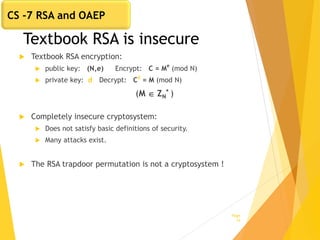
Textbook RSA is insecure
 Textbook RSA encryption:
 public key: (N,e) Encrypt: C = M
e
(mod N)
 private key: d Decrypt: Cd
= M (mod N)
(M  ZN
* )
 Completely insecure cryptosystem:
 Does not satisfy basic definitions of security.
 Many attacks exist.
 The RSA trapdoor permutation is not a cryptosystem !
Page
14
CS -7 RSA and OAEP
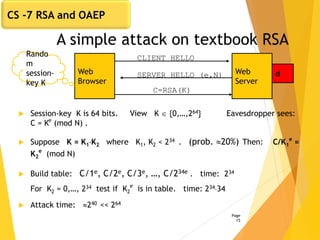
A simple attack on textbook RSA
 Session-key K is 64 bits. View K  {0,…,264} Eavesdropper sees:
C = Ke
(mod N) .
 Suppose K = K1K2 where K1, K2 < 234 . (prob. 20%) Then: C/K1
e
=
K2
e
(mod N)
 Build table: C/1e, C/2e, C/3e, …, C/234e . time: 234
For K2 = 0,…, 234 test if K2
e
is in table. time: 23434
 Attack time: 240 << 264
Page
15
Web
Browser
Web
Server
CLIENT HELLO
SERVER HELLO (e,N) d
C=RSA(K)
Rando
m
session-
key K
CS -7 RSA and OAEP
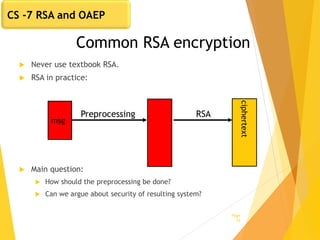
Common RSA encryption
 Never use textbook RSA.
 RSA in practice:
 Main question:
 How should the preprocessing be done?
 Can we argue about security of resulting system?
Page
16
msg
Preprocessing
ciphertext
RSA
CS -7 RSA and OAEP
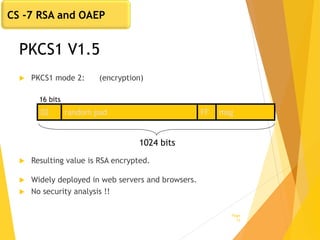
PKCS1 V1.5
 PKCS1 mode 2: (encryption)
 Resulting value is RSA encrypted.
 Widely deployed in web servers and browsers.
 No security analysis !!
Page
17
02 random pad FF msg
1024 bits
16 bits
CS -7 RSA and OAEP
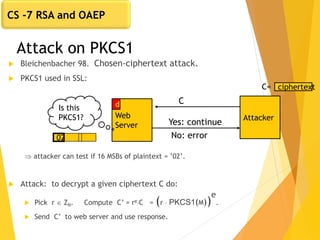
Attack on PKCS1
 Bleichenbacher 98. Chosen-ciphertext attack.
 PKCS1 used in SSL:
 attacker can test if 16 MSBs of plaintext = ’02’.
 Attack: to decrypt a given ciphertext C do:
 Pick r  ZN. Compute C’ = reC = (r  PKCS1(M))
e
.
 Send C’ to web server and use response.
AttackerWeb
Server
dIs this
PKCS1?
ciphertextC=
C
Yes: continue
No: error02
CS -7 RSA and OAEP
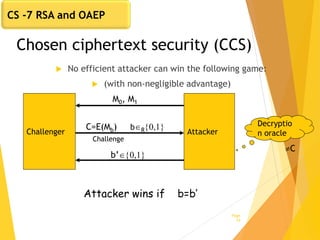
Chosen ciphertext security (CCS)
 No efficient attacker can win the following game:
 (with non-negligible advantage)
Page
19
AttackerChallenger
M0, M1
b’{0,1}
Attacker wins if b=b’
C=E(Mb) bR{0,1}
Challenge
Decryptio
n oracle
C
CS -7 RSA and OAEP
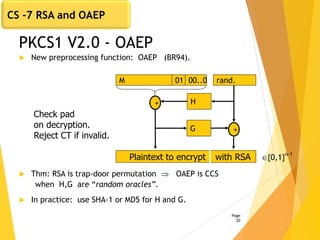
PKCS1 V2.0 - OAEP
 New preprocessing function: OAEP (BR94).
 Thm: RSA is trap-door permutation  OAEP is CCS
when H,G are “random oracles”.
 In practice: use SHA-1 or MD5 for H and G.
Page
20
H+
G +
Plaintext to encrypt with RSA
rand.M 01 00..0
Check pad
on decryption.
Reject CT if invalid.
{0,1}n-1
CS -7 RSA and OAEP
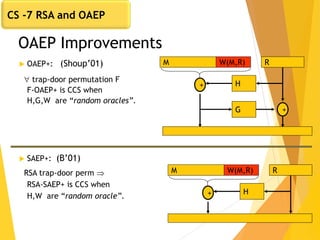
OAEP Improvements
 OAEP+: (Shoup’01)
 trap-door permutation F
F-OAEP+ is CCS when
H,G,W are “random oracles”.
 SAEP+: (B’01)
RSA trap-door perm 
RSA-SAEP+ is CCS when
H,W are “random oracle”.
Page
21
R
H+
G +
M W(M,R)
R
H+
M W(M,R)
CS -7 RSA and OAEP
Subtleties in implementing OAEP [M ’00]
OAEP-decrypt(C) {
error = 0;
if ( RSA-1
(C) > 2n-1
)
{ error =1; goto exit; }
if ( pad(OAEP-1
(RSA-1
(C))) != “01000” )
{ error = 1; goto exit; }
Page
22
}
 Problem: timing information leaks type of error.
 Attacker can decrypt any ciphertext C.
 Lesson: Don’t implement RSA-OAEP yourself …
CS -7 RSA and OAEP
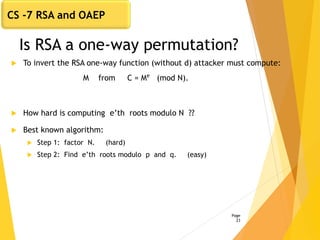
Is RSA a one-way permutation?
 To invert the RSA one-way function (without d) attacker must compute:
M from C = Me
(mod N).
 How hard is computing e’th roots modulo N ??
 Best known algorithm:
 Step 1: factor N. (hard)
 Step 2: Find e’th roots modulo p and q. (easy)
Page
23
CS -7 RSA and OAEP
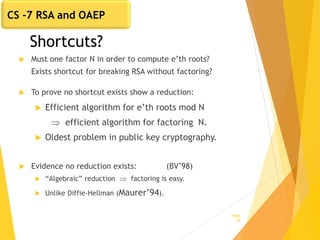
Shortcuts?
 Must one factor N in order to compute e’th roots?
Exists shortcut for breaking RSA without factoring?
 To prove no shortcut exists show a reduction:
 Efficient algorithm for e’th roots mod N
 efficient algorithm for factoring N.
 Oldest problem in public key cryptography.
 Evidence no reduction exists: (BV’98)
 “Algebraic” reduction  factoring is easy.
 Unlike Diffie-Hellman (Maurer’94).
Page
24
CS -7 RSA and OAEP
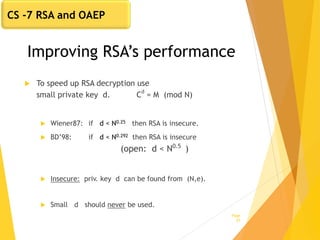
Improving RSA’s performance
 To speed up RSA decryption use
small private key d. C
d
= M (mod N)
 Wiener87: if d < N0.25 then RSA is insecure.
 BD’98: if d < N0.292 then RSA is insecure
(open: d < N0.5
)
 Insecure: priv. key d can be found from (N,e).
 Small d should never be used.
Page
25
CS -7 RSA and OAEP
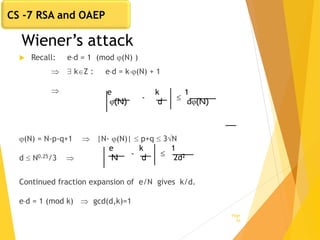
Wiener’s attack
 Recall: ed = 1 (mod (N) )
  kZ : ed = k(N) + 1

(N) = N-p-q+1  |N- (N)|  p+q  3N
d  N0.25/3 
Continued fraction expansion of e/N gives k/d.
ed = 1 (mod k)  gcd(d,k)=1
Page
26
e
(N)
k
d
- 
1
d(N)
e
N
k
d
- 
1
2d2
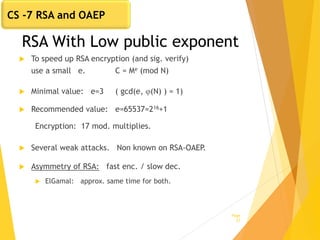
CS -7 RSA and OAEP
RSA With Low public exponent
 To speed up RSA encryption (and sig. verify)
use a small e. C = Me (mod N)
 Minimal value: e=3 ( gcd(e, (N) ) = 1)
 Recommended value: e=65537=216+1
Encryption: 17 mod. multiplies.
 Several weak attacks. Non known on RSA-OAEP.
 Asymmetry of RSA: fast enc. / slow dec.
 ElGamal: approx. same time for both.
Page
27
CS -7 RSA and OAEP
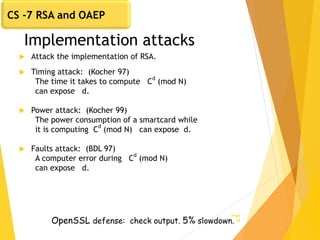
Implementation attacks
 Attack the implementation of RSA.
 Timing attack: (Kocher 97)
The time it takes to compute C
d
(mod N)
can expose d.
 Power attack: (Kocher 99)
The power consumption of a smartcard while
it is computing C
d
(mod N) can expose d.
 Faults attack: (BDL 97)
A computer error during Cd
(mod N)
can expose d.
Page
28OpenSSL defense: check output. 5% slowdown.
CS -7 RSA and OAEP
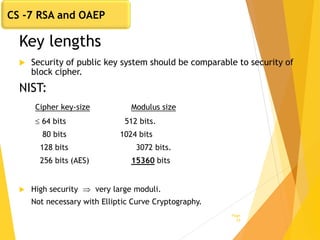
Key lengths
 Security of public key system should be comparable to security of
block cipher.
NIST:
Cipher key-size Modulus size
 64 bits 512 bits.
80 bits 1024 bits
128 bits 3072 bits.
256 bits (AES) 15360 bits
 High security  very large moduli.
Not necessary with Elliptic Curve Cryptography.
Page
29
CS -7 RSA and OAEP
Thank you
Image Source
searchenterpriseai.techtarget.com
wikipedia

Ntewrok secuirty cs7

  • 1.
  • 2.
    Session 2 objective CS-6Revision Previous Session revision CS -7 Model of Asymmetric Key Cryptography CS – 7 Factorization and other methods for Public Key Cryptography CS -7 RSA and OAEP CS-7 Diffe-Hellman Key Exchange and its Security Aspects SUMMARY
  • 3.
    CS -7 Messageauthentication & types Model of Asymmetric Key Cryptography
  • 4.
    CS -7 Messageauthentication & types Model of Asymmetric Key Cryptography
  • 5.
    Factors  Factors arethe numbers you multiply together to get a product.  For example, the product 24 has several factors.  24 = 1 x 24  24 = 2 x 12  24 = 3 x 8  24 = 4 x 6  SO, the factors are 1, 2, 3, 4, 6, 8, 12, 24 CS -7 Factorization & other methods for PK Cryptography
  • 6.
    Finding Factors  Startwith 1 times the number.  Try 2, 3, 4, etc.  When you repeat your factors, cross out the repeat - you’re done at this point.  If you get doubles (such as 4 x 4), then you’re done. Repeats or doubles let you know you’re done. CS -7 Factorization & other methods for PK Cryptography
  • 7.
    What are thefactors of 16? 1 x 16 2 x 8 3 x ?? 3 is not a factor, so cross it out 4 x 4 doubles = done The factors of 16 are 1,2,4,8,16 CS -7 Factorization & other methods for PK Cryptography
  • 8.
    Prime and CompositeNumbers Prime numbers are numbers that only have two factors: one, and the number itself. EXAMPLES: 3, 5, 7, 11, 31 Composite numbers have more than two factors. EXAMPLES: 6, 15, 18, 30, 100 CS -7 Factorization & other methods for PK Cryptography
  • 9.
    Example: Prime Factorizationof 100. 100 2 X 50 100 ÷ 2 = 50. Two is the first prime number that goes into 100. 2 is a prime number, so we are done with it. Now we deal with the 50. Divide it by 2 to get the next factors. 2 X 25 25 is not divisible by the first prime, 2. The next prime, 3, does not work either. We must divide by 5 to get a factor. 5 x 5 Both numbers are prime, leaving us with all primes. CS -7 Factorization & other methods for PK Cryptography
  • 10.
    CS -7 RSAand OAEP
  • 11.
    CS-7 Diffe-Hellman KeyExchange and its Security Aspects
  • 12.
    The RSA cryptosystem First published:  Scientific American, Aug. 1977. (after some censorship entanglements)  Currently the “work horse” of Internet security:  Most Public Key Infrastructure (PKI) products.  SSL/TLS: Certificates and key-exchange.  Secure e-mail: PGP, Outlook, … Page 12 CS -7 RSA and OAEP
  • 13.
    The RSA trapdoor1-to-1 function  Parameters: N=pq. N 1024 bits. p,q 512 bits. e – encryption exponent. gcd(e, (N) ) = 1 .  1-to-1 function: RSA(M) = Me (mod N) where MZN * Page 13  Trapdoor: d – decryption exponent. Where ed = 1 (mod (N) )  Inversion: RSA(M)d = Med = Mk(N)+1 = M (mod N)  (n,e,t,)-RSA Assumption: For any t-time alg. A: Pr[ A(N,e,x) = x 1/e (N) : ]<  p,q  n-bit primes, Npq, xZN * R R CS -7 RSA and OAEP
  • 14.
    Textbook RSA isinsecure  Textbook RSA encryption:  public key: (N,e) Encrypt: C = M e (mod N)  private key: d Decrypt: Cd = M (mod N) (M  ZN * )  Completely insecure cryptosystem:  Does not satisfy basic definitions of security.  Many attacks exist.  The RSA trapdoor permutation is not a cryptosystem ! Page 14 CS -7 RSA and OAEP
  • 15.
    A simple attackon textbook RSA  Session-key K is 64 bits. View K  {0,…,264} Eavesdropper sees: C = Ke (mod N) .  Suppose K = K1K2 where K1, K2 < 234 . (prob. 20%) Then: C/K1 e = K2 e (mod N)  Build table: C/1e, C/2e, C/3e, …, C/234e . time: 234 For K2 = 0,…, 234 test if K2 e is in table. time: 23434  Attack time: 240 << 264 Page 15 Web Browser Web Server CLIENT HELLO SERVER HELLO (e,N) d C=RSA(K) Rando m session- key K CS -7 RSA and OAEP
  • 16.
    Common RSA encryption Never use textbook RSA.  RSA in practice:  Main question:  How should the preprocessing be done?  Can we argue about security of resulting system? Page 16 msg Preprocessing ciphertext RSA CS -7 RSA and OAEP
  • 17.
    PKCS1 V1.5  PKCS1mode 2: (encryption)  Resulting value is RSA encrypted.  Widely deployed in web servers and browsers.  No security analysis !! Page 17 02 random pad FF msg 1024 bits 16 bits CS -7 RSA and OAEP
  • 18.
    Attack on PKCS1 Bleichenbacher 98. Chosen-ciphertext attack.  PKCS1 used in SSL:  attacker can test if 16 MSBs of plaintext = ’02’.  Attack: to decrypt a given ciphertext C do:  Pick r  ZN. Compute C’ = reC = (r  PKCS1(M)) e .  Send C’ to web server and use response. AttackerWeb Server dIs this PKCS1? ciphertextC= C Yes: continue No: error02 CS -7 RSA and OAEP
  • 19.
    Chosen ciphertext security(CCS)  No efficient attacker can win the following game:  (with non-negligible advantage) Page 19 AttackerChallenger M0, M1 b’{0,1} Attacker wins if b=b’ C=E(Mb) bR{0,1} Challenge Decryptio n oracle C CS -7 RSA and OAEP
  • 20.
    PKCS1 V2.0 -OAEP  New preprocessing function: OAEP (BR94).  Thm: RSA is trap-door permutation  OAEP is CCS when H,G are “random oracles”.  In practice: use SHA-1 or MD5 for H and G. Page 20 H+ G + Plaintext to encrypt with RSA rand.M 01 00..0 Check pad on decryption. Reject CT if invalid. {0,1}n-1 CS -7 RSA and OAEP
  • 21.
    OAEP Improvements  OAEP+:(Shoup’01)  trap-door permutation F F-OAEP+ is CCS when H,G,W are “random oracles”.  SAEP+: (B’01) RSA trap-door perm  RSA-SAEP+ is CCS when H,W are “random oracle”. Page 21 R H+ G + M W(M,R) R H+ M W(M,R) CS -7 RSA and OAEP
  • 22.
    Subtleties in implementingOAEP [M ’00] OAEP-decrypt(C) { error = 0; if ( RSA-1 (C) > 2n-1 ) { error =1; goto exit; } if ( pad(OAEP-1 (RSA-1 (C))) != “01000” ) { error = 1; goto exit; } Page 22 }  Problem: timing information leaks type of error.  Attacker can decrypt any ciphertext C.  Lesson: Don’t implement RSA-OAEP yourself … CS -7 RSA and OAEP
  • 23.
    Is RSA aone-way permutation?  To invert the RSA one-way function (without d) attacker must compute: M from C = Me (mod N).  How hard is computing e’th roots modulo N ??  Best known algorithm:  Step 1: factor N. (hard)  Step 2: Find e’th roots modulo p and q. (easy) Page 23 CS -7 RSA and OAEP
  • 24.
    Shortcuts?  Must onefactor N in order to compute e’th roots? Exists shortcut for breaking RSA without factoring?  To prove no shortcut exists show a reduction:  Efficient algorithm for e’th roots mod N  efficient algorithm for factoring N.  Oldest problem in public key cryptography.  Evidence no reduction exists: (BV’98)  “Algebraic” reduction  factoring is easy.  Unlike Diffie-Hellman (Maurer’94). Page 24 CS -7 RSA and OAEP
  • 25.
    Improving RSA’s performance To speed up RSA decryption use small private key d. C d = M (mod N)  Wiener87: if d < N0.25 then RSA is insecure.  BD’98: if d < N0.292 then RSA is insecure (open: d < N0.5 )  Insecure: priv. key d can be found from (N,e).  Small d should never be used. Page 25 CS -7 RSA and OAEP
  • 26.
    Wiener’s attack  Recall:ed = 1 (mod (N) )   kZ : ed = k(N) + 1  (N) = N-p-q+1  |N- (N)|  p+q  3N d  N0.25/3  Continued fraction expansion of e/N gives k/d. ed = 1 (mod k)  gcd(d,k)=1 Page 26 e (N) k d -  1 d(N) e N k d -  1 2d2 CS -7 RSA and OAEP
  • 27.
    RSA With Lowpublic exponent  To speed up RSA encryption (and sig. verify) use a small e. C = Me (mod N)  Minimal value: e=3 ( gcd(e, (N) ) = 1)  Recommended value: e=65537=216+1 Encryption: 17 mod. multiplies.  Several weak attacks. Non known on RSA-OAEP.  Asymmetry of RSA: fast enc. / slow dec.  ElGamal: approx. same time for both. Page 27 CS -7 RSA and OAEP
  • 28.
    Implementation attacks  Attackthe implementation of RSA.  Timing attack: (Kocher 97) The time it takes to compute C d (mod N) can expose d.  Power attack: (Kocher 99) The power consumption of a smartcard while it is computing C d (mod N) can expose d.  Faults attack: (BDL 97) A computer error during Cd (mod N) can expose d. Page 28OpenSSL defense: check output. 5% slowdown. CS -7 RSA and OAEP
  • 29.
    Key lengths  Securityof public key system should be comparable to security of block cipher. NIST: Cipher key-size Modulus size  64 bits 512 bits. 80 bits 1024 bits 128 bits 3072 bits. 256 bits (AES) 15360 bits  High security  very large moduli. Not necessary with Elliptic Curve Cryptography. Page 29 CS -7 RSA and OAEP
  • 30.