DISCOVER . LEARN. EMPOWER
University Institute of Engineering
AIT-CSE
Privacy and Security in IoT - CSD- 433
Unit 2
Topic –Asymmetric Cryptography-Public key Cryptosystems and
RSA
Unit 2- CRYPTOGRAPHIC FUNDAMENTALS FOR IOT
Lecture – 2.4
Delivered by
Er. Gaurav Soni (E9610)
Assistant Professor, AIT-CSE
2.
2
Privacy and Securityin IoT
CO Number Title
CO1 To identify various privacy and security requirements in
Internet of Things
CO2 To learn cryptographic techniques for a secure IoT system
CO3 To understand various Trust Models used in IoT
Course Objectives
3.
3
Privacy and
Security inIoT
CO
Number
Title Level
CO1 After successful completion of this course students will
be able to understand the security requirements in IoT.
Understand
CO2 After successful completion of this course students will
be able to understand the authentication credentials and
access control.
Understand
CO3 After successful completion of this course students will
be able to implement security algorithms to make a
secure IoT system.
Implement
Course Outcome This will be covered in this
lecture
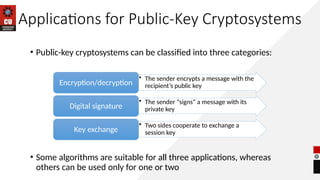
Applications for Public-KeyCryptosystems
• Public-key cryptosystems can be classified into three categories:
• Some algorithms are suitable for all three applications, whereas
others can be used only for one or two
• The sender encrypts a message with the
recipient’s public key
Encryption/decryption
• The sender “signs” a message with its
private key
Digital signature
• Two sides cooperate to exchange a
session key
Key exchange
7.
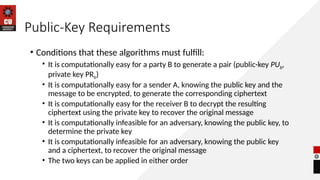
Public-Key Requirements
• Conditionsthat these algorithms must fulfill:
• It is computationally easy for a party B to generate a pair (public-key PUb,
private key PRb)
• It is computationally easy for a sender A, knowing the public key and the
message to be encrypted, to generate the corresponding ciphertext
• It is computationally easy for the receiver B to decrypt the resulting
ciphertext using the private key to recover the original message
• It is computationally infeasible for an adversary, knowing the public key, to
determine the private key
• It is computationally infeasible for an adversary, knowing the public key
and a ciphertext, to recover the original message
• The two keys can be applied in either order
8.
Public-Key Requirements
• Needa trap-door one-way function
• A one-way function is one that maps a domain into a range such that
every function value has a unique inverse, with the condition that the
calculation of the function is easy, whereas the calculation of the inverse is
infeasible
• Y = f(X) easy
• X = f–1
(Y) infeasible
• A practical public-key scheme depends on a suitable trap-door
one-way function
9.
Public-Key Cryptanalysis
• Apublic-key encryption scheme is vulnerable to a brute-force attack
• Countermeasure: use large keys
• Key size must be small enough for practical encryption and decryption
• Key sizes that have been proposed result in encryption/decryption speeds that are too
slow for general-purpose use
• Public-key encryption is currently confined to key management and signature
applications
• Another form of attack is to find some way to compute the private key given
the public key
• To date it has not been mathematically proven that this form of attack is infeasible
for a particular public-key algorithm
• Finally, there is a probable-message attack
• This attack can be thwarted by appending some random bits to simple
messages
10.
Modular Arithmetic
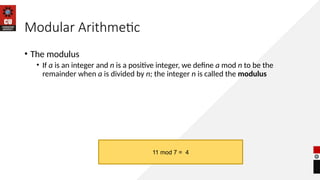
• Themodulus
• If a is an integer and n is a positive integer, we define a mod n to be the
remainder when a is divided by n; the integer n is called the modulus
11 mod 7 = 4
11.
Modular Arithmetic
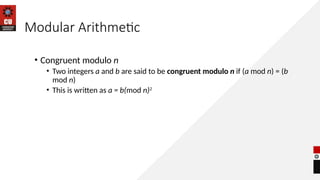
• Congruentmodulo n
• Two integers a and b are said to be congruent modulo n if (a mod n) = (b
mod n)
• This is written as a = b(mod n)2
12.
Properties of Congruences
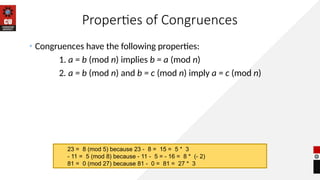
•Congruences have the following properties:
1. a = b (mod n) implies b = a (mod n)
2. a = b (mod n) and b = c (mod n) imply a = c (mod n)
23 = 8 (mod 5) because 23 - 8 = 15 = 5 * 3
- 11 = 5 (mod 8) because - 11 - 5 = - 16 = 8 * (- 2)
81 = 0 (mod 27) because 81 - 0 = 81 = 27 * 3
13.
Modular Arithmetic
• Modulararithmetic exhibits the following properties:
1. [(a mod n) + (b mod n)] mod n = (a + b) mod n
2. [(a mod n) - (b mod n)] mod n = (a - b) mod n
3. [(a mod n) * (b mod n)] mod n = (a * b) mod n
• We demonstrate the first property:
• Define (a mod n) = ra and (b mod n) = rb. Then we can write a = ra + jn for some integer j
and b = rb + kn for some integer k
• Then:
(a + b) mod n = (ra + jn + rb + kn) mod n
= (ra + rb + (k + j)n) mod n
= (ra + rb) mod n
= [(a mod n) + (b mod n)] mod n
14.
Rivest-Shamir-Adleman (RSA) Algorithm
•Developed in 1977 at MIT by Ron Rivest, Adi Shamir & Len
Adleman
• Most widely used general-purpose approach to public-key
encryption
• Is a cipher in which the plaintext and ciphertext are integers
between 0 and n – 1 for some n
• A typical size for n is 1024 bits, or 309 decimal digits
15.
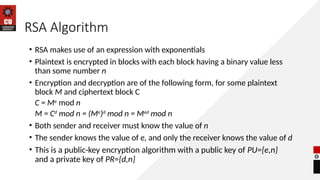
RSA Algorithm
• RSAmakes use of an expression with exponentials
• Plaintext is encrypted in blocks with each block having a binary value less
than some number n
• Encryption and decryption are of the following form, for some plaintext
block M and ciphertext block C
C = Me
mod n
M = Cd
mod n = (Me
)d
mod n = Med
mod n
• Both sender and receiver must know the value of n
• The sender knows the value of e, and only the receiver knows the value of d
• This is a public-key encryption algorithm with a public key of PU={e,n}
and a private key of PR={d,n}
16.
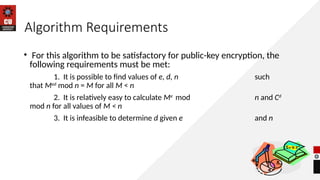
Algorithm Requirements
• Forthis algorithm to be satisfactory for public-key encryption, the
following requirements must be met:
1. It is possible to find values of e, d, n such
that Med
mod n = M for all M < n
2. It is relatively easy to calculate Me
mod n and Cd
mod n for all values of M < n
3. It is infeasible to determine d given e and n
Exponentiation in ModularArithmetic
• Both encryption and decryption in RSA involve raising an integer to
an integer power, mod n
• Can make use of a property of modular arithmetic:
[(a mod n) x (b mod n)] mod n =(a x b) mod n
• With RSA you are dealing with potentially large exponents so
efficiency of exponentiation is a consideration
20.
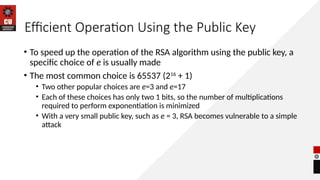
Efficient Operation Usingthe Public Key
• To speed up the operation of the RSA algorithm using the public key, a
specific choice of e is usually made
• The most common choice is 65537 (216
+ 1)
• Two other popular choices are e=3 and e=17
• Each of these choices has only two 1 bits, so the number of multiplications
required to perform exponentiation is minimized
• With a very small public key, such as e = 3, RSA becomes vulnerable to a simple
attack
21.
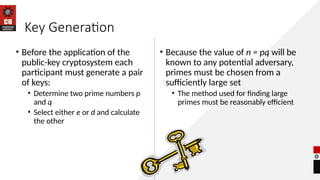
Key Generation
• Beforethe application of the
public-key cryptosystem each
participant must generate a pair
of keys:
• Determine two prime numbers p
and q
• Select either e or d and calculate
the other
• Because the value of n = pq will be
known to any potential adversary,
primes must be chosen from a
sufficiently large set
• The method used for finding large
primes must be reasonably efficient
22.
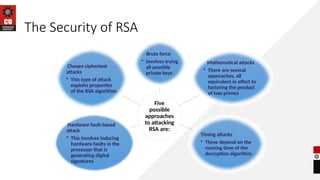
The Security ofRSA
Five
possible
approaches
to attacking
RSA are:
Brute force
• Involves trying
all possible
private keys
Mathematical attacks
• There are several
approaches, all
equivalent in effort to
factoring the product
of two primes
Timing attacks
• These depend on the
running time of the
decryption algorithm
Hardware fault-based
attack
• This involves inducing
hardware faults in the
processor that is
generating digital
signatures
Chosen ciphertext
attacks
• This type of attack
exploits properties
of the RSA algorithm
23.
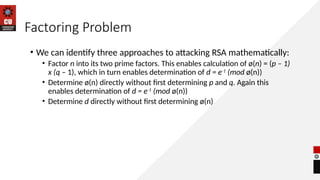
Factoring Problem
• Wecan identify three approaches to attacking RSA mathematically:
• Factor n into its two prime factors. This enables calculation of ø(n) = (p – 1)
x (q – 1), which in turn enables determination of d = e-1
(mod ø(n))
• Determine ø(n) directly without first determining p and q. Again this
enables determination of d = e-1
(mod ø(n))
• Determine d directly without first determining ø(n)
24.
Timing Attacks
• PaulKocher, a cryptographic consultant, demonstrated that a
snooper can determine a private key by keeping track of how long
a computer takes to decipher messages
• Are applicable not just to RSA but to other public-key cryptography
systems
• Are alarming for two reasons:
• It comes from a completely unexpected direction
• It is a ciphertext-only attack
Fault-Based Attack
• Anattack on a processor that is generating RSA digital signatures
• Induces faults in the signature computation by reducing the power to the
processor
• The faults cause the software to produce invalid signatures which can then
be analyzed by the attacker to recover the private key
• The attack algorithm involves inducing single-bit errors and
observing the results
• While worthy of consideration, this attack does not appear to be a
serious threat to RSA
• It requires that the attacker have physical access to the target machine
and is able to directly control the input power to the processor
27.
Chosen Ciphertext Attack(CCA)
• The adversary chooses a number of ciphertexts and is then given
the corresponding plaintexts, decrypted with the target’s private
key
• Thus the adversary could select a plaintext, encrypt it with the target’s
public key, and then be able to get the plaintext back by having it
decrypted with the private key
• The adversary exploits properties of RSA and selects blocks of data that,
when processed using the target’s private key, yield information needed
for cryptanalysis
28.
Further Reading
1. NetworkSecurity Essentials: Applications and
Standards, William Stallings
2. Cryptography and Network Security - Principles and
Practice | Seventh Edition |By Pearson, William,
Stallings
3. https://searchsecurity.techtarget.com/definition/Advan
ced-Encryption-Standard
4. https://www.cloudflare.com/learning/ssl/how-does-pu
blic-key-encryption-work/
#4 Let us take a closer look at the essential elements of a public-key encryption
scheme, using Figure 9.2 (compare with Figure 3.2).
The scheme illustrated in Figure 9.2 provides confidentiality.
#5 It is, however, possible to provide both the authentication function and confidentiality
by a double use of the public-key scheme (Figure 9.4).
In this case, we begin as before by encrypting a message, using the sender’s private
key. This provides the digital signature. Next, we encrypt again, using the receiver’s
public key. The final ciphertext can be decrypted only by the intended receiver, who
alone has the matching private key. Thus, confidentiality is provided. The disadvantage
of this approach is that the public-key algorithm, which is complex, must be
exercised four times rather than two in each communication.
#6 Before proceeding, we need to clarify one aspect of public-key cryptosystems that is
otherwise likely to lead to confusion. Public-key systems are characterized by the use
of a cryptographic algorithm with two keys, one held private and one available publicly.
Depending on the application, the sender uses either the sender’s private key or
the receiver’s public key, or both, to perform some type of cryptographic function. In
broad terms, we can classify the use of public-key cryptosystems into three categories
• Encryption/decryption: The sender encrypts a message with the recipient’s
public key.
• Digital signature: The sender “signs” a message with its private key. Signing
is achieved by a cryptographic algorithm applied to the message or to a small
block of data that is a function of the message.
• Key exchange: Two sides cooperate to exchange a session key. Several different
approaches are possible, involving the private key(s) of one or both parties.
#7 The cryptosystem illustrated in Figures 9.2 through 9.4 depends on a cryptographic algorithm based on two related keys. Diffie and Hellman postulated this system without demonstrating that such algorithms exist. However, they did lay out the conditions that such algorithms must fulfill:
It is computationally easy for a party B to generate a pair (public key PUb, private key PRb).
It is computationally easy for a sender A, knowing the public key and the message to be encrypted, M, to generate the corresponding ciphertext:
C = E(PUb, M)
3. It is computationally easy for the receiver B to decrypt the resulting ciphertext using the private key to recover the original message: M = D(PRb, C) = D[PRb, E(PUb, M)
4. It is computationally infeasible for an adversary, knowing the public key, PUb, to determine the private key, PRb
5. It is computationally infeasible for an adversary, knowing the public key, PUb, and a ciphertext, C, to recover the original message, M.
6. (optional) The two keys can be applied in either order:
M = D[PUb , E(PRb, M)] = D[PRb, E(PUb, M)]
These are formidable requirements, as evidenced by the fact that only a few algorithms (RSA, elliptic curve cryptography, Diffie-Hellman, DSS) have received widespread acceptance in the several decades since the concept of public-key cryptography was proposed.
#8 Before elaborating on why the requirements are so formidable, let us first recast
them. The requirements boil down to the need for a trap-door one-way function.
A one-way function is one that maps a domain into a range such that every
function value has a unique inverse, with the condition that the calculation of the
function is easy, whereas the calculation of the inverse is infeasible
Y = f(X) easy
X = f–1(Y) infeasible
Generally, easy is defined to mean a problem that can be solved in polynomial
time as a function of input length. Thus, if the length of the input is n bits, then the
time to compute the function is proportional to na , where a is a fixed constant. Such
algorithms are said to belong to the class P . The term infeasible is a much fuzzier
concept. In general, we can say a problem is infeasible if the effort to solve it grows
faster than polynomial time as a function of input size. For example, if the length
of the input is n bits and the time to compute the function is proportional to 2n ,
the problem is considered infeasible. Unfortunately, it is difficult to determine if a
particular algorithm exhibits this complexity. Furthermore, traditional notions of
computational complexity focus on the worst-case or average-case complexity of
an algorithm. These measures are inadequate for cryptography, which requires that
it be infeasible to invert a function for virtually all inputs, not for the worst case or
even average case. A brief introduction to some of these concepts is provided in
Appendix 9A.
We now turn to the definition of a trap-door one-way function , which is easy
to calculate in one direction and infeasible to calculate in the other direction unless
certain additional information is known. With the additional information the
inverse can be calculated in polynomial time. We can summarize as follows: A trapdoor
one-way function is a family of invertible functions fk , such that
Y = fk(X) easy, if k and X are known
X = fk–1(Y) easy, if k and Y are known
X = fk–1(Y) infeasible, if Y known but k not known
Thus, the development of a practical public-key scheme depends on discovery of a suitable trap-door one-way function.
#9 As with symmetric encryption, a public-key encryption scheme is vulnerable to a
brute-force attack. The countermeasure is the same: Use large keys. However, there
is a tradeoff to be considered. Public-key systems depend on the use of some sort of
invertible mathematical function. The complexity of calculating these functions may
not scale linearly with the number of bits in the key but grow more rapidly than that.
Thus, the key size must be large enough to make brute-force attack impractical but
small enough for practical encryption and decryption. In practice, the key sizes that
have been proposed do make brute-force attack impractical but result in encryption/
decryption speeds that are too slow for general-purpose use. Instead, as was mentioned
earlier, public-key encryption is currently confined to key management and
signature applications.
Another form of attack is to find some way to compute the private key given
the public key. To date, it has not been mathematically proven that this form of attack
is infeasible for a particular public-key algorithm. Thus, any given algorithm,
including the widely used RSA algorithm, is suspect. The history of cryptanalysis
shows that a problem that seems insoluble from one perspective can be found to
have a solution if looked at in an entirely different way.
Finally, there is a form of attack that is peculiar to public-key systems. This is,
in essence, a probable-message attack. Suppose, for example, that a message were to
be sent that consisted solely of a 56-bit DES key. An adversary could encrypt all possible
56-bit DES keys using the public key and could discover the encrypted key by
matching the transmitted ciphertext. Thus, no matter how large the key size of the
public-key scheme, the attack is reduced to a brute-force attack on a 56-bit key. This
attack can be thwarted by appending some random bits to such simple messages.
#10 If a is an integer and n is a positive integer, we define a mod n to be the remainder
when a is divided by n . The integer n is called the modulus . Thus, for any integer a:
a = qn + r 0 ≤ r < n; q = [ a/ n]
a = [a/ n] * n + ( a mod n)
#11 Two integers a and b are said to be congruent modulo n , if (a mod n ) =
(b mod n ). This is written as a K b (mod n ).2
Note that if a = 0 (mod n ), then n | a .
#12 Congruences have the following properties:
1. a = b (mod n) if n (a – b)
2. a = b (mod n) implies b = a (mod n)
3. a = b (mod n) and b = c (mod n) imply a = c (mod n)
To demonstrate the first point, if n (a - b), then (a - b) = kn for some k
So we can write a = b + kn
Therefore, (a mod n) = (remainder when b + kn is divided by n) = (remainder when b is divided by n) = (b mod n)
#13 Modular arithmetic exhibits the following properties:
1. [(a mod n) + (b mod n)] mod n = (a + b) mod n
2. [(a mod n) - (b mod n)] mod n = (a - b) mod n
3. [(a mod n) * (b mod n)] mod n = (a * b) mod n
We demonstrate the first property:
Define (a mod n) = ra and (b mod n) = rb. Then we can write a = ra + jn for some integer j and b = rb + kn for some integer k.
Then:
(a + b) mod n = (ra + jn + rb + kn) mod n
= (ra + rb + (k + j)n) mod n
= (ra + rb) mod n
= [(a mod n) + (b mod n)] mod n
#14 The pioneering paper by Diffie and Hellman [DIFF76b] introduced a new approach
to cryptography and, in effect, challenged cryptologists to come up with a cryptographic
algorithm that met the requirements for public-key systems. A number of
algorithms have been proposed for public-key cryptography. Some of these, though
initially promising, turned out to be breakable.
One of the first successful responses to the challenge was developed in 1977
by Ron Rivest, Adi Shamir, and Len Adleman at MIT and first published in 1978
[RIVE78]. The Rivest-Shamir-Adleman (RSA) scheme has since that time reigned
supreme as the most widely accepted and implemented general-purpose approach
to public-key encryption.
The RSA scheme is a cipher in which the plaintext and ciphertext are integers
between 0 and n - 1 for some n . A typical size for n is 1024 bits, or 309 decimal
digits. That is, n is less than 21024 . We examine RSA in this section in some detail,
beginning with an explanation of the algorithm. Then we examine some of the computational
and cryptanalytical implications of RSA.
#15 RSA makes use of an expression with exponentials. Plaintext is encrypted in blocks,
with each block having a binary value less than some number n . That is, the block
size must be less than or equal to log2 (n ) + 1; in practice, the block size is i bits,
where 2i < n ≤ 2i+1 . Encryption and decryption are of the following form, for some
plaintext block M and ciphertext block C.
C = Me mod n
M = Cd mod n = (Me )d mod n = Med mod n
Both sender and receiver must know the value of n . The sender knows the
value of e , and only the receiver knows the value of d . Thus, this is a public-key encryption
algorithm with a public key of PU = {e , n } and a private key of PR = {d , n }.
#16 For this algorithm to be satisfactory for public-key encryption, the following requirements
must be met.
1. It is possible to find values of e , d , n such that Med mod n = M for all M < n .
2. It is relatively easy to calculate Me mod n and Cd mod n for all values of M < n .
3. It is infeasible to determine d given e and n .
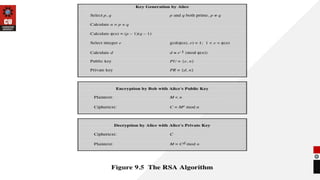
#17 Figure 9.5 summarizes the RSA algorithm. It corresponds to Figure 9.1a: Alice
generates a public/private key pair; Bob encrypts using Alice’s public key; and Alice
decrypts using her private key.
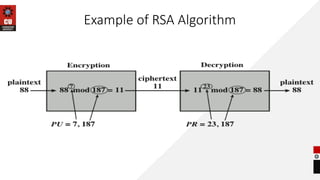
#18 An example from [SING99] is shown in Figure 9.6.
#19 Both encryption and decryption in RSA
involve raising an integer to an integer power, mod n . If the exponentiation is done
over the integers and then reduced modulo n , the intermediate values would be
gargantuan. Fortunately, as the preceding example shows, we can make use of a
property of modular arithmetic:
[(a mod n ) * (b mod n )] mod n = (a * b ) mod n
Thus, we can reduce intermediate results modulo n . This makes the calculation
practical.
Another consideration is the efficiency of exponentiation, because with RSA,
we are dealing with potentially large exponents. To see how efficiency might be increased,
consider that we wish to compute x16 . A straightforward approach requires
15 multiplications:
x16 = x * x * x * x * x * x * x * x * x * x * x * x * x * x * x * x
However, we can achieve the same final result with only four multiplications if we
repeatedly take the square of each partial result, successively forming (x2 , x4 , x8 , x16 ).
#20 To speed up the operation of the RSA algorithm using the public key, can choose to use a small value of e. The most common choice is 65537 (216 + 1); two other popular choices are 3 and 17. Each of these choices has only two 1 bits and so the number of multiplications required to perform exponentiation is minimized.
However, with a very small public key, such as e = 3, RSA becomes vulnerable to a simple attack.
#21 Before the application of the public-key cryptosystem, each
participant must generate a pair of keys. This involves the following tasks.
• Determining two prime numbers, p and q.
• Selecting either e or d and calculating the other.
First, consider the selection of p and q . Because the value of n = pq will be
known to any potential adversary, in order to prevent the discovery of p and q by
exhaustive methods, these primes must be chosen from a sufficiently large set (i.e.,
p and q must be large numbers). On the other hand, the method used for finding
large primes must be reasonably efficient.
At present, there are no useful techniques that yield arbitrarily large primes,
so some other means of tackling the problem is needed. The procedure that is generally
used is to pick at random an odd number of the desired order of magnitude
and test whether that number is prime. If not, pick successive random numbers until
one is found that tests prime.
A variety of tests for primality have been developed (e.g., see [KNUT98] for
a description of a number of such tests). Almost invariably, the tests are probabilistic.
That is, the test will merely determine that a given integer is probably prime.
Despite this lack of certainty, these tests can be run in such a way as to make the
probability as close to 1.0 as desired. As an example, one of the more efficient
and popular algorithms, the Miller-Rabin algorithm, is described in Chapter 2.
With this algorithm and most such algorithms, the procedure for testing whether
a given integer n is prime is to perform some calculation that involves n and a
randomly chosen integer a . If n “fails” the test, then n is not prime. If n “passes”
the test, then n may be prime or nonprime. If n passes many such tests with many
different randomly chosen values for a , then we can have high confidence that n
is, in fact, prime.
#22 Five possible approaches to attacking the RSA algorithm are
■ Brute force: This involves trying all possible private keys.
■ Mathematical attacks: There are several approaches, all equivalent in effort to
factoring the product of two primes.
■ Timing attacks: These depend on the running time of the decryption algorithm.
■ Hardware fault-based attack: This involves inducing hardware faults in the
processor that is generating digital signatures.
■ Chosen ciphertext attacks: This type of attack exploits properties of the RSA
algorithm.
The defense against the brute-force approach is the same for RSA as for other cryptosystems, namely, use a large key space. Thus the larger the number of bits in d, the better. However because the calculations involved both in key generation and in encryption/decryption are complex, the larger the size of the key, the slower the system will run.
#23 We can identify three approaches to attacking RSA mathematically:
Factor n into its two prime factors. This enables calculation of ø(n) = (p – 1) x (q – 1), which in turn enables determination of d = e-1 (mod ø(n))
Determine ø(n) directly without first determining p and q. Again this enables determination of d = e-1 (mod ø(n))
Determine d directly without first determining ø(n)
#24 If one needed yet another lesson about how difficult it is to
assess the security of a cryptographic algorithm, the appearance of timing attacks
provides a stunning one. Paul Kocher, a cryptographic consultant, demonstrated
that a snooper can determine a private key by keeping track of how long a computer
takes to decipher messages [KOCH96, KALI96b]. Timing attacks are applicable
not just to RSA, but to other public-key cryptography systems. This attack is alarming
for two reasons: It comes from a completely unexpected direction, and it is a
ciphertext-only attack.
A timing attack is somewhat analogous to a burglar guessing the combination
of a safe by observing how long it takes for someone to turn the dial from number
to number. We can explain the attack using the modular exponentiation algorithm
of Figure 9.8, but the attack can be adapted to work with any implementation that
does not run in fixed time. In this algorithm, modular exponentiation is accomplished
bit by bit, with one modular multiplication performed at each iteration and
an additional modular multiplication performed for each 1 bit.
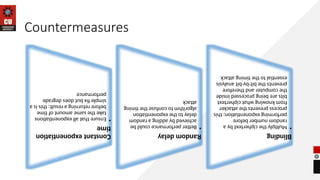
#25 Although the timing attack is a serious threat, there are simple countermeasures
that can be used, including the following.
• Constant exponentiation time: Ensure that all exponentiations take the same
amount of time before returning a result. This is a simple fix but does degrade
performance.
• Random delay: Better performance could be achieved by adding a random
delay to the exponentiation algorithm to confuse the timing attack. Kocher
points out that if defenders don’t add enough noise, attackers could still succeed
by collecting additional measurements to compensate for the random delays.
• Blinding: Multiply the ciphertext by a random number before performing
exponentiation. This process prevents the attacker from knowing what ciphertext
bits are being processed inside the computer and therefore prevents the
bit-by-bit analysis essential to the timing attack.
#26 Still another unorthodox approach to attacking RSA is reported
in [PELL10]. The approach is an attack on a processor that is generating
RSA digital signatures. The attack induces faults in the signature computation by
reducing the power to the processor. The faults cause the software to produce invalid
signatures, which can then be analyzed by the attacker to recover the private
key. The authors show how such an analysis can be done and then demonstrate it
by extracting a 1024-bit private RSA key in approximately 100 hours, using a commercially
available microprocessor.
The attack algorithm involves inducing single-bit errors and observing the results.
The details are provided in [PELL10], which also references other proposed
hardware fault-based attacks against RSA.
This attack, while worthy of consideration, does not appear to be a serious
threat to RSA. It requires that the attacker have physical access to the target
machine and that the attacker is able to directly control the input power to the
processor. Controlling the input power would for most hardware require more than
simply controlling the AC power, but would also involve the power supply control
hardware on the chip.
#27 The basic RSA algorithm is vulnerable to a chosen ciphertext attack (CCA). CCA is
defined as an attack in which the adversary chooses a number of ciphertexts and
is then given the corresponding plaintexts, decrypted with the target’s private key.
Thus, the adversary could select a plaintext, encrypt it with the target’s public key,
and then be able to get the plaintext back by having it decrypted with the private
key. Clearly, this provides the adversary with no new information. Instead, the adversary
exploits properties of RSA and selects blocks of data that, when processed
using the target’s private key, yield information needed for cryptanalysis.
To counter such attacks, RSA Security Inc., a leading RSA vendor and former holder
of the RSA patent, recommends modifying the plaintext using a procedure known
as optimal asymmetric encryption padding (OAEP). A full discussion of the threats
and OAEP are beyond our scope; see [POIN02] for an introduction and [BELL94a]
for a thorough analysis. Here, we simply summarize the OAEP procedure.


![Public-Key Cryptosystem: Secrecy
Y=E[PUb,X]
X=D[PRb,Y]](https://image.slidesharecdn.com/cst433psirsaunit2-250222164100-f4da88dd/85/IOT_DEPARTMENT_CST_433_PSI__RSA_unit2-pptx-4-320.jpg)
![Public-Key Cryptosystem: Authentication and
Secrecy
Z=E[(PUb,E(PRa,X)]
X=S[PUa ,D(PRb,Z)]](https://image.slidesharecdn.com/cst433psirsaunit2-250222164100-f4da88dd/85/IOT_DEPARTMENT_CST_433_PSI__RSA_unit2-pptx-5-320.jpg)

![Modular Arithmetic
• Modular arithmetic exhibits the following properties:
1. [(a mod n) + (b mod n)] mod n = (a + b) mod n
2. [(a mod n) - (b mod n)] mod n = (a - b) mod n
3. [(a mod n) * (b mod n)] mod n = (a * b) mod n
• We demonstrate the first property:
• Define (a mod n) = ra and (b mod n) = rb. Then we can write a = ra + jn for some integer j
and b = rb + kn for some integer k
• Then:
(a + b) mod n = (ra + jn + rb + kn) mod n
= (ra + rb + (k + j)n) mod n
= (ra + rb) mod n
= [(a mod n) + (b mod n)] mod n](https://image.slidesharecdn.com/cst433psirsaunit2-250222164100-f4da88dd/85/IOT_DEPARTMENT_CST_433_PSI__RSA_unit2-pptx-13-320.jpg)
![Exponentiation in Modular Arithmetic
• Both encryption and decryption in RSA involve raising an integer to
an integer power, mod n
• Can make use of a property of modular arithmetic:
[(a mod n) x (b mod n)] mod n =(a x b) mod n
• With RSA you are dealing with potentially large exponents so
efficiency of exponentiation is a consideration](https://image.slidesharecdn.com/cst433psirsaunit2-250222164100-f4da88dd/85/IOT_DEPARTMENT_CST_433_PSI__RSA_unit2-pptx-19-320.jpg)