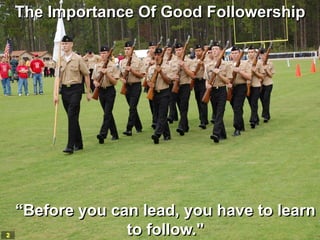
The Importance OfGood Followership
“Before you can lead, you have to learn
2 to follow."
3.
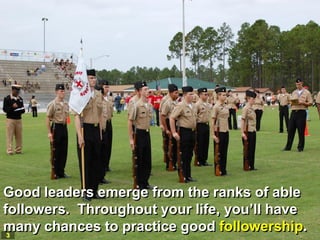
Good leaders emergefrom the ranks of able
followers. Throughout your life, you’ll have
many chances to practice good followership.
3
4.
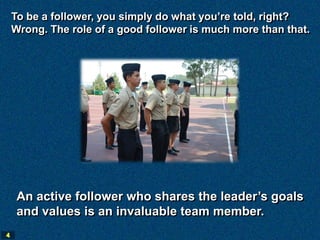
To be afollower, you simply do what you’re told, right?
Wrong. The role of a good follower is much more than that.
An active follower who shares the leader’s goals
and values is an invaluable team member.
4
5.
Where do goodleaders come from?
A. Ranks of competent followers
B. Leadership classes
C. Military training and background
D. Years of experience
5
6.
Where do goodleaders come from?
A. Ranks of competent followers
B. Leadership classes
C. Military training and background
D. Years of experience
6
7.
Followers
The “worker bees” – or whatever
you call them – are the heart and
soul of an effective team.
7
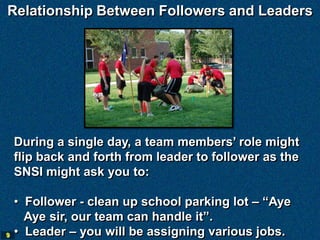
Relationship Between Followersand Leaders
During a single day, a team members’ role might
flip back and forth from leader to follower as the
SNSI might ask you to:
• Follower - clean up school parking lot – “Aye
Aye sir, our team can handle it”.
9 • Leader – you will be assigning various jobs.
10.
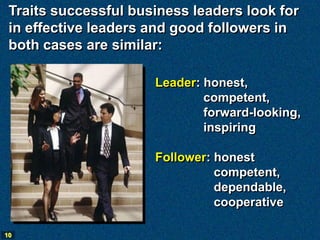
Traits successful businessleaders look for
in effective leaders and good followers in
both cases are similar:
Leader: honest,
competent,
forward-looking,
inspiring
Follower: honest
competent,
dependable,
cooperative
10
11.
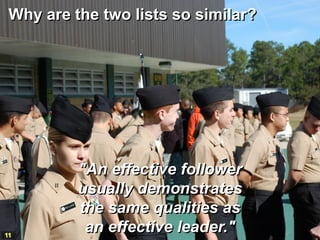
Why are thetwo lists so similar?
"An effective follower
usually demonstrates
the same qualities as
11
an effective leader."
True or False:To be a good follower,
all you have to do is obey orders.
21
22.
True or False:To be a good follower,
all you have to do is obey orders.
False
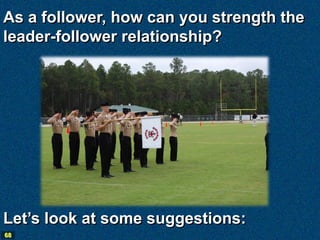
22
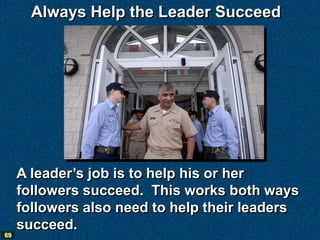
23.
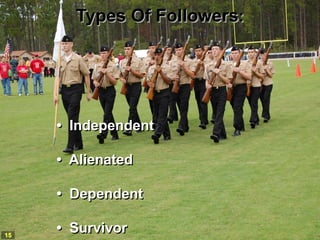
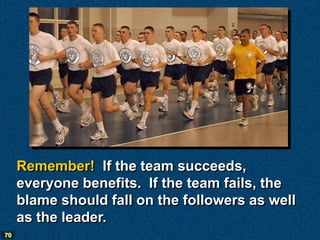
Alienated followers:
• Complain and criticize.
• Take no action.
23
• Always disagree or complain.
24.
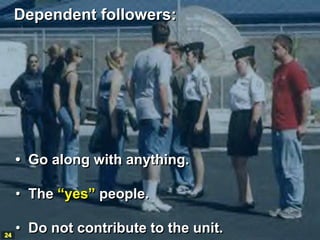
Dependent followers:
• Go along with anything.
• The “yes” people.
24
• Do not contribute to the unit.
25.
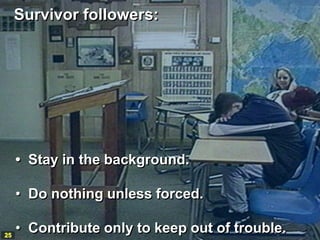
Survivor followers:
• Stay in the background.
• Do nothing unless forced.
25
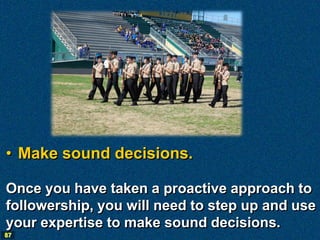
• Contribute only to keep out of trouble.
26.
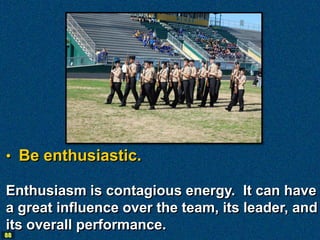
Which one ofthese behaviors belongs
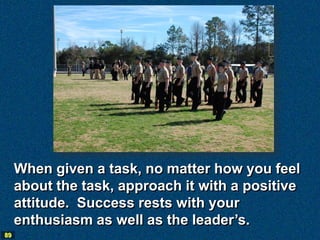
to an effective follower?
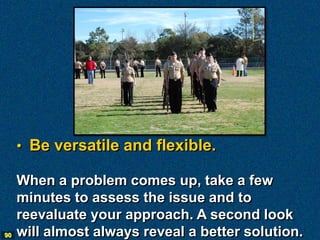
A. Never volunteering
B. Going along with anything
C. Taking on responsibility
D. Criticizing every idea
26
27.
Which one ofthese behaviors belongs
to an effective follower?
A. Never volunteering
B. Going along with anything
C. Taking on responsibility
D. Criticizing every idea
27
28.
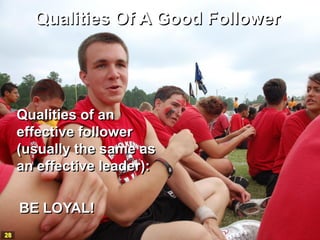
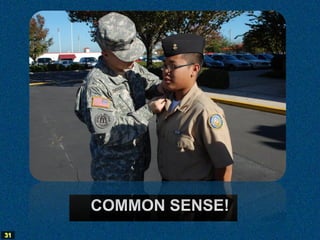
Qualities Of AGood Follower
Qualities of an
effective follower
(usually the same as
an effective leader):
BE LOYAL!
28
Good followers are_______ the
organization and its goals.
A. loyal to
B. defensive of
C. indecisive about
D. critical of
32
33.
Good followers are_______ the
organization and its goals.
A. loyal to
B. defensive of
C. indecisive about
D. critical of
33
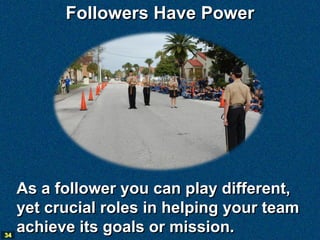
34.
Followers Have Power
As a follower you can play different,
yet crucial roles in helping your team
34
achieve its goals or mission.
35.
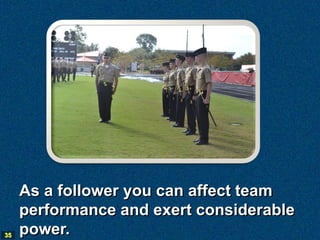
As a followeryou can affect team
performance and exert considerable
35 power.
36.
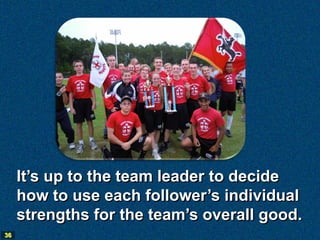
It’s up tothe team leader to decide
how to use each follower’s individual
strengths for the team’s overall good.
36
37.
True or False:Followers exert power
when they possess unique skills or
knowledge that can be used by the
group.
37
38.
True or False:Followers exert power
when they possess unique skills or
knowledge that can be used by the
group.
True
38
39.
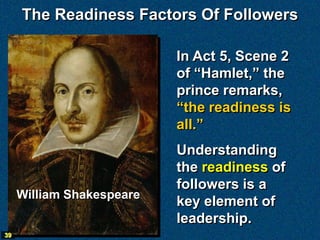
The Readiness FactorsOf Followers
In Act 5, Scene 2
of “Hamlet,” the
prince remarks,
“the readiness is
all.”
Understanding
the readiness of
followers is a
William Shakespeare
key element of
leadership.
39
40.
Readiness
How prepared a team member is to
carry out a particular task or tasks
40
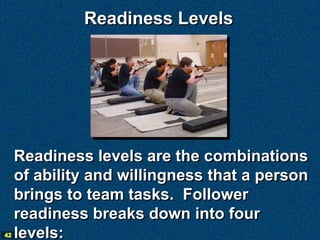
Readiness Levels
Readiness levels are the combinations
of ability and willingness that a person
brings to team tasks. Follower
readiness breaks down into four
42 levels:
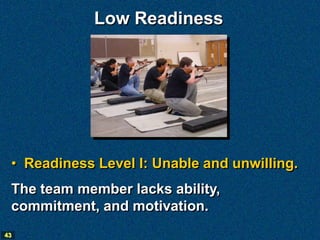
43.
Low Readiness
•Readiness Level I: Unable and unwilling.
The team member lacks ability,
commitment, and motivation.
43
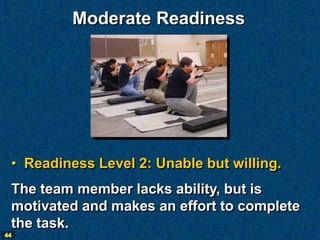
44.
Moderate Readiness
•Readiness Level 2: Unable but willing.
The team member lacks ability, but is
motivated and makes an effort to complete
the task.
44
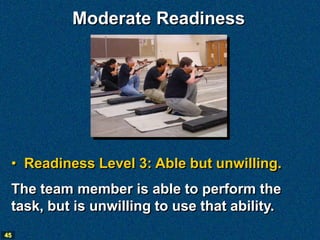
45.
Moderate Readiness
•Readiness Level 3: Able but unwilling.
The team member is able to perform the
task, but is unwilling to use that ability.
45
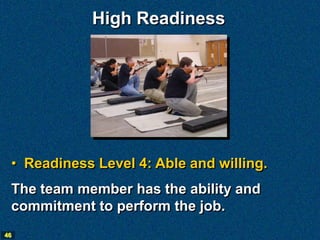
46.
High Readiness
•Readiness Level 4: Able and willing.
The team member has the ability and
commitment to perform the job.
46
47.
A good teamleader will use each
follower’s _______ for the good of the
group.
A. ideas
B. personality
C. uncertainties
D. strength
47
48.
A good teamleader will use each
follower’s _______ for the good of the
group.
A. ideas
B. personality
C. uncertainties
D. strength
48
49.
A state ofbeing prepared for action is
known as _______.
A. readiness
B. motivation
C. anticipation
D. aggression
49
50.
A state ofbeing prepared for action is
known as _______.
A. readiness
B. motivation
C. anticipation
D. aggression
50
51.
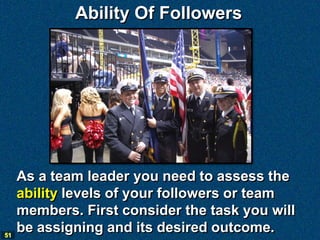
Ability Of Followers
As a team leader you need to assess the
ability levels of your followers or team
members. First consider the task you will
51
be assigning and its desired outcome.
52.
Ability
The knowledge, experience, and
skill a team member or a team
brings to a task
52
53.
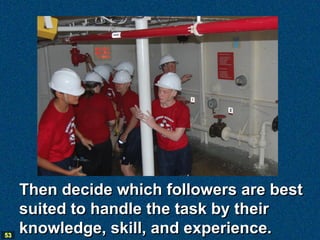
Then decide whichfollowers are best
suited to handle the task by their
53
knowledge, skill, and experience.
54.
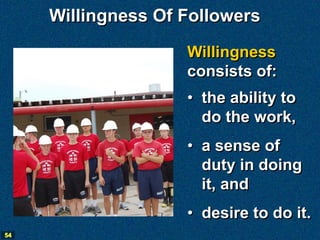
Willingness Of Followers
Willingness
consists of:
• the ability to
do the work,
• a sense of
duty in doing
it, and
• desire to do it.
54
55.
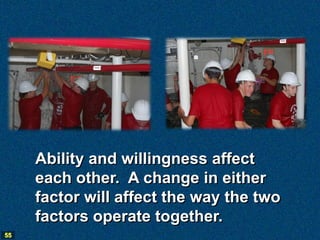
Ability and willingnessaffect
each other. A change in either
factor will affect the way the two
factors operate together.
55
56.
What should ateam leader consider
first when planning the strategy for a
task?
A. Abilities of the followers
B. Readiness of the followers
C. Desired outcome of the task
D. His/Her own readiness and ability
56
57.
What should ateam leader consider
first when planning the strategy for a
task?
A. Abilities of the followers
B. Readiness of the followers
C. Desired outcome of the task
D. His/Her own readiness and ability
57
58.
Confidence Of Followers
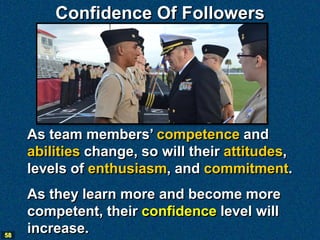
As team members’ competence and
abilities change, so will their attitudes,
levels of enthusiasm, and commitment.
As they learn more and become more
competent, their confidence level will
58
increase.
59.
Confidence
Faith or belief that a person will act
in a right, proper, or effective way,
self-assurance
59
60.
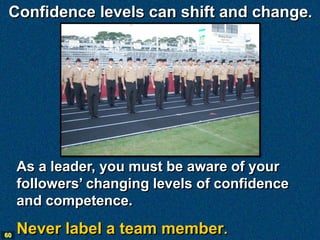
Confidence levels canshift and change.
As a leader, you must be aware of your
followers’ changing levels of confidence
and competence.
60
Never label a team member.
61.
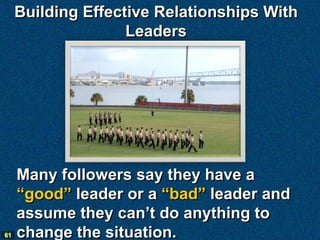
Building Effective RelationshipsWith
Leaders
Many followers say they have a
“good” leader or a “bad” leader and
assume they can’t do anything to
61 change the situation.
62.
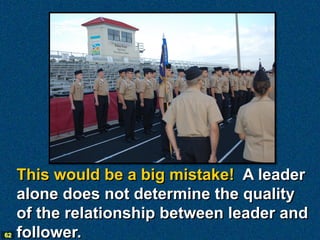
This would bea big mistake! A leader
alone does not determine the quality
of the relationship between leader and
62 follower.
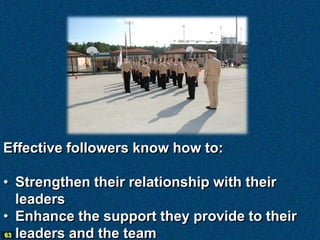
63.
Effective followers knowhow to:
• Strengthen their relationship with their
leaders
• Enhance the support they provide to their
63 leaders and the team
64.
True or False:Ability and willingness
have a dynamic relationship, i.e., a
change in one affects the other.
64
65.
True or False:Ability and willingness
have a dynamic relationship, i.e., a
change in one affects the other.
True
65
66.
True or False:An effective leader does
not label team members.
66
67.
True or False:An effective leader does
not label team members.
True
67
68.
As a follower,how can you strength the
leader-follower relationship?
Let’s look at some suggestions:
68
69.
Always Help theLeader Succeed
A leader’s job is to help his or her
followers succeed. This works both ways
followers also need to help their leaders
succeed.
69
70.
Remember! If theteam succeeds,
everyone benefits. If the team fails, the
blame should fall on the followers as well
as the leader.
70
71.
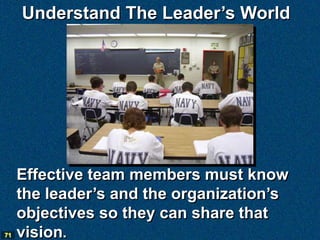
Understand The Leader’sWorld
Effective team members must know
the leader’s and the organization’s
objectives so they can share that
71 vision.
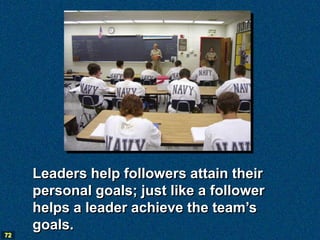
72.
Leaders help followersattain their
personal goals; just like a follower
helps a leader achieve the team’s
goals.
72
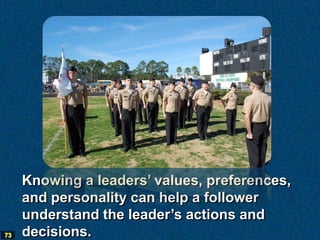
73.
Knowing a leaders’values, preferences,
and personality can help a follower
understand the leader’s actions and
73 decisions.
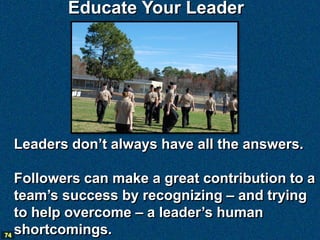
74.
Educate Your Leader
Leaders don’t always have all the answers.
Followers can make a great contribution to a
team’s success by recognizing – and trying
to help overcome – a leader’s human
74 shortcomings.
75.
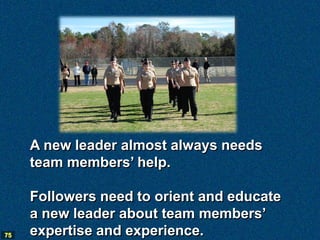
A new leaderalmost always needs
team members’ help.
Followers need to orient and educate
a new leader about team members’
75 expertise and experience.
76.
The better afollower understands a
leader, the _______ their relationship
will be.
A. stronger
B. happier
C. clearer
D. more equal
76
77.
The better afollower understands a
leader, the _______ their relationship
will be.
A. stronger
B. happier
C. clearer
D. more equal
77
78.
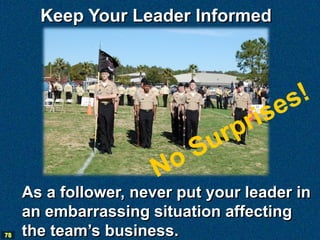
Keep Your LeaderInformed
As a follower, never put your leader in
an embarrassing situation affecting
78 the team’s business.
79.
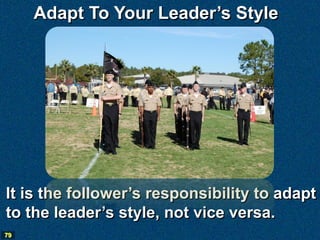
Adapt To YourLeader’s Style
It is the follower’s responsibility to adapt
to the leader’s style, not vice versa.
79
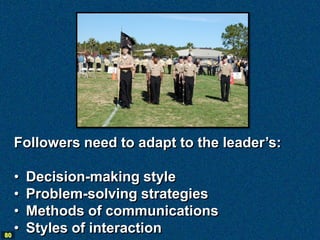
80.
Followers need toadapt to the leader’s:
• Decision-making style
• Problem-solving strategies
• Methods of communications
80
• Styles of interaction
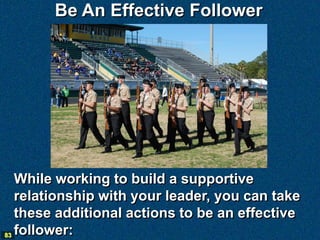
Be An EffectiveFollower
While working to build a supportive
relationship with your leader, you can take
these additional actions to be an effective
83 follower:
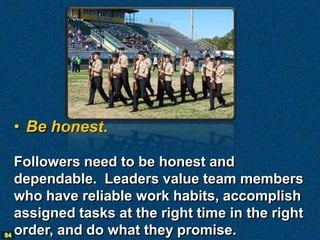
84.
• Be honest.
Followers need to be honest and
dependable. Leaders value team members
who have reliable work habits, accomplish
assigned tasks at the right time in the right
84 order, and do what they promise.
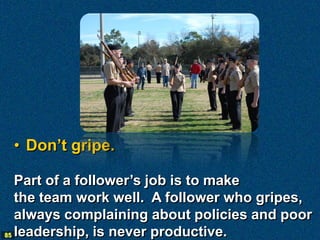
85.
• Don’t gripe.
Part of a follower’s job is to make
the team work well. A follower who gripes,
always complaining about policies and poor
85 leadership, is never productive.
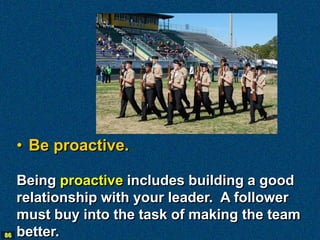
86.
• Be proactive.
Being proactive includes building a good
relationship with your leader. A follower
must buy into the task of making the team
86 better.
87.
• Make sounddecisions.
Once you have taken a proactive approach to
followership, you will need to step up and use
your expertise to make sound decisions.
87
88.
• Be enthusiastic.
Enthusiasmis contagious energy. It can have
a great influence over the team, its leader, and
its overall performance.
88
89.
When given atask, no matter how you feel
about the task, approach it with a positive
attitude. Success rests with your
enthusiasm as well as the leader’s.
89
90.
• Be versatileand flexible.
When a problem comes up, take a few
minutes to assess the issue and to
reevaluate your approach. A second look
90 will almost always reveal a better solution.
91.
Instead of gripingabout poor
leadership, a follower should be
_______, i.e. he/she should take the
initiative to try to make things happen.
A. inventive
B. proactive
C. ingenious
D. mobile
91
92.
Instead of gripingabout poor
leadership, a follower should be
_______, i.e. he/she should take the
initiative to try to make things happen.
A. inventive
B. proactive
C. ingenious
D. mobile
92
93.
A follower’s _______generates energy
that spreads and exerts a positive
influence on the team, its leader, and
its performance.
A. integrity
B. dependability
C. enthusiasm
D. willingness
93
94.
A follower’s _______generates energy
that spreads and exerts a positive
influence on the team, its leader, and
its performance.
A. integrity
B. dependability
C. enthusiasm
D. willingness
94
95.
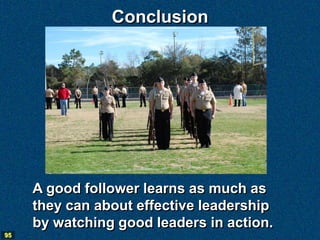
Conclusion
A good follower learns as much as
they can about effective leadership
by watching good leaders in action.
95
Q.1. If yourattitudes, actions, and
behavior help a leader succeed,
what are you displaying?
A.1. A. Readiness
B. Followership
C. Initiative
D. Confidence
97
98.
Q.1. If yourattitudes, actions, and
behavior help a leader succeed,
what are you displaying?
A.1. A. Readiness
B. Followership
C. Initiative
D. Confidence
98
99.
Q.2. What isthe number one trait that
successful business leaders look
for in both effective leaders and
good followers?
A.2. A. Dependability
B. Cooperation
C. Honesty
D. Competence
99
100.
Q.2. What isthe number one trait that
successful business leaders look
for in both effective leaders and
good followers?
A.2. A. Dependability
B. Cooperation
C. Honesty
D. Competence
100
101.
Q.3. What typeof follower actively
seeks responsibility, completes
tasks, and suggests ideas for
improvement?
A.3. A. Alienated follower
B. Survivor
C. Dependent follower
D. Effective follower
101
102.
Q.3. What typeof follower actively
seeks responsibility, completes
tasks, and suggests ideas for
improvement?
A.3. A. Alienated follower
B. Survivor
C. Dependent follower
D. Effective follower
102
103.
Q.4. What typeof follower stays in the
background, never volunteers,
and does just enough to stay out
of trouble?
A.4. A. Alienated follower
B. Survivor
C. Dependent follower
D. Effective follower
103
104.
Q.4. What typeof follower stays in the
background, never volunteers,
and does just enough to stay out
of trouble?
A.4. A. Alienated follower
B. Survivor
C. Dependent follower
D. Effective follower
104
105.
Q.5. What typeof follower waits to be
told what to do, goes along with
anything, and does not do any
thinking?
A.5. A. Alienated follower
B. Survivor
C. Dependent follower
D. Effective follower
105
106.
Q.5. What typeof follower waits to be
told what to do, goes along with
anything, and does not do any
thinking?
A.5. A. Alienated follower
B. Survivor
C. Dependent follower
D. Effective follower
106
107.
Q.6. What typeof follower always
complains, criticizes, and
questions?
A.6. A. Alienated follower
B. Survivor
C. Dependent follower
D. Effective follower
107
108.
Q.6. What typeof follower always
complains, criticizes, and
questions?
A.6. A. Alienated follower
B. Survivor
C. Dependent follower
D. Effective follower
108
109.
Q.7. If youdo what has to be done
without anyone having to tell
you, you are showing _______.
A.7. A. common sense
B. ability
C. initiative
D. dependability
109
110.
Q.7. If youdo what has to be done
without anyone having to tell
you, you are showing _______.
A.7. A. common sense
B. ability
C. initiative
D. dependability
110
111.
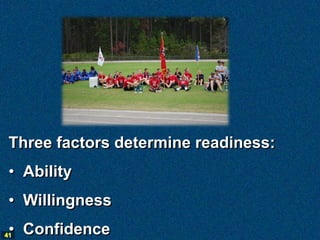
Q.8. What threefactors are used to
determine a follower’s readiness?
A.8. A. Ability, willingness, confidence
B. Ability, willingness,
dependability
C. Initiative, willingness,
confidence
D. Willingness, confidence,
dependability
111
112.
Q.8. What threefactors are used to
determine a follower’s readiness?
A.8. A. Ability, willingness, confidence
B. Ability, willingness,
dependability
C. Initiative, willingness,
confidence
D. Willingness, confidence,
dependability
112
113.
Q.9. What termis used to refer to a
state of being prepared for
action?
A.9. A. Motivation
B. Readiness
C. Assertiveness
D. Initiative
113
114.
Q.9. What termis used to refer to a
state of being prepared for
action?
A.9. A. Motivation
B. Readiness
C. Assertiveness
D. Initiative
114
115.
Q.10. In ReadinessLevel 3, the
follower is _______.
A.10. A. unable but willing
B. unable and unwilling
C. able and willing
D. able but unwilling
115
116.
Q.10. In ReadinessLevel 3, the
follower is _______.
A.10. A. unable but willing
B. unable and unwilling
C. able and willing
D. able but unwilling
116
117.
Q.11. What traitmay followers in
Readiness Levels 2 and 4 have
in common?
A.11. A. ability
B. unwillingness
C. insecurity
D. confidence
117
118.
Q.11. What traitmay followers in
Readiness Levels 2 and 4 have
in common?
A.11. A. ability
B. unwillingness
C. insecurity
D. confidence
118
119.
Q.12. Which ofthe following statements is NOT
accurate regarding the readiness of
followers?
A.12. A. The confidence level of followers
increases during the course of
performing a task.
B. A team member’s apparent unwillingness
may instead be a lack of confidence.
C. A team leader’s first consideration when
planning the strategy for a task is to
consider the readiness of the followers.
D. Because ability and willingness affect
each other, their function is susceptible
to a change in either one.
119
120.
Q.12. Which ofthe following statements is NOT
accurate regarding the readiness of
followers?
A.12. A. The confidence level of followers
increases during the course of
performing a task.
B. A team member’s apparent unwillingness
may instead be a lack of confidence.
C. A team leader’s first consideration when
planning the strategy for a task is to
consider the readiness of the followers.
D. Because ability and willingness affect
each other, their function is susceptible
to a change in either one.
120
121.
Q.13. What termis used to refer to the
degree to which a team member
shows confidence,
commitment, and motivation to
carry out a task?
A.13. A. willingness
B. dependability
C. ability
D. initiative
121
122.
Q.13. What termis used to refer to the
degree to which a team member
shows confidence,
commitment, and motivation to
carry out a task?
A.13. A. willingness
B. dependability
C. ability
D. initiative
122
123.
Q.14. A teammember’s _______ is a
combination of the knowledge,
experience, and skill that he/she
brings to a task.
A.14. A. willingness
B. ability
C. confidence
D. readiness
123
124.
Q.14. A teammember’s _______ is a
combination of the knowledge,
experience, and skill that he/she
brings to a task.
A.14. A. willingness
B. ability
C. confidence
D. readiness
124
125.
Q.15. Which ofthese statements is true
regarding the relationship between
leader and follower?
A.15. A. A good relationship between leader
and follower is a matter of luck.
B. If a leader is bad, the followers can
do nothing to change the situation.
C. The leader alone is responsible for
the quality of the relationship.
D. Effective followers attempt to build a
strong relationship with the leader.
125
126.
Q.15. Which ofthese statements is true
regarding the relationship between
leader and follower?
A.15. A. A good relationship between leader
and follower is a matter of luck.
B. If a leader is bad, the followers can
do nothing to change the situation.
C. The leader alone is responsible for
the quality of the relationship.
D. Effective followers attempt to build a
strong relationship with the leader.
126
127.
Q.16. If followersunderstand the
leader’s personality and values,
they will better understand
his/her _______.
A.16. A. actions and decisions
B. talents
C. responsibilities
D. weaknesses
127
128.
Q.16. If followersunderstand the
leader’s personality and values,
they will better understand
his/her _______.
A.16. A. actions and decisions
B. talents
C. responsibilities
D. weaknesses
128
129.
Q.17. An effectivefollower shares the
_______ of the leader and the
organization.
A.17. A. knowledge
B. weakness
C. vision
D. strategy
129
130.
Q.17. An effectivefollower shares the
_______ of the leader and the
organization.
A.17. A. knowledge
B. weakness
C. vision
D. strategy
130
131.
Q.18. A/An _______leader is most
likely to need the help of team
members.
A.18. A. young
B. new
C. ambitious
D. quiet
131
132.
Q.18. A/An _______leader is most
likely to need the help of team
members.
A.18. A. young
B. new
C. ambitious
D. quiet
132
133.
Q.19. What isone of the first responsibilities
that followers have to a new leader?
A.19. A. To express their fears and concerns
about the team’s performance and
outcomes
B. To outline the strengths and
weaknesses of the former leader
C. To explain the expectations they
have for him/her
D. To educate him/her about the team
members’ expertise and experience
133
134.
Q.19. What isone of the first responsibilities
that followers have to a new leader?
A.19. A. To express their fears and concerns
about the team’s performance and
outcomes
B. To outline the strengths and
weaknesses of the former leader
C. To explain the expectations they
have for him/her
D. To educate him/her about the team
members’ expertise and experience
134
135.
Q.20. What isthe most effective strategy
in adapting to a new leader?
A.20. A. New leaders must adapt to the
former leader’s style.
B. New leaders must adapt to the
followers’ styles.
C. Followers must adapt to the new
leader’s style.
D. Both followers and leaders must
adapt to each other’s styles.
135
136.
Q.20. What isthe most effective strategy
in adapting to a new leader?
A.20. A. New leaders must adapt to the
former leader’s style.
B. New leaders must adapt to the
followers’ styles.
C. Followers must adapt to the new
leader’s style.
D. Both followers and leaders must
adapt to each other’s styles.
136
137.
Q.21. Effective leadersensure that
their expectations about
followers’ roles and
responsibilities are _______.
A.21. A. fair
B. clear
C. realistic
D. agreeable
137
138.
Q.21. Effective leadersensure that
their expectations about
followers’ roles and
responsibilities are _______.
A.21. A. fair
B. clear
C. realistic
D. agreeable
138
139.
Q.22. What shouldfollowers do if a
leader’s expectations are not
clear?
A.22. A. Ask him/her to clarify them
B. Be patient because they will
understand the expectations
after further analysis
C. Wait awhile since group actions
will illuminate the expectations
D. Inquire how other followers
interpret the expectations
139
140.
Q.22. What shouldfollowers do if a
leader’s expectations are not
clear?
A.22. A. Ask him/her to clarify them
B. Be patient because they will
understand the expectations
after further analysis
C. Wait awhile since group actions
will illuminate the expectations
D. Inquire how other followers
interpret the expectations
140
141.
Q.23. Who assumed the role of follower and
leader many times throughout his
career, which included being a veteran
of World War II and the Korean
Conflict, one of the original NASA
astronauts, the first American to orbit
the Earth, a US senator, and voyager
on the space shuttle?
A.23. A. John Glenn
B. Chuck Yeager
C. Alan Shepherd
D. Neil Armstrong
141
142.
Q.23. Who assumed the role of follower and
leader many times throughout his
career, which included being a veteran
of World War II and the Korean
Conflict, one of the original NASA
astronauts, the first American to orbit
the Earth, a US senator, and voyager
on the space shuttle?
A.23. A. John Glenn
B. Chuck Yeager
C. Alan Shepherd
D. Neil Armstrong
142
143.
Q.24. If afollower does not have
_______, his/her other qualities
are not important.
A.24. A. initiative
B. dependability
C. integrity
D. willingness
143
144.
Q.24. If afollower does not have
_______, his/her other qualities
are not important.
A.24. A. initiative
B. dependability
C. integrity
D. willingness
144
145.
Q.25. What effectdoes griping have on a
team?
A.25. A. It has a positive effect on followers
because they are able to express
their feelings.
B. It weakens the leader’s authority and
the team’s ability to function well.
C. It brings the problems to the
leader’s attention and he/she can
correct them.
D. It generates a type of team spirit
since everyone can share their
145
frustrations.
146.
Q.25. What effectdoes griping have on a
team?
A.25. A. It has a positive effect on followers
because they are able to express
their feelings.
B. It weakens the leader’s authority and
the team’s ability to function well.
C. It brings the problems to the
leader’s attention and he/she can
correct them.
D. It generates a type of team spirit
since everyone can share their
146
frustrations.
147.
Q.26. When, insteadof griping, a team
member takes the initiative and
assumes part of the
responsibility to make things
happen, he/she is being
_______.
A.26. A. proactive
B. inventive
C. versatile
D. enthusiastic
147
148.
Q.26. When, insteadof griping, a team
member takes the initiative and
assumes part of the
responsibility to make things
happen, he/she is being
_______.
A.26. A. proactive
B. inventive
C. versatile
D. enthusiastic
148
149.
Q.27. A teammember must follow up
his/her proactive approach by
_______.
A.27. A. making sound decisions
B. setting higher goals
C. analyzing progress
D. gathering support
149
150.
Q.27. A teammember must follow up
his/her proactive approach by
_______.
A.27. A. making sound decisions
B. setting higher goals
C. analyzing progress
D. gathering support
150
151.
Q.28. An effectivefollower shows
_______ by not getting
frustrated at the first roadblock,
but devising another way to
accomplish a task.
A.28. A. initiative
B. enthusiasm
C. flexibility
D. integrity
151
152.
Q.28. An effectivefollower shows
_______ by not getting
frustrated at the first roadblock,
but devising another way to
accomplish a task.
A.28. A. initiative
B. enthusiasm
C. flexibility
D. integrity
152
153.
Q.29. The qualitymost closely
associated with integrity is
_______.
A.29. A. courage
B. dependability
C. loyalty
D. honesty
153
154.
Q.29. The qualitymost closely
associated with integrity is
_______.
A.29. A. courage
B. dependability
C. loyalty
D. honesty
154
155.
Q.30. Which ofthese statements about
followership is NOT true?
A.30. A. Having a poor leader places an
enormous burden on the followers, but
complaining is never productive.
B. An example of a follower’s proactive
behavior is offering the leader
suggestions for improvement.
C. The important thing is the
accomplishing of a task, not the attitude
with which it is accomplished.
D. A team’s success depends as much on
the followers’ enthusiasm as on the
155
leader’s.
156.
Q.30. Which ofthese statements about
followership is NOT true?
A.30. A. Having a poor leader places an
enormous burden on the followers, but
complaining is never productive.
B. An example of a follower’s proactive
behavior is offering the leader
suggestions for improvement.
C. The important thing is the
accomplishing of a task, not the attitude
with which it is accomplished.
D. A team’s success depends as much on
the followers’ enthusiasm as on the
156
leader’s.






![In Search Of Leadership A Discussion Of Leadership And Follow Ship [Autosaved]](https://cdn.slidesharecdn.com/ss_thumbnails/insearchofleadershipadiscussionofleadershipandfollowshipautosaved-124005506515-phpapp01-thumbnail.jpg?width=640&height=640&fit=bounds)


