© 2013 Joe Hessmiller
Leadership is Simple
The Challenge is Effective Followership
Joe Hessmiller
• Director, CAI
• Over 30 years in IT; analyst, programmer,
project manager, business development,
business unit manager, CIO.
• Worked with – and learned from - dozens
of executives and managers from F500
corporations, large government agencies
and the military in US and UK.
2
Objective for Presentation
1. What Is Leadership?
2. What Is Followership?
3. Where Do You Start?
4. How To Get Others On Board?
3
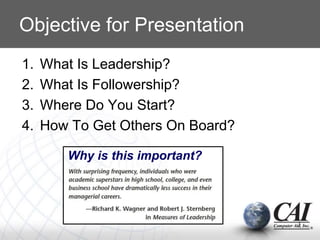
Why is this important?
What Is Leadership?
•
•
•
•
•
•
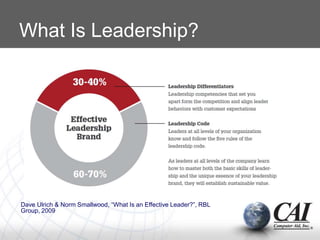
What Is Leadership?
Dave Ulrich & Norm Smallwood, “What Is an Effective Leader?”, RBL
Group, 2009
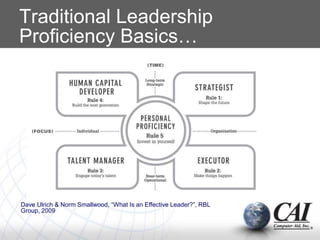
Traditional Leadership
Proficiency Basics…
Dave Ulrich & Norm Smallwood, “What Is an Effective Leader?”, RBL
Group, 2009
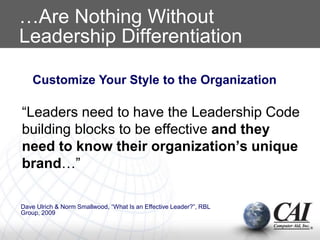
…Are Nothing Without
Leadership Differentiation
“Leaders need to have the Leadership Code
building blocks to be effective and they
need to know their organization’s unique
brand…”
Customize Your Style to the Organization
Dave Ulrich & Norm Smallwood, “What Is an Effective Leader?”, RBL
Group, 2009
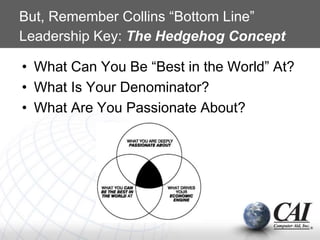
But, Remember Collins “Bottom Line”
Leadership Key: The Hedgehog Concept
• What Can You Be “Best in the World” At?
• What Is Your Denominator?
• What Are You Passionate About?
What Is Followership?
•
•
•
•
•
•
Warren Bennis: No Leadership
Without Followership
“…the longer I study effective
leaders, the more I am convinced
of the underappreciated
importance of effective followers..”
Warren Bennis, Distinguished Professor of Business Administration at the
University of Southern California School of Business Administration, THE
DILEMMA AT THE TOP; Followers Make Good Leaders Good, 1989
Leaders Need Effective
Followers
“Executives who ignited transformations
from good to great did not first figure out
where to drive the bus, then get the right
people to take it there. Instead, they got
the right people on the bus and then
figured out where to drive it.”
Jim Collins, “Good to Great”, 2001
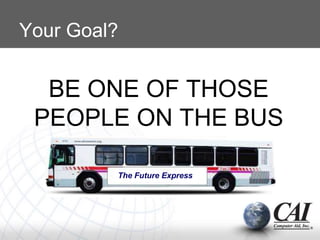
Your Goal?
BE ONE OF THOSE
PEOPLE ON THE BUS
The Future Express
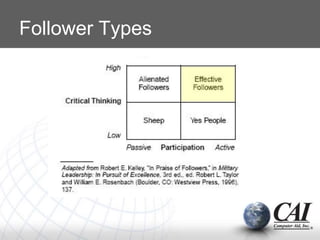
Follower Types
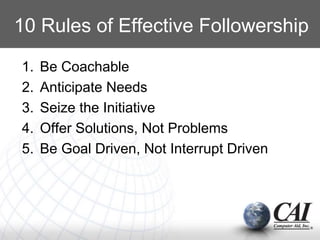
10 Rules of Effective Followership
1. Be Coachable
2. Anticipate Needs
3. Seize the Initiative
4. Offer Solutions, Not Problems
5. Be Goal Driven, Not Interrupt Driven
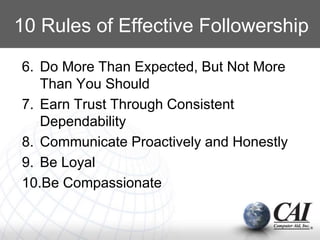
6. Do More Than Expected, But Not More
Than You Should
7. Earn Trust Through Consistent
Dependability
8. Communicate Proactively and Honestly
9. Be Loyal
10.Be Compassionate
10 Rules of Effective Followership
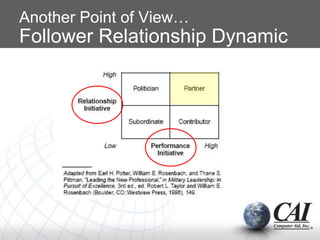
Another Point of View…
Follower Relationship Dynamic
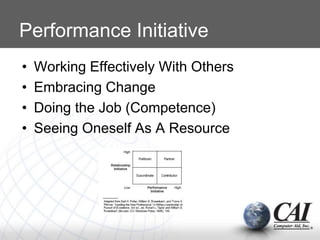
Performance Initiative
• Working Effectively With Others
• Embracing Change
• Doing the Job (Competence)
• Seeing Oneself As A Resource
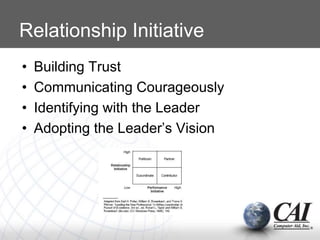
Relationship Initiative
• Building Trust
• Communicating Courageously
• Identifying with the Leader
• Adopting the Leader’s Vision
Enough “Theory”
Where Do You Start?
•
•
•
•
•
•
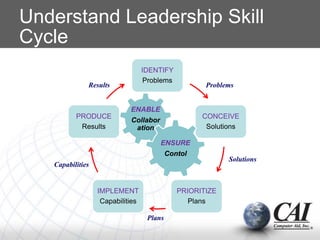
Understand Leadership Skill
Cycle
IDENTIFY
Problems
CONCEIVE
Solutions
PRIORITIZE
Plans
IMPLEMENT
Capabilities
PRODUCE
Results
Results Problems
Solutions
Plans
Capabilities
ENABLE
Collabor
ation
ENSURE
Contol
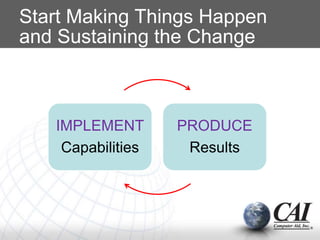
Start Making Things Happen
and Sustaining the Change
IMPLEMENT
Capabilities
PRODUCE
Results
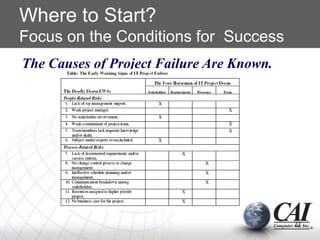
The Causes of Project Failure Are Known.
Where to Start?
Focus on the Conditions for Success
22
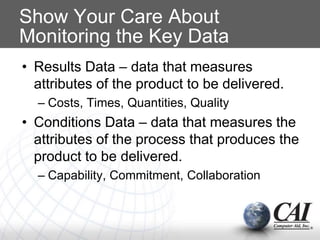
Show Your Care About
Monitoring the Key Data
• Results Data – data that measures
attributes of the product to be delivered.
– Costs, Times, Quantities, Quality
• Conditions Data – data that measures the
attributes of the process that produces the
product to be delivered.
– Capability, Commitment, Collaboration
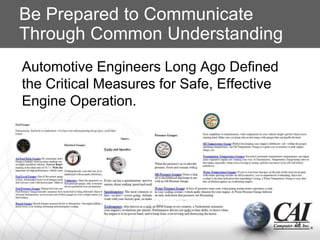
Be Prepared to Communicate
Through Common Understanding
Automotive Engineers Long Ago Defined
the Critical Measures for Safe, Effective
Engine Operation.
24
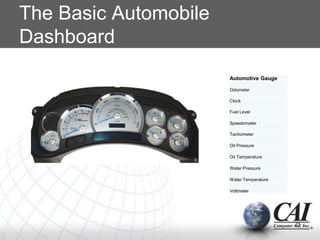
The Basic Automobile
Dashboard
Automotive Gauge
Odometer
Clock
Fuel Level
Speedometer
Tachometer
Oil Pressure
Oil Temperature
Water Pressure
Water Temperature
Voltmeter
25
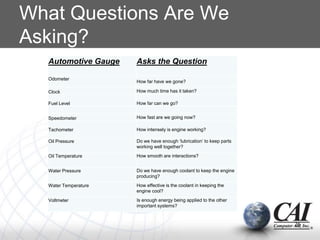
What Questions Are We
Asking?
Automotive Gauge Asks the Question
Odometer
How far have we gone?
Clock How much time has it taken?
Fuel Level How far can we go?
Speedometer How fast are we going now?
Tachometer How intensely is engine working?
Oil Pressure Do we have enough ‘lubrication’ to keep parts
working well together?
Oil Temperature How smooth are interactions?
Water Pressure Do we have enough coolant to keep the engine
producing?
Water Temperature How effective is the coolant in keeping the
engine cool?
Voltmeter Is enough energy being applied to the other
important systems?
26
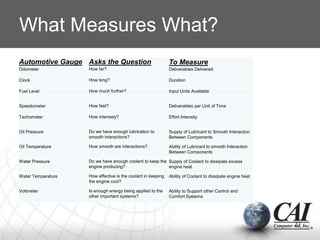
What Measures What?
Automotive Gauge Asks the Question To Measure
Odometer How far? Deliverables Delivered
Clock How long? Duration
Fuel Level How much further? Input Units Available
Speedometer How fast? Deliverables per Unit of Time
Tachometer How intensely? Effort Intensity
Oil Pressure Do we have enough lubrication to
smooth interactions?
Supply of Lubricant to Smooth Interaction
Between Components
Oil Temperature How smooth are interactions? Ability of Lubricant to smooth Interaction
Between Components
Water Pressure Do we have enough coolant to keep the
engine producing?
Supply of Coolant to dissipate excess
engine heat
Water Temperature How effective is the coolant in keeping
the engine cool?
Ability of Coolant to dissipate engine heat
Voltmeter Is enough energy being applied to the
other important systems?
Ability to Support other Control and
Comfort Systems
27
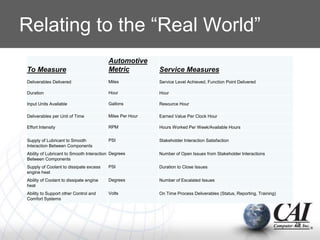
Relating to the “Real World”
To Measure
Automotive
Metric Service Measures
Deliverables Delivered Miles Service Level Achieved, Function Point Delivered
Duration Hour Hour
Input Units Available Gallons Resource Hour
Deliverables per Unit of Time Miles Per Hour Earned Value Per Clock Hour
Effort Intensity RPM Hours Worked Per Week/Available Hours
Supply of Lubricant to Smooth
Interaction Between Components
PSI Stakeholder Interaction Satisfaction
Ability of Lubricant to Smooth Interaction
Between Components
Degrees Number of Open Issues from Stakeholder Interactions
Supply of Coolant to dissipate excess
engine heat
PSI Duration to Close Issues
Ability of Coolant to dissipate engine
heat
Degrees Number of Escalated Issues
Ability to Support other Control and
Comfort Systems
Volts On Time Process Deliverables (Status, Reporting, Training)
28
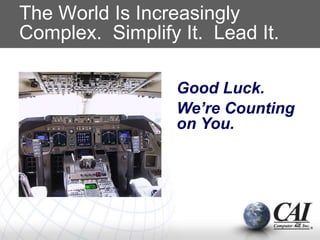
The World Is Increasingly
Complex. Simplify It. Lead It.
29
Good Luck.
We’re Counting
on You.

Leadership is Simple, Followership is a Challenge - Lehigh University Guest Lecture

  • 1.
    © 2013 JoeHessmiller Leadership is Simple The Challenge is Effective Followership
  • 2.
    Joe Hessmiller • Director,CAI • Over 30 years in IT; analyst, programmer, project manager, business development, business unit manager, CIO. • Worked with – and learned from - dozens of executives and managers from F500 corporations, large government agencies and the military in US and UK. 2
  • 3.
    Objective for Presentation 1.What Is Leadership? 2. What Is Followership? 3. Where Do You Start? 4. How To Get Others On Board? 3 Why is this important?
  • 4.
  • 5.
    What Is Leadership? DaveUlrich & Norm Smallwood, “What Is an Effective Leader?”, RBL Group, 2009
  • 6.
    Traditional Leadership Proficiency Basics… DaveUlrich & Norm Smallwood, “What Is an Effective Leader?”, RBL Group, 2009
  • 7.
    …Are Nothing Without LeadershipDifferentiation “Leaders need to have the Leadership Code building blocks to be effective and they need to know their organization’s unique brand…” Customize Your Style to the Organization Dave Ulrich & Norm Smallwood, “What Is an Effective Leader?”, RBL Group, 2009
  • 8.
    But, Remember Collins“Bottom Line” Leadership Key: The Hedgehog Concept • What Can You Be “Best in the World” At? • What Is Your Denominator? • What Are You Passionate About?
  • 9.
  • 10.
    Warren Bennis: NoLeadership Without Followership “…the longer I study effective leaders, the more I am convinced of the underappreciated importance of effective followers..” Warren Bennis, Distinguished Professor of Business Administration at the University of Southern California School of Business Administration, THE DILEMMA AT THE TOP; Followers Make Good Leaders Good, 1989
  • 11.
    Leaders Need Effective Followers “Executiveswho ignited transformations from good to great did not first figure out where to drive the bus, then get the right people to take it there. Instead, they got the right people on the bus and then figured out where to drive it.” Jim Collins, “Good to Great”, 2001
  • 12.
    Your Goal? BE ONEOF THOSE PEOPLE ON THE BUS The Future Express
  • 13.
  • 14.
    10 Rules ofEffective Followership 1. Be Coachable 2. Anticipate Needs 3. Seize the Initiative 4. Offer Solutions, Not Problems 5. Be Goal Driven, Not Interrupt Driven
  • 15.
    6. Do MoreThan Expected, But Not More Than You Should 7. Earn Trust Through Consistent Dependability 8. Communicate Proactively and Honestly 9. Be Loyal 10.Be Compassionate 10 Rules of Effective Followership
  • 16.
    Another Point ofView… Follower Relationship Dynamic
  • 17.
    Performance Initiative • WorkingEffectively With Others • Embracing Change • Doing the Job (Competence) • Seeing Oneself As A Resource
  • 18.
    Relationship Initiative • BuildingTrust • Communicating Courageously • Identifying with the Leader • Adopting the Leader’s Vision
  • 19.
    Enough “Theory” Where DoYou Start? • • • • • •
  • 20.
  • 21.
    Start Making ThingsHappen and Sustaining the Change IMPLEMENT Capabilities PRODUCE Results
  • 22.
    The Causes ofProject Failure Are Known. Where to Start? Focus on the Conditions for Success 22
  • 23.
    Show Your CareAbout Monitoring the Key Data • Results Data – data that measures attributes of the product to be delivered. – Costs, Times, Quantities, Quality • Conditions Data – data that measures the attributes of the process that produces the product to be delivered. – Capability, Commitment, Collaboration
  • 24.
    Be Prepared toCommunicate Through Common Understanding Automotive Engineers Long Ago Defined the Critical Measures for Safe, Effective Engine Operation. 24
  • 25.
    The Basic Automobile Dashboard AutomotiveGauge Odometer Clock Fuel Level Speedometer Tachometer Oil Pressure Oil Temperature Water Pressure Water Temperature Voltmeter 25
  • 26.
    What Questions AreWe Asking? Automotive Gauge Asks the Question Odometer How far have we gone? Clock How much time has it taken? Fuel Level How far can we go? Speedometer How fast are we going now? Tachometer How intensely is engine working? Oil Pressure Do we have enough ‘lubrication’ to keep parts working well together? Oil Temperature How smooth are interactions? Water Pressure Do we have enough coolant to keep the engine producing? Water Temperature How effective is the coolant in keeping the engine cool? Voltmeter Is enough energy being applied to the other important systems? 26
  • 27.
    What Measures What? AutomotiveGauge Asks the Question To Measure Odometer How far? Deliverables Delivered Clock How long? Duration Fuel Level How much further? Input Units Available Speedometer How fast? Deliverables per Unit of Time Tachometer How intensely? Effort Intensity Oil Pressure Do we have enough lubrication to smooth interactions? Supply of Lubricant to Smooth Interaction Between Components Oil Temperature How smooth are interactions? Ability of Lubricant to smooth Interaction Between Components Water Pressure Do we have enough coolant to keep the engine producing? Supply of Coolant to dissipate excess engine heat Water Temperature How effective is the coolant in keeping the engine cool? Ability of Coolant to dissipate engine heat Voltmeter Is enough energy being applied to the other important systems? Ability to Support other Control and Comfort Systems 27
  • 28.
    Relating to the“Real World” To Measure Automotive Metric Service Measures Deliverables Delivered Miles Service Level Achieved, Function Point Delivered Duration Hour Hour Input Units Available Gallons Resource Hour Deliverables per Unit of Time Miles Per Hour Earned Value Per Clock Hour Effort Intensity RPM Hours Worked Per Week/Available Hours Supply of Lubricant to Smooth Interaction Between Components PSI Stakeholder Interaction Satisfaction Ability of Lubricant to Smooth Interaction Between Components Degrees Number of Open Issues from Stakeholder Interactions Supply of Coolant to dissipate excess engine heat PSI Duration to Close Issues Ability of Coolant to dissipate engine heat Degrees Number of Escalated Issues Ability to Support other Control and Comfort Systems Volts On Time Process Deliverables (Status, Reporting, Training) 28
  • 29.
    The World IsIncreasingly Complex. Simplify It. Lead It. 29 Good Luck. We’re Counting on You.

Editor's Notes

  • #7 Strategists create, define and deliver principles of WHAT CAN BE. Leaders need to know where they are going and communicate that effectively to others. Work with OTHERS to test ideas and plan the journey (taking into consideration money, people, organizational capabilities). Executors ensure discipline (process) and the technical expertise to get the right things done right. Talent managers help people develop themselves for the good of the organization. Human Capital developers build the culture and capabilities to ensure the organization has the capabilites needed for the long term, not just the close-in objectives. Personal Proficiency. Effective leaders learn. They inspire loyalty because of their personal integrity. They are decisive and impassioned. Confident, courageous. Tolerate ambiguity.