LEADERSHIP SKILL
LEADER
Each one of you can be a Leader, Just
that you have to work towards it!
Leadership is a skill that can be
acquired with the implementation of
carefully thought of steps!
Leadership Skill
This presentation contains
Who Is a True Leader?: Modus Operandi
Change Management: Leader’s Initiative
Taking Initiative A Leader’s Job
Problem Solving for Leaders
Leading Your Team To Success
Handling Subordinate
Who Is a True Leader?
• Who would be able to guide others either by
doing something himself or by directing a specific
course of action.
• Who believes on performance rather than
experience.
• Who is able to create a image of roll model
A leader is made, not born!
The Modus Operandi
Always look for a silver lining
Follow this golden rule in any situation that you
find negative.
Try & learn from experiences.
Focus on what went wrong & why.
Evaluate each & every action that you perform.
A leader is made, not born!
The Modus Operandi
Set realistic & achievable goals
Focus on the task in hand
Be clear what you want to achieve
A leader is made, not born!
The Modus Operandi
Know the value of discipline & truth
Accept the responsibility for consequence of your
action.
Never do something that goes against your
conscience.
Begin & take a task to its completion.
Commit with your goal
LOOK INWARDS, KNOW YOURSELF AS A
PERSON & GIVE YOURSELF WHATEVER
INPUT NEEDED TO BECOME A BETTER
PERSON.
Remember:
Where constant striving stretches its arms towards
perfection :Rabindranath Togore
CHANGE MANAGEMENT:
LEADER’S INITIATIVE
For change, leader will need to be
able influence others & bring them
around to his way of thinking.
Incorporating change
Attitudinal Change: A Job specific Approach
Clarify that attitudinal change that you so desire
is a job specific one & nothing personal.
Demonstrate how the way that you are
advocating work
Keep the job specific nature of the attitudinal
change in focus & to highlight it.
Incorporating change
Attitudinal Change: A Job specific Approach
Invite suggestions & incorporate a few.
Analyze the person & judge the right kind of
approach required & then decide on an
appropriate approach.
Incorporating change
Be prepared with facts
Once you have created an atmosphere of
compliance, come out with hard facts to support
your stand.
Be prepared to defend your stand.
Incorporating change
Be open towards positive suggestions
Invite others’ opinions & be willing to listen with
an open ear and mind
Treat them on par by valuating their suggestions
& trying them out if they sound feasible.
TAKING INITIATIVE-A
LEADER’S JOB
There is always hesitation when it
comes to being the first one to do

something.
Taking Initiative-A Leader’s Job
Self Consciences
Try to develop a mindset wherein if you are
sure about something you just go ahead & do it,
not waiting for another person to show you the
way.
Taking Initiative-A Leader’s Job
Seize the right moment
Know when to take the initiative.
Develop the knack of being able to seize the right
moment & lead the way.
Assess yourself & analyze about success.
See you have adequate time.
Take a stock of resources.
Taking Initiative-A Leader’s Job
Right Mindset
Be open & perceptive towards sensing a
situation where you can take a initiative.
Always grab the opportunities.
Always attempt to look at situations from different
perspectives.
Taking Initiative-A Leader’s Job
Handle the obstacles
Arm yourself with attitude to think of ways to
surmount the blockages.
Visualize the task that you are about to perform
& then ponder on the possible hurdles.
Taking Initiative-A Leader’s Job
Keep an open mind
Keep open ears & eyes
Be receptive to ideas that you see & hear.
Be proactive
Involve your team
Encourage new ideas
Delegate task
PROBLEM SOLVING FOR
LEADERS
The only thing that every problem has is a
solution!
Problem Solving
Try, Try & Try Till You Succeed
The wise learn from others’ experiences and
fool from their own”
Problem Solving
Be Objective
Tackle the problem objectively.
Analyze the facts about it.
Pinpoint what went wrong & why.
Ask lot of questions both to self & others.
Do not let emotion colour your opinions.
Listen will.
Problem Solving
How important the problem is?
Give the problem the credit sue to it, neither
more nor less.
Imagine a situation where it is not solved,
hypothetical consequences would answer your
question.
Problem Solving
Break down into tasks & delegate
Identify the tasks to be performed.
Assign the tasks specific people.
Give specific requirement & concise directions.
Show the way to arrive at the solutions.
Beware of being overconfident.
Problem Solving
Implement your solution
Always cross check facts & discuss ideas with
other people.
Once a solution is decided upon, go ahead &
implement it.
Always test your solution
Once they are implemented, monitor them.
LEADING YOUR TEAM TO
SUCCESS
The mark of good leader is his or her ability
to lead the team to success!
Leading Your Team To Success
Integration of various activities
Integrate various activities
Various activities means various peoples.
Coordinate the activities
Integrate them towards desired goals.
Leading Your Team To Success
The snowball effect –How to prevent it?
Arrest the problem before it grows big
Stop the snowball from gaining in size.
Anticipate & prepare for problem.
Leading Your Team To Success
Guide your team to take decisions, don’t make
it for them.
Ensure that each individual member of the
team knows what role to play.
Group discussions
Get agreement of the team members on
desired responsibilities.
Leading Your Team To Success
A virtual tool
Visualize the process of performing the task
Anticipate the possible obstacles that may be
encountered
Modify your solution if required.
HANDLING SUBORDINATES
Leadership is all about how well a
leader allows his subordinates to
grow under his guidance.
Handling Subordinates
A good leader does not let his subordinates
feel their inferiority.
The subordinates should be aware of are
the positive qualities of the leader & which,
in fact, had led to the position that he is in.
Handling Subordinates
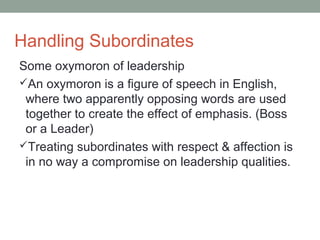
Some oxymoron of leadership
An oxymoron is a figure of speech in English,
where two apparently opposing words are used
together to create the effect of emphasis. (Boss
or a Leader)
Treating subordinates with respect & affection is
in no way a compromise on leadership qualities.
Handling Subordinates
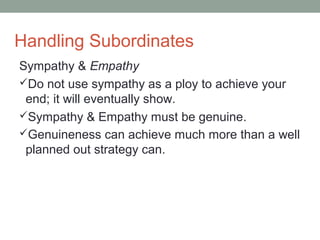
Sympathy & Empathy
Do not use sympathy as a ploy to achieve your
end; it will eventually show.
Sympathy & Empathy must be genuine.
Genuineness can achieve much more than a well
planned out strategy can.
Handling Subordinates
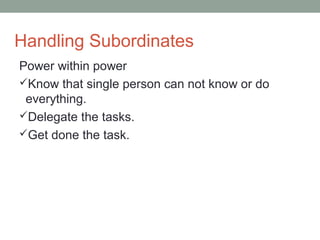
Power within power
Know that single person can not know or do
everything.
Delegate the tasks.
Get done the task.
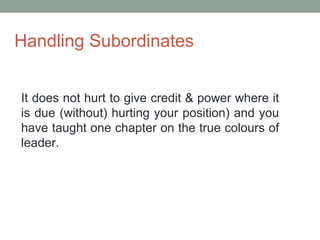
Handling Subordinates
It does not hurt to give credit & power where it
is due (without) hurting your position) and you
have taught one chapter on the true colours of
leader.
THANK YOU

Leadership skill

  • 1.
  • 2.
    LEADER Each one ofyou can be a Leader, Just that you have to work towards it! Leadership is a skill that can be acquired with the implementation of carefully thought of steps!
  • 3.
    Leadership Skill This presentationcontains Who Is a True Leader?: Modus Operandi Change Management: Leader’s Initiative Taking Initiative A Leader’s Job Problem Solving for Leaders Leading Your Team To Success Handling Subordinate
  • 4.
    Who Is aTrue Leader? • Who would be able to guide others either by doing something himself or by directing a specific course of action. • Who believes on performance rather than experience. • Who is able to create a image of roll model
  • 5.
    A leader ismade, not born! The Modus Operandi Always look for a silver lining Follow this golden rule in any situation that you find negative. Try & learn from experiences. Focus on what went wrong & why. Evaluate each & every action that you perform.
  • 6.
    A leader ismade, not born! The Modus Operandi Set realistic & achievable goals Focus on the task in hand Be clear what you want to achieve
  • 7.
    A leader ismade, not born! The Modus Operandi Know the value of discipline & truth Accept the responsibility for consequence of your action. Never do something that goes against your conscience. Begin & take a task to its completion. Commit with your goal
  • 8.
    LOOK INWARDS, KNOWYOURSELF AS A PERSON & GIVE YOURSELF WHATEVER INPUT NEEDED TO BECOME A BETTER PERSON. Remember: Where constant striving stretches its arms towards perfection :Rabindranath Togore
  • 9.
    CHANGE MANAGEMENT: LEADER’S INITIATIVE Forchange, leader will need to be able influence others & bring them around to his way of thinking.
  • 10.
    Incorporating change Attitudinal Change:A Job specific Approach Clarify that attitudinal change that you so desire is a job specific one & nothing personal. Demonstrate how the way that you are advocating work Keep the job specific nature of the attitudinal change in focus & to highlight it.
  • 11.
    Incorporating change Attitudinal Change:A Job specific Approach Invite suggestions & incorporate a few. Analyze the person & judge the right kind of approach required & then decide on an appropriate approach.
  • 12.
    Incorporating change Be preparedwith facts Once you have created an atmosphere of compliance, come out with hard facts to support your stand. Be prepared to defend your stand.
  • 13.
    Incorporating change Be opentowards positive suggestions Invite others’ opinions & be willing to listen with an open ear and mind Treat them on par by valuating their suggestions & trying them out if they sound feasible.
  • 14.
    TAKING INITIATIVE-A LEADER’S JOB Thereis always hesitation when it comes to being the first one to do something.
  • 15.
    Taking Initiative-A Leader’sJob Self Consciences Try to develop a mindset wherein if you are sure about something you just go ahead & do it, not waiting for another person to show you the way.
  • 16.
    Taking Initiative-A Leader’sJob Seize the right moment Know when to take the initiative. Develop the knack of being able to seize the right moment & lead the way. Assess yourself & analyze about success. See you have adequate time. Take a stock of resources.
  • 17.
    Taking Initiative-A Leader’sJob Right Mindset Be open & perceptive towards sensing a situation where you can take a initiative. Always grab the opportunities. Always attempt to look at situations from different perspectives.
  • 18.
    Taking Initiative-A Leader’sJob Handle the obstacles Arm yourself with attitude to think of ways to surmount the blockages. Visualize the task that you are about to perform & then ponder on the possible hurdles.
  • 19.
    Taking Initiative-A Leader’sJob Keep an open mind Keep open ears & eyes Be receptive to ideas that you see & hear. Be proactive Involve your team Encourage new ideas Delegate task
  • 20.
    PROBLEM SOLVING FOR LEADERS Theonly thing that every problem has is a solution!
  • 21.
    Problem Solving Try, Try& Try Till You Succeed The wise learn from others’ experiences and fool from their own”
  • 22.
    Problem Solving Be Objective Tacklethe problem objectively. Analyze the facts about it. Pinpoint what went wrong & why. Ask lot of questions both to self & others. Do not let emotion colour your opinions. Listen will.
  • 23.
    Problem Solving How importantthe problem is? Give the problem the credit sue to it, neither more nor less. Imagine a situation where it is not solved, hypothetical consequences would answer your question.
  • 24.
    Problem Solving Break downinto tasks & delegate Identify the tasks to be performed. Assign the tasks specific people. Give specific requirement & concise directions. Show the way to arrive at the solutions. Beware of being overconfident.
  • 25.
    Problem Solving Implement yoursolution Always cross check facts & discuss ideas with other people. Once a solution is decided upon, go ahead & implement it. Always test your solution Once they are implemented, monitor them.
  • 26.
    LEADING YOUR TEAMTO SUCCESS The mark of good leader is his or her ability to lead the team to success!
  • 27.
    Leading Your TeamTo Success Integration of various activities Integrate various activities Various activities means various peoples. Coordinate the activities Integrate them towards desired goals.
  • 28.
    Leading Your TeamTo Success The snowball effect –How to prevent it? Arrest the problem before it grows big Stop the snowball from gaining in size. Anticipate & prepare for problem.
  • 29.
    Leading Your TeamTo Success Guide your team to take decisions, don’t make it for them. Ensure that each individual member of the team knows what role to play. Group discussions Get agreement of the team members on desired responsibilities.
  • 30.
    Leading Your TeamTo Success A virtual tool Visualize the process of performing the task Anticipate the possible obstacles that may be encountered Modify your solution if required.
  • 31.
    HANDLING SUBORDINATES Leadership isall about how well a leader allows his subordinates to grow under his guidance.
  • 32.
    Handling Subordinates A goodleader does not let his subordinates feel their inferiority. The subordinates should be aware of are the positive qualities of the leader & which, in fact, had led to the position that he is in.
  • 33.
    Handling Subordinates Some oxymoronof leadership An oxymoron is a figure of speech in English, where two apparently opposing words are used together to create the effect of emphasis. (Boss or a Leader) Treating subordinates with respect & affection is in no way a compromise on leadership qualities.
  • 34.
    Handling Subordinates Sympathy &Empathy Do not use sympathy as a ploy to achieve your end; it will eventually show. Sympathy & Empathy must be genuine. Genuineness can achieve much more than a well planned out strategy can.
  • 35.
    Handling Subordinates Power withinpower Know that single person can not know or do everything. Delegate the tasks. Get done the task.
  • 36.
    Handling Subordinates It doesnot hurt to give credit & power where it is due (without) hurting your position) and you have taught one chapter on the true colours of leader.
  • 37.

Editor's Notes

  • #16 The hesitation & reluctance involved in taking the initiative are because a person is too conscience of himself/herself. This feeling should be relegated to the background consciously.
  • #17 The hesitation & reluctance involved in taking the initiative are because a person is too conscience of himself/herself. This feeling should be relegated to the background consciously.
  • #18 The hesitation & reluctance involved in taking the initiative are because a person is too conscience of himself/herself. This feeling should be relegated to the background consciously.
  • #19 The hesitation & reluctance involved in taking the initiative are because a person is too conscience of himself/herself. This feeling should be relegated to the background consciously.
  • #20 The hesitation & reluctance involved in taking the initiative are because a person is too conscience of himself/herself. This feeling should be relegated to the background consciously.