Rashid Mureed
Head of Regulatory Affairs and Pharmacovigilance
PharmEvo
LEADERSHIP
2
LEE HYATT IACOCCA
3
4
5
6
7
8
9
10
11
12
13
DEFINITION OF
LEADERSHIP
14
Leadership is an influence
relationship among leaders
and followers who intend real
changes and outcomes that
reflect their shared purposes.
Leader is the person who leads
or commands a group,
organization, or country
Leader is the person who leads
or commands a group,
organization, or country
YOU!
Leadership is about
Leadership is not something that
you do. It is an expression of who
you are.
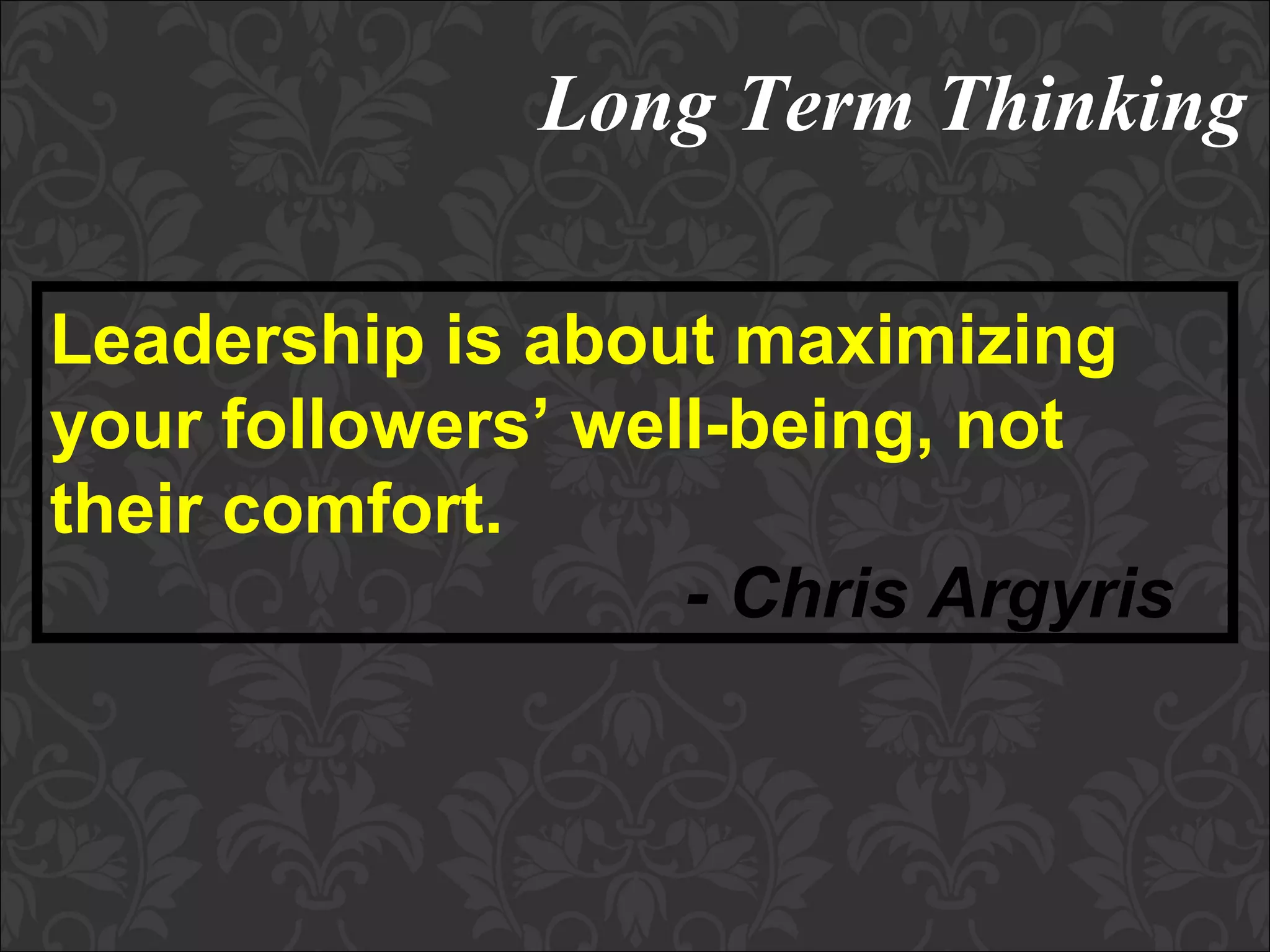
Leadership is about maximizing
your followers’ well-being, not
their comfort.
- Chris Argyris
Long Term Thinking
Leadership is about
first thinking
then deciding
followed by acting swiftly
and finally, reflecting
Successful companies actively
seek out people with leadership
potential and expose them to
career experiences that will
develop that potential.
Building Leaders
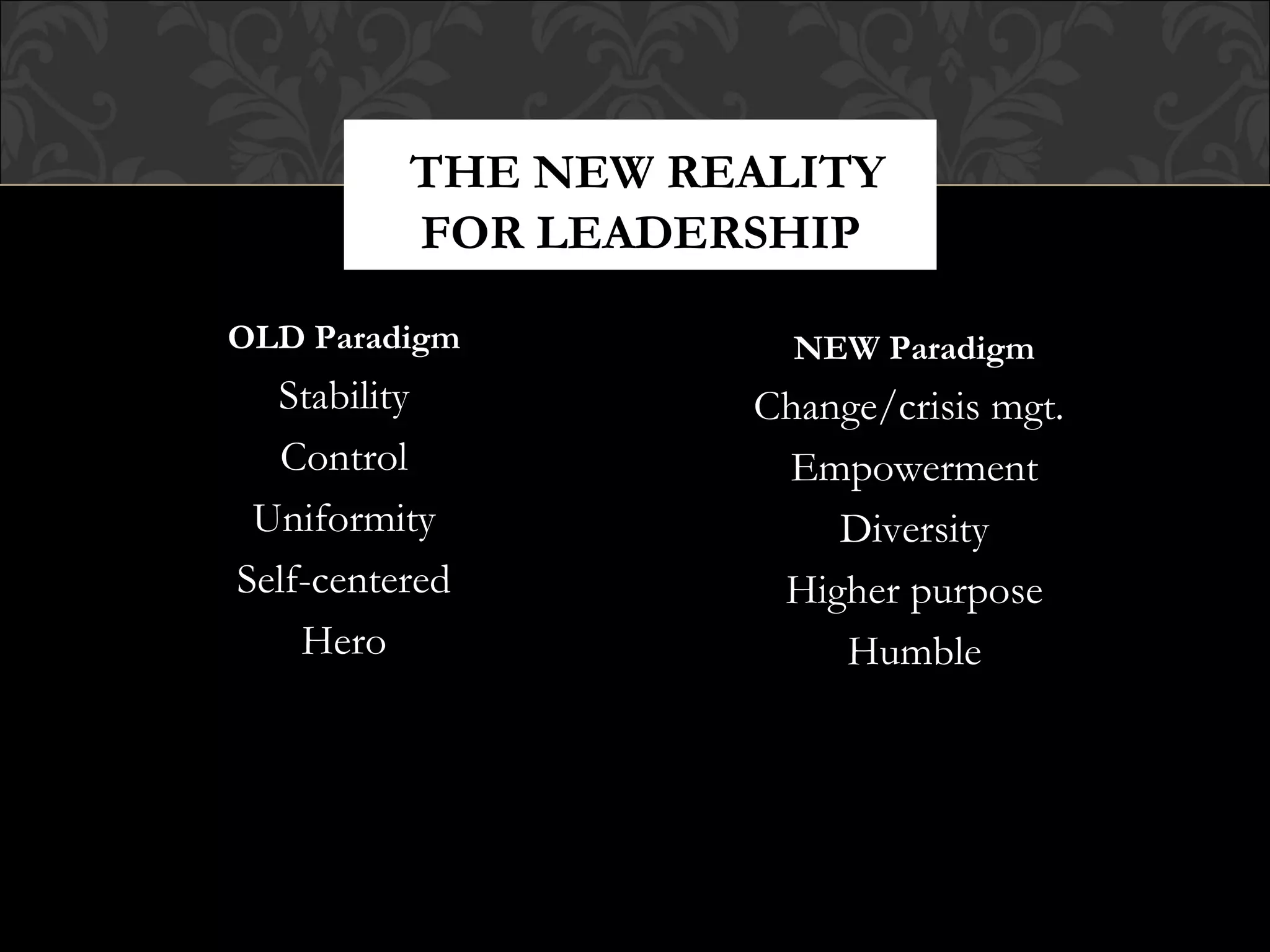
OLD Paradigm
Stability
Control
Uniformity
Self-centered
Hero
NEW Paradigm
Change/crisis mgt.
Empowerment
Diversity
Higher purpose
Humble
THE NEW REALITY
FOR LEADERSHIP
MANAGEMENT AND
VISION
Management is the attainment of
organizational goals in an effective and
efficient manner through planning,
organizing, staffing, directing, and
controlling organizational resources.
Vision is a picture of an ambitious,
desirable future for the organization or
team
CORPORATE CULTURE
WORLD CLASS
• Team Work
• Customer Focus
• Fair treatment of
employees
• Initiative
• Innovation
AVERAGE
• Minimizing risk
• Respecting the
chain of command
• Supporting the
boss
• Making budget
COMPARING MANAGEMENT AND
LEADERSHIP
Management Leadership
Direction Planning and budgeting
Keeping eye on bottom line
Creating vision and strategy
Keeping eye on horizon
Alignment Organizing and staffing
Directing and controlling
Creating boundaries
Creating shared culture and values
Helping others grow
Reducing boundaries
Relationships Focusing on objects –
producing/selling goods and services
Based on position power
Acting as boss
Focusing on people – inspiring and
motivating followers
Based on personal power
Acting as coach, facilitator, servant
COMPARING MANAGEMENT AND
LEADERSHIP
Management Leadership
Personal Qualities Emotional distance
Expert mind
Talking
Conformity
Insight into organization
Emotional connections (Heart)
Open mind (Mindfulness)
Listening (Communication)
Nonconformity (Courage)
Insight into self (Character)
Outcomes Maintains stability; creates culture of
efficiency
Creates change and a culture of
integrity
Personal Characteristics
Energy
Physical stamina
Intelligence and Ability
Intelligence
Knowledge
Judgment, decisiveness
Personality
Self-confidence
Honesty and integrity
Enthusiasm
Desire to lead
Independence
Social Characteristics
Sociability, interpersonal skills
Cooperativeness
Ability to enlist cooperation
Work-Related Characteristics
Drive, desire to excel
Responsibility in pursuit of goals
Persistence against obstacles, tenacity
Social background
Education
Mobility
PERSONAL
CHARACTERISTICS OF
LEADERS
LEADERSHIP CONTINUUM
Boss-Centered
Leadership
Subordinate-
Centered
Leadership
Use of authority by manager
Area of freedom for
subordinates
Manager makes
decisions and
announces it
Manager
“sells”
decision
Manager
presents
ideas and
invites
questions
Manager
presents tentative
decision subject
to change
Manager
permits
subordinates
to function
within limits
defined by
superior
FIVE LEADER DECISION
STYLES
Area of Influence by Leader
Area of Freedom for Group
Decide Consult
Individually
Consult
Group
Facilitate Delegate
SITUATIONAL LEADERSHIP
Follower Characteristics Appropriate Leader Style
Low readiness level
Moderate readiness level
High readiness level
Very high readiness level
Telling (high task-low relationship)
Selling (high task-high relationship)
Participating (low task-high rel.)
Delegating (low task-low relationship)
The Unethical Leader
Is arrogant and self-serving
Excessively promotes self-interest
Practices deception
Breaches agreements
Deals unfairly
Shifts blame to others
Diminishes others’ dignity
Neglects follower development
Withholds help and support
Lacks courage to confront unjust acts
The Ethical Leader
Possesses humility
Maintains concern for the greater good
Is honest and straightforward
Fulfills commitments
Strives for fairness
Takes responsibility
Shows respect for each individual
Encourages and develops others
Serves others
Shows courage to stand up for what is
right
COMPARING UNETHICAL
VERSUS ETHICAL LEADERSHIP
29
MORAL LEADERSHIP
Distinguishing right from
wrong and doing right;
seeking the just, honest, and
good in the practice of
leadership
THREE LEVELS OF
PERSONAL MORAL
DEVELOPMENT
31
Level 1:
Preconventional
Follows rules to avoid
punishment. Acts in own
interest. Blind obedience
to authority for its own
sake.
Level 2:
Conventional
Lives up to
expectations of
others. Fulfills duties
and obligations of
social system.
Upholds laws.
Level 3:
Postconventional
Follows internalized universal
principles of justice and right.
Balances concern for self
with concern for others and
the common good. Acts in
an independent and ethical
manner regardless of
expectations of others.
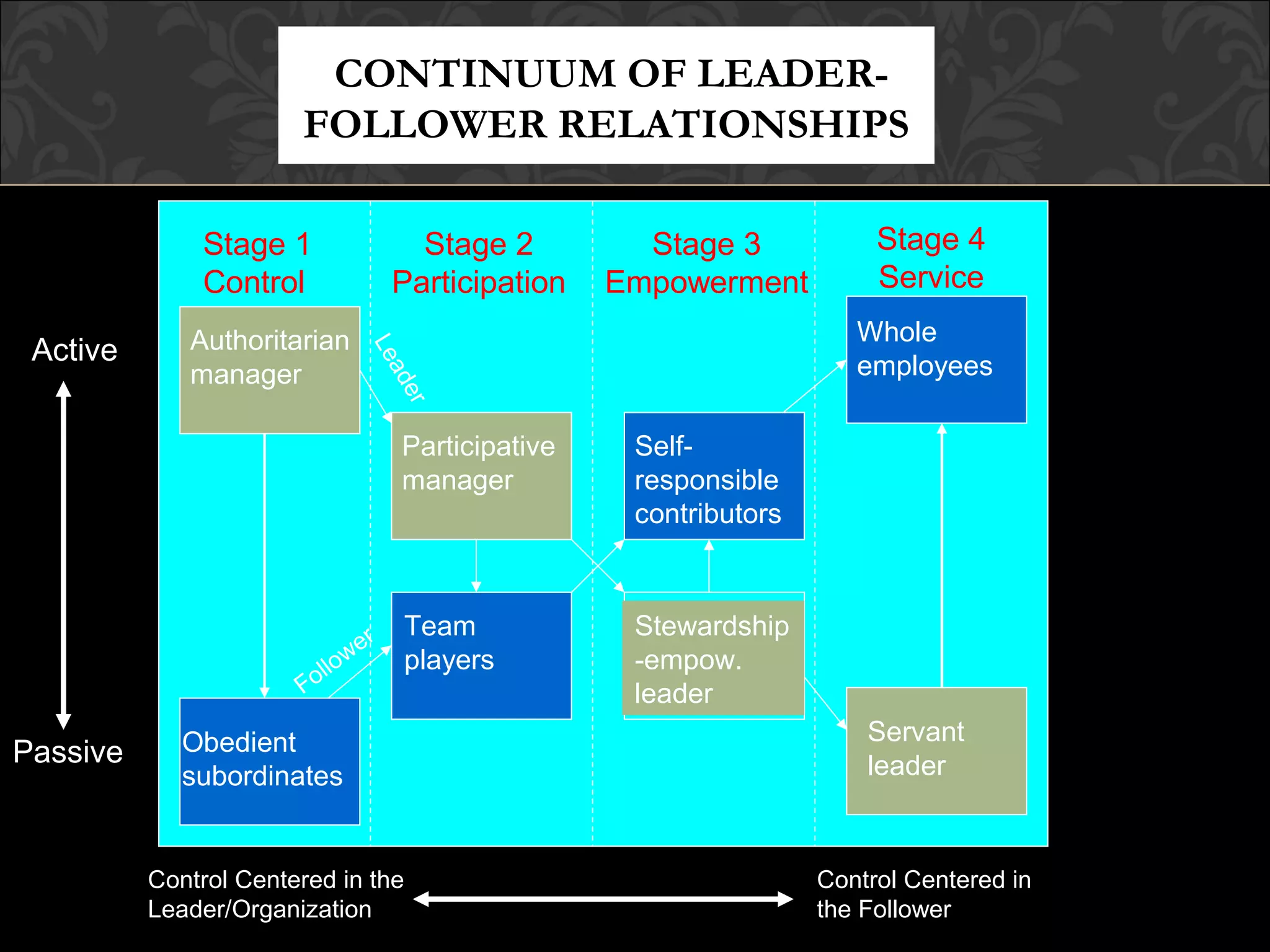
CONTINUUM OF LEADER-
FOLLOWER RELATIONSHIPS
Stage 1
Control
Stage 2
Participation
Stage 3
Empowerment
Stage 4
Service
Authoritarian
manager
Obedient
subordinates
Participative
manager
Team
players
Self-
responsible
contributors
Stewardship
-empow.
leader
Whole
employees
Servant
leader
Active
Passive
Control Centered in the
Leader/Organization
Control Centered in
the Follower
Follower
Leader
33
Critical Thinking
Thinking independently and being mindful of the effects of one’s own and other people’s
behavior on achieving the organization’s vision.
Uncritical Thinking
Failing to consider possibilities beyond what one is told; accepting the leader’s ideas
without thinking.
CRITICAL AND UNCRITICAL
THINKING
FOLLOWERSHIP STYLES
35
Independent, critical thinking
Dependent, uncritical thinking
Passive Active
Passive
Alienated Effective
Conformist
Pragmatic
Survivor
Personal Sources
Knowledge
Expertise
Effort
Persuasion
Position Sources
Location
Information
Access
SOURCES OF FOLLOWER POWER
WAYS TO INFLUENCE
YOUR LEADER
37
Be a Resource for the Leader
Determine the leader’s needs.
Zig where the leader zag.
Tell leader about you.
Align self to team purpose/vision.
Build a Relationship
Ask about leader at your
level/position.
Welcome feedback and
criticism.
Ask leader to tell you company
stories.
Help the Leader Be a Good
Leader
Ask for advice.
Tell leader what you think.
Find things to thank leader for.
View the Leader
Realistically
Give up idealized leader images.
Don’t hide anything.
Don’t criticize leader to others.
Disagree occasionally.
Desirable Leaders Are
Honest
Forward thinking
Inspiring
Competent
Desirable Colleagues
(Followers) Are
Honest
Cooperative
Dependable
Competent
RANK ORDER OF
DESIRABLE
CHARACTERISTICS
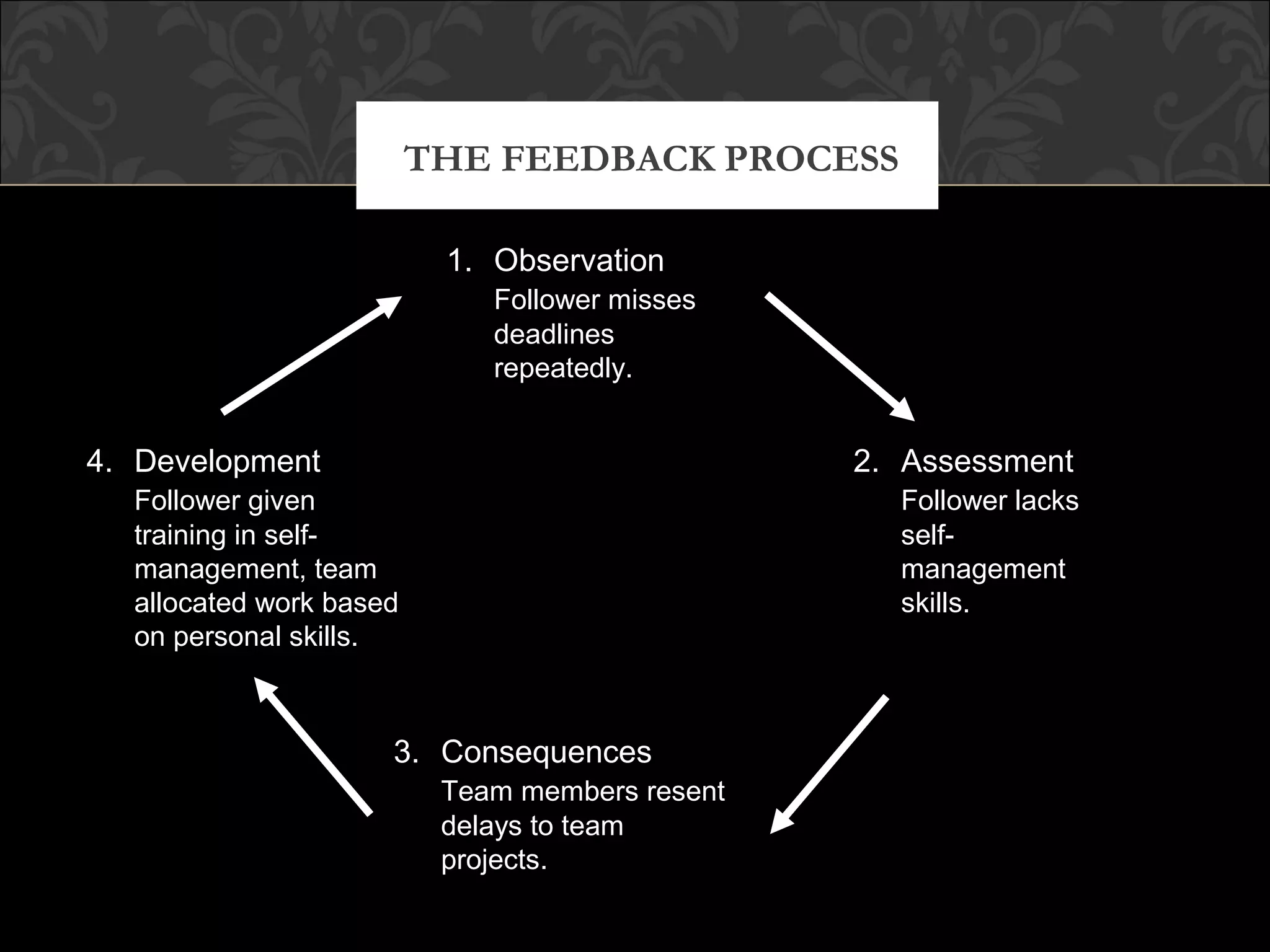
THE FEEDBACK PROCESS
1. Observation
Follower misses
deadlines
repeatedly.
2. Assessment
Follower lacks
self-
management
skills.
3. Consequences
Team members resent
delays to team
projects.
4. Development
Follower given
training in self-
management, team
allocated work based
on personal skills.
40

Leadership & Followership

  • 1.
    Rashid Mureed Head ofRegulatory Affairs and Pharmacovigilance PharmEvo LEADERSHIP
  • 2.
  • 3.
  • 4.
  • 5.
  • 6.
  • 7.
  • 8.
  • 9.
  • 10.
  • 11.
  • 12.
  • 13.
  • 14.
    DEFINITION OF LEADERSHIP 14 Leadership isan influence relationship among leaders and followers who intend real changes and outcomes that reflect their shared purposes. Leader is the person who leads or commands a group, organization, or country Leader is the person who leads or commands a group, organization, or country
  • 15.
    YOU! Leadership is about Leadershipis not something that you do. It is an expression of who you are.
  • 16.
    Leadership is aboutmaximizing your followers’ well-being, not their comfort. - Chris Argyris Long Term Thinking
  • 17.
    Leadership is about firstthinking then deciding followed by acting swiftly and finally, reflecting
  • 18.
    Successful companies actively seekout people with leadership potential and expose them to career experiences that will develop that potential. Building Leaders
  • 19.
    OLD Paradigm Stability Control Uniformity Self-centered Hero NEW Paradigm Change/crisismgt. Empowerment Diversity Higher purpose Humble THE NEW REALITY FOR LEADERSHIP
  • 20.
    MANAGEMENT AND VISION Management isthe attainment of organizational goals in an effective and efficient manner through planning, organizing, staffing, directing, and controlling organizational resources. Vision is a picture of an ambitious, desirable future for the organization or team
  • 21.
    CORPORATE CULTURE WORLD CLASS •Team Work • Customer Focus • Fair treatment of employees • Initiative • Innovation AVERAGE • Minimizing risk • Respecting the chain of command • Supporting the boss • Making budget
  • 22.
    COMPARING MANAGEMENT AND LEADERSHIP ManagementLeadership Direction Planning and budgeting Keeping eye on bottom line Creating vision and strategy Keeping eye on horizon Alignment Organizing and staffing Directing and controlling Creating boundaries Creating shared culture and values Helping others grow Reducing boundaries Relationships Focusing on objects – producing/selling goods and services Based on position power Acting as boss Focusing on people – inspiring and motivating followers Based on personal power Acting as coach, facilitator, servant
  • 23.
    COMPARING MANAGEMENT AND LEADERSHIP ManagementLeadership Personal Qualities Emotional distance Expert mind Talking Conformity Insight into organization Emotional connections (Heart) Open mind (Mindfulness) Listening (Communication) Nonconformity (Courage) Insight into self (Character) Outcomes Maintains stability; creates culture of efficiency Creates change and a culture of integrity
  • 24.
    Personal Characteristics Energy Physical stamina Intelligenceand Ability Intelligence Knowledge Judgment, decisiveness Personality Self-confidence Honesty and integrity Enthusiasm Desire to lead Independence Social Characteristics Sociability, interpersonal skills Cooperativeness Ability to enlist cooperation Work-Related Characteristics Drive, desire to excel Responsibility in pursuit of goals Persistence against obstacles, tenacity Social background Education Mobility PERSONAL CHARACTERISTICS OF LEADERS
  • 25.
    LEADERSHIP CONTINUUM Boss-Centered Leadership Subordinate- Centered Leadership Use ofauthority by manager Area of freedom for subordinates Manager makes decisions and announces it Manager “sells” decision Manager presents ideas and invites questions Manager presents tentative decision subject to change Manager permits subordinates to function within limits defined by superior
  • 26.
    FIVE LEADER DECISION STYLES Areaof Influence by Leader Area of Freedom for Group Decide Consult Individually Consult Group Facilitate Delegate
  • 27.
    SITUATIONAL LEADERSHIP Follower CharacteristicsAppropriate Leader Style Low readiness level Moderate readiness level High readiness level Very high readiness level Telling (high task-low relationship) Selling (high task-high relationship) Participating (low task-high rel.) Delegating (low task-low relationship)
  • 28.
    The Unethical Leader Isarrogant and self-serving Excessively promotes self-interest Practices deception Breaches agreements Deals unfairly Shifts blame to others Diminishes others’ dignity Neglects follower development Withholds help and support Lacks courage to confront unjust acts The Ethical Leader Possesses humility Maintains concern for the greater good Is honest and straightforward Fulfills commitments Strives for fairness Takes responsibility Shows respect for each individual Encourages and develops others Serves others Shows courage to stand up for what is right COMPARING UNETHICAL VERSUS ETHICAL LEADERSHIP
  • 29.
  • 30.
    MORAL LEADERSHIP Distinguishing rightfrom wrong and doing right; seeking the just, honest, and good in the practice of leadership
  • 31.
    THREE LEVELS OF PERSONALMORAL DEVELOPMENT 31 Level 1: Preconventional Follows rules to avoid punishment. Acts in own interest. Blind obedience to authority for its own sake. Level 2: Conventional Lives up to expectations of others. Fulfills duties and obligations of social system. Upholds laws. Level 3: Postconventional Follows internalized universal principles of justice and right. Balances concern for self with concern for others and the common good. Acts in an independent and ethical manner regardless of expectations of others.
  • 32.
    CONTINUUM OF LEADER- FOLLOWERRELATIONSHIPS Stage 1 Control Stage 2 Participation Stage 3 Empowerment Stage 4 Service Authoritarian manager Obedient subordinates Participative manager Team players Self- responsible contributors Stewardship -empow. leader Whole employees Servant leader Active Passive Control Centered in the Leader/Organization Control Centered in the Follower Follower Leader
  • 33.
  • 34.
    Critical Thinking Thinking independentlyand being mindful of the effects of one’s own and other people’s behavior on achieving the organization’s vision. Uncritical Thinking Failing to consider possibilities beyond what one is told; accepting the leader’s ideas without thinking. CRITICAL AND UNCRITICAL THINKING
  • 35.
    FOLLOWERSHIP STYLES 35 Independent, criticalthinking Dependent, uncritical thinking Passive Active Passive Alienated Effective Conformist Pragmatic Survivor
  • 36.
  • 37.
    WAYS TO INFLUENCE YOURLEADER 37 Be a Resource for the Leader Determine the leader’s needs. Zig where the leader zag. Tell leader about you. Align self to team purpose/vision. Build a Relationship Ask about leader at your level/position. Welcome feedback and criticism. Ask leader to tell you company stories. Help the Leader Be a Good Leader Ask for advice. Tell leader what you think. Find things to thank leader for. View the Leader Realistically Give up idealized leader images. Don’t hide anything. Don’t criticize leader to others. Disagree occasionally.
  • 38.
    Desirable Leaders Are Honest Forwardthinking Inspiring Competent Desirable Colleagues (Followers) Are Honest Cooperative Dependable Competent RANK ORDER OF DESIRABLE CHARACTERISTICS
  • 39.
    THE FEEDBACK PROCESS 1.Observation Follower misses deadlines repeatedly. 2. Assessment Follower lacks self- management skills. 3. Consequences Team members resent delays to team projects. 4. Development Follower given training in self- management, team allocated work based on personal skills.
  • 40.