2021
WHAT IS THE
DIFFERENCE
BETWEEN
LEADERSHIP
AND
MANAGEMENT?
INFLUENCING
MOTIVATING
INSPIRING
CREATING
MENTORING
PLANNING
ORGANIZING
STAFFING
COORDINATING
CONTROLLING
LEADERSHIP
MANAGEME
NT
Management is
operational; it’s about
setting priorities,
evaluating priorities,
hiring and firing
decisions, compensation
decisions, and things like
that.
Leadership is a coach, or
even a spiritual guide.
They are responsible for
maintaining energy,
keeping everyone on the
team inspired and
helping them grow, and
for ensuring everyone is
aligned in the same
direction.
What’s the
difference and
why both roles
does value?
✓Leadership is about motivating people to
comprehend and believe in the vision you
set for the company and to work with you
on achieving your goals.
✓Leadership refers to an individual's
ability to influence, motivate, and
enable others to contribute toward
organizational success.
✓It is about developing critical thinking,
problem solving and process improvement
skills in others and giving them the opportunity
to apply these skills and have input on decisions.
1
2
3
L
E
A
D
E
R
S
H
I
P
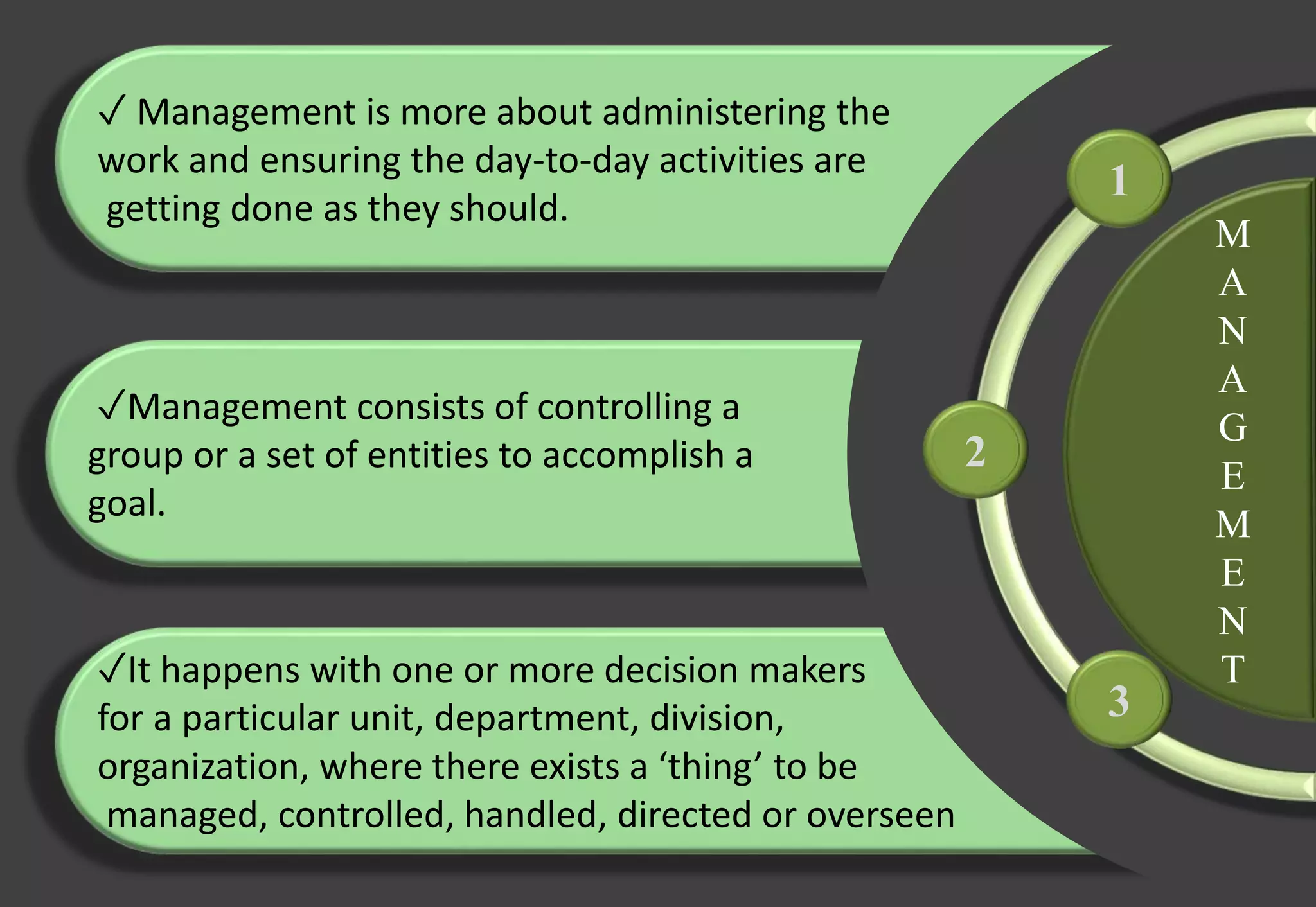
✓ Management is more about administering the
work and ensuring the day-to-day activities are
getting done as they should.
✓Management consists of controlling a
group or a set of entities to accomplish a
goal.
✓It happens with one or more decision makers
for a particular unit, department, division,
organization, where there exists a ‘thing’ to be
managed, controlled, handled, directed or overseen
1
2
3
M
A
N
A
G
E
M
E
N
T
Distinctions of Leadership and Management
“A Trilogy on Leadership
and Effective
Management”
Author:
Anthony A. D’Souza
1. Anthony D'Souza - he is the outstanding third world
leader writes on Christian leadership and he has 25
works in 87 publications in 4 languages and 1,046 library
holdings.
Call for leaders – Leaders assumptions - Key functions for effective
leadership - Individual development - Influence of leadership
styles - Influential communication - Improving interpersonal
relationships - Gaining understanding - Group dynamics -
Opposing styles of leadership - Effective discussion leaders -
Motivation and satisfaction - Tips for effective leadership -
Expressing feelings - Problems-solving and decision making - The
challenge of change - Planned change - Work-related stress -
Coping through rational emotive imagery - The pareto time
principle - Goal setting for life - The winning attitude.
Managers are concerned with the present. Looks to the future.
Make sure details are taken of. Set broad purpose and directions.
Exercise control to make sure
that things work well.
Create commitment that things may work
together.
Solve todays problem by addressing
difficulties caused by changing events.
Creates better future by seizing opportunities
stimulated by changing events.
Focus on process. Focus on the product.
Focus on problem behavior and
try to improve it through
counseling, coaching and nurturing.
Focus on what is right and praise it.
Make sure people put in an
honest day’s work of their pay.
Inspire people to do their best.
Organize and plan to meet
this year’s objective.
Create a vision of the years down the road.
Create efficient policies and
standard operating procedures.
Go beyond the need for standard
and create a more efficient system.
Focus on efficiency. Focus on effectiveness.
MANAGEMENT LEADERSHIP
by: Anthony D'Souza
Distinctions of Leadership and Management
“Learning to Lead: A Workbook on
Becoming a Leader, summed up
the Management vs. Leadership
distinction”
Author:
Warren Gamaliel Bennis
2. Warren Bennis - as
an American scholar, organizational
consultant and author, widely regarded as a
pioneer of the contemporary field
of Leadership Studies. Bennis was University
Professor and Distinguished Professor of
Business Administration and Founding
Chairman of The Leadership Institute at
the University of South California.
 “To manage means to bring about, to
accomplish, to have charge of or
responsibility for, to conduct. Leading is
influencing, guiding in a direction, course,
action, opinion.”
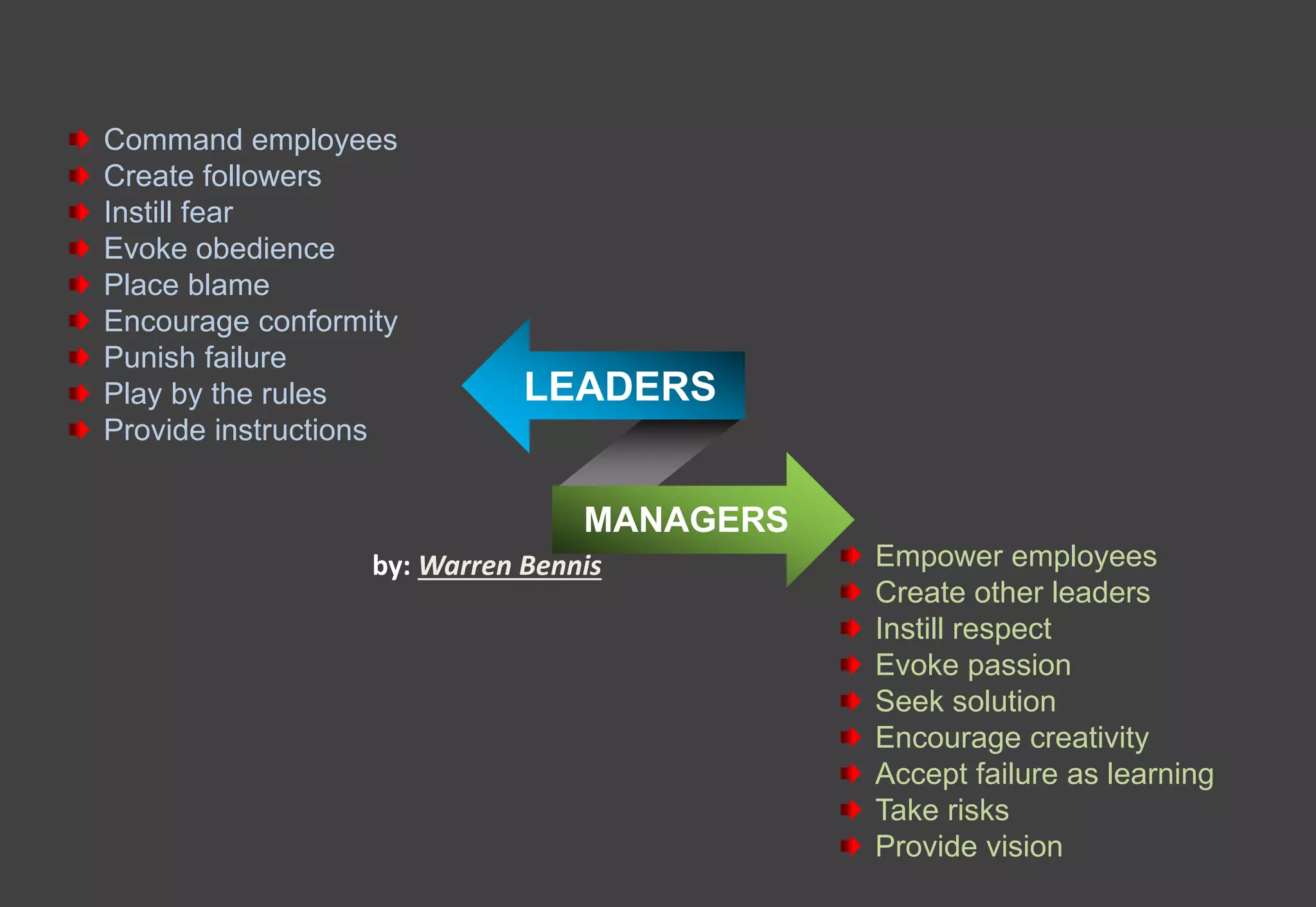
LEADERS
MANAGERS
Command employees
Create followers
Instill fear
Evoke obedience
Place blame
Encourage conformity
Punish failure
Play by the rules
Provide instructions
Empower employees
Create other leaders
Instill respect
Evoke passion
Seek solution
Encourage creativity
Accept failure as learning
Take risks
Provide vision
by: Warren Bennis
Distinctions of Leadership and Management
“A Force for Change”
Author:
John P. Kotter
3. John P. Kotter - is a best-selling author,
award winning business and management
thought leader, business entrepreneur and
Harvard Professor. His ideas, books, and
company, Kotter, help mobilize people
around the world to better lead
organizations in an era of increasingly rapid
change.
 A Force for change showed the
importance of an organization needing
the respective strengths of management
and leadership.
The
8-steps
For
Leading
Change
By:
John
Kotter
CREATE A
SENSE OF
URGENCY
BUILD A
GUIDING
COALITION
FORM A
STRATEGIC
VISION AND
INITIATIVES ENLIST A
VOLUNTEER
ARMY
Help others see the
need for change
through a bold,
aspirational
opportunity
statement that
communicates the
importance of
acting immediately.
A volunteer army
needs a coalition of
effective people –
born of its own
ranks – to guide it,
coordinate it, and
communicate its
activities.
Clarify how the
future will be
different from the
past and how you
can make that
future a reality
through initiatives
linked directly to
the vision.
Large-scale change can
only occur when
massive numbers of
people rally around a
common opportunity.
They must be bought-
in and urgent to drive
change – moving in the
same direction.
The
8-steps
For
Leading
Change
By:
John
Kotter
ENABLE
ACTION BY
REMOVING
BARRIERS
GENERATE
SHORT-TERM
WINS SUSTAIN
ACCELERATION
INSTITUTE
CHANGE
Removing barriers
such as inefficient
processes and
hierarchies provides
the freedom
necessary to work
across silos and
generate real
impact.
Wins are the
molecules of results.
They must be
recognized,
collected and
communicated –
early and often – to
track progress and
energize volunteers
to persist.
Press harder after the
first successes. Your
increasing credibility can
improve systems,
structures and policies.
Be relentless with
initiating change after
change until the vision is
a reality.
Articulate the
connections between
the new behaviors and
organizational success,
making sure they
continue until they
become strong enough
to replace old habits.
6 Steps to Effective Management During Change
by KARIN SYREN
The process must begin with a clear
and detailed statement of objectives
and move from there to goal design.
Goals must be directly accountable to
the vision while remaining in alignment
with the stated purpose of the
organization.
Efficiency in this area requires the
ability and resources to develop and
effectively communicate
design/redesign plans and realistic
schedules, while maintaining a balance
between the broad view and day
operation.
Great communication is the delivery of
clearly stated information on the true
state things, is timely, pertinent, and
requires confirmation that the message
has been understood. The more ways in
which information is given, the more
believable it becomes and the more
likely to initiate action .
STEP 1
Establish Objectives
STEP 3
Communicate
STEP 2
Organize and Plan
6 Steps to Effective Management During Change
by KARIN SYREN
Motivation is the purpose provider, the impetus
for action. Experts acknowledge that the
feelings of the individual or team toward the
motivator are key to the degree of motivation
achieved. Change is disturbance of the status
quo, and will always involve a degree of
resistance. Involving key staff in the design and
implementation process can be extremely
productive
Developing people ought to be a primary goal
of any organization. Developing existing staff
during a period of transition is practical and
profitable. Leaders have the power to provide
an environment rich in opportunity and
resource. Ignorance in this area can be a costly
flaw surfacing during periods of change.
Employees must be made aware of their
progress, in new and developing settings, as
well as in familiar ones. Measurement and
evaluation should be designed to reflect the
vision while motivating and initiating self-
government of the individual. Growth is a
process best achieved and assessed under
relatively stable circumstances.
STEP 4
Motivate
STEP 6
Measure & Analyze
STEP 5
Develop Staff
Leadership vs Management:
Why Both Roles Have Value?
While companies often
like say they are
grooming leaders, both
management and
leadership are important
functions.
• Great managers may not have large spheres
of influence, but they can be masterful at
running projects and getting things done.
They know how to plan, organize, and
coordinate. When a company has a complex
project to undertake, a smart manager
knows how to execute.
• A great leader, on the other hand, may be
influential and have fantastic new ideas, but
may not be so adept at managing the many
ongoing details involved with getting a
project done. Leadership is more about
inspiring, motivating, and innovating.
“Leaders and managers each bring their own
strengths to the table. Leaders are the go-getters,
and are driven by policy. Managers are task-oriented
and more hands on in their work. By each
understanding the other's strengths, there will be a
greater impact toward the goals of the organization.”
-end

Leadership vs management

  • 1.
  • 2.
    INFLUENCING MOTIVATING INSPIRING CREATING MENTORING PLANNING ORGANIZING STAFFING COORDINATING CONTROLLING LEADERSHIP MANAGEME NT Management is operational; it’sabout setting priorities, evaluating priorities, hiring and firing decisions, compensation decisions, and things like that. Leadership is a coach, or even a spiritual guide. They are responsible for maintaining energy, keeping everyone on the team inspired and helping them grow, and for ensuring everyone is aligned in the same direction. What’s the difference and why both roles does value?
  • 3.
    ✓Leadership is aboutmotivating people to comprehend and believe in the vision you set for the company and to work with you on achieving your goals. ✓Leadership refers to an individual's ability to influence, motivate, and enable others to contribute toward organizational success. ✓It is about developing critical thinking, problem solving and process improvement skills in others and giving them the opportunity to apply these skills and have input on decisions. 1 2 3 L E A D E R S H I P
  • 4.
    ✓ Management ismore about administering the work and ensuring the day-to-day activities are getting done as they should. ✓Management consists of controlling a group or a set of entities to accomplish a goal. ✓It happens with one or more decision makers for a particular unit, department, division, organization, where there exists a ‘thing’ to be managed, controlled, handled, directed or overseen 1 2 3 M A N A G E M E N T
  • 5.
    Distinctions of Leadershipand Management “A Trilogy on Leadership and Effective Management” Author: Anthony A. D’Souza 1. Anthony D'Souza - he is the outstanding third world leader writes on Christian leadership and he has 25 works in 87 publications in 4 languages and 1,046 library holdings. Call for leaders – Leaders assumptions - Key functions for effective leadership - Individual development - Influence of leadership styles - Influential communication - Improving interpersonal relationships - Gaining understanding - Group dynamics - Opposing styles of leadership - Effective discussion leaders - Motivation and satisfaction - Tips for effective leadership - Expressing feelings - Problems-solving and decision making - The challenge of change - Planned change - Work-related stress - Coping through rational emotive imagery - The pareto time principle - Goal setting for life - The winning attitude.
  • 6.
    Managers are concernedwith the present. Looks to the future. Make sure details are taken of. Set broad purpose and directions. Exercise control to make sure that things work well. Create commitment that things may work together. Solve todays problem by addressing difficulties caused by changing events. Creates better future by seizing opportunities stimulated by changing events. Focus on process. Focus on the product. Focus on problem behavior and try to improve it through counseling, coaching and nurturing. Focus on what is right and praise it. Make sure people put in an honest day’s work of their pay. Inspire people to do their best. Organize and plan to meet this year’s objective. Create a vision of the years down the road. Create efficient policies and standard operating procedures. Go beyond the need for standard and create a more efficient system. Focus on efficiency. Focus on effectiveness. MANAGEMENT LEADERSHIP by: Anthony D'Souza
  • 7.
    Distinctions of Leadershipand Management “Learning to Lead: A Workbook on Becoming a Leader, summed up the Management vs. Leadership distinction” Author: Warren Gamaliel Bennis 2. Warren Bennis - as an American scholar, organizational consultant and author, widely regarded as a pioneer of the contemporary field of Leadership Studies. Bennis was University Professor and Distinguished Professor of Business Administration and Founding Chairman of The Leadership Institute at the University of South California.  “To manage means to bring about, to accomplish, to have charge of or responsibility for, to conduct. Leading is influencing, guiding in a direction, course, action, opinion.”
  • 8.
    LEADERS MANAGERS Command employees Create followers Instillfear Evoke obedience Place blame Encourage conformity Punish failure Play by the rules Provide instructions Empower employees Create other leaders Instill respect Evoke passion Seek solution Encourage creativity Accept failure as learning Take risks Provide vision by: Warren Bennis
  • 9.
    Distinctions of Leadershipand Management “A Force for Change” Author: John P. Kotter 3. John P. Kotter - is a best-selling author, award winning business and management thought leader, business entrepreneur and Harvard Professor. His ideas, books, and company, Kotter, help mobilize people around the world to better lead organizations in an era of increasingly rapid change.  A Force for change showed the importance of an organization needing the respective strengths of management and leadership.
  • 10.
    The 8-steps For Leading Change By: John Kotter CREATE A SENSE OF URGENCY BUILDA GUIDING COALITION FORM A STRATEGIC VISION AND INITIATIVES ENLIST A VOLUNTEER ARMY Help others see the need for change through a bold, aspirational opportunity statement that communicates the importance of acting immediately. A volunteer army needs a coalition of effective people – born of its own ranks – to guide it, coordinate it, and communicate its activities. Clarify how the future will be different from the past and how you can make that future a reality through initiatives linked directly to the vision. Large-scale change can only occur when massive numbers of people rally around a common opportunity. They must be bought- in and urgent to drive change – moving in the same direction.
  • 11.
    The 8-steps For Leading Change By: John Kotter ENABLE ACTION BY REMOVING BARRIERS GENERATE SHORT-TERM WINS SUSTAIN ACCELERATION INSTITUTE CHANGE Removingbarriers such as inefficient processes and hierarchies provides the freedom necessary to work across silos and generate real impact. Wins are the molecules of results. They must be recognized, collected and communicated – early and often – to track progress and energize volunteers to persist. Press harder after the first successes. Your increasing credibility can improve systems, structures and policies. Be relentless with initiating change after change until the vision is a reality. Articulate the connections between the new behaviors and organizational success, making sure they continue until they become strong enough to replace old habits.
  • 12.
    6 Steps toEffective Management During Change by KARIN SYREN The process must begin with a clear and detailed statement of objectives and move from there to goal design. Goals must be directly accountable to the vision while remaining in alignment with the stated purpose of the organization. Efficiency in this area requires the ability and resources to develop and effectively communicate design/redesign plans and realistic schedules, while maintaining a balance between the broad view and day operation. Great communication is the delivery of clearly stated information on the true state things, is timely, pertinent, and requires confirmation that the message has been understood. The more ways in which information is given, the more believable it becomes and the more likely to initiate action . STEP 1 Establish Objectives STEP 3 Communicate STEP 2 Organize and Plan
  • 13.
    6 Steps toEffective Management During Change by KARIN SYREN Motivation is the purpose provider, the impetus for action. Experts acknowledge that the feelings of the individual or team toward the motivator are key to the degree of motivation achieved. Change is disturbance of the status quo, and will always involve a degree of resistance. Involving key staff in the design and implementation process can be extremely productive Developing people ought to be a primary goal of any organization. Developing existing staff during a period of transition is practical and profitable. Leaders have the power to provide an environment rich in opportunity and resource. Ignorance in this area can be a costly flaw surfacing during periods of change. Employees must be made aware of their progress, in new and developing settings, as well as in familiar ones. Measurement and evaluation should be designed to reflect the vision while motivating and initiating self- government of the individual. Growth is a process best achieved and assessed under relatively stable circumstances. STEP 4 Motivate STEP 6 Measure & Analyze STEP 5 Develop Staff
  • 14.
    Leadership vs Management: WhyBoth Roles Have Value? While companies often like say they are grooming leaders, both management and leadership are important functions. • Great managers may not have large spheres of influence, but they can be masterful at running projects and getting things done. They know how to plan, organize, and coordinate. When a company has a complex project to undertake, a smart manager knows how to execute. • A great leader, on the other hand, may be influential and have fantastic new ideas, but may not be so adept at managing the many ongoing details involved with getting a project done. Leadership is more about inspiring, motivating, and innovating.
  • 15.
    “Leaders and managerseach bring their own strengths to the table. Leaders are the go-getters, and are driven by policy. Managers are task-oriented and more hands on in their work. By each understanding the other's strengths, there will be a greater impact toward the goals of the organization.” -end