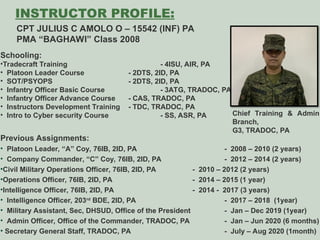
INSTRUCTOR PROFILE:
Schooling:
•Tradecraft Training - 4ISU, AIR, PA
• Platoon Leader Course - 2DTS, 2ID, PA
• SOT/PSYOPS - 2DTS, 2ID, PA
• Infantry Officer Basic Course - 3ATG, TRADOC, PA
• Infantry Officer Advance Course - CAS, TRADOC, PA
• Instructors Development Training - TDC, TRADOC, PA
• Intro to Cyber security Course - SS, ASR, PA
Previous Assignments:
• Platoon Leader, “A” Coy, 76IB, 2ID, PA - 2008 – 2010 (2 years)
• Company Commander, “C” Coy, 76IB, 2ID, PA - 2012 – 2014 (2 years)
•Civil Military Operations Officer, 76IB, 2ID, PA - 2010 – 2012 (2 years)
•Operations Officer, 76IB, 2ID, PA - 2014 – 2015 (1 year)
•Intelligence Officer, 76IB, 2ID, PA - 2014 - 2017 (3 years)
• Intelligence Officer, 203rd
BDE, 2ID, PA - 2017 – 2018 (1year)
• Military Assistant, Sec, DHSUD, Office of the President - Jan – Dec 2019 (1year)
• Admin Officer, Office of the Commander, TRADOC, PA - Jan – Jun 2020 (6 months)
• Secretary General Staff, TRADOC, PA - July – Aug 2020 (1month)
CPT JULIUS C AMOLO O – 15542 (INF) PA
PMA “BAGHAWI” Class 2008
Chief Training & Admin
Branch,
G3, TRADOC, PA
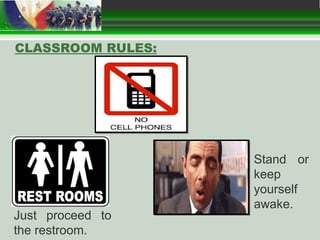
CLASSROOM RULES:
Just proceed to
the restroom.
Stand or
keep
yourself
awake.
At the end of this session, the student(s) must be
able to understand the importance of Followership.
LEARNING OUTCOME
SCOPE OF PRESENTATION
 THE ROLE OF FOLLOWER
 QUALITIES OF FOLLOWER
 CULTIVATING EFFECTIVE FOLLOWER
Followership dominates our lives and
organizations, but not our thinking,
because our preoccupation with
leadership keeps us from considering the
nature and the importance of the follower.
Effective followers differ in their motivations for
following and in their perceptions of the role. Some
choose followership as their primary role at work and
serve as team players who take satisfaction in helping
to further a cause, an idea, a product, a service, or
more rarely, a person. Others are leaders in some
situations but choose the follower role in a particular
context. Both these groups view the role of follower
as legitimate, inherently valuable, even virtuous.
1. Effective followers share a number of
essential qualities:
a. They manage themselves well.
b. They are committed to the organization
and to a purpose;
principle, or person outside themselves.
c. They build their competence and focus
their efforts for maximum
impact.
d. They are courageous, honest, and
credible.
2. Self-Management. Paradoxically, the key
to being an effective follower is the ability to
think for oneself to exercise control and
independence and to work without close
supervision. Good followers are people to
whom a leader can safely delegate
responsibility, people who anticipate needs at
their own level of competence and authority.
2. Self-Management. Another aspect of this
paradox is that effective followers see
themselves except in terms of line responsibility
as the equals of the leaders they follow.
Ineffective followers, on the other hand, buy
into the hierarchy and, seeing themselves as
subservient; vacillate between despair over
their seeming powerlessness and attempts to
manipulate leaders for their own purposes.
2. Self-Management. Self-managed followers
give their organizations a significant cost
advantage because they eliminate much of the
need for elaborate supervisory control systems
that, in any case, often lower morale.
3. Commitment. Effective followers are
committed to something a cause, a product, an
organization, an idea in addition to the care of
their own lives and careers. Some leaders
misinterpret this commitment. Commitment is
contagious. On the other hand, followers who
are strongly committed to goals not consistent
with the goals of their companies can produce
destructive results. Leaders having such
followers can even lose control of their
organizations.
3. Commitment. Effective followers temper their
loyalties to satisfy organizational needs or they
find new organizations. Effective leaders know
how to channel the energies of strong
commitment in ways that will satisfy corporate
goals as well as a follower's personal needs.
4. Competence and Focus. On the grounds
that committed incompetence is still
incompetence, effective followers master skills
that will be useful to their organizations. They
generally hold higher performance standards
than the work environment requires, and
continuing education is second nature to them,
a staple in their professional development. Good
followers see coworkers as colleagues rather
than competitors.
4. Courage. Effective followers are credible,
honest, and courageous. They establish
themselves as independent, critical thinkers
whose knowledge and judgment can be trusted.
They give credit where credit is due, admitting
mistakes and sharing successes. They form
their own views and ethical standards and stand
up for what they believe in.
4. Cultivating Effective Followers. Effective
followers are, confusingly enough, pretty much
the same qualities found in some effective
leaders. If a person has initiative, self control,
commitment, talent, honesty, credibility, and
courage, we say, "Here is a leader!"
Followership is a prerequisite for organizational
success. Your organization can take four steps
to cultivate effective followers in your workforce.
SUMMARY
SUMMARY
 THE ROLE OF FOLLOWER
 QUALITIES OF FOLLOWER
 CULTIVATING EFFECTIVE FOLLOWER
Thank You
Good Day and Mabuhay
Daghan Salamat

FOLLOWERSHIP in understanding the worlds

  • 2.
    INSTRUCTOR PROFILE: Schooling: •Tradecraft Training- 4ISU, AIR, PA • Platoon Leader Course - 2DTS, 2ID, PA • SOT/PSYOPS - 2DTS, 2ID, PA • Infantry Officer Basic Course - 3ATG, TRADOC, PA • Infantry Officer Advance Course - CAS, TRADOC, PA • Instructors Development Training - TDC, TRADOC, PA • Intro to Cyber security Course - SS, ASR, PA Previous Assignments: • Platoon Leader, “A” Coy, 76IB, 2ID, PA - 2008 – 2010 (2 years) • Company Commander, “C” Coy, 76IB, 2ID, PA - 2012 – 2014 (2 years) •Civil Military Operations Officer, 76IB, 2ID, PA - 2010 – 2012 (2 years) •Operations Officer, 76IB, 2ID, PA - 2014 – 2015 (1 year) •Intelligence Officer, 76IB, 2ID, PA - 2014 - 2017 (3 years) • Intelligence Officer, 203rd BDE, 2ID, PA - 2017 – 2018 (1year) • Military Assistant, Sec, DHSUD, Office of the President - Jan – Dec 2019 (1year) • Admin Officer, Office of the Commander, TRADOC, PA - Jan – Jun 2020 (6 months) • Secretary General Staff, TRADOC, PA - July – Aug 2020 (1month) CPT JULIUS C AMOLO O – 15542 (INF) PA PMA “BAGHAWI” Class 2008 Chief Training & Admin Branch, G3, TRADOC, PA
  • 3.
    CLASSROOM RULES: Just proceedto the restroom. Stand or keep yourself awake.
  • 5.
    At the endof this session, the student(s) must be able to understand the importance of Followership. LEARNING OUTCOME
  • 6.
    SCOPE OF PRESENTATION THE ROLE OF FOLLOWER  QUALITIES OF FOLLOWER  CULTIVATING EFFECTIVE FOLLOWER
  • 7.
    Followership dominates ourlives and organizations, but not our thinking, because our preoccupation with leadership keeps us from considering the nature and the importance of the follower.
  • 8.
    Effective followers differin their motivations for following and in their perceptions of the role. Some choose followership as their primary role at work and serve as team players who take satisfaction in helping to further a cause, an idea, a product, a service, or more rarely, a person. Others are leaders in some situations but choose the follower role in a particular context. Both these groups view the role of follower as legitimate, inherently valuable, even virtuous.
  • 9.
    1. Effective followersshare a number of essential qualities: a. They manage themselves well. b. They are committed to the organization and to a purpose; principle, or person outside themselves. c. They build their competence and focus their efforts for maximum impact. d. They are courageous, honest, and credible.
  • 10.
    2. Self-Management. Paradoxically,the key to being an effective follower is the ability to think for oneself to exercise control and independence and to work without close supervision. Good followers are people to whom a leader can safely delegate responsibility, people who anticipate needs at their own level of competence and authority.
  • 11.
    2. Self-Management. Anotheraspect of this paradox is that effective followers see themselves except in terms of line responsibility as the equals of the leaders they follow. Ineffective followers, on the other hand, buy into the hierarchy and, seeing themselves as subservient; vacillate between despair over their seeming powerlessness and attempts to manipulate leaders for their own purposes.
  • 12.
    2. Self-Management. Self-managedfollowers give their organizations a significant cost advantage because they eliminate much of the need for elaborate supervisory control systems that, in any case, often lower morale.
  • 13.
    3. Commitment. Effectivefollowers are committed to something a cause, a product, an organization, an idea in addition to the care of their own lives and careers. Some leaders misinterpret this commitment. Commitment is contagious. On the other hand, followers who are strongly committed to goals not consistent with the goals of their companies can produce destructive results. Leaders having such followers can even lose control of their organizations.
  • 14.
    3. Commitment. Effectivefollowers temper their loyalties to satisfy organizational needs or they find new organizations. Effective leaders know how to channel the energies of strong commitment in ways that will satisfy corporate goals as well as a follower's personal needs.
  • 15.
    4. Competence andFocus. On the grounds that committed incompetence is still incompetence, effective followers master skills that will be useful to their organizations. They generally hold higher performance standards than the work environment requires, and continuing education is second nature to them, a staple in their professional development. Good followers see coworkers as colleagues rather than competitors.
  • 16.
    4. Courage. Effectivefollowers are credible, honest, and courageous. They establish themselves as independent, critical thinkers whose knowledge and judgment can be trusted. They give credit where credit is due, admitting mistakes and sharing successes. They form their own views and ethical standards and stand up for what they believe in.
  • 17.
    4. Cultivating EffectiveFollowers. Effective followers are, confusingly enough, pretty much the same qualities found in some effective leaders. If a person has initiative, self control, commitment, talent, honesty, credibility, and courage, we say, "Here is a leader!" Followership is a prerequisite for organizational success. Your organization can take four steps to cultivate effective followers in your workforce.
  • 18.
    SUMMARY SUMMARY  THE ROLEOF FOLLOWER  QUALITIES OF FOLLOWER  CULTIVATING EFFECTIVE FOLLOWER
  • 19.
    Thank You Good Dayand Mabuhay Daghan Salamat