


Leadership & Supervision
Presented By- Ashish Kumar Barnwal
PGDM IV Sem
XIDAS,Jabalpur(MP)
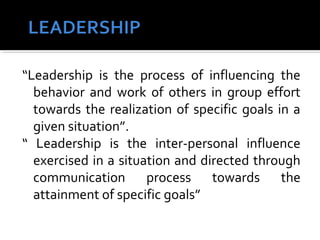
“Leadership is the process of influencing the
behavior and work of others in group effort
towards the realization of specific goals in a
given situation”.
“ Leadership is the inter-personal influence
exercised in a situation and directed through
communication process towards the
attainment of specific goals”
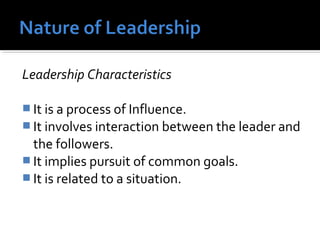
Leadership Characteristics
 It is a process of Influence.
 It involves interaction between the leader and
the followers.
 It implies pursuit of common goals.
 It is related to a situation.
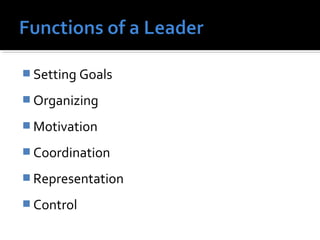
 Setting Goals
 Organizing
 Motivation
 Coordination
 Representation
 Control
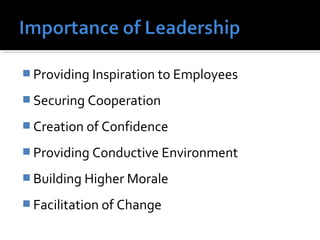
 Providing Inspiration to Employees
 Securing Cooperation
 Creation of Confidence
 Providing Conductive Environment
 Building Higher Morale
 Facilitation of Change
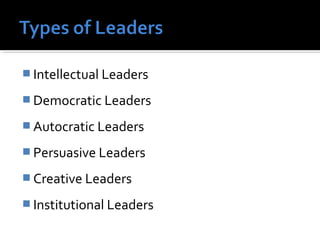
 Intellectual Leaders
 Democratic Leaders
 Autocratic Leaders
 Persuasive Leaders
 Creative Leaders
 Institutional Leaders
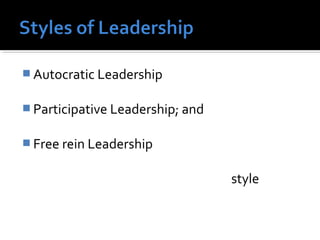
 Autocratic Leadership
 Participative Leadership; and
 Free rein Leadership
style
1. Exploitative Authoritative
2. Benevolent Authoritative
3. Consultative
4. Participative
According to Hellreigel, there are four kinds of
leadership skills:
1. Visionary Skills
2. Communication Skills
3. Sensitivity Skills
4. Self awareness Skills
List of Examples
 His men respect him
 His men follow his orders without question
 His men like him
 His work group has high morale
 He looks out for his men.
1. Fair Evaluation of Work
2. Sufficient delegation of Authority
3. Fair 5treatment for all
4. Availability to all Employees
5. Discussion of employee problems with employees.
A Leader should Avoid
1. Dependence upon superiority
2. Simulation of knowledge
3. Interface with work
4. Favoritism and discrimination
5. Public reprimands
6. Pettiness
7. Conflicting orders
8. Superfluous orders
Any organization requires a system of
communication in which orders and
information can travel from higher to lower
levels, and from lower to higher as well.
These requirements are:
• The channels of communication,
• The system of communication,
• To avoid misunderstandings and make certain
of correct transmission,
• A communication should be authoritative,
• It is a joint process,
A leader should base his actions on the
following five principles:
•Fair evaluation of work,
• Sufficient delegation of authority,
•Fair treatment for all,
• Availability to all employees,
•Discussion of employee problems with
employees
 Dependence on superiority.
 Simulation of knowledge.
 Interference with work.
 Favoritism and discrimination.
 Public reprimands.
 Pettiness.
 Conflicting orders.
 Superfluous orders.
Any organization, ultimate goal is to select leaders
who will create and drive value, whether they come
from the legacy company, the acquired
organization, or from the outside. Regardless of
their past experiences, the new leaders must
demonstrate leadership competencies and
behaviours that are aligned with the strategy,
operating model, and desired culture of the future
organization.
 Intelligence test
 Empathy test
 Vocational test
 Personality
 Personal history questionnaire
Intelligence level
Ambition level
Maturity level
Interest
Ability
 The term training refers to the acquisition
of knowledge, skills, and competencies as a
result of the teaching of vocational or
practical skills and knowledge that relate to
specific useful competencies.
 French (1946) report that in training foremen
to handle interpersonal relations role playing,
lecture, conference, reading and discussion.
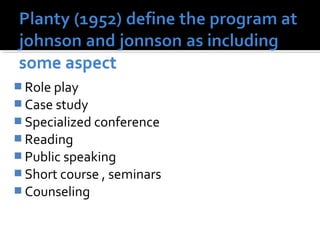
 Role play
 Case study
 Specialized conference
 Reading
 Public speaking
 Short course , seminars
 Counseling
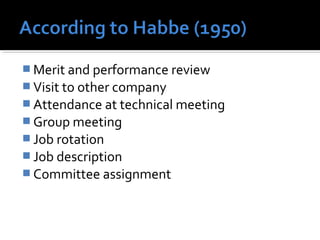
 Merit and performance review
 Visit to other company
 Attendance at technical meeting
 Group meeting
 Job rotation
 Job description
 Committee assignment
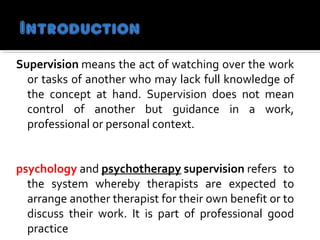
What is
supervision ?
Supervision means the act of watching over the work 
or tasks of another who may lack full knowledge of 
the  concept  at  hand.  Supervision  does  not  mean 
control  of  another  but  guidance  in  a  work, 
professional or personal context.                                        
  
psychology and psychotherapy supervision refers  to 
the  system  whereby  therapists  are  expected  to 
arrange another therapist for their own benefit or to 
discuss  their  work.  It  is  part  of  professional  good 
practice                                                     
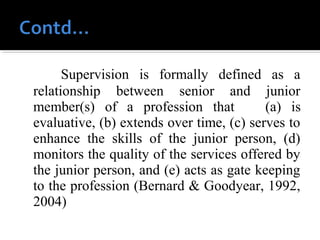
        Supervision is formally defined as a
relationship between senior and junior
member(s) of a profession that (a) is
evaluative, (b) extends over time, (c) serves to
enhance the skills of the junior person, (d)
monitors the quality of the services offered by
the junior person, and (e) acts as gate keeping
to the profession (Bernard & Goodyear, 1992,
2004)
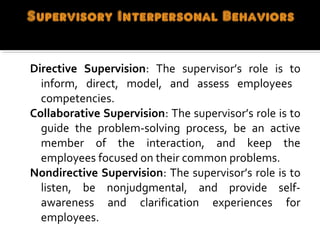
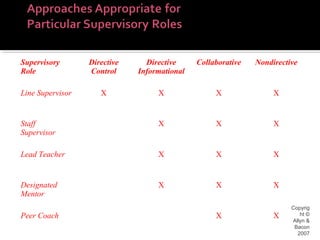
Directive Supervision:  The  supervisor’s  role  is  to 
inform,  direct,  model,  and  assess  employees   
competencies.
Collaborative Supervision: The supervisor’s role is to 
guide  the  problem-solving  process,  be  an  active 
member  of  the  interaction,  and  keep  the 
employees focused on their common problems.
Nondirective Supervision: The supervisor’s role is to 
listen,  be  nonjudgmental,  and  provide  self-
awareness  and  clarification  experiences  for 
employees.
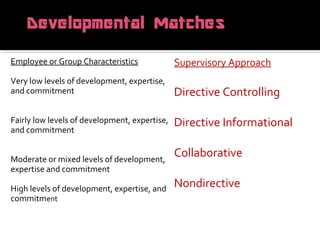
Employee or Group Characteristics
Very low levels of development, expertise, 
and commitment
Fairly low levels of development, expertise, 
and commitment
Moderate or mixed levels of development, 
expertise and commitment
High levels of development, expertise, and 
commitment
Supervisory Approach
Directive Controlling
Directive Informational
Collaborative
Nondirective
Copyrig
ht ©
Allyn &
Bacon
2007
Supervisory
Role
Directive
Control
Directive
Informational
Collaborative Nondirective
Line Supervisor X X X X
Staff
Supervisor
X X X
Lead Teacher X X X
Designated
Mentor
X X X
Peer Coach X X
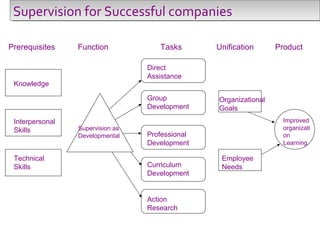
Supervision for Successful companies  Supervision for Successful companies  
Prerequisites
Knowledge
Technical
Skills
Interpersonal
Skills Supervision as
Developmental
Direct
Assistance
Curriculum
Development
Professional
Development
Group
Development
Action
Research
Organizational
Goals
Employee
Needs
Improved
organizati
on
Learning
Function Tasks Unification Product
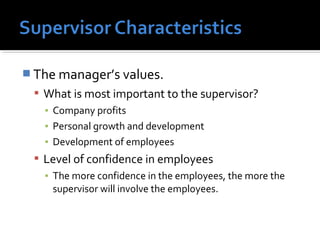
 The manager’s values.
 What is most important to the supervisor?
▪ Company profits
▪ Personal growth and development
▪ Development of employees
 Level of confidence in employees
▪ The more confidence in the employees, the more the 
supervisor will involve the employees.
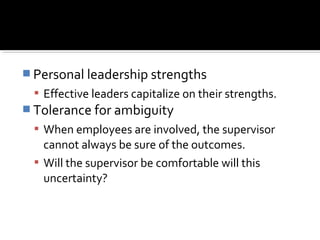
 Personal leadership strengths
 Effective leaders capitalize on their strengths.
 Tolerance for ambiguity
 When employees are involved, the supervisor 
cannot always be sure of the outcomes.
 Will the supervisor be comfortable will this 
uncertainty?
 Supervisors practice leadership by giving 
employees directions.
 Supervisors should make sure employees 
understand the directions.
▪ Directions should be stated in specific, clear terms.
 Employees should understand the reason for the 
directions.
 The image a person has of himself/herself.
 influences how the supervisor behaves.
▪ Someone who believes he or she has the power will act 
powerful.
▪ Someone who thinks himself or herself as intelligent is 
apt to make careful decisions.
▪ When supervisors do something well, they should give 
themselves credit for their success.
 A supervisor needs support from many 
people in the organization to be successful.
 They need the support of their employees. 
 They also need the support of their boss and co-
workers. 
 A supervisor who is liked and respected by
employees will inspire them to work harder
and better.
 Supervisors should be role models for employees
by following the rules of the company.
 They should also be fair in the treatment of
employees and ethical.
i. A safe supervisory relationship,
ii. Task-directed structure,
iii. Methods addressing a variety of learning
styles,
iv. Multiple supervisory roles,
v. Communication skills enhancing listening,
analyzing, and elaboration.
(i) Fiedler’s model
(ii) Developmental models,
(iii)Integrated models, and
(iv)Orientation-specific models.
 Supervisors will be relationship oriented
(people oriented) or task oriented depending
on:
▪ leader-member relations, or the extent to which the
leader has group members’ support and loyalty.
▪ task structure, or whether there is specified procedures
to follow in carrying out the task.
▪ position power, or the leader’s formal authority granted
by the organization.
 Fiedler recommends that a leader determine
whether his or her preferred leadership style
fits the situation, and, if not, the leader
should try to change the characteristics of the
situation.
 Worthington (1987) reviewed developmental
supervision models and noted patterns.
Studies revealed the behavior of supervisors
changed as supervisees gained experience,
and the supervisory relationship also
changed. There appeared to be a scientific
basis for developmental trends and patterns
in supervision
 Stoltenberg and Delworth (1987) highlight
content of eight growth areas for each
supervisee.
1.Intervention,
2.Skills competence,
3.Assessment techniques,
4.Interpersonal assessment,
5.Client conceptualization,
6.Individual differences,
7.Theoretical orientation,
8.Treatment goals and plans, and professional
ethics
 Process,
 Conceptualization, and
 Personalization.
Behavioral supervision views client problems as
learning problems; therefore it requires two
skills:
( 1) identification of the problem, and
(2) selection of the appropriate learning
technique (Leddick & Bernard, 1980).
leadership supervision

leadership supervision