PARTS OF
 SPEECH
    NOUNS?
  ADJECTIVES?
   ADVERBS?
NOUNS
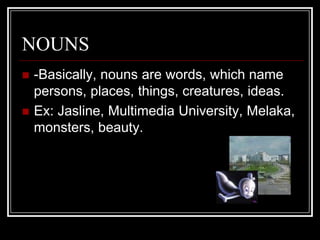
   -Basically, nouns are words, which name
    persons, places, things, creatures, ideas.
   Ex: Jasline, Multimedia University, Melaka,
    monsters, beauty.
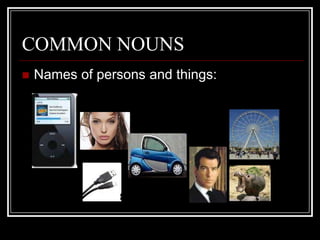
COMMON NOUNS
   Names of persons and things:
PROPER NOUNS
   NAMES for SPECIFIC People/ Places
   MUST BEGIN WITH CAPITAL LETTERS
ABSTRACT NOUNS
   NAME things that cannot be TOUCHED or
    seen, perhaps an idea.
   Ex: happiness, beauty, peace, love, anger,
    bravery, advice, pride, wisdom.
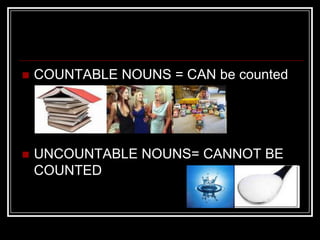
   COUNTABLE NOUNS = CAN be counted


   UNCOUNTABLE NOUNS= CANNOT BE
    COUNTED
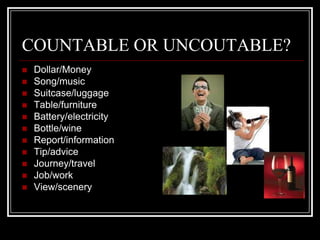
COUNTABLE OR UNCOUTABLE?
   Dollar/Money
   Song/music
   Suitcase/luggage
   Table/furniture
   Battery/electricity
   Bottle/wine
   Report/information
   Tip/advice
   Journey/travel
   Job/work
   View/scenery
Changing Singular Nouns to Plural
Nouns
   Most of the time, + s
   Ex: girl= girls, boy= boys, cane=canes

   Sometimes, we +es if the noun ends with –
    s,-ss,-x,-ch,-sh
   Ex: beach= beaches, box=boxes
   Dish=dishes, boss=bosses
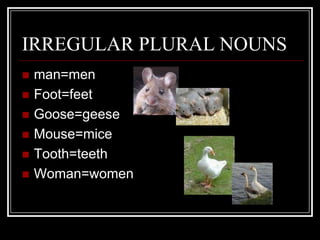
IRREGULAR PLURAL NOUNS
   man=men
   Foot=feet
   Goose=geese
   Mouse=mice
   Tooth=teeth
   Woman=women
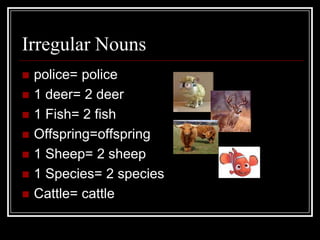
Irregular Nouns
   police= police
   1 deer= 2 deer
   1 Fish= 2 fish
   Offspring=offspring
   1 Sheep= 2 sheep
   1 Species= 2 species
   Cattle= cattle
Sometimes, if the noun ends with:
1. Consonant + y then remove y and +ies
 Ex: city = cities, baby = babies
2. Vowel + y then just add –s
 Ex: Boy= boys, key= keys
3. If with –f/fe, then + ves
Ex: Wife = wives, knife=knives
POSSESSIVE NOUNS
   To show owners, just put ‘s
   Ex: Jasline’s car, Jason’s wives.
   Singular owner, then ‘s
   Ex: A boy’s room, A cat’s bones.
   Many owners, then s’
   Ex: many boys’ bags, many doctors’
    patients.
INDEFINITE PRONOUNS
   Indefinite pronouns are words which replace
    nouns and you do not know WHO.
   Ex: someone is waiting outside.
   You know a person is outside but you do not
    know who…

   OTHER EXAMPLES OF INDEFINITE PRONOUNS

   Singular: another, anybody, anyone, anything, each, either,
    everybody, everyone, everything, little, much, neither, nobody, no
    one, nothing, one, other, somebody, someone, something
REMEMBER:
   Singular indefinite pronouns take singular verbs or singular
    personal pronouns.

   Correct: Each of the members has one vote.
    (The subject, each, is singular. Use has.)

   Someone is following me!
   Someone ARE following me! THIS IS WRONG!!! After single
    indefinite pronoun, 100% use SINGULAR VERBS
ADJECTIVES
   WORDS THAT DESCRIBE A NOUN OR
    PRONOUN:


    An angry dog, a frozen man, an excited cat, a messy room, a hot day.
ADVERBS
 An adverb gives us more information on
  VERBS.
~ normally, adverbs have –ly behind it…
 An adverb tells us the manner/way, time, place
  or answers questions such as "how," "when,"
  "where," "how often“ an ACTION happens.
 Ex: She finished her homework quickly. (How
  did she finish her homework? ~quickly(adverb)
Ex: Adverb of Manner. HOW
ACTION IS DONE…
   His mother screamed angrily at him after
    looking at his result .


   The doctor checked the pregnant lady
    carefully
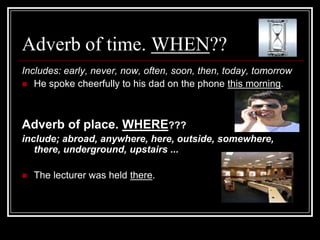
Adverb of time. WHEN??
Includes: early, never, now, often, soon, then, today, tomorrow
 He spoke cheerfully to his dad on the phone this morning.


Adverb of place. WHERE???
include; abroad, anywhere, here, outside, somewhere,
   there, underground, upstairs ...

   The lecturer was held there.
Adverbs of degree - answer the question How
much? USE TO MODIFY ADJECTIVES
includes: almost, entirely, little, much, rather, very, too
 I am too tired to play tennis tonight.


Adverbs of frequency - answer the question How
  often?
Includes: always, never, usually, frequently, sometimes,
   occasionally
 She always goes for classes alone.

Nouns, Adjectives and Adverbs

  • 1.
    PARTS OF SPEECH NOUNS? ADJECTIVES? ADVERBS?
  • 2.
    NOUNS  -Basically, nouns are words, which name persons, places, things, creatures, ideas.  Ex: Jasline, Multimedia University, Melaka, monsters, beauty.
  • 3.
    COMMON NOUNS  Names of persons and things:
  • 4.
    PROPER NOUNS  NAMES for SPECIFIC People/ Places  MUST BEGIN WITH CAPITAL LETTERS
  • 5.
    ABSTRACT NOUNS  NAME things that cannot be TOUCHED or seen, perhaps an idea.  Ex: happiness, beauty, peace, love, anger, bravery, advice, pride, wisdom.
  • 6.
    COUNTABLE NOUNS = CAN be counted  UNCOUNTABLE NOUNS= CANNOT BE COUNTED
  • 7.
    COUNTABLE OR UNCOUTABLE?  Dollar/Money  Song/music  Suitcase/luggage  Table/furniture  Battery/electricity  Bottle/wine  Report/information  Tip/advice  Journey/travel  Job/work  View/scenery
  • 8.
    Changing Singular Nounsto Plural Nouns  Most of the time, + s  Ex: girl= girls, boy= boys, cane=canes  Sometimes, we +es if the noun ends with – s,-ss,-x,-ch,-sh  Ex: beach= beaches, box=boxes  Dish=dishes, boss=bosses
  • 9.
    IRREGULAR PLURAL NOUNS  man=men  Foot=feet  Goose=geese  Mouse=mice  Tooth=teeth  Woman=women
  • 10.
    Irregular Nouns  police= police  1 deer= 2 deer  1 Fish= 2 fish  Offspring=offspring  1 Sheep= 2 sheep  1 Species= 2 species  Cattle= cattle
  • 11.
    Sometimes, if thenoun ends with: 1. Consonant + y then remove y and +ies  Ex: city = cities, baby = babies 2. Vowel + y then just add –s  Ex: Boy= boys, key= keys 3. If with –f/fe, then + ves Ex: Wife = wives, knife=knives
  • 12.
    POSSESSIVE NOUNS  To show owners, just put ‘s  Ex: Jasline’s car, Jason’s wives.  Singular owner, then ‘s  Ex: A boy’s room, A cat’s bones.  Many owners, then s’  Ex: many boys’ bags, many doctors’ patients.
  • 13.
    INDEFINITE PRONOUNS  Indefinite pronouns are words which replace nouns and you do not know WHO.  Ex: someone is waiting outside.  You know a person is outside but you do not know who…  OTHER EXAMPLES OF INDEFINITE PRONOUNS  Singular: another, anybody, anyone, anything, each, either, everybody, everyone, everything, little, much, neither, nobody, no one, nothing, one, other, somebody, someone, something
  • 14.
    REMEMBER:  Singular indefinite pronouns take singular verbs or singular personal pronouns.  Correct: Each of the members has one vote. (The subject, each, is singular. Use has.)  Someone is following me!  Someone ARE following me! THIS IS WRONG!!! After single indefinite pronoun, 100% use SINGULAR VERBS
  • 15.
    ADJECTIVES  WORDS THAT DESCRIBE A NOUN OR PRONOUN: An angry dog, a frozen man, an excited cat, a messy room, a hot day.
  • 16.
    ADVERBS  An adverbgives us more information on VERBS. ~ normally, adverbs have –ly behind it…  An adverb tells us the manner/way, time, place or answers questions such as "how," "when," "where," "how often“ an ACTION happens.  Ex: She finished her homework quickly. (How did she finish her homework? ~quickly(adverb)
  • 17.
    Ex: Adverb ofManner. HOW ACTION IS DONE…  His mother screamed angrily at him after looking at his result .  The doctor checked the pregnant lady carefully
  • 18.
    Adverb of time.WHEN?? Includes: early, never, now, often, soon, then, today, tomorrow  He spoke cheerfully to his dad on the phone this morning. Adverb of place. WHERE??? include; abroad, anywhere, here, outside, somewhere, there, underground, upstairs ...  The lecturer was held there.
  • 19.
    Adverbs of degree- answer the question How much? USE TO MODIFY ADJECTIVES includes: almost, entirely, little, much, rather, very, too  I am too tired to play tennis tonight. Adverbs of frequency - answer the question How often? Includes: always, never, usually, frequently, sometimes, occasionally  She always goes for classes alone.