NOUNS
What is noun?
Noun is a word use to name a
person, animal, place, thing
and abstract idea. Nouns are
usually the first word which
small children learn.
UNIVERSITY OF OTTAWA
NOUNS
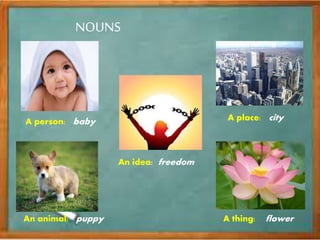
A person: baby
An animal: puppy A thing: flower
A place: city
An idea: freedom
Nouns
Singular and plural nouns:
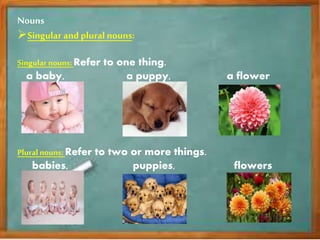
Singular nouns:Refer to one thing.
a baby, a puppy, a flower
Plural nouns:Refer to two or more things.
babies, puppies, flowers
Nouns
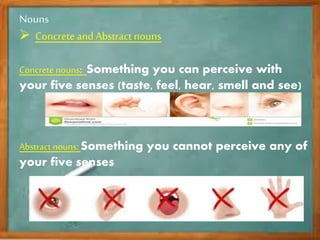
 Concrete and Abstract nouns
Concrete nouns: Something you can perceive with
your five senses (taste, feel, hear, smell and see)
Abstract nouns: Something you cannot perceive any of
your five senses
Nouns
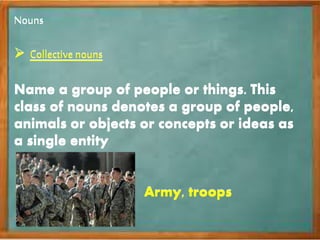
 Collective nouns
Name a group of people or things. This
class of nouns denotes a group of people,
animals or objects or concepts or ideas as
a single entity
Army, troops
Nouns
 Collective nouns
Name a group of people or things. This
class of nouns denotes a group of people,
animals or objects or concepts or ideas as
a single entity
Army, troops
Nouns
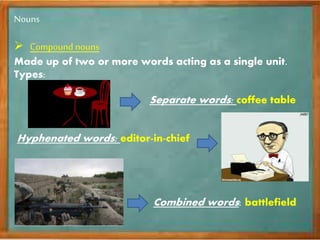
 Compound nouns
Made up of two or more words acting as a single unit.
Types:
Separate words: coffee table
Hyphenated words: editor-in-chief
Combined words: battlefield
Nouns
 Common Nouns and Proper nouns
A Common noun names anything of the nouns
(person, animal, place, thing, idea)
A Proper noun names a specific person, animal,
place, thing, idea.
person - Angela
animal (dog) - Doggie
place - Cebu
thing (pencil)- Mongol
Nouns
 Count nouns and Non count nouns
Count nouns are nouns that we can count:
( one pencil, two pencils, three pencils)
They can be singular or plural:
Ex. a book, two books
Non count nouns are nouns that we cannot
count. They have no plural form.
Ex. Bread, cheese, ice-cream, yogurt.
Put a or an before singular nouns.
Do not use article a or an with non countable nouns.
Nouns
 Possessive noun
Noun that show ownership or possession.
 Rule #1: Making singular nouns possessive
Add an apostrophe + s to most singular nouns and to
plural nouns that do not end in s.
Examples:
Singular nouns: kitten’s toy, Joe’s car, MLB’s ruling
Plurals not ending in s: women’s dresses,
sheep’s pasture, children’s toys
Nouns
(Possessive noun)
 Rule #2: Making plural nouns possessive
Add an apostrophe only to plural nouns that
already end in s.
Examples:
Companies’ workers
Horses’ stalls
Countries’ armies
Nouns
(Possessive noun)
 Rule #3: Making hyphenated nouns and compound
nouns plural
Compound and hyphenated words can be tricky. Add
the apostrophe + s to the end of the compound words or
the last word in a hyphenated noun.
Examples:
My mother-in-law’s recipe for meatloaf is my
husband’s favourite.
Nouns
(Possessive noun)
 Rule #4: Indicating possession when two
nouns are joined together
You may be writing about two people or two places or
things that share possession of an object. If two nouns
share ownership, indicate possession only once, and on
the second noun. Add the apostrophe + s to the second
noun only.
Nouns
(Possessive noun)
Examples:
Jack and Jill’s pail of water features
prominently in the nursery rhyme.
Abbot and Costello’s comedy skit “Who’s On
First” is a classic act.
Nouns
(Possessive noun)
 Rule #5: Indicating possession when two nouns are
joined, and ownership is separate
This is the trickiest of all, but thankfully you’ll probably
need this rule infrequently. When two nouns indicate
ownership, but the ownership is separate, each noun
gets the apostrophe + s. The examples below may help
you understand exactly what this means.
Nouns
(Possessive noun)
Example:
Lucy’s and Ricky’s dressing rooms were painted pink
and blue. (Each owns his or her own dressing room,
and they are different rooms).
Senator Obama’s and Senator Clinton’s educations are
outstanding. (Each senator owns his or her education,
but they attained separate educations).
End!
Thank you and God bless.
Nouns Slideshow presentation

Nouns Slideshow presentation

  • 1.
  • 2.
    What is noun? Nounis a word use to name a person, animal, place, thing and abstract idea. Nouns are usually the first word which small children learn. UNIVERSITY OF OTTAWA
  • 3.
    NOUNS A person: baby Ananimal: puppy A thing: flower A place: city An idea: freedom
  • 4.
    Nouns Singular and pluralnouns: Singular nouns:Refer to one thing. a baby, a puppy, a flower Plural nouns:Refer to two or more things. babies, puppies, flowers
  • 5.
    Nouns  Concrete andAbstract nouns Concrete nouns: Something you can perceive with your five senses (taste, feel, hear, smell and see) Abstract nouns: Something you cannot perceive any of your five senses
  • 6.
    Nouns  Collective nouns Namea group of people or things. This class of nouns denotes a group of people, animals or objects or concepts or ideas as a single entity Army, troops Nouns  Collective nouns Name a group of people or things. This class of nouns denotes a group of people, animals or objects or concepts or ideas as a single entity Army, troops
  • 7.
    Nouns  Compound nouns Madeup of two or more words acting as a single unit. Types: Separate words: coffee table Hyphenated words: editor-in-chief Combined words: battlefield
  • 8.
    Nouns  Common Nounsand Proper nouns A Common noun names anything of the nouns (person, animal, place, thing, idea) A Proper noun names a specific person, animal, place, thing, idea. person - Angela animal (dog) - Doggie place - Cebu thing (pencil)- Mongol
  • 9.
    Nouns  Count nounsand Non count nouns Count nouns are nouns that we can count: ( one pencil, two pencils, three pencils) They can be singular or plural: Ex. a book, two books Non count nouns are nouns that we cannot count. They have no plural form. Ex. Bread, cheese, ice-cream, yogurt. Put a or an before singular nouns. Do not use article a or an with non countable nouns.
  • 10.
    Nouns  Possessive noun Nounthat show ownership or possession.  Rule #1: Making singular nouns possessive Add an apostrophe + s to most singular nouns and to plural nouns that do not end in s. Examples: Singular nouns: kitten’s toy, Joe’s car, MLB’s ruling Plurals not ending in s: women’s dresses, sheep’s pasture, children’s toys
  • 11.
    Nouns (Possessive noun)  Rule#2: Making plural nouns possessive Add an apostrophe only to plural nouns that already end in s. Examples: Companies’ workers Horses’ stalls Countries’ armies
  • 12.
    Nouns (Possessive noun)  Rule#3: Making hyphenated nouns and compound nouns plural Compound and hyphenated words can be tricky. Add the apostrophe + s to the end of the compound words or the last word in a hyphenated noun. Examples: My mother-in-law’s recipe for meatloaf is my husband’s favourite.
  • 13.
    Nouns (Possessive noun)  Rule#4: Indicating possession when two nouns are joined together You may be writing about two people or two places or things that share possession of an object. If two nouns share ownership, indicate possession only once, and on the second noun. Add the apostrophe + s to the second noun only.
  • 14.
    Nouns (Possessive noun) Examples: Jack andJill’s pail of water features prominently in the nursery rhyme. Abbot and Costello’s comedy skit “Who’s On First” is a classic act.
  • 15.
    Nouns (Possessive noun)  Rule#5: Indicating possession when two nouns are joined, and ownership is separate This is the trickiest of all, but thankfully you’ll probably need this rule infrequently. When two nouns indicate ownership, but the ownership is separate, each noun gets the apostrophe + s. The examples below may help you understand exactly what this means.
  • 16.
    Nouns (Possessive noun) Example: Lucy’s andRicky’s dressing rooms were painted pink and blue. (Each owns his or her own dressing room, and they are different rooms). Senator Obama’s and Senator Clinton’s educations are outstanding. (Each senator owns his or her education, but they attained separate educations).
  • 17.