


MANPREET KAUR
11808213
B.A B.ED INTEGRATED
SCHOOL OF EDUCATION
ARTICLES
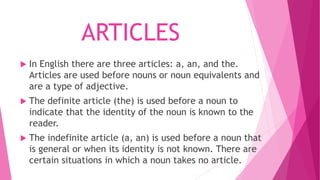
 In English there are three articles: a, an, and the.
Articles are used before nouns or noun equivalents and
are a type of adjective.
 The definite article (the) is used before a noun to
indicate that the identity of the noun is known to the
reader.
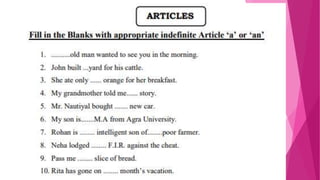
 The indefinite article (a, an) is used before a noun that
is general or when its identity is not known. There are
certain situations in which a noun takes no article.
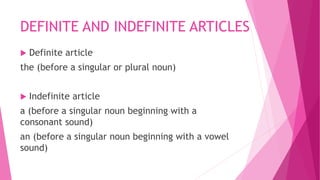
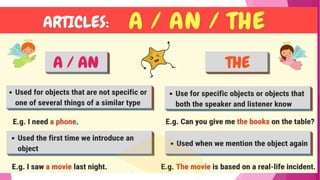
DEFINITE AND INDEFINITE ARTICLES
 Definite article
the (before a singular or plural noun)
 Indefinite article
a (before a singular noun beginning with a
consonant sound)
an (before a singular noun beginning with a vowel
sound)
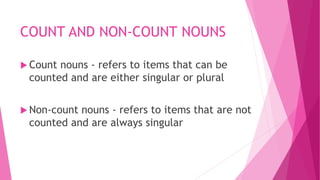
COUNT AND NON-COUNT NOUNS
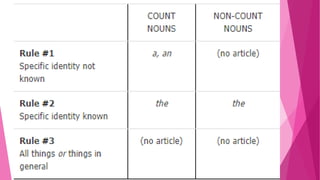
 Count nouns - refers to items that can be
counted and are either singular or plural
 Non-count nouns - refers to items that are not
counted and are always singular
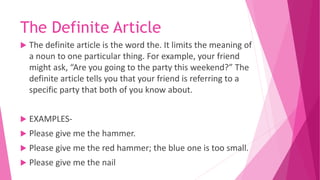
The Definite Article
 The definite article is the word the. It limits the meaning of
a noun to one particular thing. For example, your friend
might ask, “Are you going to the party this weekend?” The
definite article tells you that your friend is referring to a
specific party that both of you know about.
 EXAMPLES-
 Please give me the hammer.
 Please give me the red hammer; the blue one is too small.
 Please give me the nail
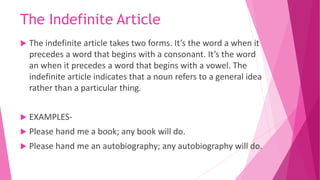
The Indefinite Article
 The indefinite article takes two forms. It’s the word a when it
precedes a word that begins with a consonant. It’s the word
an when it precedes a word that begins with a vowel. The
indefinite article indicates that a noun refers to a general idea
rather than a particular thing.
 EXAMPLES-
 Please hand me a book; any book will do.
 Please hand me an autobiography; any autobiography will do.
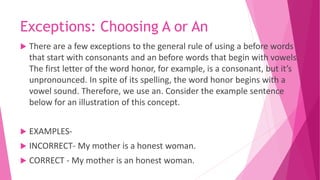
Exceptions: Choosing A or An
 There are a few exceptions to the general rule of using a before words
that start with consonants and an before words that begin with vowels.
The first letter of the word honor, for example, is a consonant, but it’s
unpronounced. In spite of its spelling, the word honor begins with a
vowel sound. Therefore, we use an. Consider the example sentence
below for an illustration of this concept.
 EXAMPLES-
 INCORRECT- My mother is a honest woman.
 CORRECT - My mother is an honest woman.
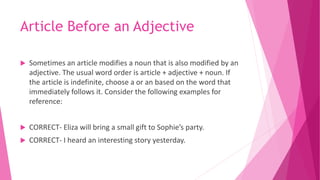
Article Before an Adjective
 Sometimes an article modifies a noun that is also modified by an
adjective. The usual word order is article + adjective + noun. If
the article is indefinite, choose a or an based on the word that
immediately follows it. Consider the following examples for
reference:
 CORRECT- Eliza will bring a small gift to Sophie’s party.
 CORRECT- I heard an interesting story yesterday.
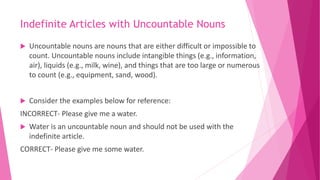
Indefinite Articles with Uncountable Nouns
 Uncountable nouns are nouns that are either difficult or impossible to
count. Uncountable nouns include intangible things (e.g., information,
air), liquids (e.g., milk, wine), and things that are too large or numerous
to count (e.g., equipment, sand, wood).
 Consider the examples below for reference:
INCORRECT- Please give me a water.
 Water is an uncountable noun and should not be used with the
indefinite article.
CORRECT- Please give me some water.
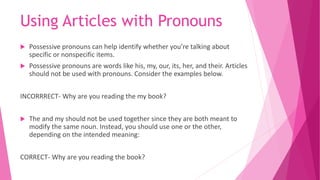
Using Articles with Pronouns
 Possessive pronouns can help identify whether you’re talking about
specific or nonspecific items.
 Possessive pronouns are words like his, my, our, its, her, and their. Articles
should not be used with pronouns. Consider the examples below.
INCORRRECT- Why are you reading the my book?
 The and my should not be used together since they are both meant to
modify the same noun. Instead, you should use one or the other,
depending on the intended meaning:
CORRECT- Why are you reading the book?
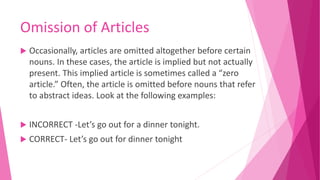
Omission of Articles
 Occasionally, articles are omitted altogether before certain
nouns. In these cases, the article is implied but not actually
present. This implied article is sometimes called a “zero
article.” Often, the article is omitted before nouns that refer
to abstract ideas. Look at the following examples:
 INCORRECT -Let’s go out for a dinner tonight.
 CORRECT- Let’s go out for dinner tonight
THANK YOU

Articles and its types

  • 2.
    MANPREET KAUR 11808213 B.A B.EDINTEGRATED SCHOOL OF EDUCATION
  • 3.
    ARTICLES  In Englishthere are three articles: a, an, and the. Articles are used before nouns or noun equivalents and are a type of adjective.  The definite article (the) is used before a noun to indicate that the identity of the noun is known to the reader.  The indefinite article (a, an) is used before a noun that is general or when its identity is not known. There are certain situations in which a noun takes no article.
  • 4.
    DEFINITE AND INDEFINITEARTICLES  Definite article the (before a singular or plural noun)  Indefinite article a (before a singular noun beginning with a consonant sound) an (before a singular noun beginning with a vowel sound)
  • 5.
    COUNT AND NON-COUNTNOUNS  Count nouns - refers to items that can be counted and are either singular or plural  Non-count nouns - refers to items that are not counted and are always singular
  • 7.
    The Definite Article The definite article is the word the. It limits the meaning of a noun to one particular thing. For example, your friend might ask, “Are you going to the party this weekend?” The definite article tells you that your friend is referring to a specific party that both of you know about.  EXAMPLES-  Please give me the hammer.  Please give me the red hammer; the blue one is too small.  Please give me the nail
  • 8.
    The Indefinite Article The indefinite article takes two forms. It’s the word a when it precedes a word that begins with a consonant. It’s the word an when it precedes a word that begins with a vowel. The indefinite article indicates that a noun refers to a general idea rather than a particular thing.  EXAMPLES-  Please hand me a book; any book will do.  Please hand me an autobiography; any autobiography will do.
  • 9.
    Exceptions: Choosing Aor An  There are a few exceptions to the general rule of using a before words that start with consonants and an before words that begin with vowels. The first letter of the word honor, for example, is a consonant, but it’s unpronounced. In spite of its spelling, the word honor begins with a vowel sound. Therefore, we use an. Consider the example sentence below for an illustration of this concept.  EXAMPLES-  INCORRECT- My mother is a honest woman.  CORRECT - My mother is an honest woman.
  • 10.
    Article Before anAdjective  Sometimes an article modifies a noun that is also modified by an adjective. The usual word order is article + adjective + noun. If the article is indefinite, choose a or an based on the word that immediately follows it. Consider the following examples for reference:  CORRECT- Eliza will bring a small gift to Sophie’s party.  CORRECT- I heard an interesting story yesterday.
  • 11.
    Indefinite Articles withUncountable Nouns  Uncountable nouns are nouns that are either difficult or impossible to count. Uncountable nouns include intangible things (e.g., information, air), liquids (e.g., milk, wine), and things that are too large or numerous to count (e.g., equipment, sand, wood).  Consider the examples below for reference: INCORRECT- Please give me a water.  Water is an uncountable noun and should not be used with the indefinite article. CORRECT- Please give me some water.
  • 12.
    Using Articles withPronouns  Possessive pronouns can help identify whether you’re talking about specific or nonspecific items.  Possessive pronouns are words like his, my, our, its, her, and their. Articles should not be used with pronouns. Consider the examples below. INCORRRECT- Why are you reading the my book?  The and my should not be used together since they are both meant to modify the same noun. Instead, you should use one or the other, depending on the intended meaning: CORRECT- Why are you reading the book?
  • 13.
    Omission of Articles Occasionally, articles are omitted altogether before certain nouns. In these cases, the article is implied but not actually present. This implied article is sometimes called a “zero article.” Often, the article is omitted before nouns that refer to abstract ideas. Look at the following examples:  INCORRECT -Let’s go out for a dinner tonight.  CORRECT- Let’s go out for dinner tonight
  • 16.