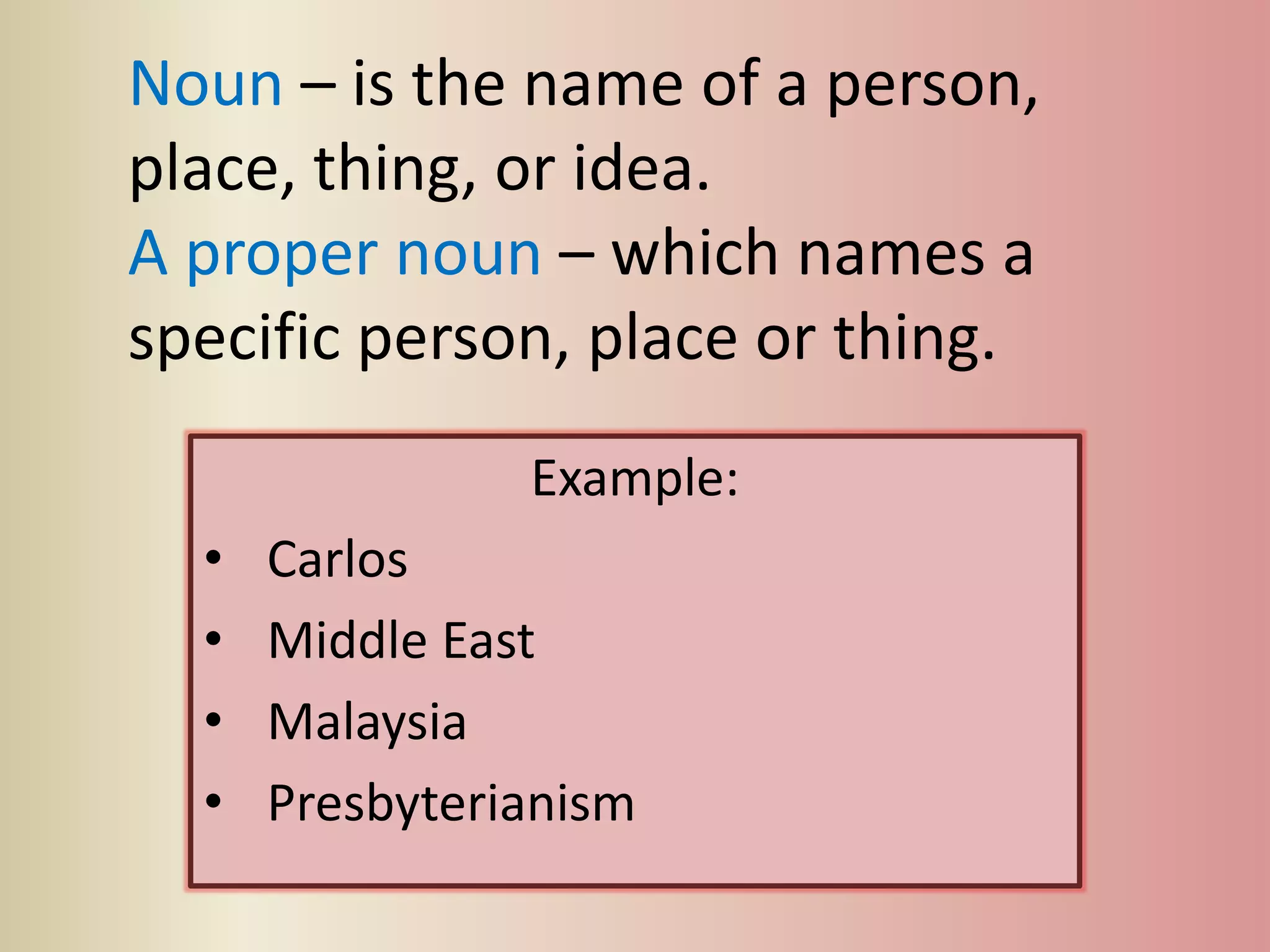
Noun – is the name of a person,
place, thing, or idea.
A proper noun – which names a
specific person, place or thing.
Example:
• Carlos
• Middle East
• Malaysia
• Presbyterianism
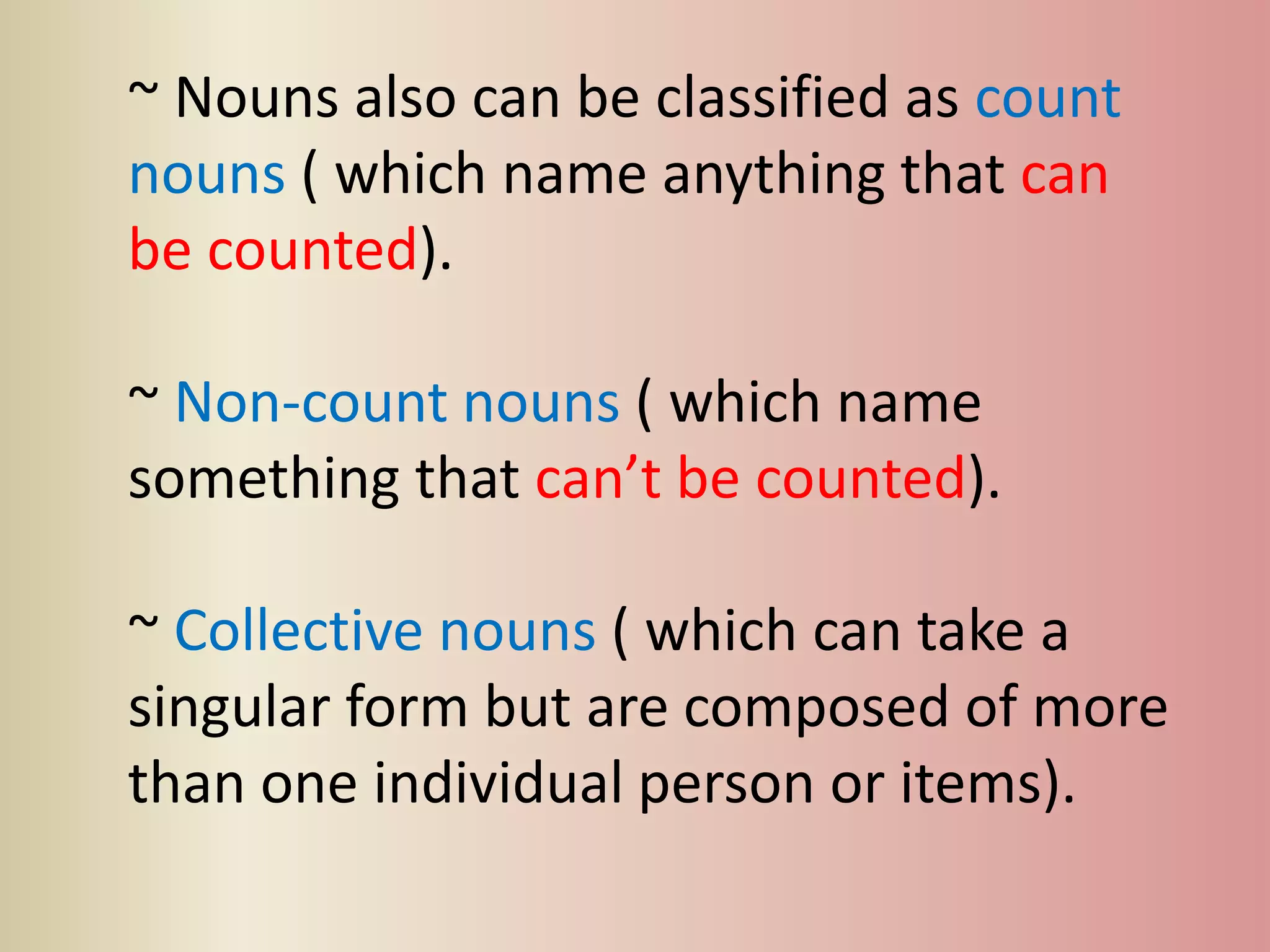
~ Nouns also can be classified as count
nouns ( which name anything that can
be counted).
~ Non-count nouns ( which name
something that can’t be counted).
~ Collective nouns ( which can take a
singular form but are composed of more
than one individual person or items).
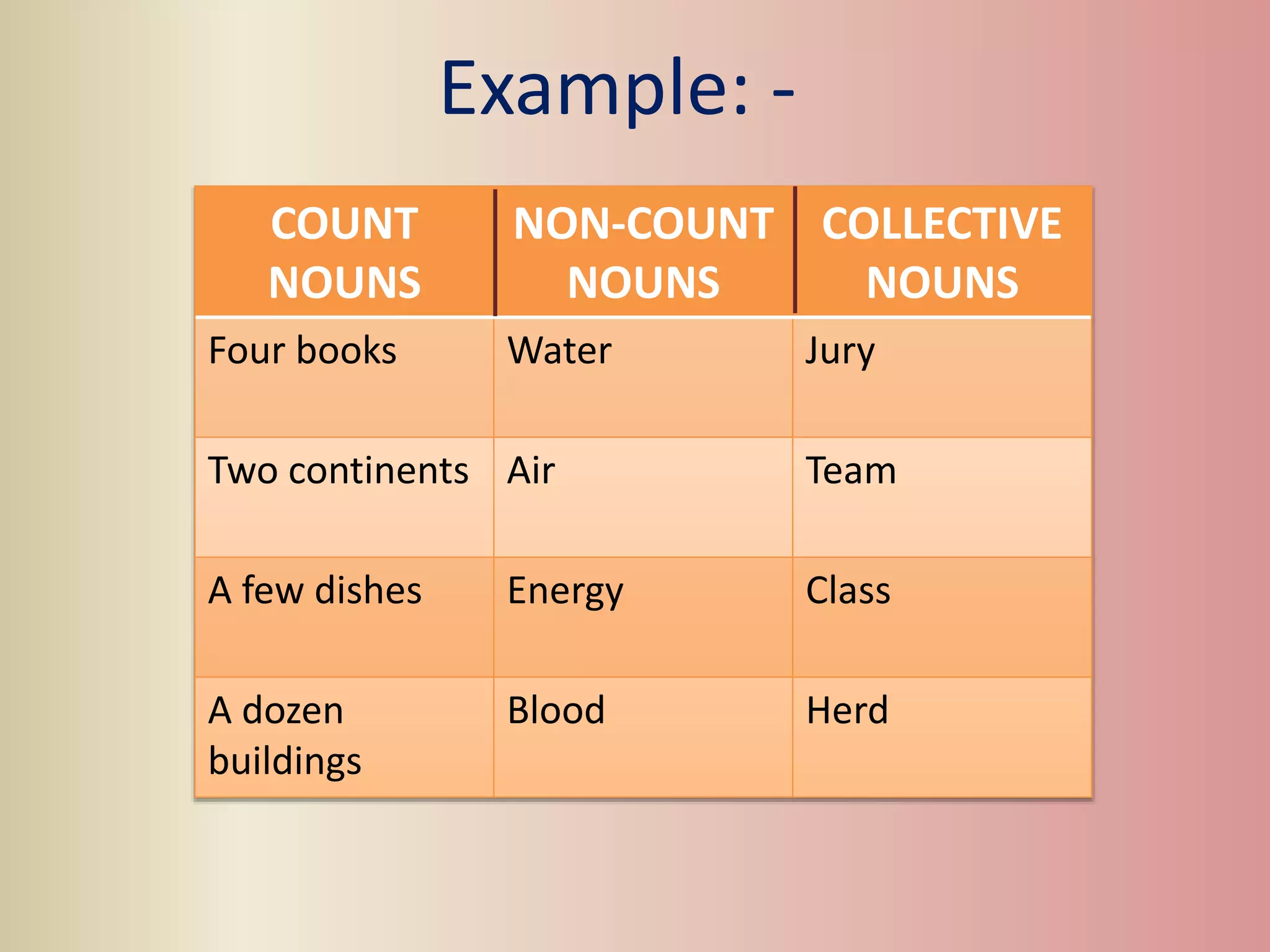
Example: -
COUNT
NOUNS
NON-COUNT
NOUNS
COLLECTIVE
NOUNS
Four books Water Jury
Two continents Air Team
A few dishes Energy Class
A dozen
buildings
Blood Herd
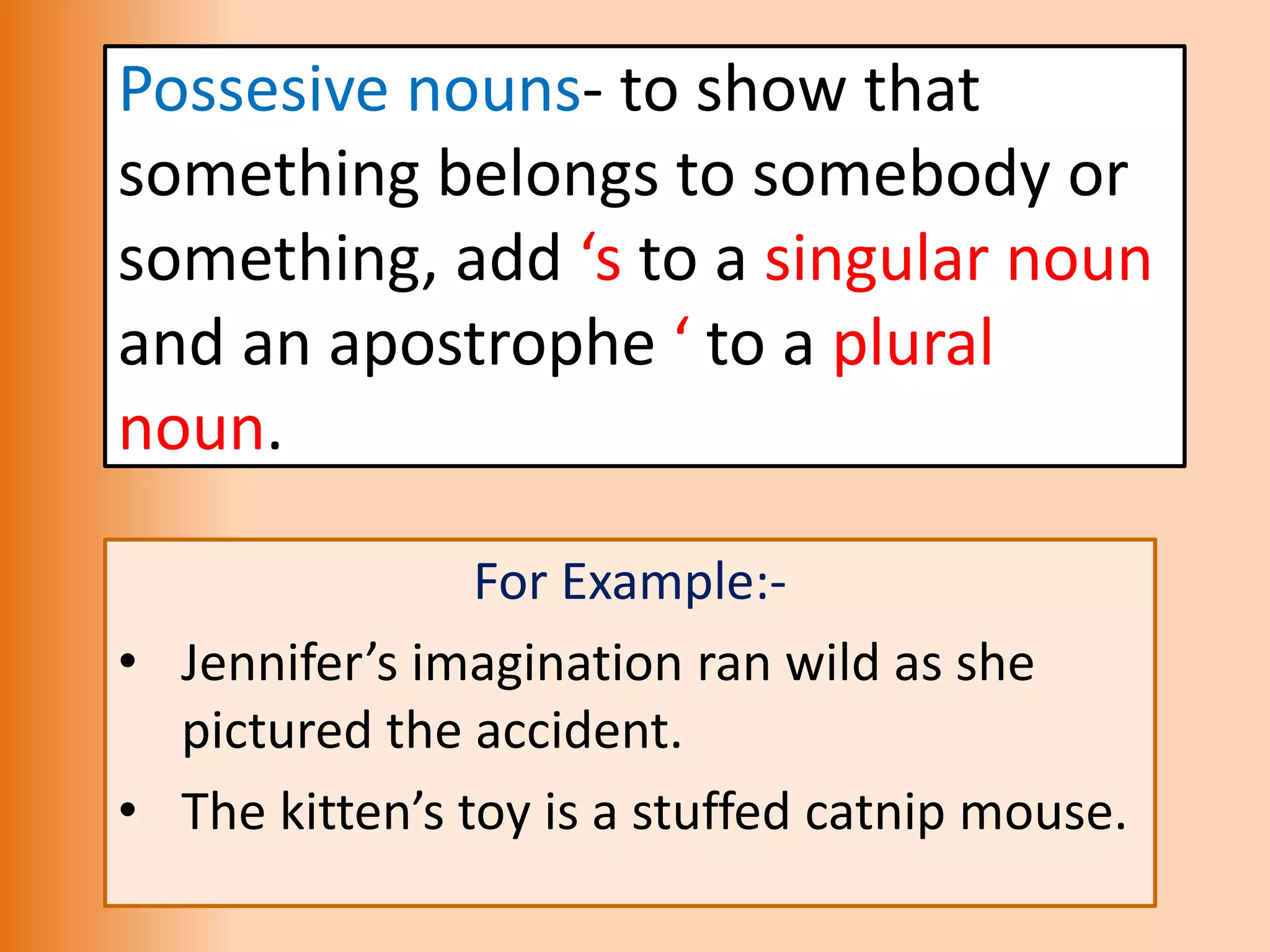
Possesive nouns- to show that
something belongs to somebody or
something, add ‘s to a singular noun
and an apostrophe ‘ to a plural
noun.
For Example:-
• Jennifer’s imagination ran wild as she
pictured the accident.
• The kitten’s toy is a stuffed catnip mouse.
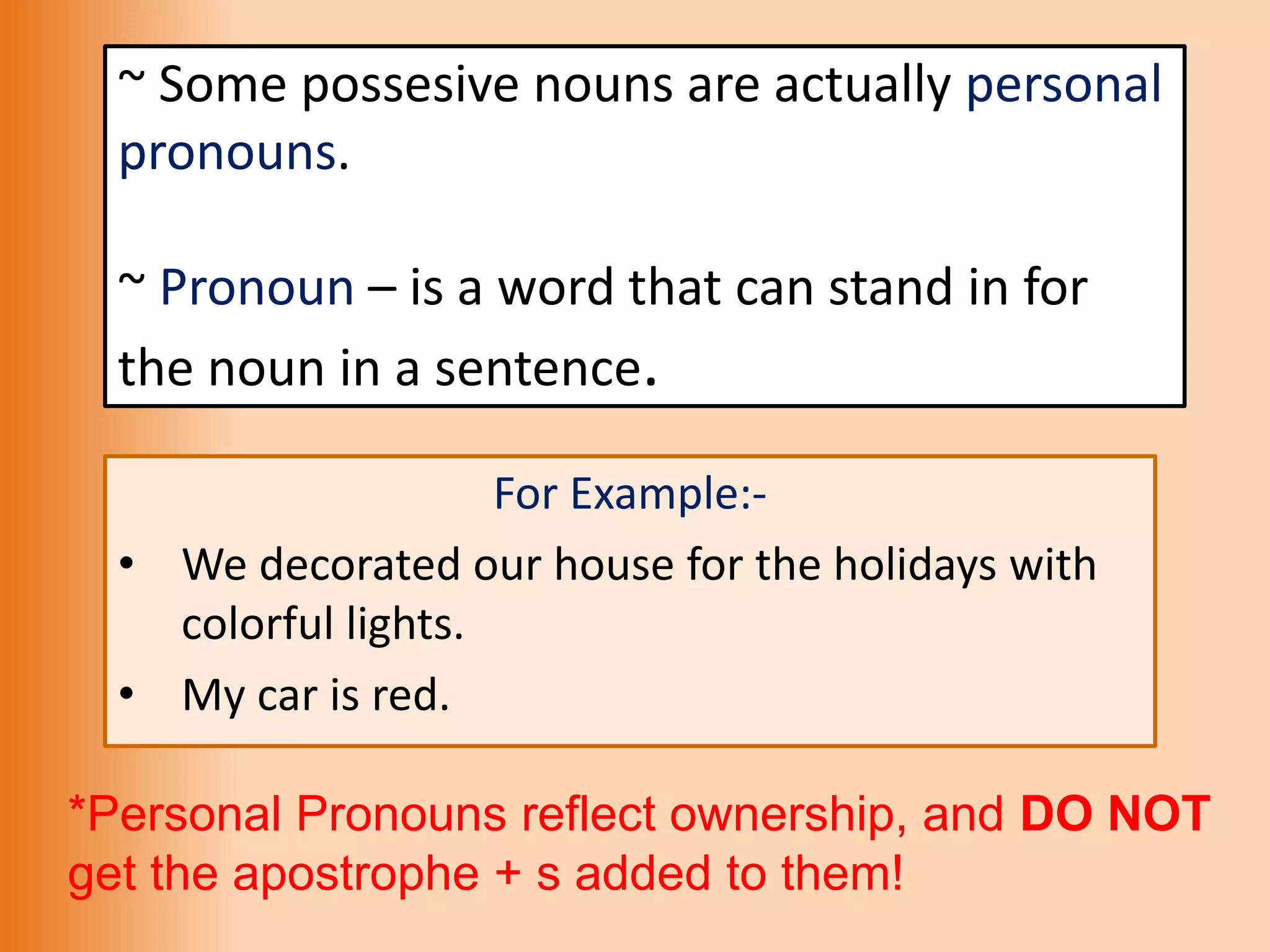
~ Some possesive nouns are actually personal
pronouns.
~ Pronoun – is a word that can stand in for
the noun in a sentence.
For Example:-
• We decorated our house for the holidays with
colorful lights.
• My car is red.
*Personal Pronouns reflect ownership, and DO NOT
get the apostrophe + s added to them!
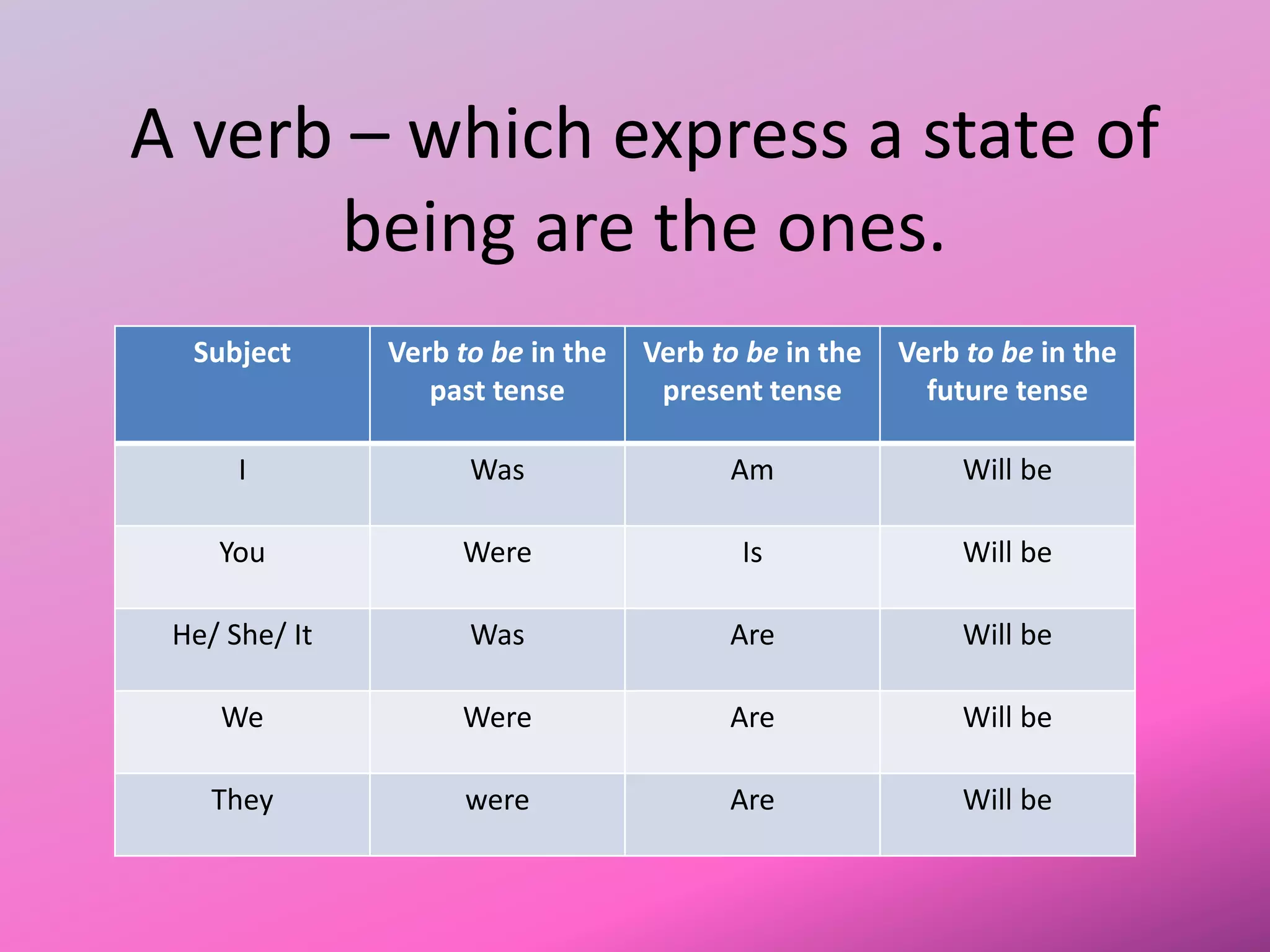
A verb – which express a state of
being are the ones.
Subject Verb to be in the
past tense
Verb to be in the
present tense
Verb to be in the
future tense
I Was Am Will be
You Were Is Will be
He/ She/ It Was Are Will be
We Were Are Will be
They were Are Will be
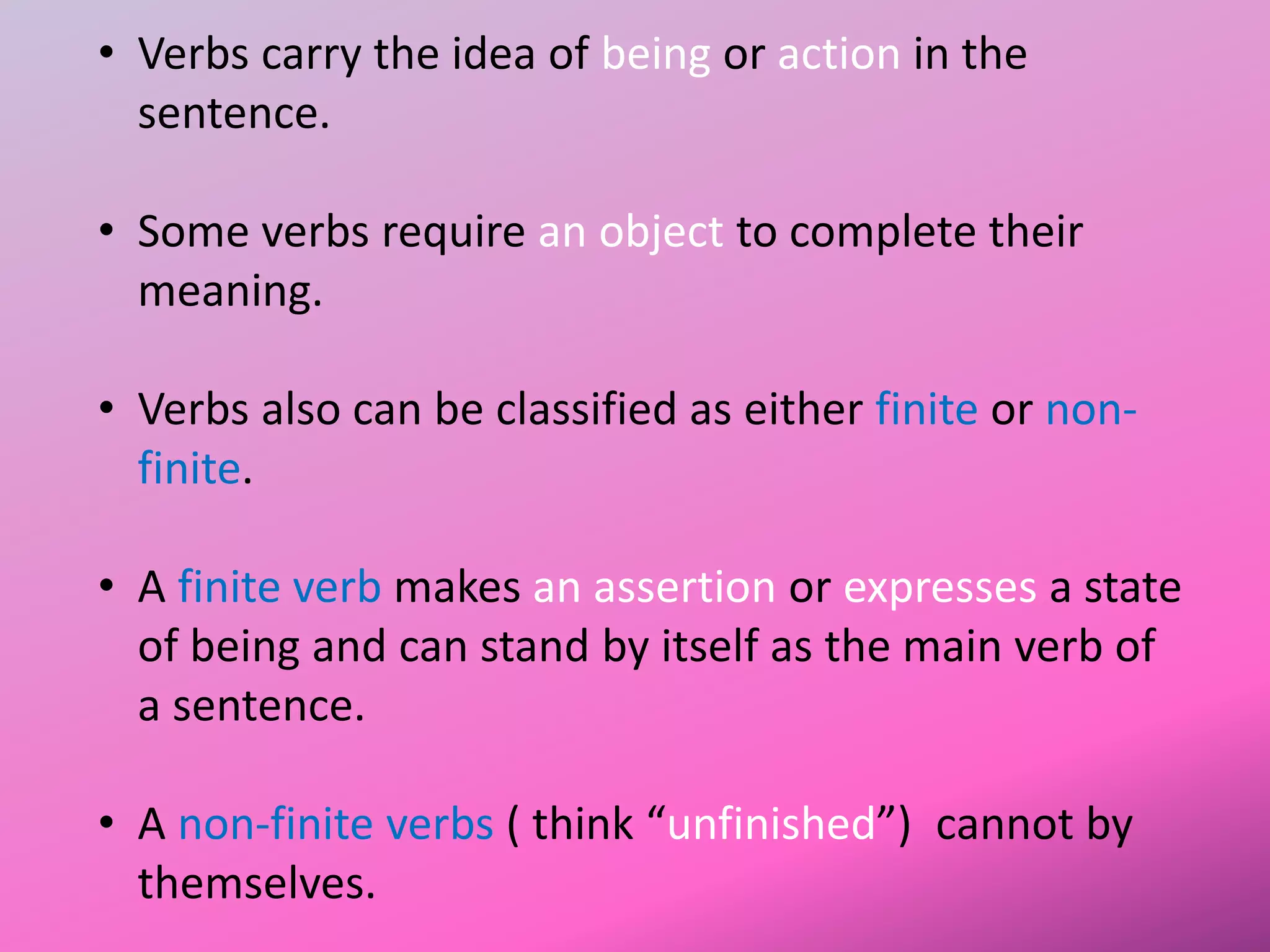
• Verbs carry the idea of being or action in the
sentence.
• Some verbs require an object to complete their
meaning.
• Verbs also can be classified as either finite or non-
finite.
• A finite verb makes an assertion or expresses a state
of being and can stand by itself as the main verb of
a sentence.
• A non-finite verbs ( think “unfinished”) cannot by
themselves.
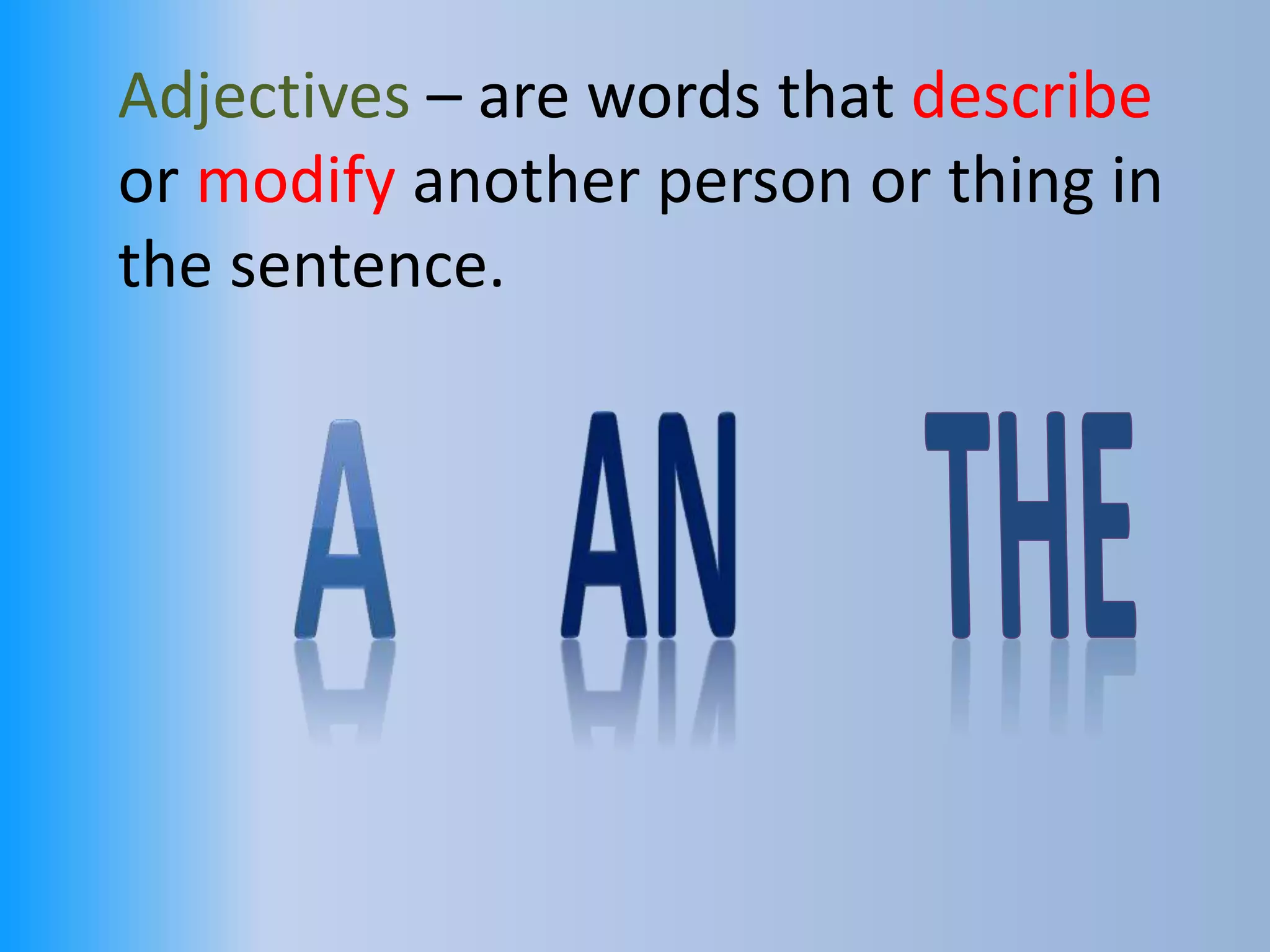
Adjectives – are words that describe
or modify another person or thing in
the sentence.
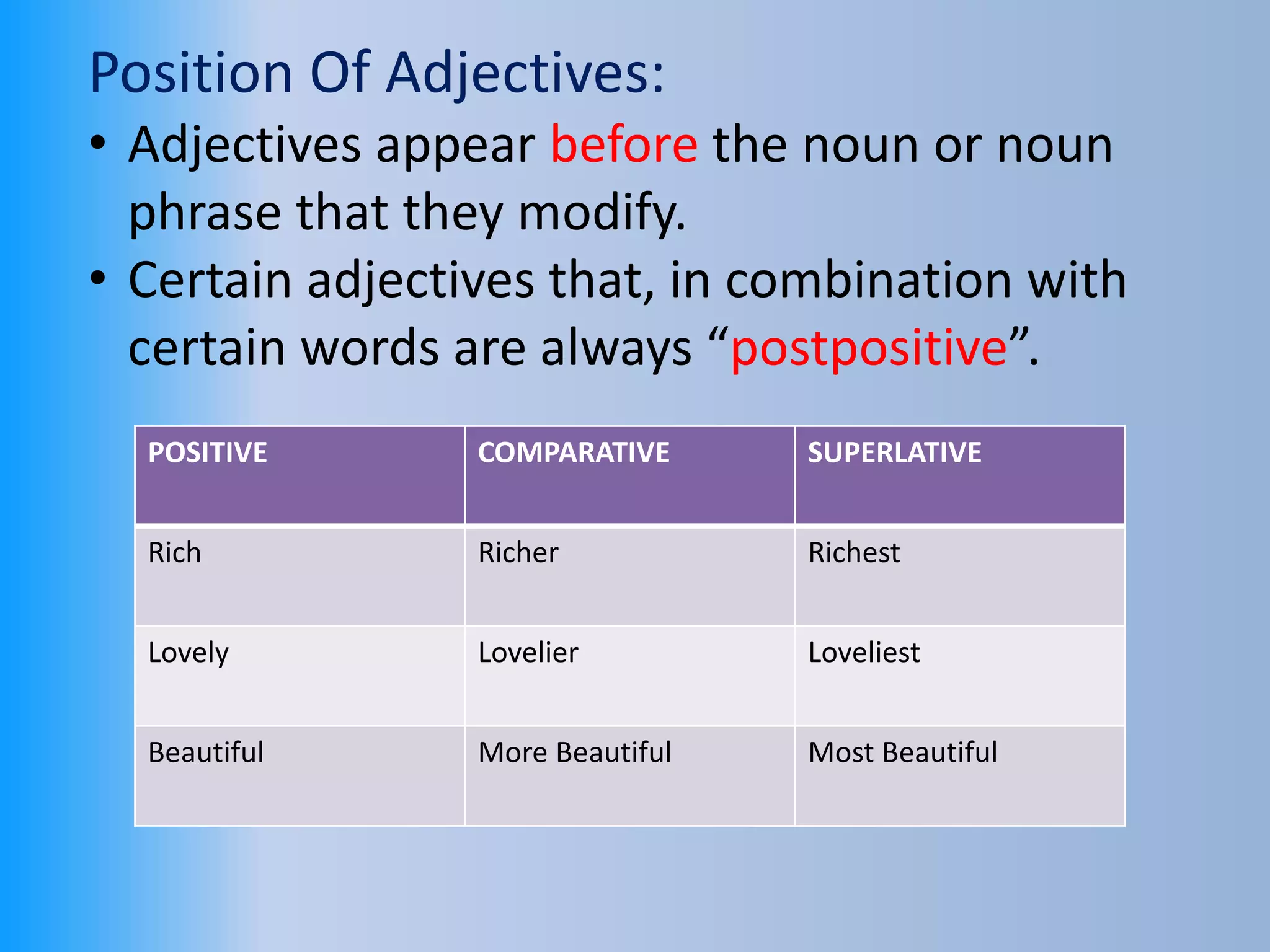
Position Of Adjectives:
• Adjectives appear before the noun or noun
phrase that they modify.
• Certain adjectives that, in combination with
certain words are always “postpositive”.
POSITIVE COMPARATIVE SUPERLATIVE
Rich Richer Richest
Lovely Lovelier Loveliest
Beautiful More Beautiful Most Beautiful
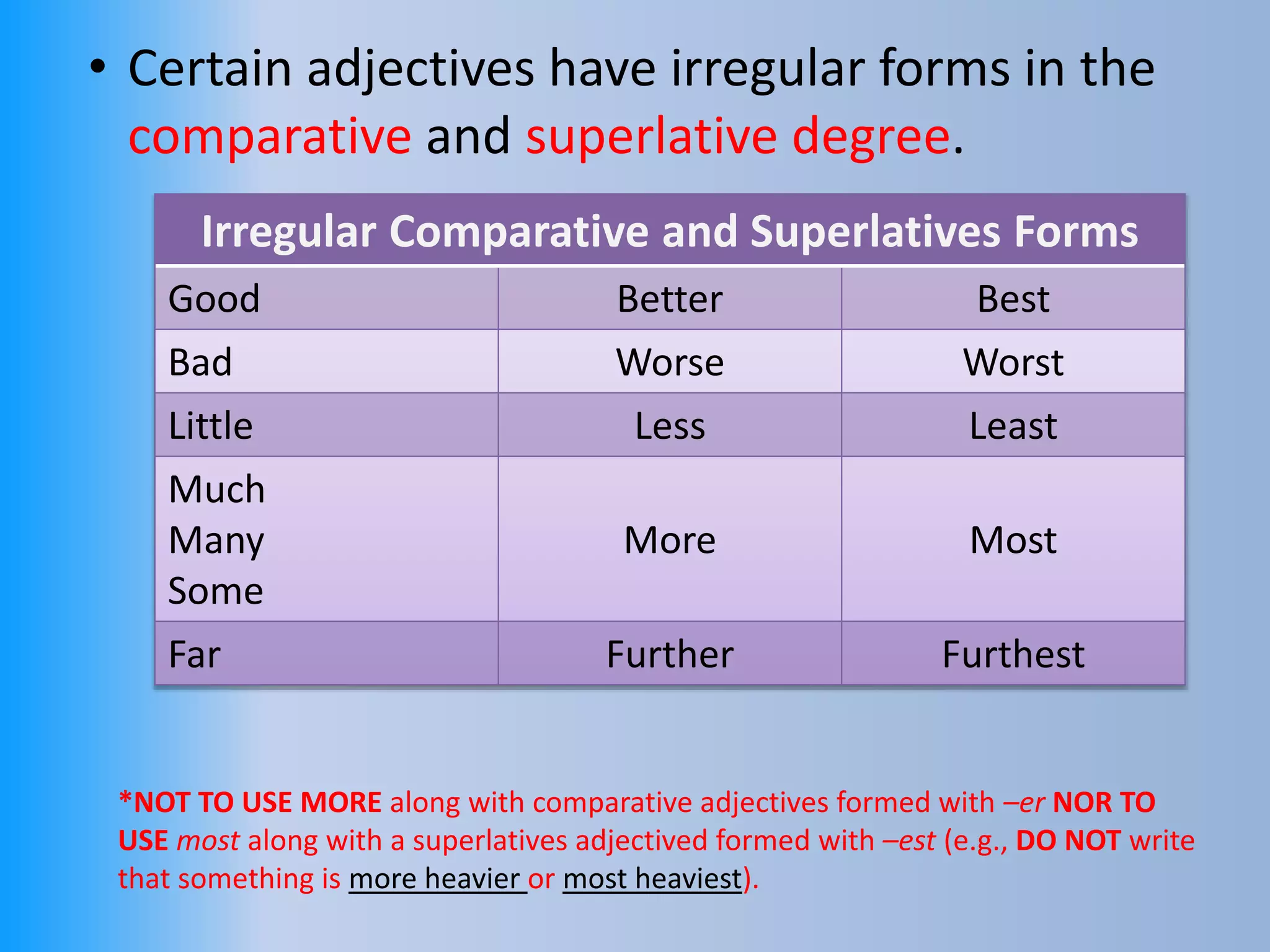
• Certain adjectives have irregular forms in the
comparative and superlative degree.
Irregular Comparative and Superlatives Forms
Good Better Best
Bad Worse Worst
Little Less Least
Much
Many
Some
More Most
Far Further Furthest
*NOT TO USE MORE along with comparative adjectives formed with –er NOR TO
USE most along with a superlatives adjectived formed with –est (e.g., DO NOT write
that something is more heavier or most heaviest).
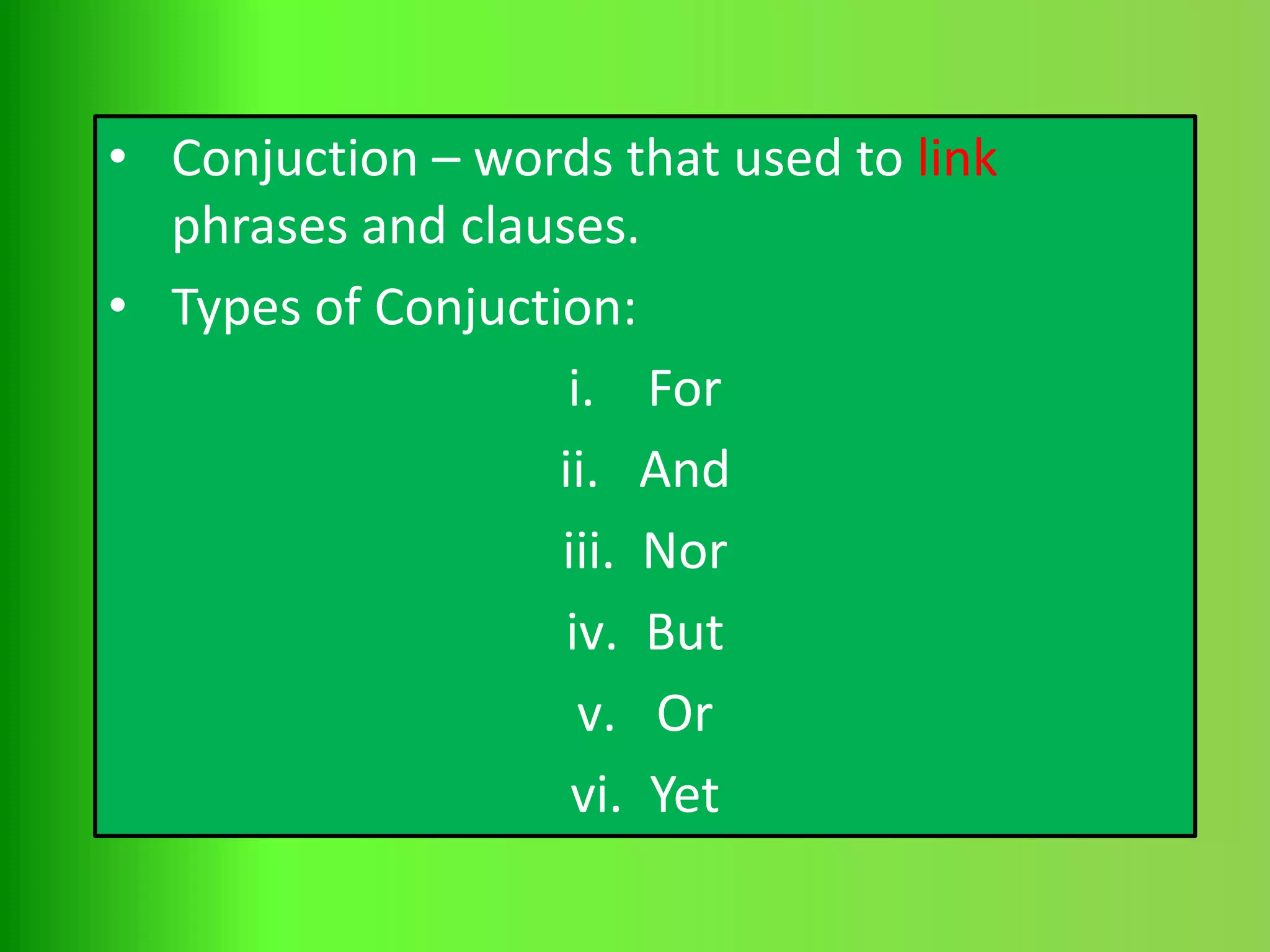
• Conjuction – words that used to link
phrases and clauses.
• Types of Conjuction:
i. For
ii. And
iii. Nor
iv. But
v. Or
vi. Yet
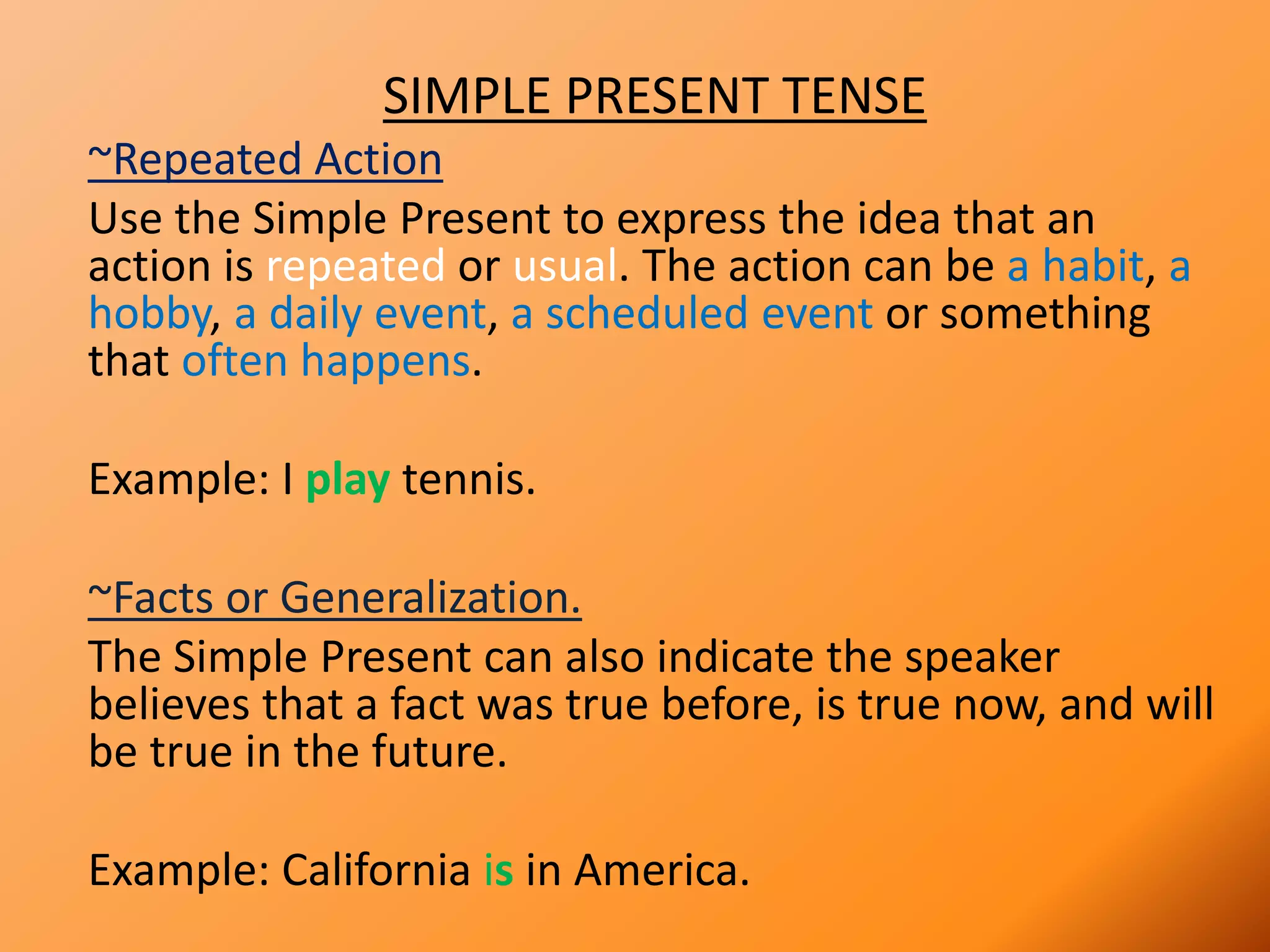
SIMPLE PRESENT TENSE
~Repeated Action
Use the Simple Present to express the idea that an
action is repeated or usual. The action can be a habit, a
hobby, a daily event, a scheduled event or something
that often happens.
Example: I play tennis.
~Facts or Generalization.
The Simple Present can also indicate the speaker
believes that a fact was true before, is true now, and will
be true in the future.
Example: California is in America.
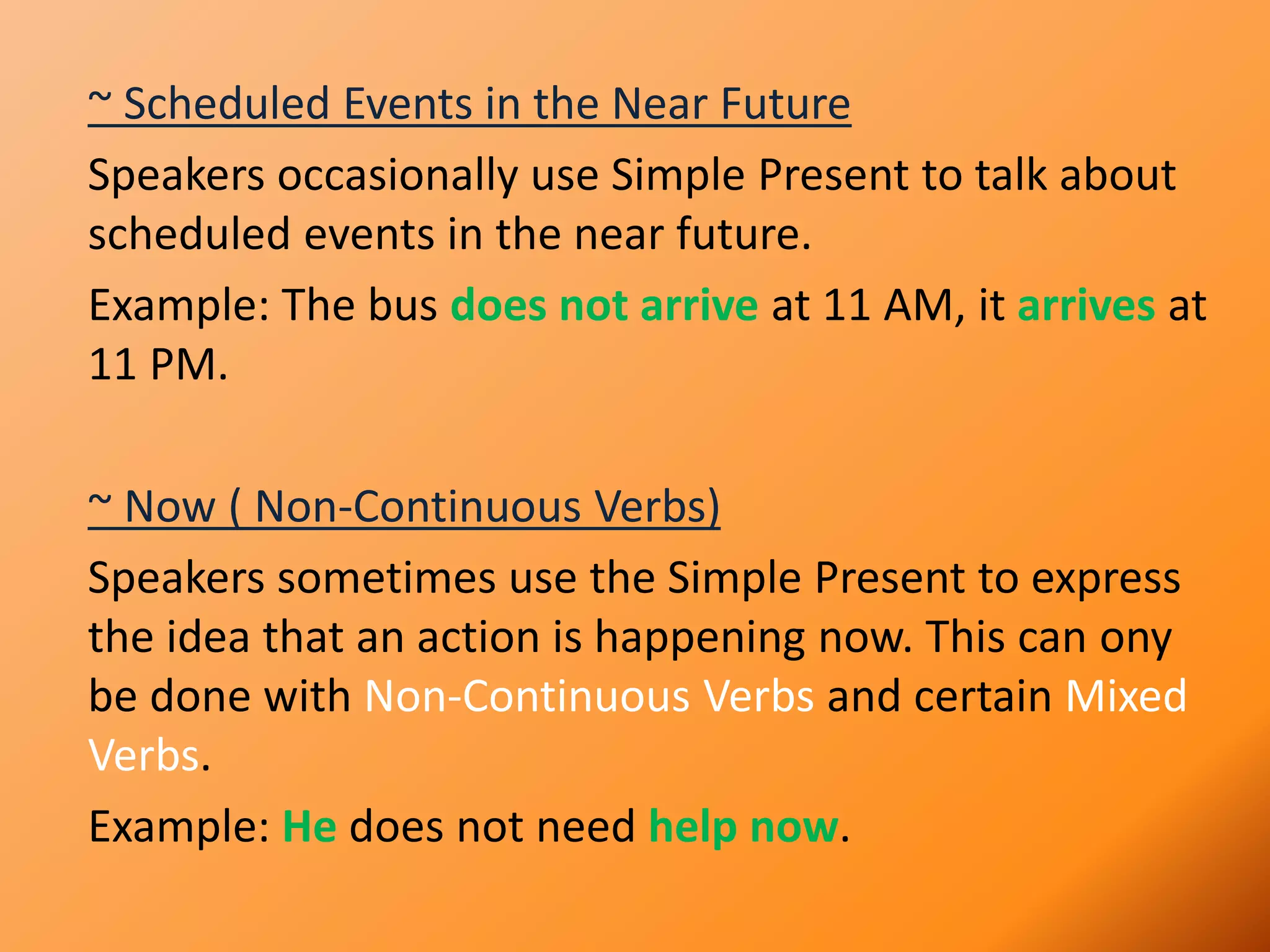
~ Scheduled Events in the Near Future
Speakers occasionally use Simple Present to talk about
scheduled events in the near future.
Example: The bus does not arrive at 11 AM, it arrives at
11 PM.
~ Now ( Non-Continuous Verbs)
Speakers sometimes use the Simple Present to express
the idea that an action is happening now. This can ony
be done with Non-Continuous Verbs and certain Mixed
Verbs.
Example: He does not need help now.
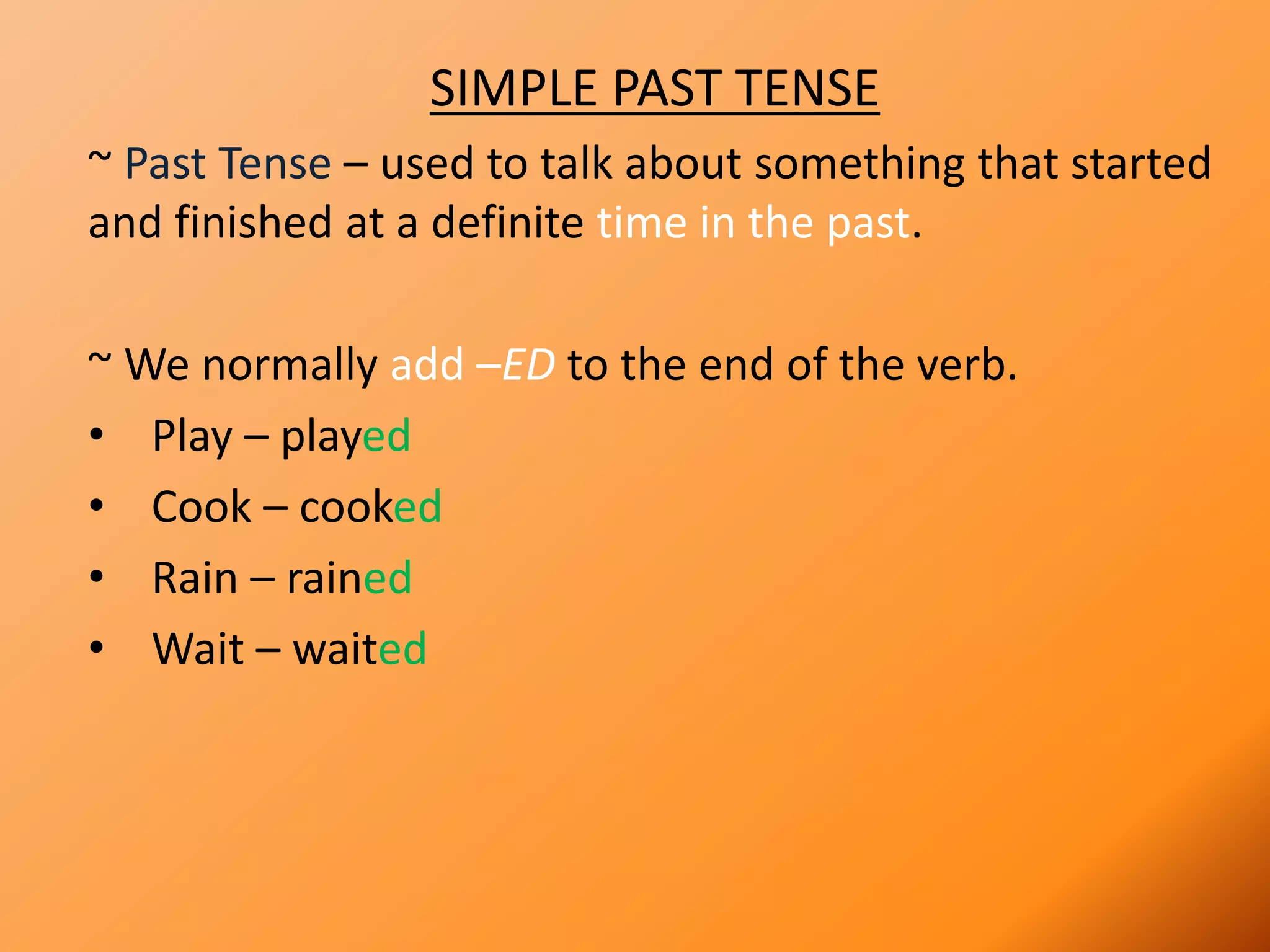
SIMPLE PAST TENSE
~ Past Tense – used to talk about something that started
and finished at a definite time in the past.
~ We normally add –ED to the end of the verb.
• Play – played
• Cook – cooked
• Rain – rained
• Wait – waited
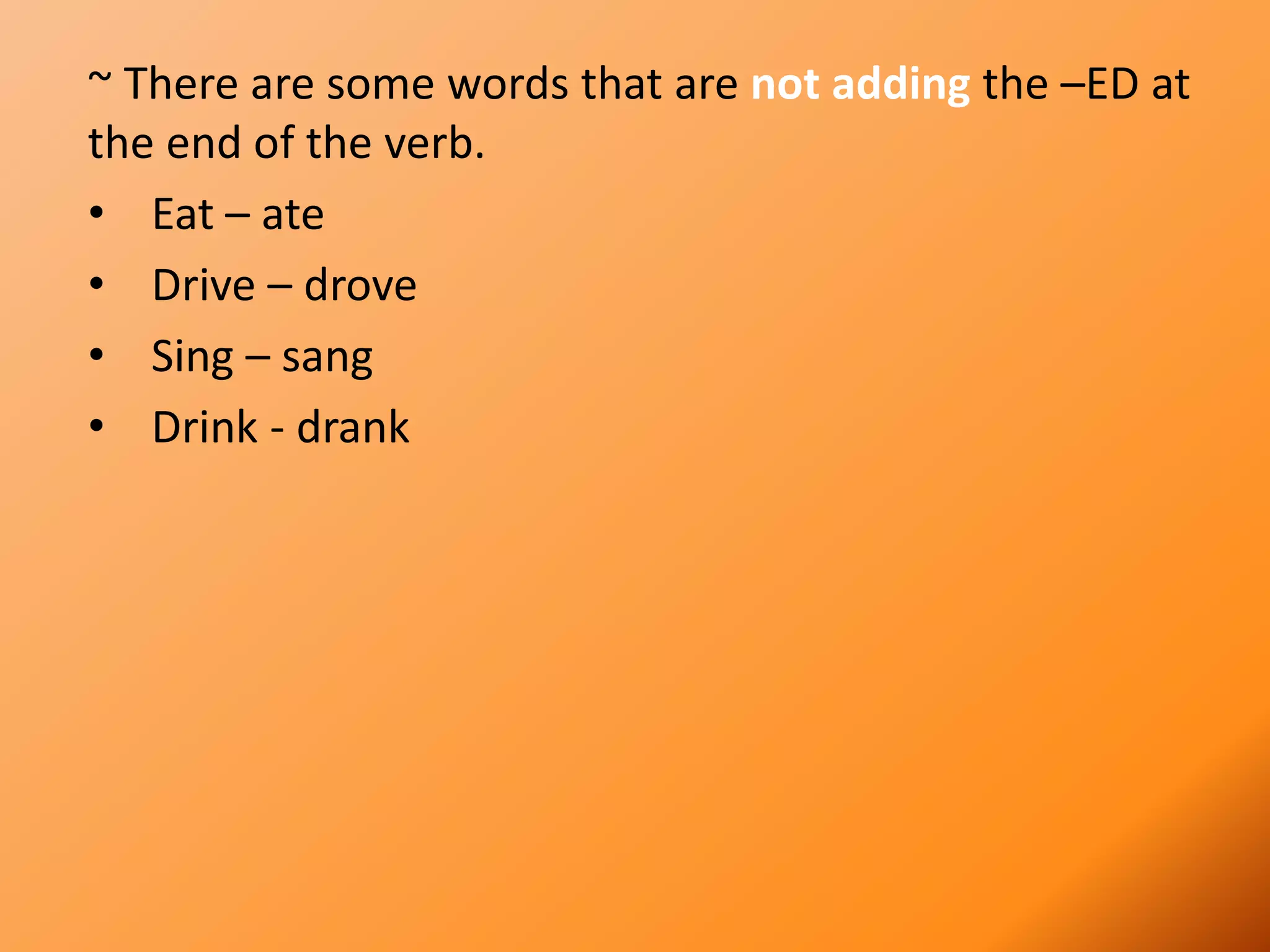
~ There are some words that are not adding the –ED at
the end of the verb.
• Eat – ate
• Drive – drove
• Sing – sang
• Drink - drank
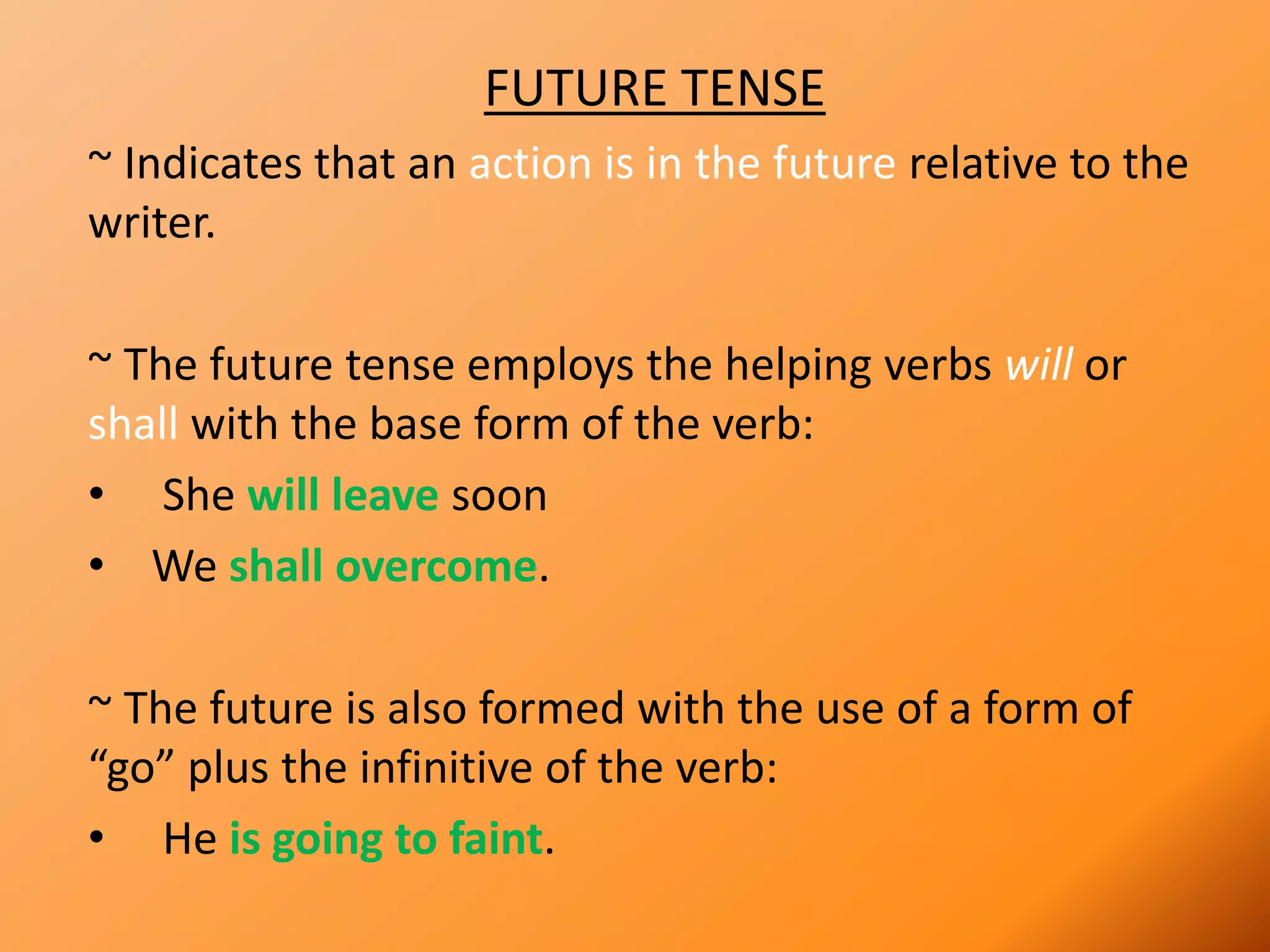
FUTURE TENSE
~ Indicates that an action is in the future relative to the
writer.
~ The future tense employs the helping verbs will or
shall with the base form of the verb:
• She will leave soon
• We shall overcome.
~ The future is also formed with the use of a form of
“go” plus the infinitive of the verb:
• He is going to faint.
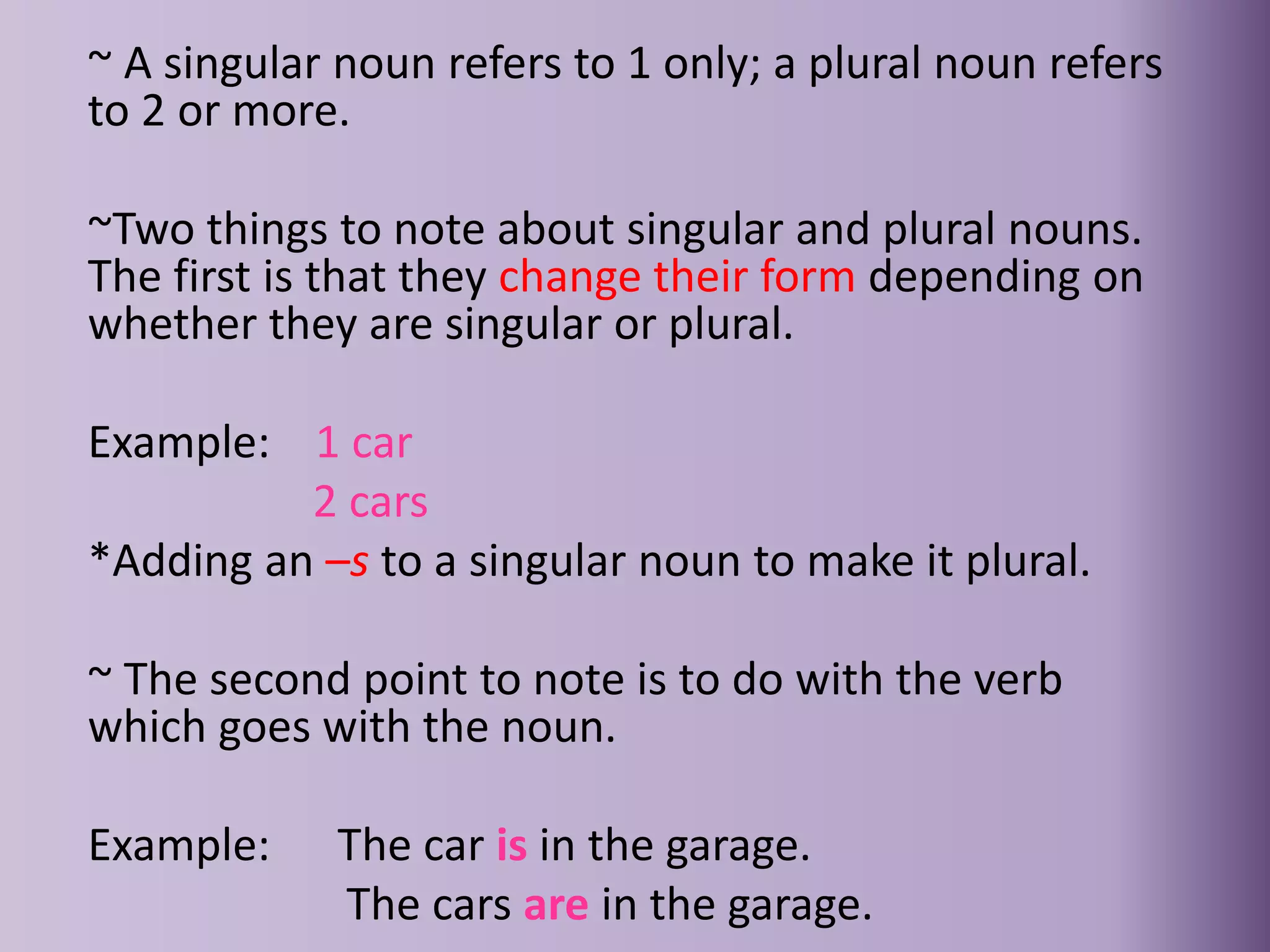
~ A singular noun refers to 1 only; a plural noun refers
to 2 or more.
~Two things to note about singular and plural nouns.
The first is that they change their form depending on
whether they are singular or plural.
Example: 1 car
2 cars
*Adding an –s to a singular noun to make it plural.
~ The second point to note is to do with the verb
which goes with the noun.
Example: The car is in the garage.
The cars are in the garage.
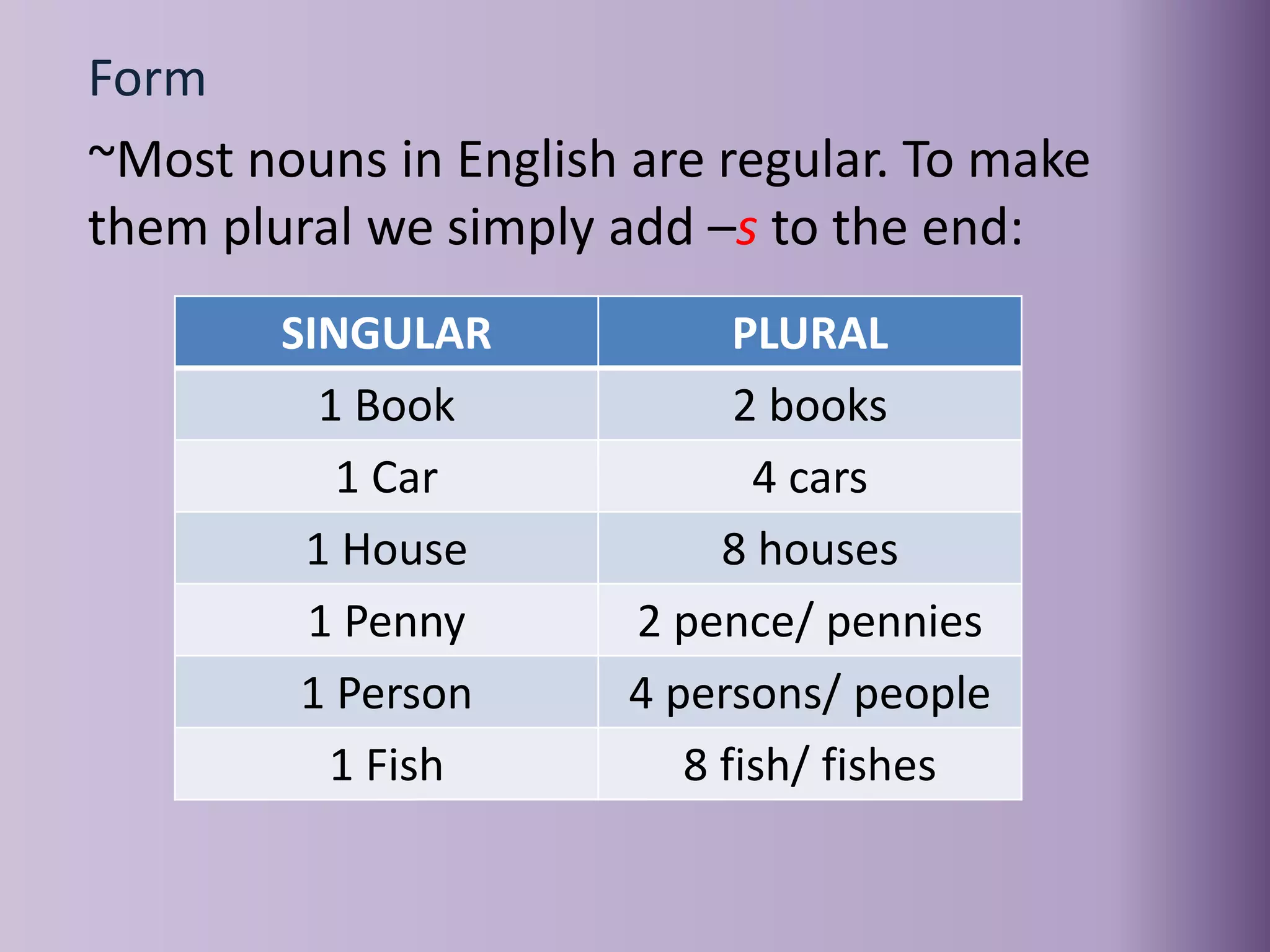
Form
~Most nouns in English are regular. To make
them plural we simply add –s to the end:
SINGULAR PLURAL
1 Book 2 books
1 Car 4 cars
1 House 8 houses
1 Penny 2 pence/ pennies
1 Person 4 persons/ people
1 Fish 8 fish/ fishes
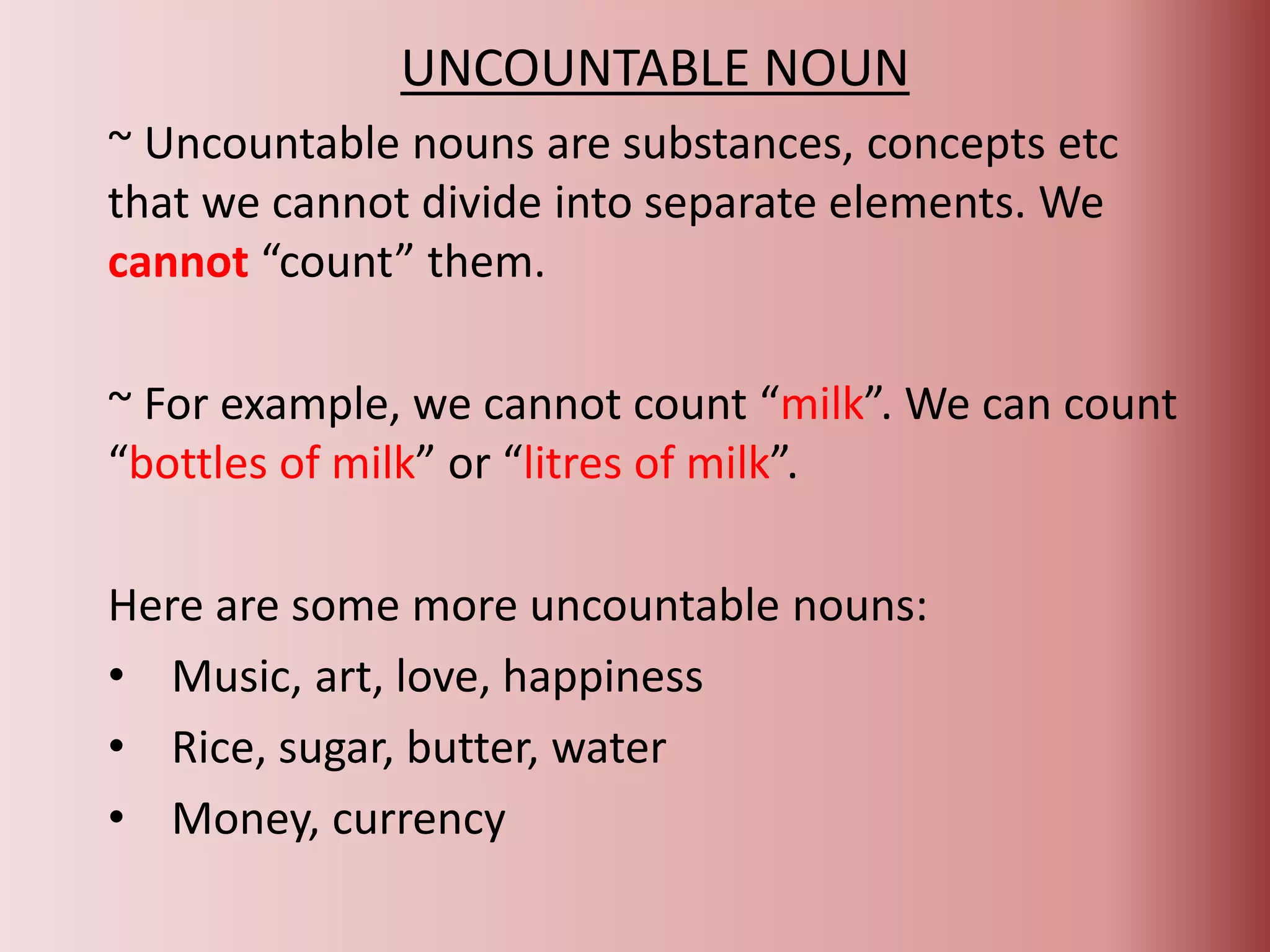
UNCOUNTABLE NOUN
~ Uncountable nouns are substances, concepts etc
that we cannot divide into separate elements. We
cannot “count” them.
~ For example, we cannot count “milk”. We can count
“bottles of milk” or “litres of milk”.
Here are some more uncountable nouns:
• Music, art, love, happiness
• Rice, sugar, butter, water
• Money, currency
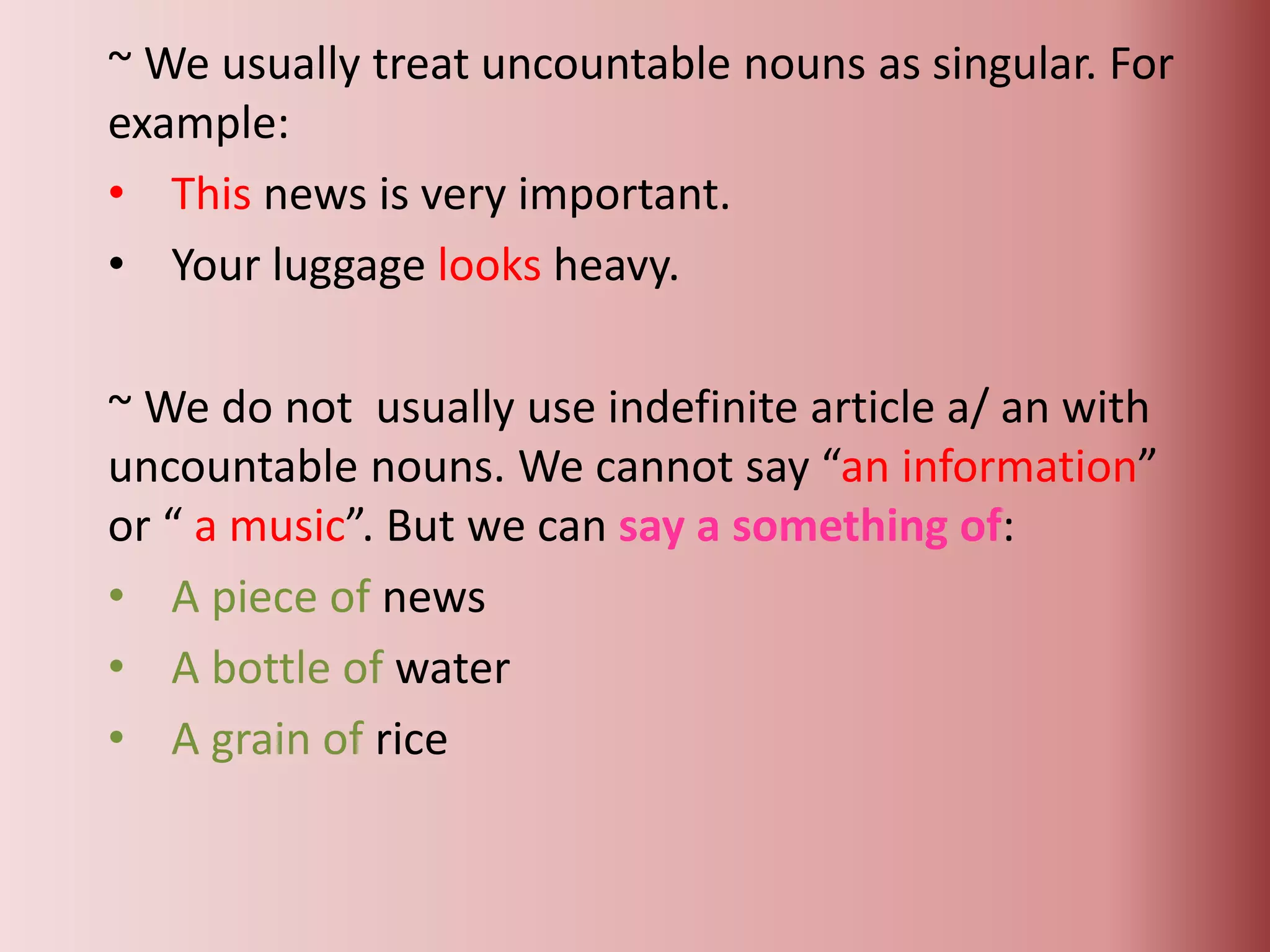
~ We usually treat uncountable nouns as singular. For
example:
• This news is very important.
• Your luggage looks heavy.
~ We do not usually use indefinite article a/ an with
uncountable nouns. We cannot say “an information”
or “ a music”. But we can say a something of:
• A piece of news
• A bottle of water
• A grain of rice
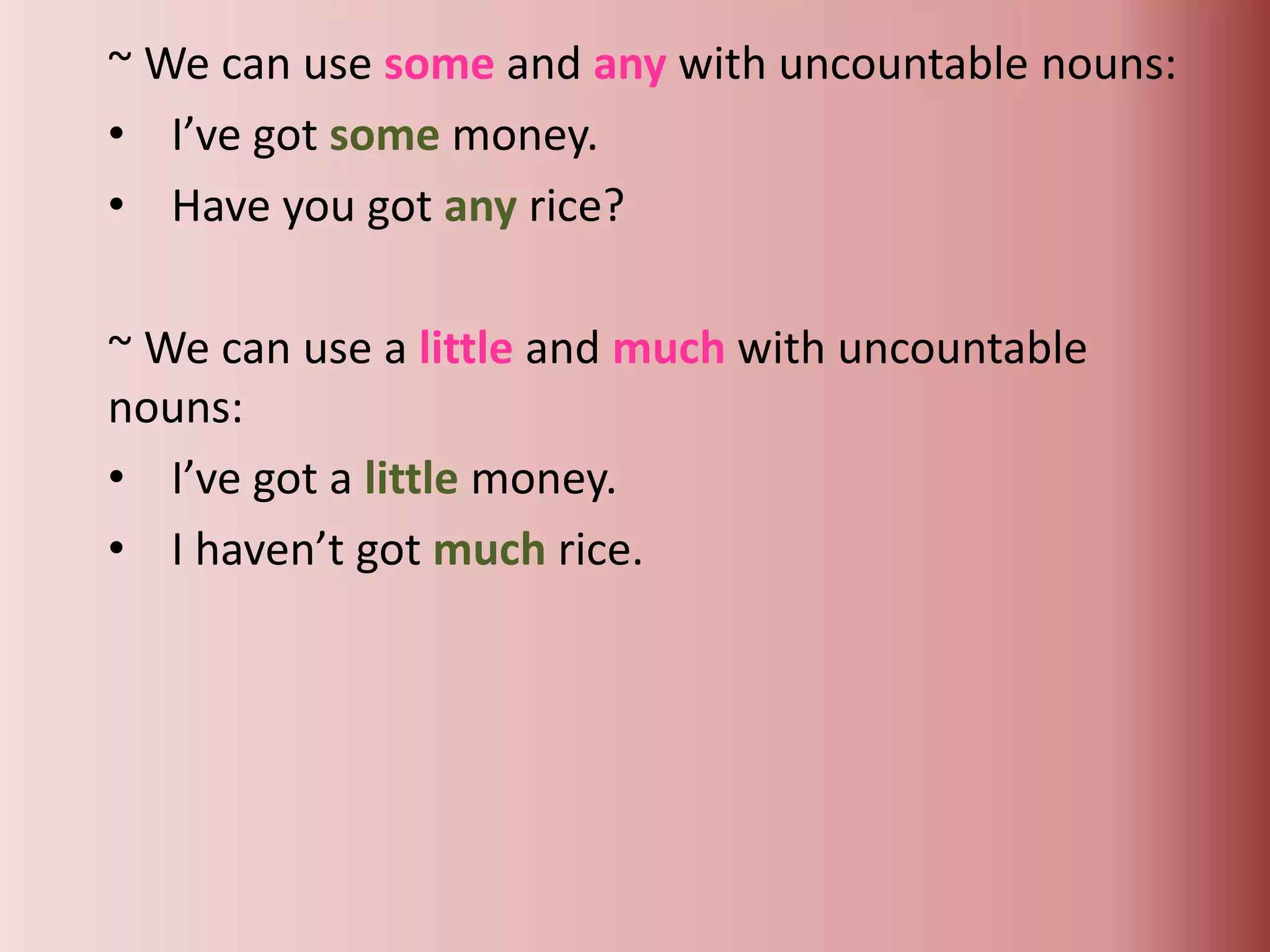
~ We can use some and any with uncountable nouns:
• I’ve got some money.
• Have you got any rice?
~ We can use a little and much with uncountable
nouns:
• I’ve got a little money.
• I haven’t got much rice.
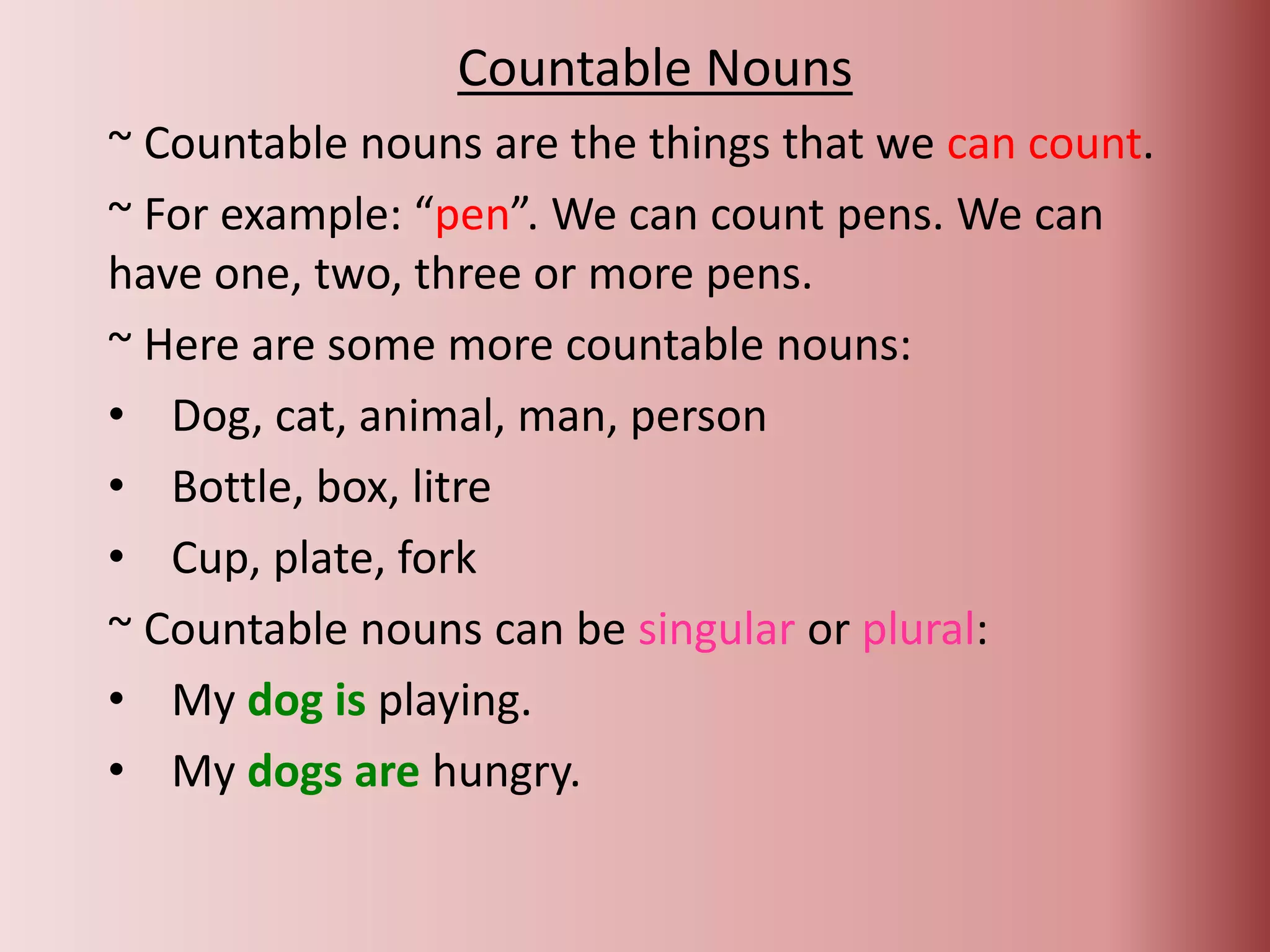
Countable Nouns
~ Countable nouns are the things that we can count.
~ For example: “pen”. We can count pens. We can
have one, two, three or more pens.
~ Here are some more countable nouns:
• Dog, cat, animal, man, person
• Bottle, box, litre
• Cup, plate, fork
~ Countable nouns can be singular or plural:
• My dog is playing.
• My dogs are hungry.
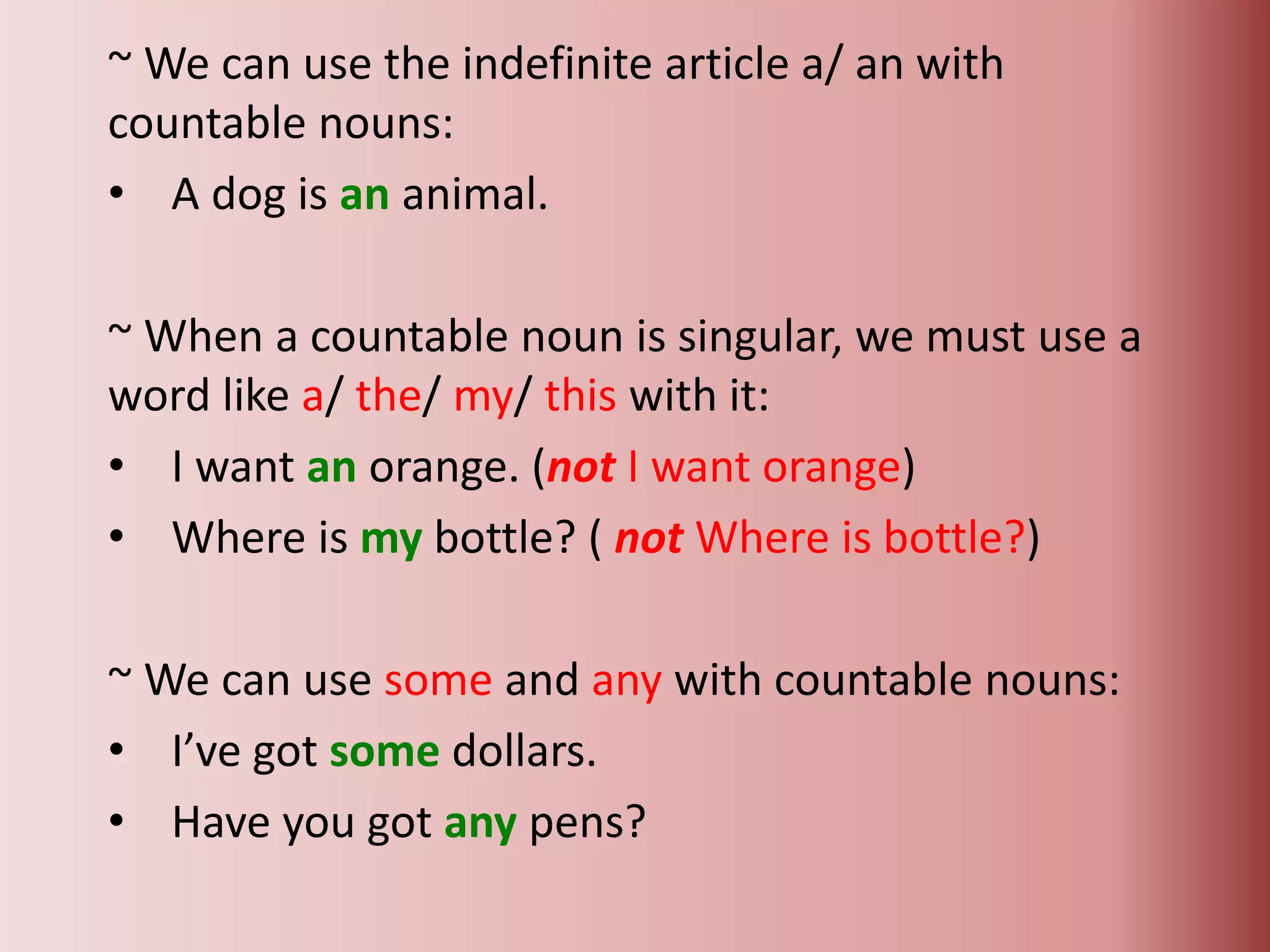
~ We can use the indefinite article a/ an with
countable nouns:
• A dog is an animal.
~ When a countable noun is singular, we must use a
word like a/ the/ my/ this with it:
• I want an orange. (not I want orange)
• Where is my bottle? ( not Where is bottle?)
~ We can use some and any with countable nouns:
• I’ve got some dollars.
• Have you got any pens?
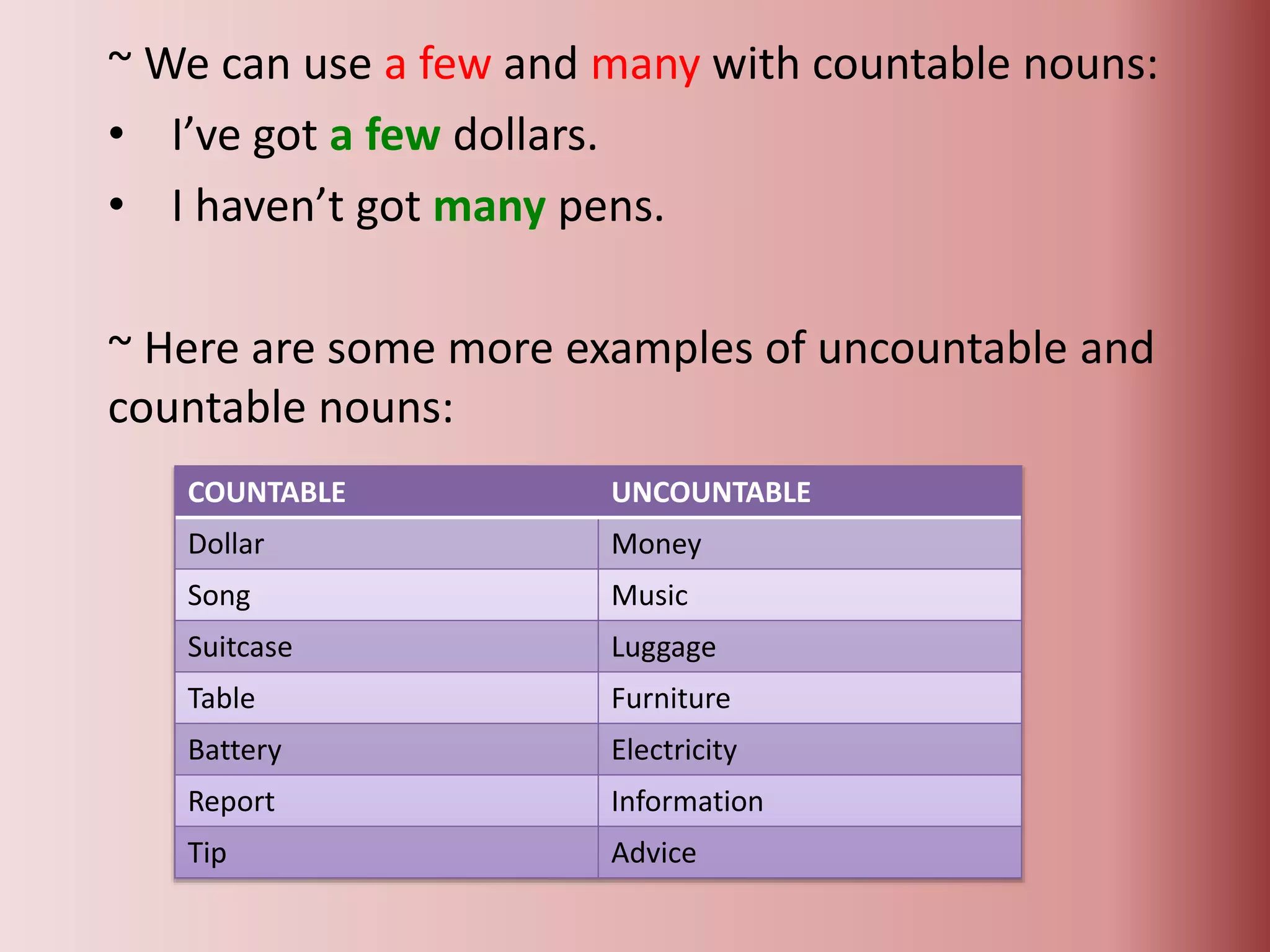
~ We can use a few and many with countable nouns:
• I’ve got a few dollars.
• I haven’t got many pens.
~ Here are some more examples of uncountable and
countable nouns:
COUNTABLE UNCOUNTABLE
Dollar Money
Song Music
Suitcase Luggage
Table Furniture
Battery Electricity
Report Information
Tip Advice
~ Synonym - a word or phrase that
means the same, or nearly the same
as another word or phrase.
~ Antonym – a word or phrase that
means the opposite from another
word or phrase.
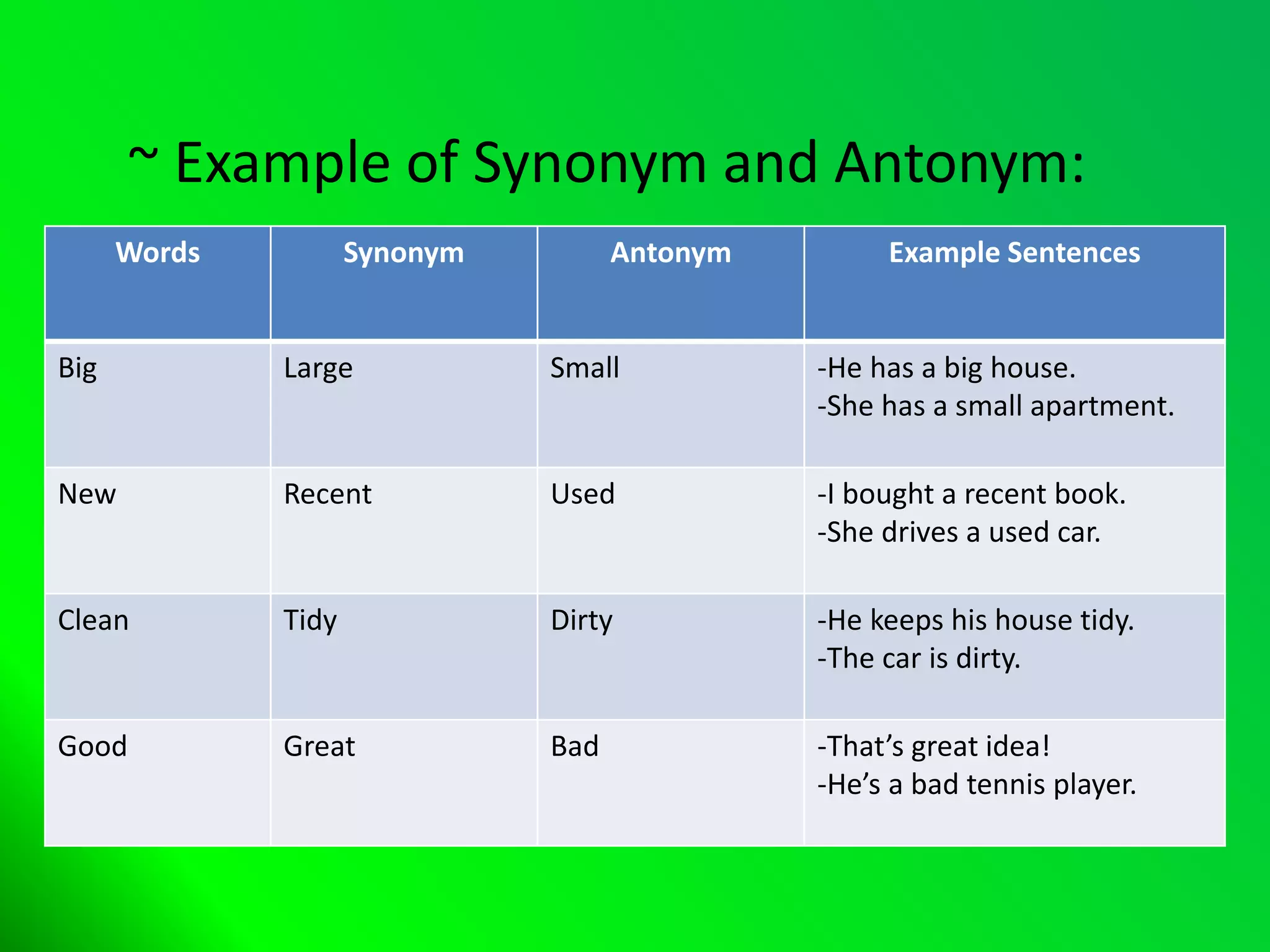
~ Example of Synonym and Antonym:
Words Synonym Antonym Example Sentences
Big Large Small -He has a big house.
-She has a small apartment.
New Recent Used -I bought a recent book.
-She drives a used car.
Clean Tidy Dirty -He keeps his house tidy.
-The car is dirty.
Good Great Bad -That’s great idea!
-He’s a bad tennis player.
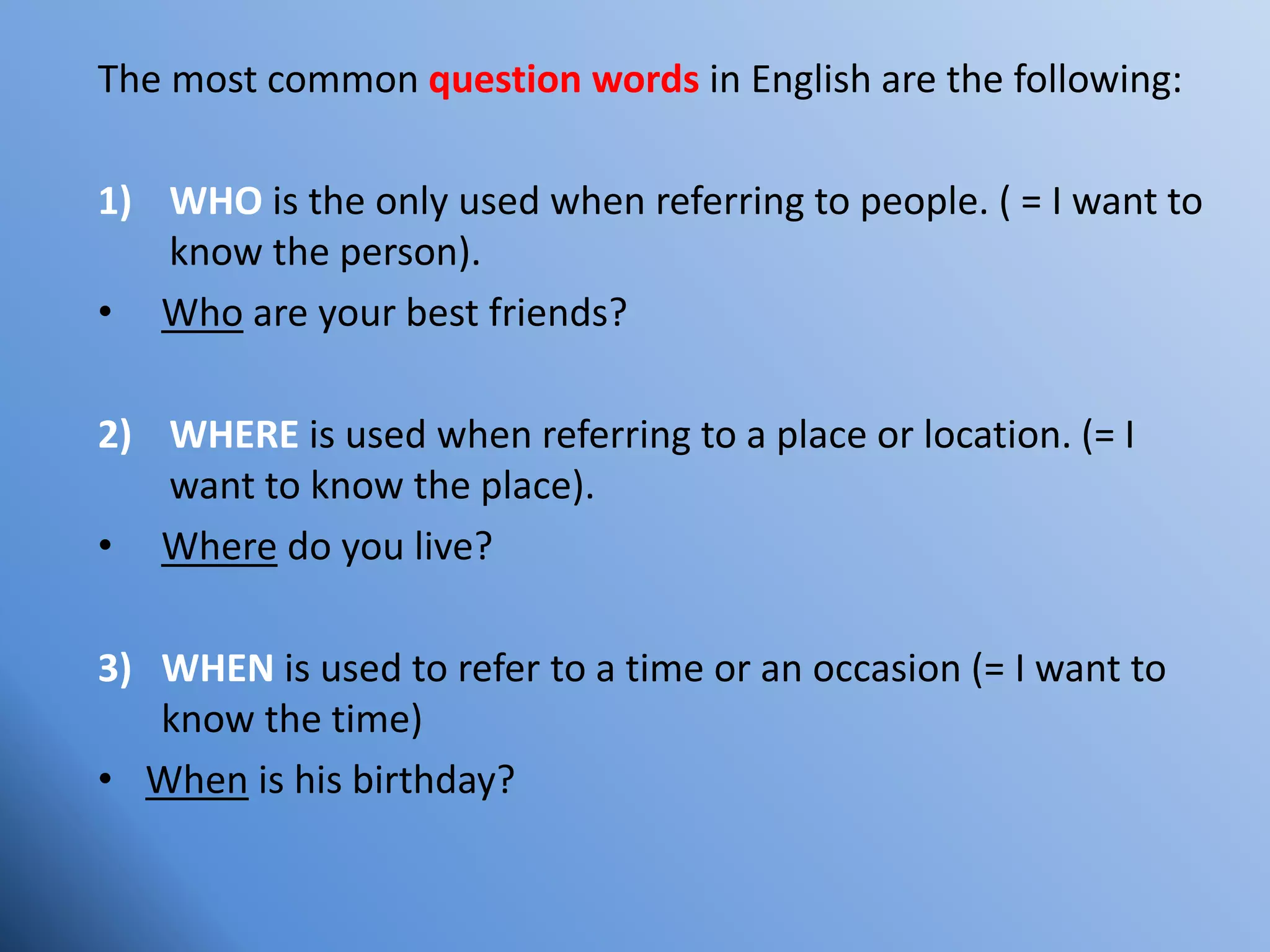
The most common question words in English are the following:
1) WHO is the only used when referring to people. ( = I want to
know the person).
• Who are your best friends?
2) WHERE is used when referring to a place or location. (= I
want to know the place).
• Where do you live?
3) WHEN is used to refer to a time or an occasion (= I want to
know the time)
• When is his birthday?
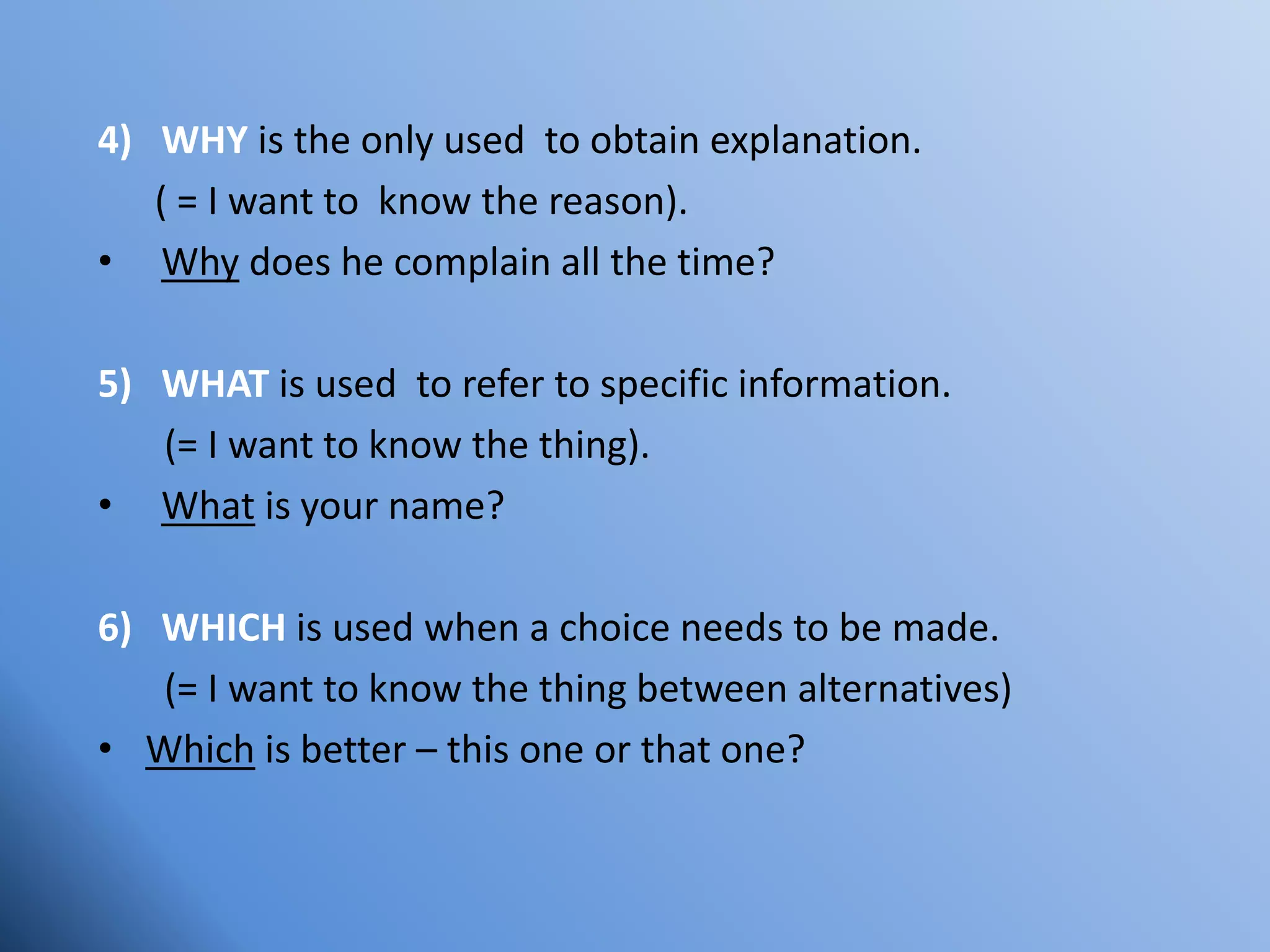
4) WHY is the only used to obtain explanation.
( = I want to know the reason).
• Why does he complain all the time?
5) WHAT is used to refer to specific information.
(= I want to know the thing).
• What is your name?
6) WHICH is used when a choice needs to be made.
(= I want to know the thing between alternatives)
• Which is better – this one or that one?
5) HOW is used to describe the manner that something is done.
(= I want to know the way)
• How does he know the answer?
~ With HOW there are a number of other expressions that are
used in questions:
• How much - refers to a quantity or a price (uncountable
nouns).
• How many - refers to a quantity ( countable nouns)
• How often - refers to frequency.
• How far - refers to distance.

English Learning Year 4

  • 3.
    Noun – isthe name of a person, place, thing, or idea. A proper noun – which names a specific person, place or thing. Example: • Carlos • Middle East • Malaysia • Presbyterianism
  • 4.
    ~ Nouns alsocan be classified as count nouns ( which name anything that can be counted). ~ Non-count nouns ( which name something that can’t be counted). ~ Collective nouns ( which can take a singular form but are composed of more than one individual person or items).
  • 5.
    Example: - COUNT NOUNS NON-COUNT NOUNS COLLECTIVE NOUNS Four booksWater Jury Two continents Air Team A few dishes Energy Class A dozen buildings Blood Herd
  • 7.
    Possesive nouns- toshow that something belongs to somebody or something, add ‘s to a singular noun and an apostrophe ‘ to a plural noun. For Example:- • Jennifer’s imagination ran wild as she pictured the accident. • The kitten’s toy is a stuffed catnip mouse.
  • 8.
    ~ Some possesivenouns are actually personal pronouns. ~ Pronoun – is a word that can stand in for the noun in a sentence. For Example:- • We decorated our house for the holidays with colorful lights. • My car is red. *Personal Pronouns reflect ownership, and DO NOT get the apostrophe + s added to them!
  • 10.
    A verb –which express a state of being are the ones. Subject Verb to be in the past tense Verb to be in the present tense Verb to be in the future tense I Was Am Will be You Were Is Will be He/ She/ It Was Are Will be We Were Are Will be They were Are Will be
  • 11.
    • Verbs carrythe idea of being or action in the sentence. • Some verbs require an object to complete their meaning. • Verbs also can be classified as either finite or non- finite. • A finite verb makes an assertion or expresses a state of being and can stand by itself as the main verb of a sentence. • A non-finite verbs ( think “unfinished”) cannot by themselves.
  • 13.
    Adjectives – arewords that describe or modify another person or thing in the sentence.
  • 14.
    Position Of Adjectives: •Adjectives appear before the noun or noun phrase that they modify. • Certain adjectives that, in combination with certain words are always “postpositive”. POSITIVE COMPARATIVE SUPERLATIVE Rich Richer Richest Lovely Lovelier Loveliest Beautiful More Beautiful Most Beautiful
  • 15.
    • Certain adjectiveshave irregular forms in the comparative and superlative degree. Irregular Comparative and Superlatives Forms Good Better Best Bad Worse Worst Little Less Least Much Many Some More Most Far Further Furthest *NOT TO USE MORE along with comparative adjectives formed with –er NOR TO USE most along with a superlatives adjectived formed with –est (e.g., DO NOT write that something is more heavier or most heaviest).
  • 17.
    • Conjuction –words that used to link phrases and clauses. • Types of Conjuction: i. For ii. And iii. Nor iv. But v. Or vi. Yet
  • 19.
    SIMPLE PRESENT TENSE ~RepeatedAction Use the Simple Present to express the idea that an action is repeated or usual. The action can be a habit, a hobby, a daily event, a scheduled event or something that often happens. Example: I play tennis. ~Facts or Generalization. The Simple Present can also indicate the speaker believes that a fact was true before, is true now, and will be true in the future. Example: California is in America.
  • 20.
    ~ Scheduled Eventsin the Near Future Speakers occasionally use Simple Present to talk about scheduled events in the near future. Example: The bus does not arrive at 11 AM, it arrives at 11 PM. ~ Now ( Non-Continuous Verbs) Speakers sometimes use the Simple Present to express the idea that an action is happening now. This can ony be done with Non-Continuous Verbs and certain Mixed Verbs. Example: He does not need help now.
  • 21.
    SIMPLE PAST TENSE ~Past Tense – used to talk about something that started and finished at a definite time in the past. ~ We normally add –ED to the end of the verb. • Play – played • Cook – cooked • Rain – rained • Wait – waited
  • 22.
    ~ There aresome words that are not adding the –ED at the end of the verb. • Eat – ate • Drive – drove • Sing – sang • Drink - drank
  • 23.
    FUTURE TENSE ~ Indicatesthat an action is in the future relative to the writer. ~ The future tense employs the helping verbs will or shall with the base form of the verb: • She will leave soon • We shall overcome. ~ The future is also formed with the use of a form of “go” plus the infinitive of the verb: • He is going to faint.
  • 25.
    ~ A singularnoun refers to 1 only; a plural noun refers to 2 or more. ~Two things to note about singular and plural nouns. The first is that they change their form depending on whether they are singular or plural. Example: 1 car 2 cars *Adding an –s to a singular noun to make it plural. ~ The second point to note is to do with the verb which goes with the noun. Example: The car is in the garage. The cars are in the garage.
  • 26.
    Form ~Most nouns inEnglish are regular. To make them plural we simply add –s to the end: SINGULAR PLURAL 1 Book 2 books 1 Car 4 cars 1 House 8 houses 1 Penny 2 pence/ pennies 1 Person 4 persons/ people 1 Fish 8 fish/ fishes
  • 28.
    UNCOUNTABLE NOUN ~ Uncountablenouns are substances, concepts etc that we cannot divide into separate elements. We cannot “count” them. ~ For example, we cannot count “milk”. We can count “bottles of milk” or “litres of milk”. Here are some more uncountable nouns: • Music, art, love, happiness • Rice, sugar, butter, water • Money, currency
  • 29.
    ~ We usuallytreat uncountable nouns as singular. For example: • This news is very important. • Your luggage looks heavy. ~ We do not usually use indefinite article a/ an with uncountable nouns. We cannot say “an information” or “ a music”. But we can say a something of: • A piece of news • A bottle of water • A grain of rice
  • 30.
    ~ We canuse some and any with uncountable nouns: • I’ve got some money. • Have you got any rice? ~ We can use a little and much with uncountable nouns: • I’ve got a little money. • I haven’t got much rice.
  • 31.
    Countable Nouns ~ Countablenouns are the things that we can count. ~ For example: “pen”. We can count pens. We can have one, two, three or more pens. ~ Here are some more countable nouns: • Dog, cat, animal, man, person • Bottle, box, litre • Cup, plate, fork ~ Countable nouns can be singular or plural: • My dog is playing. • My dogs are hungry.
  • 32.
    ~ We canuse the indefinite article a/ an with countable nouns: • A dog is an animal. ~ When a countable noun is singular, we must use a word like a/ the/ my/ this with it: • I want an orange. (not I want orange) • Where is my bottle? ( not Where is bottle?) ~ We can use some and any with countable nouns: • I’ve got some dollars. • Have you got any pens?
  • 33.
    ~ We canuse a few and many with countable nouns: • I’ve got a few dollars. • I haven’t got many pens. ~ Here are some more examples of uncountable and countable nouns: COUNTABLE UNCOUNTABLE Dollar Money Song Music Suitcase Luggage Table Furniture Battery Electricity Report Information Tip Advice
  • 35.
    ~ Synonym -a word or phrase that means the same, or nearly the same as another word or phrase. ~ Antonym – a word or phrase that means the opposite from another word or phrase.
  • 36.
    ~ Example ofSynonym and Antonym: Words Synonym Antonym Example Sentences Big Large Small -He has a big house. -She has a small apartment. New Recent Used -I bought a recent book. -She drives a used car. Clean Tidy Dirty -He keeps his house tidy. -The car is dirty. Good Great Bad -That’s great idea! -He’s a bad tennis player.
  • 38.
    The most commonquestion words in English are the following: 1) WHO is the only used when referring to people. ( = I want to know the person). • Who are your best friends? 2) WHERE is used when referring to a place or location. (= I want to know the place). • Where do you live? 3) WHEN is used to refer to a time or an occasion (= I want to know the time) • When is his birthday?
  • 39.
    4) WHY isthe only used to obtain explanation. ( = I want to know the reason). • Why does he complain all the time? 5) WHAT is used to refer to specific information. (= I want to know the thing). • What is your name? 6) WHICH is used when a choice needs to be made. (= I want to know the thing between alternatives) • Which is better – this one or that one?
  • 40.
    5) HOW isused to describe the manner that something is done. (= I want to know the way) • How does he know the answer? ~ With HOW there are a number of other expressions that are used in questions: • How much - refers to a quantity or a price (uncountable nouns). • How many - refers to a quantity ( countable nouns) • How often - refers to frequency. • How far - refers to distance.