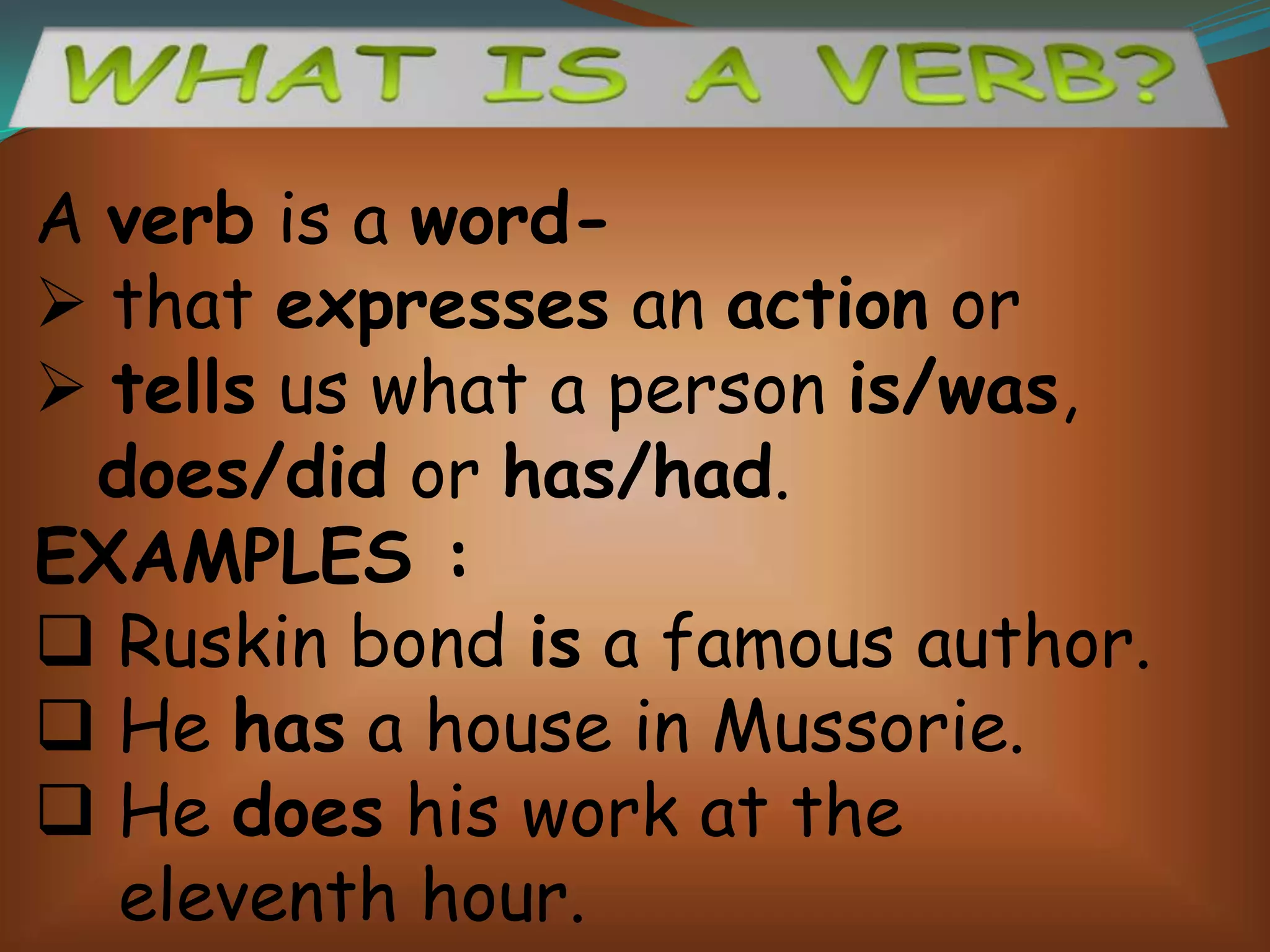
A verb is a word that expresses an action or
 tells us what a person is/was,
does/did or has/had.
EXAMPLES :
 Ruskin bond is a famous author.
 He has a house in Mussorie.
 He does his work at the
eleventh hour.
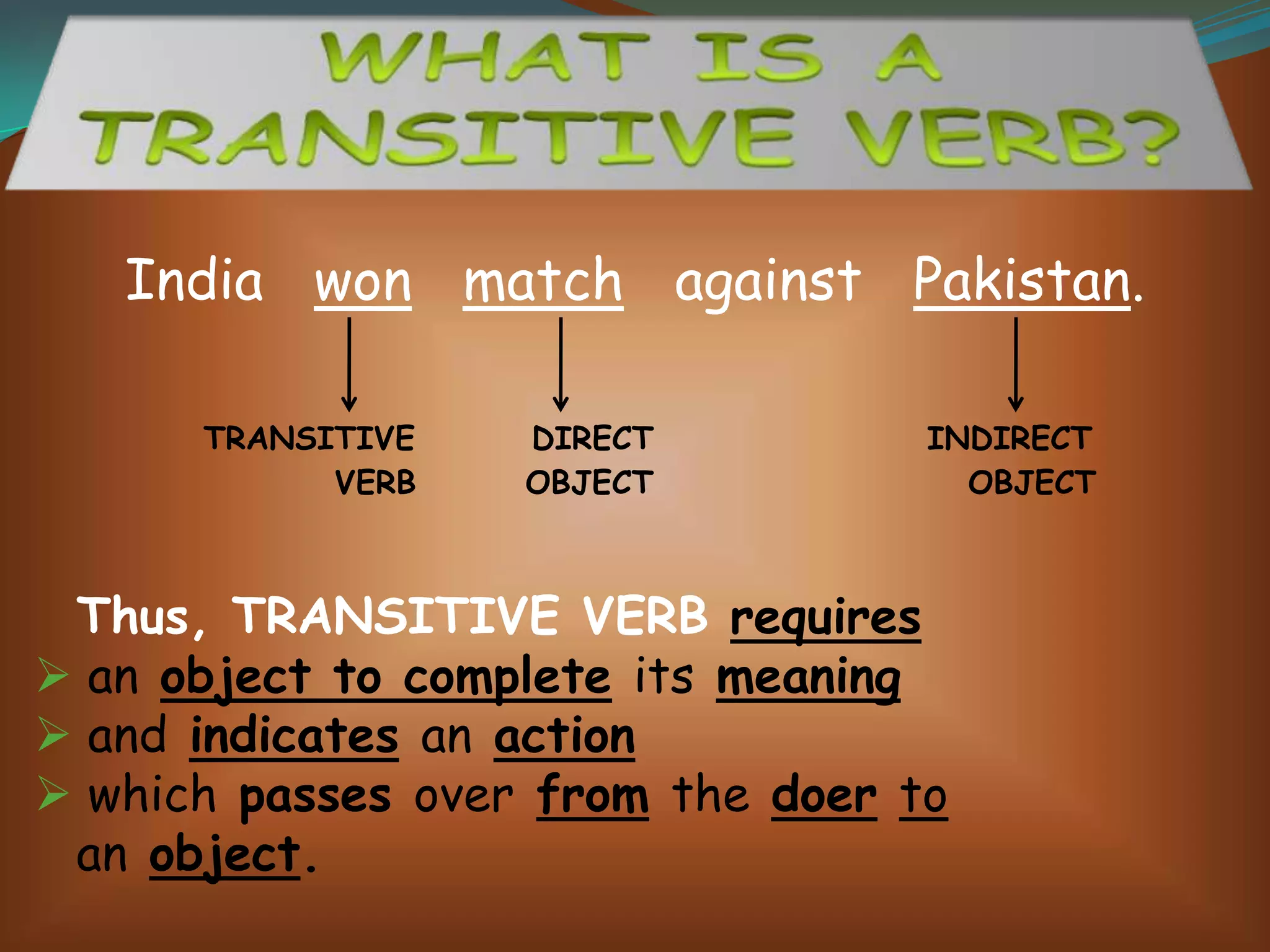
India won match against Pakistan.
TRANSITIVE
VERB

DIRECT
OBJECT

INDIRECT
OBJECT

Thus, TRANSITIVE VERB requires
 an object to complete its meaning
 and indicates an action
 which passes over from the doer to
an object.
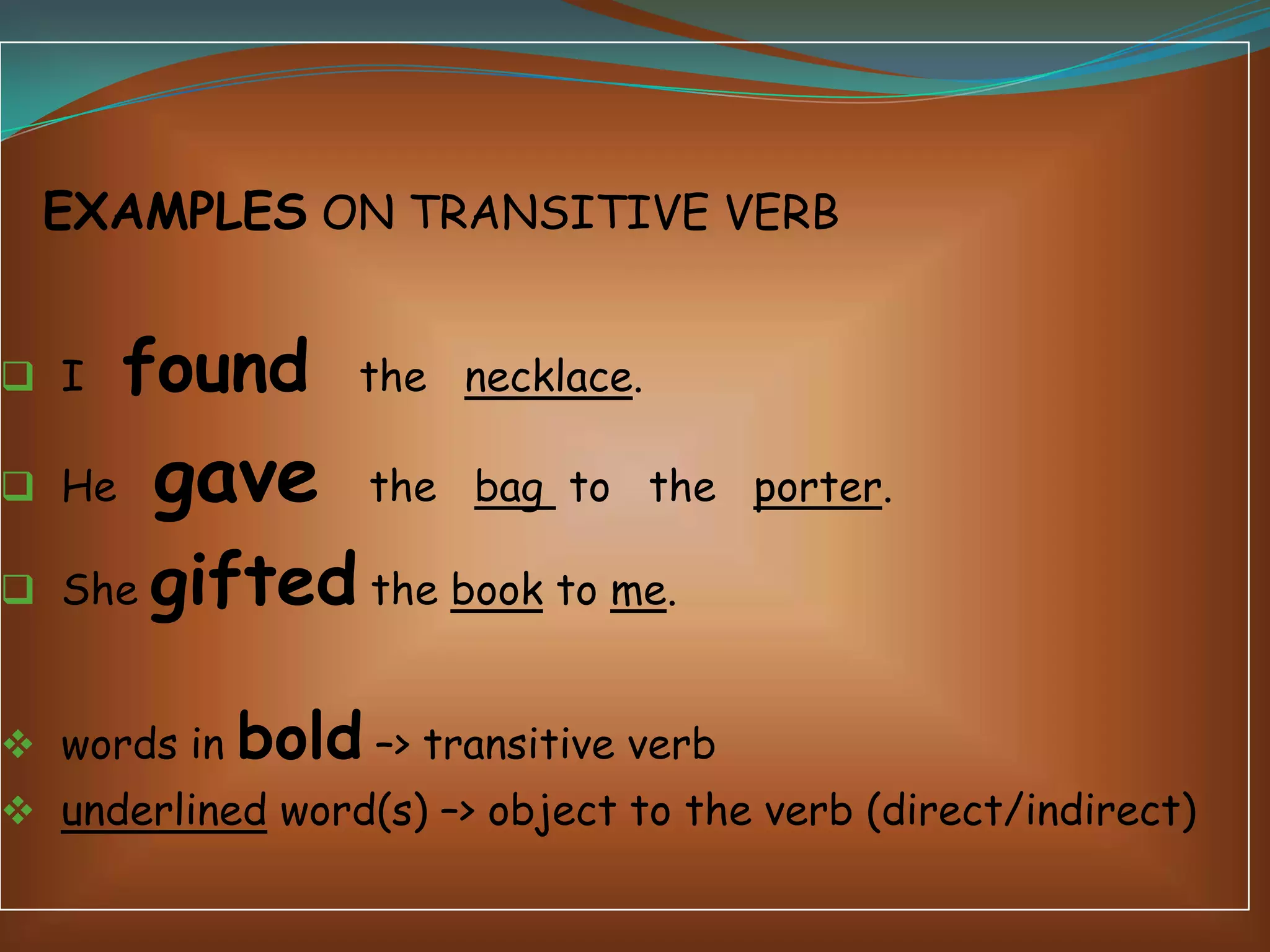
EXAMPLES ON TRANSITIVE VERB
 I

found

the necklace.

 He

gave

 She

gifted the book to me.

 words in

the bag to the porter.

bold –> transitive verb

 underlined word(s) –> object to the verb (direct/indirect)
The dog jumped.

Intransitive verb
The flight arrived late.

Complement
INTRASITIVE VERB  does not require any object to complete its
meaning but
 sometimes requires a complement [word or group of
words] to make complete sense
 which refers to the subject of the sentence.
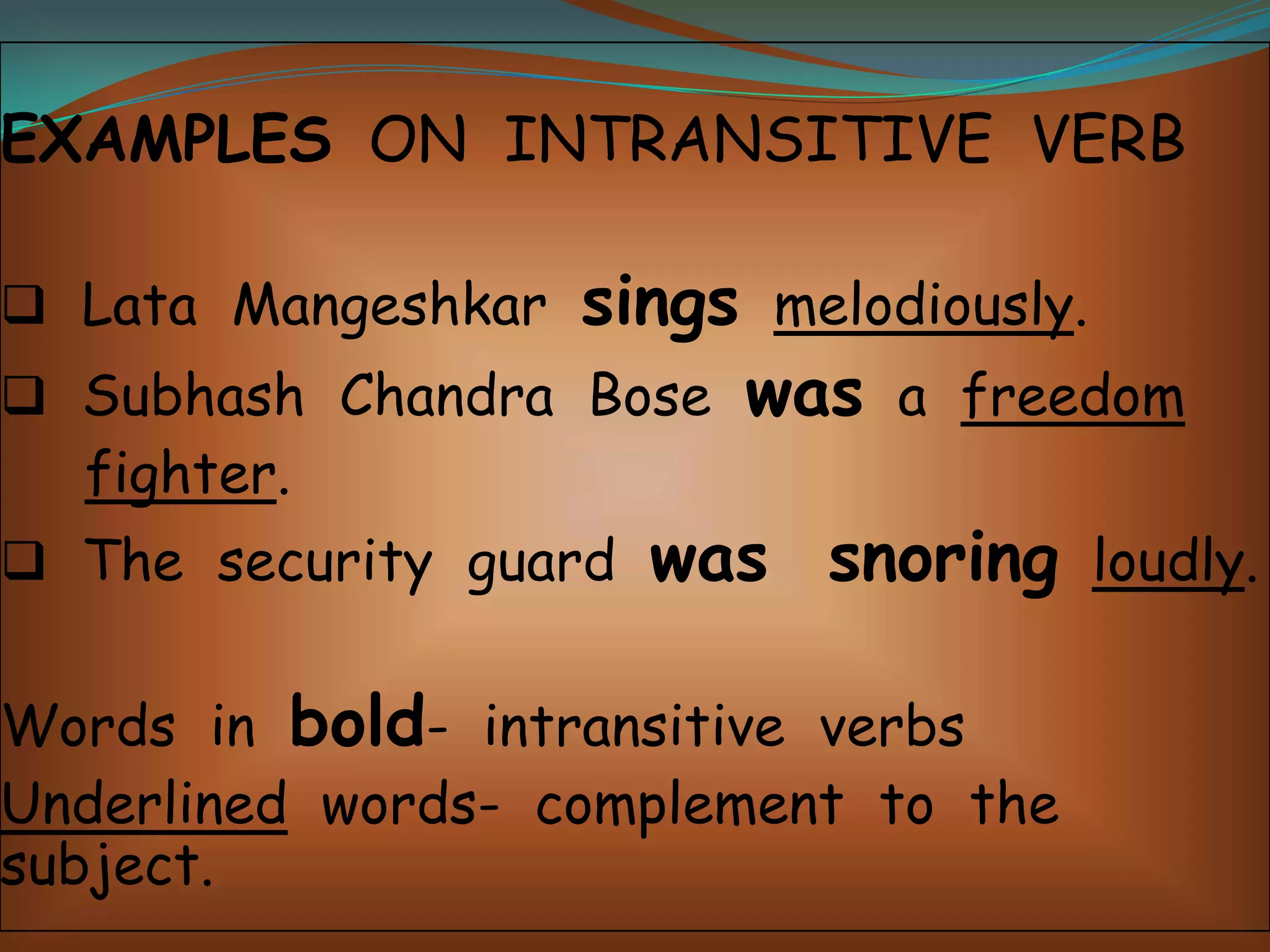
EXAMPLES ON INTRANSITIVE VERB

sings melodiously.
Subhash Chandra Bose was a freedom

 Lata Mangeshkar


fighter.

 The security guard

was snoring loudly.

Words in bold- intransitive verbs
Underlined words- complement to the
subject.
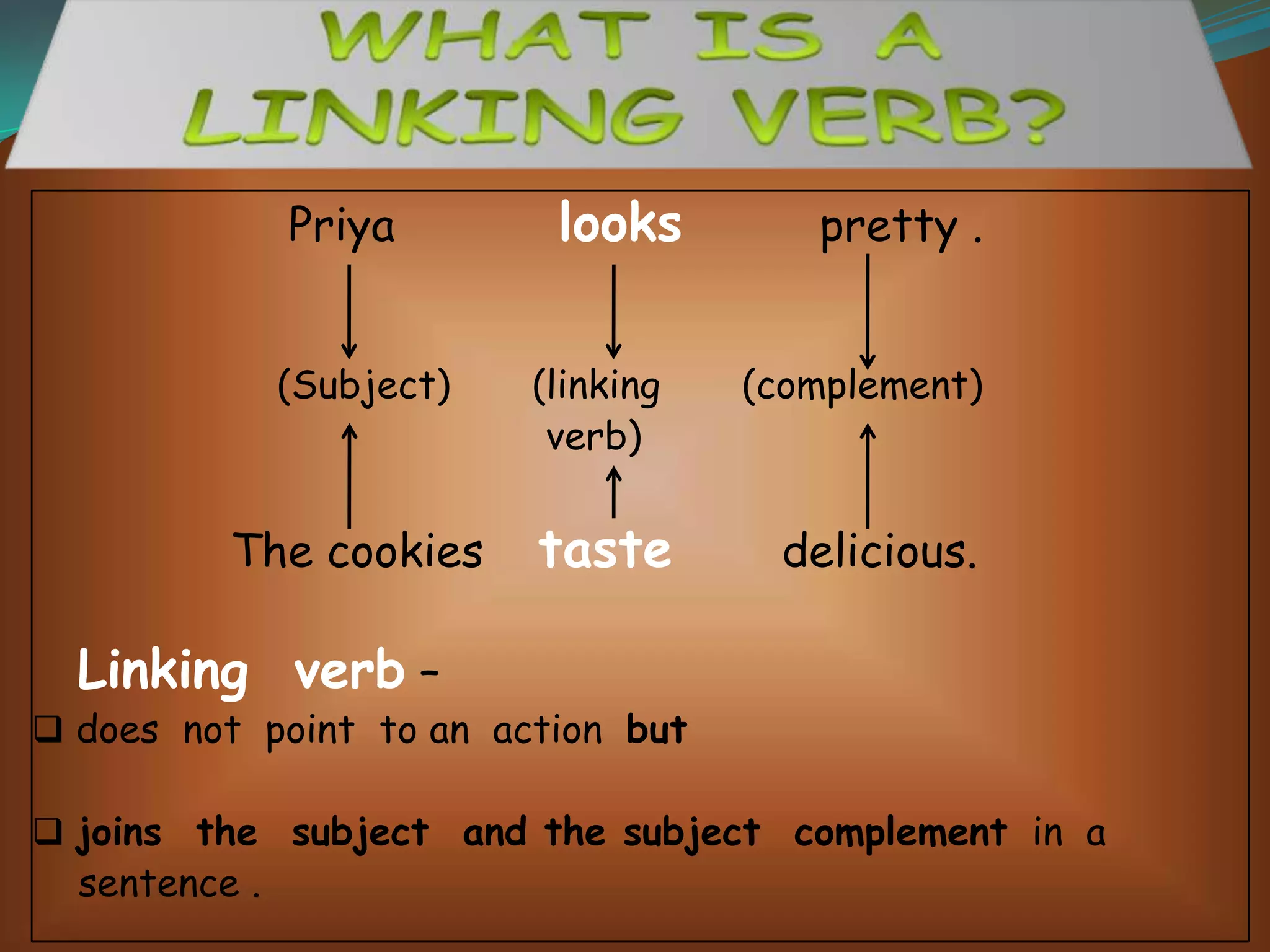
Priya

looks

(Subject)

(linking
verb)

The cookies

taste

pretty .
(complement)

delicious.

Linking verb –

 does not point to an action but
 joins the subject and the subject complement in a

sentence .
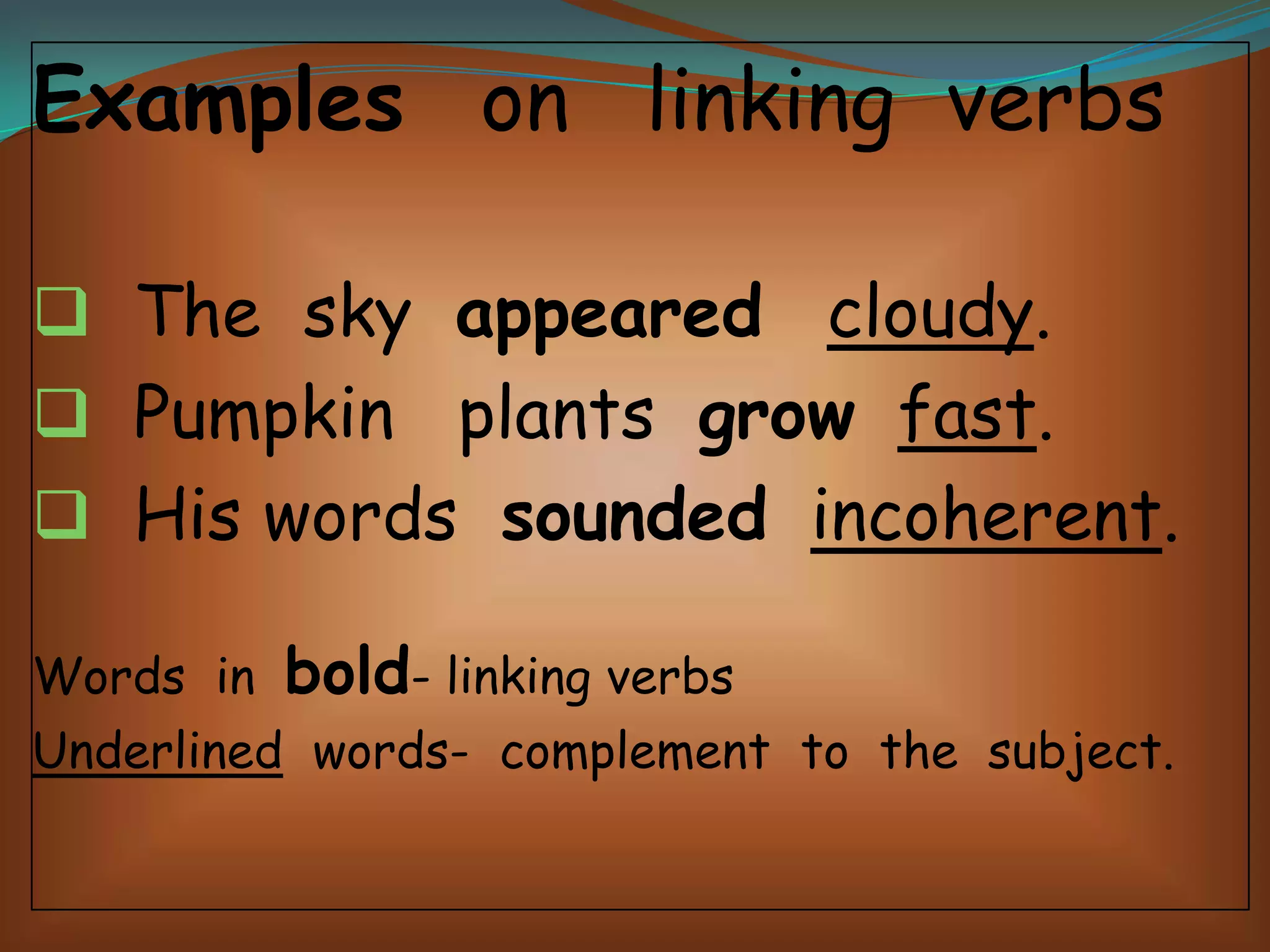
Examples on linking verbs
 The sky appeared cloudy.
 Pumpkin plants grow fast.
 His words sounded incoherent.
Words in

bold- linking verbs

Underlined words- complement to the subject.
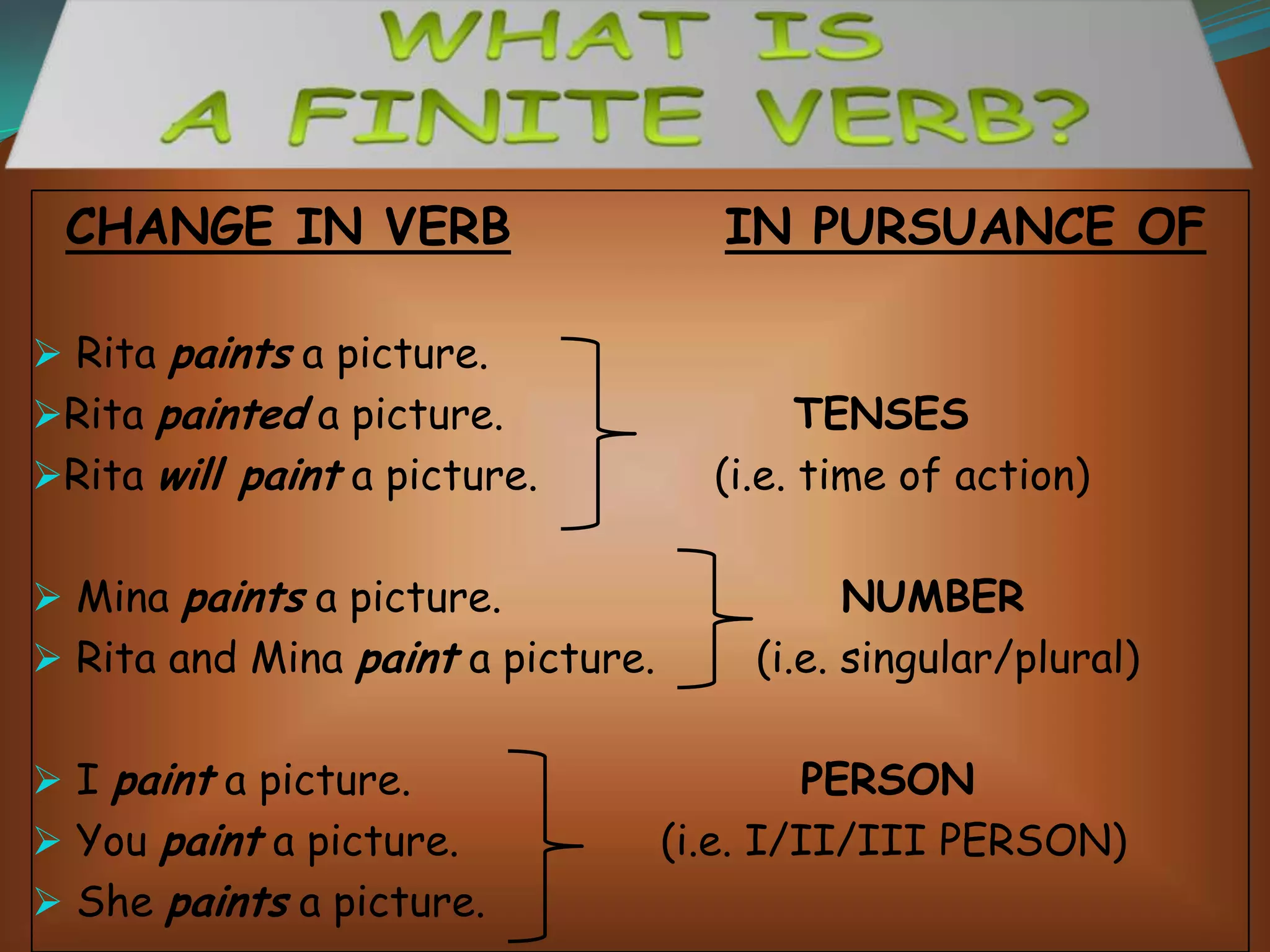
CHANGE IN VERB

IN PURSUANCE OF

 Rita paints a picture.

Rita painted a picture.

Rita will paint a picture.
 Mina paints a picture.

 Rita and Mina paint a picture.

 I paint a picture.

 You paint a picture.

 She paints a picture.

TENSES
(i.e. time of action)
NUMBER
(i.e. singular/plural)

PERSON
(i.e. I/II/III PERSON)
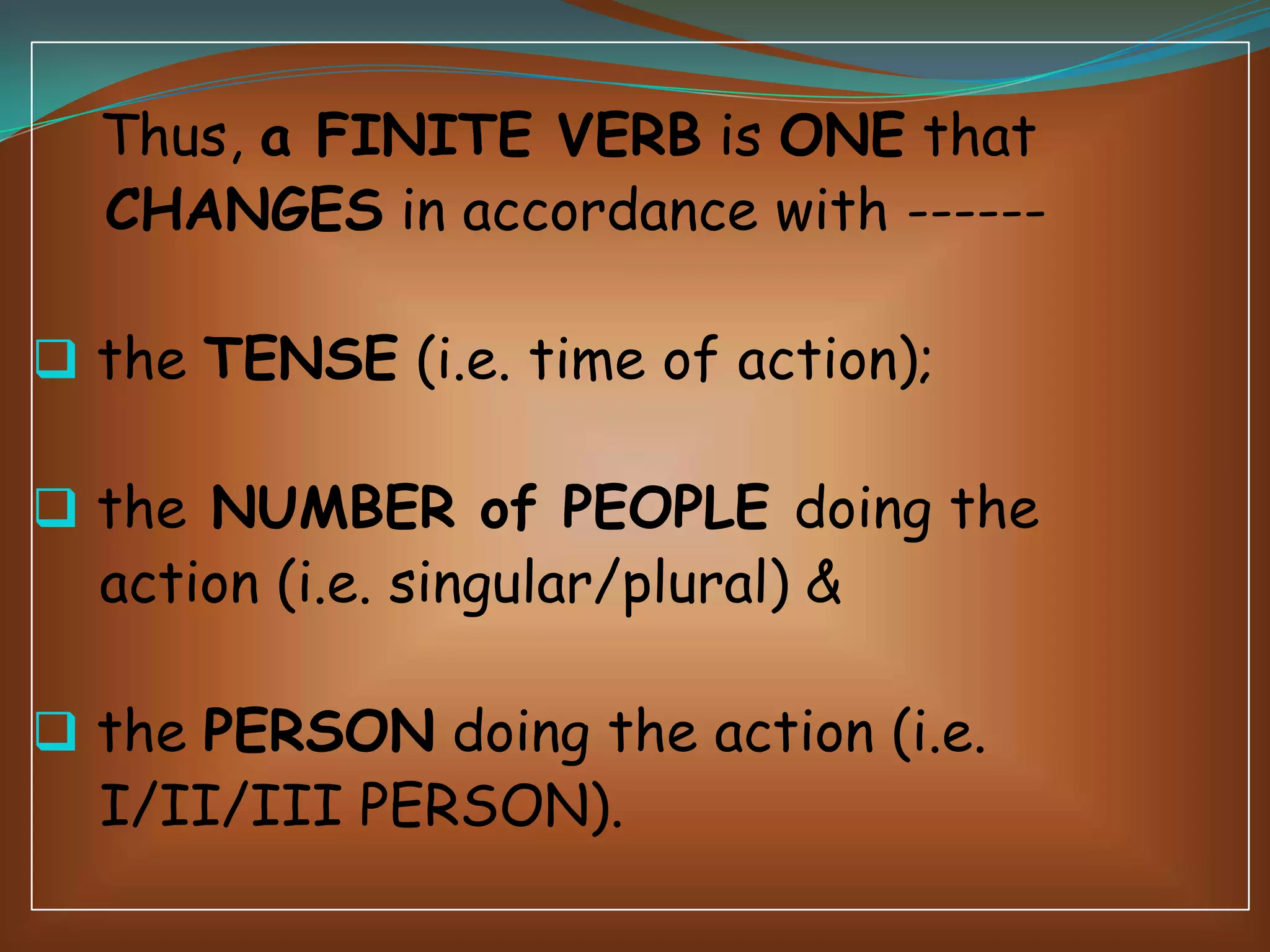
Thus, a FINITE VERB is ONE that
CHANGES in accordance with ----- the TENSE (i.e. time of action);
 the NUMBER of PEOPLE doing the

action (i.e. singular/plural) &

 the PERSON doing the action (i.e.

I/II/III PERSON).
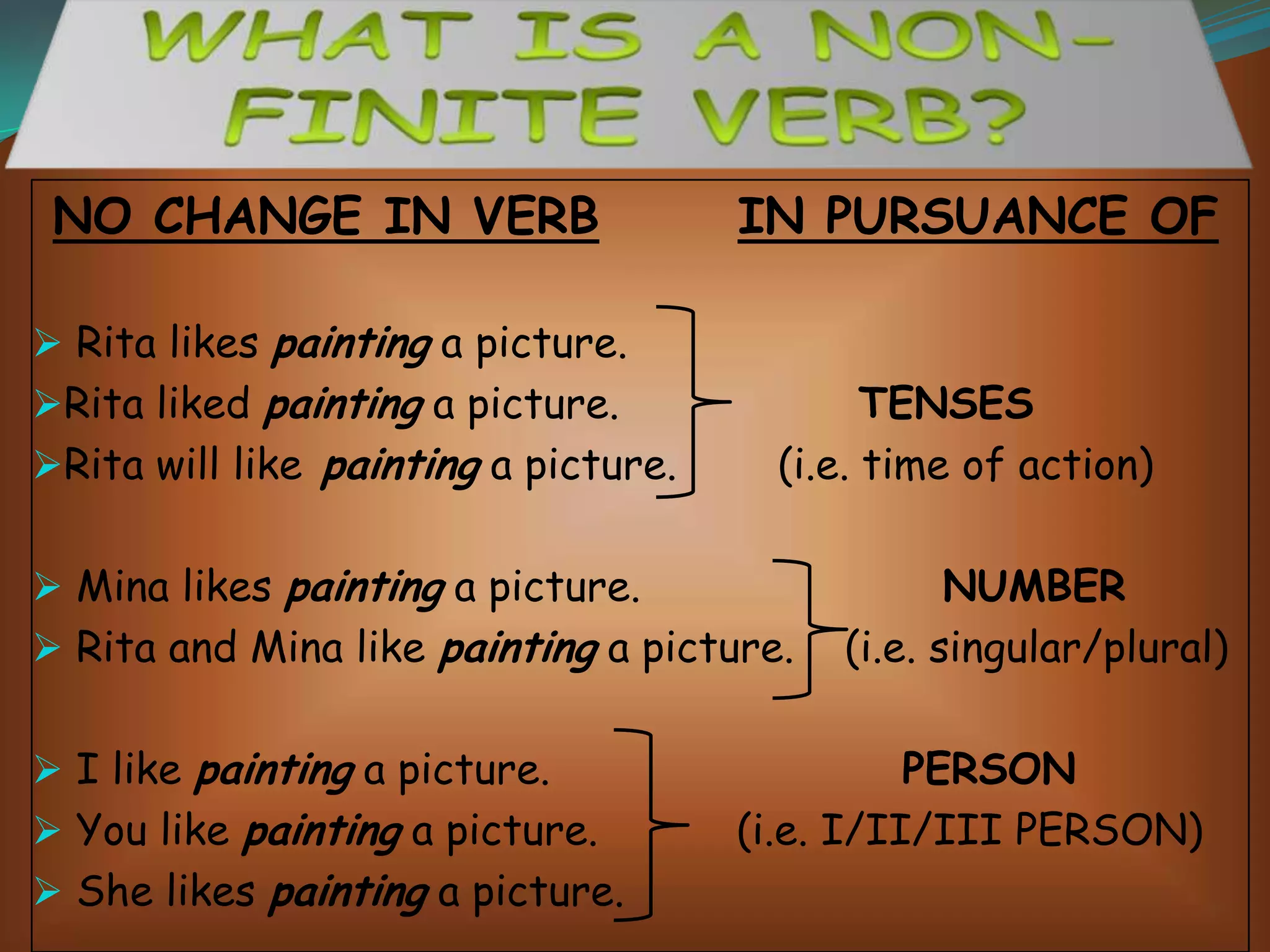
NO CHANGE IN VERB

IN PURSUANCE OF

 Rita likes painting a picture.
Rita liked painting a picture.

Rita will like painting a picture.
 Mina likes painting a picture.

TENSES
(i.e. time of action)

 Rita and Mina like painting a picture.

 I like painting a picture.

 You like painting a picture.

 She likes painting a picture.

NUMBER
(i.e. singular/plural)

PERSON
(i.e. I/II/III PERSON)
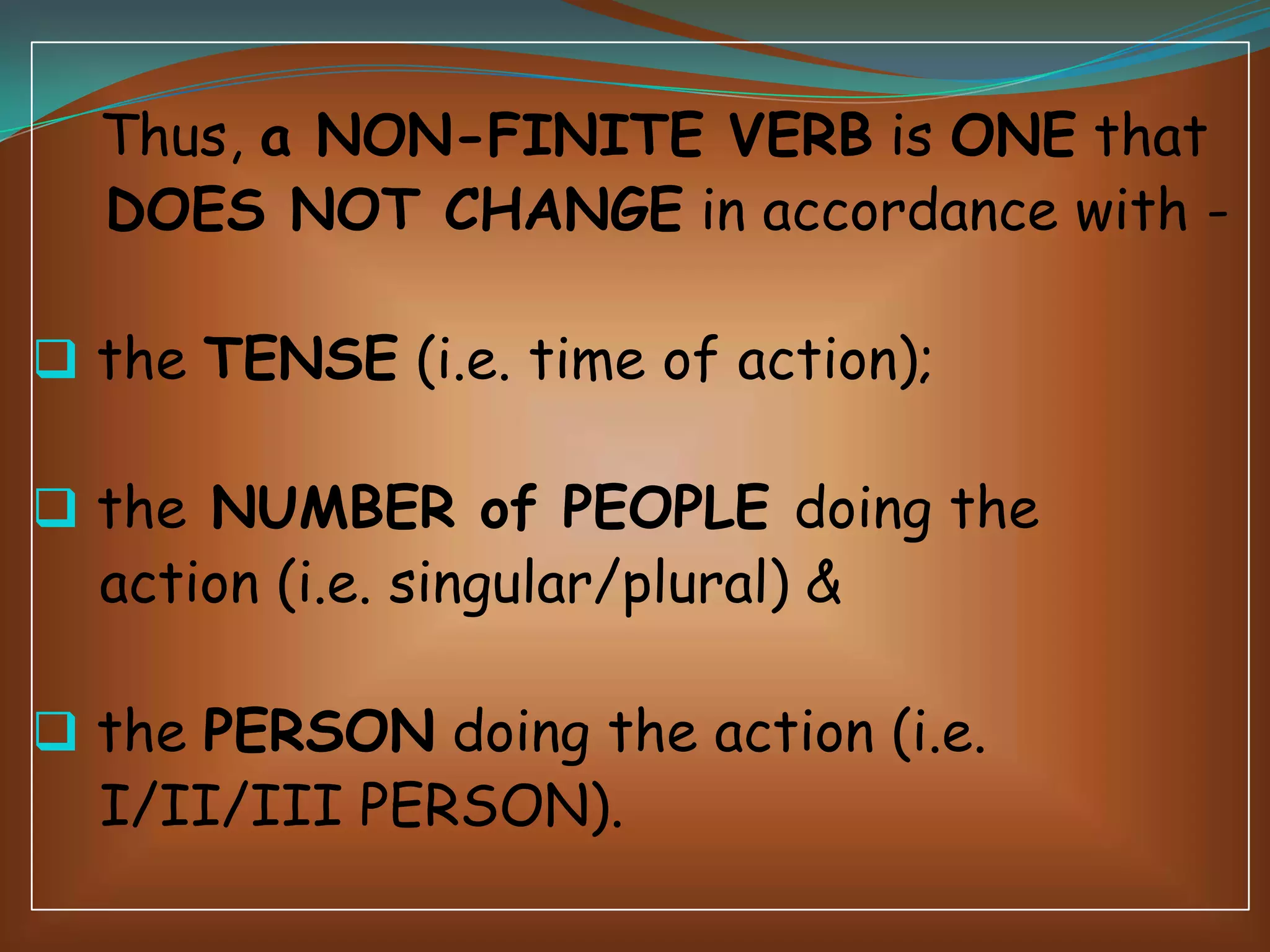
Thus, a NON-FINITE VERB is ONE that
DOES NOT CHANGE in accordance with  the TENSE (i.e. time of action);
 the NUMBER of PEOPLE doing the

action (i.e. singular/plural) &

 the PERSON doing the action (i.e.

I/II/III PERSON).
Verbs - Transitive and Intransitive,Linking and Finite ,Non-Finite (easy approach)

Verbs - Transitive and Intransitive,Linking and Finite ,Non-Finite (easy approach)

  • 2.
    A verb isa word that expresses an action or  tells us what a person is/was, does/did or has/had. EXAMPLES :  Ruskin bond is a famous author.  He has a house in Mussorie.  He does his work at the eleventh hour.
  • 5.
    India won matchagainst Pakistan. TRANSITIVE VERB DIRECT OBJECT INDIRECT OBJECT Thus, TRANSITIVE VERB requires  an object to complete its meaning  and indicates an action  which passes over from the doer to an object.
  • 6.
    EXAMPLES ON TRANSITIVEVERB  I found the necklace.  He gave  She gifted the book to me.  words in the bag to the porter. bold –> transitive verb  underlined word(s) –> object to the verb (direct/indirect)
  • 7.
    The dog jumped. Intransitiveverb The flight arrived late. Complement INTRASITIVE VERB  does not require any object to complete its meaning but  sometimes requires a complement [word or group of words] to make complete sense  which refers to the subject of the sentence.
  • 8.
    EXAMPLES ON INTRANSITIVEVERB sings melodiously. Subhash Chandra Bose was a freedom  Lata Mangeshkar  fighter.  The security guard was snoring loudly. Words in bold- intransitive verbs Underlined words- complement to the subject.
  • 10.
    Priya looks (Subject) (linking verb) The cookies taste pretty . (complement) delicious. Linkingverb –  does not point to an action but  joins the subject and the subject complement in a sentence .
  • 11.
    Examples on linkingverbs  The sky appeared cloudy.  Pumpkin plants grow fast.  His words sounded incoherent. Words in bold- linking verbs Underlined words- complement to the subject.
  • 13.
    CHANGE IN VERB INPURSUANCE OF  Rita paints a picture. Rita painted a picture. Rita will paint a picture.  Mina paints a picture.  Rita and Mina paint a picture.  I paint a picture.  You paint a picture.  She paints a picture. TENSES (i.e. time of action) NUMBER (i.e. singular/plural) PERSON (i.e. I/II/III PERSON)
  • 14.
    Thus, a FINITEVERB is ONE that CHANGES in accordance with ----- the TENSE (i.e. time of action);  the NUMBER of PEOPLE doing the action (i.e. singular/plural) &  the PERSON doing the action (i.e. I/II/III PERSON).
  • 15.
    NO CHANGE INVERB IN PURSUANCE OF  Rita likes painting a picture. Rita liked painting a picture. Rita will like painting a picture.  Mina likes painting a picture. TENSES (i.e. time of action)  Rita and Mina like painting a picture.  I like painting a picture.  You like painting a picture.  She likes painting a picture. NUMBER (i.e. singular/plural) PERSON (i.e. I/II/III PERSON)
  • 16.
    Thus, a NON-FINITEVERB is ONE that DOES NOT CHANGE in accordance with  the TENSE (i.e. time of action);  the NUMBER of PEOPLE doing the action (i.e. singular/plural) &  the PERSON doing the action (i.e. I/II/III PERSON).