Critical Thinking in Education


   Integrating Critical Thinking
   Into Learning Activities Across the
   Curriculum

   Eric Rusten & Susan Schuman – USAID/PAEM & MoE
Critical Thinking Activities
 Critical Thinking in Language Learning
 Critical Thinking in Math – Topology
 Critical Thinking in Science – How do
  planes, birds and insects fly?
Perspectives of Critical Thinking
 Critical Thinking Survey:
Defining Critical Thinking
    Some Attributes of a Critical Thinker:
               Curiosity      Problem solver   Evaluates statements
 Asking
                                               & arguments
 pertinent
               Seeks new       Actively
 questions                                     Willing to examine beliefs,
               solutions       shares new
                               knowledge       assumptions & opinions
Admits a lack of
knowledge &        Distinguishes      Sees critical thinking as a life-
understanding      between facts      long process of self-assessment
                   and opinion
     Seeks proof                         Reflective      Open to changing
                                                         ones mind
Seeks evidence to support
                                Accepts others beliefs   Waits till all facts
assumptions and beliefs
                                and opinions             before making
Seeks clarity and exactness                              judgments
                                Actively enjoys
Careful and active observer     learning                     Humility
Critical Thinking Model
Defining Critical Thinking &
Describing Critical Thinkers
 “Critical thinking is the disciplined mental activity of evaluating
  arguments [information] or propositions and making judgments
  that can guide the development of beliefs and taking action.”
    Ennis (1992)

 Critical thinking is both a frame of mind and a set of mental
  capabilities.

 “Critical thinkers: distinguish between fact and opinion; ask
  questions; make detailed observations; uncover assumptions
  and define their terms; and make assertions based on sound
  logic and solid evidence. Ellis, D. Becoming a Master Student, 1997
Perspectives on Critical Thinking

 Critical thinking is based on concepts and
  principles, not on hard and fast, or step-by-
  step, procedures.
 Critical thinking does not assure that one
  will reach either the truth or correct
  conclusions.
 Circuital thinking is a continuous process
  and often doesn’t lead to a final conclusion.
 Critical thinking is hard intellectual work
 Critical thinking is an intellectual skill that
  can (must) be learned and improved
Data >> Wisdom Chain


Data > Information > Knowledge > Wisdom
Perspectives on Learning
All reasoning/thinking/learning:
 starts and progresses with questions and a
    need to understand;
 occurs within points of view and frames of
    reference;
 proceeds from some goals and objectives,
    has an informational base;
 uses data/information that must be
    interpreted and this interpretation involves
    concepts, values, assumptions, past
    knowledge, inferences, biases, etc.
Critical Thinking, Creative Thinking,
Problem Solving, Scientific Thinking,….

   Critical Thinking
   Creative Thinking
   Scientific Thinking & Process
   Problem Solving
   Decision Making
Map of Thinking Domains
Scientific Thinking      Creative Thinking              Critical Thinking
•Understanding/theory   •Original Product           •Critical judgment
•Hypothesis             •Create Possibilities       •Assessing information
•Experiment(s)          •Create Metaphors           •Inference-using evidence
•Observations           •Testing                    •Deduction-if…then
•Conclusion(s)          •Refining                   •New or refined perspective


        Decision Making                            Problem Solving
      •Well-founded decision                    •Best solution
      •Consider options                         •Consider options
      •Predict consequences                     •Evaluate consequences
      •Select best option
                                                •Choose best solution
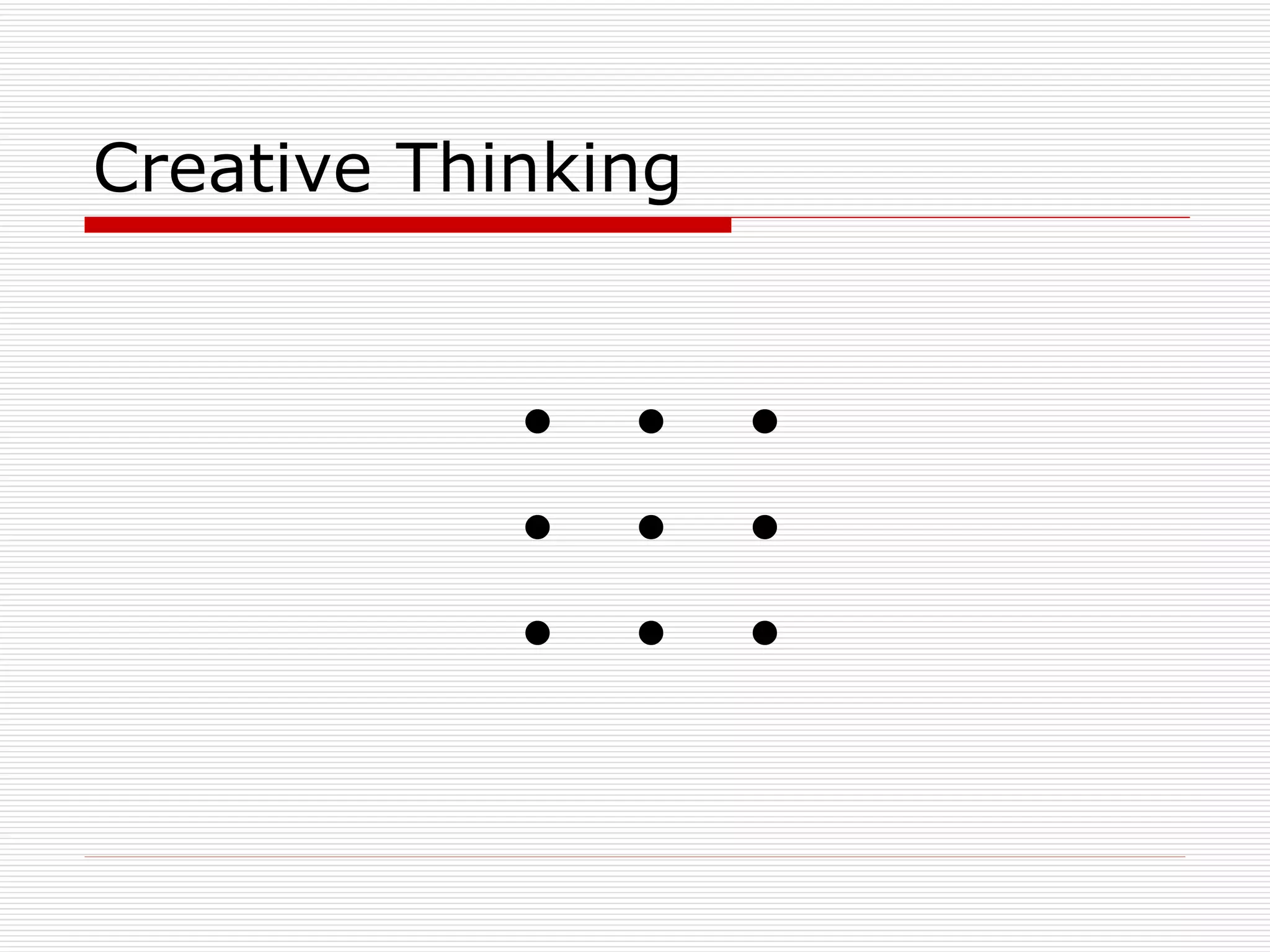
Creative Thinking


            ●   ●   ●
            ●   ●   ●
            ●   ●   ●
Problem Solving
 Suspend a 500 franc coin over water in a
  glass using a 1000 Franc note.

  What is the problem? (Parse into sub-problems)
  What do you know?
  What resources do you have and what can I do with
   them?
  What constraints do you face?
  What are some possible solutions? (brain storming)
  Evaluating possible solutions.
  Selecting best bets.
  Testing best-bet solutions.
  Assessing results.
  Refining solutions.
  Proposing final solution.
Why is Critical Thinking Important?

 To learn is to think.
 To think poorly is to learn poorly.
 To think well is to learn well.
 All content, to be learned, must be
  intellectually constructed.
 Memorizing IS NOT learning.
Why Critical Thinking is Important

 Underlies reading, writing, speaking, and listening . . .
  the basic elements of communication, learning and
  education
 Plays an important role in social change
 Helps us uncover bias and prejudice
 Is a path to freedom form half-truths, prejudice and
  deceptions
 Creates the willingness to change one point of view as
  we continue to examine and re-examine ideas that may
  seem obvious.
 Takes time and the willingness to say three essential
  words: I don't know.
 Enables us to distinguish between fact and opinion, ask
  good questions, make detailed observations, uncover
  assumptions and define their terms, and make
  assertions based on sound logic and solid evidence
Why Critical Thinking is Important

“The future now belongs to societies
that organize themselves for learning...
nations that want high incomes and full
employment must develop policies that
emphasize the acquisition of knowledge
and [thinking] skills by everyone, not
just a select few.”

Ray Marshall & Marc Tucker, Thinking For A Living: Education And The
Wealth of Nations, Basic Books. New York. 1992.
Questions & Critical Thinking

 What do you mean by_______________?
 How did you come to that conclusion?
 What was said in the text?
 What is the source of your information?
 What is the source of information in the document?
 What assumption led you to that conclusion?
 Suppose you are wrong. What are the implications?
 Why did you make that inference? Is another one
  more consistent with the data?
 Why is this issue significant?
 How do I know that what you are saying is true?
 What is an alternate explanation for this
  phenomenon?
Enabling Learners to Become
Quality Critical Thinkers
 CATS (Classroom Assessment
  Techniques): use of ongoing classroom
  assessment and reflection to monitor and
  facilitate students' critical thinking.
   Ask students to write a "Minute Paper"
    responding to specific questions such as:
   What was the most important thing you learned
    in today's class?
   What one question related to this lesson remains
    uppermost in your mind?
   How is what you learned today relevant to other
    classes or life outside of school?
Enabling Learners to Become
Quality Critical Thinkers
 Cooperative Learning: putting
  students in structured group learning
  situations (2 or more learners) is an
  excellent way to foster critical thinking.
   In cooperative learning environments,
    learners engage in active, critical thinking
    with continuous support and feedback from
    peers and the learning facilitator
Enabling Learners to Become
Quality Critical Thinkers
 Use Questions: Learning to formulate a series of
  quality questions is key to critical thinking and
  becoming a good critical thinker:
   Reciprocal Peer Questioning: Following a lesson,
     present a list of question stems to guide students in
     writing responses in small groups. Then, the whole
     class discusses some of the questions from some or
     all of the small groups.
   Reader's Questions: Require learners to write
     questions on assigned reading and turn them in at
     the beginning of class. Select a few of the questions
     as the impetus for class discussion.
   Blue Sky Questions:
   Extended Learning Questions:
   Learners’ exam questions:
   Blooms taxonomy questions:
Enabling Learners to Become
Quality Critical Thinkers
 Writing Assignments: writing for others
  demands that learners think clearly to
  communicate clearly.
   can be based on questions
   can be done in small groups or individually
   can use different structures: compare & contrast,
    cause & effect, explanation, argument, persuasion,
    etc.
   Letter to the editors (teams of learners become
    editors at different news papers and readers)
   Lab / experimental reports
Enabling Learners to Become
Quality Critical Thinkers
 Dialogues/Debates: stimulates useful discussions in
  the classroom:
      Written dialogues: Small groups of learners analyze written
       dialogues (plays, news paper articles, etc.) and identify
       different viewpoints in the dialogue, look for biases,
       presence or exclusion of important evidence, alternative
       interpretations, misstatement of facts, and errors in
       reasoning. Each group decides which view is the most
       reasonable and must defend this position. After coming to a
       conclusion, each group acts out their dialogue and explains
       their analysis of it.
      Spontaneous Group Dialogue/Debate: Students in one
       group are assigned roles (often what they don’t believe in)
       to play in a discussion (such as leader, information giver,
       opinion seeker, and disagreer). Observer groups must
       determine what roles are being played by whom,
       identifying biases and errors in thinking, evaluating
       reasoning skills, and examining ethical implications of the
       content.
Enabling Learners to Become
Quality Critical Thinkers
 Experiments and Collecting Data
  (critical thinking in science & math)
   Discovering relationships in math and
    science – pie ∏; prime numbers; area
    and volume calculations; geometry;
    temperature and color; height, arm span
    and head size; genetics; flight and air
    pressure; etc.
   Statistics and presenting information
Enabling Learners to Become
Quality Critical Thinkers
 Ambiguity: Rather than provide all
  the information as fact, produce as
  much ambiguity in the classroom as
  possible.
   Don't give students clear cut material.
   Give them conflicting information that
    they must think their way through.
   Present content as a detective story that
    they must solve by answering a set of
    questions.
Enabling Learners to Become
Quality Critical Thinkers
IDEALS -- Six Steps to Effective Thinking
 Identify the problem. — “What’s the real question
  we’re facing here?”
 Define the context. — “What are the facts and
  circumstances that frame this problem?”
 Enumerate choices. — “What are our most plausible
  three or four options?”
 Analyze options. — “What is our best course of action,
  all things considered?”
 List reasons explicitly. — “Let’s be clear: Why we are
  making this particular choice?”
 Self-correct. — “Okay, let’s look at it again. What did
  we miss?”
Critical Thinking In The Curriculum
   Earth & Life Sciences
   Physics/Chemistry
   Math
   Geography/History
     How does rainfall influence agriculture,
      history, settlements, economics,
      education, politics
 French (grammar & literature)
 Second languages
Participant Activities:
 Teams of two
 Prepare a 20 min. micro-learning
  activity that integrates elements of
  critical thinking
Suggested Planning Template
A thinking activity plan would include:

   Activity title and summary statement
   Discipline/subject(s); Grade level(s)
   Goals, objectives & learning outcomes
   Methods and Materials
       Resource needs (including time)
       Thinking skills emphasized
       Learning strategies
       Critical questions
 Activity/Lesson
 Assessing learners (teacher, peer & self)
 Extending activity beyond the classroom

Critical Thinking in Education

  • 1.
    Critical Thinking inEducation Integrating Critical Thinking Into Learning Activities Across the Curriculum Eric Rusten & Susan Schuman – USAID/PAEM & MoE
  • 2.
    Critical Thinking Activities Critical Thinking in Language Learning  Critical Thinking in Math – Topology  Critical Thinking in Science – How do planes, birds and insects fly?
  • 3.
    Perspectives of CriticalThinking  Critical Thinking Survey:
  • 4.
    Defining Critical Thinking  Some Attributes of a Critical Thinker: Curiosity Problem solver Evaluates statements Asking & arguments pertinent Seeks new Actively questions Willing to examine beliefs, solutions shares new knowledge assumptions & opinions Admits a lack of knowledge & Distinguishes Sees critical thinking as a life- understanding between facts long process of self-assessment and opinion Seeks proof Reflective Open to changing ones mind Seeks evidence to support Accepts others beliefs Waits till all facts assumptions and beliefs and opinions before making Seeks clarity and exactness judgments Actively enjoys Careful and active observer learning Humility
  • 6.
  • 7.
    Defining Critical Thinking& Describing Critical Thinkers  “Critical thinking is the disciplined mental activity of evaluating arguments [information] or propositions and making judgments that can guide the development of beliefs and taking action.” Ennis (1992)  Critical thinking is both a frame of mind and a set of mental capabilities.  “Critical thinkers: distinguish between fact and opinion; ask questions; make detailed observations; uncover assumptions and define their terms; and make assertions based on sound logic and solid evidence. Ellis, D. Becoming a Master Student, 1997
  • 8.
    Perspectives on CriticalThinking  Critical thinking is based on concepts and principles, not on hard and fast, or step-by- step, procedures.  Critical thinking does not assure that one will reach either the truth or correct conclusions.  Circuital thinking is a continuous process and often doesn’t lead to a final conclusion.  Critical thinking is hard intellectual work  Critical thinking is an intellectual skill that can (must) be learned and improved
  • 9.
    Data >> WisdomChain Data > Information > Knowledge > Wisdom
  • 10.
    Perspectives on Learning Allreasoning/thinking/learning:  starts and progresses with questions and a need to understand;  occurs within points of view and frames of reference;  proceeds from some goals and objectives, has an informational base;  uses data/information that must be interpreted and this interpretation involves concepts, values, assumptions, past knowledge, inferences, biases, etc.
  • 11.
    Critical Thinking, CreativeThinking, Problem Solving, Scientific Thinking,….  Critical Thinking  Creative Thinking  Scientific Thinking & Process  Problem Solving  Decision Making
  • 12.
    Map of ThinkingDomains Scientific Thinking Creative Thinking Critical Thinking •Understanding/theory •Original Product •Critical judgment •Hypothesis •Create Possibilities •Assessing information •Experiment(s) •Create Metaphors •Inference-using evidence •Observations •Testing •Deduction-if…then •Conclusion(s) •Refining •New or refined perspective Decision Making Problem Solving •Well-founded decision •Best solution •Consider options •Consider options •Predict consequences •Evaluate consequences •Select best option •Choose best solution
  • 13.
    Creative Thinking ● ● ● ● ● ● ● ● ●
  • 14.
    Problem Solving  Suspenda 500 franc coin over water in a glass using a 1000 Franc note.  What is the problem? (Parse into sub-problems)  What do you know?  What resources do you have and what can I do with them?  What constraints do you face?  What are some possible solutions? (brain storming)  Evaluating possible solutions.  Selecting best bets.  Testing best-bet solutions.  Assessing results.  Refining solutions.  Proposing final solution.
  • 15.
    Why is CriticalThinking Important?  To learn is to think.  To think poorly is to learn poorly.  To think well is to learn well.  All content, to be learned, must be intellectually constructed.  Memorizing IS NOT learning.
  • 16.
    Why Critical Thinkingis Important  Underlies reading, writing, speaking, and listening . . . the basic elements of communication, learning and education  Plays an important role in social change  Helps us uncover bias and prejudice  Is a path to freedom form half-truths, prejudice and deceptions  Creates the willingness to change one point of view as we continue to examine and re-examine ideas that may seem obvious.  Takes time and the willingness to say three essential words: I don't know.  Enables us to distinguish between fact and opinion, ask good questions, make detailed observations, uncover assumptions and define their terms, and make assertions based on sound logic and solid evidence
  • 17.
    Why Critical Thinkingis Important “The future now belongs to societies that organize themselves for learning... nations that want high incomes and full employment must develop policies that emphasize the acquisition of knowledge and [thinking] skills by everyone, not just a select few.” Ray Marshall & Marc Tucker, Thinking For A Living: Education And The Wealth of Nations, Basic Books. New York. 1992.
  • 18.
    Questions & CriticalThinking  What do you mean by_______________?  How did you come to that conclusion?  What was said in the text?  What is the source of your information?  What is the source of information in the document?  What assumption led you to that conclusion?  Suppose you are wrong. What are the implications?  Why did you make that inference? Is another one more consistent with the data?  Why is this issue significant?  How do I know that what you are saying is true?  What is an alternate explanation for this phenomenon?
  • 19.
    Enabling Learners toBecome Quality Critical Thinkers  CATS (Classroom Assessment Techniques): use of ongoing classroom assessment and reflection to monitor and facilitate students' critical thinking.  Ask students to write a "Minute Paper" responding to specific questions such as:  What was the most important thing you learned in today's class?  What one question related to this lesson remains uppermost in your mind?  How is what you learned today relevant to other classes or life outside of school?
  • 20.
    Enabling Learners toBecome Quality Critical Thinkers  Cooperative Learning: putting students in structured group learning situations (2 or more learners) is an excellent way to foster critical thinking.  In cooperative learning environments, learners engage in active, critical thinking with continuous support and feedback from peers and the learning facilitator
  • 21.
    Enabling Learners toBecome Quality Critical Thinkers  Use Questions: Learning to formulate a series of quality questions is key to critical thinking and becoming a good critical thinker:  Reciprocal Peer Questioning: Following a lesson, present a list of question stems to guide students in writing responses in small groups. Then, the whole class discusses some of the questions from some or all of the small groups.  Reader's Questions: Require learners to write questions on assigned reading and turn them in at the beginning of class. Select a few of the questions as the impetus for class discussion.  Blue Sky Questions:  Extended Learning Questions:  Learners’ exam questions:  Blooms taxonomy questions:
  • 22.
    Enabling Learners toBecome Quality Critical Thinkers  Writing Assignments: writing for others demands that learners think clearly to communicate clearly.  can be based on questions  can be done in small groups or individually  can use different structures: compare & contrast, cause & effect, explanation, argument, persuasion, etc.  Letter to the editors (teams of learners become editors at different news papers and readers)  Lab / experimental reports
  • 23.
    Enabling Learners toBecome Quality Critical Thinkers  Dialogues/Debates: stimulates useful discussions in the classroom:  Written dialogues: Small groups of learners analyze written dialogues (plays, news paper articles, etc.) and identify different viewpoints in the dialogue, look for biases, presence or exclusion of important evidence, alternative interpretations, misstatement of facts, and errors in reasoning. Each group decides which view is the most reasonable and must defend this position. After coming to a conclusion, each group acts out their dialogue and explains their analysis of it.  Spontaneous Group Dialogue/Debate: Students in one group are assigned roles (often what they don’t believe in) to play in a discussion (such as leader, information giver, opinion seeker, and disagreer). Observer groups must determine what roles are being played by whom, identifying biases and errors in thinking, evaluating reasoning skills, and examining ethical implications of the content.
  • 24.
    Enabling Learners toBecome Quality Critical Thinkers  Experiments and Collecting Data (critical thinking in science & math)  Discovering relationships in math and science – pie ∏; prime numbers; area and volume calculations; geometry; temperature and color; height, arm span and head size; genetics; flight and air pressure; etc.  Statistics and presenting information
  • 25.
    Enabling Learners toBecome Quality Critical Thinkers  Ambiguity: Rather than provide all the information as fact, produce as much ambiguity in the classroom as possible.  Don't give students clear cut material.  Give them conflicting information that they must think their way through.  Present content as a detective story that they must solve by answering a set of questions.
  • 26.
    Enabling Learners toBecome Quality Critical Thinkers IDEALS -- Six Steps to Effective Thinking  Identify the problem. — “What’s the real question we’re facing here?”  Define the context. — “What are the facts and circumstances that frame this problem?”  Enumerate choices. — “What are our most plausible three or four options?”  Analyze options. — “What is our best course of action, all things considered?”  List reasons explicitly. — “Let’s be clear: Why we are making this particular choice?”  Self-correct. — “Okay, let’s look at it again. What did we miss?”
  • 27.
    Critical Thinking InThe Curriculum  Earth & Life Sciences  Physics/Chemistry  Math  Geography/History  How does rainfall influence agriculture, history, settlements, economics, education, politics  French (grammar & literature)  Second languages
  • 28.
    Participant Activities:  Teamsof two  Prepare a 20 min. micro-learning activity that integrates elements of critical thinking
  • 29.
    Suggested Planning Template Athinking activity plan would include:  Activity title and summary statement  Discipline/subject(s); Grade level(s)  Goals, objectives & learning outcomes  Methods and Materials  Resource needs (including time)  Thinking skills emphasized  Learning strategies  Critical questions  Activity/Lesson  Assessing learners (teacher, peer & self)  Extending activity beyond the classroom