Future Perfect Continuous Tense
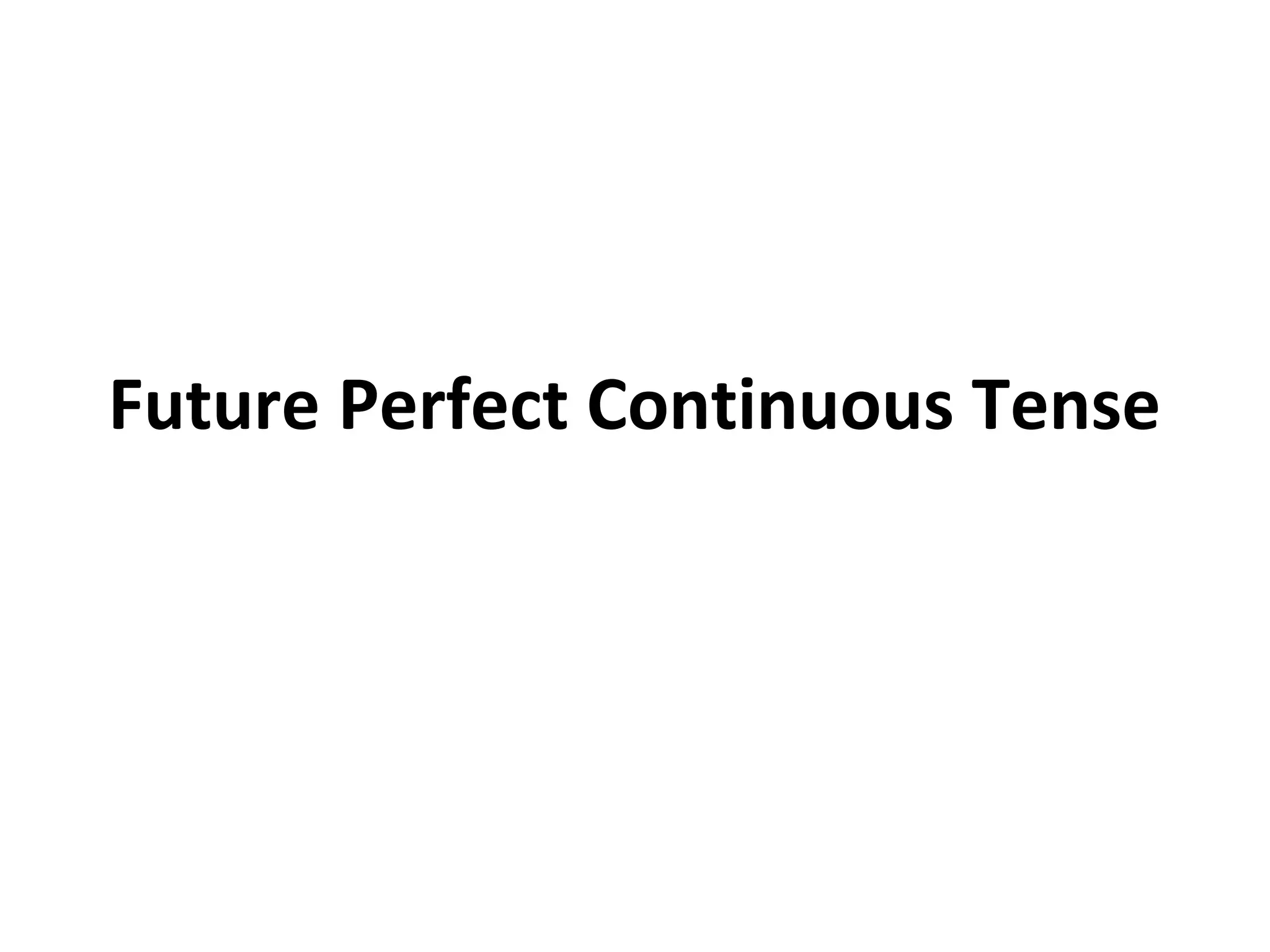
The structure of the future perfect continuous
tense
subj
auxiliary
auxiliary
auxiliary
+
+
+
+ main verb
ect
verb WILL verb HAVE verb BE
invariable

invariable

past
participle

will

have

been

present
participle
base + ing
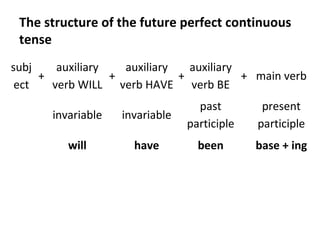
example sentences with the future perfect
continuous tense
auxiliar
subject
y verb
+ I

will

auxilia auxiliar main
ry verb y verb verb
have

been

working

for four
hours.

+ You

will

have

been

for two
travelling
days.

- She

will

not have

been

using

the car.

- We

will

not have

been

waiting

long.

? Will

you

have

been

playing

football?

? Will

they

have

been

watching TV?
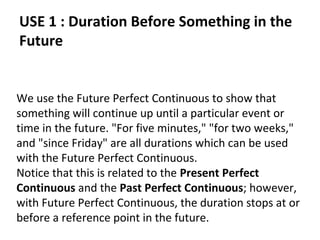
USE 1 : Duration Before Something in the
Future

We use the Future Perfect Continuous to show that
something will continue up until a particular event or
time in the future. "For five minutes," "for two weeks,"
and "since Friday" are all durations which can be used
with the Future Perfect Continuous.
Notice that this is related to the Present Perfect
Continuous and the Past Perfect Continuous; however,
with Future Perfect Continuous, the duration stops at or
before a reference point in the future.
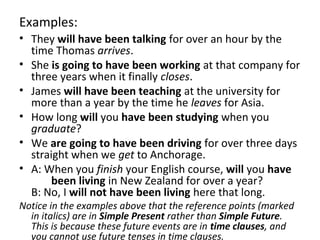
Examples:
• They will have been talking for over an hour by the
time Thomas arrives.
• She is going to have been working at that company for
three years when it finally closes.
• James will have been teaching at the university for
more than a year by the time he leaves for Asia.
• How long will you have been studying when you
graduate?
• We are going to have been driving for over three days
straight when we get to Anchorage.
• A: When you finish your English course, will you have
been living in New Zealand for over a year?
B: No, I will not have been living here that long.
Notice in the examples above that the reference points (marked
in italics) are in Simple Present rather than Simple Future.
This is because these future events are in time clauses, and
you cannot use future tenses in time clauses.
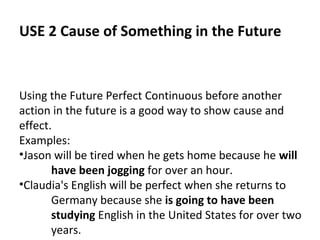
USE 2 Cause of Something in the Future

Using the Future Perfect Continuous before another
action in the future is a good way to show cause and
effect.
Examples:
•Jason will be tired when he gets home because he will
have been jogging for over an hour.
•Claudia's English will be perfect when she returns to
Germany because she is going to have been
studying English in the United States for over two
years.
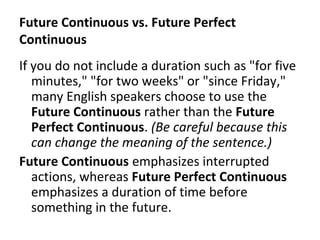
Future Continuous vs. Future Perfect
Continuous
If you do not include a duration such as "for five
minutes," "for two weeks" or "since Friday,"
many English speakers choose to use the
Future Continuous rather than the Future
Perfect Continuous. (Be careful because this
can change the meaning of the sentence.)
Future Continuous emphasizes interrupted
actions, whereas Future Perfect Continuous
emphasizes a duration of time before
something in the future.
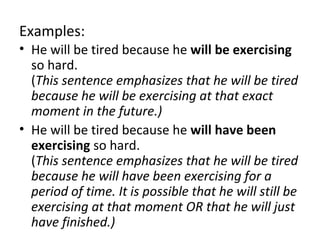
Examples:
• He will be tired because he will be exercising
so hard.
(This sentence emphasizes that he will be tired
because he will be exercising at that exact
moment in the future.)
• He will be tired because he will have been
exercising so hard.
(This sentence emphasizes that he will be tired
because he will have been exercising for a
period of time. It is possible that he will still be
exercising at that moment OR that he will just
have finished.)
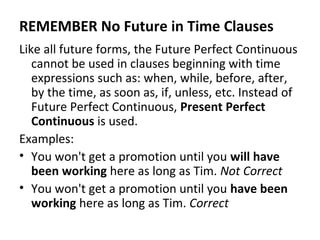
REMEMBER No Future in Time Clauses
Like all future forms, the Future Perfect Continuous
cannot be used in clauses beginning with time
expressions such as: when, while, before, after,
by the time, as soon as, if, unless, etc. Instead of
Future Perfect Continuous, Present Perfect
Continuous is used.
Examples:
• You won't get a promotion until you will have
been working here as long as Tim. Not Correct
• You won't get a promotion until you have been
working here as long as Tim. Correct
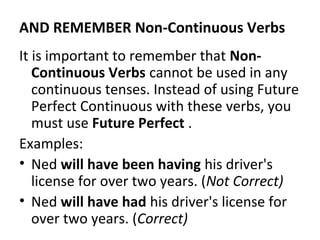
AND REMEMBER Non-Continuous Verbs
It is important to remember that NonContinuous Verbs cannot be used in any
continuous tenses. Instead of using Future
Perfect Continuous with these verbs, you
must use Future Perfect .
Examples:
• Ned will have been having his driver's
license for over two years. (Not Correct)
• Ned will have had his driver's license for
over two years. (Correct)
Future perfect continuous tense

Future perfect continuous tense

  • 1.
  • 2.
    The structure ofthe future perfect continuous tense subj auxiliary auxiliary auxiliary + + + + main verb ect verb WILL verb HAVE verb BE invariable invariable past participle will have been present participle base + ing
  • 3.
    example sentences withthe future perfect continuous tense auxiliar subject y verb + I will auxilia auxiliar main ry verb y verb verb have been working for four hours. + You will have been for two travelling days. - She will not have been using the car. - We will not have been waiting long. ? Will you have been playing football? ? Will they have been watching TV?
  • 4.
    USE 1 :Duration Before Something in the Future We use the Future Perfect Continuous to show that something will continue up until a particular event or time in the future. "For five minutes," "for two weeks," and "since Friday" are all durations which can be used with the Future Perfect Continuous. Notice that this is related to the Present Perfect Continuous and the Past Perfect Continuous; however, with Future Perfect Continuous, the duration stops at or before a reference point in the future.
  • 5.
    Examples: • They willhave been talking for over an hour by the time Thomas arrives. • She is going to have been working at that company for three years when it finally closes. • James will have been teaching at the university for more than a year by the time he leaves for Asia. • How long will you have been studying when you graduate? • We are going to have been driving for over three days straight when we get to Anchorage. • A: When you finish your English course, will you have been living in New Zealand for over a year? B: No, I will not have been living here that long. Notice in the examples above that the reference points (marked in italics) are in Simple Present rather than Simple Future. This is because these future events are in time clauses, and you cannot use future tenses in time clauses.
  • 6.
    USE 2 Causeof Something in the Future Using the Future Perfect Continuous before another action in the future is a good way to show cause and effect. Examples: •Jason will be tired when he gets home because he will have been jogging for over an hour. •Claudia's English will be perfect when she returns to Germany because she is going to have been studying English in the United States for over two years.
  • 7.
    Future Continuous vs.Future Perfect Continuous If you do not include a duration such as "for five minutes," "for two weeks" or "since Friday," many English speakers choose to use the Future Continuous rather than the Future Perfect Continuous. (Be careful because this can change the meaning of the sentence.) Future Continuous emphasizes interrupted actions, whereas Future Perfect Continuous emphasizes a duration of time before something in the future.
  • 8.
    Examples: • He willbe tired because he will be exercising so hard. (This sentence emphasizes that he will be tired because he will be exercising at that exact moment in the future.) • He will be tired because he will have been exercising so hard. (This sentence emphasizes that he will be tired because he will have been exercising for a period of time. It is possible that he will still be exercising at that moment OR that he will just have finished.)
  • 9.
    REMEMBER No Futurein Time Clauses Like all future forms, the Future Perfect Continuous cannot be used in clauses beginning with time expressions such as: when, while, before, after, by the time, as soon as, if, unless, etc. Instead of Future Perfect Continuous, Present Perfect Continuous is used. Examples: • You won't get a promotion until you will have been working here as long as Tim. Not Correct • You won't get a promotion until you have been working here as long as Tim. Correct
  • 10.
    AND REMEMBER Non-ContinuousVerbs It is important to remember that NonContinuous Verbs cannot be used in any continuous tenses. Instead of using Future Perfect Continuous with these verbs, you must use Future Perfect . Examples: • Ned will have been having his driver's license for over two years. (Not Correct) • Ned will have had his driver's license for over two years. (Correct)