READING
  AS A
PROCESS
Reading involves many processes.

 Physiological


  Cognitive


 Communication


 Psycho-social
READING AS A
PHYSIOLOGICAL
  PROCESS
PHYSIOLOGY
•Physiology is the science
 dealing with the
 functions and vital
 processes of living
 organisms.
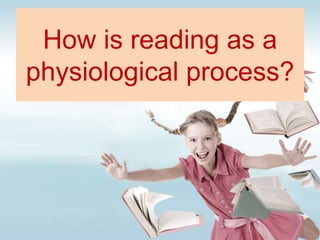
How is reading as a
physiological process?
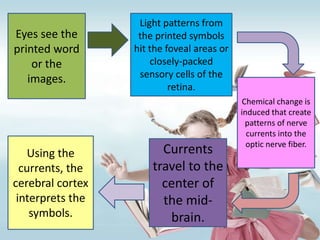
Light patterns from
Eyes see the       the printed symbols
printed word      hit the foveal areas or
    or the            closely-packed
   images.         sensory cells of the
                           retina.
                                            Chemical change is
                                            induced that create
                                             patterns of nerve
                                              currents into the
                                              optic nerve fiber.
    Using the           Currents
  currents, the       travel to the
cerebral cortex         center of
 interprets the         the mid-
    symbols.             brain.
What are the
different eye
movements
 involved in
  reading?
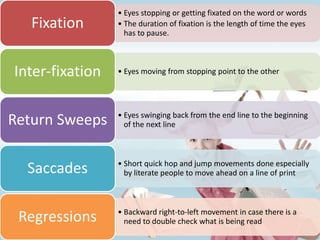
• Eyes stopping or getting fixated on the word or words
   Fixation      • The duration of fixation is the length of time the eyes
                   has to pause.


Inter-fixation   • Eyes moving from stopping point to the other


                 • Eyes swinging back from the end line to the beginning
Return Sweeps      of the next line


                 • Short quick hop and jump movements done especially
  Saccades         by literate people to move ahead on a line of print


                 • Backward right-to-left movement in case there is a
 Regressions       need to double check what is being read
READING AS A
 COGNITIVE
 PROCESS
TWO STEPS INVOLVED IN COGNITION:
• The extraneous process creates a stimulus on
  the visual centers of the brain. This consists in
  two essential aspects, namely, word
  recognition or the written symbols and
  attentive adjustment by the reader on these
  symbols.
• Fusion/ interpretation/ construction of
  meaning by the mind out of the stimuli.
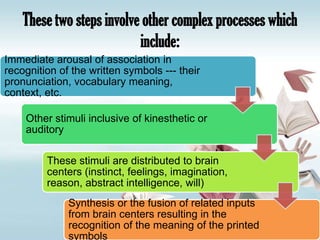
These two steps involve other complex processes which
                           include:
Immediate arousal of association in
recognition of the written symbols --- their
pronunciation, vocabulary meaning,
context, etc.

    Other stimuli inclusive of kinesthetic or
    auditory

         These stimuli are distributed to brain
         centers (instinct, feelings, imagination,
         reason, abstract intelligence, will)
              Synthesis or the fusion of related inputs
              from brain centers resulting in the
              recognition of the meaning of the printed
              symbols
Levels of
Comprehensio
     n
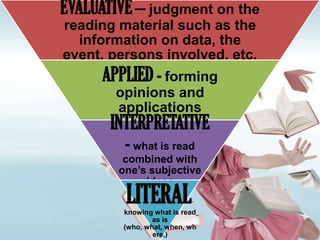
EVALUATIVE – judgment on the
reading material such as the
  information on data, the
event, persons involved, etc.
     APPLIED - forming
       opinions and
       applications
       INTERPRETATIVE
         - what is read
         combined with
        one’s subjective
             ideas
         LITERAL           -

         knowing what is read
                 as is
         (who, what, when, wh
                 ere,)
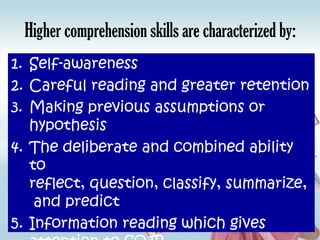
Higher comprehension skills are characterized by:
1. Self-awareness
2. Careful reading and greater retention
3. Making previous assumptions or
   hypothesis
4. The deliberate and combined ability
   to
   reflect, question, classify, summarize,
    and predict
5. Information reading which gives
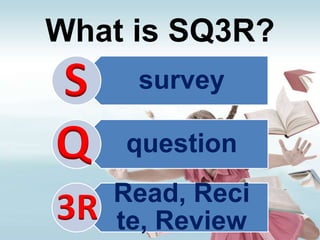
What is SQ3R?
S     survey

Q    question
     Read, Reci
3R   te, Review
How is reading as a
communication process?
LANGUAGE is a code system used by
humans to communicate. And as there
    are diverse languages, there are
diversities in the code system or symbol
  system as devised and used by man.
Characteristics of
   Language
1. Clarity
• The reader can more easily and immediately
  understand language when the code symbols
  are concrete rather than abstractions
  (universal ideas) and generalizations.
Example:
  Many students attended the student council
  meeting.
Improved: Ninety-five college students
  attended Tuesday’s student council meeting.
2. Simplicity
• Complex wording written for the sake of
  verbal erudition is less easily understood,
  compared with what is expressed directly
  and to the point.
Example:
 Shall we partake of our repast?
     Shall we eat?
Mother’s culinary dishes are exquisite.
     Mother cooks well.
3. Adapted Language
• Words of expression should relate to the
  reader’s age, educational attainment,
  gender, ethnic origin, other personal
  factors. The inappropriate use of technical
  or specialized words should also be
  avoided.
4. Forceful
• Stimulating language provides
  color, interest and excitement.
Example:
 He speaks at length while saying little.
  He spews forth words --- and says nothing.
5. Vivid Language
• Vivid wording is descriptive and stirs the
  senses of the reader.
  – Very good salesman --- crackerjacker persuader
  – Dishonest and evil --- festering corruption
  – Trouble spot --- seething hell
How is reading as a
psycho-social process?
1. People read messages from official
   communication, mass media and the
   internet.
2. Reading is a social activity that engages
   humans in the world.
3. Reading is also professional as it is a form of
   communication done in all the professions
   and human pursuits including scientific and
   technological research and studies.
4. Reading is a unique activity which you can
   adopt every day.
Reference:


Developmental Reading 1
By Aida S. Villanueva, Ph.D.
 and Rogelio L. Delos Santos

Reading as a process

  • 1.
    READING ASA PROCESS
  • 2.
    Reading involves manyprocesses. Physiological Cognitive Communication Psycho-social
  • 3.
  • 4.
    PHYSIOLOGY •Physiology is thescience dealing with the functions and vital processes of living organisms.
  • 5.
    How is readingas a physiological process?
  • 6.
    Light patterns from Eyessee the the printed symbols printed word hit the foveal areas or or the closely-packed images. sensory cells of the retina. Chemical change is induced that create patterns of nerve currents into the optic nerve fiber. Using the Currents currents, the travel to the cerebral cortex center of interprets the the mid- symbols. brain.
  • 7.
    What are the differenteye movements involved in reading?
  • 8.
    • Eyes stoppingor getting fixated on the word or words Fixation • The duration of fixation is the length of time the eyes has to pause. Inter-fixation • Eyes moving from stopping point to the other • Eyes swinging back from the end line to the beginning Return Sweeps of the next line • Short quick hop and jump movements done especially Saccades by literate people to move ahead on a line of print • Backward right-to-left movement in case there is a Regressions need to double check what is being read
  • 9.
    READING AS A COGNITIVE PROCESS
  • 10.
    TWO STEPS INVOLVEDIN COGNITION: • The extraneous process creates a stimulus on the visual centers of the brain. This consists in two essential aspects, namely, word recognition or the written symbols and attentive adjustment by the reader on these symbols. • Fusion/ interpretation/ construction of meaning by the mind out of the stimuli.
  • 11.
    These two stepsinvolve other complex processes which include: Immediate arousal of association in recognition of the written symbols --- their pronunciation, vocabulary meaning, context, etc. Other stimuli inclusive of kinesthetic or auditory These stimuli are distributed to brain centers (instinct, feelings, imagination, reason, abstract intelligence, will) Synthesis or the fusion of related inputs from brain centers resulting in the recognition of the meaning of the printed symbols
  • 12.
  • 13.
    EVALUATIVE – judgmenton the reading material such as the information on data, the event, persons involved, etc. APPLIED - forming opinions and applications INTERPRETATIVE - what is read combined with one’s subjective ideas LITERAL - knowing what is read as is (who, what, when, wh ere,)
  • 14.
    Higher comprehension skillsare characterized by: 1. Self-awareness 2. Careful reading and greater retention 3. Making previous assumptions or hypothesis 4. The deliberate and combined ability to reflect, question, classify, summarize, and predict 5. Information reading which gives
  • 15.
    What is SQ3R? S survey Q question Read, Reci 3R te, Review
  • 16.
    How is readingas a communication process?
  • 17.
    LANGUAGE is acode system used by humans to communicate. And as there are diverse languages, there are diversities in the code system or symbol system as devised and used by man.
  • 18.
  • 19.
    1. Clarity • Thereader can more easily and immediately understand language when the code symbols are concrete rather than abstractions (universal ideas) and generalizations. Example: Many students attended the student council meeting. Improved: Ninety-five college students attended Tuesday’s student council meeting.
  • 20.
    2. Simplicity • Complexwording written for the sake of verbal erudition is less easily understood, compared with what is expressed directly and to the point. Example: Shall we partake of our repast? Shall we eat? Mother’s culinary dishes are exquisite. Mother cooks well.
  • 21.
    3. Adapted Language •Words of expression should relate to the reader’s age, educational attainment, gender, ethnic origin, other personal factors. The inappropriate use of technical or specialized words should also be avoided.
  • 22.
    4. Forceful • Stimulatinglanguage provides color, interest and excitement. Example: He speaks at length while saying little. He spews forth words --- and says nothing.
  • 23.
    5. Vivid Language •Vivid wording is descriptive and stirs the senses of the reader. – Very good salesman --- crackerjacker persuader – Dishonest and evil --- festering corruption – Trouble spot --- seething hell
  • 24.
    How is readingas a psycho-social process?
  • 25.
    1. People readmessages from official communication, mass media and the internet. 2. Reading is a social activity that engages humans in the world. 3. Reading is also professional as it is a form of communication done in all the professions and human pursuits including scientific and technological research and studies. 4. Reading is a unique activity which you can adopt every day.
  • 26.
    Reference: Developmental Reading 1 ByAida S. Villanueva, Ph.D. and Rogelio L. Delos Santos