Types of VerbsParts of Speech Review
Types of VerbsA verb is a word that shows action or links a subject to another word in a sentence.There are 3 types of verbs:ActionLinking Helping
Types of VerbsAction Verb - tells what the subject is doingranhidewalkswimtold
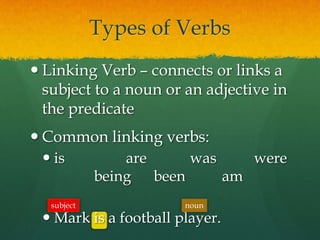
Types of VerbsLinking Verb – connects or links a subject to a noun or an adjective in the predicateCommon linking verbs:is		are 		was		were 		being      been		amMark is a football player.subjectnoun
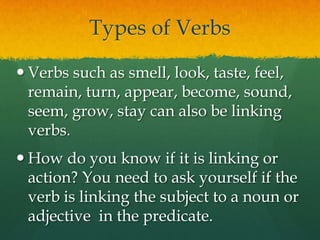
Types of VerbsVerbs such as smell, look, taste, feel, remain, turn, appear, become, sound, seem, grow, stay can also be linking verbs.How do you know if it is linking or action? You need to ask yourself if the verb is linking the subject to a noun or adjective  in the predicate.
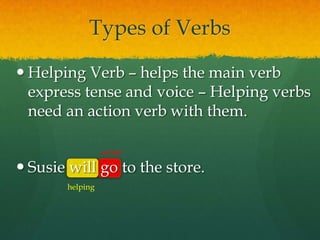
Types of VerbsHelping Verb – helps the main verb express tense and voice – Helping verbs need an action verb with them.Susie will go to the store.actionhelping
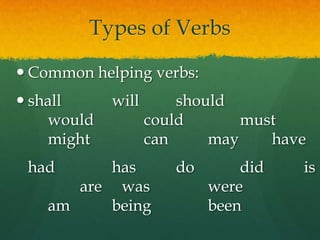
Types of VerbsCommon helping verbs: shall		will		should		would		could		must		might		can		may		have	had		has		do		did		is		are     was		were		am		being		been
Types of VerbsHow do you know if it is a helping verb or a linking verb?If there is an action verb in the clause also, it is a helping verb. If you do not see any other kind of verb, it is a linking verb.
Verb TenseVerbs are either past, present or future tense. In writing, you should always use the same tense for your verbs within your paragraph or essay.
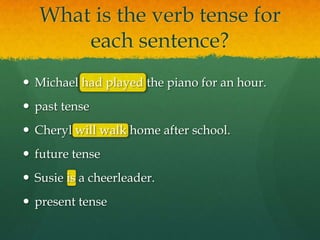
Michael had played the piano for an hour.past tenseCheryl will walk home after school.future tenseSusie is a cheerleader.present tenseWhat is the verb tense for each sentence?
The subject and verb in a clause should always agree in number. Joey walks. (singular subject/singular verb)Joey and Maggie walk. (plural subject/plural verb)She runs. (singular subject/singular verb)They run. (plural subject/plural verb)Subject – Verb Agreement

Types of Verbs

  • 1.
    Types of VerbsPartsof Speech Review
  • 2.
    Types of VerbsAverb is a word that shows action or links a subject to another word in a sentence.There are 3 types of verbs:ActionLinking Helping
  • 3.
    Types of VerbsActionVerb - tells what the subject is doingranhidewalkswimtold
  • 4.
    Types of VerbsLinkingVerb – connects or links a subject to a noun or an adjective in the predicateCommon linking verbs:is are was were being been amMark is a football player.subjectnoun
  • 5.
    Types of VerbsVerbssuch as smell, look, taste, feel, remain, turn, appear, become, sound, seem, grow, stay can also be linking verbs.How do you know if it is linking or action? You need to ask yourself if the verb is linking the subject to a noun or adjective in the predicate.
  • 6.
    Types of VerbsHelpingVerb – helps the main verb express tense and voice – Helping verbs need an action verb with them.Susie will go to the store.actionhelping
  • 7.
    Types of VerbsCommonhelping verbs: shall will should would could must might can may have had has do did is are was were am being been
  • 8.
    Types of VerbsHowdo you know if it is a helping verb or a linking verb?If there is an action verb in the clause also, it is a helping verb. If you do not see any other kind of verb, it is a linking verb.
  • 9.
    Verb TenseVerbs areeither past, present or future tense. In writing, you should always use the same tense for your verbs within your paragraph or essay.
  • 10.
    Michael had playedthe piano for an hour.past tenseCheryl will walk home after school.future tenseSusie is a cheerleader.present tenseWhat is the verb tense for each sentence?
  • 11.
    The subject andverb in a clause should always agree in number. Joey walks. (singular subject/singular verb)Joey and Maggie walk. (plural subject/plural verb)She runs. (singular subject/singular verb)They run. (plural subject/plural verb)Subject – Verb Agreement