ENGLISH
GRAMMA
R
SESSIONS FOR UPSC NDA & CDS
And Other Competitive
Examinations…
By : MAYANK
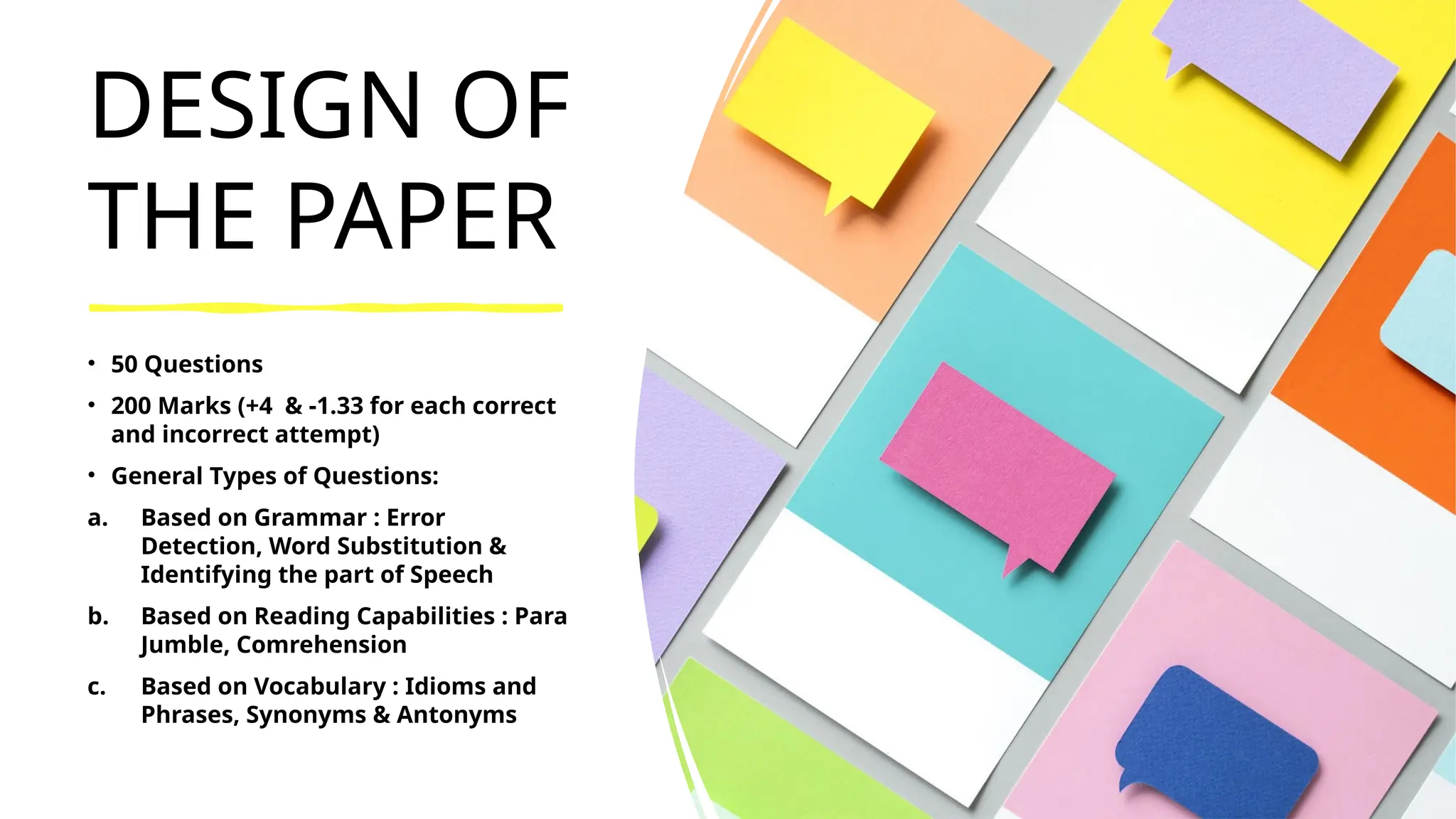
DESIGN OF
THE PAPER
• 50 Questions
• 200 Marks (+4 & -1.33 for each correct
and incorrect attempt)
• General Types of Questions:
a. Based on Grammar : Error
Detection, Word Substitution &
Identifying the part of Speech
b. Based on Reading Capabilities : Para
Jumble, Comrehension
c. Based on Vocabulary : Idioms and
Phrases, Synonyms & Antonyms
SPOTTING THE
ERRORS
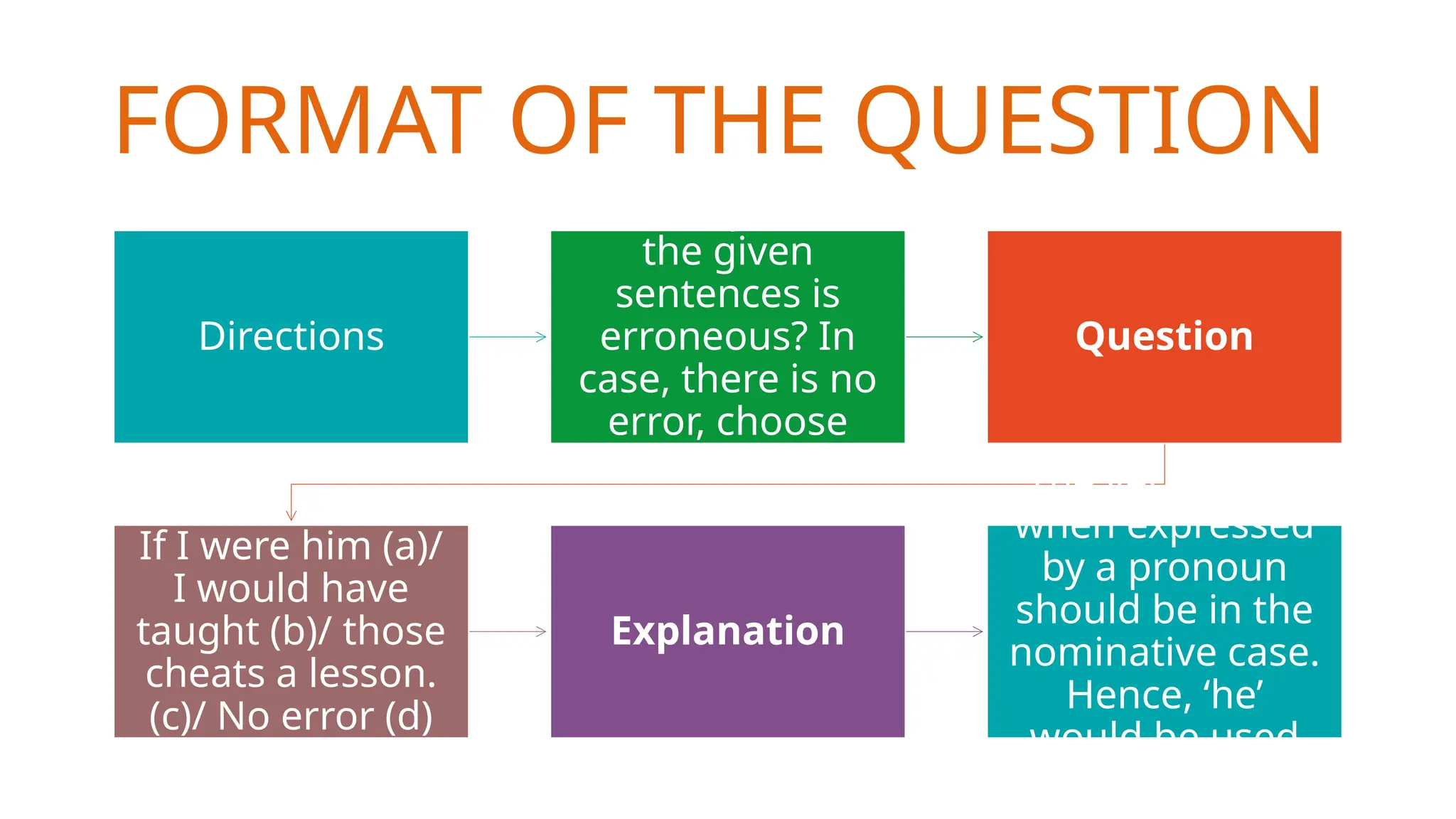
FORMAT OF THE QUESTION
Directions
Which part of
the given
sentences is
erroneous? In
case, there is no
error, choose
option (d).
Question
If I were him (a)/
I would have
taught (b)/ those
cheats a lesson.
(c)/ No error (d)
Explanation
The verb ‘were’
when expressed
by a pronoun
should be in the
nominative case.
Hence, ‘he’
would be used
instead of ‘him’.
NOUN Today’s Topic
DEFINITION
Noun is the
name of a
person, place
or a thing
apart from
intangible
Like :
Chittorgarh,
New York,
Cup, Chair,
Truth,
Charity,
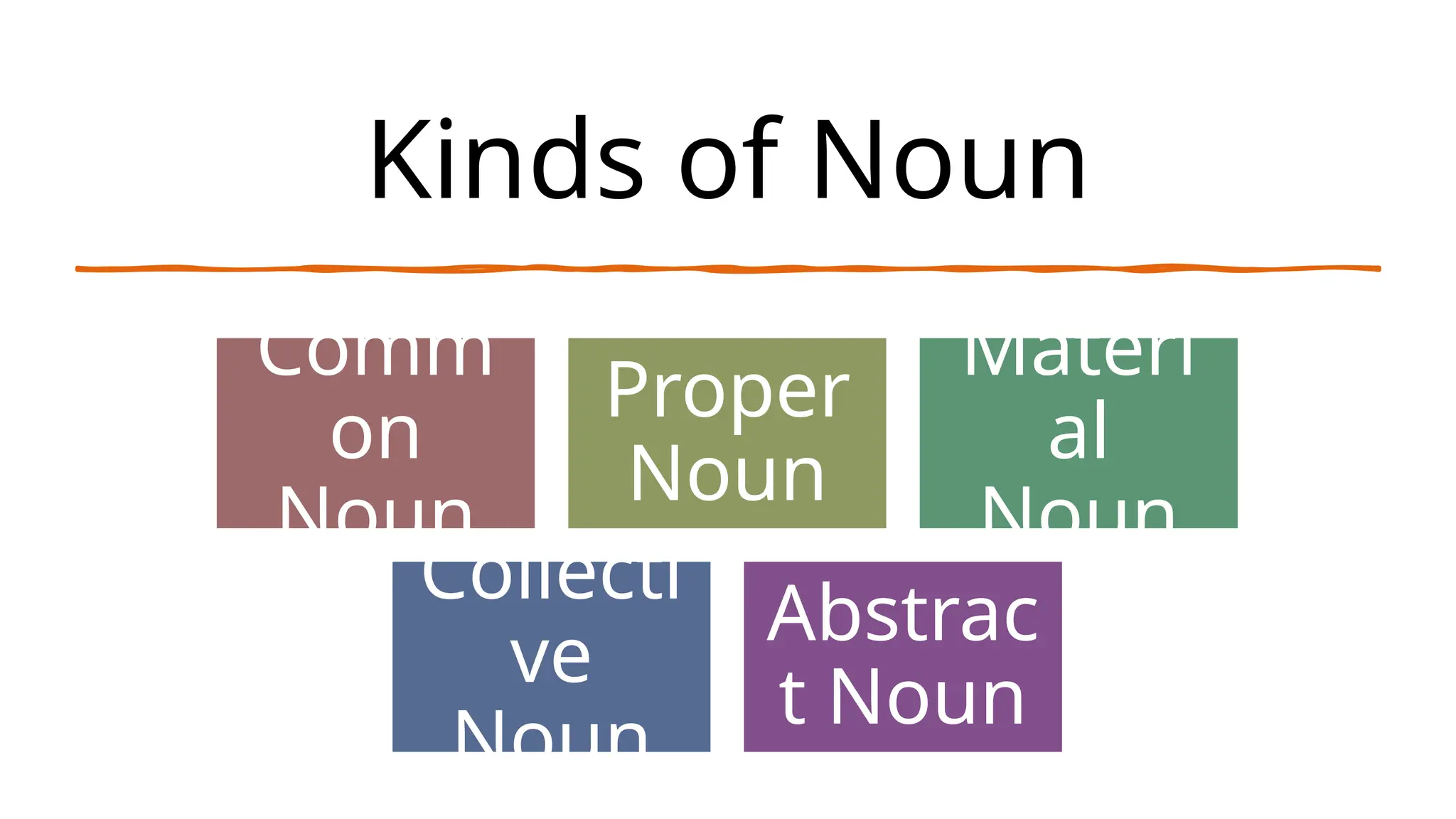
Kinds of Noun
Comm
on
Noun
Proper
Noun
Materi
al
Noun
Collecti
ve
Noun
Abstrac
t Noun
Rules of
Noun
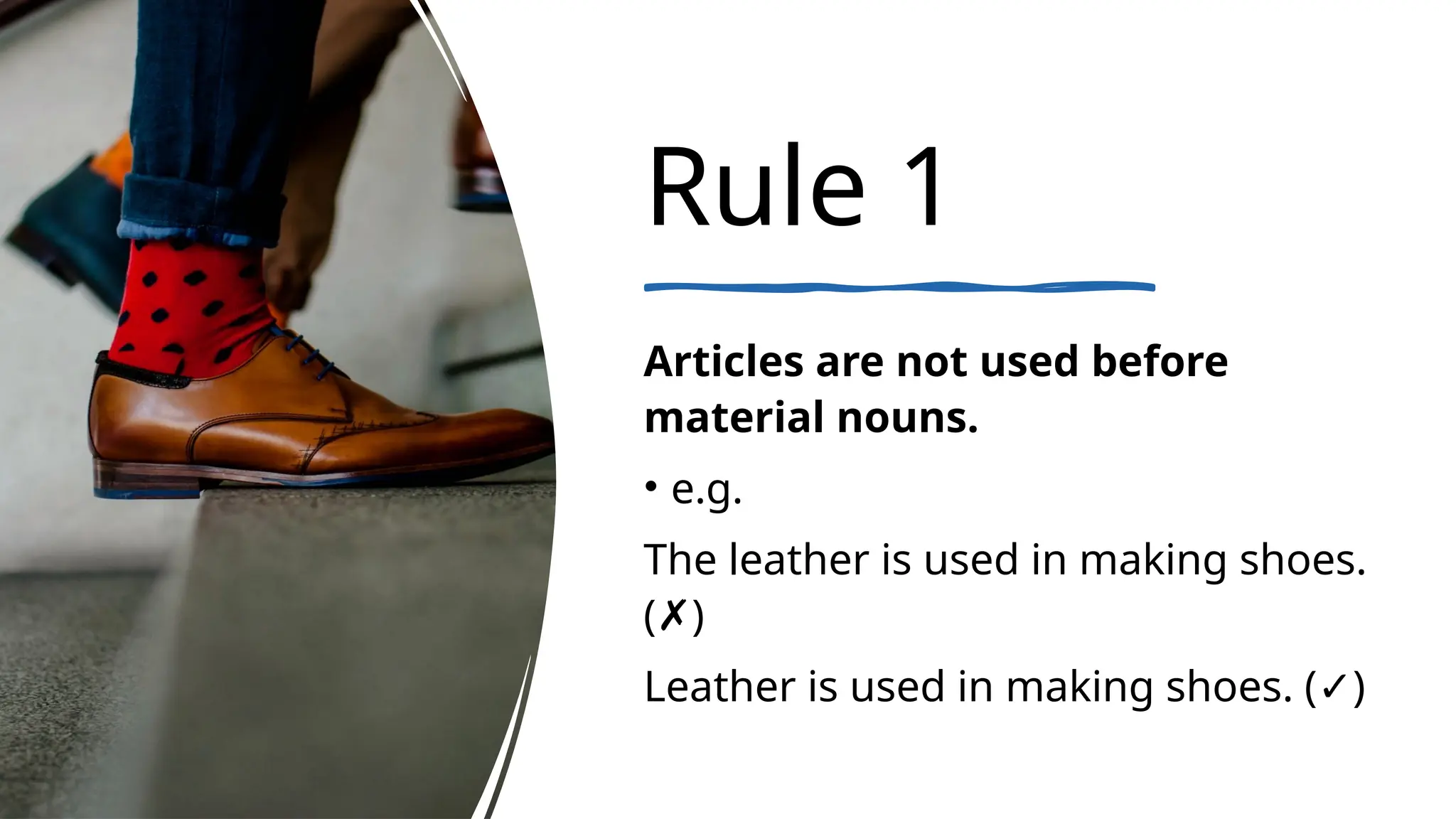
Rule 1
Articles are not used before
material nouns.
• e.g.
The leather is used in making shoes.
( )
✗
Leather is used in making shoes. ( )
✓
Rule 2
Material nouns and abstract
nouns are not used in plural.
• e.g. – Gold, Copper, Wood, Steel,
etc.
Cares of the old is necessary. ( )
✗
Care of the old is necessary. ( )
✓
Rule 3
Proper nouns are sometimes
used as common nouns.
e.g. –
• Samudragupta is the Napoleon
of India.
• Kalidas is the Shakespeare of
India.
Rule 4
• Collective nouns usually take a
singular verb and are substituted by a
singular pronoun.
• e.g.
The jury has given its verdict.
The team has performed to its
potential.
Rule 5 • Collective nouns take a plural
verb and are substituted by a
plural pronoun when the group
members do not behave as a
whole but take different
directions.
e.g. –
• The jury is / are divided in its /
their decision.
• The Ministry are much divided in
their opinion regarding the
foreign policy.
Rule 6
even
when
they
denote
living
beings,
are
consider
ed to be
of
neuter
gender.
• India has a
big army
and it is
divided
into three
major
divisions.
e.g.
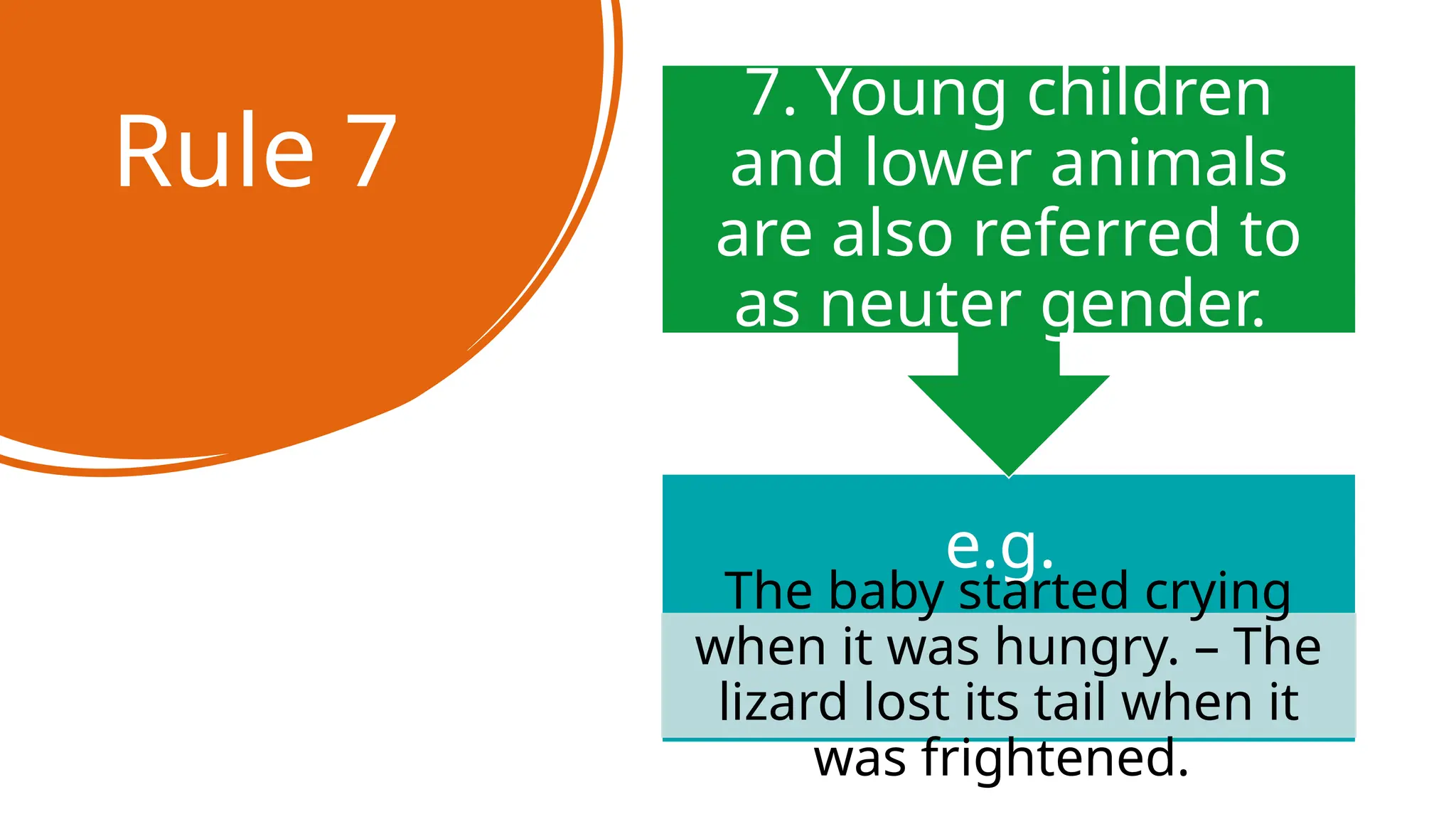
Rule 7
e.g.
The baby started crying
when it was hungry. – The
lizard lost its tail when it
was frightened.
7. Young children
and lower animals
are also referred to
as neuter gender.
Rule 8
• When objects without life are personified, they are
considered either of masculine or of feminine gender.
Masculine Gender is used for strength, violence, anger
and vengeance. It is used with sun, death, summer,
winter.
e.g.
Nature has taken his vengeance by claiming lives of 100
persons.
The sun, with his brilliance, came out of the clouds.
• These sentences emphasise the strong masculine traits of
nature and the sun, ‘vengeance’ and ‘brilliance’, so the
masculine gender ‘his’ is used.
• Feminine Gender is used for beauty, gentleness and
gracefulness. It is used with earth, moon, spring, nature and
even for sun.
e.g.
Nature offers its / her lap to those who seek it.
The sun, with her warmth, provided relief from the bitter cold.
• The tender feminine traits of nature and the sun are revealed.
So, the feminine gender (her) is used.
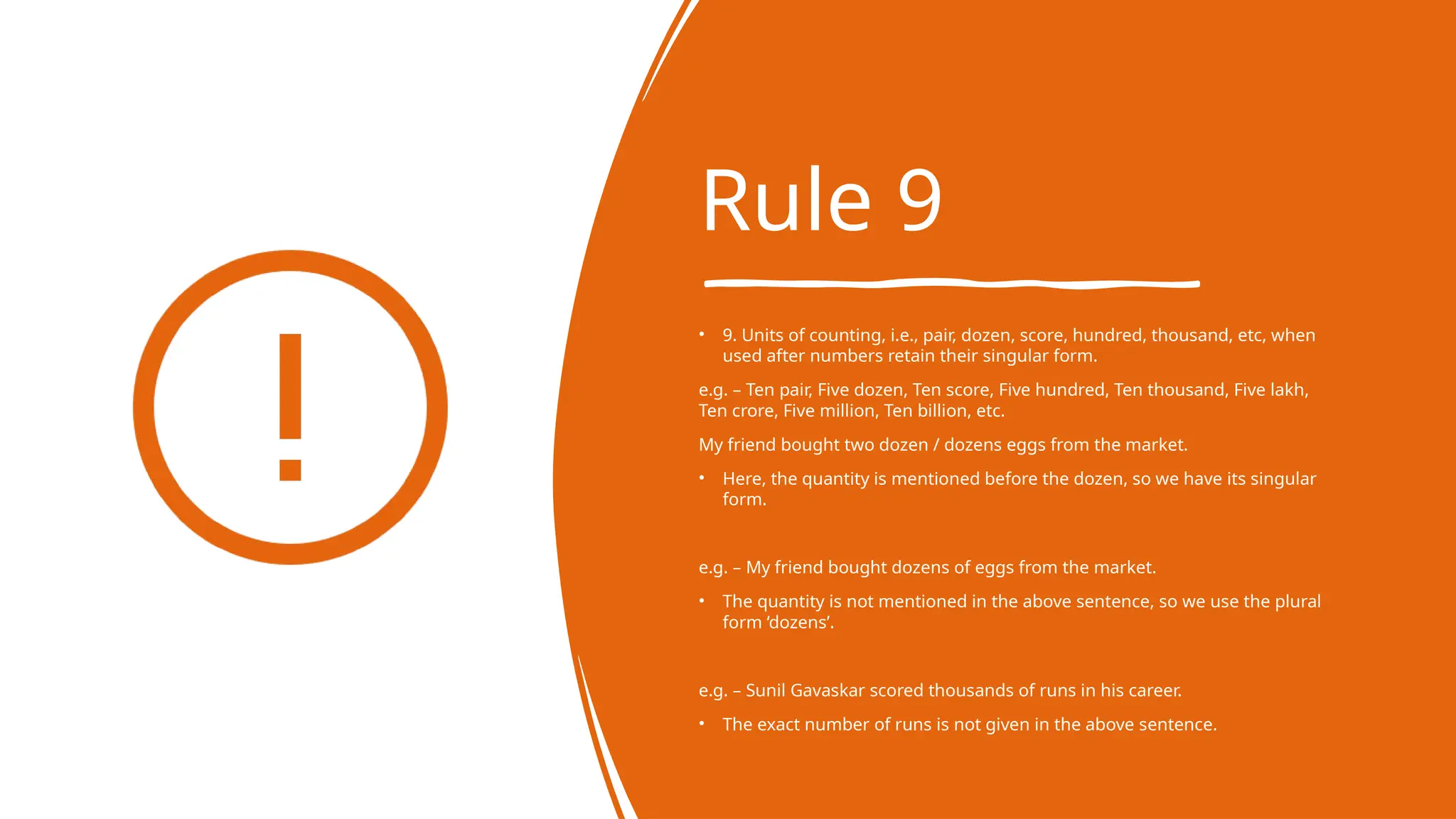
Rule 9
• 9. Units of counting, i.e., pair, dozen, score, hundred, thousand, etc, when
used after numbers retain their singular form.
e.g. – Ten pair, Five dozen, Ten score, Five hundred, Ten thousand, Five lakh,
Ten crore, Five million, Ten billion, etc.
My friend bought two dozen / dozens eggs from the market.
• Here, the quantity is mentioned before the dozen, so we have its singular
form.
e.g. – My friend bought dozens of eggs from the market.
• The quantity is not mentioned in the above sentence, so we use the plural
form ‘dozens’.
e.g. – Sunil Gavaskar scored thousands of runs in his career.
• The exact number of runs is not given in the above sentence.
Rule 10
• In a compound noun, a compound
word is not used in plural if a noun
does the work of an adjective.
e.g.
• He is pursuing a two year/ years
diploma course.
• He is a fifteen year/ years old boy.
• I have got a hundred rupee note.
• He ran a five mile race.
• They went on a fifteen day tour.
• The diploma course he is
pursuing, is of two years.
• The boy is of fifteen years.
• I have a note of hundred rupees.
• The race he ran was of five miles.
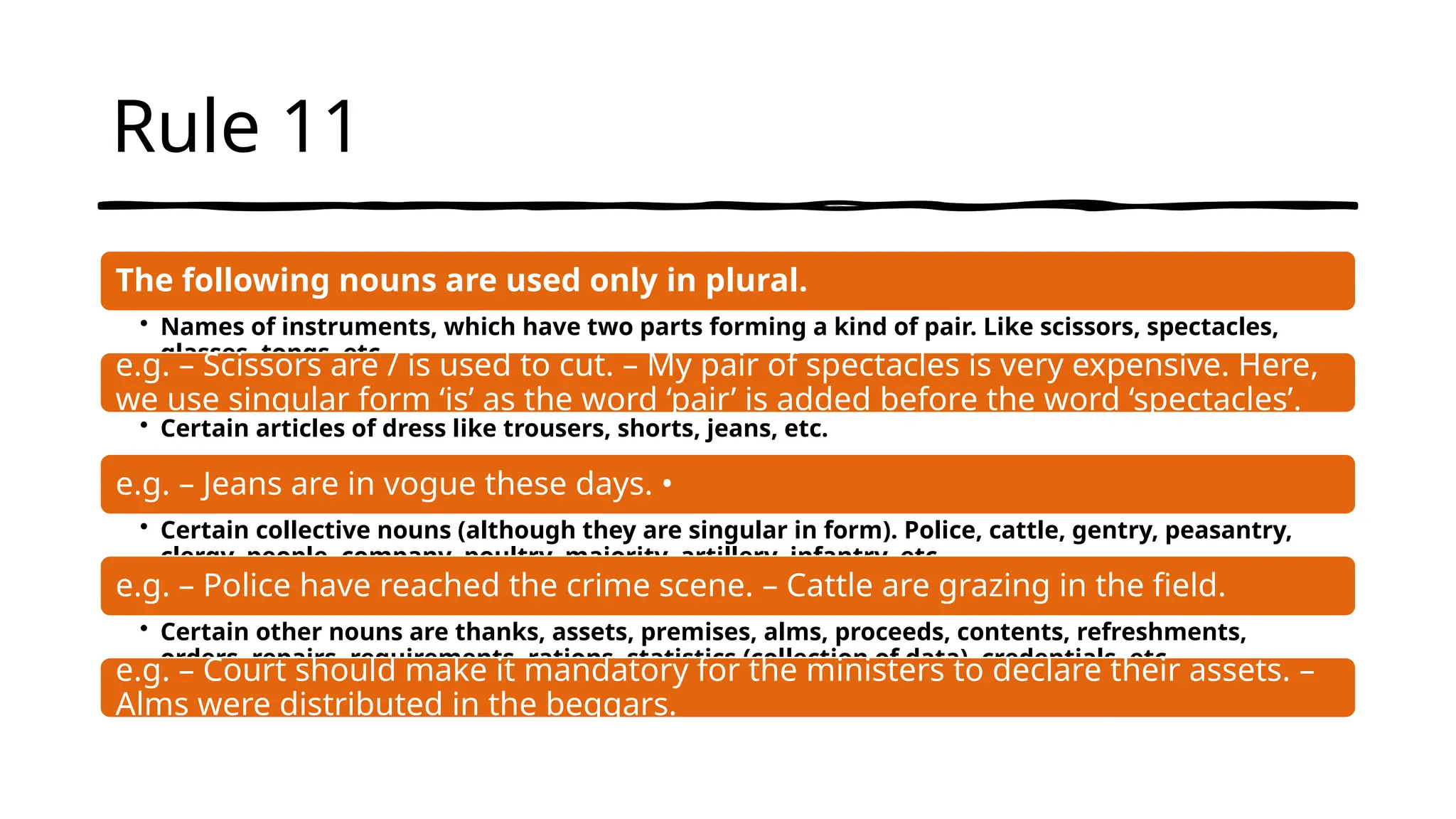
Rule 11
The following nouns are used only in plural.
• Names of instruments, which have two parts forming a kind of pair. Like scissors, spectacles,
glasses, tongs, etc.
e.g. – Scissors are / is used to cut. – My pair of spectacles is very expensive. Here,
we use singular form ‘is’ as the word ‘pair’ is added before the word ‘spectacles’.
• Certain articles of dress like trousers, shorts, jeans, etc.
e.g. – Jeans are in vogue these days. •
• Certain collective nouns (although they are singular in form). Police, cattle, gentry, peasantry,
clergy, people, company, poultry, majority, artillery, infantry, etc.
e.g. – Police have reached the crime scene. – Cattle are grazing in the field.
• Certain other nouns are thanks, assets, premises, alms, proceeds, contents, refreshments,
orders, repairs, requirements, rations, statistics (collection of data), credentials, etc.
e.g. – Court should make it mandatory for the ministers to declare their assets. –
Alms were distributed in the beggars.
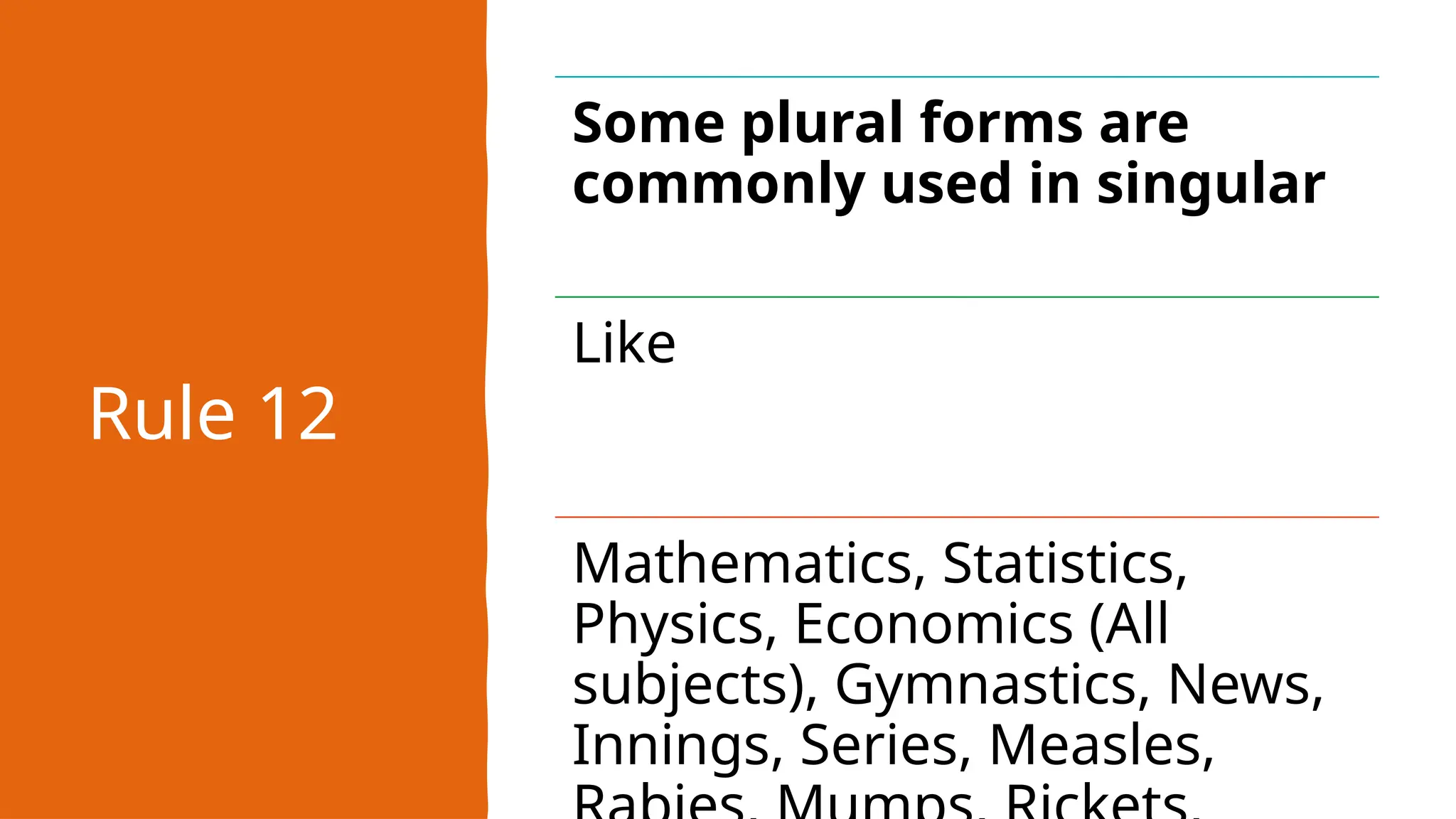
Rule 12
Some plural forms are
commonly used in singular
Like
Mathematics, Statistics,
Physics, Economics (All
subjects), Gymnastics, News,
Innings, Series, Measles,
Rule 13
Uncountable nouns are used in the singular forms only.
• Indefinite article (a, an) is not used before them, nor are they (a, an) used with plural
verbs. ‘Much’ is used in place of ‘Many’ for denoting plurality. Some of the important
nouns of this category are as follow Advice, information, hair, luggage, business, work,
word (promise), mischief, bread, scenery, abuse, vacation, evidence, employment,
alphabet, poetry, furniture, baggage, trouble, fuel, wheat, rice, stationary are material
nouns.
e.g. –
(a) He gave me an information. ( ) He gave me information. ( )
✗ ✓
(b) You should be true to your words. ( ) You should be true to your word. ( )
✗ ✓
(c) He was punished for committing many mischiefs. ( ) He was punished for
✗
committing much mischief. ( )
✓
Numbers of
Noun
TWO
TYPES
There are two kinds of numbers
of nouns, which are as follow
• Singular Noun
It refers to one (single) person,
thing, etc. e.g. boy, girl, table,
man, etc.
• Plural Noun
It refers to more than one
persons, things, etc. e.g. cities,
boys, girls, men, etc.
Sometimes plurals are
made by changing the
inside vowel.
Singular Plural
Man Men
Woman Women
Foot Feet
Tooth Teeth
Mouse Mice
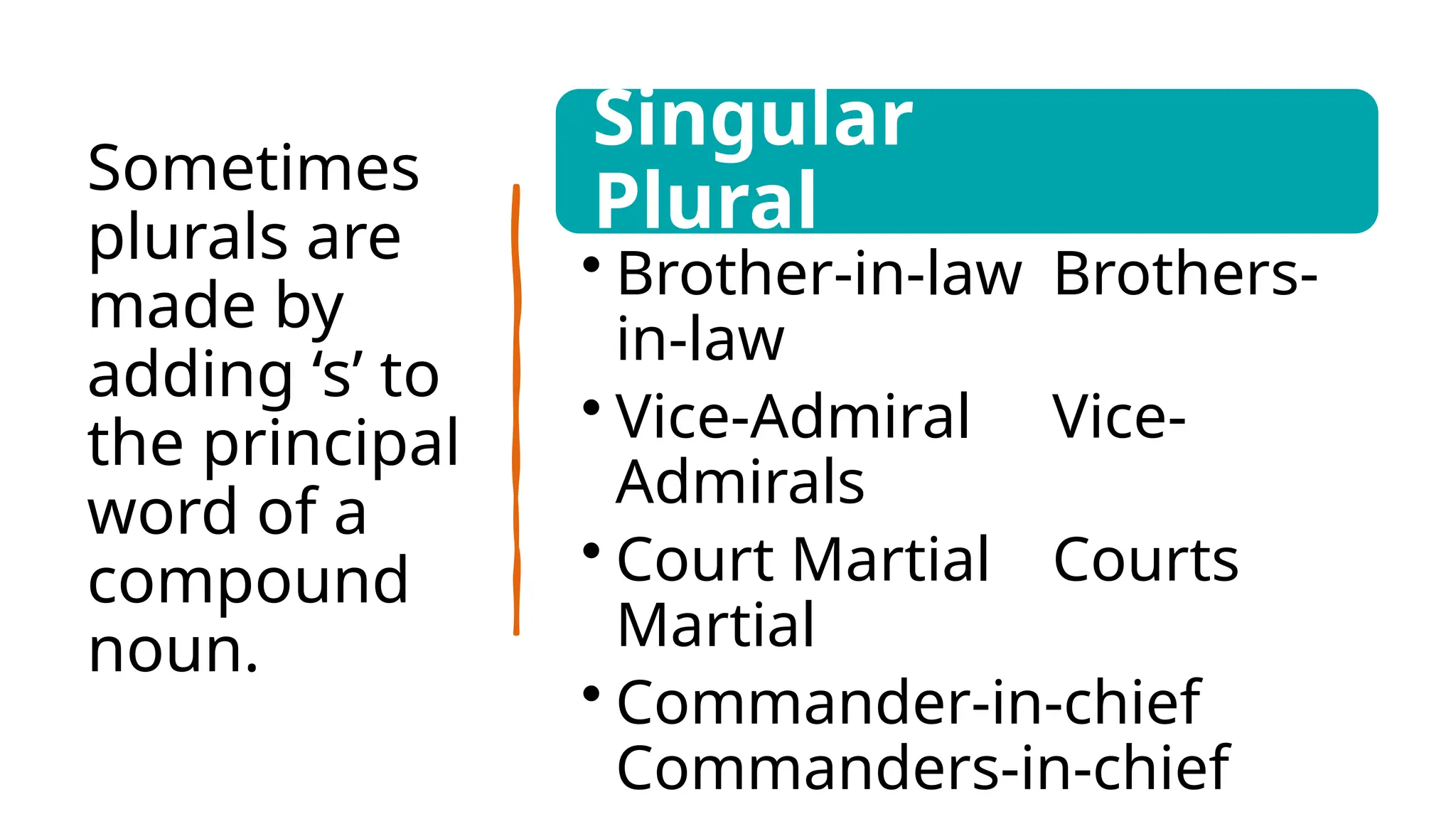
Sometimes
plurals are
made by
adding ‘s’ to
the principal
word of a
compound
noun.
Singular
Plural
• Brother-in-law Brothers-
in-law
• Vice-Admiral Vice-
Admirals
• Court Martial Courts
Martial
• Commander-in-chief
Commanders-in-chief
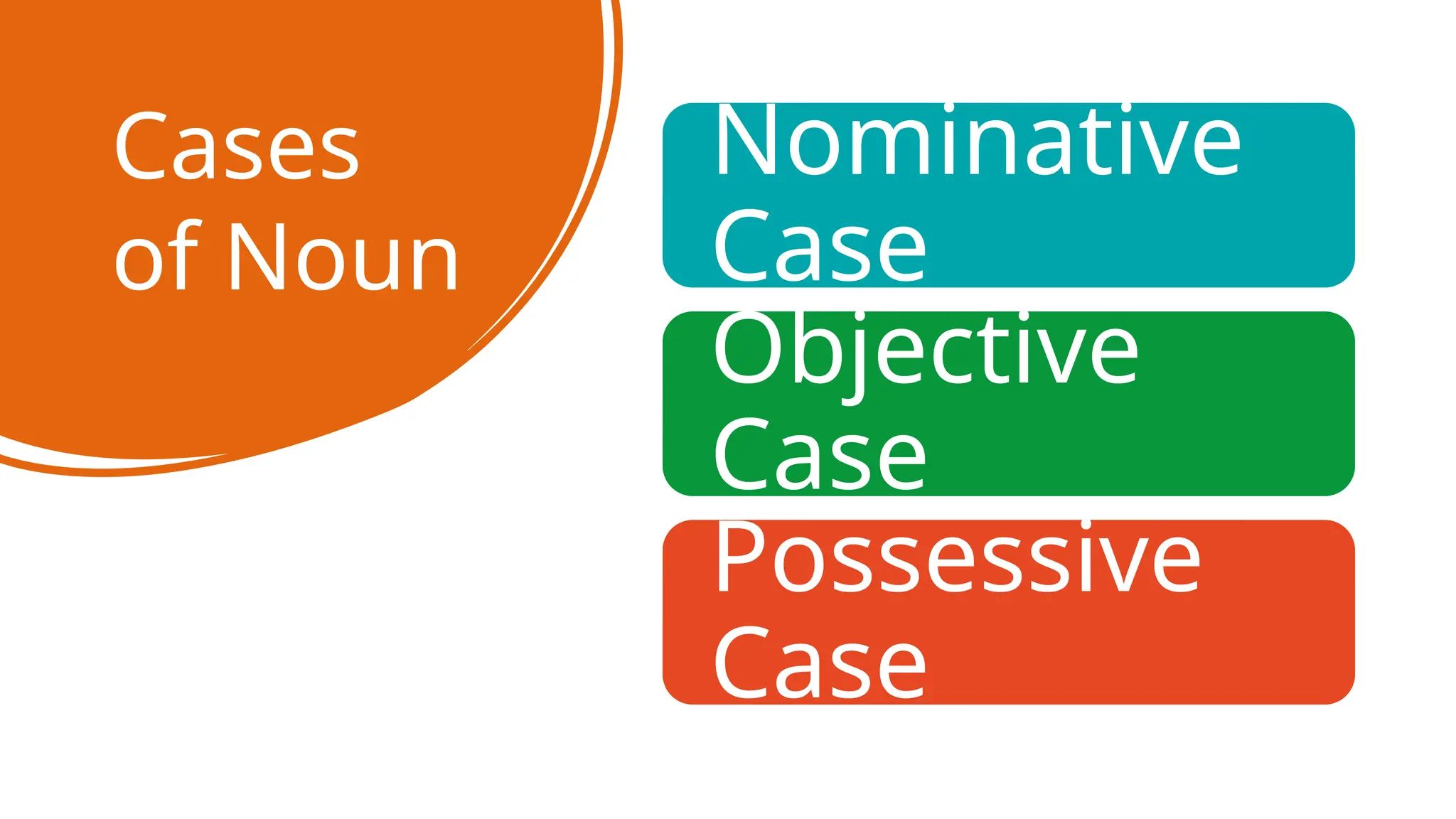
Cases
of Noun
Nominative
Case
Objective
Case
Possessive
Case
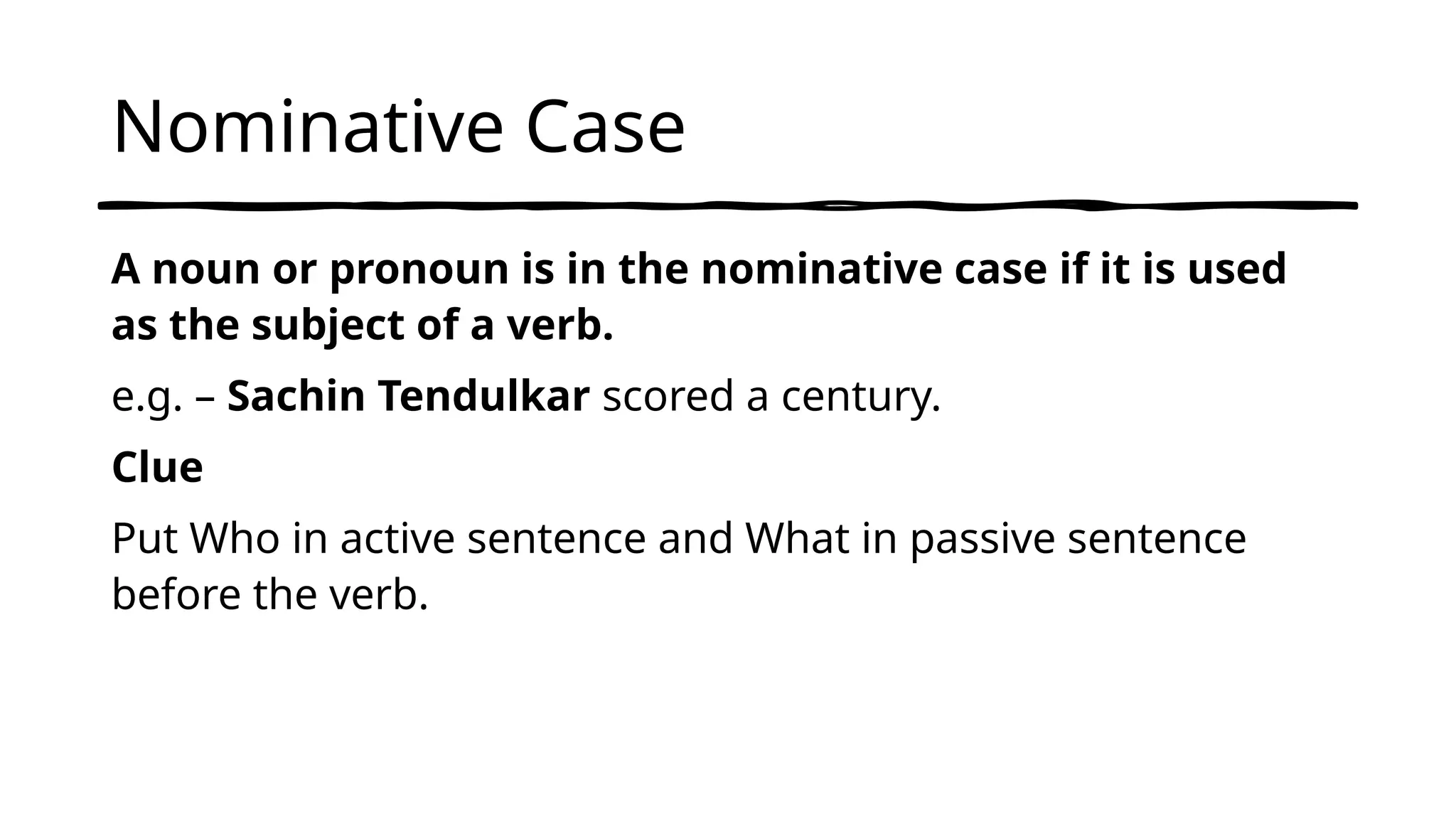
Nominative Case
A noun or pronoun is in the nominative case if it is used
as the subject of a verb.
e.g. – Sachin Tendulkar scored a century.
Clue
Put Who in active sentence and What in passive sentence
before the verb.
Objective Case
A noun or pronoun is in the objective case if it is used as
the object of a verb.
e.g.
Sachin Tendulkar scored a century (Active).
A century was scored by Sachin Tendulkar (Passive).
Clue
Put What in active sentence and Whom in the passive
sentence after the subject and the verb.
Possessive Case
A noun is said to be in the possessive case if it denotes
possession, authorship, origin, kind.
e.g. – Amit’s house is at the back-side
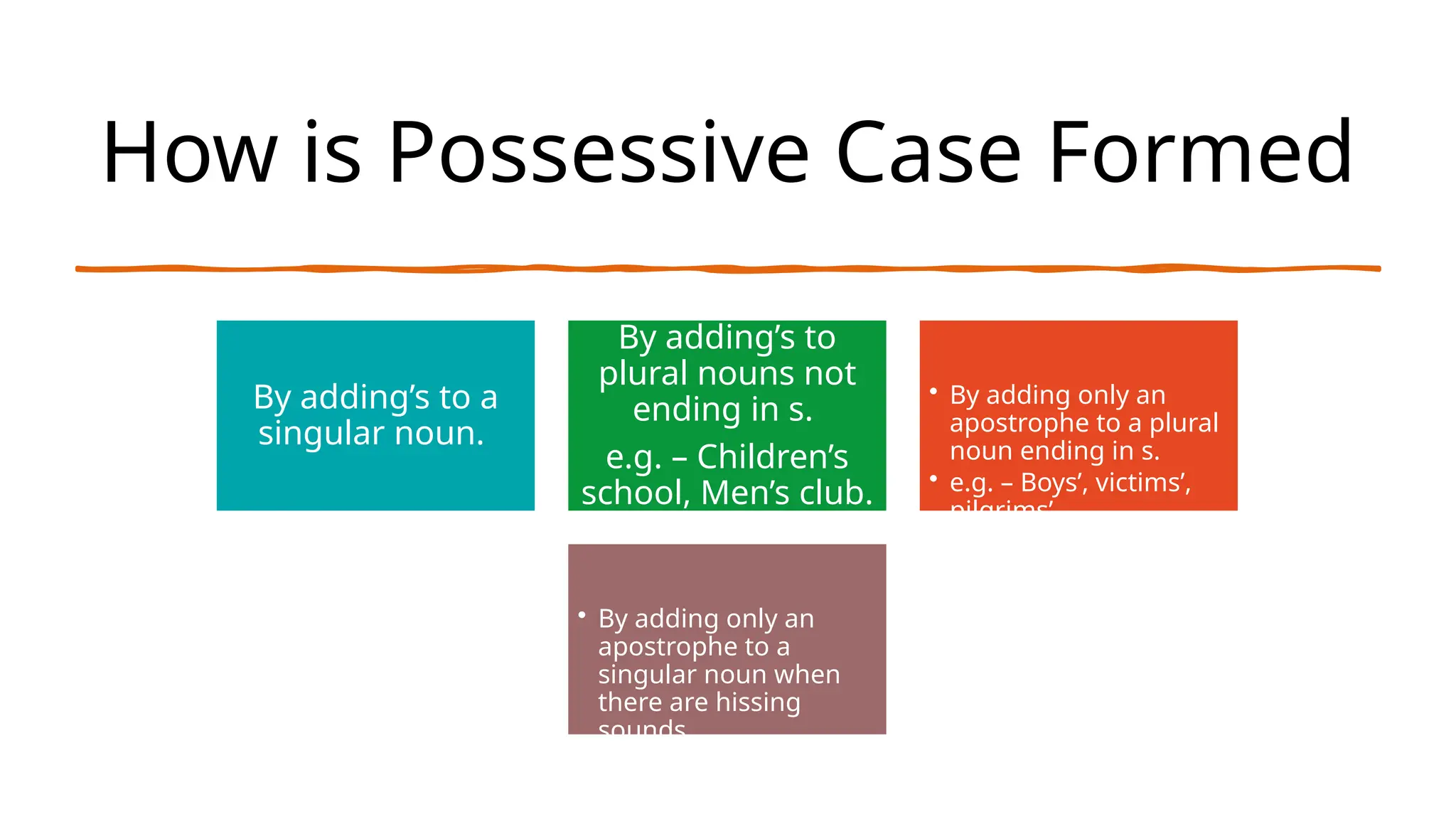
How is Possessive Case Formed
By adding’s to a
singular noun.
By adding’s to
plural nouns not
ending in s.
e.g. – Children’s
school, Men’s club.
• By adding only an
apostrophe to a plural
noun ending in s.
• e.g. – Boys’, victims’,
pilgrims’.
• By adding only an
apostrophe to a
singular noun when
there are hissing
sounds.
• e.g. – Jesus’ blessings,
for peace’ sake, for
Rules of
Possessive Case
• In case of a compound noun, the possessive sign is attached only to the last
word.
• When two or more nouns show joint possession, the apostrophe sign is put
with the latter only.
• The words his, hers, its, theirs, yours, ours are possessive and they are not
written with the possessive sign.
• The adverb ‘else’ combined with indefinite pronouns (somebody, anybody,
etc) is expressed in possessive case as ‘somebody else’s’ in place of
‘somebody’s else’.
• The words church, house, school, shop are often omitted after a possessive
case.
• The possessive case is chiefly used with the names of living things.
• The possessive case is also used with nouns denoting time, space or weight.
Confusing Nouns
Words Meaning Example
• Advice Singular means an opinion or suggestion. The
teacher gave many pieces of advice to the students before
the exam.
• Advices Plural (Advices) means information. The
invigilator gave advices to the students before the exam.
• Content Singular means satisfaction. I am content
with the contents of this book.
• Contents Plural means parts.
Words Denoting
Groups
• An army of soldiers.
• An alliance of states, powers, etc.
• An assembly of representatives.
• A convoy of ships.
• A corporation of people.
• A corps of soldiers, volunteers, police.
ERRORS
OF NOUN
EXAMPLE
Order has been issued (a)/ for his transfer to another district
(b)/ but he has not received them so far. (c)/ No error (d)
Answer & Explanation
Order has been issued (a)/ for his transfer to another district
(b)/ but he has not received them so far. (c)/ No error (d)
(a)
When a person is assigned to a new station, he receives his
‘orders’. This is a set of instructions, including where to be,
when to be there etc. So, the correct sentence would be
‘Orders have been issued ……… .’
EXAMPLE
There are two scores of books (a)/ which are lying (b)/ unused
in the library. (c)/ No error (d)

Noun and rule for spotting error for competitive exams

  • 1.
    ENGLISH GRAMMA R SESSIONS FOR UPSCNDA & CDS And Other Competitive Examinations… By : MAYANK
  • 2.
    DESIGN OF THE PAPER •50 Questions • 200 Marks (+4 & -1.33 for each correct and incorrect attempt) • General Types of Questions: a. Based on Grammar : Error Detection, Word Substitution & Identifying the part of Speech b. Based on Reading Capabilities : Para Jumble, Comrehension c. Based on Vocabulary : Idioms and Phrases, Synonyms & Antonyms
  • 3.
  • 4.
    FORMAT OF THEQUESTION Directions Which part of the given sentences is erroneous? In case, there is no error, choose option (d). Question If I were him (a)/ I would have taught (b)/ those cheats a lesson. (c)/ No error (d) Explanation The verb ‘were’ when expressed by a pronoun should be in the nominative case. Hence, ‘he’ would be used instead of ‘him’.
  • 5.
  • 6.
    DEFINITION Noun is the nameof a person, place or a thing apart from intangible Like : Chittorgarh, New York, Cup, Chair, Truth, Charity,
  • 7.
  • 8.
  • 9.
    Rule 1 Articles arenot used before material nouns. • e.g. The leather is used in making shoes. ( ) ✗ Leather is used in making shoes. ( ) ✓
  • 10.
    Rule 2 Material nounsand abstract nouns are not used in plural. • e.g. – Gold, Copper, Wood, Steel, etc. Cares of the old is necessary. ( ) ✗ Care of the old is necessary. ( ) ✓
  • 11.
    Rule 3 Proper nounsare sometimes used as common nouns. e.g. – • Samudragupta is the Napoleon of India. • Kalidas is the Shakespeare of India.
  • 12.
    Rule 4 • Collectivenouns usually take a singular verb and are substituted by a singular pronoun. • e.g. The jury has given its verdict. The team has performed to its potential.
  • 13.
    Rule 5 •Collective nouns take a plural verb and are substituted by a plural pronoun when the group members do not behave as a whole but take different directions. e.g. – • The jury is / are divided in its / their decision. • The Ministry are much divided in their opinion regarding the foreign policy.
  • 14.
    Rule 6 even when they denote living beings, are consider ed tobe of neuter gender. • India has a big army and it is divided into three major divisions. e.g.
  • 15.
    Rule 7 e.g. The babystarted crying when it was hungry. – The lizard lost its tail when it was frightened. 7. Young children and lower animals are also referred to as neuter gender.
  • 16.
    Rule 8 • Whenobjects without life are personified, they are considered either of masculine or of feminine gender. Masculine Gender is used for strength, violence, anger and vengeance. It is used with sun, death, summer, winter. e.g. Nature has taken his vengeance by claiming lives of 100 persons. The sun, with his brilliance, came out of the clouds. • These sentences emphasise the strong masculine traits of nature and the sun, ‘vengeance’ and ‘brilliance’, so the masculine gender ‘his’ is used. • Feminine Gender is used for beauty, gentleness and gracefulness. It is used with earth, moon, spring, nature and even for sun. e.g. Nature offers its / her lap to those who seek it. The sun, with her warmth, provided relief from the bitter cold. • The tender feminine traits of nature and the sun are revealed. So, the feminine gender (her) is used.
  • 17.
    Rule 9 • 9.Units of counting, i.e., pair, dozen, score, hundred, thousand, etc, when used after numbers retain their singular form. e.g. – Ten pair, Five dozen, Ten score, Five hundred, Ten thousand, Five lakh, Ten crore, Five million, Ten billion, etc. My friend bought two dozen / dozens eggs from the market. • Here, the quantity is mentioned before the dozen, so we have its singular form. e.g. – My friend bought dozens of eggs from the market. • The quantity is not mentioned in the above sentence, so we use the plural form ‘dozens’. e.g. – Sunil Gavaskar scored thousands of runs in his career. • The exact number of runs is not given in the above sentence.
  • 18.
    Rule 10 • Ina compound noun, a compound word is not used in plural if a noun does the work of an adjective. e.g. • He is pursuing a two year/ years diploma course. • He is a fifteen year/ years old boy. • I have got a hundred rupee note. • He ran a five mile race. • They went on a fifteen day tour. • The diploma course he is pursuing, is of two years. • The boy is of fifteen years. • I have a note of hundred rupees. • The race he ran was of five miles.
  • 19.
    Rule 11 The followingnouns are used only in plural. • Names of instruments, which have two parts forming a kind of pair. Like scissors, spectacles, glasses, tongs, etc. e.g. – Scissors are / is used to cut. – My pair of spectacles is very expensive. Here, we use singular form ‘is’ as the word ‘pair’ is added before the word ‘spectacles’. • Certain articles of dress like trousers, shorts, jeans, etc. e.g. – Jeans are in vogue these days. • • Certain collective nouns (although they are singular in form). Police, cattle, gentry, peasantry, clergy, people, company, poultry, majority, artillery, infantry, etc. e.g. – Police have reached the crime scene. – Cattle are grazing in the field. • Certain other nouns are thanks, assets, premises, alms, proceeds, contents, refreshments, orders, repairs, requirements, rations, statistics (collection of data), credentials, etc. e.g. – Court should make it mandatory for the ministers to declare their assets. – Alms were distributed in the beggars.
  • 20.
    Rule 12 Some pluralforms are commonly used in singular Like Mathematics, Statistics, Physics, Economics (All subjects), Gymnastics, News, Innings, Series, Measles,
  • 21.
    Rule 13 Uncountable nounsare used in the singular forms only. • Indefinite article (a, an) is not used before them, nor are they (a, an) used with plural verbs. ‘Much’ is used in place of ‘Many’ for denoting plurality. Some of the important nouns of this category are as follow Advice, information, hair, luggage, business, work, word (promise), mischief, bread, scenery, abuse, vacation, evidence, employment, alphabet, poetry, furniture, baggage, trouble, fuel, wheat, rice, stationary are material nouns. e.g. – (a) He gave me an information. ( ) He gave me information. ( ) ✗ ✓ (b) You should be true to your words. ( ) You should be true to your word. ( ) ✗ ✓ (c) He was punished for committing many mischiefs. ( ) He was punished for ✗ committing much mischief. ( ) ✓
  • 22.
  • 23.
    TWO TYPES There are twokinds of numbers of nouns, which are as follow • Singular Noun It refers to one (single) person, thing, etc. e.g. boy, girl, table, man, etc. • Plural Noun It refers to more than one persons, things, etc. e.g. cities, boys, girls, men, etc.
  • 24.
    Sometimes plurals are madeby changing the inside vowel. Singular Plural Man Men Woman Women Foot Feet Tooth Teeth Mouse Mice
  • 25.
    Sometimes plurals are made by adding‘s’ to the principal word of a compound noun. Singular Plural • Brother-in-law Brothers- in-law • Vice-Admiral Vice- Admirals • Court Martial Courts Martial • Commander-in-chief Commanders-in-chief
  • 26.
  • 27.
    Nominative Case A nounor pronoun is in the nominative case if it is used as the subject of a verb. e.g. – Sachin Tendulkar scored a century. Clue Put Who in active sentence and What in passive sentence before the verb.
  • 28.
    Objective Case A nounor pronoun is in the objective case if it is used as the object of a verb. e.g. Sachin Tendulkar scored a century (Active). A century was scored by Sachin Tendulkar (Passive). Clue Put What in active sentence and Whom in the passive sentence after the subject and the verb.
  • 29.
    Possessive Case A nounis said to be in the possessive case if it denotes possession, authorship, origin, kind. e.g. – Amit’s house is at the back-side
  • 30.
    How is PossessiveCase Formed By adding’s to a singular noun. By adding’s to plural nouns not ending in s. e.g. – Children’s school, Men’s club. • By adding only an apostrophe to a plural noun ending in s. • e.g. – Boys’, victims’, pilgrims’. • By adding only an apostrophe to a singular noun when there are hissing sounds. • e.g. – Jesus’ blessings, for peace’ sake, for
  • 31.
    Rules of Possessive Case •In case of a compound noun, the possessive sign is attached only to the last word. • When two or more nouns show joint possession, the apostrophe sign is put with the latter only. • The words his, hers, its, theirs, yours, ours are possessive and they are not written with the possessive sign. • The adverb ‘else’ combined with indefinite pronouns (somebody, anybody, etc) is expressed in possessive case as ‘somebody else’s’ in place of ‘somebody’s else’. • The words church, house, school, shop are often omitted after a possessive case. • The possessive case is chiefly used with the names of living things. • The possessive case is also used with nouns denoting time, space or weight.
  • 32.
    Confusing Nouns Words MeaningExample • Advice Singular means an opinion or suggestion. The teacher gave many pieces of advice to the students before the exam. • Advices Plural (Advices) means information. The invigilator gave advices to the students before the exam. • Content Singular means satisfaction. I am content with the contents of this book. • Contents Plural means parts.
  • 33.
    Words Denoting Groups • Anarmy of soldiers. • An alliance of states, powers, etc. • An assembly of representatives. • A convoy of ships. • A corporation of people. • A corps of soldiers, volunteers, police.
  • 34.
  • 35.
    EXAMPLE Order has beenissued (a)/ for his transfer to another district (b)/ but he has not received them so far. (c)/ No error (d)
  • 36.
    Answer & Explanation Orderhas been issued (a)/ for his transfer to another district (b)/ but he has not received them so far. (c)/ No error (d) (a) When a person is assigned to a new station, he receives his ‘orders’. This is a set of instructions, including where to be, when to be there etc. So, the correct sentence would be ‘Orders have been issued ……… .’
  • 37.
    EXAMPLE There are twoscores of books (a)/ which are lying (b)/ unused in the library. (c)/ No error (d)