CREATING BY:
NAIMUR RAHMAN (16116026)
ANNIE ALAM (16116024)
SAMIA NUSRAT NUHA (16116023)
MAHZABIN SABERA (15116018)
AFROZA AKHTER FEMI (16116005)
Presentation
on
Writing Skills
Contents
 What is writing ?
 The Writing Process
 Brush up on the basic
 Write like it's our job
 Editing the writing
 Find a best place to write
 Why writing is important
 How to Improve students’ Writing
 Types of writing
 Common Errors & Tips
 Strategies to Improve Writing
 Conclusions
What is Writing ?
 Writing can be said to be the act of forming the symbols: making marks on flat
surface of some kind.
 Writing is a process where symbols have to be arranged according to a certain
conventions to form words and words have to be arranged to form sentences.
 Writing involves encoding of a message of some kind: that is we translate our
thoughts into language. (Byren, 1988)
The Writing Process
Planning : Keep objectives in mind and research the
topic .Think about the audience. Outlining helps
organize thoughts.
Writing : Follow your outline, use your handbook.
Inspiration is acceptable but must be carefully reviewed.
Quality Control :Reread your work. Be critical of your
own work
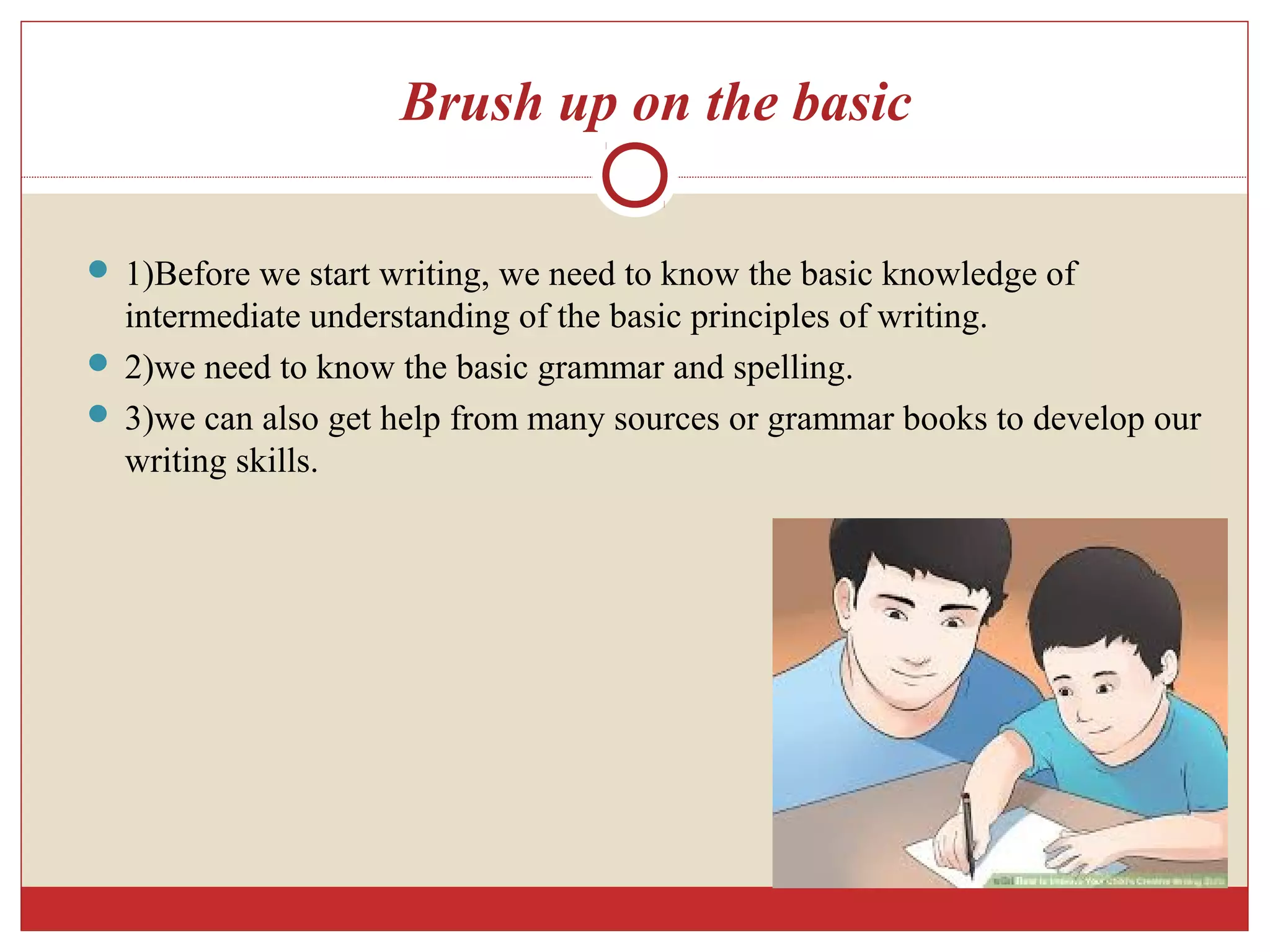
Brush up on the basic
 1)Before we start writing, we need to know the basic knowledge of
intermediate understanding of the basic principles of writing.
 2)we need to know the basic grammar and spelling.
 3)we can also get help from many sources or grammar books to develop our
writing skills.
Write like it's our job
 If we want a get better something, we have to practice writing over and over.
 For improving our writing skills we have to write regular on the basic topics.
 We can also write in a blank page what things are going on our mind. it not
only removes our fear of writing but also helps to develop a unique style.
 By practicing writing it can make our writing perfect.
Editing the writing
 Editing is one of the most essential parts of writing.
 Once we finish a piece of writing, let it sit for a day and then read it over
with fresh eyes, catching confusing bits.
 Then when we are done to read, give it another read and another.
 By editing writing we can find our mistakes. for this we can correct them.
Find a best place to write
 We should try writing in different places or at different times of the day.
 If we want to write a block, we need to get up 15 minutes earlier and writing
in the morning.
 Maybe we have trouble writing where there is a lot of noise. So we should try
writing in a quiet and comfortable place.
Why Writing is important ?
 Writing is the primary basis upon which your work, your learning, and your
intellect will be judged—in college, in the workplace, and in the community.
 Writing skills are an important part of communication.
 Writing is an essential for job skill.
 Writing helps you move easily among facts, inferences, and opinions without
getting confused—and without confusing your reader.
 Writing expresses who you are as a person.
 Writing helps others give you feedback.
How to Improve students’ Writing?
 Teach students how to hold pen or pencil.
 Encourage students to write with pencil at early stages.
 Scribbling, and drawing lines, shapes, and pictures are the first steps towards
writing.
 Make a habit to writing English everyday.
 Drawing should be encouraged by providing time and materials as soon as children
are old enough to hold a crayon.
 Start writing 10 sentences everyday.
Continue
 Write every day it’s better to practice for fifteen minutes every day than to practice
for two hours three times a week.
 Proofread, edit, and revise.
 Know your strengths and accept your weaknesses.
 Focus grammar.
 Intensive and extensive reading.
Continue
 Respect every learner’s personal best.
 Celebrate successes in appropriate ways.
 Establish time for daily writing at school as well as at home.
 Ask someone to check your writing.
 Don’t be afraid to commit mistakes.
Types of Writing
 Free writing
 Independent Writing
 Process writing
 Easy writing
 Narrative writing
 Expository writing
 Persuasive writing
Common Errors & Tips
 Company name usage
 Shortened words (thru, condn, mgmt, ref, lib)
 Repetition of words
Example: file the file in the file folder.
 Use of ampersand (&)
 Use of bold
 UPPER CASE
Continue
Punctuation
 Use commas to separate elements in a series, and to separate ideas or clauses.
 Use correct punctuation in abbreviations; e.g., for example i.e., that is etc., et
cetera .
 Do not use multiple punctuation marks, for example: !!! ... ???, etc.
 Punctuation of lists and tables
Continue
 Hyphen and dash usage
 Confusion between its and it's
 Use of apostrophe
 Abbreviations and acronyms
 Use active voice
 Do not switch tenses very often
 Proofread for accuracy
Strategies to improve writing
 Scribbling.
 Drawing lines.
 Construct and de construct words.
 Dot writing.
 Dictation.
 Copying
Conclusions
 Utilize full potential of written communication.
 Use frequent e-mails as per your requirement.
 What you write will ultimately define you as a professional to your friends.
 Match the appropriate communication method to the recipient.
 Eliminating excessive or unnecessary communication will improve your
workflow.
 Mastering these skills will improve your ability and enhance your career.
Good Luck
Happy writinG
?

How to Improve your writing skills

  • 2.
    CREATING BY: NAIMUR RAHMAN(16116026) ANNIE ALAM (16116024) SAMIA NUSRAT NUHA (16116023) MAHZABIN SABERA (15116018) AFROZA AKHTER FEMI (16116005) Presentation on Writing Skills
  • 3.
    Contents  What iswriting ?  The Writing Process  Brush up on the basic  Write like it's our job  Editing the writing  Find a best place to write  Why writing is important  How to Improve students’ Writing  Types of writing  Common Errors & Tips  Strategies to Improve Writing  Conclusions
  • 4.
    What is Writing?  Writing can be said to be the act of forming the symbols: making marks on flat surface of some kind.  Writing is a process where symbols have to be arranged according to a certain conventions to form words and words have to be arranged to form sentences.  Writing involves encoding of a message of some kind: that is we translate our thoughts into language. (Byren, 1988)
  • 5.
    The Writing Process Planning: Keep objectives in mind and research the topic .Think about the audience. Outlining helps organize thoughts. Writing : Follow your outline, use your handbook. Inspiration is acceptable but must be carefully reviewed. Quality Control :Reread your work. Be critical of your own work
  • 6.
    Brush up onthe basic  1)Before we start writing, we need to know the basic knowledge of intermediate understanding of the basic principles of writing.  2)we need to know the basic grammar and spelling.  3)we can also get help from many sources or grammar books to develop our writing skills.
  • 7.
    Write like it'sour job  If we want a get better something, we have to practice writing over and over.  For improving our writing skills we have to write regular on the basic topics.  We can also write in a blank page what things are going on our mind. it not only removes our fear of writing but also helps to develop a unique style.  By practicing writing it can make our writing perfect.
  • 8.
    Editing the writing Editing is one of the most essential parts of writing.  Once we finish a piece of writing, let it sit for a day and then read it over with fresh eyes, catching confusing bits.  Then when we are done to read, give it another read and another.  By editing writing we can find our mistakes. for this we can correct them.
  • 9.
    Find a bestplace to write  We should try writing in different places or at different times of the day.  If we want to write a block, we need to get up 15 minutes earlier and writing in the morning.  Maybe we have trouble writing where there is a lot of noise. So we should try writing in a quiet and comfortable place.
  • 10.
    Why Writing isimportant ?  Writing is the primary basis upon which your work, your learning, and your intellect will be judged—in college, in the workplace, and in the community.  Writing skills are an important part of communication.  Writing is an essential for job skill.  Writing helps you move easily among facts, inferences, and opinions without getting confused—and without confusing your reader.  Writing expresses who you are as a person.  Writing helps others give you feedback.
  • 11.
    How to Improvestudents’ Writing?  Teach students how to hold pen or pencil.  Encourage students to write with pencil at early stages.  Scribbling, and drawing lines, shapes, and pictures are the first steps towards writing.  Make a habit to writing English everyday.  Drawing should be encouraged by providing time and materials as soon as children are old enough to hold a crayon.  Start writing 10 sentences everyday.
  • 12.
    Continue  Write everyday it’s better to practice for fifteen minutes every day than to practice for two hours three times a week.  Proofread, edit, and revise.  Know your strengths and accept your weaknesses.  Focus grammar.  Intensive and extensive reading.
  • 13.
    Continue  Respect everylearner’s personal best.  Celebrate successes in appropriate ways.  Establish time for daily writing at school as well as at home.  Ask someone to check your writing.  Don’t be afraid to commit mistakes.
  • 14.
    Types of Writing Free writing  Independent Writing  Process writing  Easy writing  Narrative writing  Expository writing  Persuasive writing
  • 15.
    Common Errors &Tips  Company name usage  Shortened words (thru, condn, mgmt, ref, lib)  Repetition of words Example: file the file in the file folder.  Use of ampersand (&)  Use of bold  UPPER CASE
  • 16.
    Continue Punctuation  Use commasto separate elements in a series, and to separate ideas or clauses.  Use correct punctuation in abbreviations; e.g., for example i.e., that is etc., et cetera .  Do not use multiple punctuation marks, for example: !!! ... ???, etc.  Punctuation of lists and tables
  • 17.
    Continue  Hyphen anddash usage  Confusion between its and it's  Use of apostrophe  Abbreviations and acronyms  Use active voice  Do not switch tenses very often  Proofread for accuracy
  • 18.
    Strategies to improvewriting  Scribbling.  Drawing lines.  Construct and de construct words.  Dot writing.  Dictation.  Copying
  • 19.
    Conclusions  Utilize fullpotential of written communication.  Use frequent e-mails as per your requirement.  What you write will ultimately define you as a professional to your friends.  Match the appropriate communication method to the recipient.  Eliminating excessive or unnecessary communication will improve your workflow.  Mastering these skills will improve your ability and enhance your career.
  • 20.
  • 21.