Note
Taking &
Study Techniques
Presented BY:
The English Academy
91 88666 80407/97279 19756
englishacademybaroda@gmail.com
Corporate Training │ Personality Development │ Mentoring │ Hand Holding
Note Taking &
Study Techniques
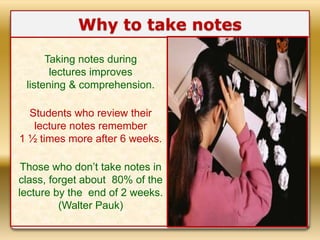
Why to take notes
Taking notes during
lectures improves
listening & comprehension.
Students who review their
lecture notes remember
1 ½ times more after 6 weeks.
Those who don’t take notes in
class, forget about 80% of the
lecture by the end of 2 weeks.
(Walter Pauk)
 When you are reviewing, notes provide a gauge to
what is important in the text.
 Personal notes are easier to remember.
 The writing down of important points helps you to
remember them even before you have studied the
material formally.
Why to take notes
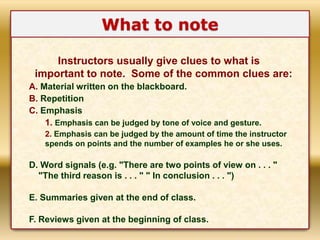
Instructors usually give clues to what is
important to note. Some of the common clues are:
A. Material written on the blackboard.
B. Repetition
C. Emphasis
1. Emphasis can be judged by tone of voice and gesture.
2. Emphasis can be judged by the amount of time the instructor
spends on points and the number of examples he or she uses.
D. Word signals (e.g. "There are two points of view on . . . "
"The third reason is . . . " " In conclusion . . . ")
E. Summaries given at the end of class.
F. Reviews given at the beginning of class.
What to note
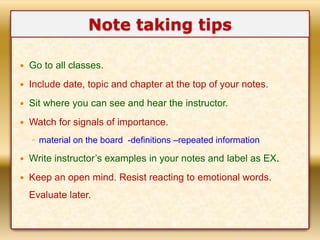
 Go to all classes.
 Include date, topic and chapter at the top of your notes.
 Sit where you can see and hear the instructor.
 Watch for signals of importance.
◦ material on the board -definitions –repeated information
 Write instructor’s examples in your notes and label as EX.
 Keep an open mind. Resist reacting to emotional words.
Evaluate later.
Note taking tips
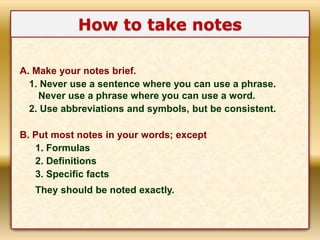
A. Make your notes brief.
1. Never use a sentence where you can use a phrase.
Never use a phrase where you can use a word.
2. Use abbreviations and symbols, but be consistent.
B. Put most notes in your words; except
1. Formulas
2. Definitions
3. Specific facts
They should be noted exactly.
How to take notes
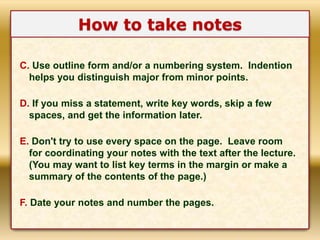
C. Use outline form and/or a numbering system. Indention
helps you distinguish major from minor points.
D. If you miss a statement, write key words, skip a few
spaces, and get the information later.
E. Don't try to use every space on the page. Leave room
for coordinating your notes with the text after the lecture.
(You may want to list key terms in the margin or make a
summary of the contents of the page.)
F. Date your notes and number the pages.
How to take notes
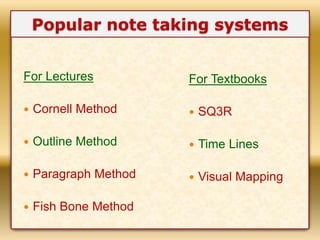
For Lectures
 Cornell Method
 Outline Method
 Paragraph Method
 Fish Bone Method
For Textbooks
 SQ3R
 Time Lines
 Visual Mapping
Popular note taking systems
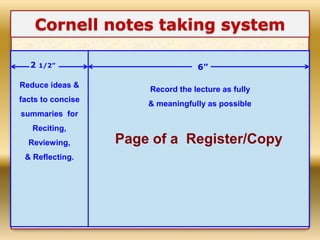
2 1/2”
Reduce ideas &
facts to concise
summaries for
Reciting,
Reviewing,
& Reflecting.
6”
Record the lecture as fully
& meaningfully as possible
Page of a Register/Copy
Cornell notes taking system
The format provides an opportunity to follow through the 5 R's of note-taking.
1. RECORD. During the lecture, record in the main column as many
meaningful facts and ideas as you can. Write legibly.
2. REDUCE. As soon after as possible, summarize these ideas and facts
concisely in the Recall Column. Summarizing clarifies meanings and
relationships, reinforces continuity, and strengthens memory. Also, it is a
way of preparing for examinations gradually and well ahead of time.
3. RECITE. Now cover the column, using only your jottings in the Recall
Column as cues or "flags" to help you recall, say over facts and ideas of
the lecture as fully as you can, not mechanically, but in your own words
and with as much appreciation of the meaning as you can. Then,
uncovering your notes, verify what you have said. This procedure helps
to transfer the facts and ideas of your long term memory.
Cornell notes taking system
4. REFLECT. Reflective students create their opinions from
their notes. They make such opinions the starting point for
their thinking about subjects under study. Such thinking aids
them to make sense out of their courses. Reflective students
continually write their ideas, put them into structures,
outlines, summaries. They keep reflecting about it. Unless
notes are revised from time to time, they soon be forgotten.
5. REVIEW. If you will spend 10 minutes every week or so in a
quick review of these notes, you will retain most of what you
have learned, and you will be able to use your knowledge
currently to greater and greater effectiveness.
Cornell notes taking system
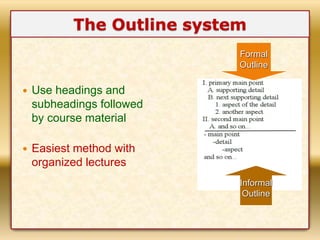
 Use headings and
subheadings followed
by course material
 Easiest method with
organized lectures
Formal
Outline
Informal
Outline
The Outline system
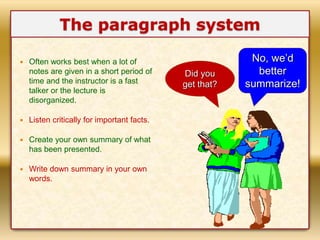
 Often works best when a lot of
notes are given in a short period of
time and the instructor is a fast
talker or the lecture is
disorganized.
 Listen critically for important facts.
 Create your own summary of what
has been presented.
 Write down summary in your own
words.
Did you
get that?
No, we’d
better
summarize!
The paragraph system
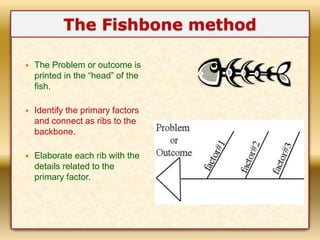
 The Problem or outcome is
printed in the “head” of the
fish.
 Identify the primary factors
and connect as ribs to the
backbone.
 Elaborate each rib with the
details related to the
primary factor.
The Fishbone method
Other
Note-Taking Tips
 Always date your notes!
 Paraphrase your notes!
 Don’t Erase Mistakes!
 For Lectures with fast talkers, consider writing
in cursive or tape recording.
 Use Abbreviations!
 Be Organized!
 Evaluate your note-taking style strategy regularly!
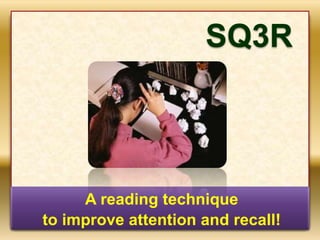
SQ3R
A reading technique
to improve attention and recall!
SQ3R Technique
Advantages
Organized and systematic for recording and reviewing
notes. Easy format for pulling out major concept and
ideas. Simple and efficient. Saves time and effort.
"Do-it-right-in-the-first-place system.“
Disadvantages
None
When to Use
In any lecture situation.
SQ3R Steps
1.Survey
2.Question
3.Read
4.Recite
5.Review
SQ3R Steps
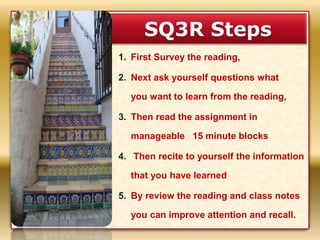
1. First Survey the reading,
2. Next ask yourself questions what
you want to learn from the reading,
3. Then read the assignment in
manageable 15 minute blocks
4. Then recite to yourself the information
that you have learned
5. By review the reading and class notes
you can improve attention and recall.
Survey
 You need to know the general picture of what is to
be read before you can meaningfully understand
and make intelligent decisions about the its details.
 Conduct a survey of reading assignments in
order to get the best possible overall picture of
what you are going to study (before you study it).
How do I Survey?
Check out / skim the Chapter Summary
This helps in assessing how difficult the material is; How much
do you know already … how much are you seeing for the first
time?
Scan the section Headings
What can you learn about how the material is organized, or
about what concepts the author thinks are more or less
important …
Look through the Diagrams/Figures/Graphics
Which diagrams, figures or graphics help you to remember
material presented in lecture? Copy good examples to include
with your notes. Create a list of important figures on a note
card
Question
Emphasizes importance of asking questions for
learning. People seem to remember what they learn
in answer to a question better than things just read or
memorized. Questions give purpose to our learning.
After you’ve surveyed your reading assignment, come
up with some questions you want to find the answers
to once you read the assignment.
Read the assignment
Read actively - read in order to answer the questions
that have been raised in your mind.
Take a break every 15 minutes and take 5 minutes to
take notes and summarize what you’ve just read in
your own words to check for understanding and to
maintain your focus.
Reading tips
Do I have to read it all??
Remember: You don’t have to read the material in chronological order –
you can skip & move around – for example, unlike a mystery novel that
you would read from first to last page (avoiding the temptation to read the
ending), go for it with a chapter or textbook - read the summary/conclusion
first (to preview what you’re about to read).
Prioritize your reading – survey the parts you may already know (or may
have been discussed in lecture) and identify the parts that are really new to
you (or may have been confusing in lecture).
Make the new and/or confusing parts a priority and read them first (while
your mind is focused and alert). Save the familiar material for later or skip
it if you know it well.
Recite
Recitation is an effective device for learning while
reading a book.
The only way you can really find out what you have
remembered and understood from your reading is to
recite to yourself.
To make sure that you understand and remember,
you should stop periodically and try to recall to
yourself what you have read.
This keeps your mind from wandering too much and
your eyes from going on auto pilot (reading with no
recall).
Review
Review is a survey of what
one has already studied.
This look over all of the notes
from the reading assignment
and class notes.
You should review every
time you finish reading.
Limit reading sessions to
max 4 hours. Take a 5 minute
break every 15 minutes. What was that
I just read?
by:
Sarwan Singh,
Corporate Training │ Education │ Mentoring │ Coaching
Find us at
englishacademybaroda@gmail.com
http://www.facebook.com/TheEnglishAcademyBaroda
@sarwan_singh
(91)88666 80407, (91)97279 19756
http://www.linkedin.com/pub/sarwan-singh/17/722/313
http://sarwansingh6644.blogspot.in
http://writebetter-speakbetter-english.blogspot.in
sarwansingh6644@gmail.com
Note
Taking &
Study Techniques
Presented BY:
The English Academy
91 88666 80407
englishacademybaroda@gmail.com
Visit us at: http://indiamart.com/english-academy/
Corporate Training │ Personality Development │ Mentoring │ Hand Holding

Note Taking and Study Techniques

  • 1.
    Note Taking & Study Techniques PresentedBY: The English Academy 91 88666 80407/97279 19756 englishacademybaroda@gmail.com Corporate Training │ Personality Development │ Mentoring │ Hand Holding
  • 2.
  • 3.
    Why to takenotes Taking notes during lectures improves listening & comprehension. Students who review their lecture notes remember 1 ½ times more after 6 weeks. Those who don’t take notes in class, forget about 80% of the lecture by the end of 2 weeks. (Walter Pauk)
  • 4.
     When youare reviewing, notes provide a gauge to what is important in the text.  Personal notes are easier to remember.  The writing down of important points helps you to remember them even before you have studied the material formally. Why to take notes
  • 5.
    Instructors usually giveclues to what is important to note. Some of the common clues are: A. Material written on the blackboard. B. Repetition C. Emphasis 1. Emphasis can be judged by tone of voice and gesture. 2. Emphasis can be judged by the amount of time the instructor spends on points and the number of examples he or she uses. D. Word signals (e.g. "There are two points of view on . . . " "The third reason is . . . " " In conclusion . . . ") E. Summaries given at the end of class. F. Reviews given at the beginning of class. What to note
  • 6.
     Go toall classes.  Include date, topic and chapter at the top of your notes.  Sit where you can see and hear the instructor.  Watch for signals of importance. ◦ material on the board -definitions –repeated information  Write instructor’s examples in your notes and label as EX.  Keep an open mind. Resist reacting to emotional words. Evaluate later. Note taking tips
  • 7.
    A. Make yournotes brief. 1. Never use a sentence where you can use a phrase. Never use a phrase where you can use a word. 2. Use abbreviations and symbols, but be consistent. B. Put most notes in your words; except 1. Formulas 2. Definitions 3. Specific facts They should be noted exactly. How to take notes
  • 8.
    C. Use outlineform and/or a numbering system. Indention helps you distinguish major from minor points. D. If you miss a statement, write key words, skip a few spaces, and get the information later. E. Don't try to use every space on the page. Leave room for coordinating your notes with the text after the lecture. (You may want to list key terms in the margin or make a summary of the contents of the page.) F. Date your notes and number the pages. How to take notes
  • 9.
    For Lectures  CornellMethod  Outline Method  Paragraph Method  Fish Bone Method For Textbooks  SQ3R  Time Lines  Visual Mapping Popular note taking systems
  • 10.
    2 1/2” Reduce ideas& facts to concise summaries for Reciting, Reviewing, & Reflecting. 6” Record the lecture as fully & meaningfully as possible Page of a Register/Copy Cornell notes taking system
  • 11.
    The format providesan opportunity to follow through the 5 R's of note-taking. 1. RECORD. During the lecture, record in the main column as many meaningful facts and ideas as you can. Write legibly. 2. REDUCE. As soon after as possible, summarize these ideas and facts concisely in the Recall Column. Summarizing clarifies meanings and relationships, reinforces continuity, and strengthens memory. Also, it is a way of preparing for examinations gradually and well ahead of time. 3. RECITE. Now cover the column, using only your jottings in the Recall Column as cues or "flags" to help you recall, say over facts and ideas of the lecture as fully as you can, not mechanically, but in your own words and with as much appreciation of the meaning as you can. Then, uncovering your notes, verify what you have said. This procedure helps to transfer the facts and ideas of your long term memory. Cornell notes taking system
  • 12.
    4. REFLECT. Reflectivestudents create their opinions from their notes. They make such opinions the starting point for their thinking about subjects under study. Such thinking aids them to make sense out of their courses. Reflective students continually write their ideas, put them into structures, outlines, summaries. They keep reflecting about it. Unless notes are revised from time to time, they soon be forgotten. 5. REVIEW. If you will spend 10 minutes every week or so in a quick review of these notes, you will retain most of what you have learned, and you will be able to use your knowledge currently to greater and greater effectiveness. Cornell notes taking system
  • 13.
     Use headingsand subheadings followed by course material  Easiest method with organized lectures Formal Outline Informal Outline The Outline system
  • 14.
     Often worksbest when a lot of notes are given in a short period of time and the instructor is a fast talker or the lecture is disorganized.  Listen critically for important facts.  Create your own summary of what has been presented.  Write down summary in your own words. Did you get that? No, we’d better summarize! The paragraph system
  • 15.
     The Problemor outcome is printed in the “head” of the fish.  Identify the primary factors and connect as ribs to the backbone.  Elaborate each rib with the details related to the primary factor. The Fishbone method
  • 16.
    Other Note-Taking Tips  Alwaysdate your notes!  Paraphrase your notes!  Don’t Erase Mistakes!  For Lectures with fast talkers, consider writing in cursive or tape recording.  Use Abbreviations!  Be Organized!  Evaluate your note-taking style strategy regularly!
  • 17.
    SQ3R A reading technique toimprove attention and recall!
  • 18.
    SQ3R Technique Advantages Organized andsystematic for recording and reviewing notes. Easy format for pulling out major concept and ideas. Simple and efficient. Saves time and effort. "Do-it-right-in-the-first-place system.“ Disadvantages None When to Use In any lecture situation.
  • 19.
  • 20.
    SQ3R Steps 1. FirstSurvey the reading, 2. Next ask yourself questions what you want to learn from the reading, 3. Then read the assignment in manageable 15 minute blocks 4. Then recite to yourself the information that you have learned 5. By review the reading and class notes you can improve attention and recall.
  • 21.
    Survey  You needto know the general picture of what is to be read before you can meaningfully understand and make intelligent decisions about the its details.  Conduct a survey of reading assignments in order to get the best possible overall picture of what you are going to study (before you study it).
  • 22.
    How do ISurvey? Check out / skim the Chapter Summary This helps in assessing how difficult the material is; How much do you know already … how much are you seeing for the first time? Scan the section Headings What can you learn about how the material is organized, or about what concepts the author thinks are more or less important … Look through the Diagrams/Figures/Graphics Which diagrams, figures or graphics help you to remember material presented in lecture? Copy good examples to include with your notes. Create a list of important figures on a note card
  • 23.
    Question Emphasizes importance ofasking questions for learning. People seem to remember what they learn in answer to a question better than things just read or memorized. Questions give purpose to our learning. After you’ve surveyed your reading assignment, come up with some questions you want to find the answers to once you read the assignment.
  • 24.
    Read the assignment Readactively - read in order to answer the questions that have been raised in your mind. Take a break every 15 minutes and take 5 minutes to take notes and summarize what you’ve just read in your own words to check for understanding and to maintain your focus.
  • 25.
    Reading tips Do Ihave to read it all?? Remember: You don’t have to read the material in chronological order – you can skip & move around – for example, unlike a mystery novel that you would read from first to last page (avoiding the temptation to read the ending), go for it with a chapter or textbook - read the summary/conclusion first (to preview what you’re about to read). Prioritize your reading – survey the parts you may already know (or may have been discussed in lecture) and identify the parts that are really new to you (or may have been confusing in lecture). Make the new and/or confusing parts a priority and read them first (while your mind is focused and alert). Save the familiar material for later or skip it if you know it well.
  • 26.
    Recite Recitation is aneffective device for learning while reading a book. The only way you can really find out what you have remembered and understood from your reading is to recite to yourself. To make sure that you understand and remember, you should stop periodically and try to recall to yourself what you have read. This keeps your mind from wandering too much and your eyes from going on auto pilot (reading with no recall).
  • 27.
    Review Review is asurvey of what one has already studied. This look over all of the notes from the reading assignment and class notes. You should review every time you finish reading. Limit reading sessions to max 4 hours. Take a 5 minute break every 15 minutes. What was that I just read?
  • 28.
    by: Sarwan Singh, Corporate Training│ Education │ Mentoring │ Coaching
  • 29.
    Find us at englishacademybaroda@gmail.com http://www.facebook.com/TheEnglishAcademyBaroda @sarwan_singh (91)8866680407, (91)97279 19756 http://www.linkedin.com/pub/sarwan-singh/17/722/313 http://sarwansingh6644.blogspot.in http://writebetter-speakbetter-english.blogspot.in sarwansingh6644@gmail.com
  • 30.
    Note Taking & Study Techniques PresentedBY: The English Academy 91 88666 80407 englishacademybaroda@gmail.com Visit us at: http://indiamart.com/english-academy/ Corporate Training │ Personality Development │ Mentoring │ Hand Holding