Reading Skills
presented By:
Muhammad Hashim
What is reading?
"Reading" is the process of looking at a series of written
symbols and getting meaning from them.
• Reading is the third of the four language skills, which
are :
• Listening
• Speaking
• Reading
• Writing
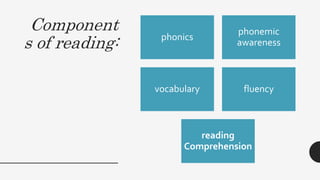
Component
s of reading: phonics
phonemic
awareness
vocabulary fluency
reading
Comprehension
Phonics: o Phonics is one of the primary building blocks of
reading.
o Its is the connection between sounds and letter
symbols.
o Without phonics, words are simply a bunch of
squiggles and lines on a page.
Phonemic
awareness:
 a subset of phonological awareness.
 Phonemic awareness is the only aspect of reading that
is essential for children to develop before they can
begin learning to read.
• Difference between phonemic awareness and phonics?
• Though there is a distinction between phonological
awareness and phonemic awareness the two terms are
often used interchangeably. For the most part both are
used to refer to what is technically phonological
awareness.
Vocabulary:  In order to read words we must first know them.
 Suppose you are reading a passage but you are un
familiar the words that’s used in that paragraph.
 There are two primary ways of teaching and learning
new vocabulary words.
i. Explicit instruction.
ii. Context clues.
Explicit instruction:This involves someone telling you
how a word is pronounced and what its meaning is.
Context clues : Context clues are the “hints” contained in
a text that help a reader figure out the meaning of an
unfamiliar word.
Fluency:  Fluency is a reader’s ability to read with speed,
accuracy and expression.
 Thus it requires him to combine and use multiple
reading skills at the same time.
 A reader must be able to move quickly enough through
a text to develop meaning.
 If he is bogged down reading each individual word, he
is not able to create an overall picture in his mind of
what the text is saying.
Reading
Comprehension:
 Reading comprehension is understanding what a
text is all about.
 Reading comprehension is the most complex aspect
of reading.
 It not only involves all of the other four aspects of
reading, it also requires the reader to draw upon
general thinking skills.
 When a reader is actively engaged with a text, he or
she is asking and answering questions about the
story and summarizing what he or she has read.
Importance
of reading:
• Reading playing an important role in today's society.There
are many adults who cannot read well enough to understand
the instructions on a medicine bottle.
• Reading is a vital skill in finding a good job. Many well-
paying jobs require reading as a part of job performance.
• There is an old saying, "The pen is mightier than the sword."
Ideas written down have changed the destiny of men and
nations for better or worse.
• Reading is fundamental in developing a good self image.
Non-readers or poor readers often have low opinions of
themselves and their abilities.
Purpose of
reading:
When reading any text, you will be expected to
• Understand the main idea in a passage, understand the
gist of it
• pick out specific, individual pieces of information from
a text
• understand ideas or feelings a writer presents in a text
• identify and understand writer's attitudes, beliefs and
argument
Types of
Reading:
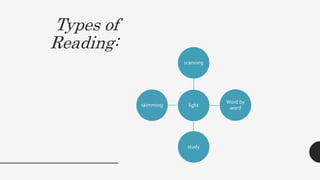
light
scanning
Word by
word
study
skimming
Scanning: • Scanning is a technique used when a person tries to
find a specific item such as a telephone number, a date,
a time, etc.
• For example, scanning a telephone book:
• You are looking for it quickly.
• You know what you are searching for (key words and
names).
• you ignore anything you are not looking for
Skimming: • When people wish to find only important ideas and not
all the details, they often skim a text.This involves
different strategies; for example, when a person skims
a newspaper article, he/she reads the headline, the
opening lead line, the first paragraph which contains an
overview of information.
• Skimming provides an 'overview' of the text. Skimming
is useful to look at chapter/section headings,
summaries and opening paragraphs.
Light: • Reading for relaxation tends to be 'light'. For example
novel reading, poetry reading, newspaper reading etc.
• Read at a pace which feels comfortable.
• Read with understand.
• Skim the boring, irrelevant passages.
Word by
word:
• This type of reading is time consuming and demands a
high level of concentration because of word by word
reading is includes.
• People use this type of reading for unfamiliar words
and concepts, scientific formulae because there is no
room for mistake of any one word.
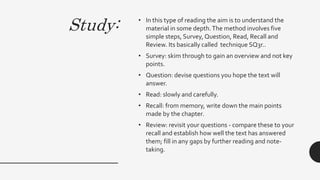
Study: • In this type of reading the aim is to understand the
material in some depth.The method involves five
simple steps, Survey, Question, Read, Recall and
Review. Its basically called technique SQ3r..
• Survey: skim through to gain an overview and not key
points.
• Question: devise questions you hope the text will
answer.
• Read: slowly and carefully.
• Recall: from memory, write down the main points
made by the chapter.
• Review: revisit your questions - compare these to your
recall and establish how well the text has answered
them; fill in any gaps by further reading and note-
taking.
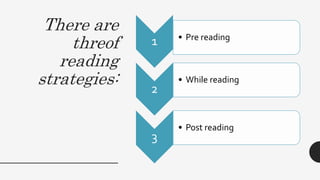
There are
threof
reading
strategies:
1 • Pre reading
2
• While reading
3
• Post reading
Pre reading: • In order to understand a text.
• With out looking on every single word.
• Its able to build confidence and create security to
learners.
 It includes some point.
 Set a focus : so that why we read text.
 Preview : formulate the theory about context.
 Make predications : getting information on own
personal experience.
during-
reading :-
• The reading activities of while-reading stage helps to:
• Encourage critical thinking of student.
• Increase attention of the students.
 Stages that’s include in during reading:
 Read silently.
 Re read
 Read loudly
 Analyze
 guess
Post
reading:-
• To check the students’ understanding and retention of
the information of a text that they have already
attempted, teachers should employ the last stage-the
post-reading stage.
• It includes some stages like:
• Seek feedback: Seek out the feedback of what had you read.
• Interpret text: Interpret/explain the meaning and purpose of text you read.
• Reading logs: Reading logs can range from simply recording what was read, to
encouraging more in depth explorations of the reading material
• Note-taking: keeping a record of performance in an area you want to improve
is a good idea.
Reasons why students
don`t understand text
reading:-
• - Students hate to read, they only read the required
textbook in order to be able to set for the achievement
routine exams.
• - Students lacked motivation to read, even if they read,
they show negative attitudes.
• - For most of the learners, reading is an extremely
difficult task that requires integrated body of skills.
Barriers to
reading:
• The main reason for poor reading comprehension
are:
• Inability to understand a word;
• Inability to understand a sentence;
• Inability to understand how sentences relate to one
another;
• Inability to understand how the information fits
together in a meaningful way.
• Lack of interest or concentration.
Improving Reading
skills.
• Reading a different variety of materials. Do not limit
yourself to textbook.
• make reading a more active process.
• promote critical thinking evaluation of reading
materials.
• enhance registration and recall of text information in
one’s memory.
Reading skills

Reading skills

  • 2.
  • 3.
    What is reading? "Reading"is the process of looking at a series of written symbols and getting meaning from them. • Reading is the third of the four language skills, which are : • Listening • Speaking • Reading • Writing
  • 5.
    Component s of reading:phonics phonemic awareness vocabulary fluency reading Comprehension
  • 6.
    Phonics: o Phonicsis one of the primary building blocks of reading. o Its is the connection between sounds and letter symbols. o Without phonics, words are simply a bunch of squiggles and lines on a page.
  • 7.
    Phonemic awareness:  a subsetof phonological awareness.  Phonemic awareness is the only aspect of reading that is essential for children to develop before they can begin learning to read. • Difference between phonemic awareness and phonics? • Though there is a distinction between phonological awareness and phonemic awareness the two terms are often used interchangeably. For the most part both are used to refer to what is technically phonological awareness.
  • 8.
    Vocabulary:  Inorder to read words we must first know them.  Suppose you are reading a passage but you are un familiar the words that’s used in that paragraph.  There are two primary ways of teaching and learning new vocabulary words. i. Explicit instruction. ii. Context clues. Explicit instruction:This involves someone telling you how a word is pronounced and what its meaning is. Context clues : Context clues are the “hints” contained in a text that help a reader figure out the meaning of an unfamiliar word.
  • 9.
    Fluency:  Fluencyis a reader’s ability to read with speed, accuracy and expression.  Thus it requires him to combine and use multiple reading skills at the same time.  A reader must be able to move quickly enough through a text to develop meaning.  If he is bogged down reading each individual word, he is not able to create an overall picture in his mind of what the text is saying.
  • 10.
    Reading Comprehension:  Reading comprehensionis understanding what a text is all about.  Reading comprehension is the most complex aspect of reading.  It not only involves all of the other four aspects of reading, it also requires the reader to draw upon general thinking skills.  When a reader is actively engaged with a text, he or she is asking and answering questions about the story and summarizing what he or she has read.
  • 11.
    Importance of reading: • Readingplaying an important role in today's society.There are many adults who cannot read well enough to understand the instructions on a medicine bottle. • Reading is a vital skill in finding a good job. Many well- paying jobs require reading as a part of job performance. • There is an old saying, "The pen is mightier than the sword." Ideas written down have changed the destiny of men and nations for better or worse. • Reading is fundamental in developing a good self image. Non-readers or poor readers often have low opinions of themselves and their abilities.
  • 12.
    Purpose of reading: When readingany text, you will be expected to • Understand the main idea in a passage, understand the gist of it • pick out specific, individual pieces of information from a text • understand ideas or feelings a writer presents in a text • identify and understand writer's attitudes, beliefs and argument
  • 13.
  • 14.
    Scanning: • Scanningis a technique used when a person tries to find a specific item such as a telephone number, a date, a time, etc. • For example, scanning a telephone book: • You are looking for it quickly. • You know what you are searching for (key words and names). • you ignore anything you are not looking for
  • 15.
    Skimming: • Whenpeople wish to find only important ideas and not all the details, they often skim a text.This involves different strategies; for example, when a person skims a newspaper article, he/she reads the headline, the opening lead line, the first paragraph which contains an overview of information. • Skimming provides an 'overview' of the text. Skimming is useful to look at chapter/section headings, summaries and opening paragraphs.
  • 16.
    Light: • Readingfor relaxation tends to be 'light'. For example novel reading, poetry reading, newspaper reading etc. • Read at a pace which feels comfortable. • Read with understand. • Skim the boring, irrelevant passages.
  • 17.
    Word by word: • Thistype of reading is time consuming and demands a high level of concentration because of word by word reading is includes. • People use this type of reading for unfamiliar words and concepts, scientific formulae because there is no room for mistake of any one word.
  • 18.
    Study: • Inthis type of reading the aim is to understand the material in some depth.The method involves five simple steps, Survey, Question, Read, Recall and Review. Its basically called technique SQ3r.. • Survey: skim through to gain an overview and not key points. • Question: devise questions you hope the text will answer. • Read: slowly and carefully. • Recall: from memory, write down the main points made by the chapter. • Review: revisit your questions - compare these to your recall and establish how well the text has answered them; fill in any gaps by further reading and note- taking.
  • 19.
    There are threof reading strategies: 1 •Pre reading 2 • While reading 3 • Post reading
  • 20.
    Pre reading: •In order to understand a text. • With out looking on every single word. • Its able to build confidence and create security to learners.  It includes some point.  Set a focus : so that why we read text.  Preview : formulate the theory about context.  Make predications : getting information on own personal experience.
  • 21.
    during- reading :- • Thereading activities of while-reading stage helps to: • Encourage critical thinking of student. • Increase attention of the students.  Stages that’s include in during reading:  Read silently.  Re read  Read loudly  Analyze  guess
  • 22.
    Post reading:- • To checkthe students’ understanding and retention of the information of a text that they have already attempted, teachers should employ the last stage-the post-reading stage. • It includes some stages like: • Seek feedback: Seek out the feedback of what had you read. • Interpret text: Interpret/explain the meaning and purpose of text you read. • Reading logs: Reading logs can range from simply recording what was read, to encouraging more in depth explorations of the reading material • Note-taking: keeping a record of performance in an area you want to improve is a good idea.
  • 23.
    Reasons why students don`tunderstand text reading:- • - Students hate to read, they only read the required textbook in order to be able to set for the achievement routine exams. • - Students lacked motivation to read, even if they read, they show negative attitudes. • - For most of the learners, reading is an extremely difficult task that requires integrated body of skills.
  • 24.
    Barriers to reading: • Themain reason for poor reading comprehension are: • Inability to understand a word; • Inability to understand a sentence; • Inability to understand how sentences relate to one another; • Inability to understand how the information fits together in a meaningful way. • Lack of interest or concentration.
  • 25.
    Improving Reading skills. • Readinga different variety of materials. Do not limit yourself to textbook. • make reading a more active process. • promote critical thinking evaluation of reading materials. • enhance registration and recall of text information in one’s memory.