READING SKILLS
Importance of reading
 Important way of getting exposed to English,
 Exposure increases communicative competence,
 You become more proficient and
 You gain confidence.
nandkishore sarap
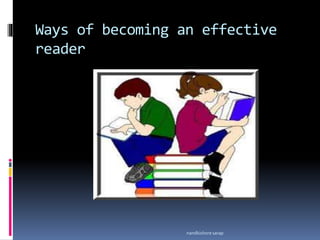
Ways of becoming an effective
reader
nandkishore sarap
Ways of becoming an effective
reader
 Fiend some time for reading everyday.
 Initially, read anything that interests you.
 If you read what you don’t understand, keep
reading to increase stamina.
 Develop reference and note making skills.
 Use good dictionary.
 Note useful words, expressions and sentence
structures.
 Note down your responses and important points
in margin. Contd…
nandkishore sarap
Ways of becoming an effective
reader
 Do some extra/supplementary reading before
going to bed.
 Read one English newspaper daily.
 Read out stories, interesting instances to your
family members and friends.
 Loud reading promotes fluency.
 Reading silently, read fast with
understanding.
nandkishore sarap
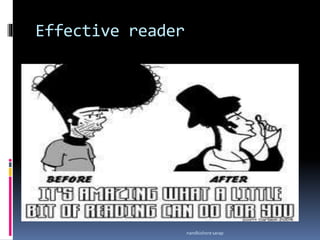
Effective reader
nandkishore sarap
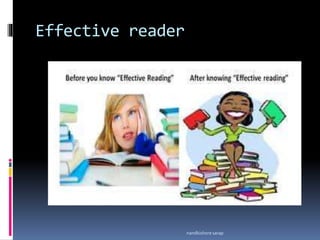
Effective reader
nandkishore sarap
Reasons for reading
 Many of us read for entertainment. (seek pleasure)
 As students, you study for tests and examinations.
 To kill time
 Some read for preparing for lectures, presentations,
discussions or for getting some information.
 Everyday (general) reading: reading of newspapers,
telephone directory, railway time-table, road maps,
charts, tables, graphs, menu cards, computer
screens, bills and receipts, roadside hoardings etc.
(Whatever the text we read, we get some information)
nandkishore sarap
Reading- an active skill
 Reading is passive skill but a good reader is
active while reading.
 Reading is interactive (mental activity)
 While reading you interpret and try to make
sense.
 What you understand is comprehension.
nandkishore sarap
Qualities of a good reader
 Good readers love reading and they enjoy it.
[distractions don’t interrupt their reading
(concentration)]
 They maintain appropriate postures.They sit and
hold the text in proper position.They take care of
amount of light and direction.They maintain
proper distance between the text and eyes.
 They do not move their neck, eyes, lips or tongue
unnecessarily.
Contd…
nandkishore sarap
Qualities of a good reader
 They do not point at printed words with a finger
or pencil/pen.
 They do not mouth words while reading silently.
 They do not repeat the line. Nor they go back to
what they have already read.
 They don’t read word by word but in sense
group.
Reading should not be burden; it should not be
something unwanted, painful, something you
would be unwilling to do it.
It should be a happy affair.
nandkishore sarap
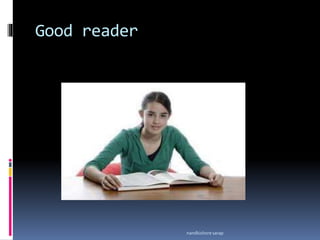
Good reader
nandkishore sarap
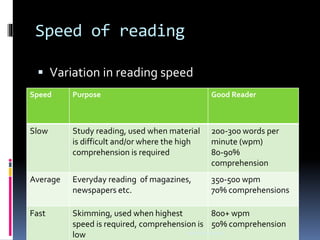
Speed of reading
 Variation in reading speed
Speed Purpose Good Reader
Slow Study reading, used when material
is difficult and/or where the high
comprehension is required
200-300 words per
minute (wpm)
80-90%
comprehension
Average Everyday reading of magazines,
newspapers etc.
350-500 wpm
70% comprehensions
Fast Skimming, used when highest
speed is required, comprehension is
low
800+ wpm
50% comprehension
nandkishore sarap
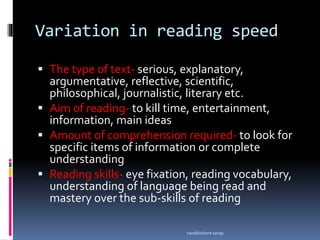
Variation in reading speed
 The type of text- serious, explanatory,
argumentative, reflective, scientific,
philosophical, journalistic, literary etc.
 Aim of reading- to kill time, entertainment,
information, main ideas
 Amount of comprehension required- to look for
specific items of information or complete
understanding
 Reading skills- eye fixation, reading vocabulary,
understanding of language being read and
mastery over the sub-skills of reading
nandkishore sarap
Sub-skills of reading
 Understanding lexical items, their conceptual
meanings, parts of sentence, relationship
between sentences and grammatical devices.
 Locating the main idea and supporting details.
 Selecting relevant facts, pieces of information
etc.
 Grasping the general idea in the passage.
 Locating a specific piece of information.
 Interpreting the text by going outside it.
Contd…
nandkishore sarap
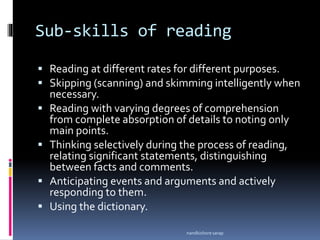
Sub-skills of reading
 Reading at different rates for different purposes.
 Skipping (scanning) and skimming intelligently when
necessary.
 Reading with varying degrees of comprehension
from complete absorption of details to noting only
main points.
 Thinking selectively during the process of reading,
relating significant statements, distinguishing
between facts and comments.
 Anticipating events and arguments and actively
responding to them.
 Using the dictionary.
nandkishore sarap
Bad reading habits
nandkishore sarap
Bad reading habits
 Wrong posture: sitting in awkward position, not
holding the book, paper etc. properly,
inadequate distance between the text and eyes.
 Unwanted movement: movement of lips while
reading silently, movement of head (these
movements slow down the speed of reading)
 Putting finger on every word: placing finger,
pencil or pen every word and moving them while
reading
 Sub vocalization: while reading silently some
utter words to themselves, mumble or read
aloud in mind
nandkishore sarap
Result of bad reading habits
nandkishore sarap
nandkishore sarap

Reading skills

  • 1.
  • 2.
    Importance of reading Important way of getting exposed to English,  Exposure increases communicative competence,  You become more proficient and  You gain confidence. nandkishore sarap
  • 3.
    Ways of becomingan effective reader nandkishore sarap
  • 4.
    Ways of becomingan effective reader  Fiend some time for reading everyday.  Initially, read anything that interests you.  If you read what you don’t understand, keep reading to increase stamina.  Develop reference and note making skills.  Use good dictionary.  Note useful words, expressions and sentence structures.  Note down your responses and important points in margin. Contd… nandkishore sarap
  • 5.
    Ways of becomingan effective reader  Do some extra/supplementary reading before going to bed.  Read one English newspaper daily.  Read out stories, interesting instances to your family members and friends.  Loud reading promotes fluency.  Reading silently, read fast with understanding. nandkishore sarap
  • 6.
  • 7.
  • 8.
    Reasons for reading Many of us read for entertainment. (seek pleasure)  As students, you study for tests and examinations.  To kill time  Some read for preparing for lectures, presentations, discussions or for getting some information.  Everyday (general) reading: reading of newspapers, telephone directory, railway time-table, road maps, charts, tables, graphs, menu cards, computer screens, bills and receipts, roadside hoardings etc. (Whatever the text we read, we get some information) nandkishore sarap
  • 9.
    Reading- an activeskill  Reading is passive skill but a good reader is active while reading.  Reading is interactive (mental activity)  While reading you interpret and try to make sense.  What you understand is comprehension. nandkishore sarap
  • 10.
    Qualities of agood reader  Good readers love reading and they enjoy it. [distractions don’t interrupt their reading (concentration)]  They maintain appropriate postures.They sit and hold the text in proper position.They take care of amount of light and direction.They maintain proper distance between the text and eyes.  They do not move their neck, eyes, lips or tongue unnecessarily. Contd… nandkishore sarap
  • 11.
    Qualities of agood reader  They do not point at printed words with a finger or pencil/pen.  They do not mouth words while reading silently.  They do not repeat the line. Nor they go back to what they have already read.  They don’t read word by word but in sense group. Reading should not be burden; it should not be something unwanted, painful, something you would be unwilling to do it. It should be a happy affair. nandkishore sarap
  • 12.
  • 13.
    Speed of reading Variation in reading speed Speed Purpose Good Reader Slow Study reading, used when material is difficult and/or where the high comprehension is required 200-300 words per minute (wpm) 80-90% comprehension Average Everyday reading of magazines, newspapers etc. 350-500 wpm 70% comprehensions Fast Skimming, used when highest speed is required, comprehension is low 800+ wpm 50% comprehension nandkishore sarap
  • 14.
    Variation in readingspeed  The type of text- serious, explanatory, argumentative, reflective, scientific, philosophical, journalistic, literary etc.  Aim of reading- to kill time, entertainment, information, main ideas  Amount of comprehension required- to look for specific items of information or complete understanding  Reading skills- eye fixation, reading vocabulary, understanding of language being read and mastery over the sub-skills of reading nandkishore sarap
  • 15.
    Sub-skills of reading Understanding lexical items, their conceptual meanings, parts of sentence, relationship between sentences and grammatical devices.  Locating the main idea and supporting details.  Selecting relevant facts, pieces of information etc.  Grasping the general idea in the passage.  Locating a specific piece of information.  Interpreting the text by going outside it. Contd… nandkishore sarap
  • 16.
    Sub-skills of reading Reading at different rates for different purposes.  Skipping (scanning) and skimming intelligently when necessary.  Reading with varying degrees of comprehension from complete absorption of details to noting only main points.  Thinking selectively during the process of reading, relating significant statements, distinguishing between facts and comments.  Anticipating events and arguments and actively responding to them.  Using the dictionary. nandkishore sarap
  • 17.
  • 18.
    Bad reading habits Wrong posture: sitting in awkward position, not holding the book, paper etc. properly, inadequate distance between the text and eyes.  Unwanted movement: movement of lips while reading silently, movement of head (these movements slow down the speed of reading)  Putting finger on every word: placing finger, pencil or pen every word and moving them while reading  Sub vocalization: while reading silently some utter words to themselves, mumble or read aloud in mind nandkishore sarap
  • 19.
    Result of badreading habits nandkishore sarap
  • 20.