Reading Skill
Reading
 What is Reading ?
 Reading is a process that involves recognizing words, leading to the
development of comprehension. According to research, reading is a process
that negotiates the meaning between the text and its reader.
 What is Reading skill ?
 Reading skill refers to the ability to understand written text .
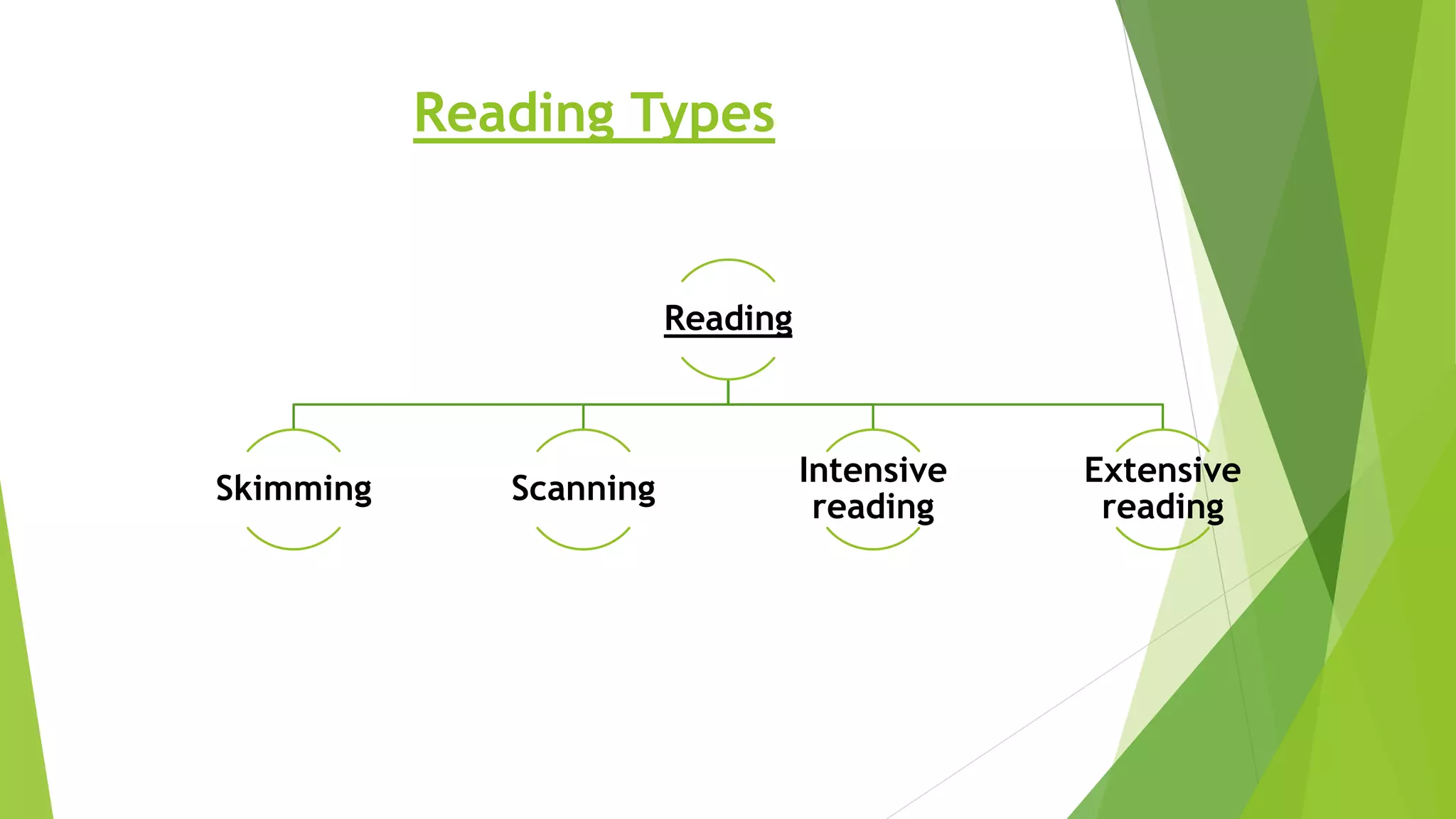
Reading Types
Reading
Skimming Scanning
Intensive
reading
Extensive
reading
Skimming
 Skimming is reading a text quickly to get a general idea of meaning. It can be contrasted with scanning .
 A technique for fast reading. A reader reads the article in order to get the general idea of it .
Purpose
 Generally to get the general idea of an article
 To sample a book before actually purchasing it
Method
 Read the title carefully
 First paragraph and introduction need to be read carefully
 Emphasis on the reading of first sentence of every paragraph
 Heading and sub headings should be read
 Pictures, charts or graphs should be noticed
 Words or phrase that are italicized or boldface must be noticed
 Summary or last paragraph is important to understand the conclusion
Example
You want to buy a novel so you read the heading and the title of the novel.
Scanning
 A technique in which a reader tries to search a particular text or word in the document
Purpose
 Generally to search a telephone number from a list
 To find a particular quotation in a book
Method
 Reader must be clearly aware of the specific information that needs to be searched in the
document
 Clues must be used to find the answer – like if one is searching for a date, then only
numbers should be looked for
 Headings can be helpful in suggesting the location of the desired information
 One should be careful in reading and skipping the sections of the passage
Example
 you want to search your name in the list of lottery .
Intensive reading
 Intensive reading involves learners reading in detail with specific learning aims and
tasks.
Purpose
 To get information and knowledge about something .
 To understand the total concept .
 To increase student reading speed .
 To increase student reading fluency .
Method
 Reading the text carefully and understand the concept .
 Revise the read text .
 Reading with full concentration .
Example
Reading English grammar to give a presentation .
Extensive reading
 Reading texts for enjoyment and to develop general reading skills.
Purpose
 To increase student confidence in their English reading ability .
 To increase student motivation in their English reading .
 To increase student reading fluency .
 To decrease dependence on word by word comprehension .
 To increase student reading speed .
Method
 Don’t look up words in the dictionary .
 Skip over parts you don’t understand .
 If you don’t enjoying one book ,toss it aside and get it another
Example
 A teacher reads a short story with learners, but does not set them any tasks except to read and
listen.
Component of reading
Decoding :The process of translating word in to sound
Comprehension :Level of understanding text
Retention : The condition of keeping something
Why reading is important ?
 Reading is fundamental to functioning in today's society.
 Reading is a vital skill in finding a good job.
 Reading is important because it develops the mind. The mind is a muscle. It needs
exercise. Understanding the written word is one way the mind grows in its ability.
 It is how we discover new things. Books, magazines and even the Internet are great
learning tools which require the ability to read and understand
 Reading develops the imagination.
 There is an old saying, "The pen is mightier than the sword.“
 Reading is important because words - spoken and written - are the building blocks
of life.
Way to improve reading
 Always Make Special Time to Read.
 Read the Right Books.
 Ask Yourself Questions While Reading and After Reading.
 Improve Fluency First.
 Once You’ve Learned to Speed Up, Slow Down!.
 Ask Lots of Questions.
 Read It Again.
 Read Many Kinds of Texts
Reading Disabilities
 Dyslexia : It is a learning disorder that impedes the student’s ability to read
and comprehend a text.
 ADHD : Attention Deficit/Hyperactivity Disorder has affected more than 6.4
million children at some point. Students who have ADHD have difficulty paying
attention and staying on task.
 Dyscalculia : Is a disorder that specifically affects one’s math capabilities.
 Dysgraphia :Dysgraphia can be related to the physical act of writing. These
students often cannot hold a pencil correctly, and their posture may be tense
while trying to write.
 Processing Deficits : When students have a processing deficit, they have
trouble making sense of sensory data. This makes it hard for students to
perform in a traditional classroom without instructional supports.
Additional Information
 Howard Berg is considered the fastest reader in the world. "The Guinness World
Record Book" recognized Berg in 1990 for his ability to read more than 25,000
words per minute
 There are over 130 million books in print.
 The four most read books in the world are The Holy Bible, Holy Quran ,Quotations
from Chairman Mao Tse-Tung, and Harry Potter.
 68% of books sold worldwide are bought by women.
 The most expensive book in the world is the 1640 Bay Psalm, which sold for $14.2
million (1,082,750,000 PRs)
 Longest novel ever written is Remembrance of Things Past by Marcel Proust,
containing an estimated 9,609,000 characters.
 The term 'bookworm' originates from insects who live in and feed on the binding
of books.

Reading skill

  • 1.
  • 2.
    Reading  What isReading ?  Reading is a process that involves recognizing words, leading to the development of comprehension. According to research, reading is a process that negotiates the meaning between the text and its reader.  What is Reading skill ?  Reading skill refers to the ability to understand written text .
  • 3.
  • 4.
    Skimming  Skimming isreading a text quickly to get a general idea of meaning. It can be contrasted with scanning .  A technique for fast reading. A reader reads the article in order to get the general idea of it . Purpose  Generally to get the general idea of an article  To sample a book before actually purchasing it Method  Read the title carefully  First paragraph and introduction need to be read carefully  Emphasis on the reading of first sentence of every paragraph  Heading and sub headings should be read  Pictures, charts or graphs should be noticed  Words or phrase that are italicized or boldface must be noticed  Summary or last paragraph is important to understand the conclusion Example You want to buy a novel so you read the heading and the title of the novel.
  • 5.
    Scanning  A techniquein which a reader tries to search a particular text or word in the document Purpose  Generally to search a telephone number from a list  To find a particular quotation in a book Method  Reader must be clearly aware of the specific information that needs to be searched in the document  Clues must be used to find the answer – like if one is searching for a date, then only numbers should be looked for  Headings can be helpful in suggesting the location of the desired information  One should be careful in reading and skipping the sections of the passage Example  you want to search your name in the list of lottery .
  • 6.
    Intensive reading  Intensivereading involves learners reading in detail with specific learning aims and tasks. Purpose  To get information and knowledge about something .  To understand the total concept .  To increase student reading speed .  To increase student reading fluency . Method  Reading the text carefully and understand the concept .  Revise the read text .  Reading with full concentration . Example Reading English grammar to give a presentation .
  • 7.
    Extensive reading  Readingtexts for enjoyment and to develop general reading skills. Purpose  To increase student confidence in their English reading ability .  To increase student motivation in their English reading .  To increase student reading fluency .  To decrease dependence on word by word comprehension .  To increase student reading speed . Method  Don’t look up words in the dictionary .  Skip over parts you don’t understand .  If you don’t enjoying one book ,toss it aside and get it another Example  A teacher reads a short story with learners, but does not set them any tasks except to read and listen.
  • 8.
    Component of reading Decoding:The process of translating word in to sound Comprehension :Level of understanding text Retention : The condition of keeping something
  • 9.
    Why reading isimportant ?  Reading is fundamental to functioning in today's society.  Reading is a vital skill in finding a good job.  Reading is important because it develops the mind. The mind is a muscle. It needs exercise. Understanding the written word is one way the mind grows in its ability.  It is how we discover new things. Books, magazines and even the Internet are great learning tools which require the ability to read and understand  Reading develops the imagination.  There is an old saying, "The pen is mightier than the sword.“  Reading is important because words - spoken and written - are the building blocks of life.
  • 10.
    Way to improvereading  Always Make Special Time to Read.  Read the Right Books.  Ask Yourself Questions While Reading and After Reading.  Improve Fluency First.  Once You’ve Learned to Speed Up, Slow Down!.  Ask Lots of Questions.  Read It Again.  Read Many Kinds of Texts
  • 11.
    Reading Disabilities  Dyslexia: It is a learning disorder that impedes the student’s ability to read and comprehend a text.  ADHD : Attention Deficit/Hyperactivity Disorder has affected more than 6.4 million children at some point. Students who have ADHD have difficulty paying attention and staying on task.  Dyscalculia : Is a disorder that specifically affects one’s math capabilities.  Dysgraphia :Dysgraphia can be related to the physical act of writing. These students often cannot hold a pencil correctly, and their posture may be tense while trying to write.  Processing Deficits : When students have a processing deficit, they have trouble making sense of sensory data. This makes it hard for students to perform in a traditional classroom without instructional supports.
  • 12.
    Additional Information  HowardBerg is considered the fastest reader in the world. "The Guinness World Record Book" recognized Berg in 1990 for his ability to read more than 25,000 words per minute  There are over 130 million books in print.  The four most read books in the world are The Holy Bible, Holy Quran ,Quotations from Chairman Mao Tse-Tung, and Harry Potter.  68% of books sold worldwide are bought by women.  The most expensive book in the world is the 1640 Bay Psalm, which sold for $14.2 million (1,082,750,000 PRs)  Longest novel ever written is Remembrance of Things Past by Marcel Proust, containing an estimated 9,609,000 characters.  The term 'bookworm' originates from insects who live in and feed on the binding of books.