Effective Study Skills for
University Students
English for
Academic
purposes
Objectives of the session
After this session you will be able to:
1. Identify important study skills required for
studying in university.
2. Identify and use a wide range of learning
and studying strategies.
3. Reflect on your current academic skills
and can chalk out an action plan for
improvement.
4. Improve your academic reading skills
Studying at University
Studying at university needs you:
1. To change your learning styles and patterns
2. To get adjusted to the new teaching
methodologies and assessment patterns
3. To work under time pressures
4. To develop critical thinking skills
5. Discuss and debate your ideas with peers
and tutors in groups
6. To be Independent researcher and learners
Approaches to learning and
teaching
Being at University you will experience a number of
different approaches to learning and teaching which
typically includes
 lectures
 seminars
 presentations
 role plays
 Class Discussion
 group and team activities
 tutorials
 on-line activities
 independent research
 practical projects
Who is an independent
learners?
Independent learners are good at:
1. managing time, stress and other commitments
2. reflecting critically on how and what they learn
3. using a wide range of learning opportunities and
resources, for example, using appropriate
printed and electronic sources
4. adapting the learning process to make use of
new opportunities
You as Learner!!!
 How independent do you think you are as
a learner?
 How keen are you to become a better
learner?
 Before a class/workshop/study session, do
you work to get clarity about what you
hope to learn?
 Do you plan how and when you are going
to learn something?
You as Learner !!!
 If you come across new study methods do
you try them?
 Do you question what you are told e.g. by
tutors, in books?
 What do you think about your past
learning experience?
Let’s find what type of
learner are you?
Introduce Yourself
as Learner!!!
Important Study Skills
 Time Management
 Information Skills
 Listening to Lectures and Taking Notes
 Academic Reading Skills
 Academic Writing Skills
 Referencing and Avoiding plagiarism
 Presentation Skills
 Working in Groups
 Examination Skills
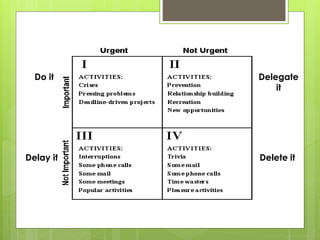
Time Management in
student Life
Delegate
it
Delete itDelay it
Do it
Let’s Listen to Your Exam
and Time Mismanagement
Stories
Listening to Lectures and
Taking Notes
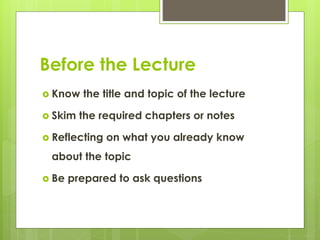
Before the Lecture
 Know the title and topic of the lecture
 Skim the required chapters or notes
 Reflecting on what you already know
about the topic
 Be prepared to ask questions
During Lecture
How to concentrate
 Avoid talking to your friends
 Avoid side thought trips
 Switch off your mobile and any other
electronic device
 Get good night sleep
 Take Notes
Taking Notes
Note taking is an important academic task
that helps you to remember what you have
learnt and helps you to review materials for
re-use in revision and assignments
 Take your notes according to the week,
topic, or assignment
 Write in short phrases rather than in
complete sentences
 It is important that you are critical when
note taking and that you only write or
draw what you will need later on
After the Lecture
 Review your notes
 Summarize your notes in your own words
 Discuss important points with friends
 Add any further explanation based on
your reading
Academic Reading Skills
Academic reading will need you to:
 Identify arguments
 Recognise whether the writing support or
oppose the main premise
 Identify the evidence
 Identify conclusions and whether the
evidence supports the conclusions
 Be a critical thinker.
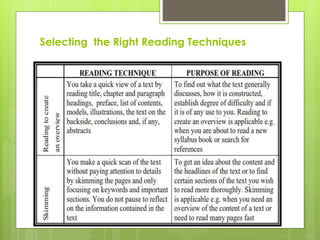
Selecting the Right Reading Techniques
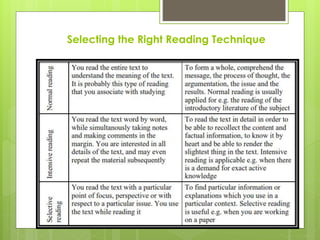
Selecting the Right Reading Technique
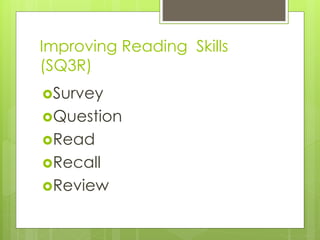
Improving Reading Skills
(SQ3R)
Survey
Question
Read
Recall
Review
Making Notes from Reading
 Use margins of the printed text to write
brief comments
 Use separate pages for detail notes
 Do not copy chunks from the texts
 Take notes in your own words
 Use colour codes
 File and organise your notes properly
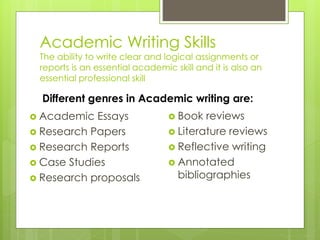
Academic Writing Skills
The ability to write clear and logical assignments or
reports is an essential academic skill and it is also an
essential professional skill
 Academic Essays
 Research Papers
 Research Reports
 Case Studies
 Research proposals
 Book reviews
 Literature reviews
 Reflective writing
 Annotated
bibliographies
Different genres in Academic writing are:
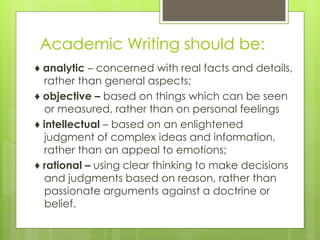
Academic Writing should be:
♦ analytic – concerned with real facts and details,
rather than general aspects;
♦ objective – based on things which can be seen
or measured, rather than on personal feelings
♦ intellectual – based on an enlightened
judgment of complex ideas and information,
rather than an appeal to emotions;
♦ rational – using clear thinking to make decisions
and judgments based on reason, rather than
passionate arguments against a doctrine or
belief.
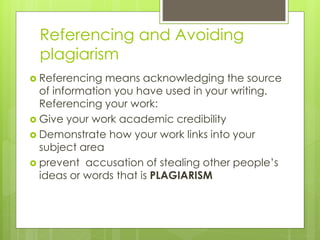
Referencing and Avoiding
plagiarism
 Referencing means acknowledging the source
of information you have used in your writing.
Referencing your work:
 Give your work academic credibility
 Demonstrate how your work links into your
subject area
 prevent accusation of stealing other people’s
ideas or words that is PLAGIARISM
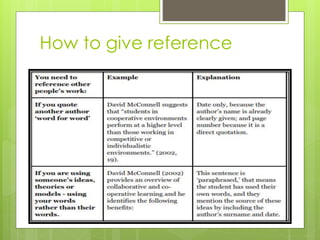
How to give reference
Presentation Skills
 Presentation skills are important as
presentations are frequently used in the
workplace as a means of disseminating
information and influencing people.
 Some of the assessments for your programme
of study may involve giving a presentation.
This could take the form of an individual
presentation or a group presentation
Working in Groups
Team working is an essential skill required by employers for
almost every job.
During your programme of study you will be asked to work in
groups and some of your assessment activities will involve
group work, that is, a group presentation or a group project.
The principle behind group assessment activities is to give you
some experience in being part of, or perhaps leading, a
team. It provides opportunities for you to develop and
demonstrate transferable skills such as:
1. communication,
2. negotiation,
3. participation,
4. compromise,
5. decision making,
6. teamwork.
Conflict Management in
Groups
 Establish a joint level of ambition
 Agree on time spent
 Keep appointments
 Concentrate on academic matters
 Communicate in a proper and polite
manner
 Make ongoing evaluations
Examination Skills
 The aim of the examination process is to test
your knowledge and understanding in an
environment with a time constraint.
 Examinations are not merely a memory test
either – they test understanding, rather than
the specific description of each and every
theory and concept.
 They also seek to evaluate some generic skills
such as time management (have you
answered all the questions you need to in the
given time period?) and your effectiveness
under pressure.
Thank You
“Intelligence plus character-that
is the goal of true education.”
Martin Luther King Jr.

Study skills

  • 1.
    Effective Study Skillsfor University Students English for Academic purposes
  • 2.
    Objectives of thesession After this session you will be able to: 1. Identify important study skills required for studying in university. 2. Identify and use a wide range of learning and studying strategies. 3. Reflect on your current academic skills and can chalk out an action plan for improvement. 4. Improve your academic reading skills
  • 3.
    Studying at University Studyingat university needs you: 1. To change your learning styles and patterns 2. To get adjusted to the new teaching methodologies and assessment patterns 3. To work under time pressures 4. To develop critical thinking skills 5. Discuss and debate your ideas with peers and tutors in groups 6. To be Independent researcher and learners
  • 4.
    Approaches to learningand teaching Being at University you will experience a number of different approaches to learning and teaching which typically includes  lectures  seminars  presentations  role plays  Class Discussion  group and team activities  tutorials  on-line activities  independent research  practical projects
  • 5.
    Who is anindependent learners? Independent learners are good at: 1. managing time, stress and other commitments 2. reflecting critically on how and what they learn 3. using a wide range of learning opportunities and resources, for example, using appropriate printed and electronic sources 4. adapting the learning process to make use of new opportunities
  • 6.
    You as Learner!!! How independent do you think you are as a learner?  How keen are you to become a better learner?  Before a class/workshop/study session, do you work to get clarity about what you hope to learn?  Do you plan how and when you are going to learn something?
  • 7.
    You as Learner!!!  If you come across new study methods do you try them?  Do you question what you are told e.g. by tutors, in books?  What do you think about your past learning experience?
  • 8.
    Let’s find whattype of learner are you?
  • 9.
  • 10.
    Important Study Skills Time Management  Information Skills  Listening to Lectures and Taking Notes  Academic Reading Skills  Academic Writing Skills  Referencing and Avoiding plagiarism  Presentation Skills  Working in Groups  Examination Skills
  • 11.
  • 12.
  • 13.
    Let’s Listen toYour Exam and Time Mismanagement Stories
  • 14.
    Listening to Lecturesand Taking Notes
  • 15.
    Before the Lecture Know the title and topic of the lecture  Skim the required chapters or notes  Reflecting on what you already know about the topic  Be prepared to ask questions
  • 16.
    During Lecture How toconcentrate  Avoid talking to your friends  Avoid side thought trips  Switch off your mobile and any other electronic device  Get good night sleep  Take Notes
  • 17.
    Taking Notes Note takingis an important academic task that helps you to remember what you have learnt and helps you to review materials for re-use in revision and assignments  Take your notes according to the week, topic, or assignment  Write in short phrases rather than in complete sentences  It is important that you are critical when note taking and that you only write or draw what you will need later on
  • 18.
    After the Lecture Review your notes  Summarize your notes in your own words  Discuss important points with friends  Add any further explanation based on your reading
  • 19.
    Academic Reading Skills Academicreading will need you to:  Identify arguments  Recognise whether the writing support or oppose the main premise  Identify the evidence  Identify conclusions and whether the evidence supports the conclusions  Be a critical thinker.
  • 20.
    Selecting the RightReading Techniques
  • 21.
    Selecting the RightReading Technique
  • 22.
  • 23.
    Making Notes fromReading  Use margins of the printed text to write brief comments  Use separate pages for detail notes  Do not copy chunks from the texts  Take notes in your own words  Use colour codes  File and organise your notes properly
  • 24.
    Academic Writing Skills Theability to write clear and logical assignments or reports is an essential academic skill and it is also an essential professional skill  Academic Essays  Research Papers  Research Reports  Case Studies  Research proposals  Book reviews  Literature reviews  Reflective writing  Annotated bibliographies Different genres in Academic writing are:
  • 25.
    Academic Writing shouldbe: ♦ analytic – concerned with real facts and details, rather than general aspects; ♦ objective – based on things which can be seen or measured, rather than on personal feelings ♦ intellectual – based on an enlightened judgment of complex ideas and information, rather than an appeal to emotions; ♦ rational – using clear thinking to make decisions and judgments based on reason, rather than passionate arguments against a doctrine or belief.
  • 26.
    Referencing and Avoiding plagiarism Referencing means acknowledging the source of information you have used in your writing. Referencing your work:  Give your work academic credibility  Demonstrate how your work links into your subject area  prevent accusation of stealing other people’s ideas or words that is PLAGIARISM
  • 27.
    How to givereference
  • 28.
    Presentation Skills  Presentationskills are important as presentations are frequently used in the workplace as a means of disseminating information and influencing people.  Some of the assessments for your programme of study may involve giving a presentation. This could take the form of an individual presentation or a group presentation
  • 29.
    Working in Groups Teamworking is an essential skill required by employers for almost every job. During your programme of study you will be asked to work in groups and some of your assessment activities will involve group work, that is, a group presentation or a group project. The principle behind group assessment activities is to give you some experience in being part of, or perhaps leading, a team. It provides opportunities for you to develop and demonstrate transferable skills such as: 1. communication, 2. negotiation, 3. participation, 4. compromise, 5. decision making, 6. teamwork.
  • 30.
    Conflict Management in Groups Establish a joint level of ambition  Agree on time spent  Keep appointments  Concentrate on academic matters  Communicate in a proper and polite manner  Make ongoing evaluations
  • 31.
    Examination Skills  Theaim of the examination process is to test your knowledge and understanding in an environment with a time constraint.  Examinations are not merely a memory test either – they test understanding, rather than the specific description of each and every theory and concept.  They also seek to evaluate some generic skills such as time management (have you answered all the questions you need to in the given time period?) and your effectiveness under pressure.
  • 32.
    Thank You “Intelligence pluscharacter-that is the goal of true education.” Martin Luther King Jr.