
Infection control nursing
BY;MR.JGSAMBAD
MSCNURSING
IKDRC COLLEGEOF NURSING
Definition
• Infection is injurious contamination of body or
parts of the body by bacteria, viruses, fungi,
protozoa and rickettsia or by the toxin that they
may produce.
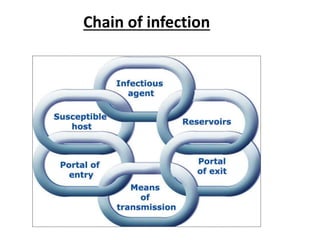
Chain of infection
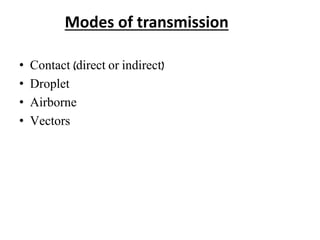
Modes of transmission
• Contact (direct or indirect)
• Droplet
• Airborne
• Vectors
Hospital infection control:-
• Medical and surgical asepsis
• Standard precautions
• Isolation precautions
• Sharp precautions
• Handling of contaminated material
• Environmental control
• Staff health promotion and education
• Evaluation
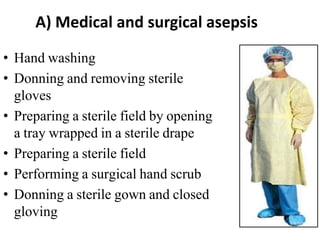
A) Medical and surgical asepsis
• Hand washing
• Donning and removing sterile
gloves
• Preparing a sterile field by opening
a tray wrapped in a sterile drape
• Preparing a sterile field
• Performing a surgical hand scrub
• Donning a sterile gown and closed
gloving
B) Standard precautions
Standard precautions are applied to blood, all
body fluids, secretions, excretions (except
sweat) non- intact skin & mucous membrane.
• Hand Hygiene
• Personal Protective Equipment (Barrier
Precaution)
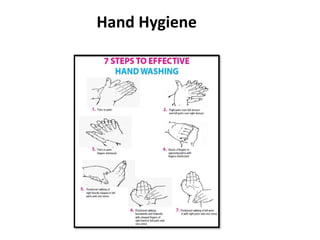
Hand Hygiene
When??
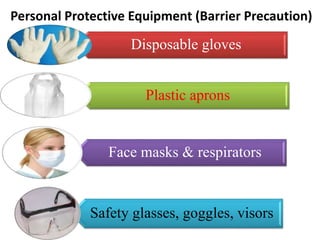
Personal Protective Equipment (Barrier Precaution)
Disposable gloves
Plastic aprons
Face masks & respirators
Safety glasses, goggles, visors
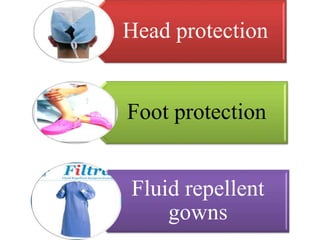
Head protection
Foot protection
Fluid repellent
gowns
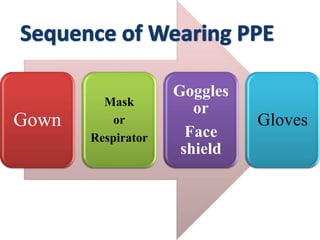
Gown
Mask
or
Respirator
Goggles
or
Face
shield
Gloves
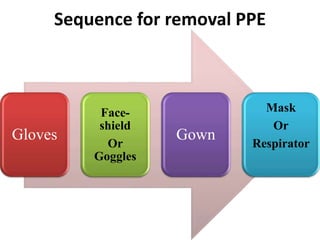
Sequence for removal PPE
Gloves
Face-
shield
Or
Goggles
Gown
Mask
Or
Respirator
C) Isolation Precautions
• Transmission-Based Precautions:
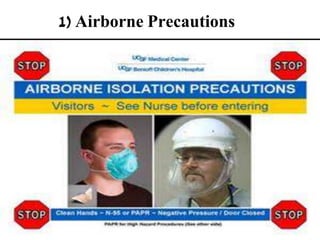
• 1) Airborne Precautions
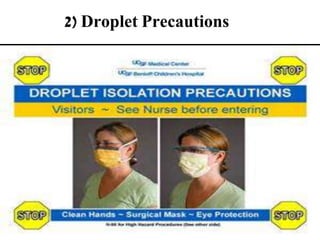
• 2) Droplet Precautions and
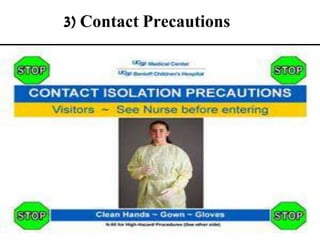
• 3) Contact Precautions.
1) Airborne Precautions
2) Droplet Precautions
3) Contact Precautions
D) Sharp precautions
–NEVER TO RECAP NEEDLES
–Dispose of used needles and small
sharps immediately in puncture resistant
boxes. Needle incinerator can be used
for disposal.
E) Handling of contaminated material
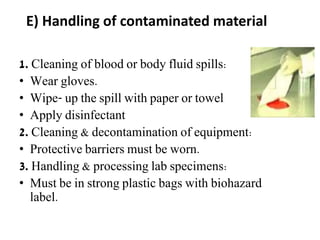
1. Cleaning of blood or body fluid spills:
• Wear gloves.
• Wipe- up the spill with paper or towel
• Apply disinfectant
2. Cleaning & decontamination of equipment:
• Protective barriers must be worn.
3. Handling & processing lab specimens:
• Must be in strong plastic bags with biohazard
label.
4. Handling & processing linen:
• Soiled linen must be handled with barrier precautions,
sent to laundry in coded bags.
• Handling & processing infectious waste:
• Must be placed in color coded, leakage proof bags,
collected with barrier precautions
• Contaminated waste incinerated or better autoclaved
prior to disposal in a landfill
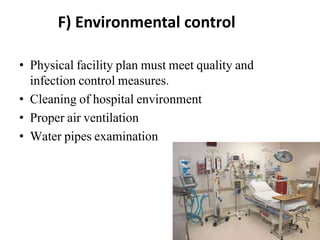
F) Environmental control
• Physical facility plan must meet quality and
infection control measures.
• Cleaning of hospital environment
• Proper air ventilation
• Water pipes examination
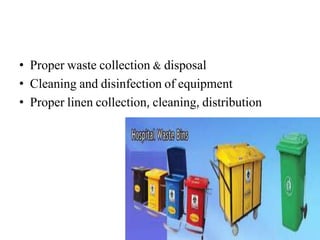
• Proper waste collection & disposal
• Cleaning and disinfection of equipment
• Proper linen collection, cleaning, distribution
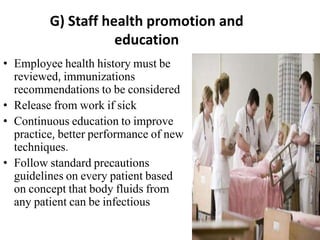
G) Staff health promotion and
education
• Employee health history must be
reviewed, immunizations
recommendations to be considered
• Release from work if sick
• Continuous education to improve
practice, better performance of new
techniques.
• Follow standard precautions
guidelines on every patient based
on concept that body fluids from
any patient can be infectious
H) Evaluation
• Measure success of infection control
techniques
• Compare patient’s response to actual outcome
25