
NOSOCOMIAL
INFECTION
Professor Syed Amin Tabish
FRCP(London), FRCP(Edin), FAMS, MD(AIIMS)
Postdoc Fellowship, Bristol University
(England)
Doctorate in Educational Leadership (USA)
An infection
 An infection results when a
pathogen invades and
begins growing within a
host.
 Disease results only if and
when, as a consequence of the
invasion and growth of a
pathogen, tissue function is
impaired.
Infectious disease
 A disease that is caused by
the invasion of a host by
agents whose activities harm
the host’s tissues (that is,
they cause disease) and can
be transmitted to other
individuals (that is, they are
infectious).
Microbes that cause IDs
 There are five major types of
infectious agents: bacteria,
viruses, fungi, protozoa,
and helminths.
 A new class of infectious
agents, the prions, has
recently been recognized.
Nosocomial Infection
 Nosocomial infections known also
as hospital-acquired infections,
hospital-associated infections
that are not present in the
patient at the time of
admission to hospital but
develop during the course of the
stay in hospital.
There are two forms:
 Endogenous infection, self-
infection, or auto-infection.
 The causative agent of the
infection is present in the patient
at the time of admission to
hospital but there are no signs of
infection.
 The infection develops during the
stay in hospital as a result of the
patient’s altered resistance.
There are two forms (contd.)
 Cross-contamination followed
by cross-infection.
 During the stay in hospital the
patient comes into contact
with new infective agents,
becomes contaminated, and
subsequently develops an
infection
Normal flora
 Healthy people are naturally
contaminated
 Faeces contain about 1013 bacteria per
gram, and the number of
microorganisms on skin varies
between 100 and 10000 per cm2.
 Many species of microorganisms live
on mucous membranes where they
form a normal flora.
What causes Infection
 Microorganisms that penetrate the skin
or the mucous membrane barrier reach
subcutaneous tissue, muscles, bones,
and body cavities (e.g. peritoneal cavity,
pleural cavity, bladder), which are
normally sterile (i.e. contain no
detectable organisms).
 If a general or local reaction to this
contamination develops, with clinical
symptoms, there is an infection.
The transition from
contamination to infection
 Healthy individuals have a normal
general resistance to infection.
 Patients with underlying disease,
newborn babies, and the elderly have
less resistance and will probably
develop an infection after
contamination.
 Health-care workers are thus less likely
to become infected than patients
Local resistance of the tissue
to infection
 The skin and the mucous membranes act
as barriers in contact with the environment.
 Infection may follow when these barriers
are breached.
 Local resistance may also be overcome by
the long-term presence of an irritant, such
as a cannula or catheter; the likelihood of
infection increases daily in a patient with
an indwelling catheter.
Minimal invasive dose
 For every type of microorganism, the minimal
infective dose can be determined; this is the
lowest number of bacteria, viruses, or fungi
that cause the first clinical signs of infection
in a healthy individual.
 For most causative agents of nosocomial
infections, the minimal infective dose is
relatively high.
 For Klebsiella and Serratia spp. and other
Enterobacteriaceae, for example, it is more
than 100 000, but for hepatitis B virus it is
less than 10.
The Source of Infection
 In a health-care facility, the
sources of infection, and of
the preceding contamination,
may be the personnel, the
patients, or the inanimate
environment.
The Source of Infection
 The hospital environment can be
contaminated with pathogens. Salmonella
or Shigella spp., Escherichia coli O157:H7,
or other pathogens may be present in the
food and cause an outbreak of disease
 If the water distribution system breaks
down, waterborne infections may develop
 The source of an outbreak of nosocomial
infection may also be a health worker who is
infected or colonized (a carrier).
Carrier State
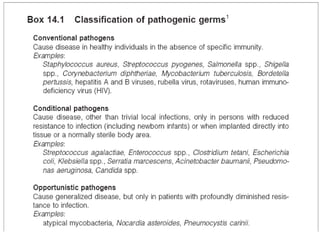
 A symptomless carrier is contaminated or
colonized by potentially pathogenic
organisms but does not develop any
infection.
 A typical example is Staphylococcus
aureus, which may be carried in the nasal
passages of 30-60% of personnel.
 Faecal carriage of enteropathogens such
as Salmonella spp. also occurs frequently
Carriers
 Other conventional pathogens that can
be found in symptomless carriers
include Streptococcus pyogenes,
Corynebacterium diphtheriae, Neisseria
meningitidis, hepatitis B virus, and
cytomegalovirus.
 Contamination of patients by carriers
can give rise to an outbreak of disease.
Hospital Epidemics
 The source of most hospital epidemics is
infected patients, i.e. patients
contaminated with pathogenic
microorganisms.
 These microorganisms are often released
into the environment in very high
numbers, exceeding the minimal infective
dose, and contaminate other patients who
subsequently develop hospital-acquired
infections.
Routes of transmission
 Microorganisms can be transmitted from their
source to a new host through direct or
indirect contact, in the air, or by vectors.
 Vector-borne transmission is typical of
countries in which insects, arthropods, and
other parasites are widespread.
 These become contaminated by contact with
excreta or secretions from an infected patient
and transmit the infective organisms
mechanically to other patients.
Airborne Transmission
 Airborne transmission occurs only with
microorganisms that are dispersed into
the air and that are characterized by a
low minimal infective dose.
 Only a few bacteria and viruses are
present in expired air, and these are
dispersed in large numbers only as a
result of sneezing or coughing.
Direct Contact
 Direct contact between patients
does not usually occur in health-
care facilities, but an infected
health-care worker can touch a
patient and directly transmit a
large number of microorganisms to
the new host.
Indirect Contact
 The most frequent route of transmission,
however, is indirect contact.
 The infected patient touches and
contaminates an object, an instrument, or
a surface.
 Subsequent contact between that item
and another patient is likely to
contaminate the second individual who
may then develop an infection.
Direct Contact
 During general care and/or medical
treatment, the hands of health-care workers
often come into close contact with patients.
 The hands of the clinical personnel are
thus the most frequent vehicles for
nosocomial infections.
 Transmission by this route is much more
common than vectorborne or airborne
transmission or other forms of direct or
indirect contact.
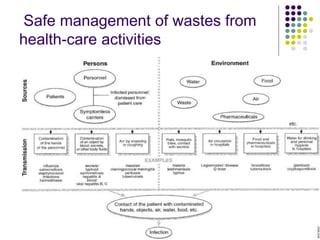
Healthcare Waste
 Health-care waste should be
considered as a reservoir of
pathogenic microorganisms, which
can cause contamination and give
rise to infection.
 If waste is inadequately managed,
these microorganisms can be
transmitted by direct contact, in the
air, or by a variety of vectors.
Healthcare Wastes
 HCW is the total waste stream from a
healthcare facility (HCF)
 HCW is a by-product of healthcare that
includes sharps, non-sharps, blood, body
parts, chemicals, pharmaceuticals,
medical devices and radioactive materials.
 Poor management of HCW exposes
healthcare workers, waste handlers
and the community to infections, toxic
effects and injuries.
Prevention
In order to prevent the spread of
nosocomial infections in health-
care facilities:
 separate the infection source from
the rest of the hospital
 cut off any route of transmission.
Prevention
The separation includes:
 the isolation of infected patients
 all aseptic techniques of the measures
that are intended to act as a barrier
between infected or potentially
contaminated tissue and the
environment, including other patients
and personnel.
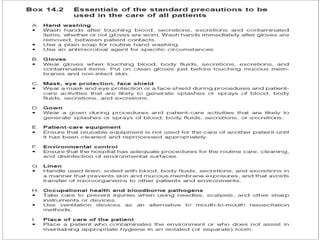
Universal precautions
 The protection of the
personnel, in particular
against the transmission of
bloodborne infections, e.g.
AIDS and viral hepatitis B
and C. Preventive measures
are known as universal or
standard precautions.
Prevention
 It is impossible to avoid all contact with
infected tissue or potentially contaminated
body fluids, excreta, and secretions.
 All objects that come in contact with
patients should be considered as
potentially contaminated.
 If an object is disposable, it should be
discarded as waste.
 If it is reusable, transmission of infective
agents must be prevented by cleaning,
disinfection, or sterilization.
Prevalence of HAI
 A wide range of nosocomial
infections, with prevalence varying
from 3% to 21% (mean 8.4%) in
individual hospitals.
Isolation of infected pts
 The first essential measure in preventing the
spread of nosocomial infections is isolation of
infected patients.
 The strictest form of isolation is applied in case of
very infectious diseases (e.g. haemorrhagic fever,
diphtheria); less stringent precautions can be taken
in case of diseases such as tuberculosis, other
respiratory infections, and infectious diarrhoea.
 Isolation of any degree is expensive, labour-
intensive, and usually inconvenient or
uncomfortable for both patients and health-care
personnel; its implementation should therefore be
adapted to the severity of the disease and to the
causative agent.
Cleaning
 The principal aim of cleaning is to remove visible dirt.
It is essentially a mechanical process: the dirt is
dissolved by water, diluted until it is no longer visible,
and rinsed off. Soaps and detergents act as solubility
promoting agents.
 The microbiological effect of cleaning is also
essentially mechanical: bacteria and other
microorganisms are suspended in the cleaning fluid
and removed from the surface.
 The efficacy of the cleaning process depends
completely on this mechanical action, since neither
soap nor detergents possess any antimicrobial
activity.
Cleaning
 Thorough cleaning will remove
more than 90% of microorganisms.
 However, careless and superficial
cleaning is much less effective
 Cleaning has therefore to be
carried out in a standardized
manner or, better, by automated
means that will guarantee an
adequate level of cleanliness.
Cleaning
 Diluting and removing the dirt also removes the
breeding-ground or
 culture medium for bacteria and fungi. Most non-
sporulating bacteria
 and viruses survive only when they are protected by
dirt or a Þlm of
 organic matter; otherwise they dry out and die. Non-
sporulating bacteria
 are unlikely to survive on clean surfaces.
 The effectiveness of disinfection and sterilization is
increased by prior or
 simultaneous cleaning.
Sterilization
 Self-evidently, an object should be sterile, i.e.
free of microorganisms, after sterilization.
However, sterilization is never absolute; by
deÞnition, sterilized. This is done by
sterilizing only objects that are clean (free of
visible dirt) and applying the principles of
good manufacturing practice.
Sterilization
 Sterilization can be achieved by both physical
and chemical means.
 Physical methods are based on the action of
heat (autoclaving, dry thermal or wet thermal
sterilization), on irradiation (g-irradiation), or
on mechanical separation by Þltration.
Chemical means include gas sterilization with
ethylene oxide or other gases, and immersion
in a disinfectant solution with sterilizing
properties (e.g. glutaraldehyde).
Disinfection
 High-level disinfection: can be expected to
destroy all microorganisms, with the exception
of large numbers of bacterial spores.
 Intermediate disinfection: inactivates
Mycobacterium tuberculosis, vegetative
bacteria, most viruses, and most fungi; does not
necessarily kill bacterial spores.
 Low-level disinfection: can kill most bacteria,
some viruses, and some fungi; cannot be relied
on to kill resistant microorganisms such as
tubercle bacilli
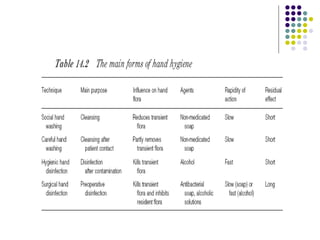
Hand Hygiene
 As the hands of health-care workers are
the most frequent vehicle of nosocomial
infections
 Hand hygiene including both hand
washing and hand disinfection is the
primary preventive measure.
 Thorough hand washing with adequate
quantities of water and soap removes
more than 90% of the transient, i.e.
superficial, flora including all or most
contaminants.
Hand washing
 An antimicrobial soap will further
reduce the transient flora, but only
if used for several minutes. Hand
washing with (non-medicated)
soap is essential when hands are
dirty and should be routine after
physical contact with a patient.
Hand hygiene
 Killing all transient flora with all
contaminants within a short time
(a few seconds) necessitates
hygienic hand disinfection: only
alcohol or alcoholic preparations
act sufficiently fast.
 Hands should be disinfected with
alcohol when an infected tissue
or body fluid is touched without
gloves.
Hand Hygiene
 During a surgical intervention, a high
proportion of gloves becomes perforated.
 Hands should therefore be disinfected
with a long-acting disinfectant before
gloves are put on.
 This will not only kill all the transient
flora, but will also prevent the
microorganisms from taking the place of
the transient flora during the intervention.
Hand-washing
 Hands should be washed for
5-10 minutes with an
antibacterial detergent
containing chlorhexidine or
an iodophore, or rubbed
twice for 2 minutes with an
alcoholic solution of one of
these antiseptics.
Thank you
very much
Safe management of wastes from
health-care activities
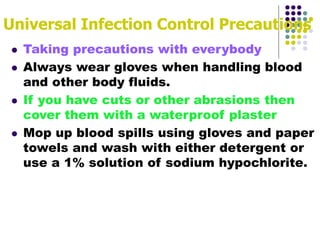
Universal Infection Control Precautions
 Taking precautions with everybody
 Always wear gloves when handling blood
and other body fluids.
 If you have cuts or other abrasions then
cover them with a waterproof plaster
 Mop up blood spills using gloves and paper
towels and wash with either detergent or
use a 1% solution of sodium hypochlorite.
 In many countries for many years health
care workers have become infected with
HIV as a result of their work.
 The main cause of HIV infection in
occupational settings is via a percutaneous
(i.e. needle stick) injury resulting in
exposure to HIV infected blood. Research
suggests that infection is rare after a needle
stick injury, with a rate of about 3 per 1000
injuries.

NOSOCOMIAL INFECTION.ppt

  • 1.
    NOSOCOMIAL INFECTION Professor Syed AminTabish FRCP(London), FRCP(Edin), FAMS, MD(AIIMS) Postdoc Fellowship, Bristol University (England) Doctorate in Educational Leadership (USA)
  • 2.
    An infection  Aninfection results when a pathogen invades and begins growing within a host.  Disease results only if and when, as a consequence of the invasion and growth of a pathogen, tissue function is impaired.
  • 3.
    Infectious disease  Adisease that is caused by the invasion of a host by agents whose activities harm the host’s tissues (that is, they cause disease) and can be transmitted to other individuals (that is, they are infectious).
  • 4.
    Microbes that causeIDs  There are five major types of infectious agents: bacteria, viruses, fungi, protozoa, and helminths.  A new class of infectious agents, the prions, has recently been recognized.
  • 5.
    Nosocomial Infection  Nosocomialinfections known also as hospital-acquired infections, hospital-associated infections that are not present in the patient at the time of admission to hospital but develop during the course of the stay in hospital.
  • 6.
    There are twoforms:  Endogenous infection, self- infection, or auto-infection.  The causative agent of the infection is present in the patient at the time of admission to hospital but there are no signs of infection.  The infection develops during the stay in hospital as a result of the patient’s altered resistance.
  • 7.
    There are twoforms (contd.)  Cross-contamination followed by cross-infection.  During the stay in hospital the patient comes into contact with new infective agents, becomes contaminated, and subsequently develops an infection
  • 8.
    Normal flora  Healthypeople are naturally contaminated  Faeces contain about 1013 bacteria per gram, and the number of microorganisms on skin varies between 100 and 10000 per cm2.  Many species of microorganisms live on mucous membranes where they form a normal flora.
  • 9.
    What causes Infection Microorganisms that penetrate the skin or the mucous membrane barrier reach subcutaneous tissue, muscles, bones, and body cavities (e.g. peritoneal cavity, pleural cavity, bladder), which are normally sterile (i.e. contain no detectable organisms).  If a general or local reaction to this contamination develops, with clinical symptoms, there is an infection.
  • 10.
    The transition from contaminationto infection  Healthy individuals have a normal general resistance to infection.  Patients with underlying disease, newborn babies, and the elderly have less resistance and will probably develop an infection after contamination.  Health-care workers are thus less likely to become infected than patients
  • 11.
    Local resistance ofthe tissue to infection  The skin and the mucous membranes act as barriers in contact with the environment.  Infection may follow when these barriers are breached.  Local resistance may also be overcome by the long-term presence of an irritant, such as a cannula or catheter; the likelihood of infection increases daily in a patient with an indwelling catheter.
  • 12.
    Minimal invasive dose For every type of microorganism, the minimal infective dose can be determined; this is the lowest number of bacteria, viruses, or fungi that cause the first clinical signs of infection in a healthy individual.  For most causative agents of nosocomial infections, the minimal infective dose is relatively high.  For Klebsiella and Serratia spp. and other Enterobacteriaceae, for example, it is more than 100 000, but for hepatitis B virus it is less than 10.
  • 13.
    The Source ofInfection  In a health-care facility, the sources of infection, and of the preceding contamination, may be the personnel, the patients, or the inanimate environment.
  • 14.
    The Source ofInfection  The hospital environment can be contaminated with pathogens. Salmonella or Shigella spp., Escherichia coli O157:H7, or other pathogens may be present in the food and cause an outbreak of disease  If the water distribution system breaks down, waterborne infections may develop  The source of an outbreak of nosocomial infection may also be a health worker who is infected or colonized (a carrier).
  • 15.
    Carrier State  Asymptomless carrier is contaminated or colonized by potentially pathogenic organisms but does not develop any infection.  A typical example is Staphylococcus aureus, which may be carried in the nasal passages of 30-60% of personnel.  Faecal carriage of enteropathogens such as Salmonella spp. also occurs frequently
  • 16.
    Carriers  Other conventionalpathogens that can be found in symptomless carriers include Streptococcus pyogenes, Corynebacterium diphtheriae, Neisseria meningitidis, hepatitis B virus, and cytomegalovirus.  Contamination of patients by carriers can give rise to an outbreak of disease.
  • 17.
    Hospital Epidemics  Thesource of most hospital epidemics is infected patients, i.e. patients contaminated with pathogenic microorganisms.  These microorganisms are often released into the environment in very high numbers, exceeding the minimal infective dose, and contaminate other patients who subsequently develop hospital-acquired infections.
  • 18.
    Routes of transmission Microorganisms can be transmitted from their source to a new host through direct or indirect contact, in the air, or by vectors.  Vector-borne transmission is typical of countries in which insects, arthropods, and other parasites are widespread.  These become contaminated by contact with excreta or secretions from an infected patient and transmit the infective organisms mechanically to other patients.
  • 19.
    Airborne Transmission  Airbornetransmission occurs only with microorganisms that are dispersed into the air and that are characterized by a low minimal infective dose.  Only a few bacteria and viruses are present in expired air, and these are dispersed in large numbers only as a result of sneezing or coughing.
  • 20.
    Direct Contact  Directcontact between patients does not usually occur in health- care facilities, but an infected health-care worker can touch a patient and directly transmit a large number of microorganisms to the new host.
  • 21.
    Indirect Contact  Themost frequent route of transmission, however, is indirect contact.  The infected patient touches and contaminates an object, an instrument, or a surface.  Subsequent contact between that item and another patient is likely to contaminate the second individual who may then develop an infection.
  • 22.
    Direct Contact  Duringgeneral care and/or medical treatment, the hands of health-care workers often come into close contact with patients.  The hands of the clinical personnel are thus the most frequent vehicles for nosocomial infections.  Transmission by this route is much more common than vectorborne or airborne transmission or other forms of direct or indirect contact.
  • 23.
    Healthcare Waste  Health-carewaste should be considered as a reservoir of pathogenic microorganisms, which can cause contamination and give rise to infection.  If waste is inadequately managed, these microorganisms can be transmitted by direct contact, in the air, or by a variety of vectors.
  • 24.
    Healthcare Wastes  HCWis the total waste stream from a healthcare facility (HCF)  HCW is a by-product of healthcare that includes sharps, non-sharps, blood, body parts, chemicals, pharmaceuticals, medical devices and radioactive materials.  Poor management of HCW exposes healthcare workers, waste handlers and the community to infections, toxic effects and injuries.
  • 25.
    Prevention In order toprevent the spread of nosocomial infections in health- care facilities:  separate the infection source from the rest of the hospital  cut off any route of transmission.
  • 26.
    Prevention The separation includes: the isolation of infected patients  all aseptic techniques of the measures that are intended to act as a barrier between infected or potentially contaminated tissue and the environment, including other patients and personnel.
  • 27.
    Universal precautions  Theprotection of the personnel, in particular against the transmission of bloodborne infections, e.g. AIDS and viral hepatitis B and C. Preventive measures are known as universal or standard precautions.
  • 28.
    Prevention  It isimpossible to avoid all contact with infected tissue or potentially contaminated body fluids, excreta, and secretions.  All objects that come in contact with patients should be considered as potentially contaminated.  If an object is disposable, it should be discarded as waste.  If it is reusable, transmission of infective agents must be prevented by cleaning, disinfection, or sterilization.
  • 29.
    Prevalence of HAI A wide range of nosocomial infections, with prevalence varying from 3% to 21% (mean 8.4%) in individual hospitals.
  • 30.
    Isolation of infectedpts  The first essential measure in preventing the spread of nosocomial infections is isolation of infected patients.  The strictest form of isolation is applied in case of very infectious diseases (e.g. haemorrhagic fever, diphtheria); less stringent precautions can be taken in case of diseases such as tuberculosis, other respiratory infections, and infectious diarrhoea.  Isolation of any degree is expensive, labour- intensive, and usually inconvenient or uncomfortable for both patients and health-care personnel; its implementation should therefore be adapted to the severity of the disease and to the causative agent.
  • 31.
    Cleaning  The principalaim of cleaning is to remove visible dirt. It is essentially a mechanical process: the dirt is dissolved by water, diluted until it is no longer visible, and rinsed off. Soaps and detergents act as solubility promoting agents.  The microbiological effect of cleaning is also essentially mechanical: bacteria and other microorganisms are suspended in the cleaning fluid and removed from the surface.  The efficacy of the cleaning process depends completely on this mechanical action, since neither soap nor detergents possess any antimicrobial activity.
  • 32.
    Cleaning  Thorough cleaningwill remove more than 90% of microorganisms.  However, careless and superficial cleaning is much less effective  Cleaning has therefore to be carried out in a standardized manner or, better, by automated means that will guarantee an adequate level of cleanliness.
  • 33.
    Cleaning  Diluting andremoving the dirt also removes the breeding-ground or  culture medium for bacteria and fungi. Most non- sporulating bacteria  and viruses survive only when they are protected by dirt or a Þlm of  organic matter; otherwise they dry out and die. Non- sporulating bacteria  are unlikely to survive on clean surfaces.  The effectiveness of disinfection and sterilization is increased by prior or  simultaneous cleaning.
  • 35.
    Sterilization  Self-evidently, anobject should be sterile, i.e. free of microorganisms, after sterilization. However, sterilization is never absolute; by deÞnition, sterilized. This is done by sterilizing only objects that are clean (free of visible dirt) and applying the principles of good manufacturing practice.
  • 36.
    Sterilization  Sterilization canbe achieved by both physical and chemical means.  Physical methods are based on the action of heat (autoclaving, dry thermal or wet thermal sterilization), on irradiation (g-irradiation), or on mechanical separation by Þltration. Chemical means include gas sterilization with ethylene oxide or other gases, and immersion in a disinfectant solution with sterilizing properties (e.g. glutaraldehyde).
  • 37.
    Disinfection  High-level disinfection:can be expected to destroy all microorganisms, with the exception of large numbers of bacterial spores.  Intermediate disinfection: inactivates Mycobacterium tuberculosis, vegetative bacteria, most viruses, and most fungi; does not necessarily kill bacterial spores.  Low-level disinfection: can kill most bacteria, some viruses, and some fungi; cannot be relied on to kill resistant microorganisms such as tubercle bacilli
  • 38.
    Hand Hygiene  Asthe hands of health-care workers are the most frequent vehicle of nosocomial infections  Hand hygiene including both hand washing and hand disinfection is the primary preventive measure.  Thorough hand washing with adequate quantities of water and soap removes more than 90% of the transient, i.e. superficial, flora including all or most contaminants.
  • 39.
    Hand washing  Anantimicrobial soap will further reduce the transient flora, but only if used for several minutes. Hand washing with (non-medicated) soap is essential when hands are dirty and should be routine after physical contact with a patient.
  • 40.
    Hand hygiene  Killingall transient flora with all contaminants within a short time (a few seconds) necessitates hygienic hand disinfection: only alcohol or alcoholic preparations act sufficiently fast.  Hands should be disinfected with alcohol when an infected tissue or body fluid is touched without gloves.
  • 41.
    Hand Hygiene  Duringa surgical intervention, a high proportion of gloves becomes perforated.  Hands should therefore be disinfected with a long-acting disinfectant before gloves are put on.  This will not only kill all the transient flora, but will also prevent the microorganisms from taking the place of the transient flora during the intervention.
  • 42.
    Hand-washing  Hands shouldbe washed for 5-10 minutes with an antibacterial detergent containing chlorhexidine or an iodophore, or rubbed twice for 2 minutes with an alcoholic solution of one of these antiseptics.
  • 44.
  • 47.
    Safe management ofwastes from health-care activities
  • 48.
    Universal Infection ControlPrecautions  Taking precautions with everybody  Always wear gloves when handling blood and other body fluids.  If you have cuts or other abrasions then cover them with a waterproof plaster  Mop up blood spills using gloves and paper towels and wash with either detergent or use a 1% solution of sodium hypochlorite.
  • 49.
     In manycountries for many years health care workers have become infected with HIV as a result of their work.  The main cause of HIV infection in occupational settings is via a percutaneous (i.e. needle stick) injury resulting in exposure to HIV infected blood. Research suggests that infection is rare after a needle stick injury, with a rate of about 3 per 1000 injuries.