

ARMAN FIROZ
PhD Scholar
School of BioSciences and Technology
VIT University, Vellore- 632014
NORMAL HUMAN
FLORA
The human microbiome (or human microbiota) is the aggregate
of microorganisms that reside on the surface and in deep layers
of skin, in the saliva and oral mucosa, in the conjunctiva, and in
the gastrointestinal tracts. They include bacteria, fungi. Some
of these organisms perform tasks that are useful for the human
host. However, the majority have no known beneficial or
harmful effect. Those that are expected to be present, and that
under normal circumstances do not cause disease, but instead
participate in maintaining health, are deemed members of the
normal flora
HUMAN MICROBIOME
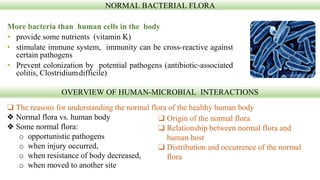
NORMAL BACTERIAL FLORA
More bacteria than human cells in the body
• provide some nutrients (vitamin K)
• stimulate immune system, immunity can be cross-reactive against
certain pathogens
• Prevent colonization by potential pathogens (antibiotic-associated
colitis, Clostridiumdifficile)
OVERVIEW OF HUMAN-MICROBIAL INTERACTIONS
❑ The reasons for understanding the normal flora of the healthy human body
❖ Normal flora vs. human body
❖ Some normal flora:
o opportunistic pathogens
o when injury occurred,
o when resistance of body decreased,
o when moved to another site
❑ Origin of the normal flora
❑ Relationship between normal flora and
human host
❑ Distribution and occurrence of the normal
flora
WHERE TO FIND MICROBE?
EVERYWHERE!
Opportunistic
Commensalistic
SYMBIOTIC
RELATIONSHIP
Mutualistic
SYMBIOSIS
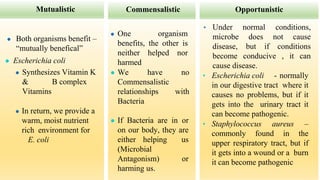
Mutualistic Commensalistic Opportunistic
● Both organisms benefit –
“mutually benefical”
● Escherichia coli
● Synthesizes Vitamin K
& B complex
Vitamins
● In return, we provide a
warm, moist nutrient
rich environment for
E. coli
● One organism
benefits, the other is
neither helped nor
harmed
● We have no
Commensalistic
relationships with
Bacteria
● If Bacteria are in or
on our body, they are
either helping us
(Microbial
Antagonism) or
harming us.
• Under normal conditions,
microbe does not cause
disease, but if conditions
become conducive , it can
cause disease.
• Escherichia coli - normally
in our digestive tract where it
causes no problems, but if it
gets into the urinary tract it
can become pathogenic.
• Staphylococcus aureus –
commonly found in the
upper respiratory tract, but if
it gets into a wound or a burn
it can become pathogenic
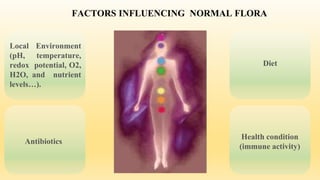
FACTORS INFLUENCING NORMAL FLORA
Diet
Health condition
(immune activity)
Antibiotics
Local Environment
(pH, temperature,
redox potential, O2,
H2O, and nutrient
levels…).
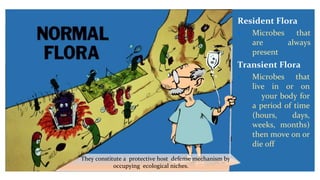
Resident Flora
● Microbes that
are always
present
Transient Flora
● Microbes that
live in or on
your body for
a period of time
(hours, days,
weeks, months)
then move on or
die off
They constitute a protective host defense mechanism by
occupying ecological niches.
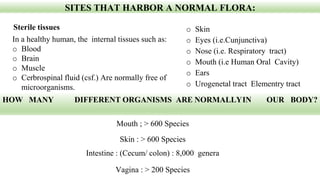
SITES THAT HARBOR A NORMAL FLORA:
Sterile tissues o Skin
o Eyes (i.e.Cunjunctiva)
o Nose (i.e. Respiratory tract)
o Mouth (i.e Human Oral Cavity)
o Ears
o Urogenetal tract Elementry tract
In a healthy human, the internal tissues such as:
o Blood
o Brain
o Muscle
o Cerbrospinal fluid (csf.) Are normally free of
microorganisms.
Mouth ; > 600 Species
Skin : > 600 Species
Intestine : (Cecum/ colon) : 8,000 genera
Vagina : > 200 Species
HOW MANY DIFFERENT ORGANISMS ARE NORMALLYIN OUR BODY?
Yes
How?
No
Why ?
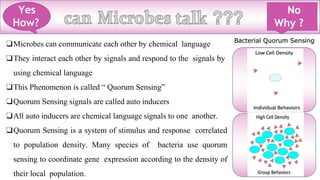
❑Microbes can communicate each other by chemical language
❑They interact each other by signals and respond to the signals by
using chemical language
❑This Phenomenon is called “ Quorum Sensing”
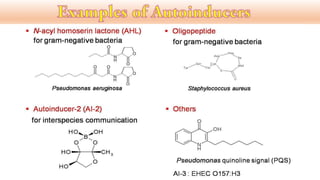
❑Quorum Sensing signals are called auto inducers
❑All auto inducers are chemical language signals to one another.
❑Quorum Sensing is a system of stimulus and response correlated
to population density. Many species of bacteria use quorum
sensing to coordinate gene expression according to the density of
their local population.
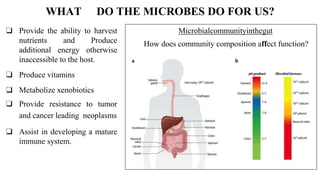
WHAT DO THE MICROBES DO FOR US?
❑ Provide the ability to harvest
nutrients and Produce
additional energy otherwise
inaccessible to the host.
❑ Produce vitamins
❑ Metabolize xenobiotics
❑ Provide resistance to tumor
and cancer leading neoplasms
❑ Assist in developing a mature
immune system.
Microbialcommunityinthegut
How does community composition affect function?
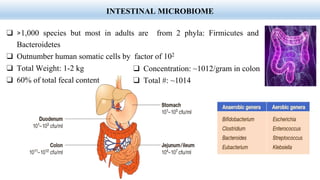
INTESTINAL MICROBIOME
❑ >1,000 species but most in adults are from 2 phyla: Firmicutes and
Bacteroidetes
❑ Outnumber human somatic cells by factor of 102
❑ Total Weight: 1-2 kg
❑ 60% of total fecal content
❑ Concentration: ~1012/gram in colon
❑ Total #: ~1014
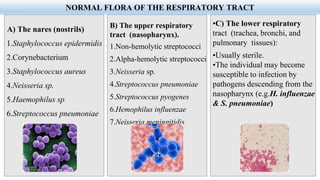
NORMAL FLORA OF THE RESPIRATORY TRACT
A) The nares (nostrils)
1.Staphylococcus epidermidis
2.Corynebacterium
3.Staphylococcus aureus
4.Neisseria sp.
5.Haemophilus sp
6.Streptococcus pneumoniae
B) The upper respiratory
tract (nasopharynx).
1.Non-hemolytic streptococci
2.Alpha-hemolytic streptococci
3.Neisseria sp.
4.Streptococcus pneumoniae
5.Streptococcus pyogenes
6.Hemophilus influenzae
7.Neisseria meningitidis
•C) The lower respiratory
tract (trachea, bronchi, and
pulmonary tissues):
•Usually sterile.
•The individual may become
susceptible to infection by
pathogens descending from the
nasopharynx (e.g.H. influenzae
& S. pneumoniae)
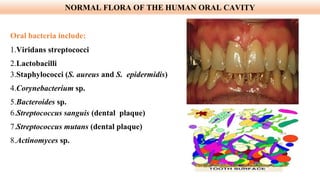
NORMAL FLORA OF THE HUMAN ORAL CAVITY
Oral bacteria include:
1.Viridans streptococci
2.Lactobacilli
3.Staphylococci (S. aureus and S. epidermidis)
4.Corynebacterium sp.
5.Bacteroides sp.
6.Streptococcus sanguis (dental plaque)
7.Streptococcus mutans (dental plaque)
8.Actinomyces sp.
METABOLOMICS
•Study of the metabolites and small
molecules that the body and gut bacteria
produce.
•New area of science
•Broader than proteomics
•Includes bacteria products with our own
genetic products
•Pioneered by Jeremy Nicholson and Jeff
Gordon
•Microbial genomes enhance our
metabolic activity
•May indirectly or directly affect our
metabolism
•The colon is very active metabolically
•20-70 gms of carbons and 5-20 gms of
protein/day
•Over 100 kcal per day!
•Mass of colonic microbiome = single
kidney
•Metabolically as active as the liver
FECAL MICROBIOTA TRANSPLANTS [FMT]
Fecal microbiota transplantation (FMT) also known as a
stool transplant is the process of transplantation of fecal
bacteria from a healthy individual into a recipient.
❑Clostridium difficile also known as "CDF/cdf", or "C.
diff", is a species of Gram-positive spore-forming
bacterium that is best known for causing antibiotic-
associated diarrhea(AAD).
❑While it can be a minor normal component of colonic
flora, the bacterium is thought to cause disease when
competing bacteria in the gut have been wiped out by
antibiotic treatment.
❑In severe cases, C. difficile can cause
"pseudomembranous colitis," a severe inflammation of the
colon.
PROCEDURE
❑Donar History(Similar to blood
donation)
❑Obtain stool sample,
homogenize with saline and filter
❑How to Administer
❑Nasogastric Tube
❑Enema
❑Colonoscope
❑Perform 6-24 hrs of obtaining
the sample
❑Future:Frozen Samples,
Lyophilized Powders,Capsules.?
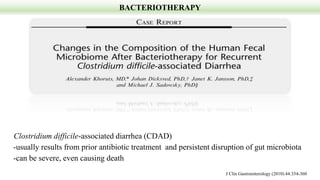
BACTERIOTHERAPY
Clostridium difficile-associated diarrhea (CDAD)
-usually results from prior antibiotic treatment and persistent disruption of gut microbiota
-can be severe, even causing death
J Clin Gastroenterology (2010) 44:354-360
CONCLUSIONS
❏ The human microbiome and the Microbiome Project: research just beginning…
❏ Gut flora by their genes, by-products, and metabolic activity influence our metabolism,
weight, activity, immunity, health and disease.
❏ Manipulation of gut flora may be an integral part of weight loss programs and different
disease treatments in the future.
❏ Future studies must focus on the mechanisms that influence of our gut flora.
❏ Studies must be place to controlled and high quality research should be done.
❏ Truly need translational science to work at the levels of the petri dish, genomics, and
clinical outcomes.
❏ Hope much much more to come!
Normal Microbial Flora in Human Body

Normal Microbial Flora in Human Body

  • 1.
    ARMAN FIROZ PhD Scholar Schoolof BioSciences and Technology VIT University, Vellore- 632014 NORMAL HUMAN FLORA
  • 2.
    The human microbiome(or human microbiota) is the aggregate of microorganisms that reside on the surface and in deep layers of skin, in the saliva and oral mucosa, in the conjunctiva, and in the gastrointestinal tracts. They include bacteria, fungi. Some of these organisms perform tasks that are useful for the human host. However, the majority have no known beneficial or harmful effect. Those that are expected to be present, and that under normal circumstances do not cause disease, but instead participate in maintaining health, are deemed members of the normal flora HUMAN MICROBIOME
  • 3.
    NORMAL BACTERIAL FLORA Morebacteria than human cells in the body • provide some nutrients (vitamin K) • stimulate immune system, immunity can be cross-reactive against certain pathogens • Prevent colonization by potential pathogens (antibiotic-associated colitis, Clostridiumdifficile) OVERVIEW OF HUMAN-MICROBIAL INTERACTIONS ❑ The reasons for understanding the normal flora of the healthy human body ❖ Normal flora vs. human body ❖ Some normal flora: o opportunistic pathogens o when injury occurred, o when resistance of body decreased, o when moved to another site ❑ Origin of the normal flora ❑ Relationship between normal flora and human host ❑ Distribution and occurrence of the normal flora
  • 4.
    WHERE TO FINDMICROBE? EVERYWHERE!
  • 5.
  • 6.
    Mutualistic Commensalistic Opportunistic ●Both organisms benefit – “mutually benefical” ● Escherichia coli ● Synthesizes Vitamin K & B complex Vitamins ● In return, we provide a warm, moist nutrient rich environment for E. coli ● One organism benefits, the other is neither helped nor harmed ● We have no Commensalistic relationships with Bacteria ● If Bacteria are in or on our body, they are either helping us (Microbial Antagonism) or harming us. • Under normal conditions, microbe does not cause disease, but if conditions become conducive , it can cause disease. • Escherichia coli - normally in our digestive tract where it causes no problems, but if it gets into the urinary tract it can become pathogenic. • Staphylococcus aureus – commonly found in the upper respiratory tract, but if it gets into a wound or a burn it can become pathogenic
  • 7.
    FACTORS INFLUENCING NORMALFLORA Diet Health condition (immune activity) Antibiotics Local Environment (pH, temperature, redox potential, O2, H2O, and nutrient levels…).
  • 8.
    Resident Flora ● Microbesthat are always present Transient Flora ● Microbes that live in or on your body for a period of time (hours, days, weeks, months) then move on or die off They constitute a protective host defense mechanism by occupying ecological niches.
  • 9.
    SITES THAT HARBORA NORMAL FLORA: Sterile tissues o Skin o Eyes (i.e.Cunjunctiva) o Nose (i.e. Respiratory tract) o Mouth (i.e Human Oral Cavity) o Ears o Urogenetal tract Elementry tract In a healthy human, the internal tissues such as: o Blood o Brain o Muscle o Cerbrospinal fluid (csf.) Are normally free of microorganisms. Mouth ; > 600 Species Skin : > 600 Species Intestine : (Cecum/ colon) : 8,000 genera Vagina : > 200 Species HOW MANY DIFFERENT ORGANISMS ARE NORMALLYIN OUR BODY?
  • 10.
    Yes How? No Why ? ❑Microbes cancommunicate each other by chemical language ❑They interact each other by signals and respond to the signals by using chemical language ❑This Phenomenon is called “ Quorum Sensing” ❑Quorum Sensing signals are called auto inducers ❑All auto inducers are chemical language signals to one another. ❑Quorum Sensing is a system of stimulus and response correlated to population density. Many species of bacteria use quorum sensing to coordinate gene expression according to the density of their local population.
  • 12.
    WHAT DO THEMICROBES DO FOR US? ❑ Provide the ability to harvest nutrients and Produce additional energy otherwise inaccessible to the host. ❑ Produce vitamins ❑ Metabolize xenobiotics ❑ Provide resistance to tumor and cancer leading neoplasms ❑ Assist in developing a mature immune system. Microbialcommunityinthegut How does community composition affect function?
  • 13.
    INTESTINAL MICROBIOME ❑ >1,000species but most in adults are from 2 phyla: Firmicutes and Bacteroidetes ❑ Outnumber human somatic cells by factor of 102 ❑ Total Weight: 1-2 kg ❑ 60% of total fecal content ❑ Concentration: ~1012/gram in colon ❑ Total #: ~1014
  • 14.
    NORMAL FLORA OFTHE RESPIRATORY TRACT A) The nares (nostrils) 1.Staphylococcus epidermidis 2.Corynebacterium 3.Staphylococcus aureus 4.Neisseria sp. 5.Haemophilus sp 6.Streptococcus pneumoniae B) The upper respiratory tract (nasopharynx). 1.Non-hemolytic streptococci 2.Alpha-hemolytic streptococci 3.Neisseria sp. 4.Streptococcus pneumoniae 5.Streptococcus pyogenes 6.Hemophilus influenzae 7.Neisseria meningitidis •C) The lower respiratory tract (trachea, bronchi, and pulmonary tissues): •Usually sterile. •The individual may become susceptible to infection by pathogens descending from the nasopharynx (e.g.H. influenzae & S. pneumoniae)
  • 15.
    NORMAL FLORA OFTHE HUMAN ORAL CAVITY Oral bacteria include: 1.Viridans streptococci 2.Lactobacilli 3.Staphylococci (S. aureus and S. epidermidis) 4.Corynebacterium sp. 5.Bacteroides sp. 6.Streptococcus sanguis (dental plaque) 7.Streptococcus mutans (dental plaque) 8.Actinomyces sp.
  • 16.
    METABOLOMICS •Study of themetabolites and small molecules that the body and gut bacteria produce. •New area of science •Broader than proteomics •Includes bacteria products with our own genetic products •Pioneered by Jeremy Nicholson and Jeff Gordon •Microbial genomes enhance our metabolic activity •May indirectly or directly affect our metabolism •The colon is very active metabolically •20-70 gms of carbons and 5-20 gms of protein/day •Over 100 kcal per day! •Mass of colonic microbiome = single kidney •Metabolically as active as the liver
  • 17.
    FECAL MICROBIOTA TRANSPLANTS[FMT] Fecal microbiota transplantation (FMT) also known as a stool transplant is the process of transplantation of fecal bacteria from a healthy individual into a recipient. ❑Clostridium difficile also known as "CDF/cdf", or "C. diff", is a species of Gram-positive spore-forming bacterium that is best known for causing antibiotic- associated diarrhea(AAD). ❑While it can be a minor normal component of colonic flora, the bacterium is thought to cause disease when competing bacteria in the gut have been wiped out by antibiotic treatment. ❑In severe cases, C. difficile can cause "pseudomembranous colitis," a severe inflammation of the colon. PROCEDURE ❑Donar History(Similar to blood donation) ❑Obtain stool sample, homogenize with saline and filter ❑How to Administer ❑Nasogastric Tube ❑Enema ❑Colonoscope ❑Perform 6-24 hrs of obtaining the sample ❑Future:Frozen Samples, Lyophilized Powders,Capsules.?
  • 18.
    BACTERIOTHERAPY Clostridium difficile-associated diarrhea(CDAD) -usually results from prior antibiotic treatment and persistent disruption of gut microbiota -can be severe, even causing death J Clin Gastroenterology (2010) 44:354-360
  • 19.
    CONCLUSIONS ❏ The humanmicrobiome and the Microbiome Project: research just beginning… ❏ Gut flora by their genes, by-products, and metabolic activity influence our metabolism, weight, activity, immunity, health and disease. ❏ Manipulation of gut flora may be an integral part of weight loss programs and different disease treatments in the future. ❏ Future studies must focus on the mechanisms that influence of our gut flora. ❏ Studies must be place to controlled and high quality research should be done. ❏ Truly need translational science to work at the levels of the petri dish, genomics, and clinical outcomes. ❏ Hope much much more to come!