Clinical microbiology. Major
tasks and purposes.
Opportunistic microbiota as
major cause of hospital
infections. Short characteristics
of microbiota representatives
from different biotopes of human
body
Vinnitsa National Pirogov Memorial Medical
University/ Department of microbiology
Clinical microbiology
Clinical microbiology is the part of medical
microbiology
Clinical microbiology investigates
microbiological aspects non-epidemic
microbial complications (for example,
nosocomial infections) and elaborates
laboratory diagnostics of them
Main tasks of the clinical
microbiology
1. Investigation of morphology, physiology,
genetics and ecology of opportunistic germs and
their significance in human being
2. Elaboration rapid diagnostic tests for infectious
complications and improvement present
methods of laboratory diagnostics
3. Study the pathogenic properties of opportunistic
microorganisms and their role in pathogenesis
of microbial complications of somatic illness
Main tasks of the clinical
microbiology
4. Investigation of mechanisms of pathogenic
agents influence on human immune system,
features of immune response to microorganisms
5. Features of microbial complication development
in immunocompromised patients
6. Ability to treat of non-contagious diseases with
specific medicines (immune sera,
immunoglobulins, vaccines)
7. Investigation symbiotic association of
microorganisms in human body
Normal microbiota
Normal microbiota (normal flora) is microbial
populations associated with skin and
mucous membranes of every human being
from shortly after birth until death.
The community of microorganisms colonising
certain biotope of human body (host) is also
known as microbiocenosis
The human body is inhabited by about
1014 microorganisms.
• Normal flora is divided into constant and
transient flora.
• Constant (obligate, resident, indigenous,
autochthonous) microflora is the native
flora.
• Transient (temporary, facultative,
allochthonous) microflora is acquired flora,
which is accidentally taken from
environment.
Most members of the normal flora are
bacteria, but fungi and protozoa inhabit the
body as well.
Normal flora inhabits the next areas and
systems of the host:
• Skin and nails
• Eyes (conjunctiva)
• External acoustic duct
• Mucous membranes of the
–Upper respiratory tract (nose, oropharinx)
–Gastrointestinal tract (from mouth to
rectum
– Genitourinary tract
According to their significance in
human pathology normal flora
can be categorized is
• helpful (mutualutic
symbionts)
• harmless (commensals)
• potential harmful
(opportunists)
Beneficial role of normal flora
1. Normal flora provides colonization
resistance of the skin and mucous
membranes by:
• Competition with “foreigners” for nutrients
• Binding with specific receptors required for
adhesion of pathogens
• Releasing harmful for pathogens metabolic
products or bacteriocins production
2. Synthesis of vitamins (group B and K) by
intestinal microbiota
Beneficial role of normal flora
3. Intestinal mirobiota takes part in bile acids
metabolism and capable of secreting
digestive enzymes
4. Neutralization a small amount of natural
toxic substances, binding of heavy metal
salts, phenolics and aldehydes by
intestinal microbiota
5. Stimulation of the host's immune system
and non-specific immune response
Harmful effect of normal flora
1. Some normal flora organisms can be
opportunistic pathogens, which cause
infectious if tissue injury occurs at specific
body sites, or if the resistant of the body to
infection is decreased.
2. Disoders in vaginal and intestinal
microbiota due to antibiotic therapy may
lead to disbiosis with clinical appearence
Harmful effect of normal flora
• Usage of broad spectrum antibiotics may
inhibit sensitive members and thereby
select resistant bacteria
• Normal flora may produce enzymes splitting
or inactivating antibiotics
• Some metabolic products of normal flora act
as cocarcinogenes (protein putrifaction
prducts, nitrites, nitrates,etc.)
Harmful effect of normal flora
• Normal germs may cause confusion in
diagnosis due to their presence in
clinical samples and their resemblance
to pathogens
• Some pathogens may belong to normal
microbiota of carriers and be
transmitted to healthy persons
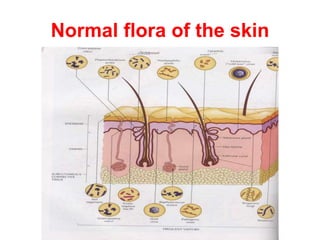
Normal flora of the skin
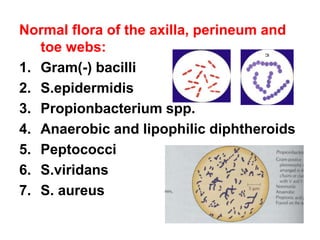
Normal flora of the axilla, perineum and
toe webs:
1. Gram(-) bacilli
2. S.epidermidis
3. Propionbacterium spp.
4. Anaerobic and lipophilic diphtheroids
5. Peptococci
6. S.viridans
7. S. aureus
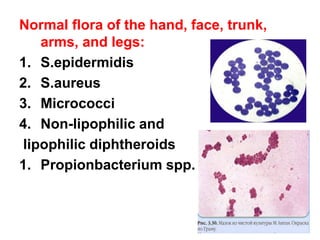
Normal flora of the hand, face, trunk,
arms, and legs:
1. S.epidermidis
2. S.aureus
3. Micrococci
4. Non-lipophilic and
lipophilic diphtheroids
1. Propionbacterium spp.
Normal flora of the upper
respiratory tract
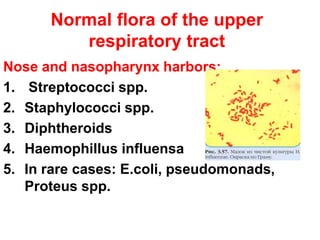
Nose and nasopharynx harbors:
1. Streptococci spp.
2. Staphylococci spp.
3. Diphtheroids
4. Haemophillus influensa
5. In rare cases: E.coli, pseudomonads,
Proteus spp.
Normal flora of the upper
respiratory tract
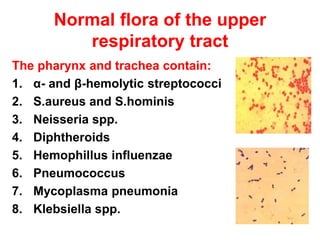
The pharynx and trachea contain:
1. α- and β-hemolytic streptococci
2. S.aureus and S.hominis
3. Neisseria spp.
4. Diphtheroids
5. Hemophillus influenzae
6. Pneumococcus
7. Mycoplasma pneumonia
8. Klebsiella spp.
Urogenital microbiota
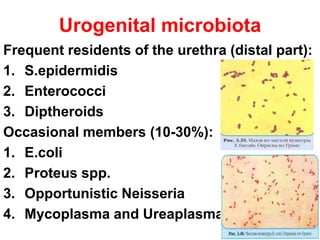
Frequent residents of the urethra (distal part):
1. S.epidermidis
2. Enterococci
3. Diptheroids
Occasional members (10-30%):
1. E.coli
2. Proteus spp.
3. Opportunistic Neisseria
4. Mycoplasma and Ureaplasma
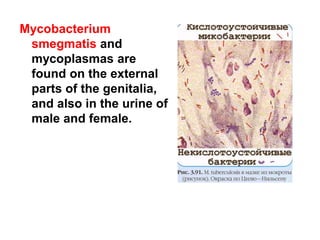
Mycobacterium
smegmatis and
mycoplasmas are
found on the external
parts of the genitalia,
and also in the urine of
male and female.
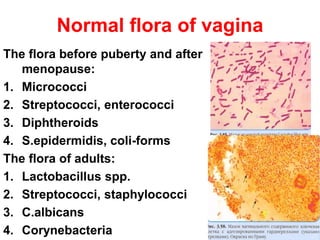
Normal flora of vagina
The flora before puberty and after
menopause:
1. Micrococci
2. Streptococci, enterococci
3. Diphtheroids
4. S.epidermidis, coli-forms
The flora of adults:
1. Lactobacillus spp.
2. Streptococci, staphylococci
3. C.albicans
4. Corynebacteria
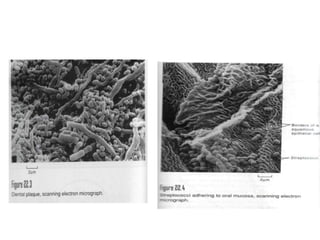
Microbiota of mouth cavity
• The oral cavity is colonize by microorganisms
from the surrounding environment within hours
after a human is born.
• Initially the microbiota consists mostly of the
genera (aerobes and anaerobes)
• Streptococcus (α-hemolytic and viridans group)
• Neisseria
• Actinomyces
• Veillonella
• Lactobacillus
• Candida
Microbiota of mouth cavity
• As the first teeth erupt, the anaerobes
(Porphyromonas, Prevotella, Fusobacterium)
become dominant due to the anaerobic
nature of the gingival groove.
• As teeth grow, S.parasanguis and S.mutans
attach to their enamel surfaces.
• S.salivarius attaches to the buccal and
gingival epithelial surfaces and colonizes the
saliva.
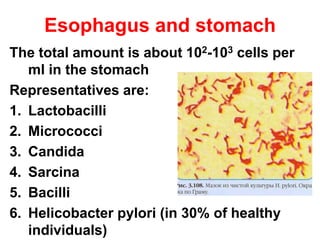
Esophagus and stomach
The total amount is about 102-103 cells per
ml in the stomach
Representatives are:
1. Lactobacilli
2. Micrococci
3. Candida
4. Sarcina
5. Bacilli
6. Helicobacter pylori (in 30% of healthy
individuals)
Duodenum and jejunum
• The bacterial count in duodenum is 103-
105 per gram, in the jejunum and
proximal ileum 105-107 per gram
• Enterococci, fungi, lactobacilli,
coliforms and various other microbes
are predominant in the duodenum and
small intestine.
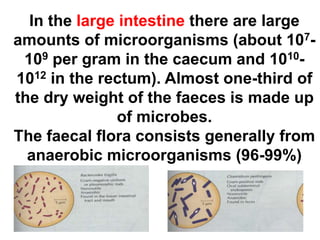
In the large intestine there are large
amounts of microorganisms (about 107-
109 per gram in the caecum and 1010-
1012 in the rectum). Almost one-third of
the dry weight of the faeces is made up
of microbes.
The faecal flora consists generally from
anaerobic microorganisms (96-99%)
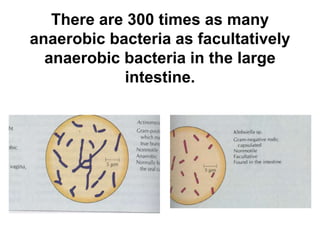
There are 300 times as many
anaerobic bacteria as facultatively
anaerobic bacteria in the large
intestine.
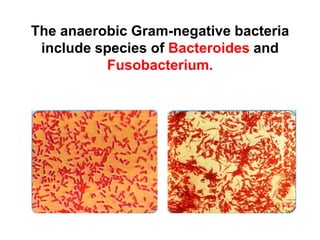
The anaerobic Gram-negative bacteria
include species of Bacteroides and
Fusobacterium.
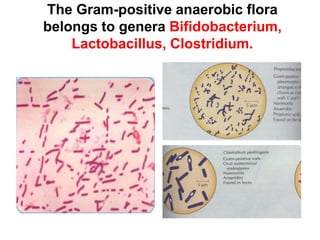
The Gram-positive anaerobic flora
belongs to genera Bifidobacterium,
Lactobacillus, Clostridium.
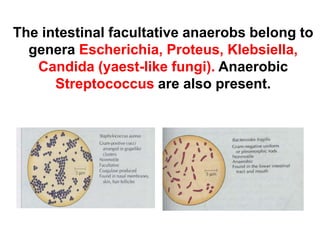
The intestinal facultative anaerobs belong to
genera Escherichia, Proteus, Klebsiella,
Candida (yaest-like fungi). Anaerobic
Streptococcus are also present.
Hospital-acquired infection
Hospital-acquired infection (hospital-
associated infection, nosocomial infection)
is a infection developing in patients after 4
daysof admission to the hospital
Source of infection may be both:
1. Exogenous (pathogen is transmitted from
surrounding environment)
2. Endogenous (pathogen belongs to normal
microbiota)
Modes of exogenous infection
transmission
1. Direct contact with contaminated
equipment or hands of medical staff
carrying hospital pathogens
2. Inhalation of droplets, dust or aerosols
containing hospital strains
3. Food-borne route (hospital food may be
contaminated with antibiotic-resistant
enteral pathogens
4. Parenteral route
Hospital pathogens
The most often germs isolated from clinical
samples at HAI:
1. Meticillin-resistant S.aureus (MRSA) and
S.epidermidis
2. Streptococci group D (enterococci)
3. Enterobacteria (coliforms and others)
4. Non-fermentive Gram-negative bacteria
(Pseudomonads, Stenotrophomonas
maltophilia, Acinetobacter, Burkholderia
and others)
5. Hepatitis B and C viruses
Common causative agents of the HAI
1. Urinary tract infection are the most often
caused by E.coli, Proteus, Klebsiella,
Serratia, pseudomonas, Providencia,
coagulase(-) staphylococci, enterococci
and C.albicans
2. Respiratory infection.
Usual pathogens are S.aureus, Klebsiella,
Enterobacter, Serratia, Proteus, E.coli,
P.aeruginosa, Acinetobacter, Legionella
pneumophila and respiratory viruses
Common causative agents of the HAI
3. Wound and skin infections, sepsis
Predominant pathogens: S.aureus,
P.aeruginosa, Proteus, E.coli, coagulase(-)
staphylococci, enterococci
4. Bacteraemia and septicaemia
Cathter-associated contaminants – Gram-
negative bacteria
Associated with artificial heart valves
pathogens – coagulase (-) staphylococci
Common causative agents of the HAI
5. Burns:
S.aureus, P.aeruginosa, Acinetobacter,
S.pyogenes
6. Gastrointestinal infection includes food-
poisoning infection and neonatal
septicaemia associated more often with
Salmonella and Shigella
Prevention of the HAI
It is based on:
1. Finding and destroying hospital pathogens
2. Proper sterilisation and disinfection of
possible inanimate vechles
3. Disinfection of contaminated materials and
biological samples from the patients
4. Frequent washing of hands and changing
working clothes
Prevention of the HAI
5.Usage of disposable syringes, needles,
sterile gloves, dressing, face-masks and
proper control of fluids for infusion
6. Reliable antiseptic measures before
operation and “cutting-down” of the skin
7. Rational antibiotic therapy and prophilaxis
8. Investigation of nosocomial infection in
details and proper treatment of every
cases

clinical microbiology

  • 1.
    Clinical microbiology. Major tasksand purposes. Opportunistic microbiota as major cause of hospital infections. Short characteristics of microbiota representatives from different biotopes of human body Vinnitsa National Pirogov Memorial Medical University/ Department of microbiology
  • 2.
    Clinical microbiology Clinical microbiologyis the part of medical microbiology Clinical microbiology investigates microbiological aspects non-epidemic microbial complications (for example, nosocomial infections) and elaborates laboratory diagnostics of them
  • 3.
    Main tasks ofthe clinical microbiology 1. Investigation of morphology, physiology, genetics and ecology of opportunistic germs and their significance in human being 2. Elaboration rapid diagnostic tests for infectious complications and improvement present methods of laboratory diagnostics 3. Study the pathogenic properties of opportunistic microorganisms and their role in pathogenesis of microbial complications of somatic illness
  • 4.
    Main tasks ofthe clinical microbiology 4. Investigation of mechanisms of pathogenic agents influence on human immune system, features of immune response to microorganisms 5. Features of microbial complication development in immunocompromised patients 6. Ability to treat of non-contagious diseases with specific medicines (immune sera, immunoglobulins, vaccines) 7. Investigation symbiotic association of microorganisms in human body
  • 5.
    Normal microbiota Normal microbiota(normal flora) is microbial populations associated with skin and mucous membranes of every human being from shortly after birth until death. The community of microorganisms colonising certain biotope of human body (host) is also known as microbiocenosis The human body is inhabited by about 1014 microorganisms.
  • 6.
    • Normal florais divided into constant and transient flora. • Constant (obligate, resident, indigenous, autochthonous) microflora is the native flora. • Transient (temporary, facultative, allochthonous) microflora is acquired flora, which is accidentally taken from environment. Most members of the normal flora are bacteria, but fungi and protozoa inhabit the body as well.
  • 7.
    Normal flora inhabitsthe next areas and systems of the host: • Skin and nails • Eyes (conjunctiva) • External acoustic duct • Mucous membranes of the –Upper respiratory tract (nose, oropharinx) –Gastrointestinal tract (from mouth to rectum – Genitourinary tract
  • 8.
    According to theirsignificance in human pathology normal flora can be categorized is • helpful (mutualutic symbionts) • harmless (commensals) • potential harmful (opportunists)
  • 9.
    Beneficial role ofnormal flora 1. Normal flora provides colonization resistance of the skin and mucous membranes by: • Competition with “foreigners” for nutrients • Binding with specific receptors required for adhesion of pathogens • Releasing harmful for pathogens metabolic products or bacteriocins production 2. Synthesis of vitamins (group B and K) by intestinal microbiota
  • 10.
    Beneficial role ofnormal flora 3. Intestinal mirobiota takes part in bile acids metabolism and capable of secreting digestive enzymes 4. Neutralization a small amount of natural toxic substances, binding of heavy metal salts, phenolics and aldehydes by intestinal microbiota 5. Stimulation of the host's immune system and non-specific immune response
  • 11.
    Harmful effect ofnormal flora 1. Some normal flora organisms can be opportunistic pathogens, which cause infectious if tissue injury occurs at specific body sites, or if the resistant of the body to infection is decreased. 2. Disoders in vaginal and intestinal microbiota due to antibiotic therapy may lead to disbiosis with clinical appearence
  • 12.
    Harmful effect ofnormal flora • Usage of broad spectrum antibiotics may inhibit sensitive members and thereby select resistant bacteria • Normal flora may produce enzymes splitting or inactivating antibiotics • Some metabolic products of normal flora act as cocarcinogenes (protein putrifaction prducts, nitrites, nitrates,etc.)
  • 13.
    Harmful effect ofnormal flora • Normal germs may cause confusion in diagnosis due to their presence in clinical samples and their resemblance to pathogens • Some pathogens may belong to normal microbiota of carriers and be transmitted to healthy persons
  • 14.
  • 15.
    Normal flora ofthe axilla, perineum and toe webs: 1. Gram(-) bacilli 2. S.epidermidis 3. Propionbacterium spp. 4. Anaerobic and lipophilic diphtheroids 5. Peptococci 6. S.viridans 7. S. aureus
  • 16.
    Normal flora ofthe hand, face, trunk, arms, and legs: 1. S.epidermidis 2. S.aureus 3. Micrococci 4. Non-lipophilic and lipophilic diphtheroids 1. Propionbacterium spp.
  • 17.
    Normal flora ofthe upper respiratory tract Nose and nasopharynx harbors: 1. Streptococci spp. 2. Staphylococci spp. 3. Diphtheroids 4. Haemophillus influensa 5. In rare cases: E.coli, pseudomonads, Proteus spp.
  • 18.
    Normal flora ofthe upper respiratory tract The pharynx and trachea contain: 1. α- and β-hemolytic streptococci 2. S.aureus and S.hominis 3. Neisseria spp. 4. Diphtheroids 5. Hemophillus influenzae 6. Pneumococcus 7. Mycoplasma pneumonia 8. Klebsiella spp.
  • 19.
    Urogenital microbiota Frequent residentsof the urethra (distal part): 1. S.epidermidis 2. Enterococci 3. Diptheroids Occasional members (10-30%): 1. E.coli 2. Proteus spp. 3. Opportunistic Neisseria 4. Mycoplasma and Ureaplasma
  • 20.
    Mycobacterium smegmatis and mycoplasmas are foundon the external parts of the genitalia, and also in the urine of male and female.
  • 21.
    Normal flora ofvagina The flora before puberty and after menopause: 1. Micrococci 2. Streptococci, enterococci 3. Diphtheroids 4. S.epidermidis, coli-forms The flora of adults: 1. Lactobacillus spp. 2. Streptococci, staphylococci 3. C.albicans 4. Corynebacteria
  • 22.
    Microbiota of mouthcavity • The oral cavity is colonize by microorganisms from the surrounding environment within hours after a human is born. • Initially the microbiota consists mostly of the genera (aerobes and anaerobes) • Streptococcus (α-hemolytic and viridans group) • Neisseria • Actinomyces • Veillonella • Lactobacillus • Candida
  • 23.
    Microbiota of mouthcavity • As the first teeth erupt, the anaerobes (Porphyromonas, Prevotella, Fusobacterium) become dominant due to the anaerobic nature of the gingival groove. • As teeth grow, S.parasanguis and S.mutans attach to their enamel surfaces. • S.salivarius attaches to the buccal and gingival epithelial surfaces and colonizes the saliva.
  • 25.
    Esophagus and stomach Thetotal amount is about 102-103 cells per ml in the stomach Representatives are: 1. Lactobacilli 2. Micrococci 3. Candida 4. Sarcina 5. Bacilli 6. Helicobacter pylori (in 30% of healthy individuals)
  • 26.
    Duodenum and jejunum •The bacterial count in duodenum is 103- 105 per gram, in the jejunum and proximal ileum 105-107 per gram • Enterococci, fungi, lactobacilli, coliforms and various other microbes are predominant in the duodenum and small intestine.
  • 27.
    In the largeintestine there are large amounts of microorganisms (about 107- 109 per gram in the caecum and 1010- 1012 in the rectum). Almost one-third of the dry weight of the faeces is made up of microbes. The faecal flora consists generally from anaerobic microorganisms (96-99%)
  • 28.
    There are 300times as many anaerobic bacteria as facultatively anaerobic bacteria in the large intestine.
  • 29.
    The anaerobic Gram-negativebacteria include species of Bacteroides and Fusobacterium.
  • 30.
    The Gram-positive anaerobicflora belongs to genera Bifidobacterium, Lactobacillus, Clostridium.
  • 31.
    The intestinal facultativeanaerobs belong to genera Escherichia, Proteus, Klebsiella, Candida (yaest-like fungi). Anaerobic Streptococcus are also present.
  • 32.
    Hospital-acquired infection Hospital-acquired infection(hospital- associated infection, nosocomial infection) is a infection developing in patients after 4 daysof admission to the hospital Source of infection may be both: 1. Exogenous (pathogen is transmitted from surrounding environment) 2. Endogenous (pathogen belongs to normal microbiota)
  • 33.
    Modes of exogenousinfection transmission 1. Direct contact with contaminated equipment or hands of medical staff carrying hospital pathogens 2. Inhalation of droplets, dust or aerosols containing hospital strains 3. Food-borne route (hospital food may be contaminated with antibiotic-resistant enteral pathogens 4. Parenteral route
  • 34.
    Hospital pathogens The mostoften germs isolated from clinical samples at HAI: 1. Meticillin-resistant S.aureus (MRSA) and S.epidermidis 2. Streptococci group D (enterococci) 3. Enterobacteria (coliforms and others) 4. Non-fermentive Gram-negative bacteria (Pseudomonads, Stenotrophomonas maltophilia, Acinetobacter, Burkholderia and others) 5. Hepatitis B and C viruses
  • 35.
    Common causative agentsof the HAI 1. Urinary tract infection are the most often caused by E.coli, Proteus, Klebsiella, Serratia, pseudomonas, Providencia, coagulase(-) staphylococci, enterococci and C.albicans 2. Respiratory infection. Usual pathogens are S.aureus, Klebsiella, Enterobacter, Serratia, Proteus, E.coli, P.aeruginosa, Acinetobacter, Legionella pneumophila and respiratory viruses
  • 36.
    Common causative agentsof the HAI 3. Wound and skin infections, sepsis Predominant pathogens: S.aureus, P.aeruginosa, Proteus, E.coli, coagulase(-) staphylococci, enterococci 4. Bacteraemia and septicaemia Cathter-associated contaminants – Gram- negative bacteria Associated with artificial heart valves pathogens – coagulase (-) staphylococci
  • 37.
    Common causative agentsof the HAI 5. Burns: S.aureus, P.aeruginosa, Acinetobacter, S.pyogenes 6. Gastrointestinal infection includes food- poisoning infection and neonatal septicaemia associated more often with Salmonella and Shigella
  • 38.
    Prevention of theHAI It is based on: 1. Finding and destroying hospital pathogens 2. Proper sterilisation and disinfection of possible inanimate vechles 3. Disinfection of contaminated materials and biological samples from the patients 4. Frequent washing of hands and changing working clothes
  • 39.
    Prevention of theHAI 5.Usage of disposable syringes, needles, sterile gloves, dressing, face-masks and proper control of fluids for infusion 6. Reliable antiseptic measures before operation and “cutting-down” of the skin 7. Rational antibiotic therapy and prophilaxis 8. Investigation of nosocomial infection in details and proper treatment of every cases