Microbial Flora of
Human Body
(Normal Flora)
NORMAL FLORA:
These are mixture of micro-organisms
regularly found at any anatomical site
on or within the body of a healthy
person.
Factors influencing normal flora:
• The makeup of the normal flora depends upon various
factors, including:
– Genetics
– Age
– Sex
– Stress
– Nutrition
– Diet
– Antiobiotic & other drugs
Normal Microbial Flora:
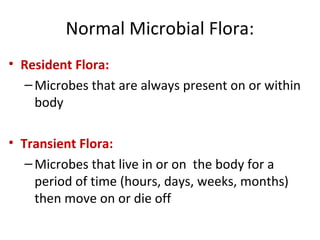
• Resident Flora:
–Microbes that are always present on or within
body
• Transient Flora:
–Microbes that live in or on the body for a
period of time (hours, days, weeks, months)
then move on or die off
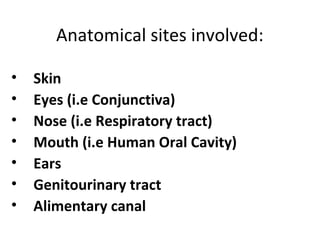
Anatomical sites involved:
• Skin
• Eyes (i.e Conjunctiva)
• Nose (i.e Respiratory tract)
• Mouth (i.e Human Oral Cavity)
• Ears
• Genitourinary tract
• Alimentary canal
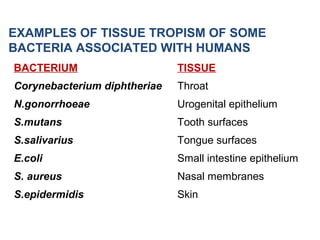
BACTERIUM TISSUE
Corynebacterium diphtheriae Throat
N.gonorrhoeae Urogenital epithelium
S.mutans Tooth surfaces
S.salivarius Tongue surfaces
E.coli Small intestine epithelium
S. aureus Nasal membranes
S.epidermidis Skin
EXAMPLES OF TISSUE TROPISM OF SOME
BACTERIA ASSOCIATED WITH HUMANS
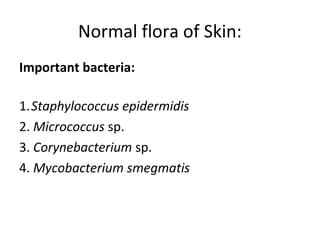
Normal flora of Skin:
Important bacteria:
1.Staphylococcus epidermidis
2. Micrococcus sp.
3. Corynebacterium sp.
4. Mycobacterium smegmatis
Normal Flora of the Conjunctiva:
1. Staphylococcus epidermidis
2. Corynebacterium spp.
3. Propoinibacterium acnes
4. Staphylococcus aureus
5. Viridans streptococci
6. Neisseria spp.
7. Haemophilus influenzae
Normal Flora of the Respiratory Tract:
A). The nares (nostrils) :
1. Staphylococcus epidermidis
2. Corynebacteria spp.
3. Staphylococcus aureus
4. Neisseria spp.
5. Haemophilus spp.
6. Streptococcus pneumoniae
Normal Flora of the Respiratory Tract:
B) The upper respiratory tract (nasopharynx):
1. Non-hemolytic streptococci
2. Alpha-hemolytic streptococci
3. Neisseria spp.
4. Streptococcus pneumoniae
5. Streptococcus pyogenes
6. Haemophilus influenzae
7. Neisseria meningitidis
Normal Flora of the Respiratory Tract:
C) The lower respiratory tract:(trachea, bronchi, and
pulmonary tissues):
• Usually sterile.
• The individual may become susceptible to infection by
pathogens descending from the nasopharynx:
e.g. H. influenzae,
S. pneumoniae
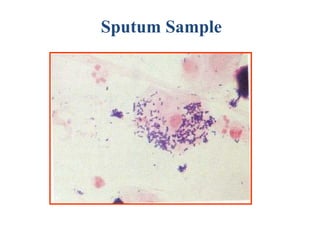
Sputum Sample
Normal Flora of the Human Oral Cavity:
Oral bacteria include:
1. Viridans streptococci
2. Lactobacilli
3. Staphylococci (S. aureus and S. epidermidis)
4. Corynebacterium sp.
5. Bacteroides sp.
6. Streptococcus sanguis (dental plaque)
7. Streptococcus mutans (dental plaque)
8. Actinomyces sp.
The Normal Flora of The Ears (i.e. external ear)
The external ears contains a variety of micro-
organisms. These include:
1. Staphylococcus epidermidis
2. Staphylococcus aureus
3. Corynebacterium sp
Normal flora of the Urogenital Tract:
a) The anterior urethra:
1. Staphylococcus epidermidis
2. Enterococcus faecalis
3. Alpha-hemolytic streptococci.
4. Some enteric bacteria (e.g. E. coli, Proteus sp.)
5. Corynebacteria sp.
6. Acinetobacter sp.
7. Mycoplasma sp.
8. Candida sp.
9. Mycobacterium smegmatis
Normal flora of the Urogenital Tract:
b) The vagina:
1. Corynebacterium sp.
2. Staphylococci
3. Non-pyogenic streptococci
4. Escherichia coli
5. Lactobacillus acidophilus*
6. Flavobacterium sp.
7. Clostridium sp.
8. Viridans streptococci
9. Other Enterobacteria
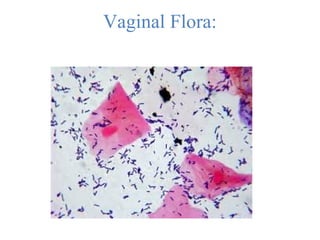
Vaginal Flora:
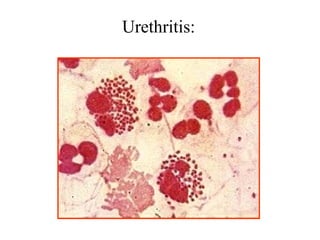
Urethritis:
Normal flora - Gastrointestinal tract
Location (adult) Bacteria/gr
am contents
Duodenum 103
-106
Jejunum and ileum 105
-108
Caecum and
transverse colon
108
-1010
Sigmoid colon and
rectum
1011
Normal Flora of the Gastrointestinal Tract
(GIT):
• In breast-fed infants :
1. Bifido bacteria account for more than 90% of the total
intestinal bacteria.
2. Enterobacteriaceae
3. Enterococci
4. Bacteroides
5. Staphylococci
6. Lactobacilli
7. Clostridia
Normal Flora of the Gastrointestinal Tract
(GIT):
• In bottle-fed infants:
• Bifidobacteria are not predominant. When breast-fed
infants are switched to a diet of cow's milk or solid food,
bifidobacteria are progressively joined by:
1. Enterics
2. Bacteroides
3. Enterococci
4. Lactobacilli
5. Clostridia
Normal Flora of the Gastrointestinal Tract
(GIT):
In the upper GIT of adult humans mainly acid-
tolerant lactobacilli present:
e.g. Helicobacter pylori
Normal Flora of the Gastrointestinal Tract
(GIT):
• The proximal small intestine:
1. Lactobacilli
2. Enterococcus faecalis
3. Coliforms
4. Bacteroides
The flora of the large intestine (colon):
1. Enterococci
2. Clostridia
3. Lactobacilli
4. Bacteroides
5. Bifidobacterium (Bifidobacterium bifidum)
6. Escherichia coli
7. Methanogenic bacteria
8. Viridans streptococci
9. Staphylococcus sp.
10. Proteus sp.
11. Candida albicans (Yeast)
12. Mycoplama sp.
THE ROLE/ BENEFITS OF THE NORMAL FLORA:
1. The normal flora synthesize and excrete vitamins
in excess of their own needs, which can be
absorbed as nutrients by the host.
For example, enteric bacteria secrete Vitamin K
and Vitamin B12, and lactic acid bacteria
produce certain B-vitamins.
THE ROLE/ BENEFITS OF THE NORMAL FLORA:
2. The normal flora prevent colonization by
pathogens by competing for attachment sites or
for essential nutrients.
This important beneficial effect, which has been
demonstrated in the oral cavity, the intestine, the
skin, and the vaginal epithelium.
THE ROLE/ BENEFITS OF THE NORMAL FLORA:
3. The normal flora may antagonize other bacteria
through the production of substances which
inhibit or kill non-indigenous species.
Intestinal bacteria produce a variety of
substances like non-specific fatty acids, peroxides
and highly specific bacteriocins, which inhibit or
kill other bacteria.
THE ROLE/ BENEFITS OF THE NORMAL FLORA:
4. The normal flora stimulates the development of
certain tissues, i.e., the caecum (in animals) and
certain lymphatic tissues (Peyer's patches) in the
GI tract.
The caecum of germ-free animals is enlarged,
thin-walled, and fluid-filled, compared to that
organ in conventional animals.
THE ROLE/ BENEFITS OF THE NORMAL FLORA:
5. The normal flora stimulates the production of
“cross-reactive antibodies’’.
Since the normal flora behave as antigens in an
animal, they induce an Ab mediated immune
response.
Low levels of antibodies produced against
components of the normal flora are known to
cross react with certain related pathogens, and
thereby prevent infection or invasion.
Sterile tissues:
In a healthy human, the internal tissues
such as:
• blood
• brain
• muscle
• Cerebrospinal fluid (CSF)
are normally free of microorganisms.
Role of Microbiologist:
Accurate diagnosis: by Rapid/ quick, meaningful
reporting
Role of Physician:
Proper treatment with antimicrobial regimen/
standard guidelines
by avoiding overuse*/ misuse of antimicrobials
* by treating pathogen, NOT the normal flora!!
NATURAL MICROBIAL HABITATS
Soil
Water
Air
Animals and Animal Products
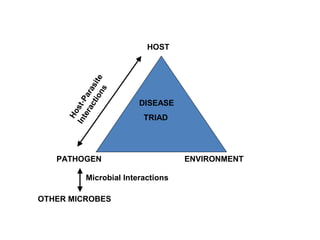
PATHOGEN ENVIRONMENT
HOST
DISEASE
TRIAD
Host-Parasite
Interactions
OTHER MICROBES
Microbial Interactions
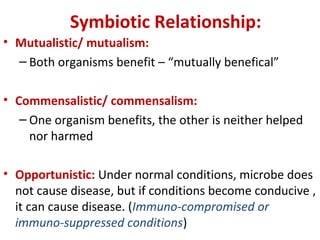
Symbiotic Relationship:
• Mutualistic/ mutualism:
– Both organisms benefit – “mutually benefical”
• Commensalistic/ commensalism:
– One organism benefits, the other is neither helped
nor harmed
• Opportunistic: Under normal conditions, microbe does
not cause disease, but if conditions become conducive ,
it can cause disease. (Immuno-compromised or
immuno-suppressed conditions)
Mutualistic
• Escherichia coli :
–Synthesizes Vitamin K & B complex Vitamins
–In return, we provide a warm, moist nutrient
rich environment for Escherichia coli
Commensalistic
• We have no Commensalistic relationships with
Bacteria
• If Bacteria are in or on our body, they are either
helping us (Microbial Antagonism) or harming us.
Opportunistic:
• Escherichia coli - normally in our digestive tract
where it causes no problems, but if it gets into
the urinary tract it can become pathogenic.
• Staphylococcus aureus – commonly found in the
upper respiratory tract, but if it gets into a
wound or a burn it can become pathogenic
Probiotics/ Prebiotics:
• Probiotic:
–Oral administration of living organisms to
promote health
–Species specific: adherence and growth
(tropism)
• Prebiotic: Non-digestible food that stimulates
growth or activity of GI microbiota, especially
bifidobacteria and lactobacillus bacteria
–Typically a carbohydrate: soluble fiber
KEY QUESTIONS:
1. Define normal microbial flora. Mention the role/
benefits of normal flora in human body.
2. Normal flora of mouth and upper respiratory
tract.
3. Normal flora of skin.
4. Normal flora of gastro-intestinal tract.
5. Normal flora of genitourinary tract.
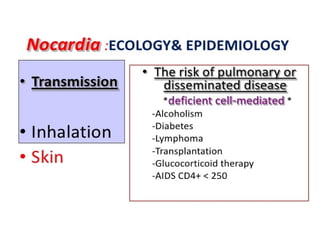
Nocardia
• Morphologically resembles Actinomyces.
• They are acid fast up to 1% Sulphuric acid.
• Majority of them are saprophytes.
Species:
1.N. asteroides.
2.N. brasiliensis.
3.N. madurae
Culture:
Readily grow on ordinary media.
Requires incubation for 3 weeks, usually
produce pigmented colonies.
Pathogenesis:
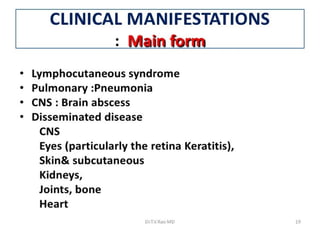
Mainly produces opportunistic infections in
immuno-compromised persons.
Causes mainly pulmonary disease like
pneumonia, lung abscess or lesion resembling
tubercolosis.
May cause mycetoma.
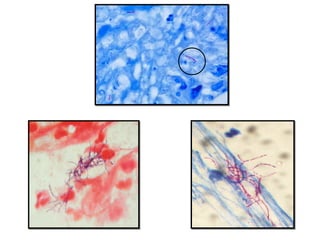
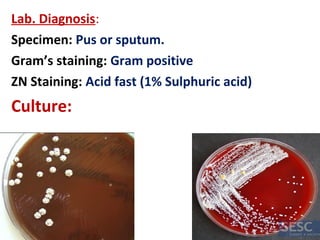
Lab. Diagnosis:
Specimen: Pus or sputum.
Gram’s staining: Gram positive
ZN Staining: Acid fast (1% Sulphuric acid)
Culture:
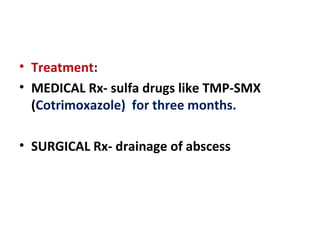
• Treatment:
• MEDICAL Rx- sulfa drugs like TMP-SMX
(Cotrimoxazole) for three months.
• SURGICAL Rx- drainage of abscess
THANK YOU

Normal flora(1)

  • 1.
    Microbial Flora of HumanBody (Normal Flora)
  • 2.
    NORMAL FLORA: These aremixture of micro-organisms regularly found at any anatomical site on or within the body of a healthy person.
  • 3.
    Factors influencing normalflora: • The makeup of the normal flora depends upon various factors, including: – Genetics – Age – Sex – Stress – Nutrition – Diet – Antiobiotic & other drugs
  • 4.
    Normal Microbial Flora: •Resident Flora: –Microbes that are always present on or within body • Transient Flora: –Microbes that live in or on the body for a period of time (hours, days, weeks, months) then move on or die off
  • 5.
    Anatomical sites involved: •Skin • Eyes (i.e Conjunctiva) • Nose (i.e Respiratory tract) • Mouth (i.e Human Oral Cavity) • Ears • Genitourinary tract • Alimentary canal
  • 6.
    BACTERIUM TISSUE Corynebacterium diphtheriaeThroat N.gonorrhoeae Urogenital epithelium S.mutans Tooth surfaces S.salivarius Tongue surfaces E.coli Small intestine epithelium S. aureus Nasal membranes S.epidermidis Skin EXAMPLES OF TISSUE TROPISM OF SOME BACTERIA ASSOCIATED WITH HUMANS
  • 7.
    Normal flora ofSkin: Important bacteria: 1.Staphylococcus epidermidis 2. Micrococcus sp. 3. Corynebacterium sp. 4. Mycobacterium smegmatis
  • 8.
    Normal Flora ofthe Conjunctiva: 1. Staphylococcus epidermidis 2. Corynebacterium spp. 3. Propoinibacterium acnes 4. Staphylococcus aureus 5. Viridans streptococci 6. Neisseria spp. 7. Haemophilus influenzae
  • 9.
    Normal Flora ofthe Respiratory Tract: A). The nares (nostrils) : 1. Staphylococcus epidermidis 2. Corynebacteria spp. 3. Staphylococcus aureus 4. Neisseria spp. 5. Haemophilus spp. 6. Streptococcus pneumoniae
  • 10.
    Normal Flora ofthe Respiratory Tract: B) The upper respiratory tract (nasopharynx): 1. Non-hemolytic streptococci 2. Alpha-hemolytic streptococci 3. Neisseria spp. 4. Streptococcus pneumoniae 5. Streptococcus pyogenes 6. Haemophilus influenzae 7. Neisseria meningitidis
  • 11.
    Normal Flora ofthe Respiratory Tract: C) The lower respiratory tract:(trachea, bronchi, and pulmonary tissues): • Usually sterile. • The individual may become susceptible to infection by pathogens descending from the nasopharynx: e.g. H. influenzae, S. pneumoniae
  • 12.
  • 13.
    Normal Flora ofthe Human Oral Cavity: Oral bacteria include: 1. Viridans streptococci 2. Lactobacilli 3. Staphylococci (S. aureus and S. epidermidis) 4. Corynebacterium sp. 5. Bacteroides sp. 6. Streptococcus sanguis (dental plaque) 7. Streptococcus mutans (dental plaque) 8. Actinomyces sp.
  • 14.
    The Normal Floraof The Ears (i.e. external ear) The external ears contains a variety of micro- organisms. These include: 1. Staphylococcus epidermidis 2. Staphylococcus aureus 3. Corynebacterium sp
  • 15.
    Normal flora ofthe Urogenital Tract: a) The anterior urethra: 1. Staphylococcus epidermidis 2. Enterococcus faecalis 3. Alpha-hemolytic streptococci. 4. Some enteric bacteria (e.g. E. coli, Proteus sp.) 5. Corynebacteria sp. 6. Acinetobacter sp. 7. Mycoplasma sp. 8. Candida sp. 9. Mycobacterium smegmatis
  • 16.
    Normal flora ofthe Urogenital Tract: b) The vagina: 1. Corynebacterium sp. 2. Staphylococci 3. Non-pyogenic streptococci 4. Escherichia coli 5. Lactobacillus acidophilus* 6. Flavobacterium sp. 7. Clostridium sp. 8. Viridans streptococci 9. Other Enterobacteria
  • 17.
  • 18.
  • 19.
    Normal flora -Gastrointestinal tract Location (adult) Bacteria/gr am contents Duodenum 103 -106 Jejunum and ileum 105 -108 Caecum and transverse colon 108 -1010 Sigmoid colon and rectum 1011
  • 20.
    Normal Flora ofthe Gastrointestinal Tract (GIT): • In breast-fed infants : 1. Bifido bacteria account for more than 90% of the total intestinal bacteria. 2. Enterobacteriaceae 3. Enterococci 4. Bacteroides 5. Staphylococci 6. Lactobacilli 7. Clostridia
  • 21.
    Normal Flora ofthe Gastrointestinal Tract (GIT): • In bottle-fed infants: • Bifidobacteria are not predominant. When breast-fed infants are switched to a diet of cow's milk or solid food, bifidobacteria are progressively joined by: 1. Enterics 2. Bacteroides 3. Enterococci 4. Lactobacilli 5. Clostridia
  • 22.
    Normal Flora ofthe Gastrointestinal Tract (GIT): In the upper GIT of adult humans mainly acid- tolerant lactobacilli present: e.g. Helicobacter pylori
  • 23.
    Normal Flora ofthe Gastrointestinal Tract (GIT): • The proximal small intestine: 1. Lactobacilli 2. Enterococcus faecalis 3. Coliforms 4. Bacteroides
  • 24.
    The flora ofthe large intestine (colon): 1. Enterococci 2. Clostridia 3. Lactobacilli 4. Bacteroides 5. Bifidobacterium (Bifidobacterium bifidum) 6. Escherichia coli 7. Methanogenic bacteria 8. Viridans streptococci 9. Staphylococcus sp. 10. Proteus sp. 11. Candida albicans (Yeast) 12. Mycoplama sp.
  • 25.
    THE ROLE/ BENEFITSOF THE NORMAL FLORA: 1. The normal flora synthesize and excrete vitamins in excess of their own needs, which can be absorbed as nutrients by the host. For example, enteric bacteria secrete Vitamin K and Vitamin B12, and lactic acid bacteria produce certain B-vitamins.
  • 26.
    THE ROLE/ BENEFITSOF THE NORMAL FLORA: 2. The normal flora prevent colonization by pathogens by competing for attachment sites or for essential nutrients. This important beneficial effect, which has been demonstrated in the oral cavity, the intestine, the skin, and the vaginal epithelium.
  • 27.
    THE ROLE/ BENEFITSOF THE NORMAL FLORA: 3. The normal flora may antagonize other bacteria through the production of substances which inhibit or kill non-indigenous species. Intestinal bacteria produce a variety of substances like non-specific fatty acids, peroxides and highly specific bacteriocins, which inhibit or kill other bacteria.
  • 28.
    THE ROLE/ BENEFITSOF THE NORMAL FLORA: 4. The normal flora stimulates the development of certain tissues, i.e., the caecum (in animals) and certain lymphatic tissues (Peyer's patches) in the GI tract. The caecum of germ-free animals is enlarged, thin-walled, and fluid-filled, compared to that organ in conventional animals.
  • 29.
    THE ROLE/ BENEFITSOF THE NORMAL FLORA: 5. The normal flora stimulates the production of “cross-reactive antibodies’’. Since the normal flora behave as antigens in an animal, they induce an Ab mediated immune response. Low levels of antibodies produced against components of the normal flora are known to cross react with certain related pathogens, and thereby prevent infection or invasion.
  • 30.
    Sterile tissues: In ahealthy human, the internal tissues such as: • blood • brain • muscle • Cerebrospinal fluid (CSF) are normally free of microorganisms.
  • 31.
    Role of Microbiologist: Accuratediagnosis: by Rapid/ quick, meaningful reporting Role of Physician: Proper treatment with antimicrobial regimen/ standard guidelines by avoiding overuse*/ misuse of antimicrobials * by treating pathogen, NOT the normal flora!!
  • 32.
  • 33.
  • 34.
    Symbiotic Relationship: • Mutualistic/mutualism: – Both organisms benefit – “mutually benefical” • Commensalistic/ commensalism: – One organism benefits, the other is neither helped nor harmed • Opportunistic: Under normal conditions, microbe does not cause disease, but if conditions become conducive , it can cause disease. (Immuno-compromised or immuno-suppressed conditions)
  • 35.
    Mutualistic • Escherichia coli: –Synthesizes Vitamin K & B complex Vitamins –In return, we provide a warm, moist nutrient rich environment for Escherichia coli
  • 36.
    Commensalistic • We haveno Commensalistic relationships with Bacteria • If Bacteria are in or on our body, they are either helping us (Microbial Antagonism) or harming us.
  • 37.
    Opportunistic: • Escherichia coli- normally in our digestive tract where it causes no problems, but if it gets into the urinary tract it can become pathogenic. • Staphylococcus aureus – commonly found in the upper respiratory tract, but if it gets into a wound or a burn it can become pathogenic
  • 38.
    Probiotics/ Prebiotics: • Probiotic: –Oraladministration of living organisms to promote health –Species specific: adherence and growth (tropism) • Prebiotic: Non-digestible food that stimulates growth or activity of GI microbiota, especially bifidobacteria and lactobacillus bacteria –Typically a carbohydrate: soluble fiber
  • 39.
    KEY QUESTIONS: 1. Definenormal microbial flora. Mention the role/ benefits of normal flora in human body. 2. Normal flora of mouth and upper respiratory tract. 3. Normal flora of skin. 4. Normal flora of gastro-intestinal tract. 5. Normal flora of genitourinary tract.
  • 40.
    Nocardia • Morphologically resemblesActinomyces. • They are acid fast up to 1% Sulphuric acid. • Majority of them are saprophytes. Species: 1.N. asteroides. 2.N. brasiliensis. 3.N. madurae
  • 42.
    Culture: Readily grow onordinary media. Requires incubation for 3 weeks, usually produce pigmented colonies. Pathogenesis: Mainly produces opportunistic infections in immuno-compromised persons. Causes mainly pulmonary disease like pneumonia, lung abscess or lesion resembling tubercolosis. May cause mycetoma.
  • 46.
    Lab. Diagnosis: Specimen: Pusor sputum. Gram’s staining: Gram positive ZN Staining: Acid fast (1% Sulphuric acid) Culture:
  • 47.
    • Treatment: • MEDICALRx- sulfa drugs like TMP-SMX (Cotrimoxazole) for three months. • SURGICAL Rx- drainage of abscess
  • 48.

Editor's Notes

  • #20 In the normal adult colon, 96–99% of the resident bacterial flora consists of anaerobes: bacteroides species, especially B fragilis; fusobacterium species; anaerobic lactobacilli, e.g., bifidobacteria; clostridia (C perfringens); and anaerobic gram-positive cocci (Peptostreptococcus species).