THIRD STAGE
DEFINITION
• From expulsion of the foetus to delivery
  of the placenta, cord and membranes
DURATION
• Primigravida – 15 minutes
• Multigravida – 5 minutes
• Generally     – not > 30 minutes
07/31/12          Dr. Yin Moe Han            1
PLACENTA SEPARATION

Two Methods
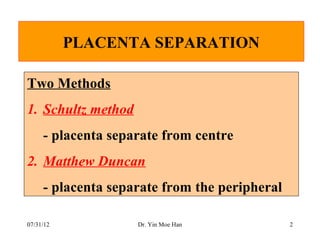
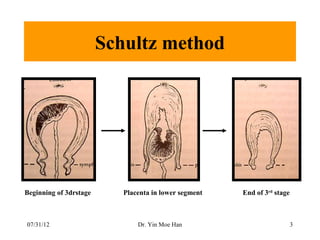
1. Schultz method
     - placenta separate from centre
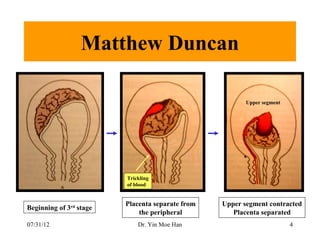
2. Matthew Duncan
     - placenta separate from the peripheral

07/31/12            Dr. Yin Moe Han            2
Schultz method


Beginning of 3drstage      Placenta in lower segment   End of 3rd stage


07/31/12                       Dr. Yin Moe Han                            3
Matthew Duncan

                                                         Upper segment


                         Trickling
                         of blood


                         Placenta separate from   Upper segment contracted
Beginning of 3rd stage
                             the peripheral          Placenta separated
07/31/12                     Dr. Yin Moe Han                             4
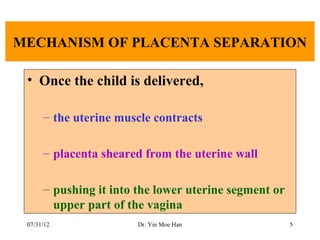
MECHANISM OF PLACENTA SEPARATION

 • Once the child is delivered,

      – the uterine muscle contracts

      – placenta sheared from the uterine wall

      – pushing it into the lower uterine segment or
        upper part of the vagina
 07/31/12               Dr. Yin Moe Han                5
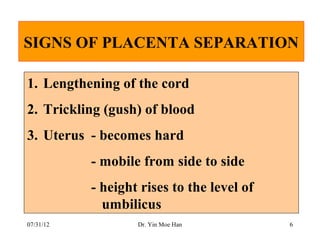
SIGNS OF PLACENTA SEPARATION

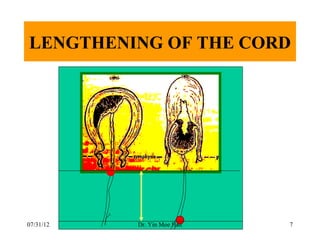
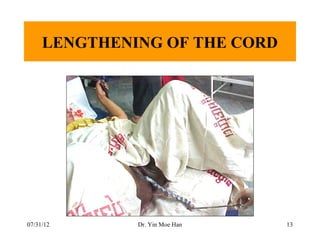
1. Lengthening of the cord
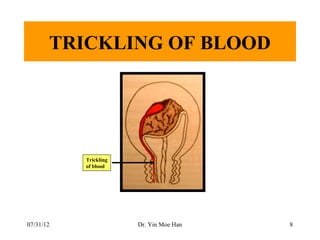
2. Trickling (gush) of blood
3. Uterus - becomes hard
           - mobile from side to side
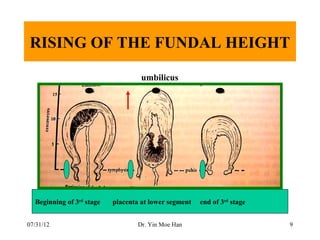
           - height rises to the level of
             umbilicus
07/31/12           Dr. Yin Moe Han          6
LENGTHENING OF THE CORD


07/31/12   Dr. Yin Moe Han   7
TRICKLING OF BLOOD


           Trickling
           of blood


07/31/12               Dr. Yin Moe Han   8
RISING OF THE FUNDAL HEIGHT

                                    umbilicus


  Beginning of 3rd stage   placenta at lower segment   end of 3rd stage


07/31/12                           Dr. Yin Moe Han                        9
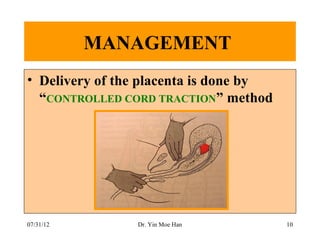
MANAGEMENT
• Delivery of the placenta is done by
  “CONTROLLED CORD TRACTION” method


07/31/12        Dr. Yin Moe Han         10
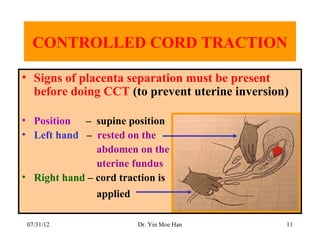
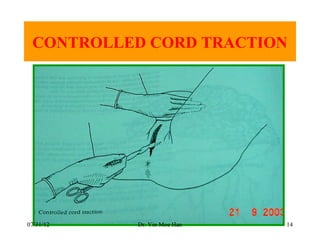
CONTROLLED CORD TRACTION

• Signs of placenta separation must be present
  before doing CCT (to prevent uterine inversion)

• Position – supine position
• Left hand – rested on the
               abdomen on the
               uterine fundus
• Right hand – cord traction is
               applied

 07/31/12                Dr. Yin Moe Han        11
07/31/12   Dr. Yin Moe Han   12
LENGTHENING OF THE CORD


07/31/12      Dr. Yin Moe Han   13
CONTROLLED CORD TRACTION


07/31/12   Dr. Yin Moe Han   14
MANAGEMENT
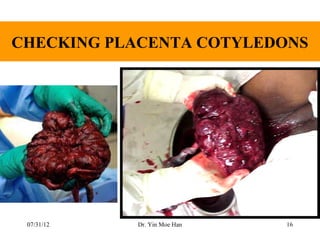
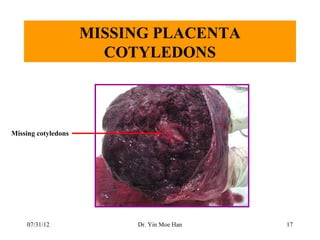
• Check placenta to see if any cotyledons
  are missing

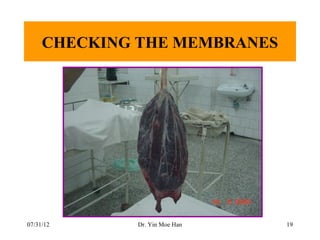
• Check membranes to see whether they
  are complete or incomplete

• Check tears of the genital tract
07/31/12          Dr. Yin Moe Han           15
CHECKING PLACENTA COTYLEDONS


 07/31/12   Dr. Yin Moe Han   16
MISSING PLACENTA
                       COTYLEDONS


Missing cotyledons


    07/31/12              Dr. Yin Moe Han   17
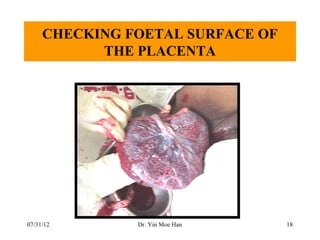
CHECKING FOETAL SURFACE OF
           THE PLACENTA


07/31/12       Dr. Yin Moe Han    18
CHECKING THE MEMBRANES


07/31/12     Dr. Yin Moe Han   19
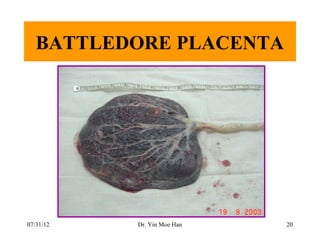
BATTLEDORE PLACENTA


07/31/12   Dr. Yin Moe Han   20
07/31/12   Dr. Yin Moe Han   21

Normal labour, third stage by Dr Yin Moe

  • 1.
    THIRD STAGE DEFINITION • Fromexpulsion of the foetus to delivery of the placenta, cord and membranes DURATION • Primigravida – 15 minutes • Multigravida – 5 minutes • Generally – not > 30 minutes 07/31/12 Dr. Yin Moe Han 1
  • 2.
    PLACENTA SEPARATION Two Methods 1.Schultz method - placenta separate from centre 2. Matthew Duncan - placenta separate from the peripheral 07/31/12 Dr. Yin Moe Han 2
  • 3.
    Schultz method Beginning of3drstage Placenta in lower segment End of 3rd stage 07/31/12 Dr. Yin Moe Han 3
  • 4.
    Matthew Duncan Upper segment Trickling of blood Placenta separate from Upper segment contracted Beginning of 3rd stage the peripheral Placenta separated 07/31/12 Dr. Yin Moe Han 4
  • 5.
    MECHANISM OF PLACENTASEPARATION • Once the child is delivered, – the uterine muscle contracts – placenta sheared from the uterine wall – pushing it into the lower uterine segment or upper part of the vagina 07/31/12 Dr. Yin Moe Han 5
  • 6.
    SIGNS OF PLACENTASEPARATION 1. Lengthening of the cord 2. Trickling (gush) of blood 3. Uterus - becomes hard - mobile from side to side - height rises to the level of umbilicus 07/31/12 Dr. Yin Moe Han 6
  • 7.
    LENGTHENING OF THECORD 07/31/12 Dr. Yin Moe Han 7
  • 8.
    TRICKLING OF BLOOD Trickling of blood 07/31/12 Dr. Yin Moe Han 8
  • 9.
    RISING OF THEFUNDAL HEIGHT umbilicus Beginning of 3rd stage placenta at lower segment end of 3rd stage 07/31/12 Dr. Yin Moe Han 9
  • 10.
    MANAGEMENT • Delivery ofthe placenta is done by “CONTROLLED CORD TRACTION” method 07/31/12 Dr. Yin Moe Han 10
  • 11.
    CONTROLLED CORD TRACTION •Signs of placenta separation must be present before doing CCT (to prevent uterine inversion) • Position – supine position • Left hand – rested on the abdomen on the uterine fundus • Right hand – cord traction is applied 07/31/12 Dr. Yin Moe Han 11
  • 12.
    07/31/12 Dr. Yin Moe Han 12
  • 13.
    LENGTHENING OF THECORD 07/31/12 Dr. Yin Moe Han 13
  • 14.
  • 15.
    MANAGEMENT • Check placentato see if any cotyledons are missing • Check membranes to see whether they are complete or incomplete • Check tears of the genital tract 07/31/12 Dr. Yin Moe Han 15
  • 16.
    CHECKING PLACENTA COTYLEDONS 07/31/12 Dr. Yin Moe Han 16
  • 17.
    MISSING PLACENTA COTYLEDONS Missing cotyledons 07/31/12 Dr. Yin Moe Han 17
  • 18.
    CHECKING FOETAL SURFACEOF THE PLACENTA 07/31/12 Dr. Yin Moe Han 18
  • 19.
  • 20.
  • 21.
    07/31/12 Dr. Yin Moe Han 21