Series of events that occur in the
female genital organ in an effort
to expel the products of
conception (fetus, placenta and
membranes) out of the womb
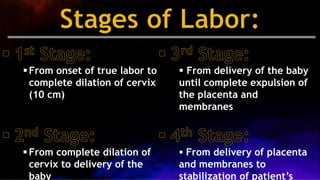
From onset of true labor to
complete dilation of cervix
(10 cm)
 From complete dilation of
cervix to delivery of the
baby
 From delivery of the baby
until complete expulsion of
the placenta and
membranes
 From delivery of placenta
and membranes to
stabilization of patient’s
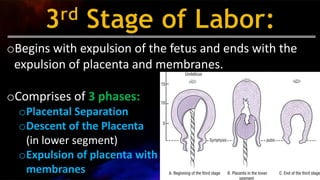
oBegins with expulsion of the fetus and ends with the
expulsion of placenta and membranes.
oComprises of 3 phases:
oPlacental Separation
oDescent of the Placenta
(in lower segment)
oExpulsion of placenta with
membranes
oUterus: Highly elastic but Placenta: Inelastic.
oAfter delivery of the baby in the 2nd stage, uterus
suddenly contracts and retracts.
oBut the placenta can not keep that pace like that of
uterine contraction due to shearing force and its
inelastic property.
oThus, Placenta BUCKLES and SEPARATES.
oPlane of placental separation: Deep in the
spongy layer of decidua basalis
oResults in tearing of numerous torn sinuses
resulting in immediate gush of blood.
o Placental separation may occur in any of the
2 ways:
o Central Separation (Schultze):
(Retro-placental Hematoma)
o Marginal Separation (Mathews-Duncan):
(more frequent)
o Uterus becomes globular and hard
o Sudden gush of blood from vagina
o Uterus rises in the abdomen
(as placenta has been separated and forced down into the lower
segment and vagina, where it pushes the uterus upward)
o True cord lengthening
(Most reliable clinical sign)
oDue to:
• Uterine Contraction
• Weight of descending placenta
After placental separation, it is forced
down into the flabby lower uterine
segment or upper part of vagina by
effective contraction and retraction of
the uterus.
After the descent of the placenta, it along with the
membranes are expelled out into the outer world by:
Voluntary Contraction
(Bearing Down Efforts)
Manual Procedure
Normally 30 mins.
(EXPECTANT MANAGEMENT)
Can be reduced to 5 mins by
ACTIVE MANAGEMENT.
 Normally 50-200 ml.
 Controlled by following mechanisms:
 Living Ligature
 Thrombosis due to hypercoagulable state in
pregnancy
 Apposition of uterine walls following placental
expulsion
(Myotamponade)
 Post-partum Hemorrhage
 Retained Placenta (> 30 mins)
 Shock: Hemorrhagic OR, Non-Hemorrhagic
 Pulmonary Embolism: Amniotic Fluid OR, Air
 Uterine Inversion
Management of
3rd Stage of Labor
Active Management
of 3rd Stage of Labor
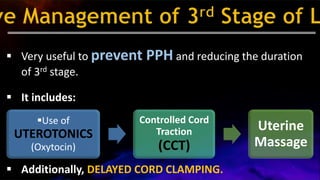
 Very useful to prevent PPH and reducing the duration
of 3rd stage.
 It includes:
 Additionally, DELAYED CORD CLAMPING.
Use of
UTEROTONICS
(Oxytocin)
Controlled Cord
Traction
(CCT)
Uterine
Massage
Objectives of AMTSL:
 To reduce blood loss by 1/5th
 To reduce risk of PPH by 60%
 Early placental separation
 To shorten the duration of 3rd stage
Use of Uterotonics:
 Within 1 minute of delivery of the baby, palpate the uterus to rule
out the presence of additional baby(s).
 Then, after being sure of no multiple pregnancy, give
OXYTOCIN 10 IU IM to the mother.
Controlled Cord Traction (CCT):
 One hand hold the cord (which is clamped close to the perineum)
and pulls the cord BACKWARD and DOWNWARD.
 Other hand on the supra-pubic region for simultaneous
counter-traction to push uterus UPWARD and BACKWARD.
Controlled Cord Traction (CCT):
 Wait for the uterine contraction before pulling the cord.
 If placenta doesn’t descent within 30-40 secs of CCT, do not pull
forcefully. Instead wait for next contraction to start aver again.
 Twist the Placenta while simultaneously applying
gentle traction for its delivery after placenta reaches the
introitus.
(to prevent tearing of the membranes)
After Controlled Cord Traction (CCT),
Always massage the uterus
for sustained contraction for
preventing PPH.
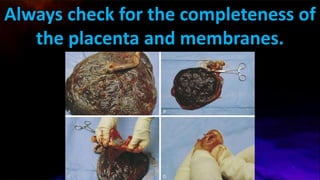
Always check for the completeness of
the placenta and membranes.
Disadvantage of
Active Management of 3rd Stage of Labor:
 Slight increase in the incidence of RETAINED
PLACENTA (1%-2%).
 Then, consequent increased incidence of Manual
removal of placenta.
Expectant Management
of 3rd Stage of Labor
aka
Passive Management
“No Touch” “Hands Off”
• Here, the placental separation and descent into vagina are allowed
to occur spontaneously.
• We only look very closely for the signs of placental separation
• Then we ask the patient to “Bear Down” simultaneously with the
hardening of the uterus.
• Usually the raised intra-abdominal pressure is enough to expel the
placenta.

• If fail, we can safely wait for about 10 mins if there is no bleeding.
• As placenta passes through introitus, we use the twisting method
to prevent the stripping of the membranes.
3rd stage of labor

3rd stage of labor

  • 2.
    Series of eventsthat occur in the female genital organ in an effort to expel the products of conception (fetus, placenta and membranes) out of the womb
  • 3.
    From onset oftrue labor to complete dilation of cervix (10 cm)  From complete dilation of cervix to delivery of the baby  From delivery of the baby until complete expulsion of the placenta and membranes  From delivery of placenta and membranes to stabilization of patient’s
  • 4.
    oBegins with expulsionof the fetus and ends with the expulsion of placenta and membranes. oComprises of 3 phases: oPlacental Separation oDescent of the Placenta (in lower segment) oExpulsion of placenta with membranes
  • 5.
    oUterus: Highly elasticbut Placenta: Inelastic. oAfter delivery of the baby in the 2nd stage, uterus suddenly contracts and retracts. oBut the placenta can not keep that pace like that of uterine contraction due to shearing force and its inelastic property. oThus, Placenta BUCKLES and SEPARATES.
  • 6.
    oPlane of placentalseparation: Deep in the spongy layer of decidua basalis oResults in tearing of numerous torn sinuses resulting in immediate gush of blood.
  • 7.
    o Placental separationmay occur in any of the 2 ways: o Central Separation (Schultze): (Retro-placental Hematoma) o Marginal Separation (Mathews-Duncan): (more frequent)
  • 8.
    o Uterus becomesglobular and hard o Sudden gush of blood from vagina o Uterus rises in the abdomen (as placenta has been separated and forced down into the lower segment and vagina, where it pushes the uterus upward) o True cord lengthening (Most reliable clinical sign)
  • 9.
    oDue to: • UterineContraction • Weight of descending placenta
  • 10.
    After placental separation,it is forced down into the flabby lower uterine segment or upper part of vagina by effective contraction and retraction of the uterus.
  • 11.
    After the descentof the placenta, it along with the membranes are expelled out into the outer world by: Voluntary Contraction (Bearing Down Efforts) Manual Procedure
  • 12.
    Normally 30 mins. (EXPECTANTMANAGEMENT) Can be reduced to 5 mins by ACTIVE MANAGEMENT.
  • 13.
     Normally 50-200ml.  Controlled by following mechanisms:  Living Ligature  Thrombosis due to hypercoagulable state in pregnancy  Apposition of uterine walls following placental expulsion (Myotamponade)
  • 14.
     Post-partum Hemorrhage Retained Placenta (> 30 mins)  Shock: Hemorrhagic OR, Non-Hemorrhagic  Pulmonary Embolism: Amniotic Fluid OR, Air  Uterine Inversion
  • 15.
  • 16.
  • 17.
     Very usefulto prevent PPH and reducing the duration of 3rd stage.  It includes:  Additionally, DELAYED CORD CLAMPING. Use of UTEROTONICS (Oxytocin) Controlled Cord Traction (CCT) Uterine Massage
  • 18.
    Objectives of AMTSL: To reduce blood loss by 1/5th  To reduce risk of PPH by 60%  Early placental separation  To shorten the duration of 3rd stage
  • 19.
    Use of Uterotonics: Within 1 minute of delivery of the baby, palpate the uterus to rule out the presence of additional baby(s).  Then, after being sure of no multiple pregnancy, give OXYTOCIN 10 IU IM to the mother.
  • 20.
    Controlled Cord Traction(CCT):  One hand hold the cord (which is clamped close to the perineum) and pulls the cord BACKWARD and DOWNWARD.  Other hand on the supra-pubic region for simultaneous counter-traction to push uterus UPWARD and BACKWARD.
  • 21.
    Controlled Cord Traction(CCT):  Wait for the uterine contraction before pulling the cord.  If placenta doesn’t descent within 30-40 secs of CCT, do not pull forcefully. Instead wait for next contraction to start aver again.  Twist the Placenta while simultaneously applying gentle traction for its delivery after placenta reaches the introitus. (to prevent tearing of the membranes)
  • 22.
    After Controlled CordTraction (CCT), Always massage the uterus for sustained contraction for preventing PPH.
  • 23.
    Always check forthe completeness of the placenta and membranes.
  • 24.
    Disadvantage of Active Managementof 3rd Stage of Labor:  Slight increase in the incidence of RETAINED PLACENTA (1%-2%).  Then, consequent increased incidence of Manual removal of placenta.
  • 25.
    Expectant Management of 3rdStage of Labor aka Passive Management
  • 26.
    “No Touch” “HandsOff” • Here, the placental separation and descent into vagina are allowed to occur spontaneously. • We only look very closely for the signs of placental separation • Then we ask the patient to “Bear Down” simultaneously with the hardening of the uterus. • Usually the raised intra-abdominal pressure is enough to expel the placenta. • If fail, we can safely wait for about 10 mins if there is no bleeding. • As placenta passes through introitus, we use the twisting method to prevent the stripping of the membranes.