Presented By
Abdulla Khamis Ngwali
ZU/FHS/4674/13
INTRODUCTION
• Some women experience significant problems
during the months of gestation that can greatly
affect pregnancy outcome.
• The syndrome of pre-eclampsia can affect all
maternal organ systems, but it is usually detected
by the presence of new hypertension, proteinuria,
and edema in pregnancy (Douglas & Redman, 1994).
THE STATUS OF THE PATIENT
Demographic data
Patient’s particulars
• Name: M. M. A.
• Permanent address: Chumbuni, Unguja.
• Age: 27years
• Sex: Female
• Occupation: House Wife
• Marital Status: Married
• Husband’s name: Mohd Hassan
• Date of admission: 02/03/2016
• Time: 10:35am
MEDICAL HISTORY
Patient’s Present History/ chief complain
• A 27-years old primigravida patient was admitted at
Maternity Ward at Mnazi Mmoja Hospital on 2nd
of March,
2016 with 35 Weeks and 3 days of gestation age with a
diagnosis of severe pre-eclampsia.
• She complained that, she feels pain in the epigastric
region and feel dizziness. She was pale and fairly looking
and had a BP of 180/110mmHg measured, a dipstick
Proteinuria of 2+, oedema +++, a severe headache and
visual blurring.
Patient’s Present History/ chief complain cont’
• Subsequently she undergo delivery by cesarean section
under general anesthesia and twins’ baby boys’ one with
weighing 1.8kgs and 1.6kgs was delivered with APGAR
scores of 7 and 9 respectively.
Previous Medical history
• No previous hospitalization history, family background
shows a history of hypertension.
• During Her first and second prenatal visits had been
normal in all parameters including BP, which was
recorded as 120/80 to 110/70mmHg.
• From her third visit showed a slight risen of her Blood
Pressure which reads 140/90 mmHg, slight proteinuria
of 2+ with slight edema of the lower limb.
Previous Medical history Cont’
• The woman was seen on the next week with slight
decrease of vital signs and laboratory investigation.
CURRENT DIAGNOSIS AND
TREATMENT
Diagnosis
• Severe Pre-eclampsia.
Treatment:
• Medication such as antihypertensive and MgSO4
infusion was started with a loading dose 4g in 250mL
N/SIV, run over 15minutes (slowly), 5g + 1 Ml
Lignocaine IM in R or L buttock.
• Followed by a maintenance dose of Magnesium Sulfate
2g/h as a continuous intravenous infusion for 24h.
• Tablet Aldoment 800mg t.d.s 2/7
• Syrup Haemovit 15ml t.d.s 2/5.
NURSING ASSESSMENT OF THE PATIENT
• Subjective data
• Objective data
VITAL SIGNS AND TEST RESULTS
Vital sign
The vital signs were done, where by the results shows that:-
Date Time Vital Signs
02/03/2016 10: 50am
BP: 180/110mmHg, Temp: 37.5ºC, Resp
rate: 21b/min, Pulse rate: 75b/min, SP02:
97%
03/03/2016 10:55am
BP: 165/85mhhmHg, Temp: 37.7ºC, Resp
rate: 22b/min
Pulse rate: 73b/min, SP02: 98%
Test Results
The doctor was suspect pre- eclampsia to the patient, the
certain tests were needed and the result shows that:-
• Blood tests :- Full blood picture was done and the
results shows:-
Hemoglobin/hematocrit: - 12 g/dl, Platelets:-
< 100,000/mm3
and Bilirubin 3mg/dl
• Urine analysis:- A single urine sample that was used
to measure the ratio of; Creatinine >1.2 mg/dl, and
Protein 2+
• Ultrasound: - The ultrasound shows that; the Fetal
heart rate was 132b/min, fetal weight first twin is
1.8kg and second twin is 1.6kg, and the amount of
fluid in the uterus (amniotic fluid) was adequate.
NURSING OBSERVATION
• General state of health
Patient was well groomed with cleanness of the body,
conscious and aware of one’s self and environment
and she can move by herself.
• Mental Status
The patient is alert, conscious, and aware of the
environment.
NURSING DIAGNOSIS
1. Risk of developing eclampsia related to severe pre-
eclampsia as evidence by BP of 180/110mmHg measured,
a dipstick Proteinuria of 2+, oedema +++, a severe
headache and visual blurring.
2. Excess fluid volume related to increase fluid intake as
evidence by edema and frequency urination.
3. Activity intolerance related to hypertension as evidence by
feels dizziness, slight headache and abdominal pains.
NURSING DIAGNOSIS
4. Sleep pattern disturbance related to feeling of birth
process as evidence by patient complained that she
having irregular sleep.
5. Fear related to hospitalization as evidence by increased
tension, increased systolic blood pressure
183/100mmHg
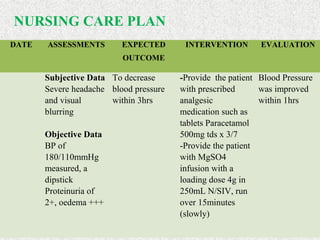
NURSING CARE PLAN
DATE ASSESSMENTS EXPECTED
OUTCOME
INTERVENTION EVALUATION
Subjective Data
Severe headache
and visual
blurring
Objective Data
BP of
180/110mmHg
measured, a
dipstick
Proteinuria of
2+, oedema +++
To decrease
blood pressure
within 3hrs
-Provide the patient
with prescribed
analgesic
medication such as
tablets Paracetamol
500mg tds x 3/7
-Provide the patient
with MgSO4
infusion with a
loading dose 4g in
250mL N/SIV, run
over 15minutes
(slowly)
Blood Pressure
was improved
within 1hrs
NURSING CARE PLAN
DATE ASSESSMENTS EXPECTED
OUTCOME
INTERVENTION EVALUATION
Subjective
Data
Frequency
urination.
Objective
Data
Edema
To decrease
fluid volume
within 7days
-Encourage the
patient to
decrease fluid
intake from 1.5L
to 750ml
After 3 days
the fluid
volume was
reduce.
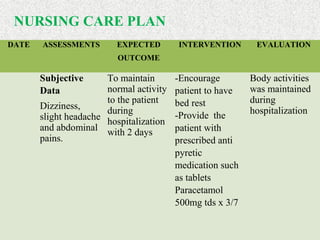
NURSING CARE PLAN
DATE ASSESSMENTS EXPECTED
OUTCOME
INTERVENTION EVALUATION
Subjective
Data
Dizziness,
slight headache
and abdominal
pains.
To maintain
normal activity
to the patient
during
hospitalization
with 2 days
-Encourage
patient to have
bed rest
-Provide the
patient with
prescribed anti
pyretic
medication such
as tablets
Paracetamol
500mg tds x 3/7
Body activities
was maintained
during
hospitalization
NURSING CARE PLAN
DATE ASSESSMENTS EXPECTED
OUTCOME
INTERVENTION EVALUATION
Subjective Data
Patient
complained that
she having
irregular sleep
To maintain
normal sleep of
the patient
during
hospitalization
within a day.
-Counsel the patient
and Health
education due to her
condition.
-Encourage patient
to decrease stress.
-Provide good
ventilation in the
room, minimize
environmental
activity or noise
Sleep pattern
was maintained
within a day
NURSING CARE PLAN
DATE ASSESSMENTS EXPECTED
OUTCOME
INTERVENTION EVALUATION
Subjective Data
Increased tension
Objective Data
Increased
systolic blood
pressure
183/100mmHg
To reduce fear of
the patient due to
hospitalization
within a day
Monitor blood
pressure of the
patient so as not to
continuing
increasing.
-Administer
antihypertensive
drugs.
-Counsel the patient
from free of
hospitalized fear.
During
assessment,
Fear was reduce
during
hospitalization
within a day
CARE PROVIDED OF THE PATIENT WITH
SEVERE PRE-ECLAMPSIA
(Nursing care and management)
• Nursing care was done to the patient to prevent serious
consequence to the mother’s and fetus’s health,
including eclampsia, stillbirth, and liver and kidney
failure.
• The patient was carefully monitored on high blood
pressure and convulsions, and was treated with
medication such as with antihypertensive and MgSO4
infusion.
• A woman will be advised to follow a prescribed
medication regularly.
• She should take enough rest, small exercises, eat
balanced diet and proper hygiene.
• Continue with post partum care schedule visit to
evaluate her condition and should send her children for
immunization, continue with breast feeding.
HEALTH EDUCATION TO THE PATIENT
ACCORDING TO HER CONDITION
• Should as well be counseling for informed choice of
post partum family planning.
• Next pregnancy should attend ANC services early to
prevent and identify and appropriate management of
pre-eclampsia.
RECOMMENDATIONS FOR CHANGES OF THE
CURRENT CARE PLAN
1. In the attempt to improve care of women with severe pre-
eclampsia efforts should be made by hospital
administrators to ensure that there are adequate equipment
and supplies for assessing and managing patients
(example cardio pulmonary monitor, oxygen, suction and
BP machine) with severe pre-eclampsia.
RECOMMENDATIONS FOR CHANGES OF THE
CURRENT CARE PLAN
2. Hospital administration should formulate operational
team that will assess and ensure the adherence of
checklist/Guideline use in managing women with severe
pre-eclampsia.
This will help in improving quality of care in the
management of severe pre-eclampsia.
RECOMMENDATIONS FOR CHANGES OF THE
CURRENT CARE PLAN
3. Hospital administrators should make sure improvement of
Nurse-midwives knowledge and practice should be
parallel with the improvement of resuscitative equipment
and essential drugs for managing severe pre-eclampsia.
This should be done through continuing education,
seminars and in service training.
PREE ECLAMPSIA

PREE ECLAMPSIA

  • 1.
    Presented By Abdulla KhamisNgwali ZU/FHS/4674/13
  • 3.
    INTRODUCTION • Some womenexperience significant problems during the months of gestation that can greatly affect pregnancy outcome. • The syndrome of pre-eclampsia can affect all maternal organ systems, but it is usually detected by the presence of new hypertension, proteinuria, and edema in pregnancy (Douglas & Redman, 1994).
  • 4.
    THE STATUS OFTHE PATIENT Demographic data Patient’s particulars • Name: M. M. A. • Permanent address: Chumbuni, Unguja. • Age: 27years • Sex: Female • Occupation: House Wife • Marital Status: Married • Husband’s name: Mohd Hassan • Date of admission: 02/03/2016 • Time: 10:35am
  • 5.
    MEDICAL HISTORY Patient’s PresentHistory/ chief complain • A 27-years old primigravida patient was admitted at Maternity Ward at Mnazi Mmoja Hospital on 2nd of March, 2016 with 35 Weeks and 3 days of gestation age with a diagnosis of severe pre-eclampsia. • She complained that, she feels pain in the epigastric region and feel dizziness. She was pale and fairly looking and had a BP of 180/110mmHg measured, a dipstick Proteinuria of 2+, oedema +++, a severe headache and visual blurring.
  • 6.
    Patient’s Present History/chief complain cont’ • Subsequently she undergo delivery by cesarean section under general anesthesia and twins’ baby boys’ one with weighing 1.8kgs and 1.6kgs was delivered with APGAR scores of 7 and 9 respectively.
  • 7.
    Previous Medical history •No previous hospitalization history, family background shows a history of hypertension. • During Her first and second prenatal visits had been normal in all parameters including BP, which was recorded as 120/80 to 110/70mmHg. • From her third visit showed a slight risen of her Blood Pressure which reads 140/90 mmHg, slight proteinuria of 2+ with slight edema of the lower limb.
  • 8.
    Previous Medical historyCont’ • The woman was seen on the next week with slight decrease of vital signs and laboratory investigation.
  • 9.
    CURRENT DIAGNOSIS AND TREATMENT Diagnosis •Severe Pre-eclampsia. Treatment: • Medication such as antihypertensive and MgSO4 infusion was started with a loading dose 4g in 250mL N/SIV, run over 15minutes (slowly), 5g + 1 Ml Lignocaine IM in R or L buttock. • Followed by a maintenance dose of Magnesium Sulfate 2g/h as a continuous intravenous infusion for 24h. • Tablet Aldoment 800mg t.d.s 2/7 • Syrup Haemovit 15ml t.d.s 2/5.
  • 10.
    NURSING ASSESSMENT OFTHE PATIENT • Subjective data • Objective data
  • 11.
    VITAL SIGNS ANDTEST RESULTS Vital sign The vital signs were done, where by the results shows that:- Date Time Vital Signs 02/03/2016 10: 50am BP: 180/110mmHg, Temp: 37.5ºC, Resp rate: 21b/min, Pulse rate: 75b/min, SP02: 97% 03/03/2016 10:55am BP: 165/85mhhmHg, Temp: 37.7ºC, Resp rate: 22b/min Pulse rate: 73b/min, SP02: 98%
  • 12.
    Test Results The doctorwas suspect pre- eclampsia to the patient, the certain tests were needed and the result shows that:- • Blood tests :- Full blood picture was done and the results shows:- Hemoglobin/hematocrit: - 12 g/dl, Platelets:- < 100,000/mm3 and Bilirubin 3mg/dl
  • 13.
    • Urine analysis:-A single urine sample that was used to measure the ratio of; Creatinine >1.2 mg/dl, and Protein 2+ • Ultrasound: - The ultrasound shows that; the Fetal heart rate was 132b/min, fetal weight first twin is 1.8kg and second twin is 1.6kg, and the amount of fluid in the uterus (amniotic fluid) was adequate.
  • 14.
    NURSING OBSERVATION • Generalstate of health Patient was well groomed with cleanness of the body, conscious and aware of one’s self and environment and she can move by herself. • Mental Status The patient is alert, conscious, and aware of the environment.
  • 15.
    NURSING DIAGNOSIS 1. Riskof developing eclampsia related to severe pre- eclampsia as evidence by BP of 180/110mmHg measured, a dipstick Proteinuria of 2+, oedema +++, a severe headache and visual blurring. 2. Excess fluid volume related to increase fluid intake as evidence by edema and frequency urination. 3. Activity intolerance related to hypertension as evidence by feels dizziness, slight headache and abdominal pains.
  • 16.
    NURSING DIAGNOSIS 4. Sleeppattern disturbance related to feeling of birth process as evidence by patient complained that she having irregular sleep. 5. Fear related to hospitalization as evidence by increased tension, increased systolic blood pressure 183/100mmHg
  • 17.
    NURSING CARE PLAN DATEASSESSMENTS EXPECTED OUTCOME INTERVENTION EVALUATION Subjective Data Severe headache and visual blurring Objective Data BP of 180/110mmHg measured, a dipstick Proteinuria of 2+, oedema +++ To decrease blood pressure within 3hrs -Provide the patient with prescribed analgesic medication such as tablets Paracetamol 500mg tds x 3/7 -Provide the patient with MgSO4 infusion with a loading dose 4g in 250mL N/SIV, run over 15minutes (slowly) Blood Pressure was improved within 1hrs
  • 18.
    NURSING CARE PLAN DATEASSESSMENTS EXPECTED OUTCOME INTERVENTION EVALUATION Subjective Data Frequency urination. Objective Data Edema To decrease fluid volume within 7days -Encourage the patient to decrease fluid intake from 1.5L to 750ml After 3 days the fluid volume was reduce.
  • 19.
    NURSING CARE PLAN DATEASSESSMENTS EXPECTED OUTCOME INTERVENTION EVALUATION Subjective Data Dizziness, slight headache and abdominal pains. To maintain normal activity to the patient during hospitalization with 2 days -Encourage patient to have bed rest -Provide the patient with prescribed anti pyretic medication such as tablets Paracetamol 500mg tds x 3/7 Body activities was maintained during hospitalization
  • 20.
    NURSING CARE PLAN DATEASSESSMENTS EXPECTED OUTCOME INTERVENTION EVALUATION Subjective Data Patient complained that she having irregular sleep To maintain normal sleep of the patient during hospitalization within a day. -Counsel the patient and Health education due to her condition. -Encourage patient to decrease stress. -Provide good ventilation in the room, minimize environmental activity or noise Sleep pattern was maintained within a day
  • 21.
    NURSING CARE PLAN DATEASSESSMENTS EXPECTED OUTCOME INTERVENTION EVALUATION Subjective Data Increased tension Objective Data Increased systolic blood pressure 183/100mmHg To reduce fear of the patient due to hospitalization within a day Monitor blood pressure of the patient so as not to continuing increasing. -Administer antihypertensive drugs. -Counsel the patient from free of hospitalized fear. During assessment, Fear was reduce during hospitalization within a day
  • 22.
    CARE PROVIDED OFTHE PATIENT WITH SEVERE PRE-ECLAMPSIA (Nursing care and management) • Nursing care was done to the patient to prevent serious consequence to the mother’s and fetus’s health, including eclampsia, stillbirth, and liver and kidney failure. • The patient was carefully monitored on high blood pressure and convulsions, and was treated with medication such as with antihypertensive and MgSO4 infusion.
  • 23.
    • A womanwill be advised to follow a prescribed medication regularly. • She should take enough rest, small exercises, eat balanced diet and proper hygiene. • Continue with post partum care schedule visit to evaluate her condition and should send her children for immunization, continue with breast feeding. HEALTH EDUCATION TO THE PATIENT ACCORDING TO HER CONDITION
  • 24.
    • Should aswell be counseling for informed choice of post partum family planning. • Next pregnancy should attend ANC services early to prevent and identify and appropriate management of pre-eclampsia.
  • 25.
    RECOMMENDATIONS FOR CHANGESOF THE CURRENT CARE PLAN 1. In the attempt to improve care of women with severe pre- eclampsia efforts should be made by hospital administrators to ensure that there are adequate equipment and supplies for assessing and managing patients (example cardio pulmonary monitor, oxygen, suction and BP machine) with severe pre-eclampsia.
  • 26.
    RECOMMENDATIONS FOR CHANGESOF THE CURRENT CARE PLAN 2. Hospital administration should formulate operational team that will assess and ensure the adherence of checklist/Guideline use in managing women with severe pre-eclampsia. This will help in improving quality of care in the management of severe pre-eclampsia.
  • 27.
    RECOMMENDATIONS FOR CHANGESOF THE CURRENT CARE PLAN 3. Hospital administrators should make sure improvement of Nurse-midwives knowledge and practice should be parallel with the improvement of resuscitative equipment and essential drugs for managing severe pre-eclampsia. This should be done through continuing education, seminars and in service training.