PRESENTER:
RITU CHAHAL
2017033
LABOR
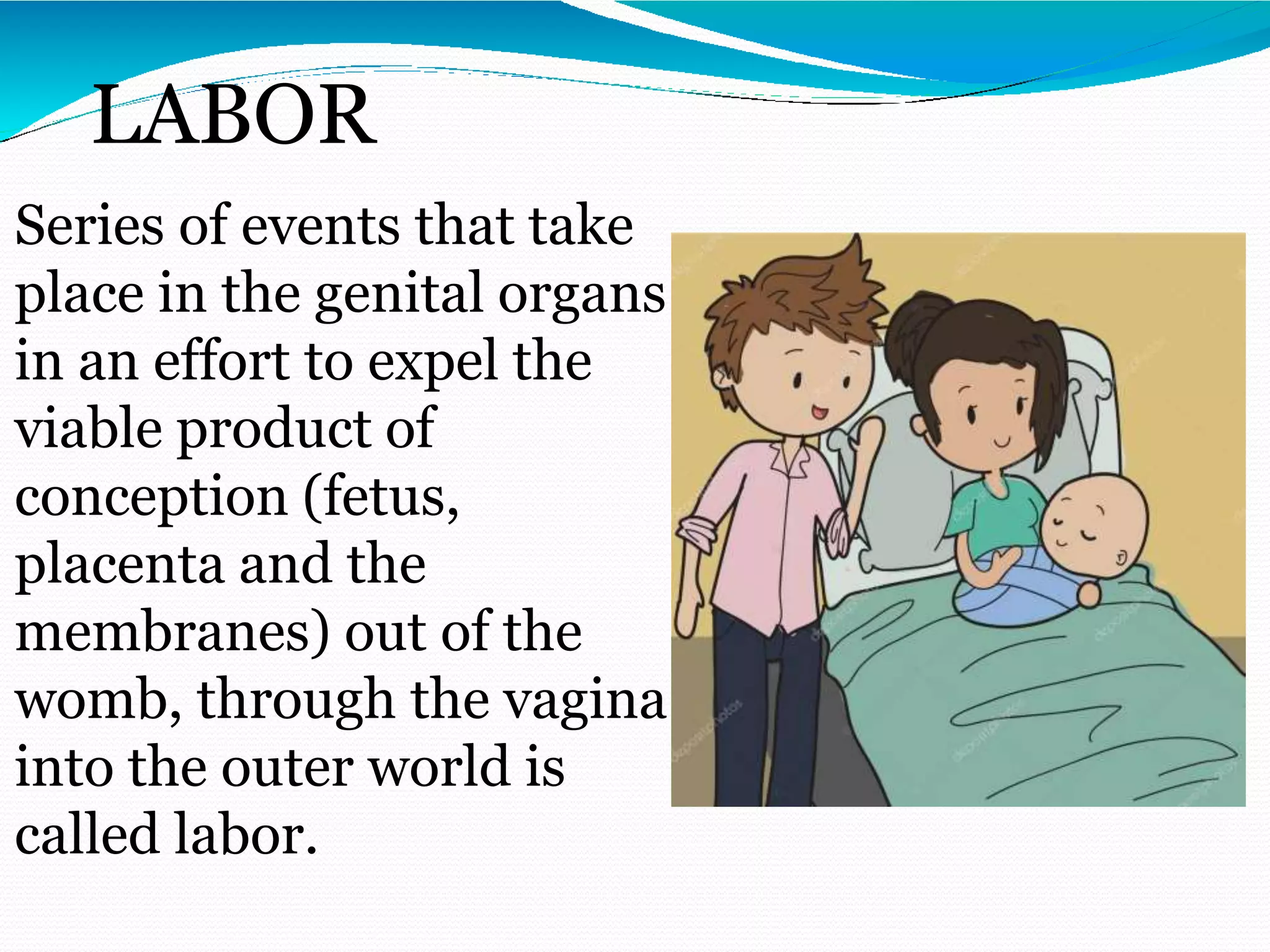
Series of events that take
place in the genital organs
in an effort to expel the
viable product of
conception (fetus,
placenta and the
membranes) out of the
womb, through the vagina
into the outer world is
called labor.
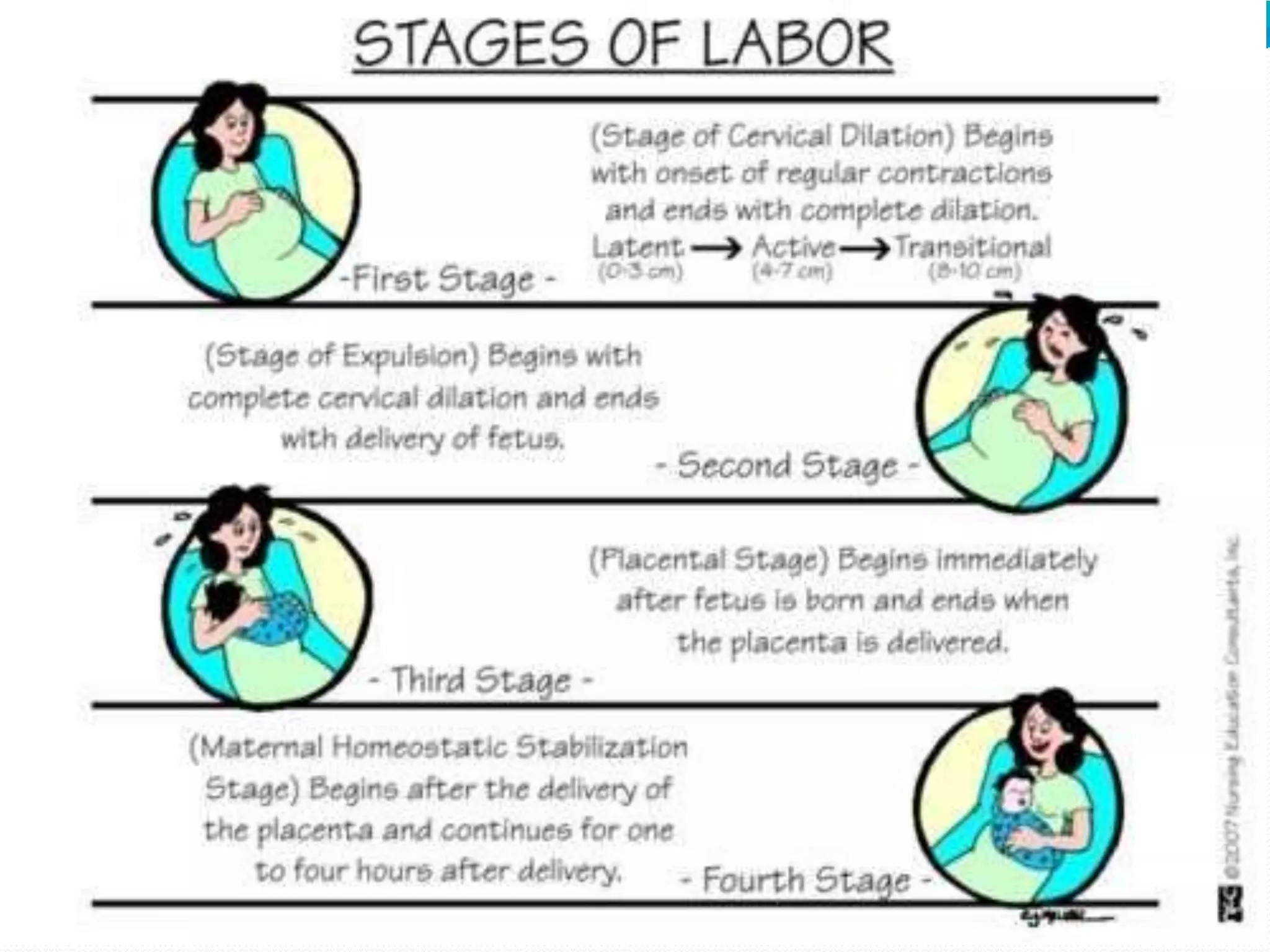
The third stage of labor ----- interval from the
deliveryof the babyto the separation andexpulsion of the
placenta
Normally the delivery of placenta will take about5-10
minutes after delivery of the baby regardless of theparity
The major complication associated with this period is
postpartum hemorrhage (PPH)---- the most common cause
of maternal morbidity andmortality in developing
countries.
THIRD STAGE PHYSIOLOGY
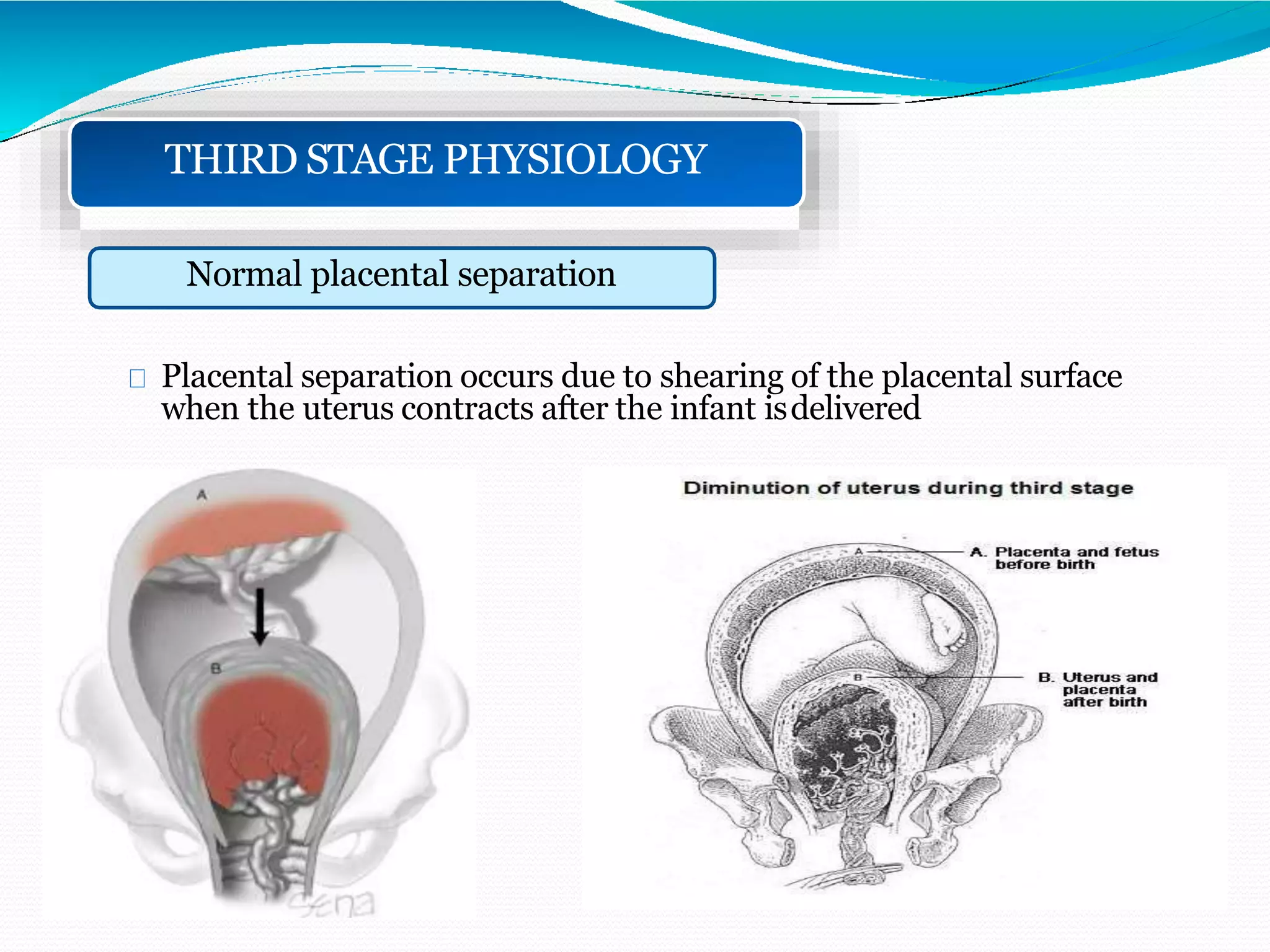
Normal placental separation
Placental separation occurs due to shearing of the placental surface
when the uterus contracts after the infant isdelivered
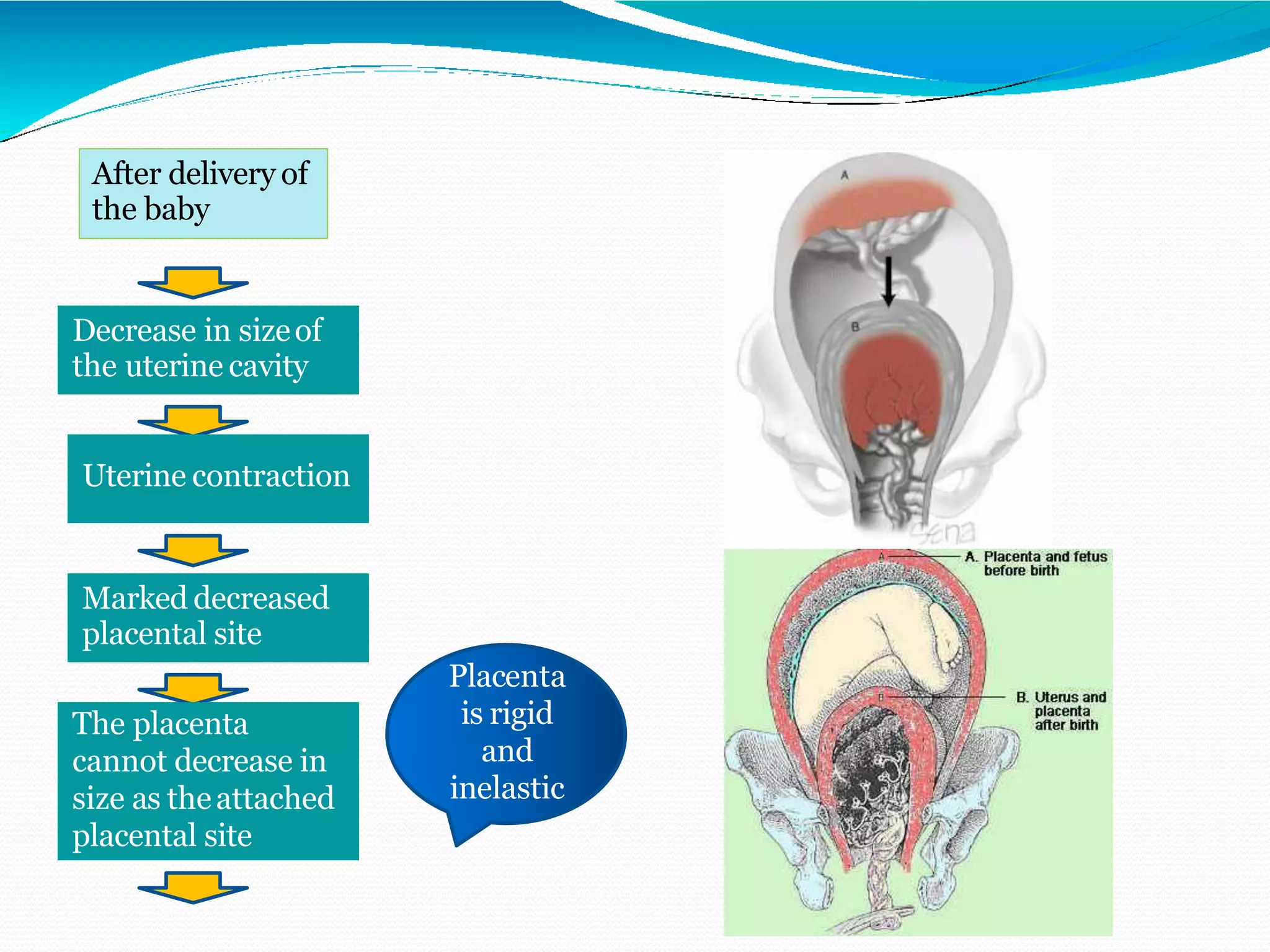
After delivery of
the baby
Decrease in sizeof
the uterine cavity
Uterinecontraction
Marked decreased
placental site
Marked decreased
placental site
The placenta
cannot decrease in
size as theattached
placental site
Uterine contraction
Decrease in sizeof
the uterine cavity
Placenta
is rigid
and
inelastic
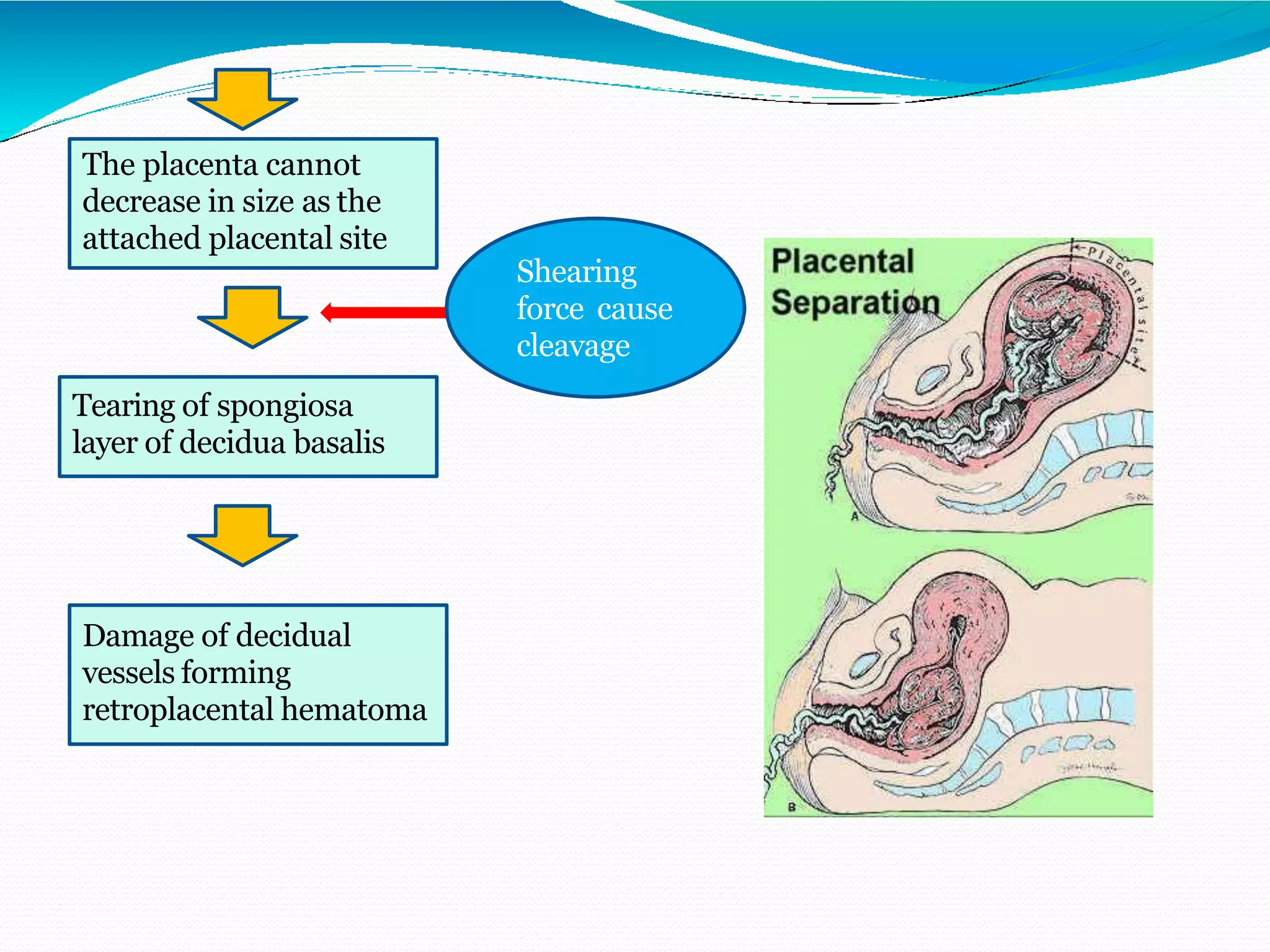
cause cleavage
The placenta cannot
decrease in size as the
attached placental site
Tearing of spongiosa
layer of decidua basalis
Damage of decidual
vessels forming
retroplacental hematoma
Shearing
force cause
cleavage
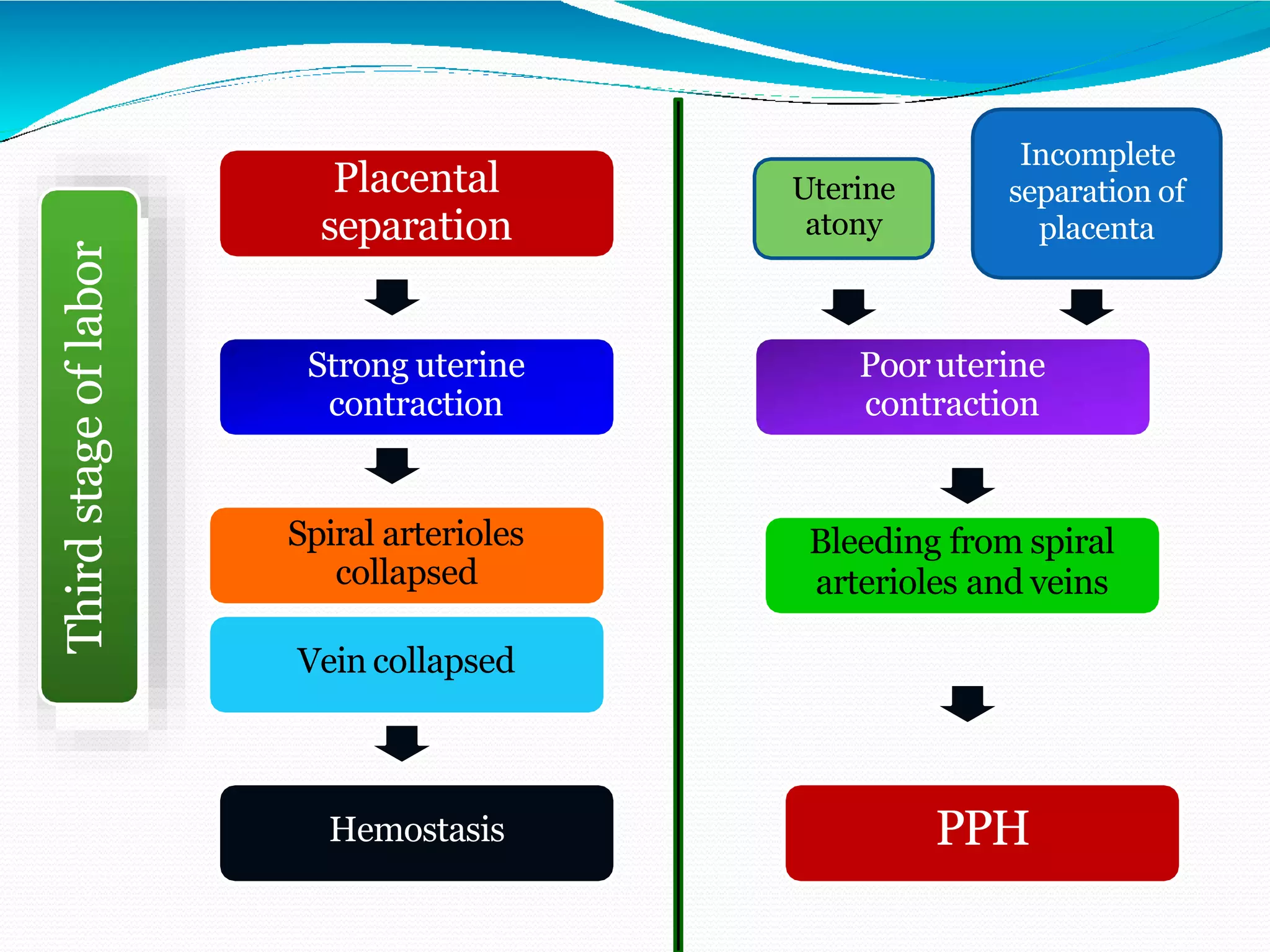
Placental
separation
Strong uterine
contraction
Spiral arterioles
collapsed
Vein collapsed
Hemostasis
Pooruterine
contraction
Bleeding from spiral
arterioles and veins
PPH
Uterine
atony
Incomplete
separation of
placenta
Thirdstageoflabor
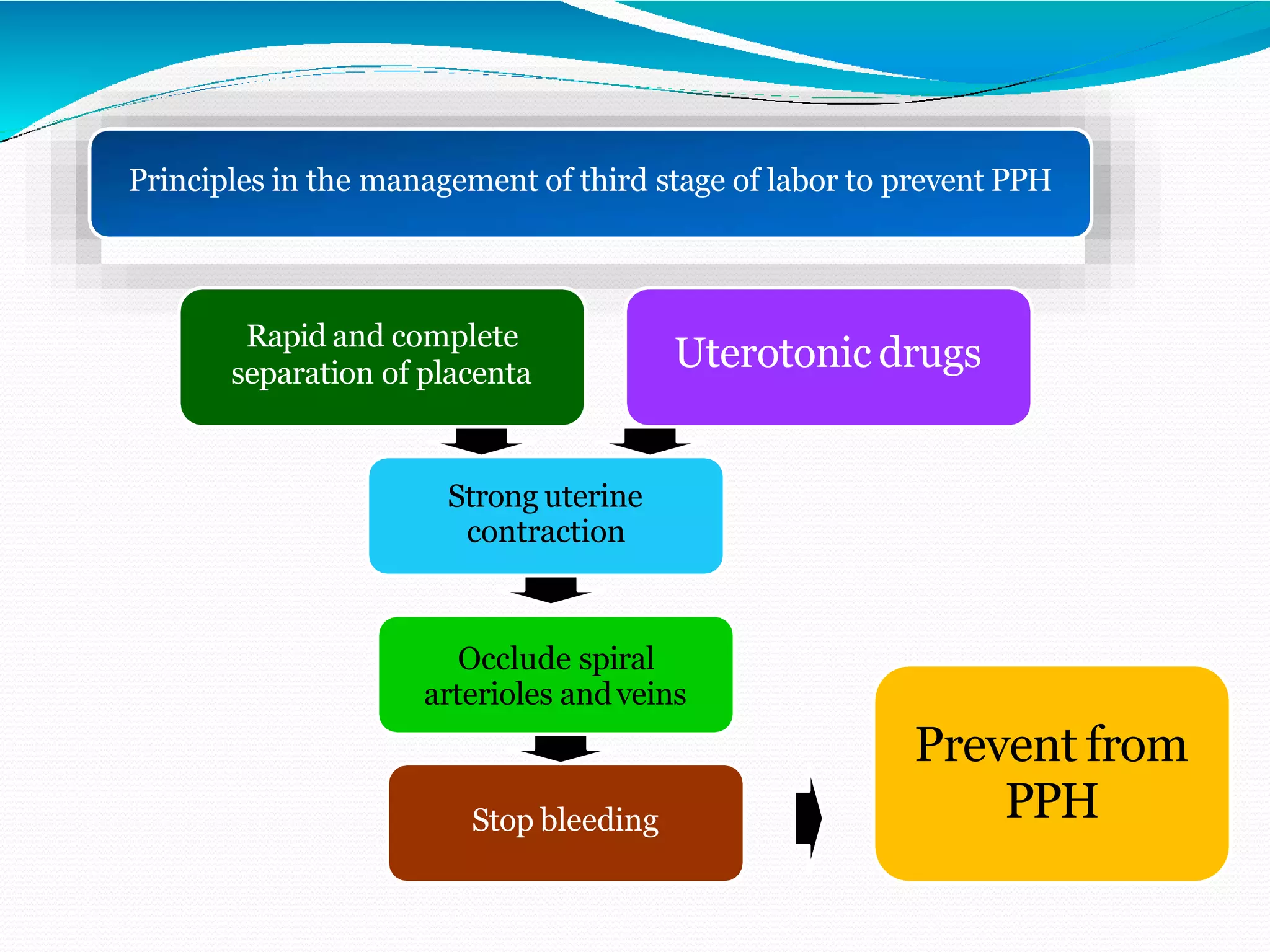
Principles in the management of third stage of labor to prevent PPH
Rapid and complete
separation of placenta
Prevent from
PPH
Strong uterine
contraction
Occlude spiral
arterioles andveins
Stop bleeding
Uterotonic drugs
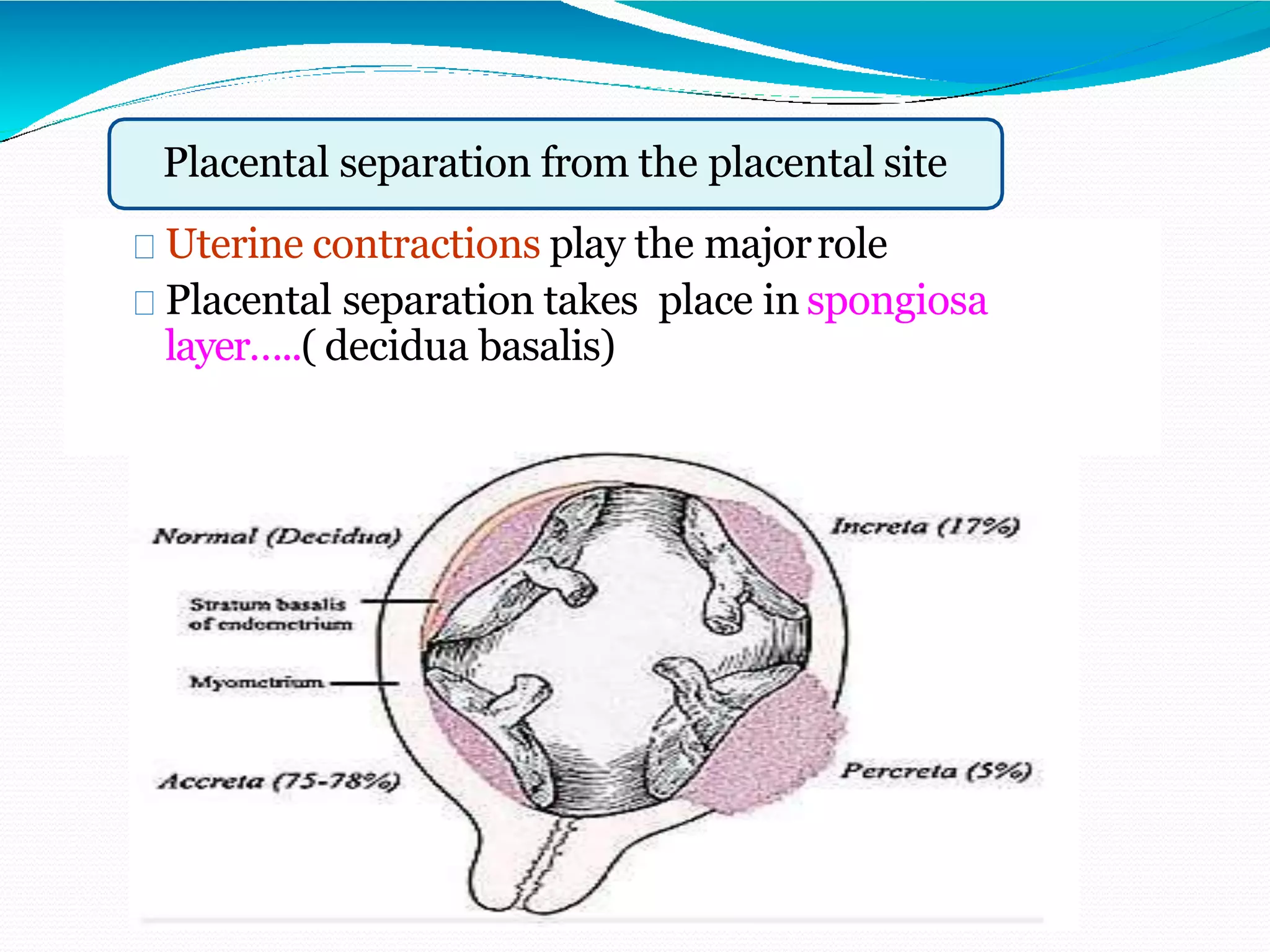
Uterine contractions play the majorrole
Placental separation takes place in spongiosa
layer…..( decidua basalis)
Placental separation from the placental site
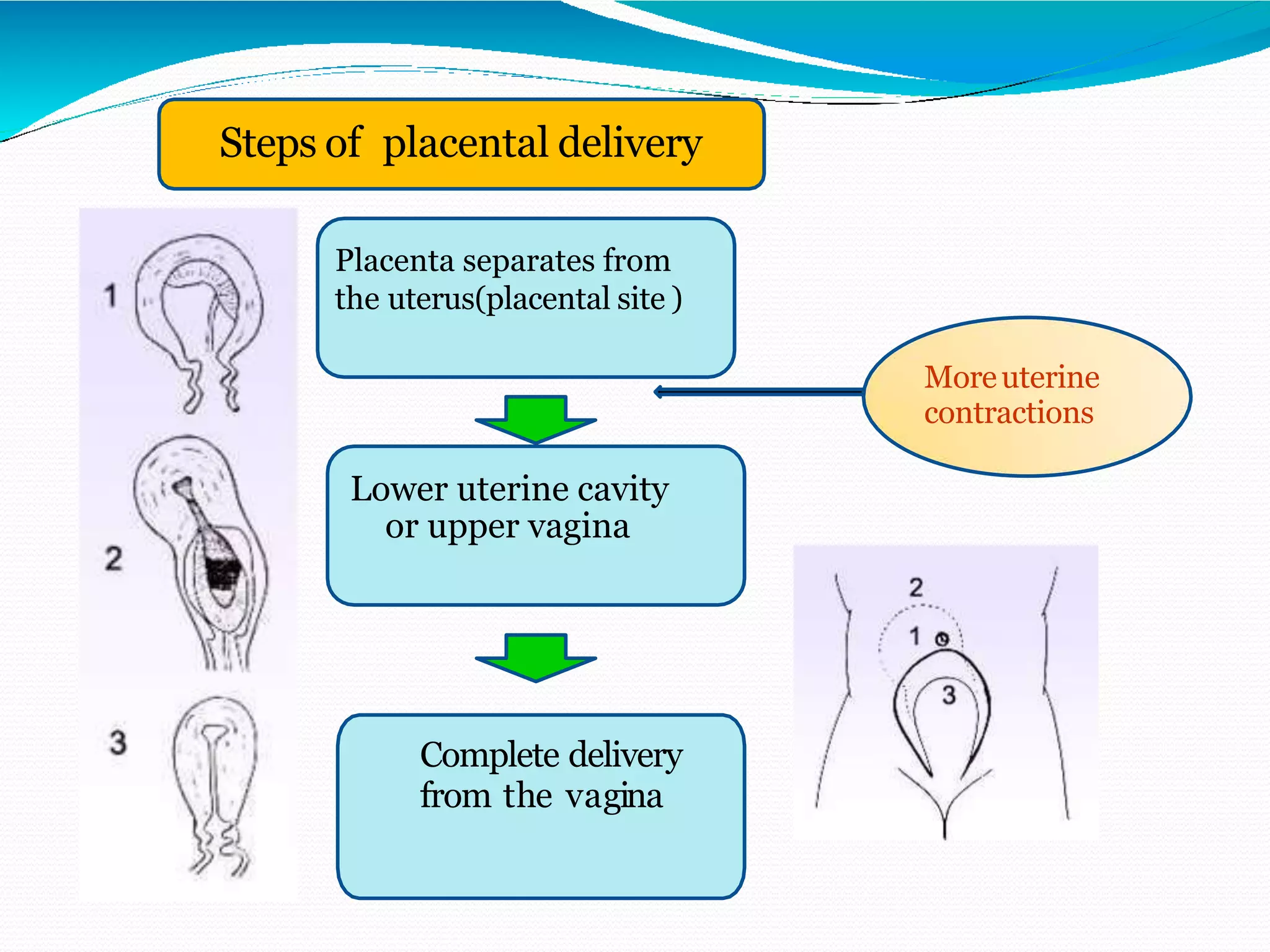
the uterus(placental site)
Placenta separates from
the uterus(placental site )
Lower uterine cavity
or upper vagina
Complete delivery
from the vagina
Moreuterine
contractions
Steps of placental delivery
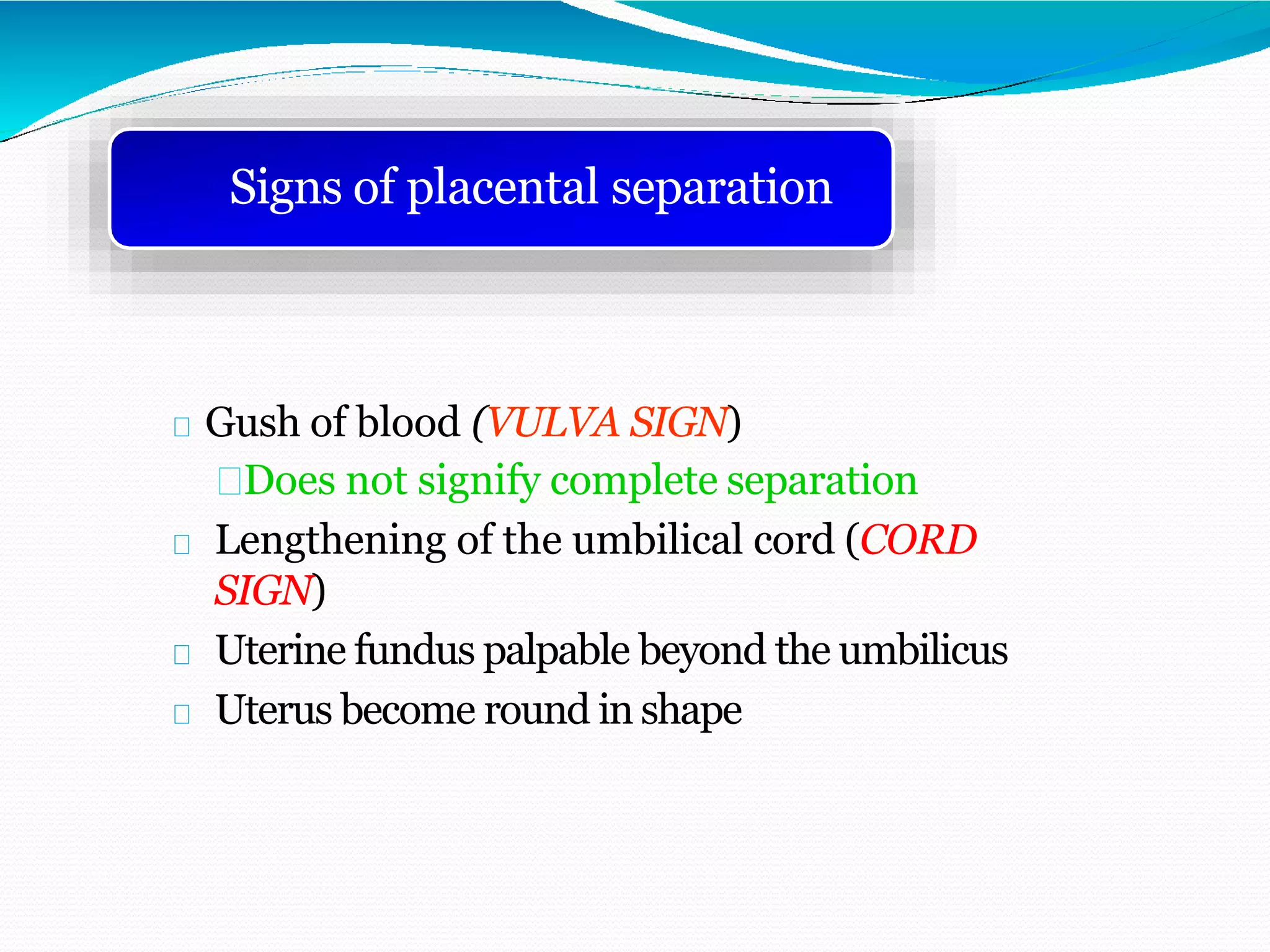
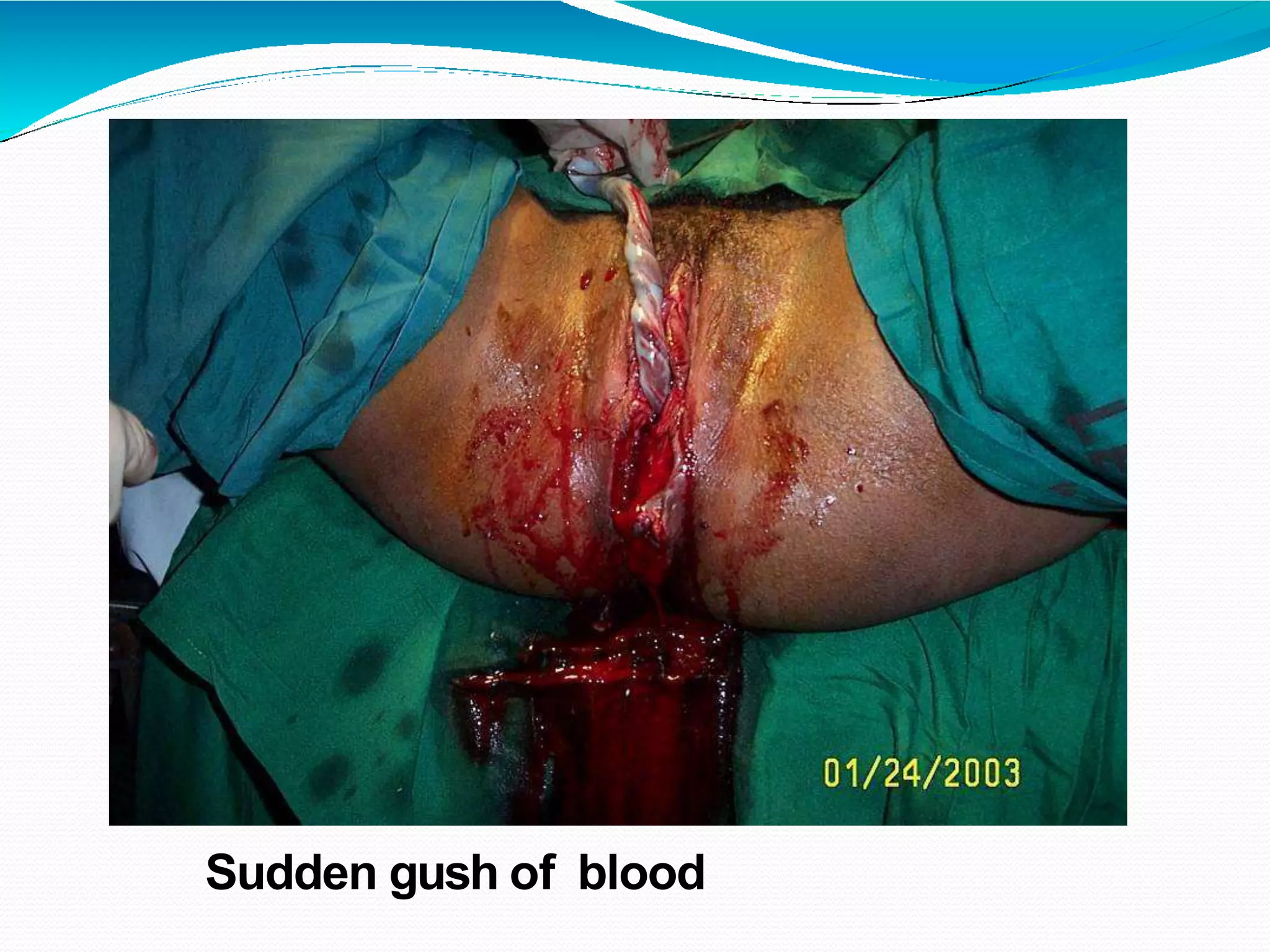
Gush of blood (VULVA SIGN)
Does not signify complete separation
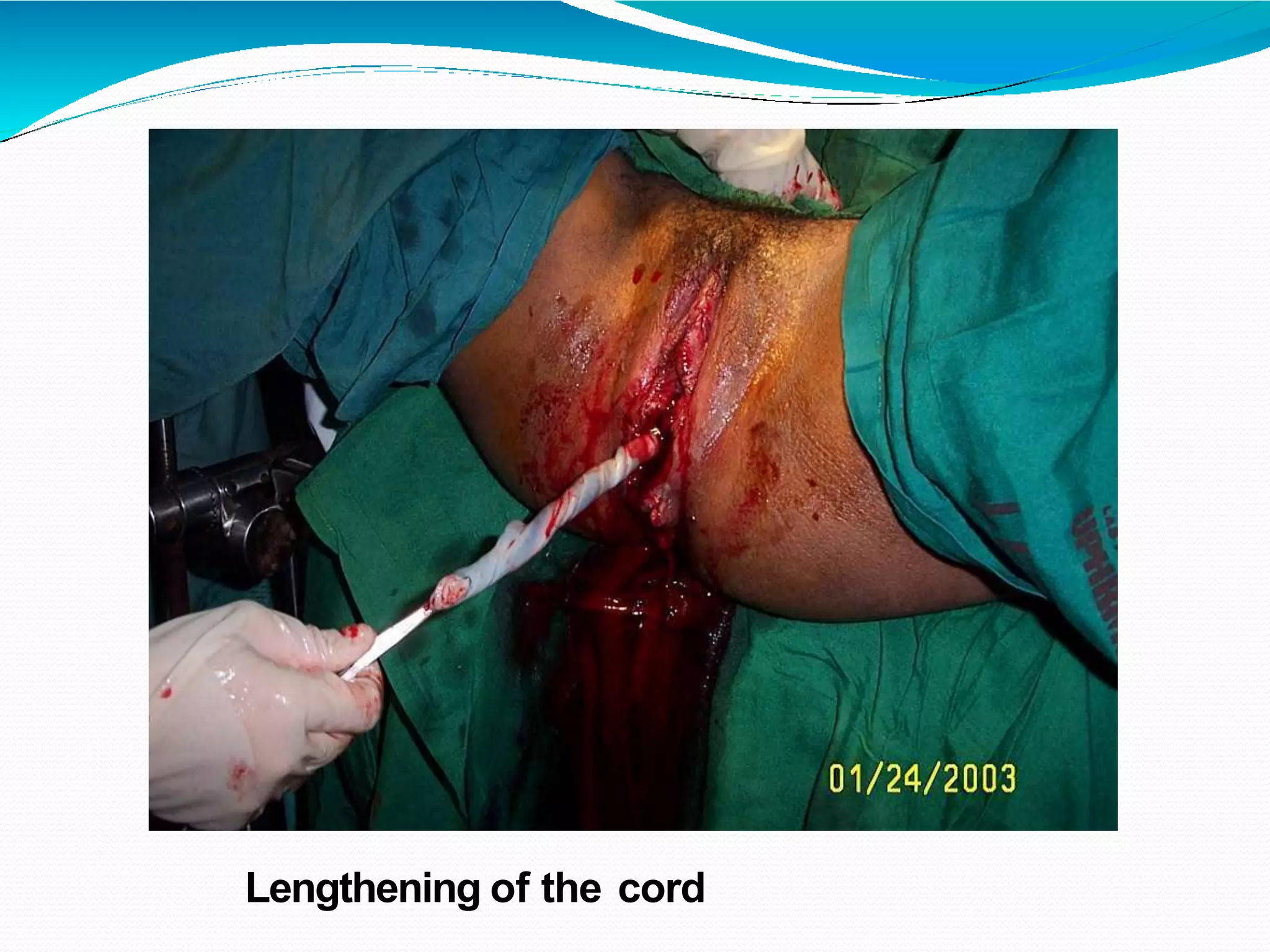
Lengthening of the umbilical cord (CORD
SIGN)
Uterine fundus palpable beyond the umbilicus
Uterus become round in shape
Signs of placental separation
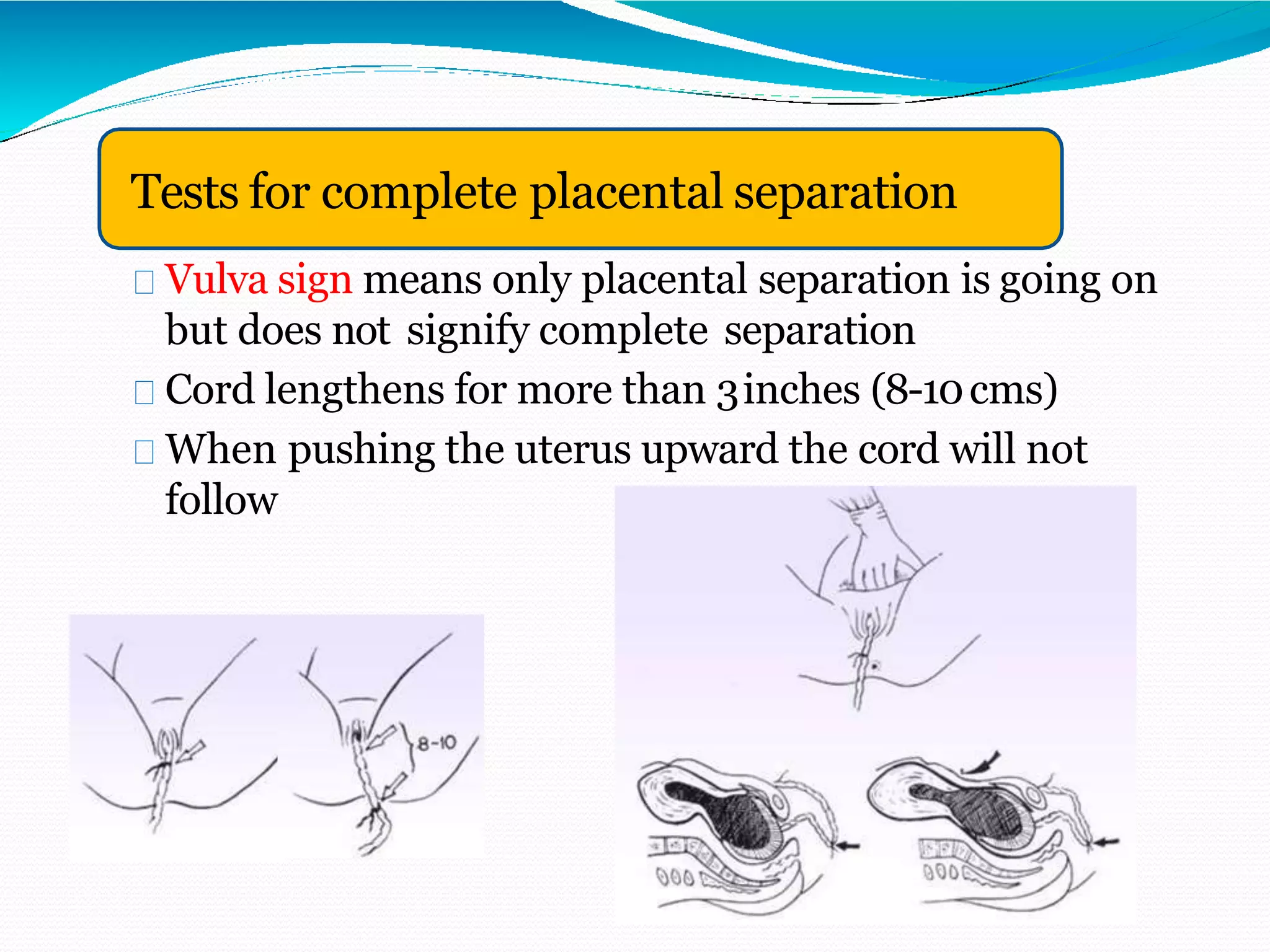
Vulva sign means only placental separation is going on
but does not signify complete separation
Cord lengthens for more than 3inches (8-10cms)
When pushing the uterus upward the cord will not
follow
Tests for complete placental separation
Spontaneous uterine contractions,
Downward pressure from the developing retroplacental
hematoma
An increase in maternal intraabdominal pressure
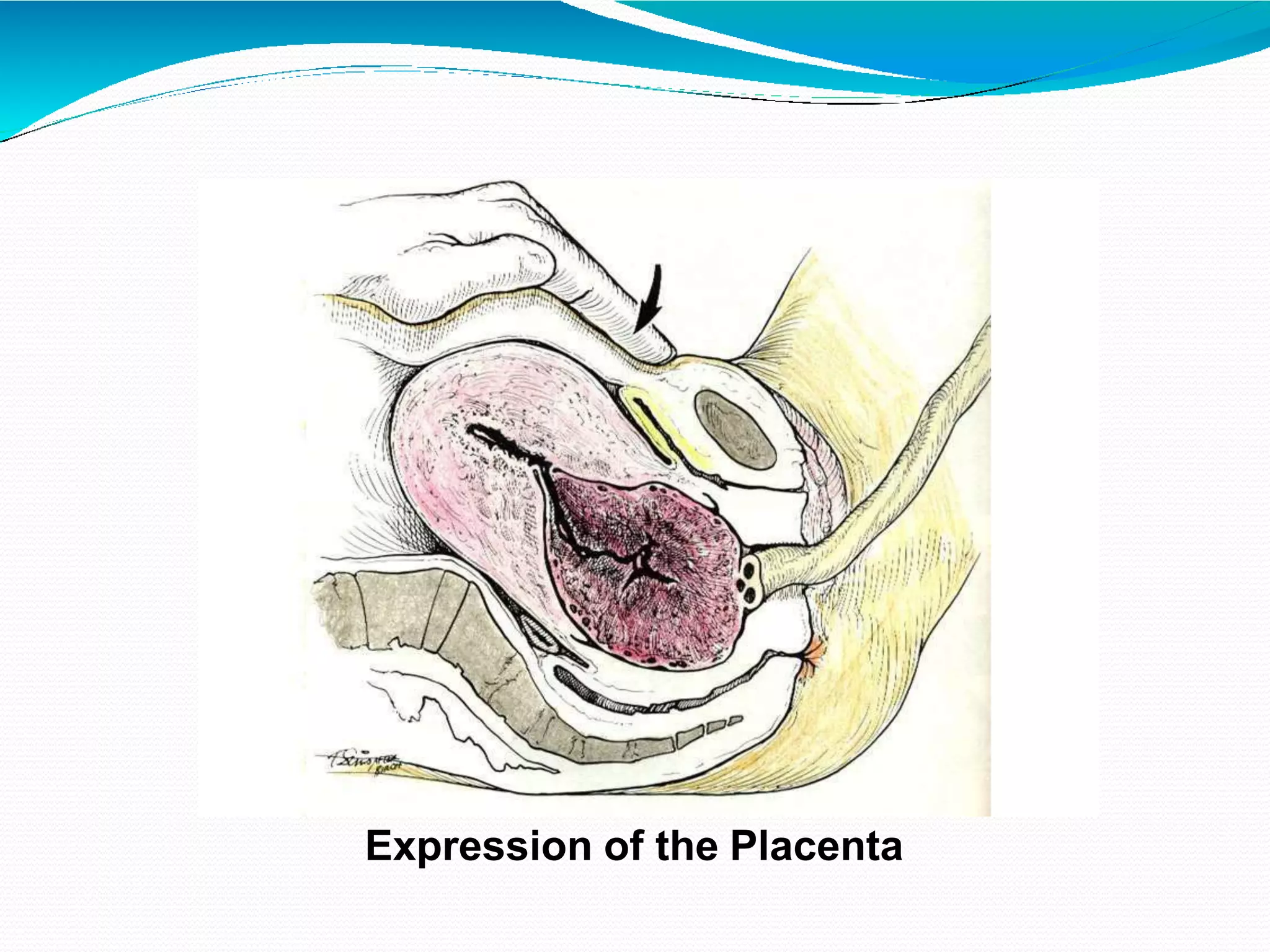
Placental expulsion follows as a result of
Sudden gush of blood
Lengthening of the cord
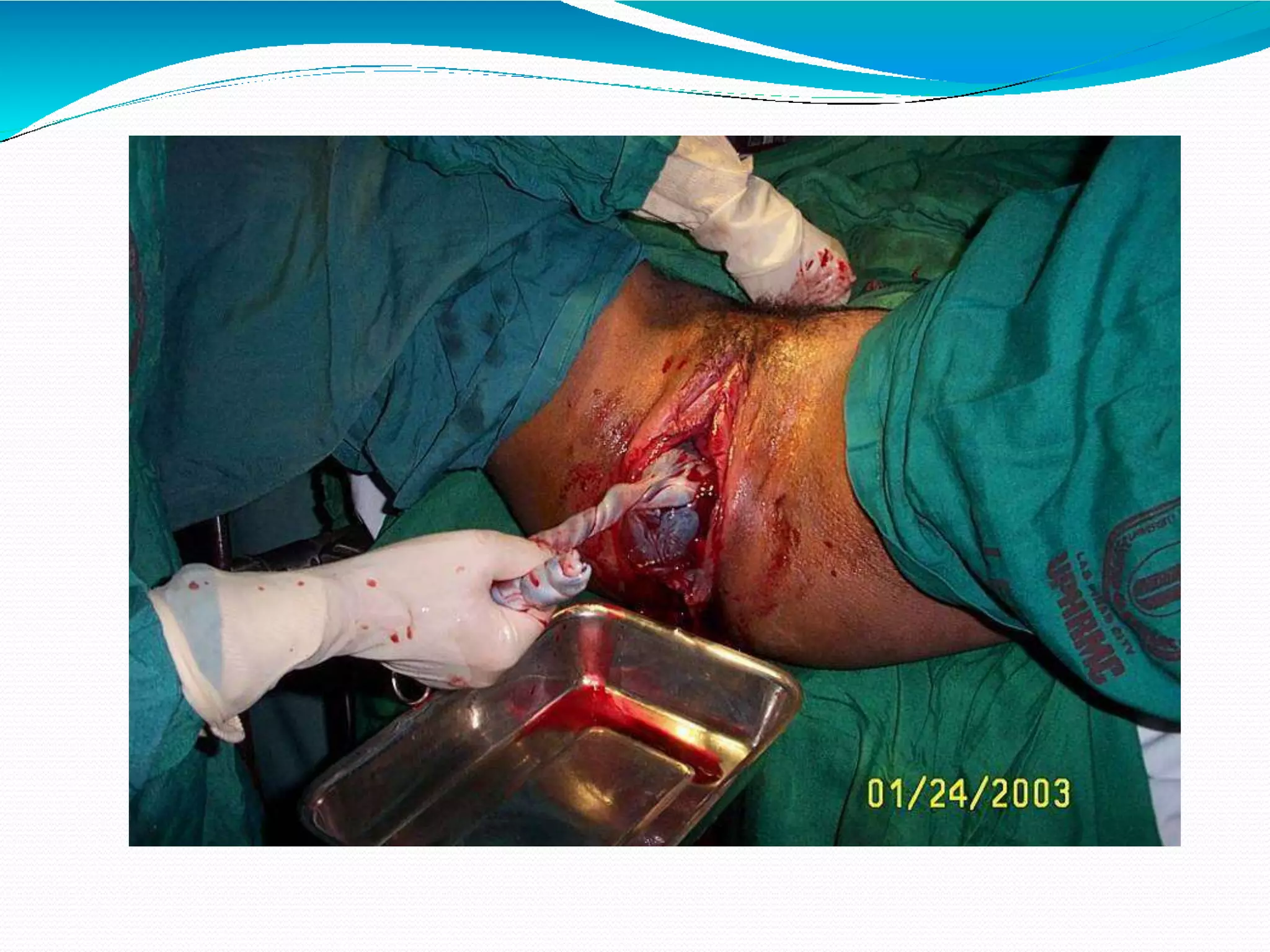
Expression of the Placenta
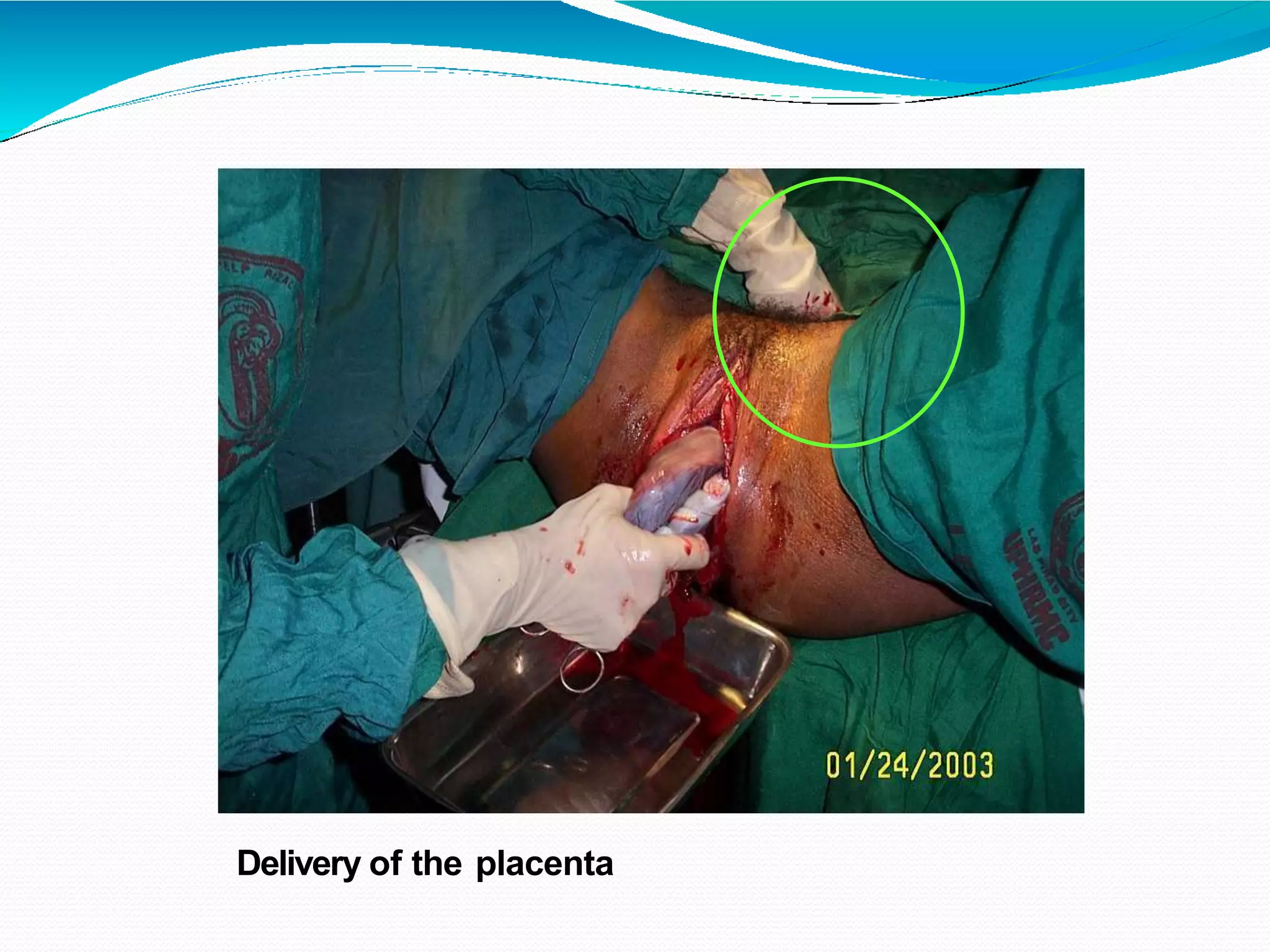
Delivery of the placenta
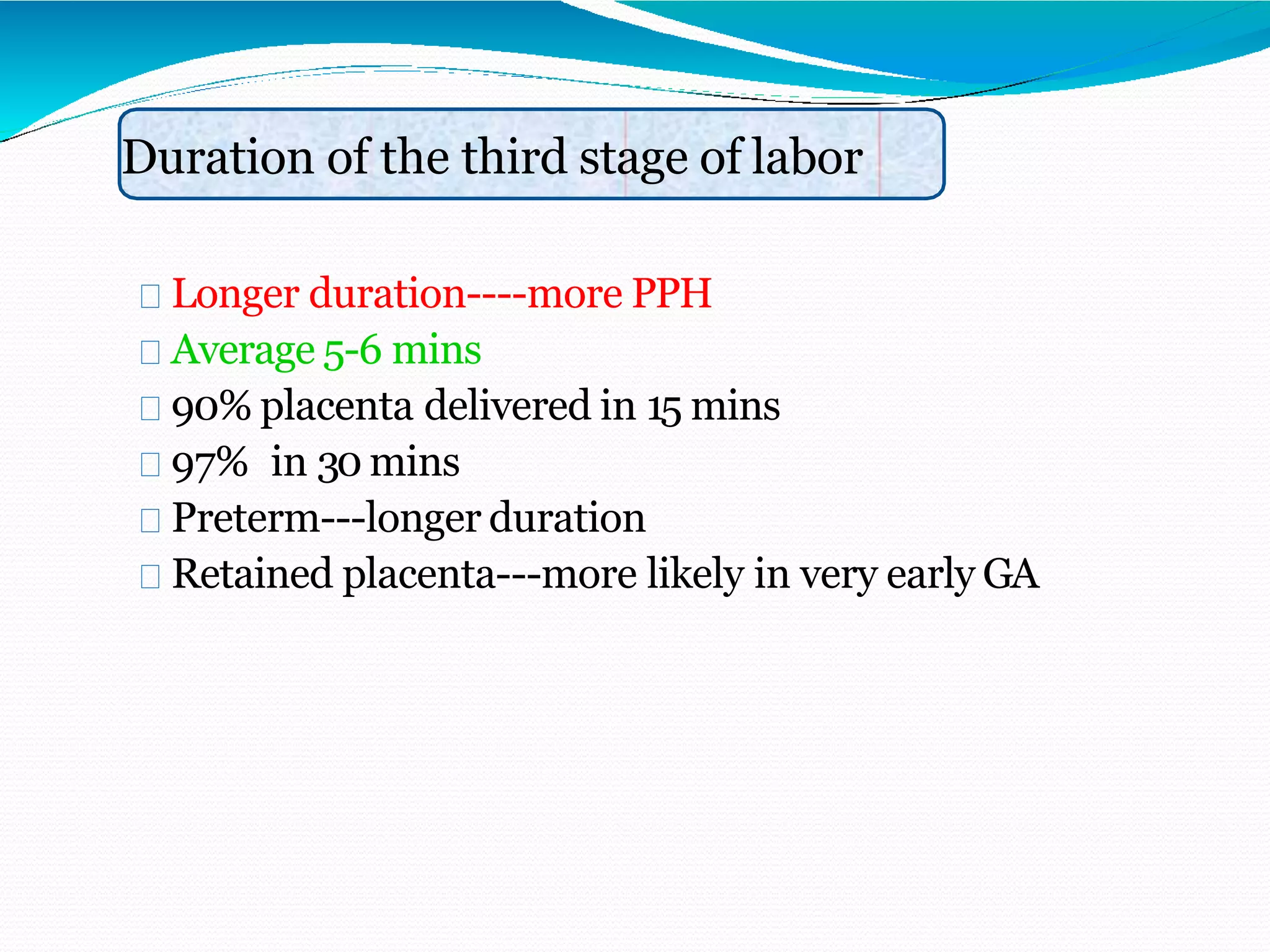
Longer duration----more PPH
Average 5-6 mins
90% placenta delivered in 15 mins
97% in 30 mins
Preterm---longer duration
Retained placenta---more likely in very early GA
Duration of the third stage of labor
Expectant management
MANAGEMENT OF THIRD STAGE OF LABOR
Expectant management
Spontaneous delivery of the placenta without
the useof uterotonic agents or cordtraction
Delivered by maternal expulsive force and
gravitational force
The placenta may be incomplete separated or
entrapped inthe lower uterine segment or upper
vagina
Takes more time
More bleeding
Active management
Early cord clamping
Administration of a uterotonic agent prior to placenta
separation.
Controlled cord traction
Uterine massage
Reduced risks of maternal blood loss
MANAGEMENT OF THIRD STAGEOF LABOR
Urinary bladder should be emptied in all cases
Administration of a uterotonic agent is recommended
during the third stage to reduce maternal blood loss
Uterotonic agents should not be given until after
delivery of the anterior fetal shoulder toensure that
shoulder dystocia is notexacerbated.
The clinician should also be certain that there is no
undiagnosed and undelivered twin
DRUGS USED FOR ACTIVEMANAGEMENT
Methergine
Oxytocin
There are insufficient data to determinewhether
administration of the uterotonic agent is more
effective
If it is given after delivery of the anterior shoulderbut
before separation of the placenta
Or immediately upon expulsion of theplacenta
Maneuver to facilitate placentaldelivery
Brandt-Andrews maneuver
Controlled cord traction (recommended by WHO)
Fundal Pressure
Controlled cord traction
recommended by
WHO
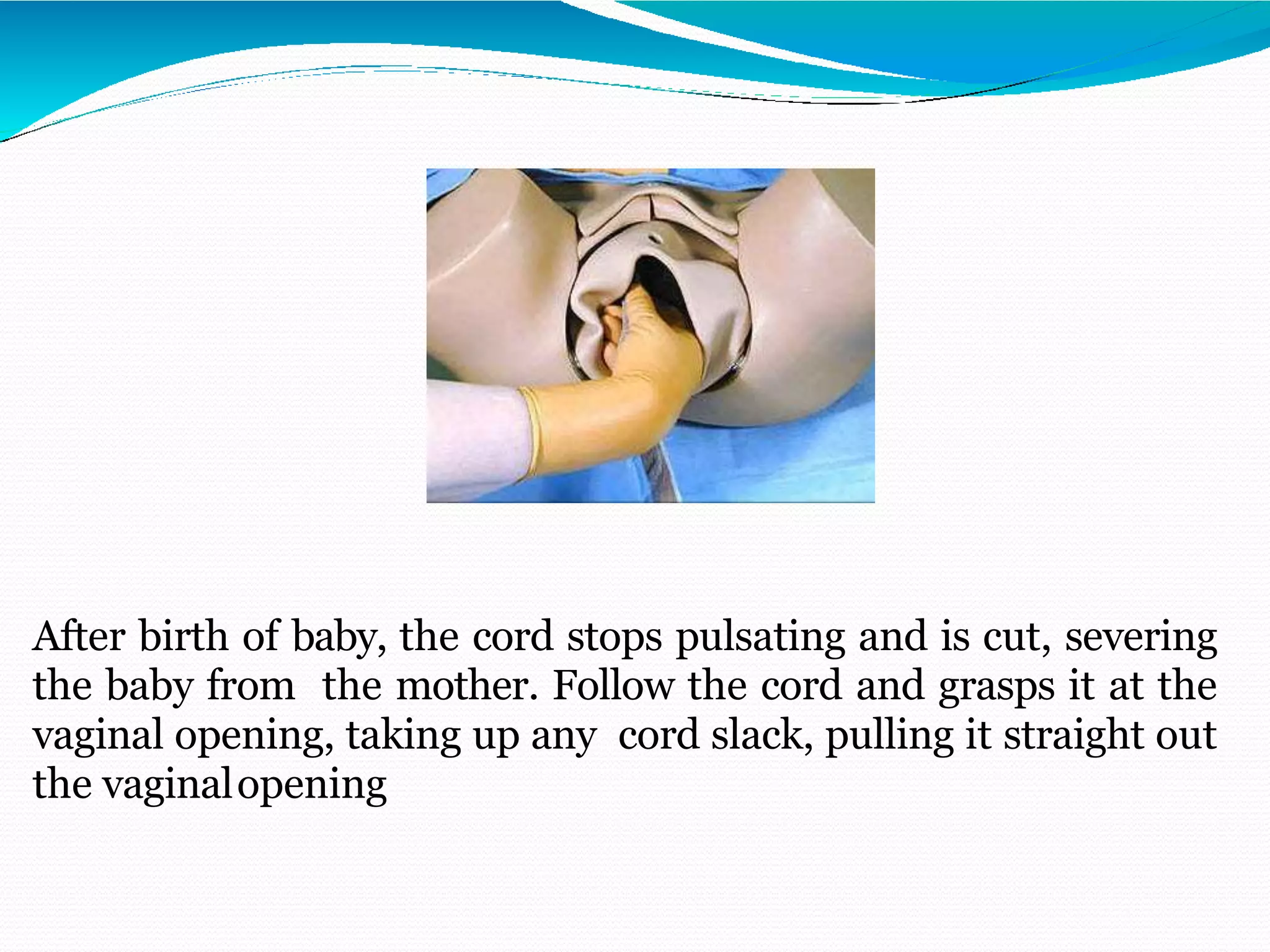
After birth of baby, the cord stops pulsating and is cut, severing
the baby from the mother. Follow the cord and grasps it at the
vaginal opening, taking up any cord slack, pulling it straight out
the vaginalopening
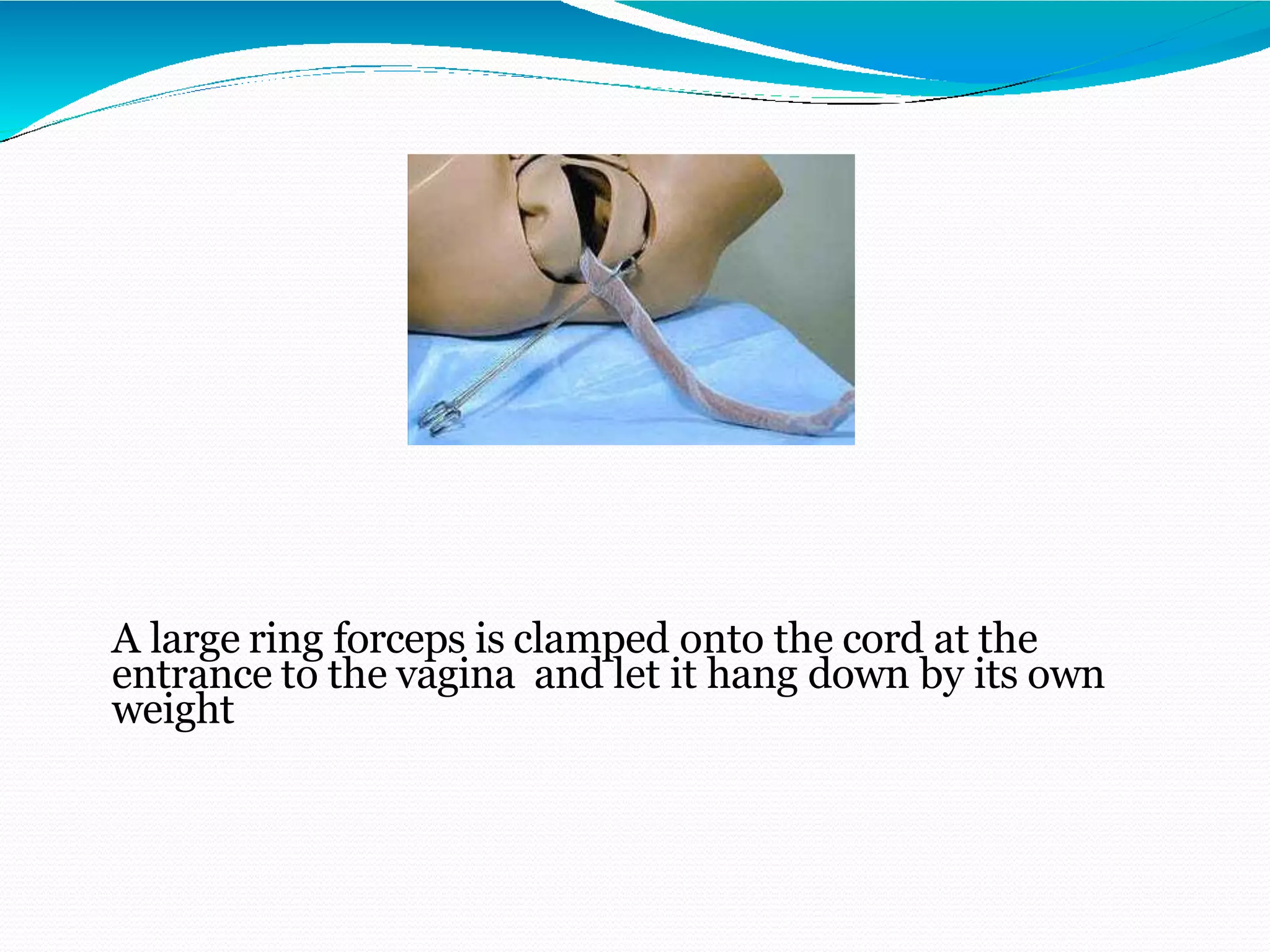
A large ring forceps is clamped onto the cord at the
entrance to the vagina and let it hang down by its own
weight
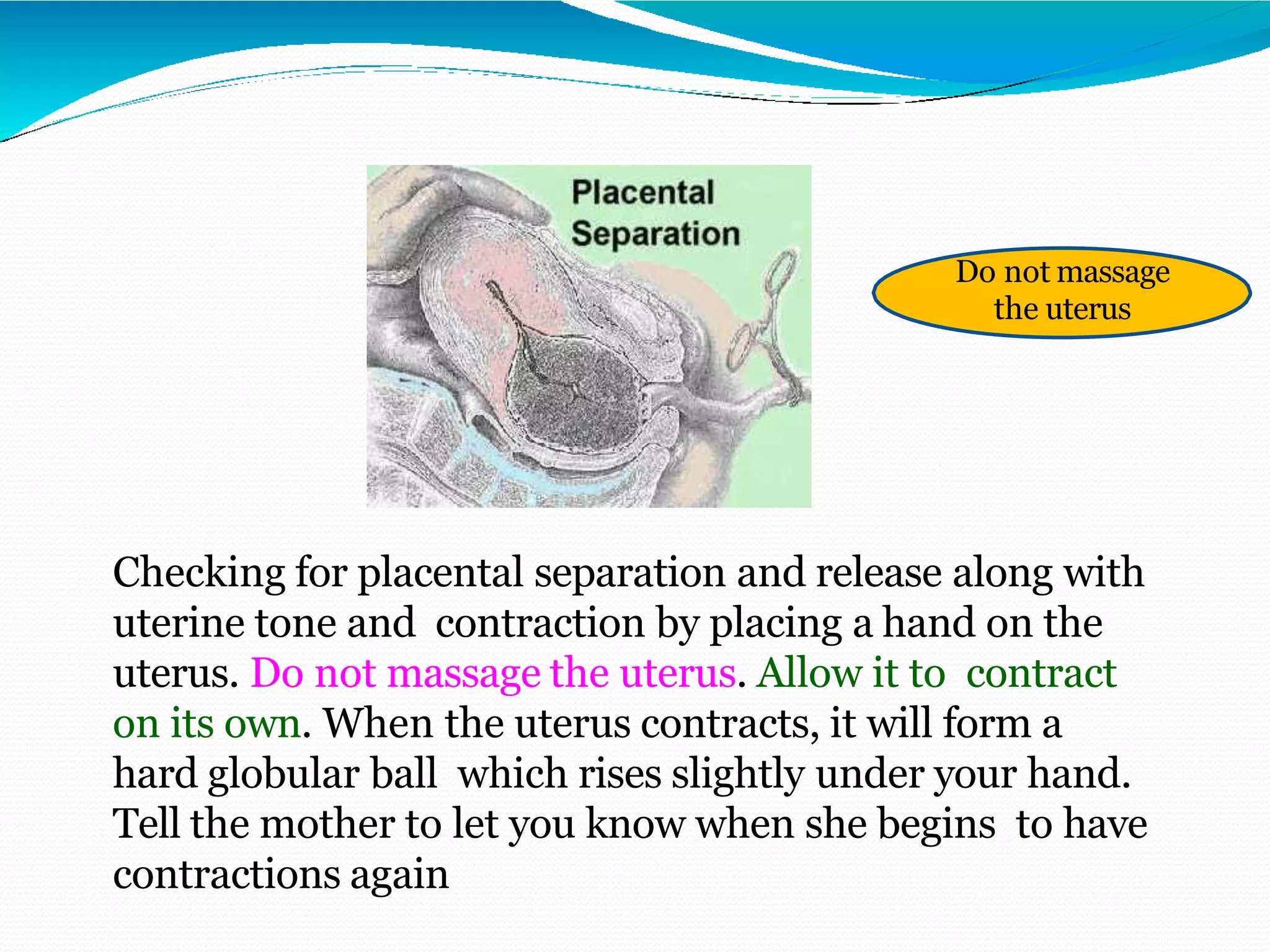
Checking for placental separation and release along with
uterine tone and contraction by placing a hand on the
uterus. Do not massage the uterus. Allow it to contract
on its own. When the uterus contracts, it will form a
hard globular ball which rises slightly under your hand.
Tell the mother to let you know when she begins to have
contractions again
Do not massage
the uterus
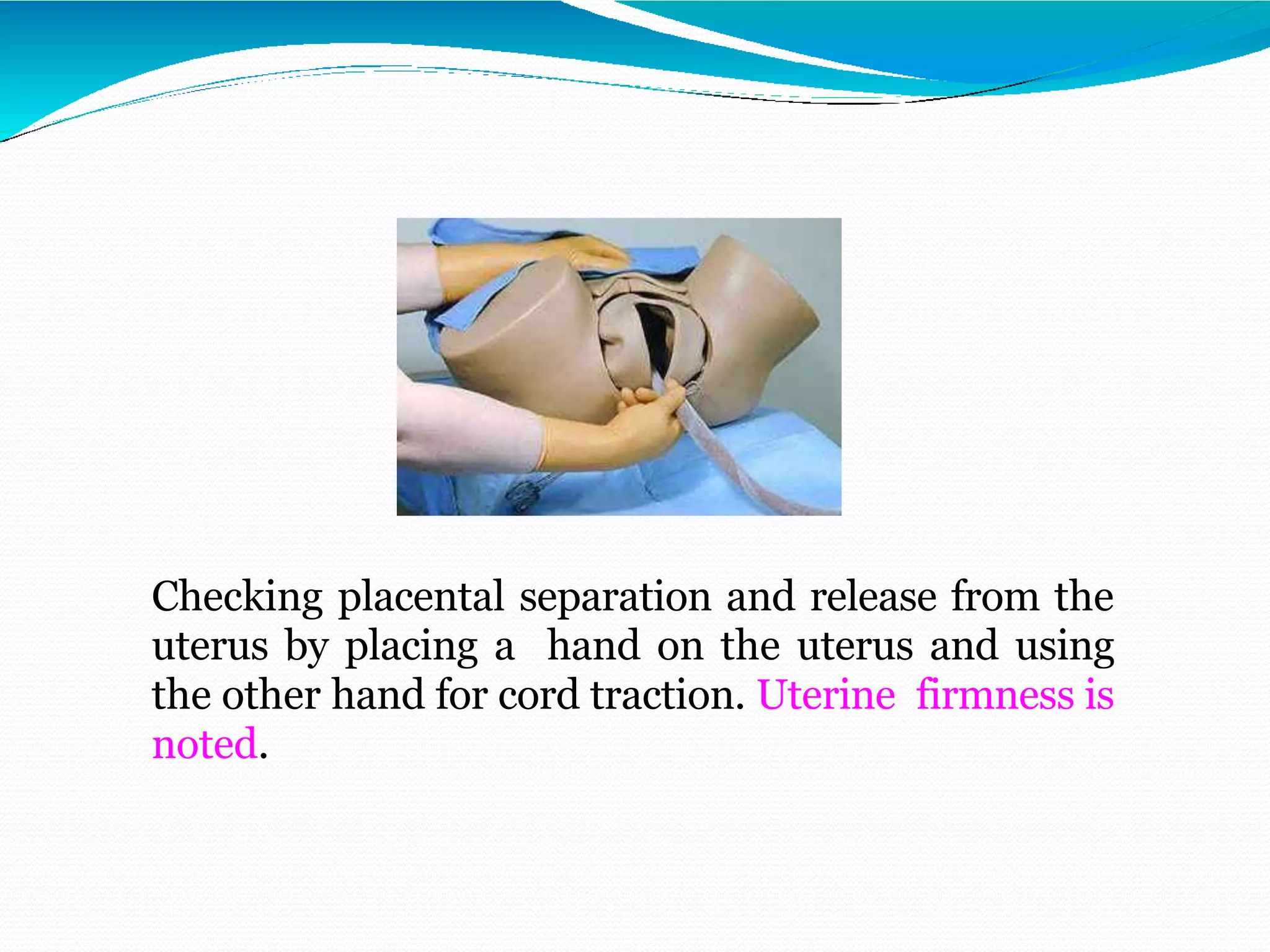
Checking placental separation and release from the
uterus by placing a hand on the uterus and using
the other hand for cord traction. Uterine firmness is
noted.
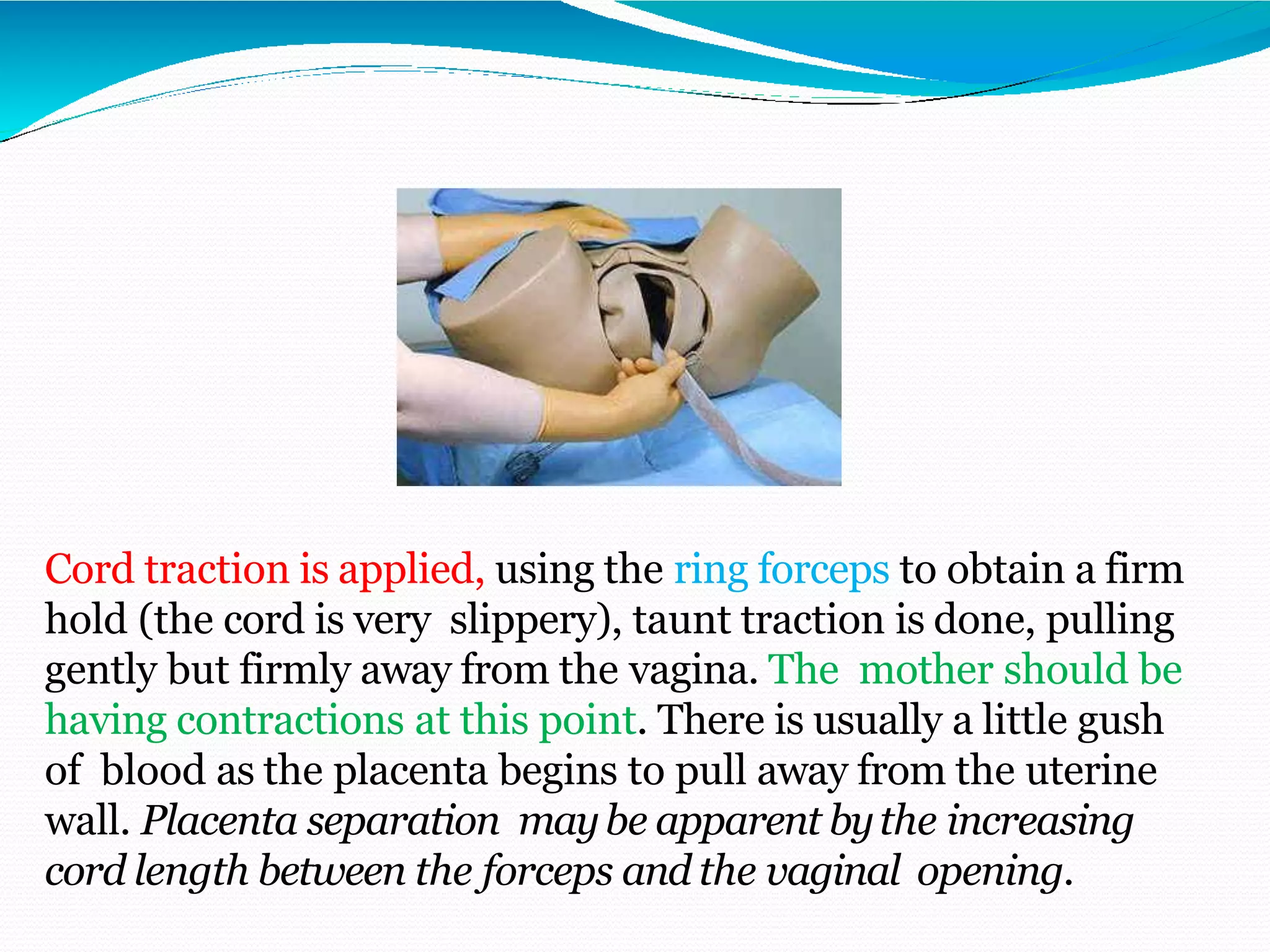
Cord traction is applied, using the ring forceps to obtain a firm
hold (the cord is very slippery), taunt traction is done, pulling
gently but firmly away from the vagina. The mother should be
having contractions at this point. There is usually a little gush
of blood as the placenta begins to pull away from the uterine
wall. Placenta separation maybe apparent bythe increasing
cord length between the forceps and the vaginal opening.
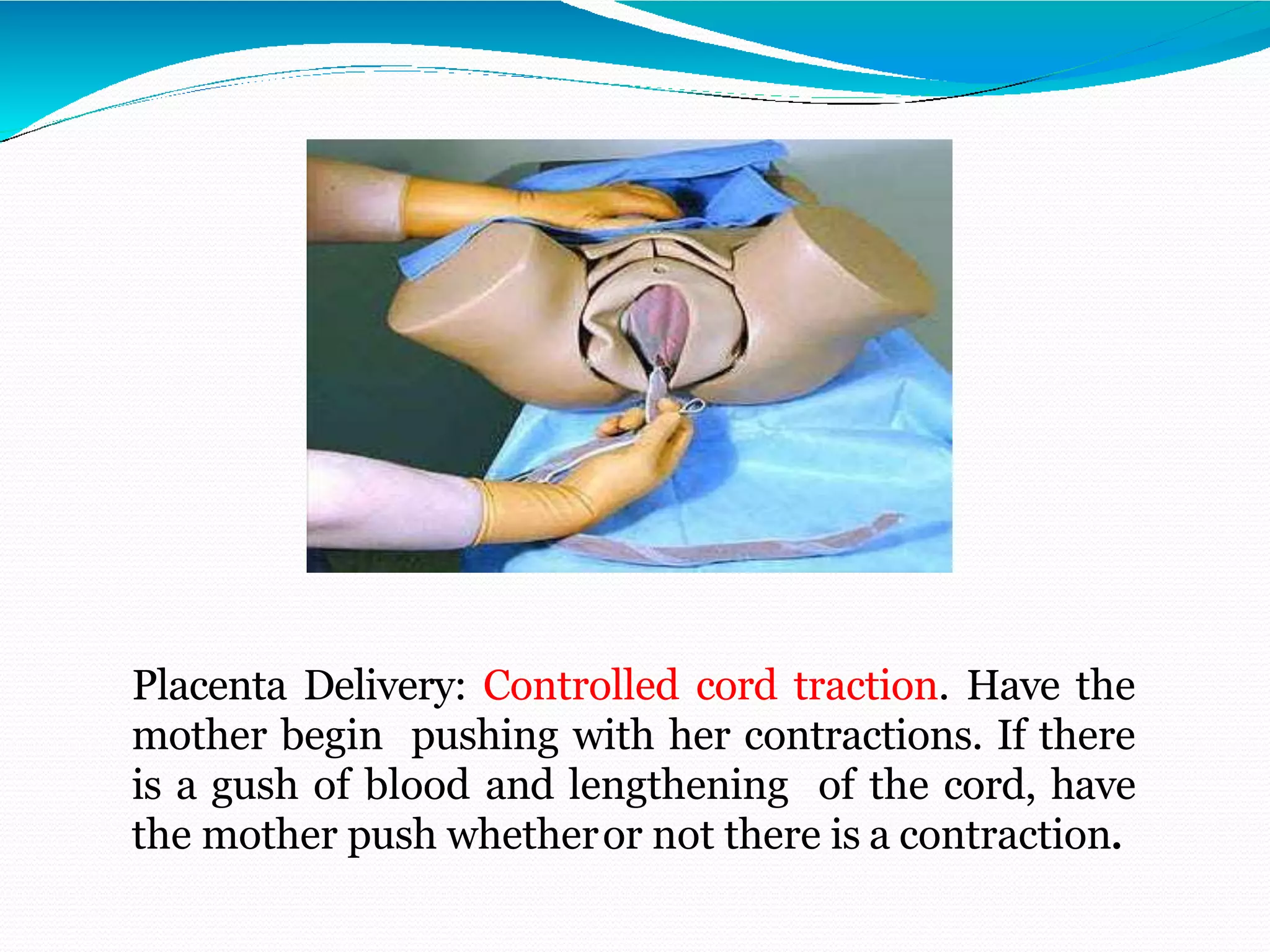
Placenta Delivery: Controlled cord traction. Have the
mother begin pushing with her contractions. If there
is a gush of blood and lengthening of the cord, have
the mother push whetheror not there is a contraction.
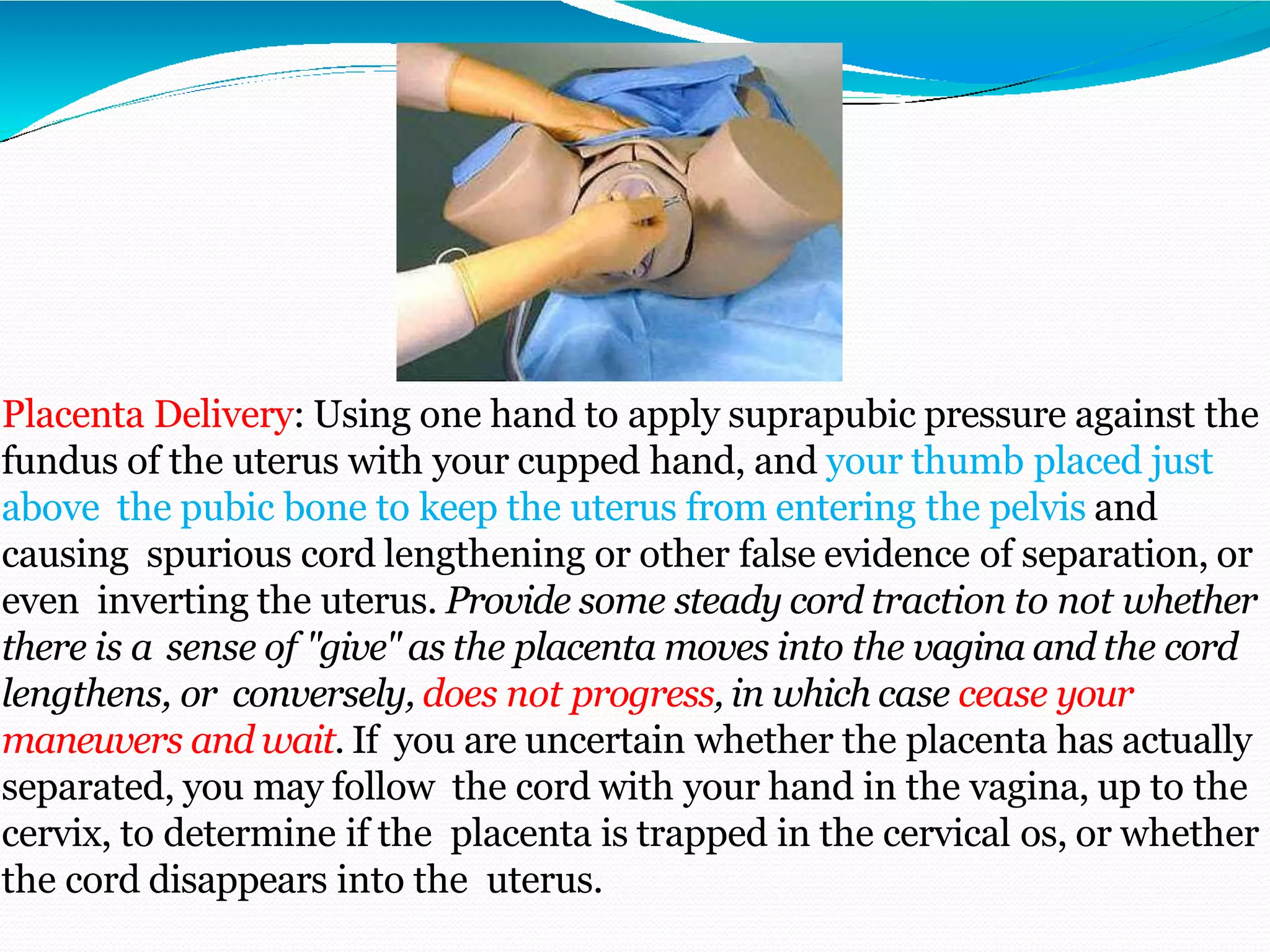
Placenta Delivery: Using one hand to apply suprapubic pressure against the
fundus of the uterus with your cupped hand, and your thumb placed just
above the pubic bone to keep the uterus from entering the pelvis and
causing spurious cord lengthening or other false evidence of separation, or
even inverting the uterus. Provide some steady cord traction to not whether
there is a sense of "give" as the placenta moves into the vagina and the cord
lengthens, or conversely, does not progress, in which case cease your
maneuvers and wait. If you are uncertain whether the placenta has actually
separated, you may follow the cord with your hand in the vagina, up to the
cervix, to determine if the placenta is trapped in the cervical os, or whether
the cord disappears into the uterus.
There is no hurry to deliver theplacenta
It is normal and safe, if there is no bleeding, to wait up
to an hour, checking for separation periodically
The placenta has been known to stay attached to the
uterine wall for days after a delivery. If this occurs
because there is acreta, this is the safe state until the
problem can be evaluated more completely.
In the absence of heavy bleeding
If the placenta has separated without your knowledge
and it is not delivered , then the uterus may be silently
filling with blood.
This is another reason for keeping your abdominal
hand over the uterus at all times until the delivery of
the placenta is imminent at theintroitus
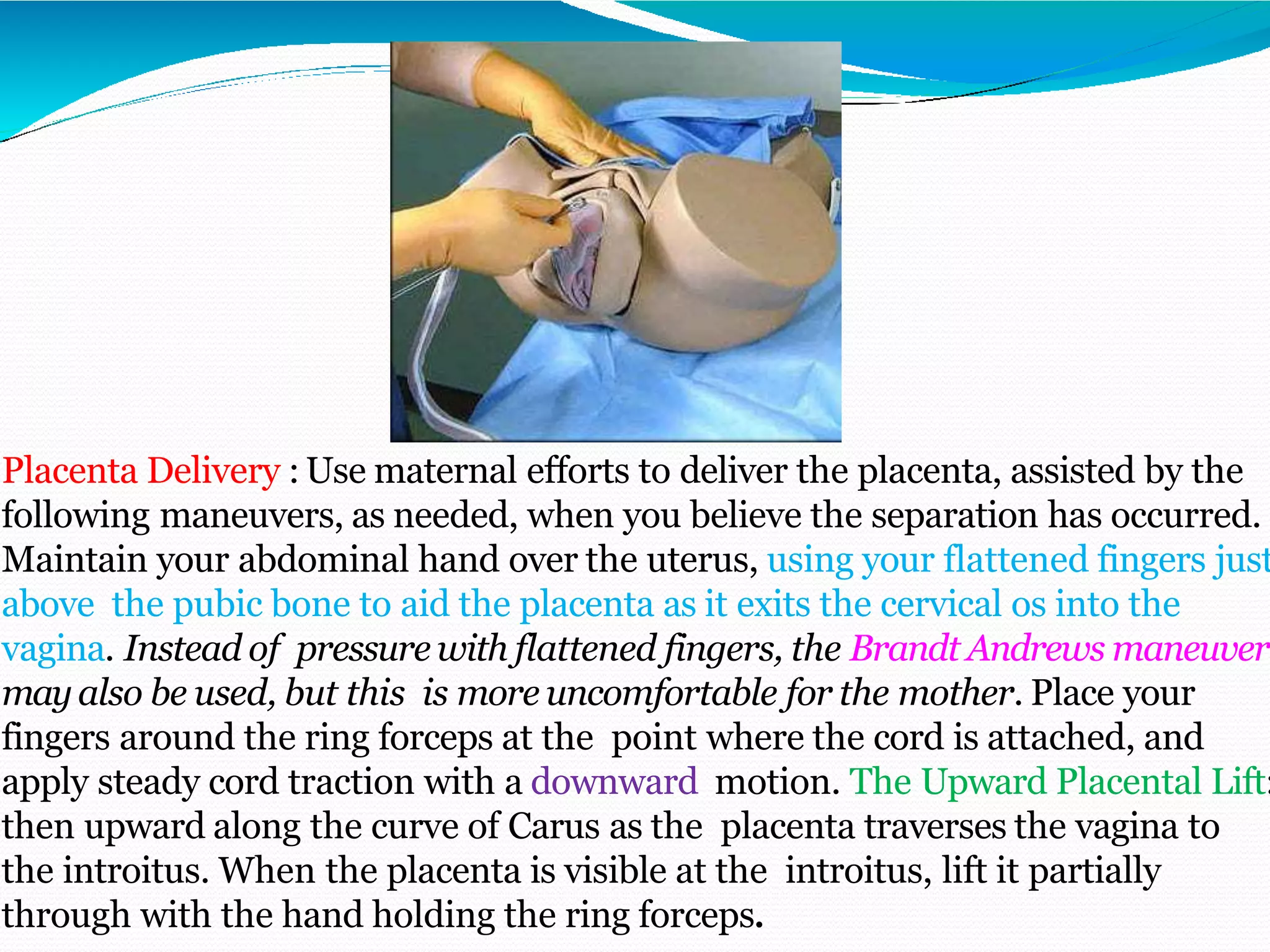
Placenta Delivery : Use maternal efforts to deliver the placenta, assisted by the
following maneuvers, as needed, when you believe the separation has occurred.
Maintain your abdominal hand over the uterus, using your flattened fingers just
above the pubic bone to aid the placenta as it exits the cervical os into the
vagina. Instead of pressure with flattened fingers, the Brandt Andrews maneuver
mayalso be used, but this is more uncomfortable for the mother. Place your
fingers around the ring forceps at the point where the cord is attached, and
apply steady cord traction with a downward motion. The Upward Placental Lift:
then upward along the curve of Carus as the placenta traverses the vagina to
the introitus. When the placenta is visible at the introitus, lift it partially
through with the hand holding the ring forceps.
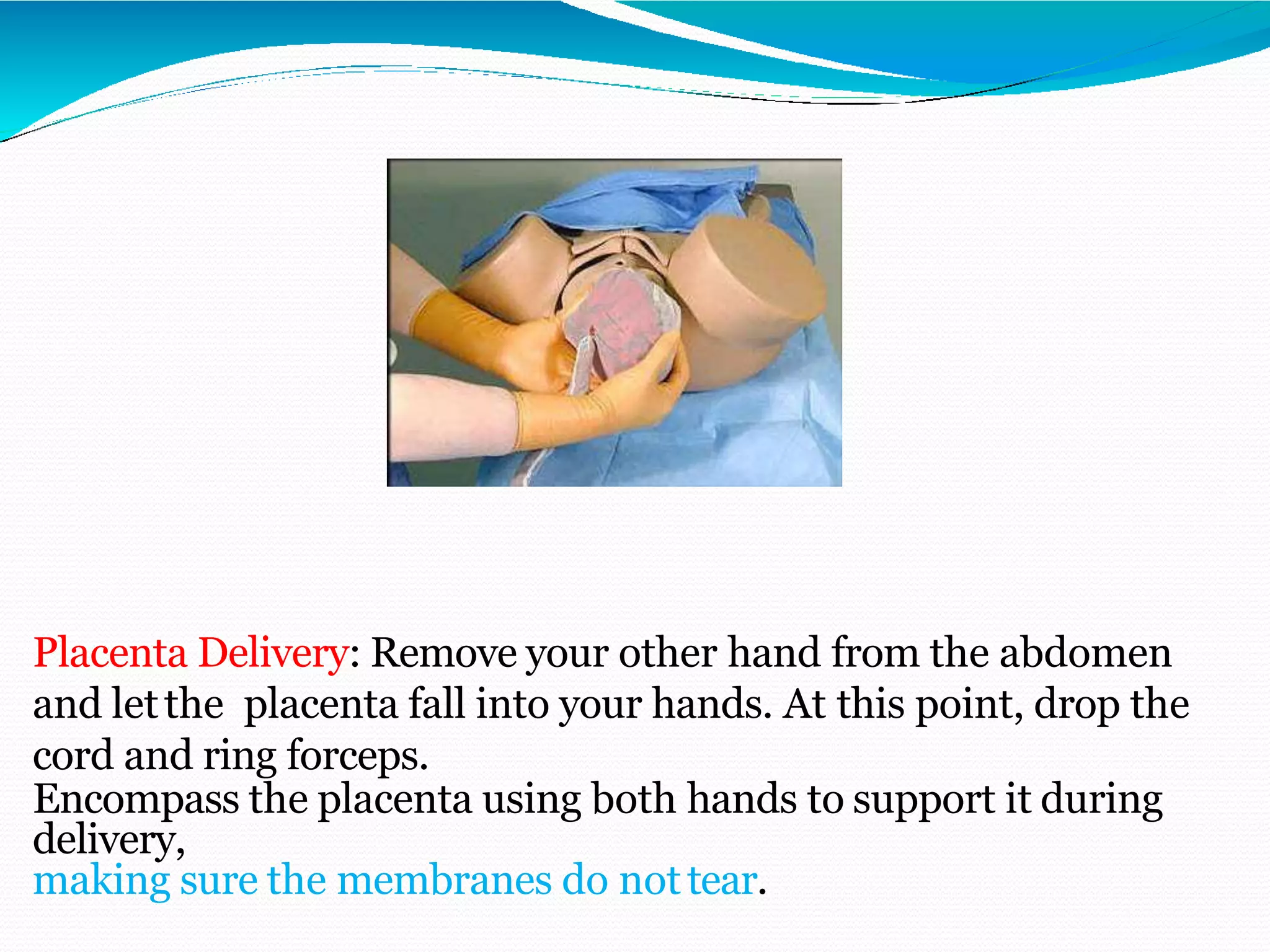
Placenta Delivery: Remove your other hand from the abdomen
and letthe placenta fall into your hands. At this point, drop the
cord and ring forceps.
Encompass the placenta using both hands to support it during
delivery,
making sure the membranes do nottear.
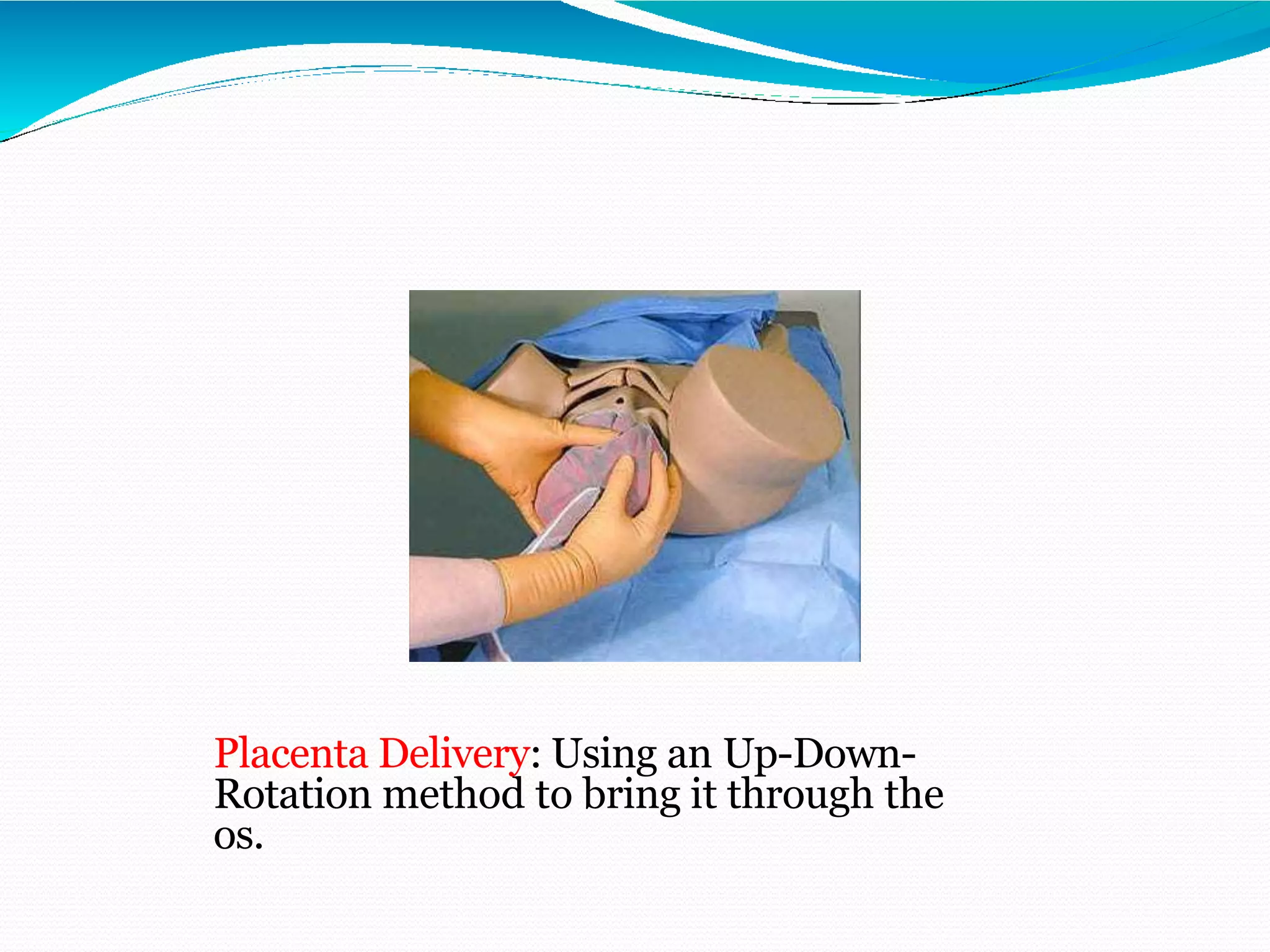
Placenta Delivery: Using an Up-Down-
Rotation method to bring it through the
os.
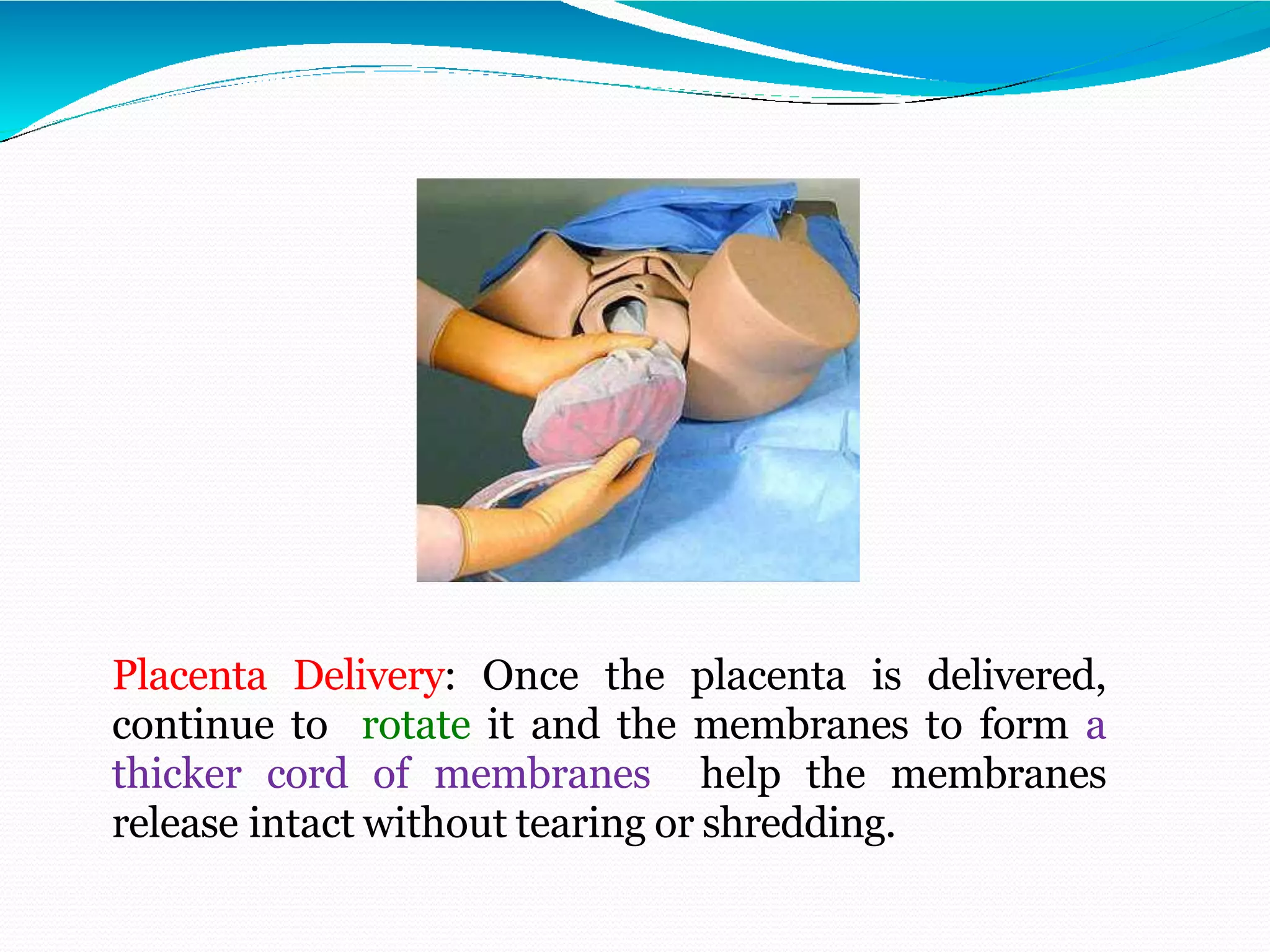
Placenta Delivery: Once the placenta is delivered,
continue to rotate it and the membranes to form a
thicker cord of membranes help the membranes
release intact without tearing or shredding.
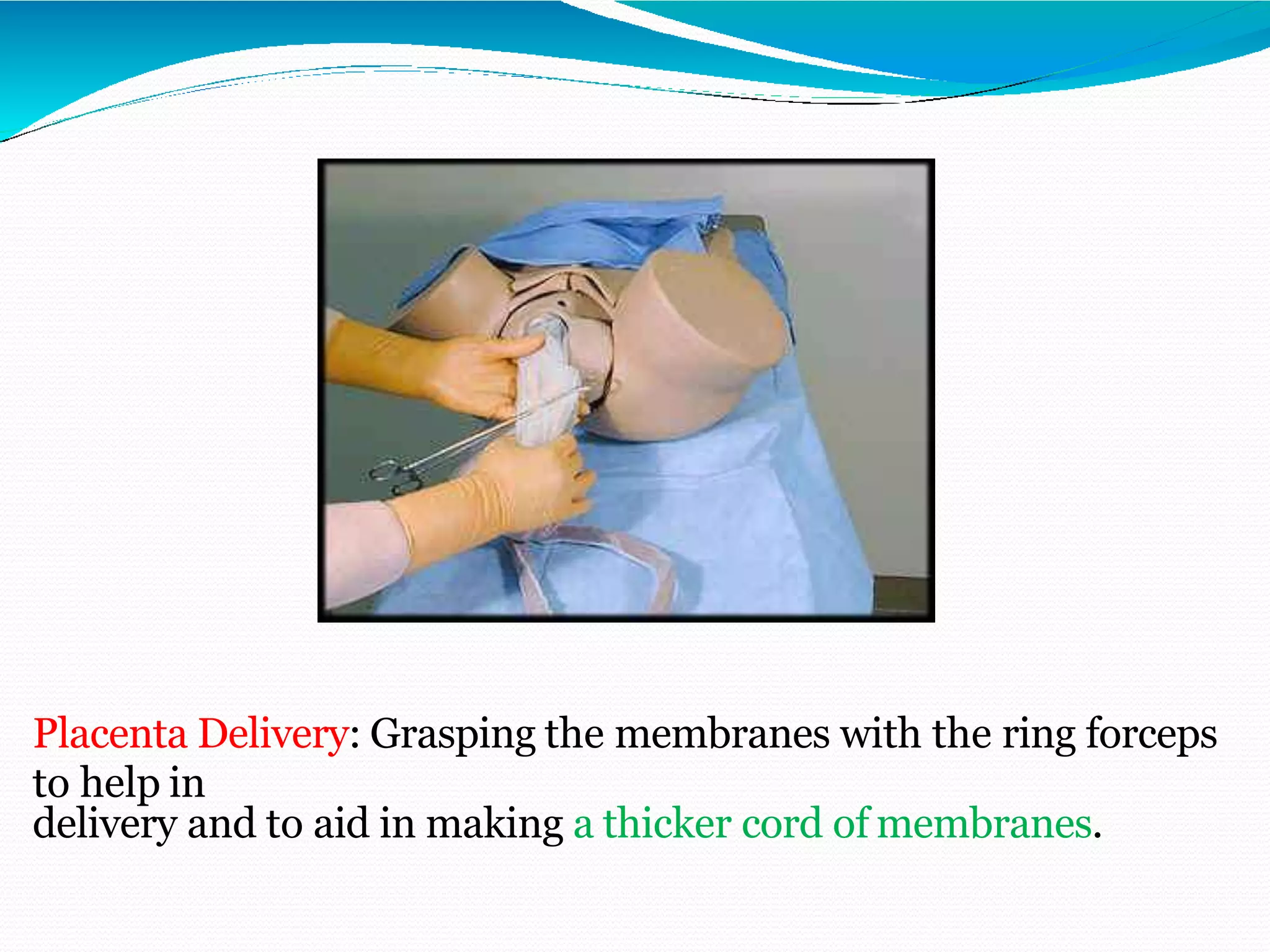
Placenta Delivery: Grasping the membranes with the ring forceps
to help in
delivery and to aid in making a thicker cord of membranes.
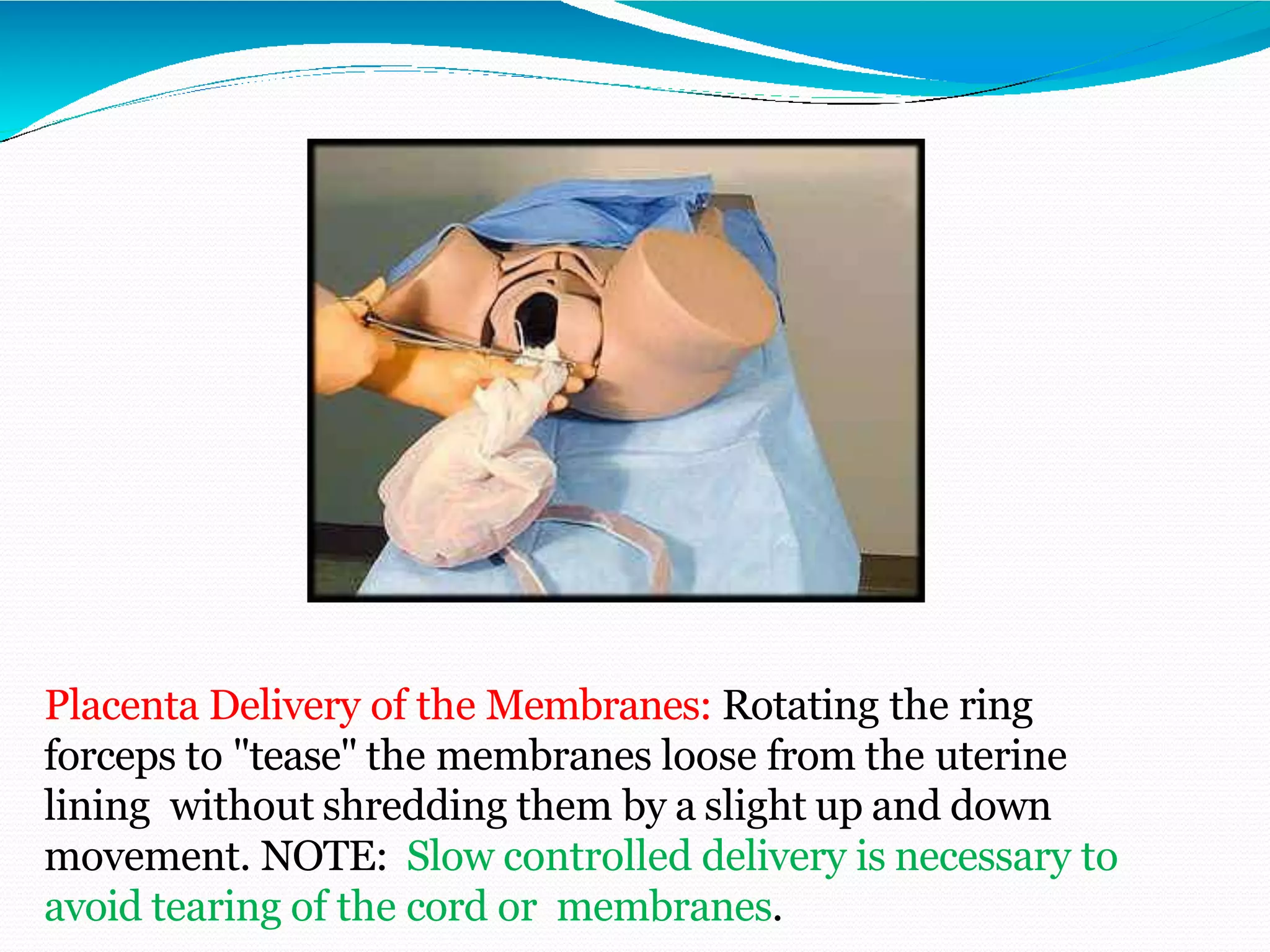
Placenta Delivery of the Membranes: Rotating the ring
forceps to "tease" the membranes loose from the uterine
lining without shredding them by a slight up and down
movement. NOTE: Slow controlled delivery is necessary to
avoid tearing of the cord or membranes.
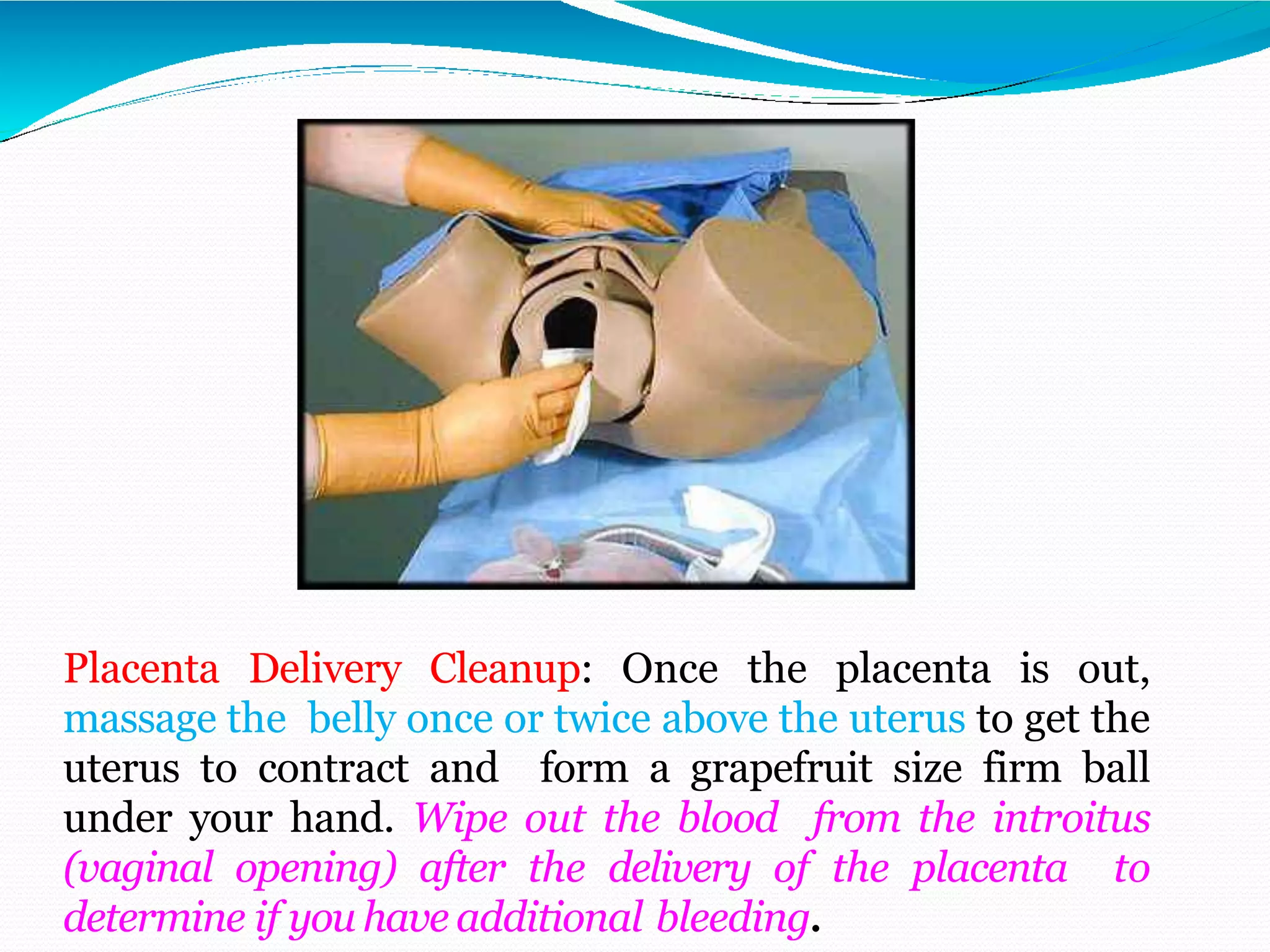
Placenta Delivery Cleanup: Once the placenta is out,
massage the belly once or twice above the uterus to get the
uterus to contract and form a grapefruit size firm ball
under your hand. Wipe out the blood from the introitus
(vaginal opening) after the delivery of the placenta to
determine if you have additional bleeding.
Rapid infusion of intravenous oxytocin
(10units) upon delivery of the
anterior shoulder (to limit the risk of
shoulderdystocia).
After delivery of the baby and when
signs of placental separationareevident,
we employ the Brandt maneuver andput
gentle traction on the umbilical cord to
facilitate delivery of the placenta.
Perform manual uterine massage and
continue the oxytocin infusion after
delivery of the placenta
PRACTICALLY
Anteriorshoulder
delivered
Rapid synyto
infusion
Signs of placental
separation
Brandt-Andrew
Placenta completely
delivered
Manual uterine
massage
Fundal pressure maneuver
The fundus is pushed downward and backward
after placing 4 fingers behind the fundus and the
thumb in front using the uterus as a sort of piston.
Pressure must be given only when the uterus
becomes hard.
Uterus is massaged to make it hard, which
facilitates expulsion of retained clots if any.
Hemorrhage
Uterine inversion
Retained placenta
Major complications of the third stage of labor
Management of 3rd stage of labor

Management of 3rd stage of labor

  • 1.
  • 2.
    LABOR Series of eventsthat take place in the genital organs in an effort to expel the viable product of conception (fetus, placenta and the membranes) out of the womb, through the vagina into the outer world is called labor.
  • 4.
    The third stageof labor ----- interval from the deliveryof the babyto the separation andexpulsion of the placenta Normally the delivery of placenta will take about5-10 minutes after delivery of the baby regardless of theparity The major complication associated with this period is postpartum hemorrhage (PPH)---- the most common cause of maternal morbidity andmortality in developing countries.
  • 5.
    THIRD STAGE PHYSIOLOGY Normalplacental separation Placental separation occurs due to shearing of the placental surface when the uterus contracts after the infant isdelivered
  • 6.
    After delivery of thebaby Decrease in sizeof the uterine cavity Uterinecontraction Marked decreased placental site Marked decreased placental site The placenta cannot decrease in size as theattached placental site Uterine contraction Decrease in sizeof the uterine cavity Placenta is rigid and inelastic
  • 7.
    cause cleavage The placentacannot decrease in size as the attached placental site Tearing of spongiosa layer of decidua basalis Damage of decidual vessels forming retroplacental hematoma Shearing force cause cleavage
  • 8.
    Placental separation Strong uterine contraction Spiral arterioles collapsed Veincollapsed Hemostasis Pooruterine contraction Bleeding from spiral arterioles and veins PPH Uterine atony Incomplete separation of placenta Thirdstageoflabor
  • 9.
    Principles in themanagement of third stage of labor to prevent PPH Rapid and complete separation of placenta Prevent from PPH Strong uterine contraction Occlude spiral arterioles andveins Stop bleeding Uterotonic drugs
  • 10.
    Uterine contractions playthe majorrole Placental separation takes place in spongiosa layer…..( decidua basalis) Placental separation from the placental site
  • 11.
    the uterus(placental site) Placentaseparates from the uterus(placental site ) Lower uterine cavity or upper vagina Complete delivery from the vagina Moreuterine contractions Steps of placental delivery
  • 12.
    Gush of blood(VULVA SIGN) Does not signify complete separation Lengthening of the umbilical cord (CORD SIGN) Uterine fundus palpable beyond the umbilicus Uterus become round in shape Signs of placental separation
  • 13.
    Vulva sign meansonly placental separation is going on but does not signify complete separation Cord lengthens for more than 3inches (8-10cms) When pushing the uterus upward the cord will not follow Tests for complete placental separation
  • 14.
    Spontaneous uterine contractions, Downwardpressure from the developing retroplacental hematoma An increase in maternal intraabdominal pressure Placental expulsion follows as a result of
  • 15.
  • 16.
  • 18.
  • 19.
  • 20.
    Longer duration----more PPH Average5-6 mins 90% placenta delivered in 15 mins 97% in 30 mins Preterm---longer duration Retained placenta---more likely in very early GA Duration of the third stage of labor
  • 21.
    Expectant management MANAGEMENT OFTHIRD STAGE OF LABOR Expectant management Spontaneous delivery of the placenta without the useof uterotonic agents or cordtraction Delivered by maternal expulsive force and gravitational force The placenta may be incomplete separated or entrapped inthe lower uterine segment or upper vagina Takes more time More bleeding
  • 22.
    Active management Early cordclamping Administration of a uterotonic agent prior to placenta separation. Controlled cord traction Uterine massage Reduced risks of maternal blood loss MANAGEMENT OF THIRD STAGEOF LABOR Urinary bladder should be emptied in all cases
  • 23.
    Administration of auterotonic agent is recommended during the third stage to reduce maternal blood loss Uterotonic agents should not be given until after delivery of the anterior fetal shoulder toensure that shoulder dystocia is notexacerbated. The clinician should also be certain that there is no undiagnosed and undelivered twin
  • 24.
    DRUGS USED FORACTIVEMANAGEMENT Methergine Oxytocin
  • 25.
    There are insufficientdata to determinewhether administration of the uterotonic agent is more effective If it is given after delivery of the anterior shoulderbut before separation of the placenta Or immediately upon expulsion of theplacenta
  • 26.
    Maneuver to facilitateplacentaldelivery Brandt-Andrews maneuver Controlled cord traction (recommended by WHO) Fundal Pressure
  • 27.
  • 28.
    After birth ofbaby, the cord stops pulsating and is cut, severing the baby from the mother. Follow the cord and grasps it at the vaginal opening, taking up any cord slack, pulling it straight out the vaginalopening
  • 29.
    A large ringforceps is clamped onto the cord at the entrance to the vagina and let it hang down by its own weight
  • 30.
    Checking for placentalseparation and release along with uterine tone and contraction by placing a hand on the uterus. Do not massage the uterus. Allow it to contract on its own. When the uterus contracts, it will form a hard globular ball which rises slightly under your hand. Tell the mother to let you know when she begins to have contractions again Do not massage the uterus
  • 31.
    Checking placental separationand release from the uterus by placing a hand on the uterus and using the other hand for cord traction. Uterine firmness is noted.
  • 32.
    Cord traction isapplied, using the ring forceps to obtain a firm hold (the cord is very slippery), taunt traction is done, pulling gently but firmly away from the vagina. The mother should be having contractions at this point. There is usually a little gush of blood as the placenta begins to pull away from the uterine wall. Placenta separation maybe apparent bythe increasing cord length between the forceps and the vaginal opening.
  • 33.
    Placenta Delivery: Controlledcord traction. Have the mother begin pushing with her contractions. If there is a gush of blood and lengthening of the cord, have the mother push whetheror not there is a contraction.
  • 34.
    Placenta Delivery: Usingone hand to apply suprapubic pressure against the fundus of the uterus with your cupped hand, and your thumb placed just above the pubic bone to keep the uterus from entering the pelvis and causing spurious cord lengthening or other false evidence of separation, or even inverting the uterus. Provide some steady cord traction to not whether there is a sense of "give" as the placenta moves into the vagina and the cord lengthens, or conversely, does not progress, in which case cease your maneuvers and wait. If you are uncertain whether the placenta has actually separated, you may follow the cord with your hand in the vagina, up to the cervix, to determine if the placenta is trapped in the cervical os, or whether the cord disappears into the uterus.
  • 35.
    There is nohurry to deliver theplacenta It is normal and safe, if there is no bleeding, to wait up to an hour, checking for separation periodically The placenta has been known to stay attached to the uterine wall for days after a delivery. If this occurs because there is acreta, this is the safe state until the problem can be evaluated more completely. In the absence of heavy bleeding
  • 36.
    If the placentahas separated without your knowledge and it is not delivered , then the uterus may be silently filling with blood. This is another reason for keeping your abdominal hand over the uterus at all times until the delivery of the placenta is imminent at theintroitus
  • 37.
    Placenta Delivery :Use maternal efforts to deliver the placenta, assisted by the following maneuvers, as needed, when you believe the separation has occurred. Maintain your abdominal hand over the uterus, using your flattened fingers just above the pubic bone to aid the placenta as it exits the cervical os into the vagina. Instead of pressure with flattened fingers, the Brandt Andrews maneuver mayalso be used, but this is more uncomfortable for the mother. Place your fingers around the ring forceps at the point where the cord is attached, and apply steady cord traction with a downward motion. The Upward Placental Lift: then upward along the curve of Carus as the placenta traverses the vagina to the introitus. When the placenta is visible at the introitus, lift it partially through with the hand holding the ring forceps.
  • 38.
    Placenta Delivery: Removeyour other hand from the abdomen and letthe placenta fall into your hands. At this point, drop the cord and ring forceps. Encompass the placenta using both hands to support it during delivery, making sure the membranes do nottear.
  • 39.
    Placenta Delivery: Usingan Up-Down- Rotation method to bring it through the os.
  • 40.
    Placenta Delivery: Oncethe placenta is delivered, continue to rotate it and the membranes to form a thicker cord of membranes help the membranes release intact without tearing or shredding.
  • 41.
    Placenta Delivery: Graspingthe membranes with the ring forceps to help in delivery and to aid in making a thicker cord of membranes.
  • 42.
    Placenta Delivery ofthe Membranes: Rotating the ring forceps to "tease" the membranes loose from the uterine lining without shredding them by a slight up and down movement. NOTE: Slow controlled delivery is necessary to avoid tearing of the cord or membranes.
  • 43.
    Placenta Delivery Cleanup:Once the placenta is out, massage the belly once or twice above the uterus to get the uterus to contract and form a grapefruit size firm ball under your hand. Wipe out the blood from the introitus (vaginal opening) after the delivery of the placenta to determine if you have additional bleeding.
  • 44.
    Rapid infusion ofintravenous oxytocin (10units) upon delivery of the anterior shoulder (to limit the risk of shoulderdystocia). After delivery of the baby and when signs of placental separationareevident, we employ the Brandt maneuver andput gentle traction on the umbilical cord to facilitate delivery of the placenta. Perform manual uterine massage and continue the oxytocin infusion after delivery of the placenta PRACTICALLY Anteriorshoulder delivered Rapid synyto infusion Signs of placental separation Brandt-Andrew Placenta completely delivered Manual uterine massage
  • 45.
    Fundal pressure maneuver Thefundus is pushed downward and backward after placing 4 fingers behind the fundus and the thumb in front using the uterus as a sort of piston. Pressure must be given only when the uterus becomes hard. Uterus is massaged to make it hard, which facilitates expulsion of retained clots if any.
  • 47.
    Hemorrhage Uterine inversion Retained placenta Majorcomplications of the third stage of labor