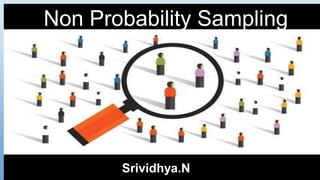
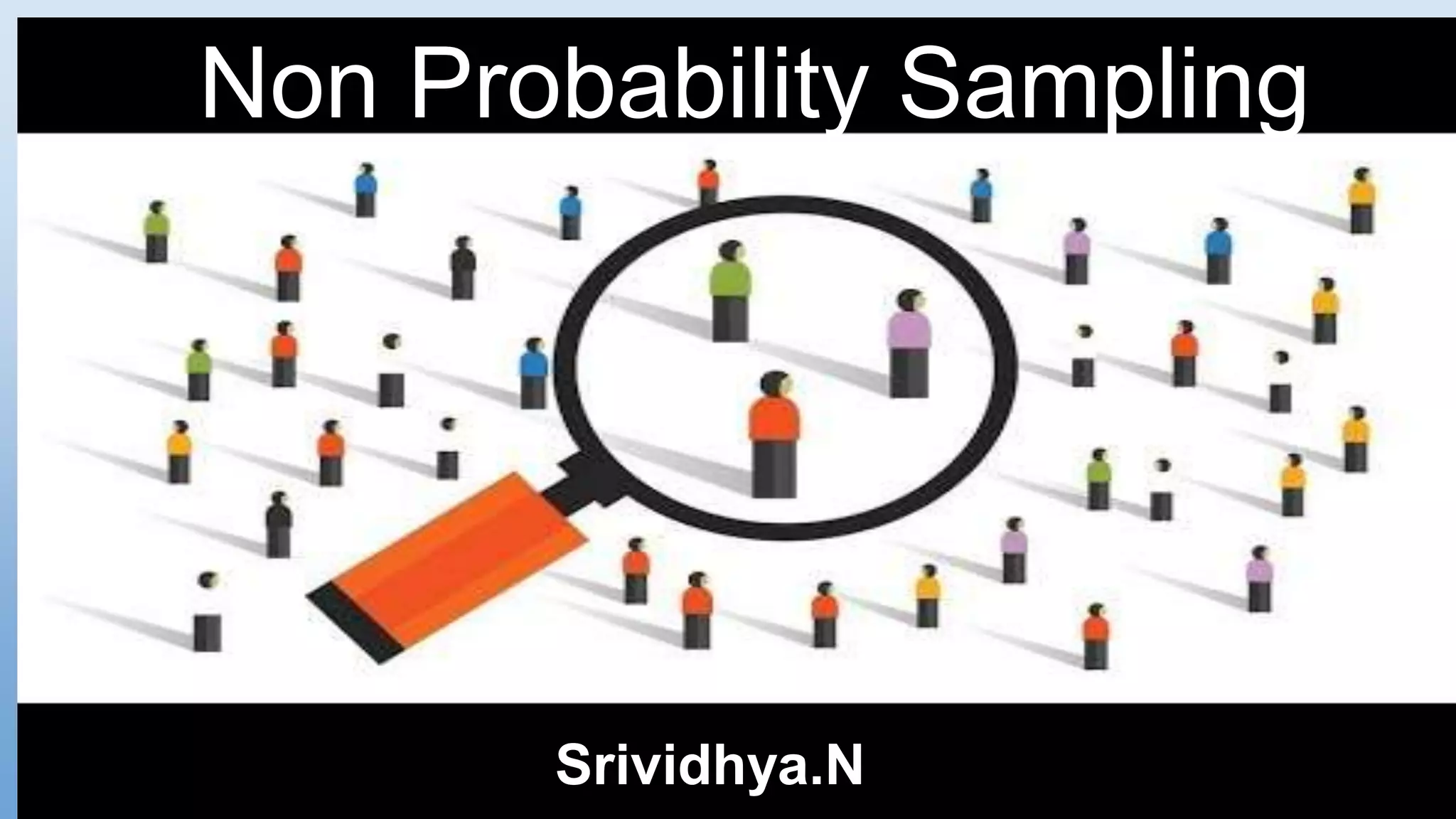
Non Probability Sampling
Srividhya.N
Introduction
Generally it is believed that non random methods of sampling are more likely to
produce lot of bias. But in nursing research most of the time non random sampling
techniques are used.
Definition
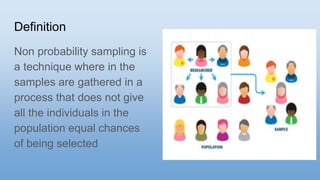
Non probability sampling is
a technique where in the
samples are gathered in a
process that does not give
all the individuals in the
population equal chances
of being selected
Features
● No equal chance for participation
● Time limitation in studies may affect probability sampling
technique
● Subjects are selected on the basis of purpose and availability
● Cannot be used in generalization
Uses
● Study related to particular trait
● Used in qualitative,exploratory or Pilot study
● Used when random sampling method is not possible
● Used when the researcher has limited budget
Types of non probability sampling method
● Purposive sampling
● Convenience sampling
● Volunteer sampling
● Consecutive sampling
● Quota sampling
● Snowball sampling
● Genealogy sampling
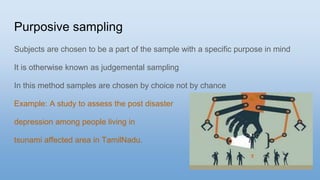
Purposive sampling
Subjects are chosen to be a part of the sample with a specific purpose in mind
It is otherwise known as judgemental sampling
In this method samples are chosen by choice not by chance
Example: A study to assess the post disaster
depression among people living in
tsunami affected area in TamilNadu.
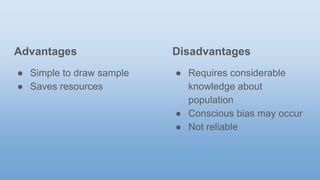
Advantages
● Simple to draw sample
● Saves resources
Disadvantages
● Requires considerable
knowledge about
population
● Conscious bias may occur
● Not reliable
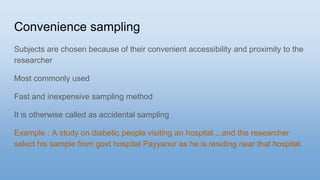
Convenience sampling
Subjects are chosen because of their convenient accessibility and proximity to the
researcher
Most commonly used
Fast and inexpensive sampling method
It is otherwise called as accidental sampling
Example : A study on diabetic people visiting an hospital....and the researcher
select his sample from govt hospital Payyanur as he is residing near that hospital.
Hey , are you
willing to join
the study?
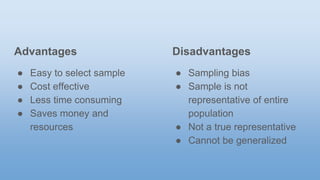
Advantages
● Easy to select sample
● Cost effective
● Less time consuming
● Saves money and
resources
Disadvantages
● Sampling bias
● Sample is not
representative of entire
population
● Not a true representative
● Cannot be generalized
Volunteer sampling
Target subjects are informed through mass media to participate in study
and interested participants may voluntarily contact researcher.
Example: The researcher if
interested to assess the
effectiveness of a selected
yoga technique in
hypertension.
So she gives an advertisement
for participation in scheduled
yoga classes and does pre
and post assessment
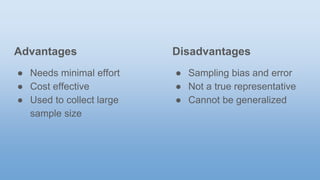
Advantages
● Needs minimal effort
● Cost effective
● Used to collect large
sample size
Disadvantages
● Sampling bias and error
● Not a true representative
● Cannot be generalized
Consecutive sampling
Picks up all the available subjects who are meeting the preset inclusion and
exclusion criteria
Also known as enumerative sampling
Similar to convenient sampling technique
One of the best in non random sampling method
Example: A researcher want to study a lifestyle of patients with post coronary
catheterization , he will select all patients admitted during a month in particular
hospital.
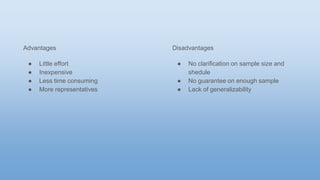
Advantages
● Little effort
● Inexpensive
● Less time consuming
● More representatives
Disadvantages
● No clarification on sample size and
shedule
● No guarantee on enough sample
● Lack of generalizability
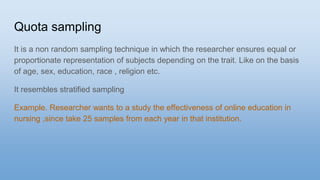
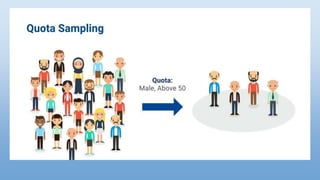
Quota sampling
It is a non random sampling technique in which the researcher ensures equal or
proportionate representation of subjects depending on the trait. Like on the basis
of age, sex, education, race , religion etc.
It resembles stratified sampling
Example. Researcher wants to a study the effectiveness of online education in
nursing ,since take 25 samples from each year in that institution.
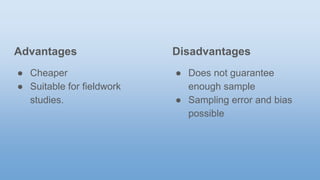
Advantages
● Cheaper
● Suitable for fieldwork
studies.
Disadvantages
● Does not guarantee
enough sample
● Sampling error and bias
possible
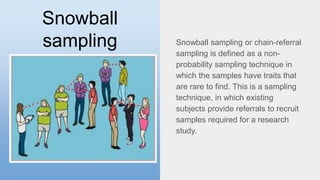
Snowball
sampling Snowball sampling or chain-referral
sampling is defined as a non-
probability sampling technique in
which the samples have traits that
are rare to find. This is a sampling
technique, in which existing
subjects provide referrals to recruit
samples required for a research
study.
Types
Linear snowball :
In linear sampling it starts with one person and that person bring one sample and
it goes till the researcher gets enough sample size
Exponential snowball sampling:
In this type one sample refer two or many samples at a time till the achieved
sample size met.
Advantages
● Quicker to find sample
● Coast effective
● Sample hesitant subjects
Disadvantages
● Sampling bias
● Lack of cooperation
Genealogy Sampling
It is a sampling method in which a entire family or lineages are involved in
research
This sampling method is commonly used to study hereditary or genetic
abnormalities
Example: The researcher is interested to study presence
of oncology disease in a family and so he will select
All the members in that family.
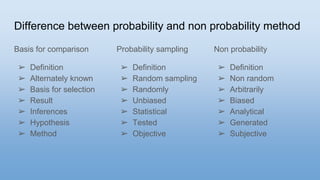
Difference between probability and non probability method
Basis for comparison
➢ Definition
➢ Alternately known
➢ Basis for selection
➢ Result
➢ Inferences
➢ Hypothesis
➢ Method
Probability sampling
➢ Definition
➢ Random sampling
➢ Randomly
➢ Unbiased
➢ Statistical
➢ Tested
➢ Objective
Non probability
➢ Definition
➢ Non random
➢ Arbitrarily
➢ Biased
➢ Analytical
➢ Generated
➢ Subjective
Summary
Non probability sampling method
● Purposive sampling
● Convenience sampling
● Volunteer sampling
● Consecutive sampling
● Quota sampling
● Snowball sampling
● Genealogy sampling
Thank you
Subscribe and share for more
videos

Non probability sampling process

  • 1.
  • 2.
    Introduction Generally it isbelieved that non random methods of sampling are more likely to produce lot of bias. But in nursing research most of the time non random sampling techniques are used.
  • 3.
    Definition Non probability samplingis a technique where in the samples are gathered in a process that does not give all the individuals in the population equal chances of being selected
  • 4.
    Features ● No equalchance for participation ● Time limitation in studies may affect probability sampling technique ● Subjects are selected on the basis of purpose and availability ● Cannot be used in generalization
  • 5.
    Uses ● Study relatedto particular trait ● Used in qualitative,exploratory or Pilot study ● Used when random sampling method is not possible ● Used when the researcher has limited budget
  • 6.
    Types of nonprobability sampling method ● Purposive sampling ● Convenience sampling ● Volunteer sampling ● Consecutive sampling ● Quota sampling ● Snowball sampling ● Genealogy sampling
  • 7.
    Purposive sampling Subjects arechosen to be a part of the sample with a specific purpose in mind It is otherwise known as judgemental sampling In this method samples are chosen by choice not by chance Example: A study to assess the post disaster depression among people living in tsunami affected area in TamilNadu.
  • 8.
    Advantages ● Simple todraw sample ● Saves resources Disadvantages ● Requires considerable knowledge about population ● Conscious bias may occur ● Not reliable
  • 9.
    Convenience sampling Subjects arechosen because of their convenient accessibility and proximity to the researcher Most commonly used Fast and inexpensive sampling method It is otherwise called as accidental sampling Example : A study on diabetic people visiting an hospital....and the researcher select his sample from govt hospital Payyanur as he is residing near that hospital.
  • 10.
    Hey , areyou willing to join the study?
  • 11.
    Advantages ● Easy toselect sample ● Cost effective ● Less time consuming ● Saves money and resources Disadvantages ● Sampling bias ● Sample is not representative of entire population ● Not a true representative ● Cannot be generalized
  • 12.
    Volunteer sampling Target subjectsare informed through mass media to participate in study and interested participants may voluntarily contact researcher.
  • 13.
    Example: The researcherif interested to assess the effectiveness of a selected yoga technique in hypertension. So she gives an advertisement for participation in scheduled yoga classes and does pre and post assessment
  • 14.
    Advantages ● Needs minimaleffort ● Cost effective ● Used to collect large sample size Disadvantages ● Sampling bias and error ● Not a true representative ● Cannot be generalized
  • 15.
    Consecutive sampling Picks upall the available subjects who are meeting the preset inclusion and exclusion criteria Also known as enumerative sampling Similar to convenient sampling technique One of the best in non random sampling method Example: A researcher want to study a lifestyle of patients with post coronary catheterization , he will select all patients admitted during a month in particular hospital.
  • 16.
    Advantages ● Little effort ●Inexpensive ● Less time consuming ● More representatives Disadvantages ● No clarification on sample size and shedule ● No guarantee on enough sample ● Lack of generalizability
  • 17.
    Quota sampling It isa non random sampling technique in which the researcher ensures equal or proportionate representation of subjects depending on the trait. Like on the basis of age, sex, education, race , religion etc. It resembles stratified sampling Example. Researcher wants to a study the effectiveness of online education in nursing ,since take 25 samples from each year in that institution.
  • 19.
    Advantages ● Cheaper ● Suitablefor fieldwork studies. Disadvantages ● Does not guarantee enough sample ● Sampling error and bias possible
  • 20.
    Snowball sampling Snowball samplingor chain-referral sampling is defined as a non- probability sampling technique in which the samples have traits that are rare to find. This is a sampling technique, in which existing subjects provide referrals to recruit samples required for a research study.
  • 22.
    Types Linear snowball : Inlinear sampling it starts with one person and that person bring one sample and it goes till the researcher gets enough sample size Exponential snowball sampling: In this type one sample refer two or many samples at a time till the achieved sample size met.
  • 23.
    Advantages ● Quicker tofind sample ● Coast effective ● Sample hesitant subjects Disadvantages ● Sampling bias ● Lack of cooperation
  • 24.
    Genealogy Sampling It isa sampling method in which a entire family or lineages are involved in research This sampling method is commonly used to study hereditary or genetic abnormalities Example: The researcher is interested to study presence of oncology disease in a family and so he will select All the members in that family.
  • 25.
    Difference between probabilityand non probability method Basis for comparison ➢ Definition ➢ Alternately known ➢ Basis for selection ➢ Result ➢ Inferences ➢ Hypothesis ➢ Method Probability sampling ➢ Definition ➢ Random sampling ➢ Randomly ➢ Unbiased ➢ Statistical ➢ Tested ➢ Objective Non probability ➢ Definition ➢ Non random ➢ Arbitrarily ➢ Biased ➢ Analytical ➢ Generated ➢ Subjective
  • 26.
    Summary Non probability samplingmethod ● Purposive sampling ● Convenience sampling ● Volunteer sampling ● Consecutive sampling ● Quota sampling ● Snowball sampling ● Genealogy sampling
  • 27.
    Thank you Subscribe andshare for more videos