SHEFEENA.K.M
M.Ed STUDENT
NSS TRAINING COLLEGE
OTTAPALAM
Sampling
Measuring a small portion of something and then
making a general statement about the whole
thing.
 Process of selecting a number of units for a
study in such a way that the units represent
the larger group from which they are selected.
Sampling is a process of collection of data.
Sampling is a good representative of the
population.
Techniques
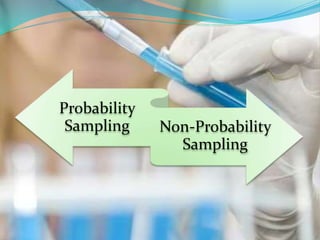
Probability
Sampling Non-Probability
Sampling
Probability Sampling
Non-Probability sampling
Characteristics
 There is no idea of population.
 There is no probability of selecting any
individual.
 It has free distribution.
 The observations are not used for
generalization purpose.
 Non-parametric or non-inferential statistics
are used.
 There is no risk for drawing conclusions.
Non-Probability Sampling
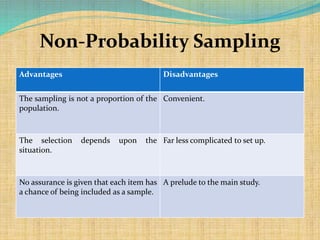
Advantages Disadvantages
The sampling is not a proportion of the
population.
Convenient.
The selection depends upon the
situation.
Far less complicated to set up.
No assurance is given that each item has
a chance of being included as a sample.
A prelude to the main study.
Types
Purposive sampling
 Start with a purpose in mind.
 The sample is selected to include people of
interest.
 Exclude those who do not suit the purpose.
 Samples are chosen well, based on a certain
criterion.
 There is assurance of quality responses.
 Biased selection of samples may occur.
 Time-consuming process.
Convenience sampling
 Samples most available are chosen.
 Samples are familiar to the researcher.
 Saves time, money and effort.
 Easy data collection through a known group or
class. Examples are friends, co-workers etc.
 No accurate way to assess representativeness of
samples.
 Possible restrictions of generalization about the
study findings.
Quota sampling
 A quota is established.
 There is freedom to choose any respondent as long as
the quota is met.
 Subjects are recruited as they arrive and the
researcher will assign them to demographic groups
based on variables like age, gender or educational
background.
 Each stratum is generally represented.
 Time-consuming.
Snowball sampling
 Is done with the help of study subjects to choose
other potential subjects.
 A useful tool for building networks and
increasing the number of participants.
 Very good for locating people of specific
population.
 Can quickly find people who are experts on a
field.
 Heavily reliant on skill of the individual.
 A time consuming process.
Conclusion
On the basis of sample study, we can predict
and generalize the behavior of the population.
Most researchers come to a conclusion of their
study by studying a small sample from the
huge population or universe. It is widely used
in qualitative research.
Non probability sampling

Non probability sampling

  • 1.
  • 2.
  • 3.
    Measuring a smallportion of something and then making a general statement about the whole thing.
  • 4.
     Process ofselecting a number of units for a study in such a way that the units represent the larger group from which they are selected. Sampling is a process of collection of data. Sampling is a good representative of the population.
  • 5.
  • 6.
  • 7.
  • 8.
  • 9.
  • 10.
     There isno idea of population.  There is no probability of selecting any individual.  It has free distribution.  The observations are not used for generalization purpose.  Non-parametric or non-inferential statistics are used.  There is no risk for drawing conclusions.
  • 11.
    Non-Probability Sampling Advantages Disadvantages Thesampling is not a proportion of the population. Convenient. The selection depends upon the situation. Far less complicated to set up. No assurance is given that each item has a chance of being included as a sample. A prelude to the main study.
  • 12.
  • 13.
  • 14.
     Start witha purpose in mind.  The sample is selected to include people of interest.  Exclude those who do not suit the purpose.  Samples are chosen well, based on a certain criterion.  There is assurance of quality responses.  Biased selection of samples may occur.  Time-consuming process.
  • 15.
  • 16.
     Samples mostavailable are chosen.  Samples are familiar to the researcher.  Saves time, money and effort.  Easy data collection through a known group or class. Examples are friends, co-workers etc.  No accurate way to assess representativeness of samples.  Possible restrictions of generalization about the study findings.
  • 17.
  • 18.
     A quotais established.  There is freedom to choose any respondent as long as the quota is met.  Subjects are recruited as they arrive and the researcher will assign them to demographic groups based on variables like age, gender or educational background.  Each stratum is generally represented.  Time-consuming.
  • 19.
  • 20.
     Is donewith the help of study subjects to choose other potential subjects.  A useful tool for building networks and increasing the number of participants.  Very good for locating people of specific population.  Can quickly find people who are experts on a field.  Heavily reliant on skill of the individual.  A time consuming process.
  • 21.
  • 22.
    On the basisof sample study, we can predict and generalize the behavior of the population. Most researchers come to a conclusion of their study by studying a small sample from the huge population or universe. It is widely used in qualitative research.

Editor's Notes

  • #8 Probability sampling is a sampling technique in which sample from a larger population are chosen using a method based on the theory of probability. For a participant to be considered as a probability sample, he/she must be selected using a random selection.
  • #9 Non-probability sampling is a sampling technique where the samples are gathered in a process that does not all the individuals in the population equal chances of being selected. In the absence of any idea of probability the method of sampling is known as Non-probability sampling. Non-probability sampling is a sampling technique where the samples are gathered in a process that does not all the individuals in the population equal chances of being selected. In the absence of any idea of probability the method of sampling is known as Non-probability sampling.