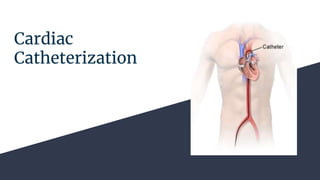
Cardiac
Catheterization
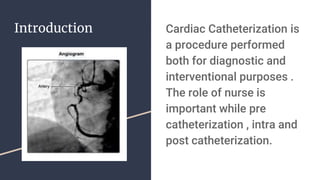
Introduction Cardiac Catheterization is
a procedure performed
both for diagnostic and
interventional purposes .
The role of nurse is
important while pre
catheterization , intra and
post catheterization.
Definition It is one of the invasive
procedure used to
visualize the heart
chambers , valves and
great vessel in order to
diagnose and treat
abnormalities of the
coronary arteries
Purpose
To analyze
Chamber
pressure
O2 saturation
Ventricular function
Valvular insufficiency
Stenosis
Septal defects
Congenital abnormalities
Myocardial infarction
Indications Both diagnostics and therapeutics
❏ Unstable angina
❏ ACS
❏ Myocardial Infarction
❏ Congenital defects
❏ Abnormal stress test
❏ Planned valve surgeries
❏ Cardiogenic shock
❏ Ventricular arrhythmias
Therapeutic ❏ Percutaneous coronary angiogram
❏ Percutaneous transluminal coronary
angioplasty
❏ Valvuloplasty
❏ Valvotomy
Contraindication
❏ Hypersensitivity to contrast medium
❏ Pregnancy
❏ Severe systemic infection
❏ Irreversible brain damage
❏ Severe heart failure
❏ Acute GI bleeding
❏ Severe hypokalemia
❏ INR more than 1.8
❏ Acute renal failure
❏ Severe Anemia
Types
RIGHT HEART CATHETERIZATION LEFT HEART CATHETERIZATION
Sites used in cardiac catheterization
Right side:
● Femoral vein
● Antecubital vein
Left heart:
● Brachial artery
● Radial artery
● Femoral artery
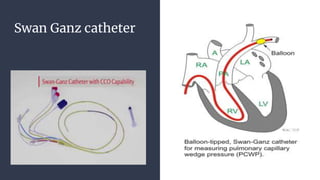
Catheters used
Swan Ganz catheter
Contrast agents
● Sodium diatrizoate
● Iohexol
● Ioversol
● Ioxaglate
Patient preparation
● Doctor’s order
● Informed consent
● Lab test CBC,ESR,Renal function, PT,INR, ECHO,X ray, Infectious markers and serology
tests
● Check for allergy to iodine and seafoods
● Skin preparation
● IV cannulation
● Placement of ECG electrodes
● Check pedal pulse and mark it .( Dorsalis pedis and Posterior tibial)
● Monitor hemodynamic status
● Keep NPO for 6 to 8 Hrs
● If creatinine above 1.5 IV fluid should be stated 6 hrs prior to angiogram
● ECG should be taken(12 lead ECG)
● Due per medications should be administered as per order( Aspirin, Clopidgrel,
Pantoprazole, Diazepam
● Empty the bladder before sending patient to cath lab
● Instruct the patient regarding procedure time and experience of hot flush during injection of
dye
● Sometime patient may have nausea and headache
● Assist the patient go wear OT dress
● Check for any implants ,dentures etc
● Handover the valuables to appropriate person
● Check and document height and weight to calculate the dose of dye or contrast media
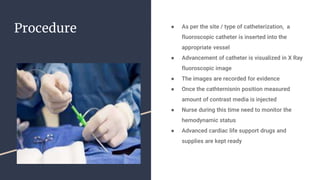
Procedure ● As per the site / type of catheterization, a
fluoroscopic catheter is inserted into the
appropriate vessel
● Advancement of catheter is visualized in X Ray
fluoroscopic image
● The images are recorded for evidence
● Once the cathternisnin position measured
amount of contrast media is injected
● Nurse during this time need to monitor the
hemodynamic status
● Advanced cardiac life support drugs and
supplies are kept ready
Procedure (contn..) ● Patient should be monitored for any cardiac
arrhythmias
● The size of the chambers, pressures are checked
as per the need
● To visualize coronary arteries the catheter is
placed in ascending aorta and the contrast is
injected into coronary arteries
● If therapeutic is indicated ,it is done accordingly
● Patient’s pedal pulse is checked frequently during
the procedure for signs of poor perfusion of the
extremity
● Once the procedure is done the catheters are
removed and pressure dressing is applied
● Patient shifted to recovery room for observation
Post procedure care
● Bedrest for 6 hours with affected extremity
● Observe the catheter site for bleeding or hematoma
● Record 12 lead ECG and correlate the findings
● Check peripheral pulses in the affected extremity every 15 mins for 1 hour and 30 mins for next hour
and every hour
● Monitor hemodynamic status continuously
● Watch for signs of complications
● Advice the patient to keep the affected leg straight for 4 to 6 hours
● Head can be elevated to 30 Degree
● Started feeding and advice to drink more fluids
● Repeat LABS if needed
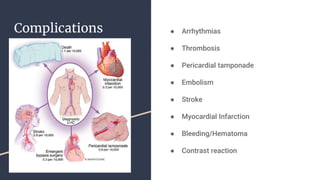
Complications ● Arrhythmias
● Thrombosis
● Pericardial tamponade
● Embolism
● Stroke
● Myocardial Infarction
● Bleeding/Hematoma
● Contrast reaction
Cardiac  catheterization

Cardiac catheterization

  • 1.
  • 2.
    Introduction Cardiac Catheterizationis a procedure performed both for diagnostic and interventional purposes . The role of nurse is important while pre catheterization , intra and post catheterization.
  • 3.
    Definition It isone of the invasive procedure used to visualize the heart chambers , valves and great vessel in order to diagnose and treat abnormalities of the coronary arteries
  • 4.
    Purpose To analyze Chamber pressure O2 saturation Ventricularfunction Valvular insufficiency Stenosis Septal defects Congenital abnormalities Myocardial infarction
  • 5.
    Indications Both diagnosticsand therapeutics ❏ Unstable angina ❏ ACS ❏ Myocardial Infarction ❏ Congenital defects ❏ Abnormal stress test ❏ Planned valve surgeries ❏ Cardiogenic shock ❏ Ventricular arrhythmias
  • 6.
    Therapeutic ❏ Percutaneouscoronary angiogram ❏ Percutaneous transluminal coronary angioplasty ❏ Valvuloplasty ❏ Valvotomy
  • 7.
    Contraindication ❏ Hypersensitivity tocontrast medium ❏ Pregnancy ❏ Severe systemic infection ❏ Irreversible brain damage ❏ Severe heart failure ❏ Acute GI bleeding ❏ Severe hypokalemia ❏ INR more than 1.8 ❏ Acute renal failure ❏ Severe Anemia
  • 8.
    Types RIGHT HEART CATHETERIZATIONLEFT HEART CATHETERIZATION
  • 9.
    Sites used incardiac catheterization Right side: ● Femoral vein ● Antecubital vein Left heart: ● Brachial artery ● Radial artery ● Femoral artery
  • 10.
  • 11.
  • 12.
    Contrast agents ● Sodiumdiatrizoate ● Iohexol ● Ioversol ● Ioxaglate
  • 13.
    Patient preparation ● Doctor’sorder ● Informed consent ● Lab test CBC,ESR,Renal function, PT,INR, ECHO,X ray, Infectious markers and serology tests ● Check for allergy to iodine and seafoods ● Skin preparation ● IV cannulation ● Placement of ECG electrodes ● Check pedal pulse and mark it .( Dorsalis pedis and Posterior tibial) ● Monitor hemodynamic status ● Keep NPO for 6 to 8 Hrs
  • 14.
    ● If creatinineabove 1.5 IV fluid should be stated 6 hrs prior to angiogram ● ECG should be taken(12 lead ECG) ● Due per medications should be administered as per order( Aspirin, Clopidgrel, Pantoprazole, Diazepam ● Empty the bladder before sending patient to cath lab ● Instruct the patient regarding procedure time and experience of hot flush during injection of dye ● Sometime patient may have nausea and headache ● Assist the patient go wear OT dress ● Check for any implants ,dentures etc ● Handover the valuables to appropriate person ● Check and document height and weight to calculate the dose of dye or contrast media
  • 15.
    Procedure ● Asper the site / type of catheterization, a fluoroscopic catheter is inserted into the appropriate vessel ● Advancement of catheter is visualized in X Ray fluoroscopic image ● The images are recorded for evidence ● Once the cathternisnin position measured amount of contrast media is injected ● Nurse during this time need to monitor the hemodynamic status ● Advanced cardiac life support drugs and supplies are kept ready
  • 16.
    Procedure (contn..) ●Patient should be monitored for any cardiac arrhythmias ● The size of the chambers, pressures are checked as per the need ● To visualize coronary arteries the catheter is placed in ascending aorta and the contrast is injected into coronary arteries ● If therapeutic is indicated ,it is done accordingly ● Patient’s pedal pulse is checked frequently during the procedure for signs of poor perfusion of the extremity ● Once the procedure is done the catheters are removed and pressure dressing is applied ● Patient shifted to recovery room for observation
  • 17.
    Post procedure care ●Bedrest for 6 hours with affected extremity ● Observe the catheter site for bleeding or hematoma ● Record 12 lead ECG and correlate the findings ● Check peripheral pulses in the affected extremity every 15 mins for 1 hour and 30 mins for next hour and every hour ● Monitor hemodynamic status continuously ● Watch for signs of complications ● Advice the patient to keep the affected leg straight for 4 to 6 hours ● Head can be elevated to 30 Degree ● Started feeding and advice to drink more fluids ● Repeat LABS if needed
  • 18.
    Complications ● Arrhythmias ●Thrombosis ● Pericardial tamponade ● Embolism ● Stroke ● Myocardial Infarction ● Bleeding/Hematoma ● Contrast reaction