
Sample and Sampling
methods
Part I
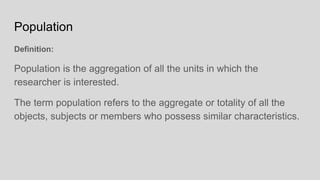
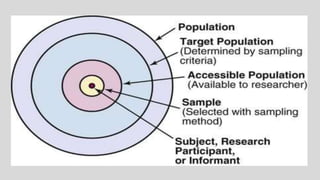
Population
Definition:
Population is the aggregation of all the units in which the
researcher is interested.
The term population refers to the aggregate or totality of all the
objects, subjects or members who possess similar characteristics.
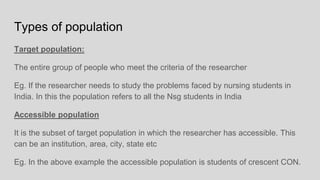
Types of population
Target population:
The entire group of people who meet the criteria of the researcher
Eg. If the researcher needs to study the problems faced by nursing students in
India. In this the population refers to all the Nsg students in India
Accessible population
It is the subset of target population in which the researcher has accessible. This
can be an institution, area, city, state etc
Eg. In the above example the accessible population is students of crescent CON.
Sample
Definition :
It is defined as a representative unit of a target population , which is to
be worked upon by researchers during their study
Sample consists of subsets of units which comprise the population
selected by investigators or researchers to participate in their research
project
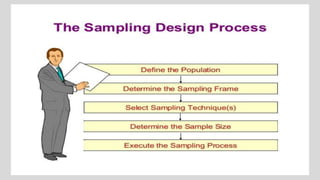
Sampling process
It is the process of selecting observations to provide an
adequate description and inferences of the population.
Sampling frame:
Listing of population from which a sample is chosen
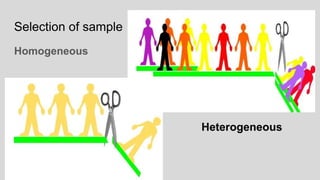
Selection of sample
Homogeneous
Heterogeneous
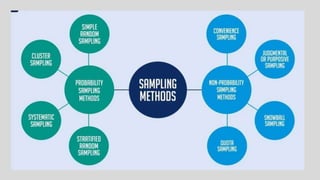
Probability sampling methods
Random selection of the elements/members of the population
In this every subject in a population has equal chance to be selected as study
sample
Features:
Equal chances of being selected
Equal opportunity for selection
Absence of both systemic and sampling bias
Complete elimination of sampling bias
Simple Random Sampling
All subsets of the frame are given an equal probability.
Methods of selection:
Lottery method:
Use of table of random numbers
Use of computer
Sampling process:
● Identify and define the population
● Determine the desired sample size
● List all members of the population
● Assign all members on the list a consecutive number
● Select an arbitrary starting point from a table of random numbers and
read the appropriate number of digits
Advantages
● Minimum knowledge of
population
● Easy to analyse data
Disadvantages
● Low frequency of use
● Does not require researcher’s
expertise
● Larger risk of random error
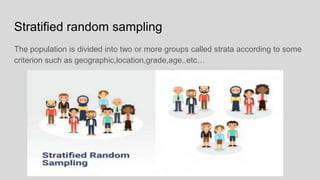
Stratified random sampling
The population is divided into two or more groups called strata according to some
criterion such as geographic,location,grade,age..etc…
Selection process
● Identify and define the population
● Determine the desired sample size
● Identify each strata
● Put the entire population in each strata
● Select equal representatives from each strata
Advantages
● Assures representation of all
group in sample population
● Characteristics of all stratum
can be estimated
● Comparisons can be made
between each stratum
Disadvantages
● Requires accurate information
on proportion of each stratum
● Stratified lists expensive to
prepare
Cluster sampling method
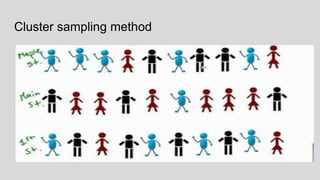
Process of randomly selecting intact groups, not defined within the defined
population sharing similar characteristics
It can be
● Neighbourhood
● School
● Districts
● Classroom
Cluster sampling method
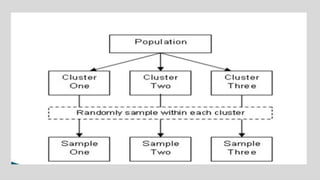
Selection process
● Identify and define the population
● Determine the desired sample size
● Identify logical cluster
● Make the whole population into different cluster
● Estimate average number per cluster
● Divide the sample size with number of cluster
● Randomly select the needed sample from each cluster
Advantages
● Can estimate the
characteristics of both
cluster and population
Disadvantages
● Expensive
● Each stage in cluster will
induce sampling error
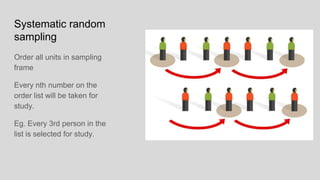
Systematic random
sampling
Order all units in sampling
frame
Every nth number on the
order list will be taken for
study.
Eg. Every 3rd person in the
list is selected for study.
Selection process
● Identify and define the population
● Make sampling frame
● Determine the desired sample
● Decide on the nth number, in which you are going to select sample
● Select according to the fraction(nth number)
● The first number can be picked randomly
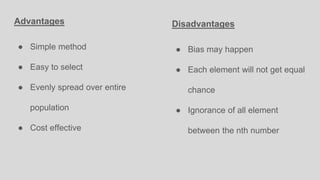
Advantages
● Simple method
● Easy to select
● Evenly spread over entire
population
● Cost effective
Disadvantages
● Bias may happen
● Each element will not get equal
chance
● Ignorance of all element
between the nth number
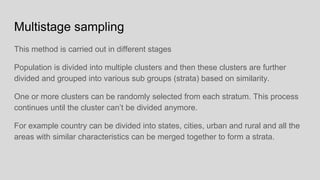
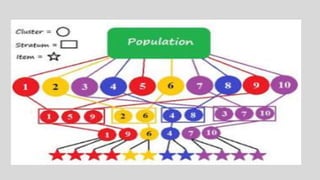
Multistage sampling
This method is carried out in different stages
Population is divided into multiple clusters and then these clusters are further
divided and grouped into various sub groups (strata) based on similarity.
One or more clusters can be randomly selected from each stratum. This process
continues until the cluster can’t be divided anymore.
For example country can be divided into states, cities, urban and rural and all the
areas with similar characteristics can be merged together to form a strata.
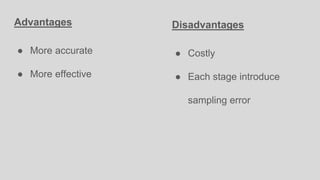
Advantages
● More accurate
● More effective
Disadvantages
● Costly
● Each stage introduce
sampling error
Summary
● Population
● Sample
● Sampling process
● Sampling type
● Probability sampling
method
● Features of probability
sampling
● Types of probability
sampling
Thank you

Sample and sampling methods

  • 1.
  • 2.
    Population Definition: Population is theaggregation of all the units in which the researcher is interested. The term population refers to the aggregate or totality of all the objects, subjects or members who possess similar characteristics.
  • 3.
    Types of population Targetpopulation: The entire group of people who meet the criteria of the researcher Eg. If the researcher needs to study the problems faced by nursing students in India. In this the population refers to all the Nsg students in India Accessible population It is the subset of target population in which the researcher has accessible. This can be an institution, area, city, state etc Eg. In the above example the accessible population is students of crescent CON.
  • 4.
    Sample Definition : It isdefined as a representative unit of a target population , which is to be worked upon by researchers during their study Sample consists of subsets of units which comprise the population selected by investigators or researchers to participate in their research project
  • 6.
    Sampling process It isthe process of selecting observations to provide an adequate description and inferences of the population. Sampling frame: Listing of population from which a sample is chosen
  • 7.
  • 10.
    Probability sampling methods Randomselection of the elements/members of the population In this every subject in a population has equal chance to be selected as study sample Features: Equal chances of being selected Equal opportunity for selection Absence of both systemic and sampling bias Complete elimination of sampling bias
  • 11.
    Simple Random Sampling Allsubsets of the frame are given an equal probability. Methods of selection: Lottery method: Use of table of random numbers Use of computer
  • 12.
    Sampling process: ● Identifyand define the population ● Determine the desired sample size ● List all members of the population ● Assign all members on the list a consecutive number ● Select an arbitrary starting point from a table of random numbers and read the appropriate number of digits
  • 13.
    Advantages ● Minimum knowledgeof population ● Easy to analyse data Disadvantages ● Low frequency of use ● Does not require researcher’s expertise ● Larger risk of random error
  • 14.
    Stratified random sampling Thepopulation is divided into two or more groups called strata according to some criterion such as geographic,location,grade,age..etc…
  • 15.
    Selection process ● Identifyand define the population ● Determine the desired sample size ● Identify each strata ● Put the entire population in each strata ● Select equal representatives from each strata
  • 16.
    Advantages ● Assures representationof all group in sample population ● Characteristics of all stratum can be estimated ● Comparisons can be made between each stratum Disadvantages ● Requires accurate information on proportion of each stratum ● Stratified lists expensive to prepare
  • 17.
    Cluster sampling method Processof randomly selecting intact groups, not defined within the defined population sharing similar characteristics It can be ● Neighbourhood ● School ● Districts ● Classroom
  • 18.
  • 20.
    Selection process ● Identifyand define the population ● Determine the desired sample size ● Identify logical cluster ● Make the whole population into different cluster ● Estimate average number per cluster ● Divide the sample size with number of cluster ● Randomly select the needed sample from each cluster
  • 21.
    Advantages ● Can estimatethe characteristics of both cluster and population Disadvantages ● Expensive ● Each stage in cluster will induce sampling error
  • 22.
    Systematic random sampling Order allunits in sampling frame Every nth number on the order list will be taken for study. Eg. Every 3rd person in the list is selected for study.
  • 23.
    Selection process ● Identifyand define the population ● Make sampling frame ● Determine the desired sample ● Decide on the nth number, in which you are going to select sample ● Select according to the fraction(nth number) ● The first number can be picked randomly
  • 24.
    Advantages ● Simple method ●Easy to select ● Evenly spread over entire population ● Cost effective Disadvantages ● Bias may happen ● Each element will not get equal chance ● Ignorance of all element between the nth number
  • 25.
    Multistage sampling This methodis carried out in different stages Population is divided into multiple clusters and then these clusters are further divided and grouped into various sub groups (strata) based on similarity. One or more clusters can be randomly selected from each stratum. This process continues until the cluster can’t be divided anymore. For example country can be divided into states, cities, urban and rural and all the areas with similar characteristics can be merged together to form a strata.
  • 27.
    Advantages ● More accurate ●More effective Disadvantages ● Costly ● Each stage introduce sampling error
  • 28.
    Summary ● Population ● Sample ●Sampling process ● Sampling type ● Probability sampling method ● Features of probability sampling ● Types of probability sampling
  • 29.