Non Probability Sampling
KARTHIK SRINI B R
Non Probability Sampling
Non-probability sampling is a sampling
technique where the odds of any member
being selected for a sample cannot be
calculated. It’s the opposite of probability
sampling, where you can calculate the
odds. In addition, probability sampling
involves random selection, while non-
probability sampling does not–it relies on
the subjective judgement of the researcher.
Advantage
A major advantage with non-probability
sampling is that — compared to
probability sampling — it’s very cost-
and time-effective. It’s also easy to use
and can also be used when it’s
impossible to conduct probability
sampling. Example, when you have a
very small population to work with.
Disadvantage
One major disadvantage of non-
probability sampling is that it’s
impossible to know how well you are
representing the population. Plus, you
can’t calculate confidence intervals and
margins of error. This is the major reason
why, if at all possible, you should
consider probability sampling methods
first.
Types Of
Non Probability
Sampling
Convenience Sampling
As the name suggests, this involves
collecting a sample from somewhere
convenient to you.
The mall, your local school, your
temple. Sometimes called accidental
sampling, opportunity sampling or
grab sampling.
Haphazard Sampling
Where a researcher chooses items
haphazardly, trying to simulate
randomness. However, the result
may not be random at all and is
often tainted by selection bias.
Purposive Sampling
Where the researcher chooses a
sample based on their knowledge
about the population and the study
itself.
The study participants are chosen
based on the study’s purpose.
Expert Sampling
In this method, the researcher draws
the sample from a list of experts in
the field.
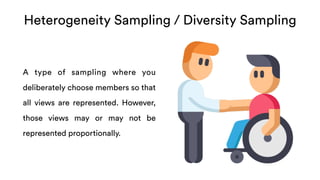
Heterogeneity Sampling / Diversity Sampling
A type of sampling where you
deliberately choose members so that
all views are represented. However,
those views may or may not be
represented proportionally.
Modal Instance Sampling
The most “typical” members are
chosen from a set.
Quota Sampling
Where the groups in the sample are
proportional to the groups in the
population.
Snowball Sampling
Where research participants recruit
other members for the study. This
method is particularly useful when
participants might be hard to find.
KSGowder

Non Probability Sampling

  • 1.
  • 2.
    Non Probability Sampling Non-probabilitysampling is a sampling technique where the odds of any member being selected for a sample cannot be calculated. It’s the opposite of probability sampling, where you can calculate the odds. In addition, probability sampling involves random selection, while non- probability sampling does not–it relies on the subjective judgement of the researcher.
  • 3.
    Advantage A major advantagewith non-probability sampling is that — compared to probability sampling — it’s very cost- and time-effective. It’s also easy to use and can also be used when it’s impossible to conduct probability sampling. Example, when you have a very small population to work with.
  • 4.
    Disadvantage One major disadvantageof non- probability sampling is that it’s impossible to know how well you are representing the population. Plus, you can’t calculate confidence intervals and margins of error. This is the major reason why, if at all possible, you should consider probability sampling methods first.
  • 5.
  • 6.
    Convenience Sampling As thename suggests, this involves collecting a sample from somewhere convenient to you. The mall, your local school, your temple. Sometimes called accidental sampling, opportunity sampling or grab sampling.
  • 7.
    Haphazard Sampling Where aresearcher chooses items haphazardly, trying to simulate randomness. However, the result may not be random at all and is often tainted by selection bias.
  • 8.
    Purposive Sampling Where theresearcher chooses a sample based on their knowledge about the population and the study itself. The study participants are chosen based on the study’s purpose.
  • 9.
    Expert Sampling In thismethod, the researcher draws the sample from a list of experts in the field.
  • 10.
    Heterogeneity Sampling /Diversity Sampling A type of sampling where you deliberately choose members so that all views are represented. However, those views may or may not be represented proportionally.
  • 11.
    Modal Instance Sampling Themost “typical” members are chosen from a set.
  • 12.
    Quota Sampling Where thegroups in the sample are proportional to the groups in the population.
  • 13.
    Snowball Sampling Where researchparticipants recruit other members for the study. This method is particularly useful when participants might be hard to find.
  • 14.