1
2
Presentation On
Non- Destructive Testing
Presented By
Monjurul Islam
Service Engineer
3
Content
 Non-Destructive Testing(NDT)
 Brief About 6 NDT Method
 Most Common NDT Method
4
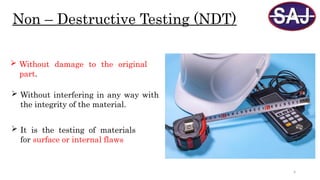
Non – Destructive Testing (NDT)
 Without damage to the original
part.
 It is the testing of materials
for surface or internal flaws
 Without interfering in any way with
the integrity of the material.
Importance Of NDT
 To ensure product reliability
 To prevent accidents and save human lives
 To ensure customer satisfaction and to maintain the manufacturer’s “good name”
 To aid in better product design
 Prevent accidents and reduce costs
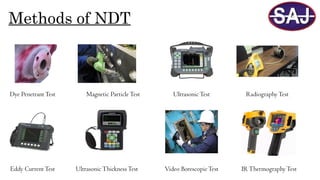
Methods of NDT
Dye PenetrantTest Magnetic ParticleTest UltrasonicTest Radiography Test
Eddy Current Test Ultrasonic ThicknessTest Video BorescopicTest IRThermography Test
7
Most Common NDT Method
 Visual Test
 Liquid Penetrant Test
 Magnetic Particle Test
 Ultrasonic Test
 Radiography Test
8
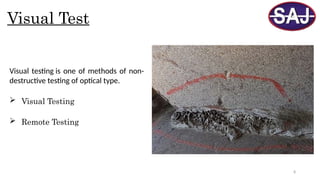
Visual Test
Visual testing is one of methods of non-
destructive testing of optical type.
 Visual Testing
 Remote Testing
9
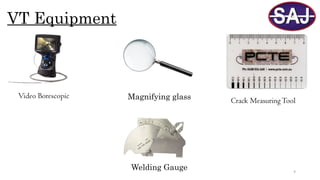
VT Equipment
Video Borescopic
Crack MeasuringTool
Magnifying glass
Welding Gauge
10
Advantage of VT
Fast implementation
 Lower workload for testers
 Quick bug detection
 Testing Equipment Are Portable
 Inexpensive
11
Disadvantage of VT
 Surface indications only
 Generally only able to detect large flaws
 Possible misinterpretation of flaws.
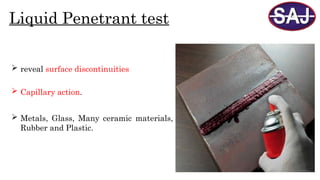
 reveal surface discontinuities
Liquid Penetrant test
 Capillary action.
 Metals, Glass, Many ceramic materials,
Rubber and Plastic.
LPT Equipment
 White Discarded Cloth
 Cleaner
 Penetrant
 Developer
14
Process of Liquid Penetrant test
 Surface Preparation
 Penetrant Application
 Penetrant Dwell Time
 Penetrant Removal
 Developer Application
 Developing Time
 Inspection
 Clean Surface
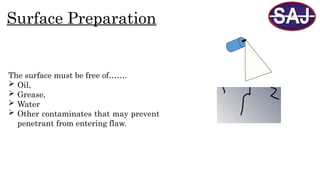
Surface Preparation
The surface must be free of…….
 Oil,
 Grease,
 Water
 Other contaminates that may prevent
penetrant from entering flaw.
16
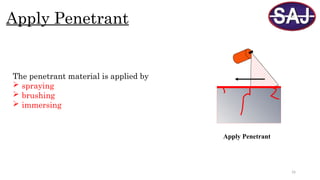
Apply Penetrant
The penetrant material is applied by
 spraying
 brushing
 immersing
Apply Penetrant
17
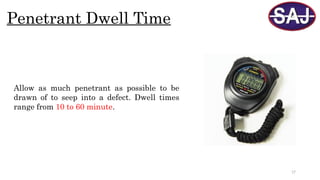
Penetrant Dwell Time
Allow as much penetrant as possible to be
drawn of to seep into a defect. Dwell times
range from 10 to 60 minute.
18
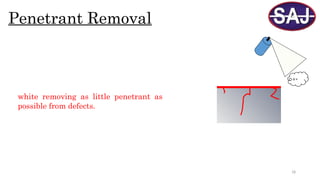
Penetrant Removal
white removing as little penetrant as
possible from defects.
19
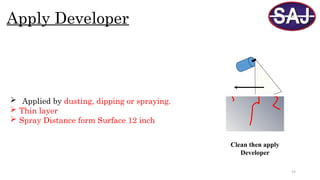
Apply Developer
 Applied by dusting, dipping or spraying.
 Thin layer
 Spray Distance form Surface 12 inch
Clean then apply
Developer
20
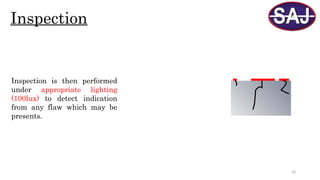
Inspection
Inspection is then performed
under appropriate lighting
(100lux) to detect indication
from any flaw which may be
presents.
21
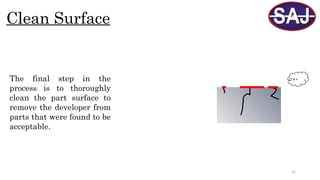
Clean Surface
The final step in the
process is to thoroughly
clean the part surface to
remove the developer from
parts that were found to be
acceptable.
22
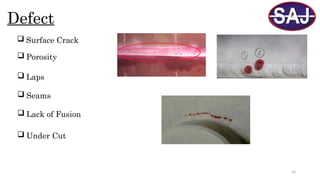
Defect
 Surface Crack
 Porosity
 Laps
 Seams
 Lack of Fusion
 Under Cut
23
Types of Penetrant
 Fluorescent Penetrant
 Visible Penetrant
24
Advantage of LPT
Works on complicated geometric shapes
 Visual, real-world results
Sensitive to small surface interruptions
Liquid penetrant testing materials are individually very cost-
effective
 Find Surface Defect
25
Disadvantage of LPT
 Sensitive to surface-breaking defects only
 No depth sizing
 Time-taking; post-cleaning also necessary
 No recordable data handy for progress monitoring
26
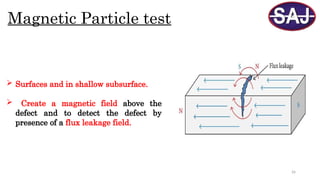
Magnetic Particle test
 Surfaces and in shallow subsurface.
 Create a magnetic field above the
defect and to detect the defect by
presence of a flux leakage field.
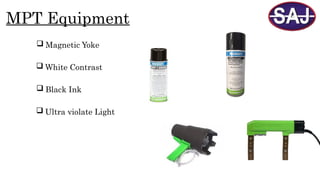
MPT Equipment
 Magnetic Yoke
 White Contrast
 Black Ink
 Ultra violate Light
28
Process of Magnetic Particle Test
 White Contrast Application
 Magnetize Test Component & Apply Black Ink
 Inspection
29
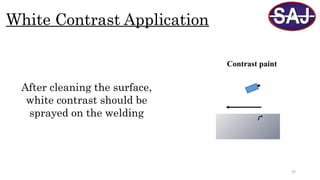
White Contrast Application
Contrast paint
After cleaning the surface,
white contrast should be
sprayed on the welding
30
Magnetize Test Component & Apply Black Ink
Magnet & Ink
The magnetic yoke must be placed
on the surface to create magnetic
flux and black ink must be sprayed.
The magnetic yoke has to be
examined in the same way as the X
by holding the angel
31
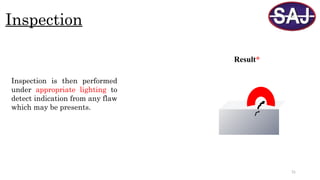
Inspection
Result*
Inspection is then performed
under appropriate lighting to
detect indication from any flaw
which may be presents.
32
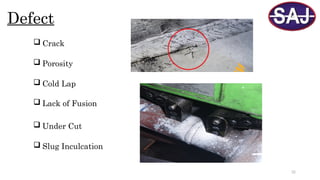
Defect
 Crack
 Porosity
 Cold Lap
 Lack of Fusion
 Under Cut
 Slug Inculcation
33
Advantage of MPT
 Can detect both surface and near-surface indications
 A relatively fast method of examination.
 Indications are visible directly on the surface.
 Low-cost compared to many other NDE methods.
 Post-cleaning generally not necessary.
34
Disadvantage of MPT
 Non-ferrous materials, such as aluminium, magnesium, or most
stainless steels, cannot be inspected.
Examination of large parts may require use of equipment with
special power requirements.
 Only small sections or small parts can be examined at one time.
 Detects surface and near-to-surface discontinuities only
35
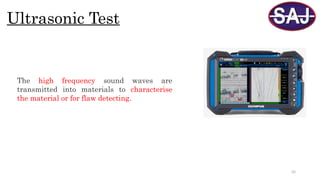
Ultrasonic Test
The high frequency sound waves are
transmitted into materials to characterise
the material or for flaw detecting.
36
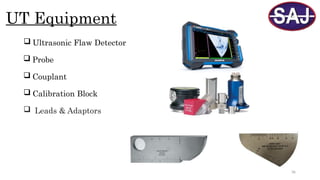
UT Equipment
 Ultrasonic Flaw Detector
 Probe
 Couplant
 Calibration Block
 Leads & Adaptors
37
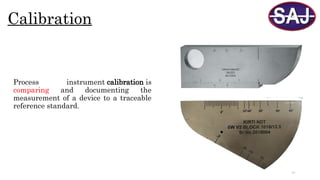
Calibration
Process instrument calibration is
comparing and documenting the
measurement of a device to a traceable
reference standard.
38
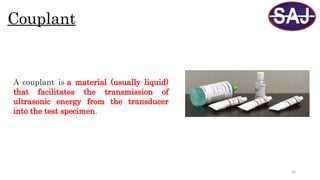
Couplant
A couplant is a material (usually liquid)
that facilitates the transmission of
ultrasonic energy from the transducer
into the test specimen.
39
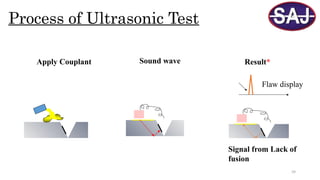
Process of Ultrasonic Test
Apply Couplant Sound wave
Signal from Lack of
fusion
Flaw display
Result*
40
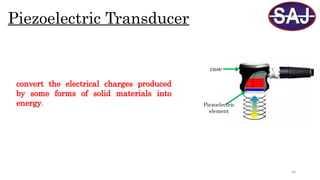
Piezoelectric Transducer
convert the electrical charges produced
by some forms of solid materials into
energy. Piezoelectric
element
case
41
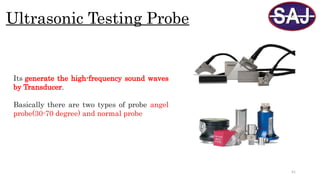
Ultrasonic Testing Probe
Its generate the high-frequency sound waves
by Transducer.
Basically there are two types of probe angel
probe(30-70 degree) and normal probe
42
Defect
 Root Crack
 Lack of Side-wall fusion
 Side-Wall Crack
 Center Line Crack
 Slug Inculcation
 Lack of Penetration
 Porosity
 Over Penetration
43
Advantage of UT
 High penetration power, allowing for flaw detection deep within a part
 Can be used to test when only one side of an object is accessible
Highly automated and portable operations possible
 Immediate results can be obtained, allowing for immediate decisions
to be made
44
Disadvantage of UT
 Requires experienced technicians for inspection and for data
interpretation
 Objects that are rough, irregularly shaped, very small or thin, or not
homogeneous are difficult to inspect
 Couplants required for tests that use conventional UT
 Loose scale or paint will need to be removed before testing can
commence, although clean, properly bonded paint can be left in place
45
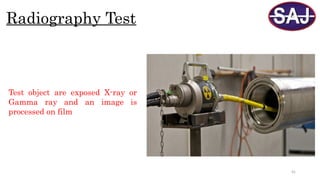
Radiography Test
Test object are exposed X-ray or
Gamma ray and an image is
processed on film
46
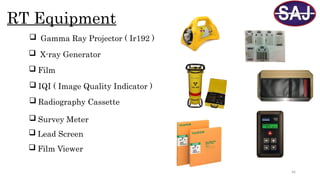
RT Equipment
 Gamma Ray Projector ( Ir192 )
 X-ray Generator
 Film
 IQI ( Image Quality Indicator )
 Radiography Cassette
 Lead Screen
 Survey Meter
 Film Viewer
47
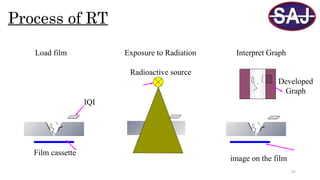
Radioactive source
Film cassette
Load film Exposure to Radiation Interpret Graph
IQI
Developed
Graph
image on the film
Process of RT
48
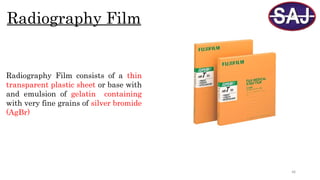
Radiography Film
Radiography Film consists of a thin
transparent plastic sheet or base with
and emulsion of gelatin containing
with very fine grains of silver bromide
(AgBr)
49
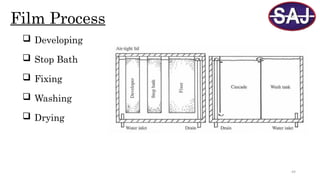
Film Process
 Developing
 Stop Bath
 Fixing
 Washing
 Drying
50
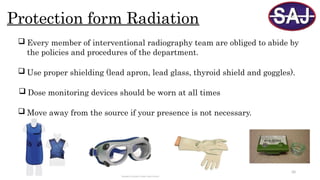
Protection form Radiation
 Every member of interventional radiography team are obliged to abide by
the policies and procedures of the department.
 Use proper shielding (lead apron, lead glass, thyroid shield and goggles).
 Dose monitoring devices should be worn at all times
 Move away from the source if your presence is not necessary.
51
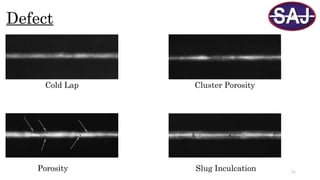
Defect
Cold Lap
Porosity
Cluster Porosity
Slug Inculcation
52
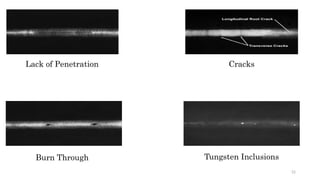
Lack of Penetration Cracks
Burn Through Tungsten Inclusions
53
Advantage of RT
 Radiography can be used with most materials
 Radiography can be used to provide a permanent visual record
 Minimal surface preparation require
 Radiography can reveal fine discontinuities within a material
54
Disadvantage of RT
 Radiography safety procedures must always be followed
 Accessibility can be limited the radiographer must have access to both sides
of the test
 Discontinuities that are not parallel with the radiation beam are difficult to
locate.
 Radiography is an expensive testing method
55
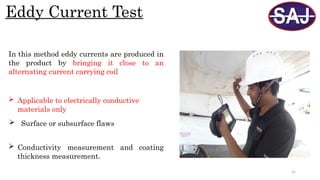
Eddy Current Test
 Applicable to electrically conductive
materials only
 Surface or subsurface flaws
 Conductivity measurement and coating
thickness measurement.
In this method eddy currents are produced in
the product by bringing it close to an
alternating current carrying coil
56
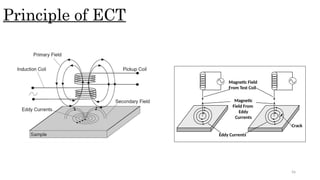
Magnetic Field
From Test Coil
Magnetic
Field From
Eddy
Currents
Eddy Currents
Crack
Principle of ECT
57
Advantages of ECT
•Able to detect surface and near-surface cracks as small as 0.5mm
•Provides immediate feedback
•Portable and light equipment
•Non-contact method making it possible to inspect high-temperature surfaces and
underwater surfaces
•Able to detect defects through several layers, including non-conductive surface coatings,
without interference from planar defects
58
Disadvantage of ECT
•Can only be used on conductive materials
•The depth of penetration is variable
•Very susceptible to magnetic permeability changes – making testing of welds in ferromagnetic
materials difficult – but with modern digital flaw detectors and probe design, not impossible
•Unable to detect defects that are parallel to the test object’s surface
•Careful signal interpretation is required to differentiate between relevant and non-
relevant indications
59

Basic NDT Training. Phased Array Ultrasonic

  • 1.
  • 2.
    2 Presentation On Non- DestructiveTesting Presented By Monjurul Islam Service Engineer
  • 3.
    3 Content  Non-Destructive Testing(NDT) Brief About 6 NDT Method  Most Common NDT Method
  • 4.
    4 Non – DestructiveTesting (NDT)  Without damage to the original part.  It is the testing of materials for surface or internal flaws  Without interfering in any way with the integrity of the material.
  • 5.
    Importance Of NDT To ensure product reliability  To prevent accidents and save human lives  To ensure customer satisfaction and to maintain the manufacturer’s “good name”  To aid in better product design  Prevent accidents and reduce costs
  • 6.
    Methods of NDT DyePenetrantTest Magnetic ParticleTest UltrasonicTest Radiography Test Eddy Current Test Ultrasonic ThicknessTest Video BorescopicTest IRThermography Test
  • 7.
    7 Most Common NDTMethod  Visual Test  Liquid Penetrant Test  Magnetic Particle Test  Ultrasonic Test  Radiography Test
  • 8.
    8 Visual Test Visual testingis one of methods of non- destructive testing of optical type.  Visual Testing  Remote Testing
  • 9.
    9 VT Equipment Video Borescopic CrackMeasuringTool Magnifying glass Welding Gauge
  • 10.
    10 Advantage of VT Fastimplementation  Lower workload for testers  Quick bug detection  Testing Equipment Are Portable  Inexpensive
  • 11.
    11 Disadvantage of VT Surface indications only  Generally only able to detect large flaws  Possible misinterpretation of flaws.
  • 12.
     reveal surfacediscontinuities Liquid Penetrant test  Capillary action.  Metals, Glass, Many ceramic materials, Rubber and Plastic.
  • 13.
    LPT Equipment  WhiteDiscarded Cloth  Cleaner  Penetrant  Developer
  • 14.
    14 Process of LiquidPenetrant test  Surface Preparation  Penetrant Application  Penetrant Dwell Time  Penetrant Removal  Developer Application  Developing Time  Inspection  Clean Surface
  • 15.
    Surface Preparation The surfacemust be free of…….  Oil,  Grease,  Water  Other contaminates that may prevent penetrant from entering flaw.
  • 16.
    16 Apply Penetrant The penetrantmaterial is applied by  spraying  brushing  immersing Apply Penetrant
  • 17.
    17 Penetrant Dwell Time Allowas much penetrant as possible to be drawn of to seep into a defect. Dwell times range from 10 to 60 minute.
  • 18.
    18 Penetrant Removal white removingas little penetrant as possible from defects.
  • 19.
    19 Apply Developer  Appliedby dusting, dipping or spraying.  Thin layer  Spray Distance form Surface 12 inch Clean then apply Developer
  • 20.
    20 Inspection Inspection is thenperformed under appropriate lighting (100lux) to detect indication from any flaw which may be presents.
  • 21.
    21 Clean Surface The finalstep in the process is to thoroughly clean the part surface to remove the developer from parts that were found to be acceptable.
  • 22.
    22 Defect  Surface Crack Porosity  Laps  Seams  Lack of Fusion  Under Cut
  • 23.
    23 Types of Penetrant Fluorescent Penetrant  Visible Penetrant
  • 24.
    24 Advantage of LPT Workson complicated geometric shapes  Visual, real-world results Sensitive to small surface interruptions Liquid penetrant testing materials are individually very cost- effective  Find Surface Defect
  • 25.
    25 Disadvantage of LPT Sensitive to surface-breaking defects only  No depth sizing  Time-taking; post-cleaning also necessary  No recordable data handy for progress monitoring
  • 26.
    26 Magnetic Particle test Surfaces and in shallow subsurface.  Create a magnetic field above the defect and to detect the defect by presence of a flux leakage field.
  • 27.
    MPT Equipment  MagneticYoke  White Contrast  Black Ink  Ultra violate Light
  • 28.
    28 Process of MagneticParticle Test  White Contrast Application  Magnetize Test Component & Apply Black Ink  Inspection
  • 29.
    29 White Contrast Application Contrastpaint After cleaning the surface, white contrast should be sprayed on the welding
  • 30.
    30 Magnetize Test Component& Apply Black Ink Magnet & Ink The magnetic yoke must be placed on the surface to create magnetic flux and black ink must be sprayed. The magnetic yoke has to be examined in the same way as the X by holding the angel
  • 31.
    31 Inspection Result* Inspection is thenperformed under appropriate lighting to detect indication from any flaw which may be presents.
  • 32.
    32 Defect  Crack  Porosity Cold Lap  Lack of Fusion  Under Cut  Slug Inculcation
  • 33.
    33 Advantage of MPT Can detect both surface and near-surface indications  A relatively fast method of examination.  Indications are visible directly on the surface.  Low-cost compared to many other NDE methods.  Post-cleaning generally not necessary.
  • 34.
    34 Disadvantage of MPT Non-ferrous materials, such as aluminium, magnesium, or most stainless steels, cannot be inspected. Examination of large parts may require use of equipment with special power requirements.  Only small sections or small parts can be examined at one time.  Detects surface and near-to-surface discontinuities only
  • 35.
    35 Ultrasonic Test The highfrequency sound waves are transmitted into materials to characterise the material or for flaw detecting.
  • 36.
    36 UT Equipment  UltrasonicFlaw Detector  Probe  Couplant  Calibration Block  Leads & Adaptors
  • 37.
    37 Calibration Process instrument calibrationis comparing and documenting the measurement of a device to a traceable reference standard.
  • 38.
    38 Couplant A couplant isa material (usually liquid) that facilitates the transmission of ultrasonic energy from the transducer into the test specimen.
  • 39.
    39 Process of UltrasonicTest Apply Couplant Sound wave Signal from Lack of fusion Flaw display Result*
  • 40.
    40 Piezoelectric Transducer convert theelectrical charges produced by some forms of solid materials into energy. Piezoelectric element case
  • 41.
    41 Ultrasonic Testing Probe Itsgenerate the high-frequency sound waves by Transducer. Basically there are two types of probe angel probe(30-70 degree) and normal probe
  • 42.
    42 Defect  Root Crack Lack of Side-wall fusion  Side-Wall Crack  Center Line Crack  Slug Inculcation  Lack of Penetration  Porosity  Over Penetration
  • 43.
    43 Advantage of UT High penetration power, allowing for flaw detection deep within a part  Can be used to test when only one side of an object is accessible Highly automated and portable operations possible  Immediate results can be obtained, allowing for immediate decisions to be made
  • 44.
    44 Disadvantage of UT Requires experienced technicians for inspection and for data interpretation  Objects that are rough, irregularly shaped, very small or thin, or not homogeneous are difficult to inspect  Couplants required for tests that use conventional UT  Loose scale or paint will need to be removed before testing can commence, although clean, properly bonded paint can be left in place
  • 45.
    45 Radiography Test Test objectare exposed X-ray or Gamma ray and an image is processed on film
  • 46.
    46 RT Equipment  GammaRay Projector ( Ir192 )  X-ray Generator  Film  IQI ( Image Quality Indicator )  Radiography Cassette  Lead Screen  Survey Meter  Film Viewer
  • 47.
    47 Radioactive source Film cassette Loadfilm Exposure to Radiation Interpret Graph IQI Developed Graph image on the film Process of RT
  • 48.
    48 Radiography Film Radiography Filmconsists of a thin transparent plastic sheet or base with and emulsion of gelatin containing with very fine grains of silver bromide (AgBr)
  • 49.
    49 Film Process  Developing Stop Bath  Fixing  Washing  Drying
  • 50.
    50 Protection form Radiation Every member of interventional radiography team are obliged to abide by the policies and procedures of the department.  Use proper shielding (lead apron, lead glass, thyroid shield and goggles).  Dose monitoring devices should be worn at all times  Move away from the source if your presence is not necessary.
  • 51.
  • 52.
    52 Lack of PenetrationCracks Burn Through Tungsten Inclusions
  • 53.
    53 Advantage of RT Radiography can be used with most materials  Radiography can be used to provide a permanent visual record  Minimal surface preparation require  Radiography can reveal fine discontinuities within a material
  • 54.
    54 Disadvantage of RT Radiography safety procedures must always be followed  Accessibility can be limited the radiographer must have access to both sides of the test  Discontinuities that are not parallel with the radiation beam are difficult to locate.  Radiography is an expensive testing method
  • 55.
    55 Eddy Current Test Applicable to electrically conductive materials only  Surface or subsurface flaws  Conductivity measurement and coating thickness measurement. In this method eddy currents are produced in the product by bringing it close to an alternating current carrying coil
  • 56.
    56 Magnetic Field From TestCoil Magnetic Field From Eddy Currents Eddy Currents Crack Principle of ECT
  • 57.
    57 Advantages of ECT •Ableto detect surface and near-surface cracks as small as 0.5mm •Provides immediate feedback •Portable and light equipment •Non-contact method making it possible to inspect high-temperature surfaces and underwater surfaces •Able to detect defects through several layers, including non-conductive surface coatings, without interference from planar defects
  • 58.
    58 Disadvantage of ECT •Canonly be used on conductive materials •The depth of penetration is variable •Very susceptible to magnetic permeability changes – making testing of welds in ferromagnetic materials difficult – but with modern digital flaw detectors and probe design, not impossible •Unable to detect defects that are parallel to the test object’s surface •Careful signal interpretation is required to differentiate between relevant and non- relevant indications

  • 59.